Lindsay in Thailand: Vietnam & Beyond

December 2, 2015

Please excuse me if I may sound like a broken record, but after my fall break this past week, I still believe “a lack of formal plans or expectations makes for the best adventures.” Little did I know, a lack of a valid Vietnamese Visa does too. And so the adventure begins…

One week before fall break, the scramble began. I entered my program’s student activity room to find my like-minded friends crowded around computers.

Pictures of random places were pulled up on the screens and the air was filled with frantic questions. “Where are you going?” “That looks cool” “Well, maybe we can go there too.” Simultaneously, tabs with destination information all the way from Korea to Singapore with every country in between were pulled up on my computer screen. For the next nine days, Southeast Asia was my oyster, and I had no idea where I was going.

Eventually, after much debate with myself, I decided I would not try to squeeze in the wonder of Angkor Wat or Bali’s beaches, but rather experience as much of one country as I could. Vietnam seemed to have it all, from cascading mountains and quiet beaches to busy city streets.
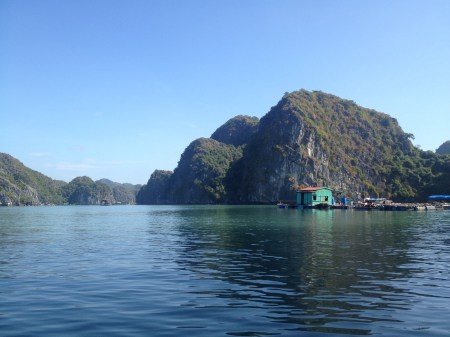
 

Little wonders- Ha Long Bay, Vietnam

Little wonders- Ha Long Bay, Vietnam


My only travel transaction was a round trip ticket from Bangkok to Hanoi for most of the week until the rest of the plans eventually fell into place. Before break began, my friend Billy and I inquired about a Vietnam visa from several different sources, including the Thai embassy. We were told that it was possible to get a tourist Visa upon arrival in Hanoi. Little did we know…

We took the overnight bus to Bangkok with several of our friends and arrived at the Don Muang Airport before 4 am—plenty of time to spare before our 7:15 flight. I found out in the check-in line, however, that a pre-entry form was required to enter Vietnam, and that we would not be making our flight. We applied for the rush visa application service that claimed processing took “3 hours at the most.” That Saturday, however, was a holiday. Rather than pay the $200 to get the other available last-minute entry form, we returned to the drawing board. Within four hours, we were on a flight to a southern Thai island, Krabi, and would not return to Bangkok until Monday evening. On Tuesday afternoon, we flew to Hanoi and spent the night there. The next morning, we traveled to Ha Long Bay in Northeastern Vietnam and I eventually met up with four friends to adventure to Sapa in Northwestern Vietnam. Throughout my traveling within Thailand and beyond its borders, I have learned some things and I thought that I would share them with you.
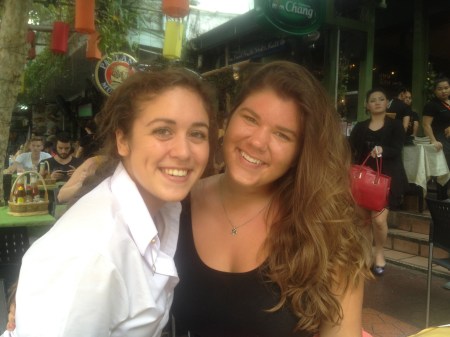
 

Because of the changes in our travel plans, Billy and I were able to enjoy a meal with Dominiki, a fellow UR friend and Bonner Scholar currently studying in Bangkok.

Because of the changes in our travel plans, Billy and I were able to enjoy a meal with Dominiki, a fellow UR friend and Bonner Scholar currently studying in Bangkok.


  1. Do your research- I am all about the random adventures, but once you decide on an adventure, it is a great idea to acquire some additional information. For example, sometimes while traveling no matter how much I attempt to “speak the Thai way,” my American accent reveals itself, and so do the “farang prices.” Before you get charged extra, look up some additional information on the Internet of where you are headed to or what you are doing. From personal experience, simply searching how much a taxi ride should be to a destination could cut your costs in half.
  1. Take the Local Transport- Compared to the U.S., transportation in Asia is pretty inexpensive. Although these rides can take up a little more time, it can be time well spent talking with the locals and enjoying the beautiful views out your window. Also, for extended rides, consider taking an overnight train or bus so you don’t miss out on exploring during the day and you can avoid the price of additional sleeping accommodations.


I brought my birthday cards from family and friends on the trip with me and found the overnight train ride to be the perfect time to read them.

I brought my birthday cards from family and friends on the trip with me and found the overnight train ride to be the perfect time to read them.


  1. Learn the language, or at least the magic words– When traveling to a different country, always try your best to learn the magic words- ‘please’ and ‘thank you,’ ‘hello’ and ‘goodbye’…and ‘bathroom’ is probably good to know, too. Kind words go a long way no matter what country you are in. Attempting to learn a foreign language shows those you interact with, even if they can speak English, that you recognize you are the one coming into their country and you appreciate their language and culture.
  1. Start Climbing- No matter the distance or the number of steps, always climb to the tippy top of wherever you are. Not only can this venture provide an incredible view of the area, but it often elicits this certain spectacular emotion of feeling so small in a such a big world. Pull up a chair (or a rock), sit there, take a deep breath, and take it all in.


Billy and I at the ‘Overlook’ in Koh Phi Phi, a Southern Thai Island.

Billy and I at the ‘Overlook’ in Koh Phi Phi, a Southern Thai Island.


  1. Look into booking a backpacker’s hostel– Hostels are definitely an establishment that I have come to love while studying abroad and will miss when I return to the states. Not only do most of these backpacker hostels offer the same amenities as hotels for a cheaper price, but they also allow you to meet interesting people from around the world. I have discovered that Southeast Asia is a huge European vacation spot and it has been wonderful talking with these travelers. Some of the best food I have eaten, cultural sites I have seen, and shopping I have done has been because of these backpacker’s personal experience and advice they have received from their friends and families who have visited the places before.
  1. Take the road less traveled by (even if it is up a steep mountain)– When on vacation, it is easy to fall into the common traveler’s trap. It’s great to experience all the touristy things a place has to offer, but also venture down the alleyways and find the cutest coffee shops. For example, when you are offered two options- to do an easy trek with more tourists or a 16 mile hike up a mountain with no one around but the Sa Pa tribal groups-take the longer route. Even if you’re legs scream at you now, your soul will thank you for it later.


Sa Pa, Vietnam- one of my favorite places on Earth.

Sa Pa, Vietnam- one of my favorite places on Earth.


These two children, ages 6 and 8, walk more than one and a half hours up and down the mountain everyday to get to and from school.

These two children, ages 6 and 8, walk more than one and a half hours up and down the mountain everyday to get to and from school.


  1. Learn from the Locals– My favorite part of my trip was talking with the individuals who lived in the area, especially in Sa Pa, Vietnam. Our trekking guide, Pen, let us not only see into the history and culture of the area, but also into her daily life and routine. You can learn so much through personal exchanges, which can make you fall in love with the place even more.


Although these Sa Pa Sister guides trek 11 miles up the same mountain everyday, they still take the time to sit and enjoy the view.

Although these Sa Pa Sister guides trek 11 miles up the same mountain everyday, they still take the time to sit and enjoy the view.


  1. Obtain a VISA before entering a foreign country– Yes, this seems quite obvious. But if for some reason things don’t work out as you initially planned, don’t sweat it. Take a deep breath, get creative, and see this hiccup as an opportunity for a new adventure. Oh, and eventually add it to your anthology of amusing stories.


Jiaqi in Italy: Coming to the Tuscan Heart – Volterra

December 2, 2015

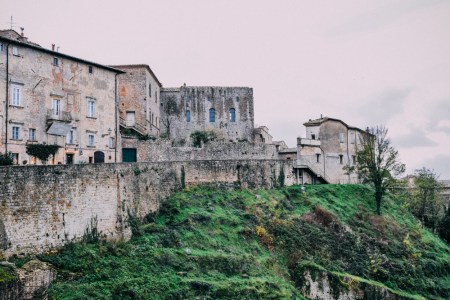
Draped over the rising hillsides in central Tuscany,  Volterra is a stone-clad town topped with gorgeous medieval towers, and littered with
winding alleyways where swinging washing lines give way to blooming hanging baskets of rose flowers. Thanks to its high-perched position over the rolling plains, sweeping panoramas of Central Italy are available from most all of the flagstone-covered “piazzas”.


Etruscan town

Etruscan town


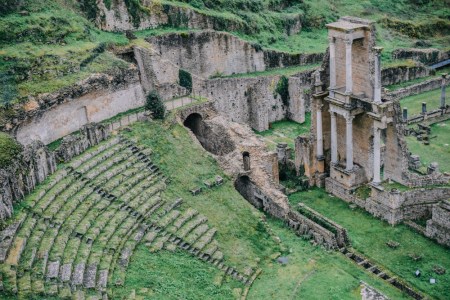
Last weekend, I revisited Pisa to see my Italian friend Gabriele and we decided to make a road trip to Volterra. After the sudden train strike and bus delay, we finally made it to the Etruscan hill town in late afternoon. The moment we stood by the panoramic view point overlooking the Roman theater, all efforts seemed worthwhile.


Roman theater

Roman theater


On the tuscan hill

On the tuscan hill


Volterra is a particular town built and razed by the Romans, the grand Tuscan dukes, and the formidable Medici family alike. Its historic centre plays host to ubiquitous basilicas, cobblestone streets, red-tiled roofs, while its sporadic piazzas are filled with the scent of intensively-flavored olive oils sourced straight from the hills. Hopefully, my photos of Volterra can give you a hint of the town’s irresistible, timelessly charm.


Color of Volterra

Color of Volterra


Street of Volterra

Street of Volterra


Sunset in Volterra

Sunset in Volterra


Jiaqi in Italy: Via Padova-the Multicultural Heart of Milan

December 1, 2015

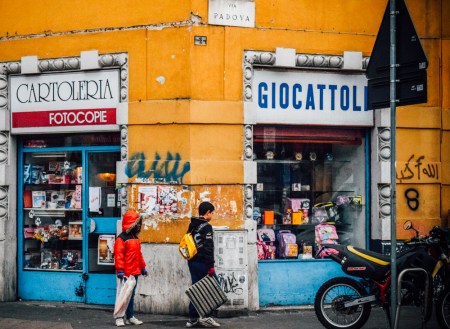
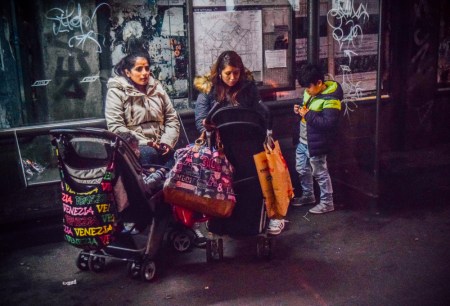
The moment you get off the Loreto station and walk up to Via Padova, you enter the world of secret Milan. Multiculturalism is evident everywhere: from the South American restaurants, Chinese supermarkets, to the many money transfer service shops on every corner. With the often-heard rumor of this street being the “most dangerous” one in Milan, Via Padova captivates me to observe this chaotic neighborhood and the complexity of Milan as an immigrant city.


Street of via padova

Street of Via Padova


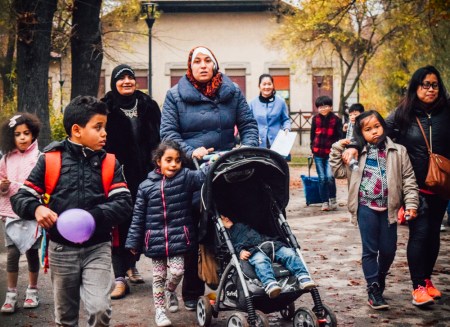
People of via padova

People of Via Padova


Southamerican service store

Southamerican service store


Chinese store

Chinese store


From the primary school full of immigrant children and the convenience stores in different languages, Via Padova is both a mysterious and simple neighborhood. From the obscure posters on the street walls and graffitis, you find prostitution ads as well as recruitment for a massage girl’s crew. On the other hand, this is not only the center for underground activities but the safety net for many foreign newcomers. Here they find their home cuisine, their people, their languages spoken, their comfort zones.


Arabic-style hair salon

Arabic-style hair salon


Via padova pubic school

Via Padova public school


If Milan’s international environment, on business conferences of daily life, have a special resonance with you, the streets of Via Padova will be a catalyst for the deeper revelation of Milan: a Milan of multiethnic character. Translating these multiethnic, chaotic street scenes into photographic images is the challenge I would like to address. While taking honest shots of pedestrians and street stores, I want to communicate the atmosphere and authentic air of this unusual neighborhood.


Bus station in Via Padova

Bus station in Via Padova


Layla in Australia: Redfern

November 17, 2015

We are in the thick of exams season at Sydney Uni! Exams work very differently here compared to how they are at Richmond. They’re spread out over 3 weeks, with the first week being a ‘reading week’ where there are no exams. I was unlucky enough to have 3 exams on the last 3 days of the exam period, and to put the cherry on top, the last on is on a Saturday! Needless to say, I have quite a few long nights ahead of me. In this post, I’m going to talk about housing here in Sydney and the neighborhood I live in.

Sydney University exchange students get a discount to live at a building called Urbanest Cleveland Street in Redfern, an inner-city suburb of Sydney. It’s about a ten-minute walk up the Cleveland Street to the edge of campus. However, Sydney real estate prices are very, very expensive, and Urbanest is no exception. I would compare Urbanest to Gateway Village back at Richmond, but it is much more expensive, even considering the favorable exchange rate. Luckily, the Office of International Exchange is generous enough to give students studying abroad in expensive locations a $1000 stipend, which helps mitigate the ridiculous cost of housing in Sydney. There are other student accommodations in the suburbs surrounding Sydney Uni, but my Urbanest location had the advantages over these options of ensuite bathrooms, a kitchen for each apartment, availability on a semester-only basis, and the discount.

I share an apartment with five other (American) exchange students, one who also happens to be a Richmond student. The six of us share a kitchen, with each of us having our own bedroom and bathroom. The building itself is very modern and comes equipped with a (very expensive!) laundry room, computer lab, gaming room, and gym, among other amenities. So while Urbanest is expensive, I think that the quality of the housing and its proximity to campus is worth the cost.


My (cleaned just for this picture!) bedroom at Urbanest. It's definitely a comfortable size for one person.

My (cleaned just for this picture!) bedroom at Urbanest. It’s definitely a comfortable size for one person.


While my building is technically located in Redfern, it is actually at the corner of 3 different Sydney suburbs – Redfern, Chippendale, and Darlington. It’s also less than a five-minute walk to Redfern station, one of the biggest train stations in Sydney. You can take a train from Redfern to pretty much anywhere in the city (except for the airport, which can be frustrating as a travelling exchange student). Living so close to the train station has been a highlight of my time in Sydney — I’ve never lived in a city before, and public transport has always been nonexistent. Not having to rely on a car and being able to catch a train anywhere I want to go in the city has been an amazing experience.

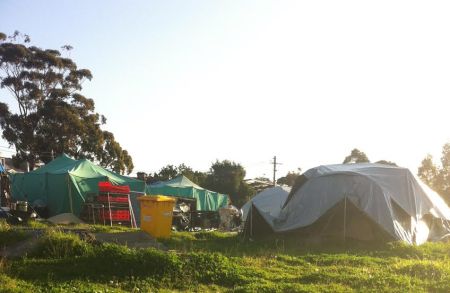
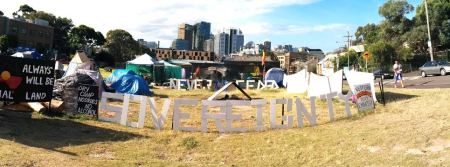
On the way to Redfern station, I walk up what was formerly the most infamous street in Sydney – Eveleigh Street, or ‘The Block.’ The first time I walked up Eveleigh Street, I immediately noticed a grouping of tents in a field, just in sight of the station. I later learned that the tents were what is called an Aboriginal Tent Embassy. To explain the origins of this tent embassy, I need to explain Redfern itself.


The Redfern Aboriginal Tent Embassy, captured in July 2015.

The Redfern Aboriginal Tent Embassy, captured in July 2015.


Redfern is a suburb with notorious connotations in Sydney. When I first told my parents that I’d be living in Redfern, they balked. As people with a view of Sydney from the early 2000s, all they knew of Redfern was its seedy reputation. The neighbourhood is known for its high concentration of Aboriginal Australians. As I’ve learned in my Australian history class this semester, the relationship between Aboriginal Australians and non-indigenous Australians has been extremely complex and is fraught with tension to this day.  For example, even before Australia became an independent nation, the advent of white settlers decreased the native population by 90%, and up until the 1970s, the federal government forcibly removed indigenous children from their families under the guise of “child protection.” Aboriginal Australians still experience severely disproportionate rates of poverty and incarceration, and lowered life expectancy and health. It’s been fascinating to observe the differences between the way indigenous peoples are treated here versus in the United States. Here, the prime minister in 2008 made a formal apology on behalf of the government to the indigenous population, there is a National Sorry Day annually for people to reflect on the historical treatment of Aboriginal Australians, and before many speeches and ceremonies, it’s customary to mention that the indigenous tribe is the “true owner of the land.” Thinking of these differences though, I can’t help but reflect on one of the signs I saw at the tent embassy: “don’t recognise, decolonise.” While it seems like Australia is much more progressive concerning its relations with its indigenous people compared to the United States, is it just a facade? It doesn’t seem like merely mentioning and apologising and reflecting is enough — what actions are being taken?


The Australian Aboriginal Flag painted on a wall next to the tent embassy. Another difference from the United States: it is designated as one of the official flags of Australia and is flown alongside the Australian flag.

The Australian Aboriginal Flag painted on a wall next to the tent embassy. Another difference from the United States: it is designated as one of the official flags of Australia and is flown alongside the Australian flag.


One day right before mid-semester break, I walked my normal path up Eveleigh Street to Redfern station and was shocked to see that the field where the tent embassy had been was completely empty. I later learned they had been evicted. As the presence of my student accommodation complex suggests, Redfern has been rapidly gentrifying and has mostly shed its infamous reputation. It’s not fully gentrified yet — there are always a few people begging outside of the station — but it’s been dramatically changed in the last decade or so. Developers from a charity called the Aboriginal Housing Company evicted Aboriginal people from their homes on Eveleigh Street and then demolished them, promising to provide low-cost housing for the original residents. Instead, the company has decided to build more student accommodation on the land, and the tent embassy was erected in protest. The eviction came coupled with a promise of a grant to build the promised low-cost housing alongside the student accommodation, but I definitely will be following this case when I’m back in America to see if it actually comes to fruition.


This image isn't mine; it's from Wikipedia. But I really like it because it shows the proximity of Redfern to the rest of the city, and shows the appeal of the neighborhood for gentrification. Also -- see that ugly brick building with the weird windows in the background? That's Urbanest Cleveland Street.

This image isn’t mine; it’s from Wikipedia. But I really like it because it shows the proximity of Redfern to the rest of the city, and shows the appeal of the neighborhood for gentrification. Also — see that ugly brick building with the weird windows in the background? That’s Urbanest Cleveland Street.


Living in Redfern has been an eye-opening experience for me. It’s been a way for me to see the history I’ve been learning about in class first-hand. It’s been a lesson in prejudice — I was initially nervous to be living in Redfern, but I’ve since learned that it’s not at all dangerous and not to judge places on their reputation. And lastly, it’s been an amazing way to experience living in a city for the first time.


This is my favorite street in Redfern, called Vine Street. Walking past the brightly-colored houses on my walk to the station always puts a smile on my face.

This is my favorite street in Redfern, called Vine Street. Walking past the brightly-colored houses on my walk to the station always puts a smile on my face.


Jiaqi in Italy: Things I Wish I Knew Before Studying Abroad in Milan

November 12, 2015

1. Research about the city and know more than the touristic center

I can not be happier when I find out this incredibly valuable article that truly captures the essence of Milan. It helps me navigate the city and pull out the most intriguing, local spots immediately, in which some places that many expats in Milan would not even think of. Doing some research about the city you are going to is definitely the key to a happy new start in a new environment, since you will start seeing the best of the best, while others are probably still confused by the currency change.


View of the Piazza Duomo

View of the Piazza Duomo


View of Milan

View of Milan


2. Take it easy

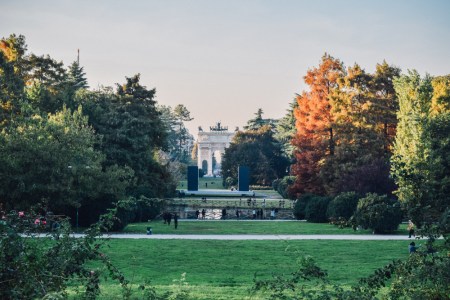
No matter where we are, in our home university or anywhere around the world, the biggest problem facing us 20-somethings is purely peer pressure. Yes, you will find the competition out there once you start your first day of class. Ambitious youths compete against each other on how many new cities they have visited so far, how many European capitals that they have taken a stroll through, and perhaps how many new friends they have made. Studying abroad is not playing the statistic game that we have already tired of in school; it is rather a new chapter in our life in which we can choose to be the best version of ourselves. Why not enjoy it? Take your time, learn to cook the local cuisine, sip in a local specialty tea or drink, and marvel at the fall color in an exotic country.


Sunny afternoon in the park

Sunny afternoon in the park


Parco Sempione

Parco Sempione


3. Go Off the Beaten Path

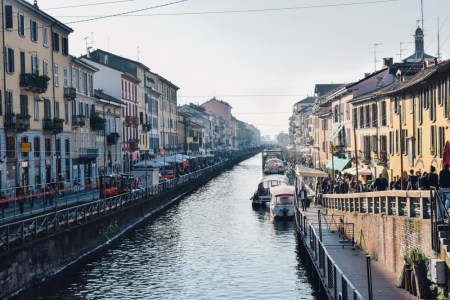
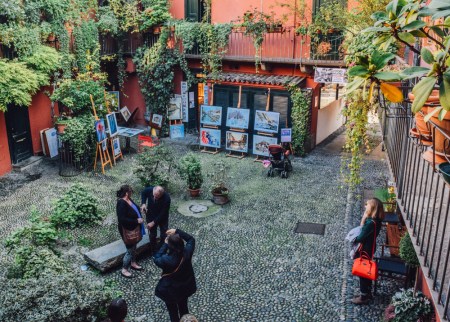
Milan is much more than fifty shades of gray, a funny term that Italians use to refer to their country’s industrial city. The city’s hidden gems never cease to amaze me. Every neighborhood has a particular but equally charming vibe, either luxurious-chic, alternative-hip, or down-to-earth humbleness. Navigli, my favorite neighborhood in Milan, has the cutest cafes in town and some hidden mysteries that only the local history experts know. It used to be a working-class canal neighborhood where all the poor ladies washed laundry for rich families; it used to be the inspirational studio of Milan’s legendary artist Leonardo Da Vinci; it used to be an artist bottega where pupils sit by the canal from sunrise to sunset to draw people from lives. Learning the history of your city’s neighborhoods not only strengthens your understanding of the culture but also makes you much more an interesting guide when your family or friends come visit you.


Navigli neighborhood

Navigli neighborhood


Hidden garden in Navigli

Hidden garden in Navigli


4. Most importantly, embrace what you have!

It’s not that uncommon to hear complaints about a new, gigantic city from some abroad students. Depending on your own capacity to adapt to a radically different environment, moving to a new country is a personal revolution that will probably trigger resistance! What you need to do is simply to relax – and you’d be better to do it the local way. Take my city Milan as an example, relaxation means a “caffè” (italian expresso) in the afternoon, an aperitivo from the rooftop bar with views of Duomo, a stroll through the fashion district, a people-watching game at the chic crowd.


Duomo

Duomo


Jiaqi in Italy: Old-fashioned Market in Viale Papiniano

November 5, 2015
Typical vendor

Typical vendor


I have always had a passion for markets. Fresh produce straight coming from the farmers, cheeses, condiments, clothes, shoes, accessories, shoes, but also home objects. Strictly fresh, honest, low-price, and practical.

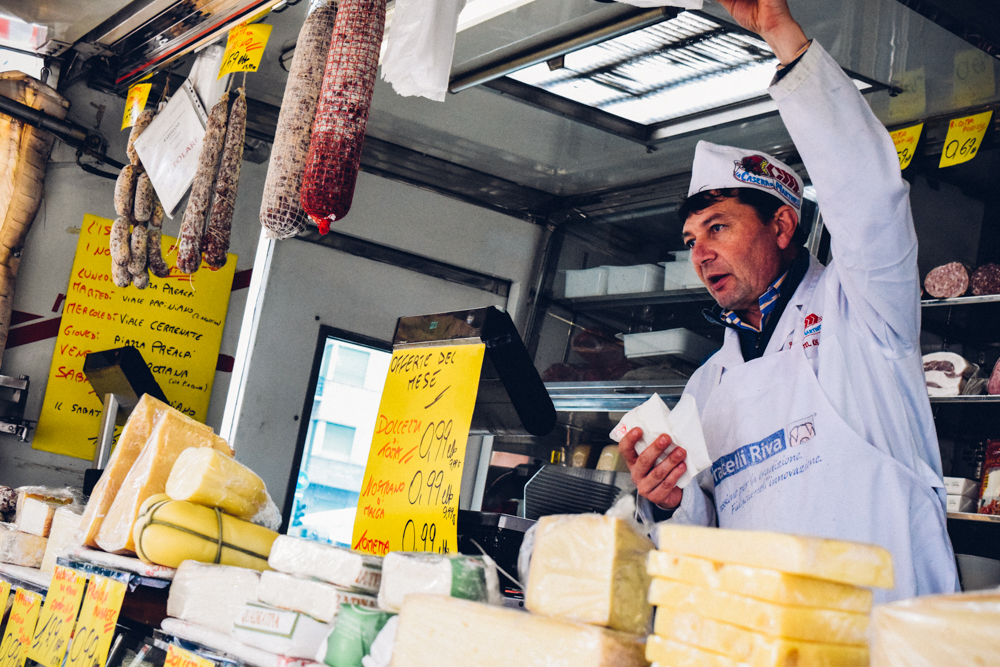
My journey in Milan began with a treasure hunt across different farmers’ markets in the city, in search of kitchen essentials, unique clothes, and an authentic view of the local Milanese people. Among all these markets in Milan, there is probably no more vibrant place like the one in Viale Papiniano. Upon entering the characteristically mundane plaza, I was immediately catapulted into the old-fashioned market atmosphere. Through a close look at the intense color and the natural human interactions, I want to present the veracity of the local life in Milan, a part of Milan that is less represented in mass media.


Cheese paradise

Cheese paradise


Cheese stand

Cheese stand


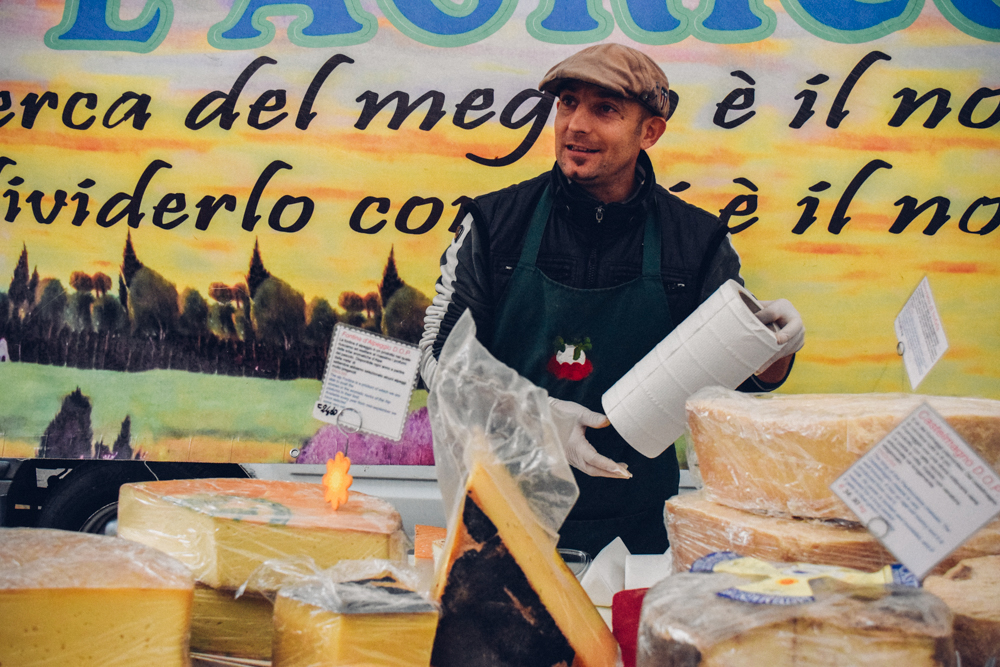
Cheese vendor

Cheese vendor


Passion for cheese has already become an important part of Italian identity. Milanese are no exception, and they for sure know what is good taste. Cheeses, “formaggi” in Italian, come in amazingly diverse variety and quantity in Papiniano market. Each cheese stand has its own specialty and character. My favorite, however, is the organic cheese stand that sells truffled-flavor cheese exclusively. With one little bite, the indescribable flavor of minerals from that far-away mountain has already convinced me.


Italian in-season produce

Italian in-season produce


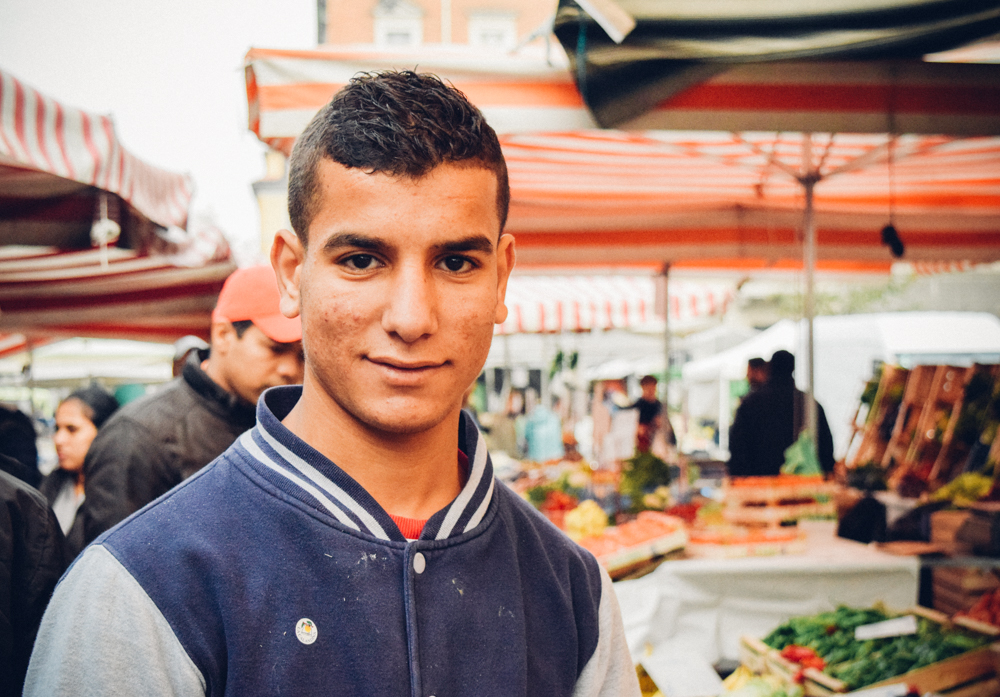
Fruit vendor Muhammad

Fruit vendor Muhammad


Four Euros please

Four Euros please


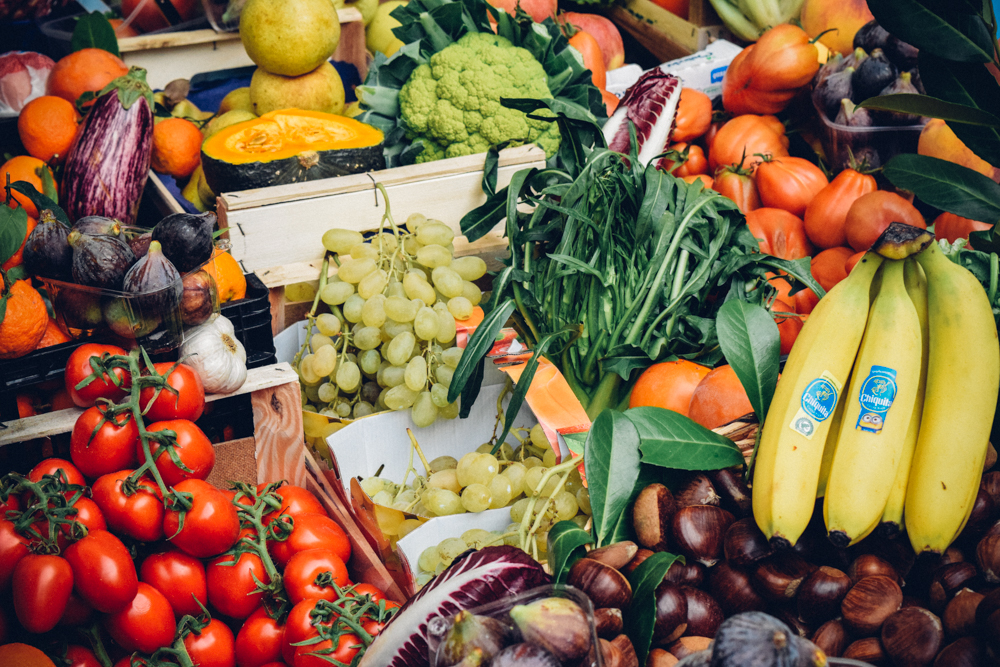
It’s a great opportunity to see what fruit and vegetables are in season, and Italy has a fantastic range of diverse produce year-round. As what you would expect at a market, there is also the usual yelling and bargaining conversations, which makes it much more lively than a normal supermarket. The stand of Muhammad, a young immigrant from Pakistan, is my go-to place because he always greets me with a warm smile and often discounts.


Dan In Argentina: A True Porteño

November 5, 2015
The word "porteño" is what you call someone from Buenos Aires. As the weeks and months pass, I am feeling more and more like a true porteño. Recently, a bunch of my friends and I took a cooking class on traditional Argentine foods. We made empanadas, beef stew and a dulce de leche desert. It was one of the best meals I've had here! And it tasted even better knowing I had kneaded the dough and stirred the stew. This, among others, was a cultural experience for which UR reimbursed the cost.

The word “porteño” is what you call someone from Buenos Aires. As the weeks and months pass, I am feeling more and more like a true porteño. Recently, a bunch of my friends and I took a cooking class on traditional Argentine foods. We made empanadas, beef stew and a dulce de leche desert. It was one of the best meals I’ve had here! And it tasted even better knowing I had kneaded the dough and stirred the stew. This, among others, was a cultural experience for which UR reimbursed the cost.


Also like a true porteño, I recently took a day trip to Delta del Tigre, a small residential town north of the city, in the province of Buenos Aires. This area is made up of a bunch of islands separated by narrow canals, streams and rivers. You can take boat taxis to different islands, have a picnic and just relax. Here's a picture of me being awkward on a small bridge connecting two close islands.

Also like a true porteño, I recently took a day trip to Delta del Tigre, a small residential town north of the city, in the province of Buenos Aires. This area is made up of a bunch of islands separated by narrow canals, streams and rivers. You can take boat taxis to different islands, have a picnic and just relax. Here’s a picture of me being awkward on a small bridge connecting two close islands.


I, being my true porteño self, also experienced the beauty of an Argentine asado recently. An asado is the equivalent of the American cookout. My host family invited me to their first asado of the summer. As meat cooked on the huge grill, a fragrant smoke filled the room! Along with regular steaks and chorizo sausages, I tried (and subsequently did not enjoy) cow intestines and blood pudding... but of course, as a porteño, I had to try.

I, being my true porteño self, also experienced the beauty of an Argentine asado recently. An asado is the equivalent of the American cookout. My host family invited me to their first asado of the summer. As meat cooked on the huge grill, a fragrant smoke filled the room! Along with regular steaks and chorizo sausages, I tried (and subsequently did not enjoy) cow intestines and blood pudding… but of course, as a porteño, I had to try.


Jiaqi in Italy: Parma & Bergamo: Probably the Best of Italy

November 4, 2015

There is no better way to learn about Italy than visiting its less-known, more relaxed cities. With the intention of going off the beaten paths, I visited Parma and Bergamo last weekend for a weekend escape from the 24/7 dynamic Milan. I want to hunt for the humble trattorias and their simple, satisfying, inexpensive cooking. I want to look into those elegant, tranquil courtyards inside of the residential houses with historic outlooks. I listen to how people talk on the train, how they converse with the baristas while quickly sipping their espressos, and how they complain about the weather over phone.


Town of Parma

Town of Parma


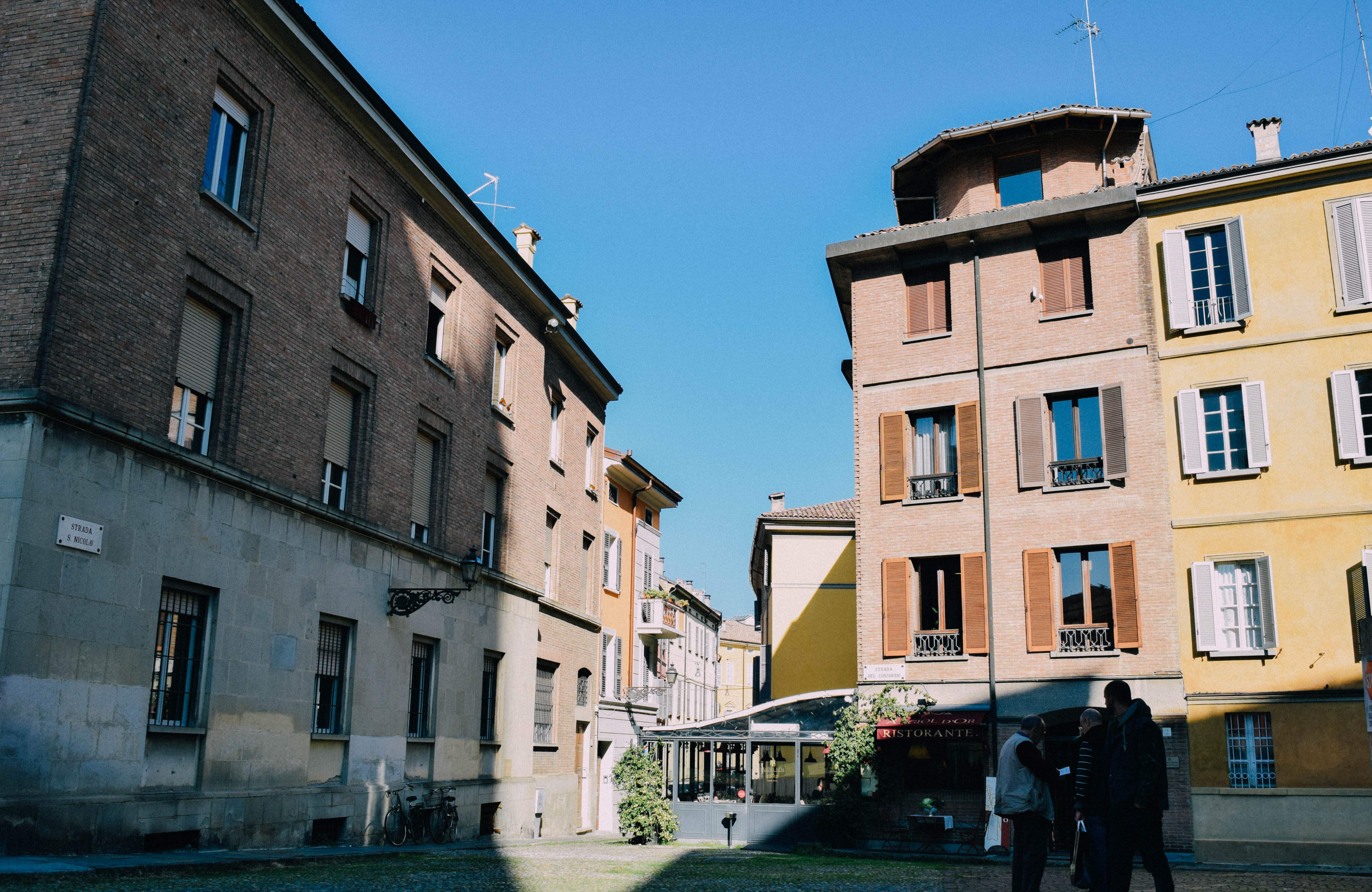
Historic center of Parma

Historic center of Parma


I come to Parma because like everyone, I want to pretend for a day at least, that I am Italian. There is no easier city to do that in than Parma. One can walk the markets without bumping shoulders with other tourists, eat a sandwich made of the irresistible local prosciutto at any hour of the day, have a late aperitif down an alley cast in an orange sunset glow. Walk along a narrow street in the historic center and see grandmas hang wet clothes from the balcony.


Teatro Farnese di Parma

Teatro Farnese di Parma


Parma and high art don’t collide often in the same sentence, but when I am standing in the middle of Teatro Farnese and reading through Correggio’s fresco masterpieces in National Gallery of Parma, I am left completely speechless. Those artists have built these works with meticulousness and extreme attention to details. Looking at these frescos and wooden panels, I can truly feel the religious piety that these artists have devoted into their art.


HIstoric Bergamo

Historic Bergamo


A peak inside Bergamo

A peak inside-Bergamo


Under the roof-Bergamo

Under the roof-Bergamo


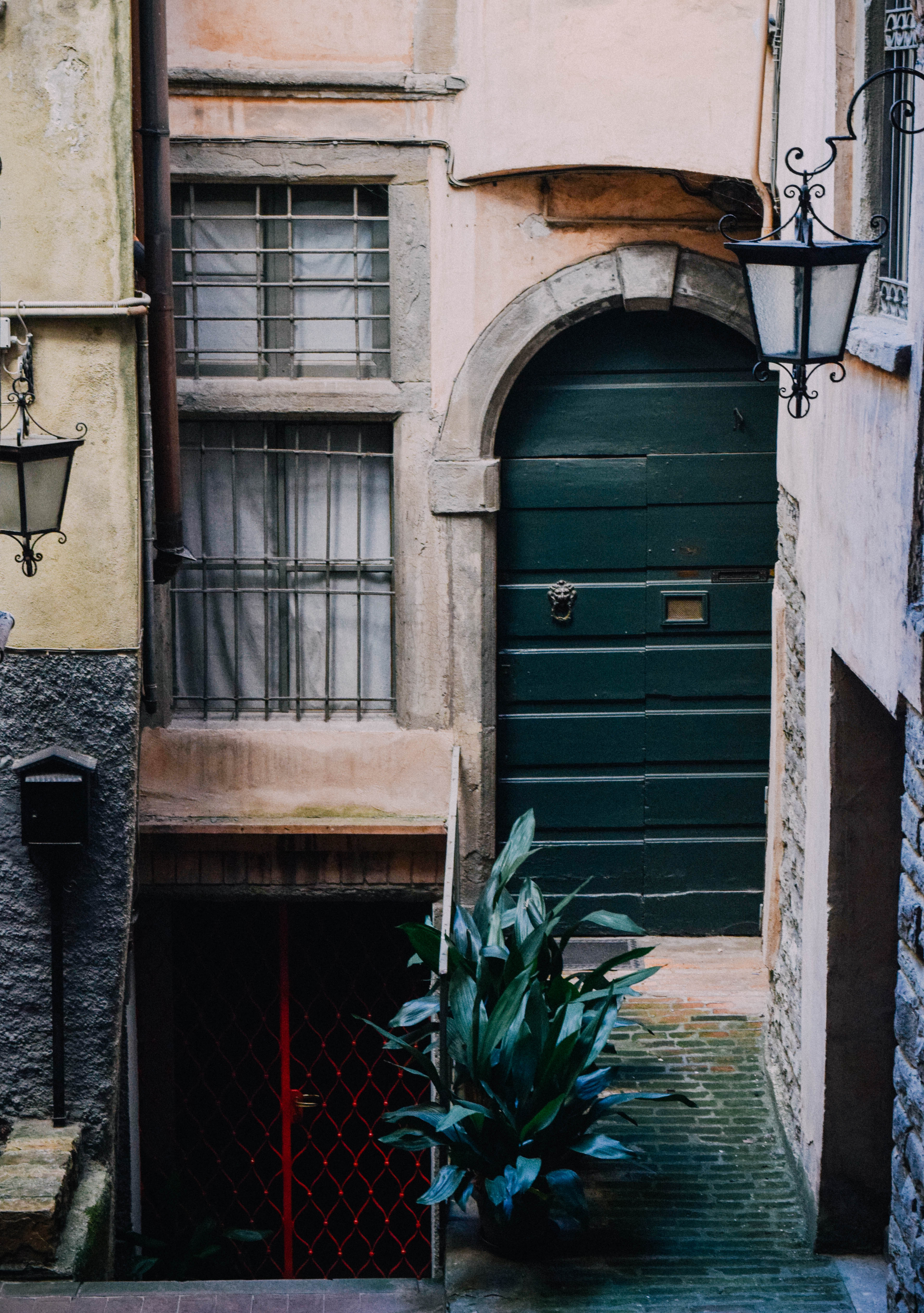
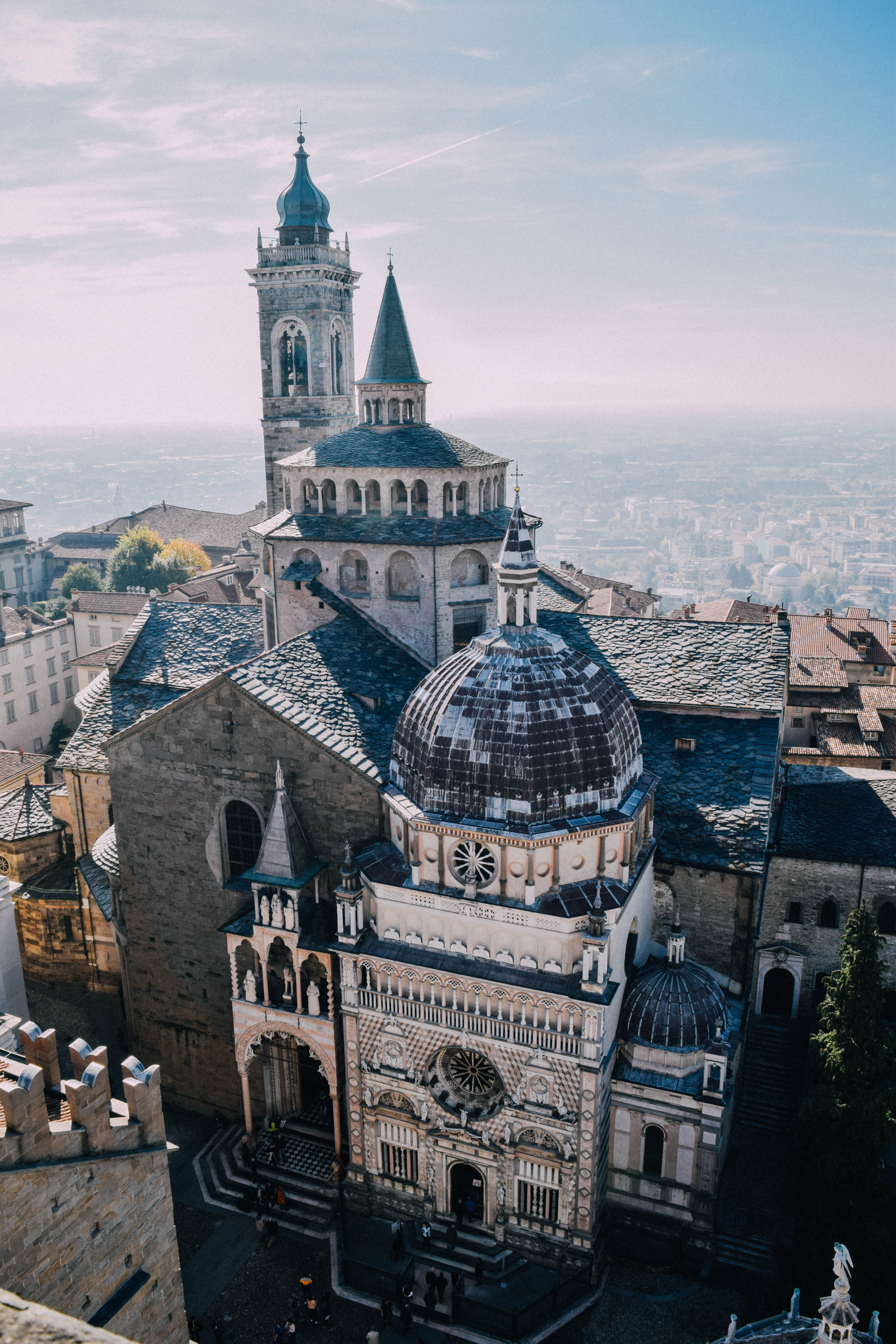
Bergamo, a gorgeous city slightly north of Milan, is also a precious gem overshadowed by its metropolitan neighbor. Housed the  stunning Renaissance-style Basilica di Santa Maria Maggiore, Bergamo also features Venetian rocky city walls and fascinating underground waterways. Hidden and understated elegance, is the characteristic that Bergamo shares with Milan. Inside of every torn down residence exterior, there is always a cozy and chic courtyard. La dolce vita to the core.


Lindsay in Thailand: The Thai Funnies

October 19, 2015


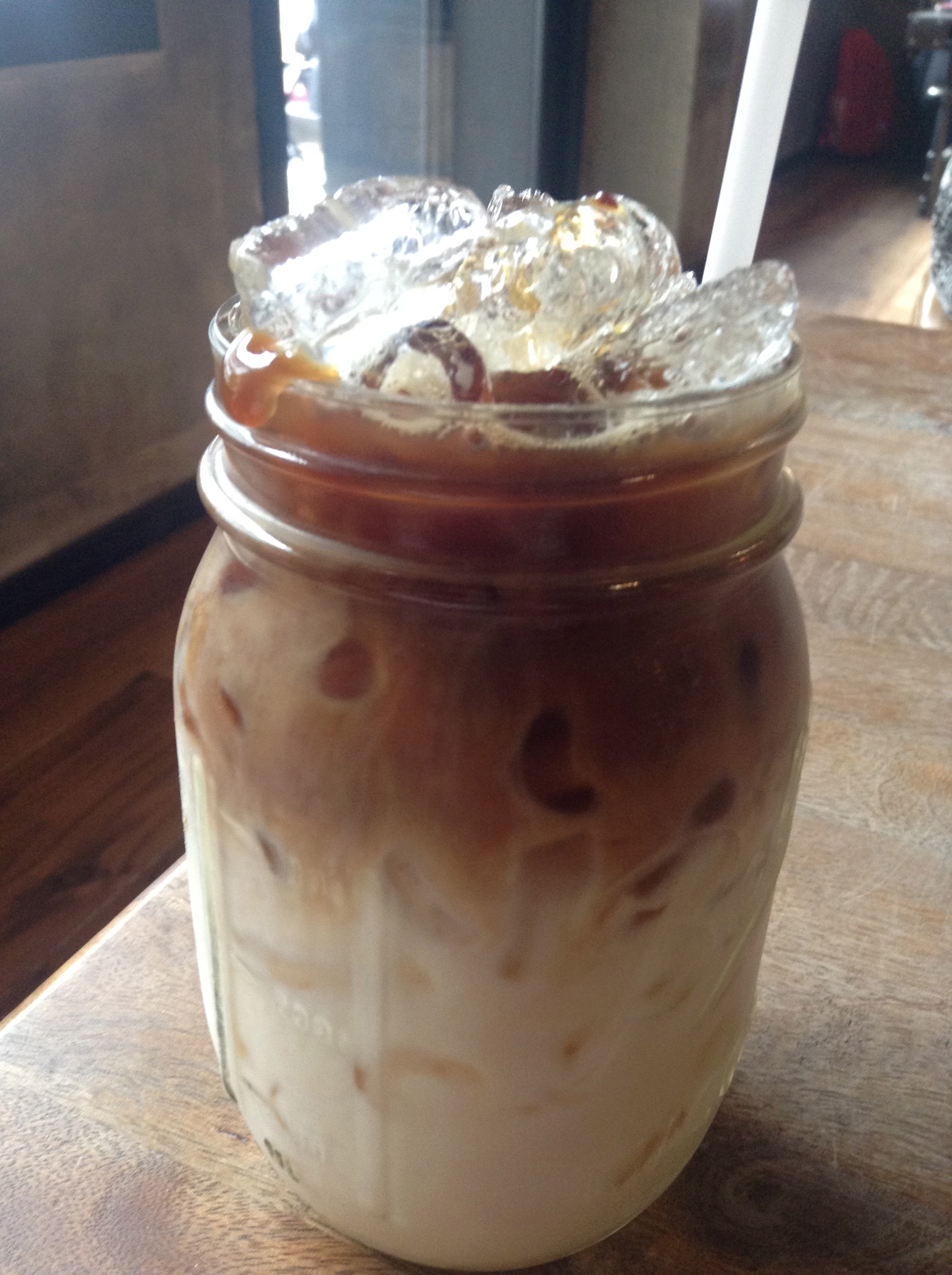
I had an iced latte. Now I'm just missing the pumpkin spice.

I had an iced latte. Now I’m just missing the pumpkin spice.


Today, I reminisced a bit about home. I found myself missing Fall leaves and the stereotypical pumpkin spice latte. I decided to somehow satisfy my seasonal coffee craving as I put on my scarf (in the 80 degree heat) and headed to a quaint café nearby. Even with my personal attempt of a mock pumpkin spice latte, I craved something unusual- what my Gram might call the Sunday newspaper “funnies.” Using this as inspiration, I thought I would make my own written comics, compiling a few funny occurrences and random thoughts from my Thai adventure so far. Enjoy!

  1. Apparent Differences in Distance
  2. Language Barriers or Avenues of Understanding
  3. Finger Foods
  4. Facebook (and Selfie) Official

Apparent Differences in Distance

My first morning in Khon Kaen, my lovely roommate and her friend wanted to take me and another exchange student out for breakfast. They informed us about a great cafe nearby, Have a Break. We walked 25 seconds down the street from our apartment, hidden from the sun under our umbrellas, to find that Have a Break was closed. Disheartened, our Thai roommates turned around and began to head back to our rooms. I then suggested going to another cafe two buildings down. With this proposal, they stared at the further café’s sign for a couple of minutes and insisted it was too far away. I replied that I did not mind the extra exercise, and in another ten seconds, we arrived at Cafe Me 2 less than 100 yards from our original departure point.


My first, and definitely not last, honey toast

My first, and definitely not last, honey toast


A closer look a the infamous Thai dessert!

A closer look a the infamous Thai dessert!


Before leaving for Thailand, I envisioned the people to be extremely active, contrasting them to the stereotypical “lazy Americans” who use drive-thrus so they do not have to get out of their cars to pick up food and who even drive in circles to get the closest parking spot at the gym (I know… I’m guilty of this too). I was shocked to find the existing aversion to walking not only in the city of Khon Kaen, but also in many rural villages. Thais love their motocis. I have been told that “walking four miles is dangerous” and have also been driven to village houses 100 yards down the dirt road. If you see a Thai individual, especially students in Khon Kaen, it is likely that their motoci is just a step and a hop away.


My Thai roommate, Yui, on her motorci

My Thai roommate, Yui, on her motoci


P.S. In addition to seeing up to four people on one motorbike, do not be surprised to also see cages of rabbits, full-grown Poodles, and babies like I was!

Language Barriers or Avenues of Understanding

At my first community homestay, I accidentally caused a ruckus. I stayed in a rural village a half of an hour outside of Khon Kaen with a Thai family for three days. My family consisted of my ‘Mehh,’ ‘Paw’ and another exchange student, Billy. Each morning, Meh made a ginormous breakfast that in actuality could constitute both lunch and dinner, as well. One morning, I approached my Meh in the kitchen with the little Thai I knew. As she fried chicken, I made a chopping gesture to indicate I wanted to help prepare the vegetables. She stopped what she was doing and simply stared at me. I repeated the motion as her head tilted in confusion. I then stated ‘sa poem pack.’ Now, I know this phrase does not come close to what I wanted to say, but at the time I thought “hair wash vegetables” might suggest rinsing veggies. With no luck, I tried ‘ab nahm pack.’


Keo Kruyah Kone chan (my family): One of our lovely neighbors, myself, Meh, Billy, and Paw

Keo Kruyah Kone chan (my family): One of our lovely neighbors, myself, Meh, Billy, and Paw


Ab nahm, meaning to take a shower, is a word Thais know very well. It is not uncommon for Thais to shower up to three times per day, so Thai families often offer their shower to guests even before offering a cold beverage.


My family and neighbors packing all the leftover food Billy and I could finish for breakfast for our lunches...Yum!!

My family and neighbors packing all the leftover food Billy and I could finish for breakfast for our lunches…Yum!!


In actuality, I did not want to shower with vegetables, but my Meh thought I did. She handed me an assortment of greens as she escorted me upstairs to the bathroom. I refused, and in desperation, Meh handed me forks, knives, spoons, and fruit as I was sat down at the table. Meh’s cries for help as she leaned over the fence could barely be heard over Billy’s laughter. Soon enough, I found myself swarmed by ten villagers attempting to understand that I simply wanted to help Meh make breakfast, not wash vegetable hair or shower vegetables.


Students gathered together as our Thai families gave blessings in a traditional ceremony before our departure back to Khon Kaen.

Students gathered together as our Thai families gave blessings in a traditional ceremony before our departure back to Khon Kaen.


Although that was an experience in itself, I did not find the next one as humorous. Because I was leaving for Singapore to visit my friend Colleen right after class, I wanted to make a copy of my passport photo on my lunch break. I arrived at the photo shop soaked after an unexpected monsoon and handed the worker my soggy photo. I requested one ‘4×6’ photo, and what did I leave with an hour later? Not only four 6x6s photos, six 4×4 photos, 150 baht additional payment, near tears, and a single 4×6 passport photocopy, but also a new understanding and appreciation.

While I intentionally attempted to remain calm and refrain my frustration, the photo shop worker did it with ease. He did everything he could to help me, from bringing out an electronic translator to offering his own money to pay for the photos I did not intend to purchase. For such a simple gesture, it made me question myself: How helpful am I to those who don’t speak English in America? How accommodating are we as a country to non-native English speakers?

I cannot count the amount of times I have heard the phrase “If you want to live in America, speak English.” I have heard of many people hanging up the telephone or raising their tone of voice with telephone assistants who are difficult to understand. I myself have giggled when I heard foreigners mispronounce an English word.

Since becoming more aware of our nation’s language deficit, I found I do not have much room to laugh. A mere 18% of Americans are fluent in another language while 53% of our European counterparts are fluent in at least one other language.

I myself have traveled throughout Europe and I cannot say anything more than ‘hello,’ ‘thank you,’ and ‘goodbye’ in any of the six countries I visited. Many citizens in these European countries; however, could hold conversations with me in English. They did not know if I was a tourist, new community member, or established citizen, yet they catered to my little comprehension.   Yet, I can still recall several moments of frustration when they did not understand my questions and requests—all in English.

Until now, I have expected others to accommodate to my sole English speaking capabilities. I had never honestly and intentionally tried to master a language. I had never been in a place for an extended amount of time where I could not find a single soul who could speak English. Have you?

I swear that if the Thai people had not expressed so much kindness and patience with me (and my language incapability) as they have so far, my experience would be very different. Studying abroad in any location is a difficult transition, even if you do speak the same language. I could not imagine permanently moving to the U.S. as a foreigner or refugee, searching for a new adventure or new life, and not being given the same assistance the Thai people have willingly offered. Before evaluating someone else’s communication abilities in the U.S., I hope to recall the difficult language barrier I faced, and the beautiful friendships I formed through eventual and somewhat unconventional communication methods.

Finger Foods

I have always been a fan of eating with my hands and playing with my food, and I am happy to say Thailand is too. In my first week of orientation, I took a class called “Thai Etiquette.” Along with learning how to properly wai, situate my legs while sitting on dinner mats, and point my feet in a temple, I learned how to eat with my hands.
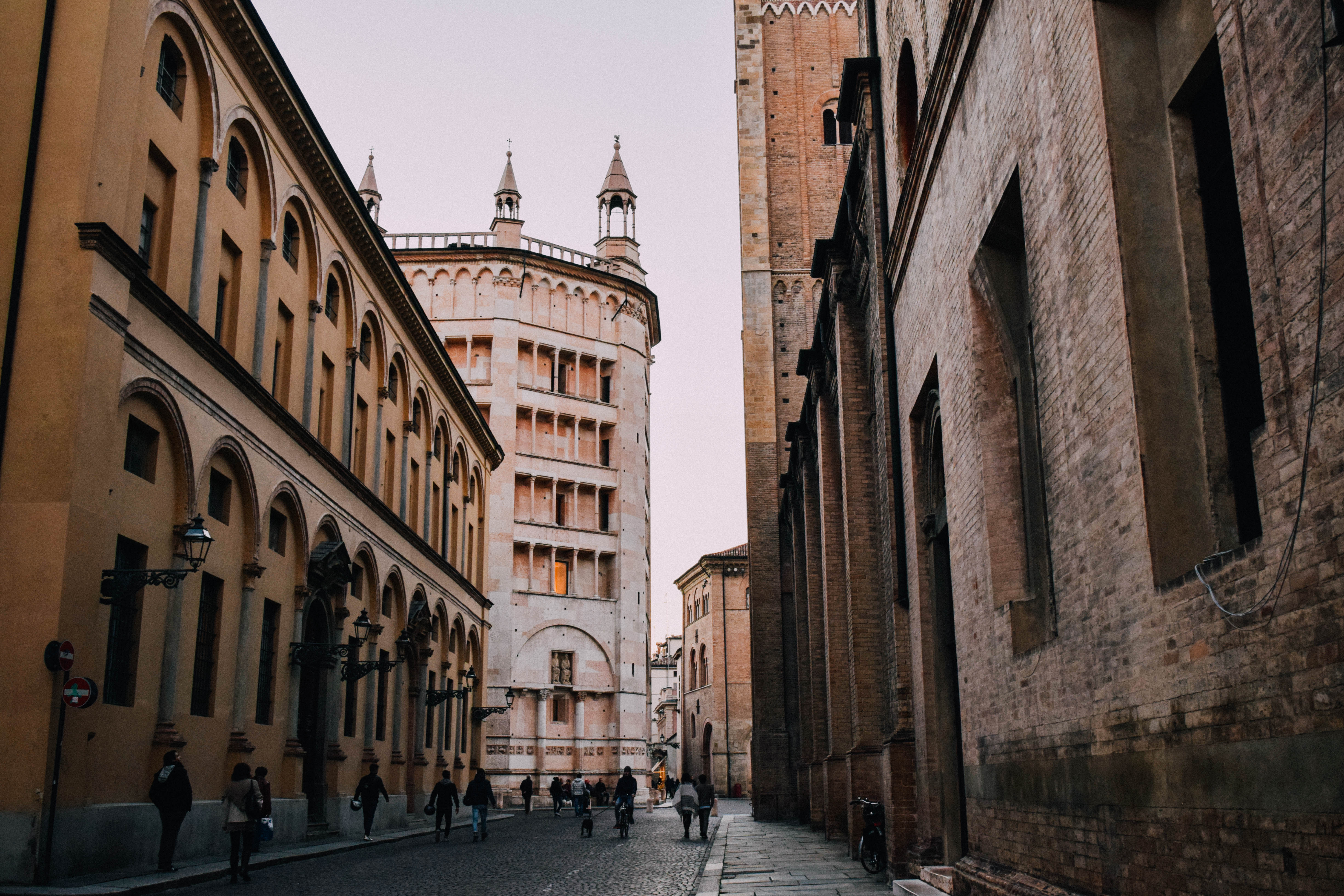
 

A Thai etiquette class

Thai etiquette class


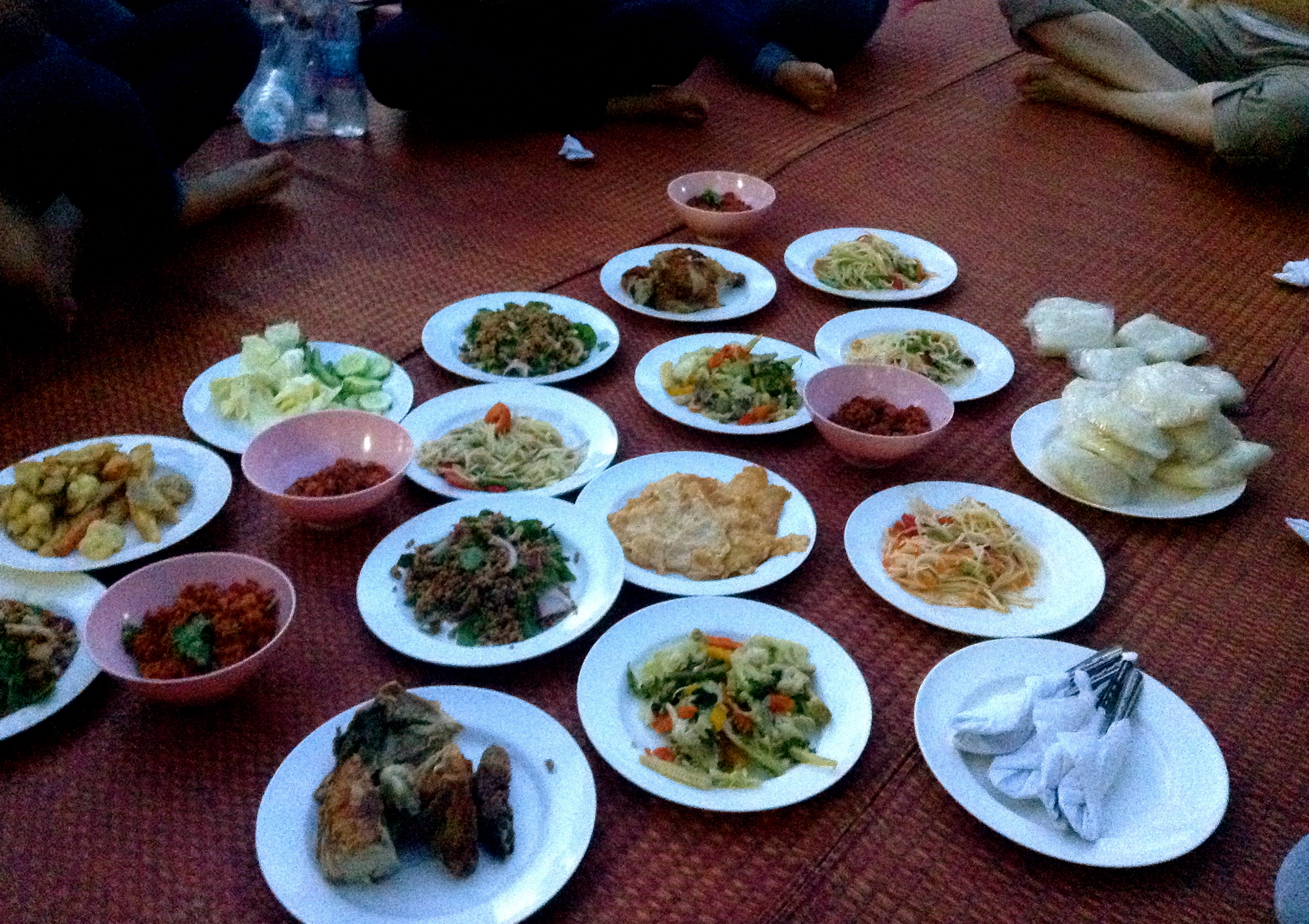
Although I was thrilled to eat with my hands, I was not initially as keen on all the food sharing. For any fans of the television show, Friends, you might say I was Joey who “doesn’t share food” as easily. That has sure changed for the better! In Thailand, communal eating is very popular. In Isaan villages, the families roll out mats onto bamboo tables. The family will then gather cross-legged on the mat, surrounding the bowls of traditional Northeastern Isann food.


IMG_3143

A traditional Isaan meal


At any homestay, I can be sure to find Som Tom (spicy papaya salad), blah toad (fried fish), ky toad (fried egg), guy yong (grilled chicken), and moo bing (minced pork) at breakfast, lunch, and dinner. Proper technique includes making a small ball of cow neow (sticky rice) and using that as a ‘spoon’ to scoop up small bits of each of the dishes. No one has a personal plate and communal eating utensils are also used (which means less dish washing).
This communal finger food setting is one that I love! Not only does it avoid loading your personal plate with more than you can handle, it also ensures you will not feel bad about wasting food left on your plate or stuffing yourself (too much, although it is inevitable most of the time). You do not have to worry about finishing your meal too early or being the last to finish because you simply eat until you are satisfied-no rush needed.

You can also extend the ‘communal’ eating aspect to ‘community’ eating. At each of the five village homestays I have been to, it is not uncommon to have seven or more additional friends and relatives gathered around the family’s table. Eating is considered an art form, and one that everyone should enjoy. Meh and Paw do not hesitate to yell “gin cow” to random passer-bys on bicycles, tractors, and motorcycles. ‘Gin cow’ literally means ‘eat rice,’ but also ‘eat food’ because most every dish involves some form of rice- white, black, purple, red, sticky, sweet, fried etc.,. The list goes on and on.

Facebook (and Selfie) Official

Farang; a word I might even consider a nickname now. Farang in Thai means “a person of white race.” I hear this term quite often followed by shutter clicks and camera flashes. Once, while on an overnight seven-hour bus ride to Bangkok (without my fellow ‘farang’ friends), I was sleeping with my night mask near the aisle. I woke up quite quickly when a bright light crept under my cover. A girl two rows ahead of me was taking a selfie with my ‘farang’ self and forgot to turn off her flash. She was initially shocked when I became quite aware of it but was not too embarrassed as the picture taking continued without hesitation.


My first Thai selfie, complete with peace signs and all

My first Thai selfie, complete with peace signs and all.


This experience was unique, but not too dissimilar to others. In Thai culture, it is much more acceptable to take pictures of people you do not know. I have had hiking tour guides, children, restaurant owners, gym instructors, and even Thai government officials sneak pictures of farang.

Keep in mind; however, that even if you don’t ever meet those people again, those stealthy photos may resurface. Many times, you can even view them as a shared link or as a post on your facebook wall. When I was studying Thai with a friend at a local café, two Khon Kaen university students were seated next to us. We didn’t speak to each other during the four hours we were there, and I only occasionally heard giggles after I attempted to formulate Thai questions and responses. (Then again, if I heard what I actually sounded like, I would laugh at me too).


American feast with Farang!

American feast with Farang!


It was not until I packed up my belongings to leave when the two girls stopped me and asked if I could be friends with them. “Of course,” I responded. I wanted to hang out with more Thai peers. Rather than exchanging phone numbers, they immediately handed me a pad of paper to write down my name, asking if I ‘facebooked’ often. They then requested a ‘selfie’ with me. Before even walking down the stairs of the small café, I had two friend requests and was tagged in a photo. Before coming to Thailand, prepare yourself. Be aware that Thais are #selfiegame strong.


Jiaqi in Italy: A Weekend In Budapest vs A Weekend In Milan

October 15, 2015

Like Milan, Budapest has been reputed as a city of endless charm. During the summer, I randomly met an Hungarian girl called Gabriella in a museum workshop and we instantly became best friends. Now that she is back in Budapest, I decided to spend a weekend with her and take the chance to visit this long-dreamed-about city. After four days of devouring delicious homemade Hungarian food and marveling at the Central European architectural wonder, I did notice some differences between the Budapest-style weekend and the Milanese weekend. Here are some insights from me, a casual tourist who observes seriously:

  • Breakfast. Hungarian weekend breakfast is long, sumptuous, and conversation-friendly. The Milanese breakfast, instead, is …? Wait what? Does that even exist? It did baffle me many times that a country obsessive with food does not have an extensive breakfast menu. Breakfast in Milan and northern Italy usually consists of only a few biscuits and a cup of cappuccino. At the most, you add a brioche and some orange juice. The breakfast I had in Budapest, however, is probably the type of big meal you will eat in your grandma’s country kitchen when you go back once a year. Locally-produced ham, hummus, whole wheat bread, fresh butter, cheese platters, pastries, milk and coffee…etc. “A great weekend always starts with a satisfying long breakfast,” said my Hungarian friend.
  • Cafe Culture. There is no need to re-emphasize how a cafe functions as a semi-religious institution in Italy. Yes, there is a certain ritual and drinking pattern that you are forced to respect and follow. In Hungary, everything about coffee is much more casual. An even more casual and relaxing atmosphere dominates the cafes in Budapest. The former Jewish quarter, now turning into a hip, “ruined” pub district, hides a collection of gem-like cafe bars.
  • People and Style. The Milanese fashion style is hard to miss even when you are visiting the city for just one day. Take a look of this street fashion blog  which generates a sense of how the Milanese dress themselves. “La bella figura” (the beautiful figure), said by Italians, defines their attitude toward everyday elegance. Fashionistas in Budapest, are relatively more reserved. It’s hard to spot flashy color and revealing jewelry in the fanciest neighborhood of Budapest, while even the shop cashier in Milan wears a pair of Valentino-labeled shoes. In the subway, most people prefer to wear darker colors and their coats are more conservatively designed. For me, this is rather a difference of personality than a difference of taste.


Turkish bath cafe


The Budapest Market Hall


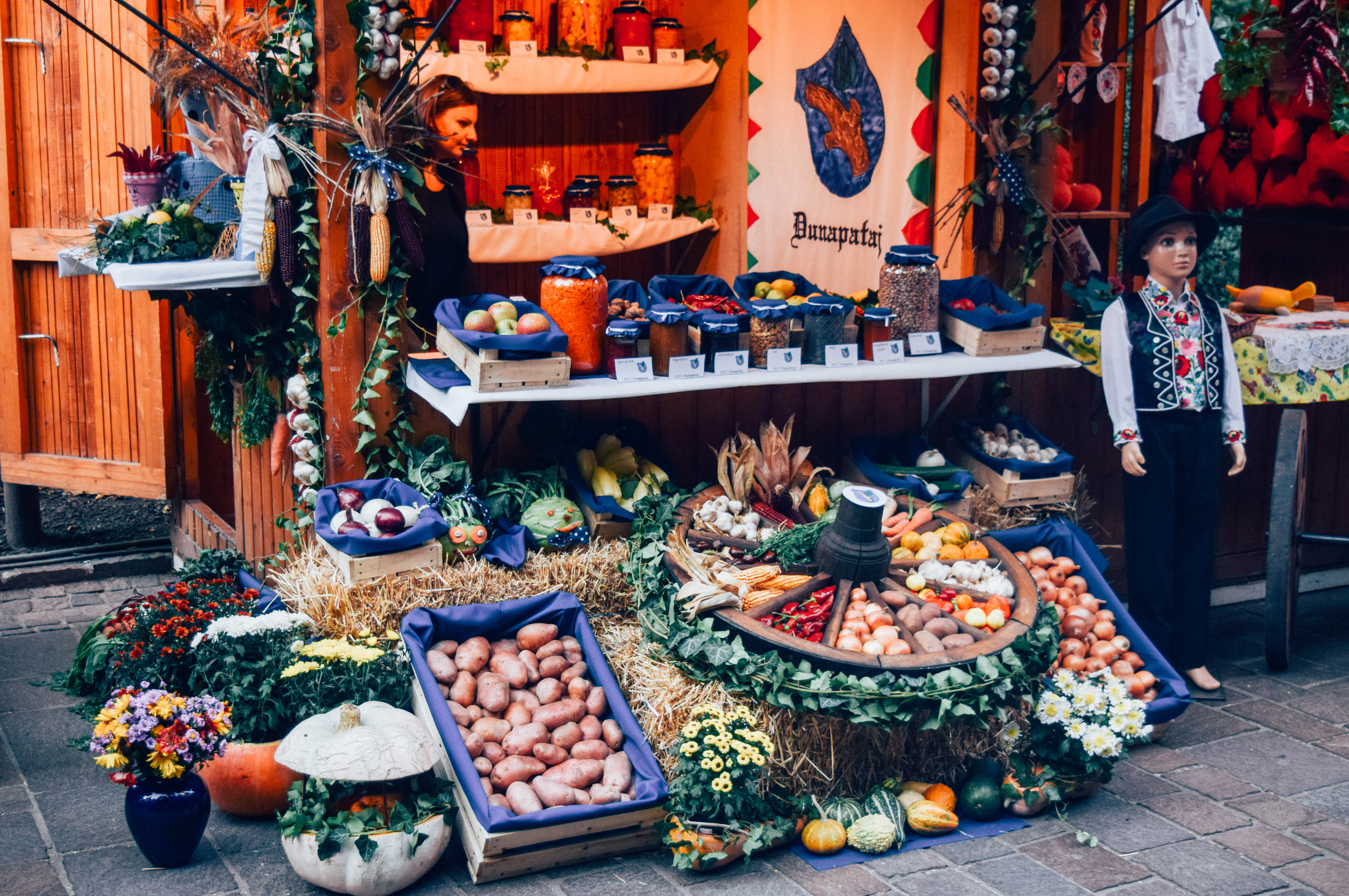
Local Farmer's market


Impressve Parliament Building


Hungarian style ham


Budapest Chain Bridge


Beautiful Budapest riverside