Garrett in Bonaire – Bon dia!

August 29, 2014

Bon dia!

(That is “Good day!” in Papiamentu, the official language of Bonaire.)

My name is Garrett, and I am a rising junior at the University of Richmond as a Mathematics and Biology double major, with an as-yet-undeclared minor in Integrated Science. However, this upcoming semester I will be studying abroad in Bonaire as a part of the CIEE program in Tropical Marine Ecology and Conservation.

First thing’s first. I know most of you are asking “Bon-where?” Well, it is in fact a small Caribbean island off the coast of Venezuela. It is a special municipality of the Kingdom of the Netherlands and was formerly part of the Lesser Antilles. It is located in the southern Caribbean as a part of the ABC islands, along with its neighbors Aruba and Curaçao.

Fifty miles off the coast of Venezuela, Bonaire is situated in the southern Caribbean along with the rest of the ABC islands From Google: http://www.harbourvillage.com/art11/bonaire/image001.jpg

Fifty miles off the coast of Venezuela, Bonaire is situated in the southern Caribbean along with the rest of the ABC islands
From Google: http://www.harbourvillage.com/art11/bonaire/image001.jpg

The island itself is approximately 114 square miles and is home to about 17,500 people. To give a size reference, it is less than half of the size of New York City (that’s including all five Boroughs) and has a population size that falls somewhere between the undergraduate student populations of UVA and Virginia Tech.

A map of Bonaire shows that it is only about 24 miles long and 3-5 miles wide. From Google: http://www.lovebonaire.com/images/BonaireMap-MED.gif

A map of Bonaire shows that it is only about 24 miles long and 3-5 miles wide.
From Google: http://www.lovebonaire.com/images/BonaireMap-MED.gif

Additionally, you may be wondering about CIEE. Well, my specific program is not run through a foreign university like many people would think of a stereotypical study abroad experience. Instead, my study abroad experience is run through the Council on International Educational Exchange or CIEE. Through their program, I will be staying at a research station, with 12 other students, in Kralendijk, Bonaire, where we will be taking classes in marine biology and conducting our own marine research. And that is precisely why I chose this program. Not only can I take upper level biology classes that transfer credit back to UR, but I will also be getting a once in a lifetime experience living on a Caribbean island steps away from the ocean, where I will be scuba diving for my classes and gaining firsthand experience in a potential career field. In a week’s time, I will be out in the water with the coral reef as my classroom.

I can’t believe it. I leave in 4 days!

It may be because just four days ago I was moving my sister into her dorm room for her first semester at Arcadia, but right now, I’m experiencing the same emotional rollercoaster that came just before I moved off to college two years ago. Nervous because I don’t exactly know what is to come. Detached because I know all of my friends at UR are having a great first week of school. Excited because I know it’s going to be an amazing experience. Worried because I still have yet to pack. Stressed because, apparently, memorizing 100 fish ID’s in a week is something I also need to fit into my schedule. Eager because everyone tells me Bonaire has some of the most beautiful diving in the world. Whatever my emotions are now, I tell myself that I have to stay open-minded and be ready for new experiences.

Change is on the horizon, but it’s going to be the best sunrise I’ve seen in awhile!

Stay tuned for my adventures!


Diana in Copenhagen: The Preparation (or lack thereof)

August 18, 2014

Hello all! My name is Diana and I’m excited to have the opportunity to share my experiences with you all through this blog. I’m a Business Administration major concentrating in Marketing and looking to pursue a minor in Rhetoric and Communications, although I haven’t declared it yet. As the title of this post suggests, I’m going to study abroad in Copenhagen, Denmark this fall and am experiencing a whirlwind of emotions because of it. I’m beside myself with excitement, eager to begin my journey, curious about what the experience will bring me, and anxious about not being the least bit ready.

A year ago if you’d asked me to imagine what I would look like one week before studying in Denmark for four months I would conjure up an image of chaos. Flashes of lists would overwhelm me: ones of what to pack and buy while others would detail planned adventures to explore the continent. In this vision my room would be littered with piles of clothes and adapters and I would be engulfed in the packing nightmare every twenty-something endures before an extended trip with limited packing space.

Instead, I am sitting in the administration building at my job at a YMCA residential summer camp in Wakefield, RI (one of the two places on the property with full electricity and WiFi) at 11 pm waiting to return to a cabin full of sleeping adolescents. Not a bag is packed, no lists are made, and I’ve had minimal available brainpower to even realize how close I am to having the experience abroad that I hope will change my life. This is my thirteenth year at Camp Fuller and my fourth working at the place marked by rustic buildings, cabins with no walls or electricity, and amazing people from all over the world.

My cabin

Where I’ve lived for the past twelve weeks. There are only half walls so the sides open up as flaps.

The dock

Where I spend my mornings docking up after driving the water skiing boat for a few hours

I’ve made countless memories at this place and most can be attributed to the people who have found there way here from places like Australia, New Zealand, Poland, England, Ireland, Spain, and South Africa. Each year, people from every corner of the world somehow find their way to this run-down camp in the smallest state the United States and experience the culture here—my culture. I’ve grown used to being the host to these world travelers. I feel confident explaining how things work and am comfortable being the host and facilitator of their experiences in my country. As the summer is slowly drawing to a close though, I am becoming very aware of the clock ticking towards the moment when the tables turn.

diana and sara

Here I am with Sara, a counselor from Denmark I’ve known for the past two years. I can’t wait to have her show me around her home country now. We’ve already planned to meet up and cook authentic Danish food!

To be honest, I feel like I’m going into this experience blind, and that only intensifies my anxiety and excitement. This will be my first time having a single room in a dorm for example. Will I get lonely? Will I be able to go back to having a roommate after experiencing this freedom? Copenhagen is notoriously expensive. Will I be able to budget myself? Will I have enough means to do everything I want to do? I’ve never lived in a city before and am so attached to my GPS I’d consider naming my first child Garmin. How many times will I get lost? Will I end up loving the city and dread my return home to suburbia?

My questions are endless but I know in a mere number of days I will start getting answers. It’s crazy to imagine myself trading in my staff shirts and one-piece bathing suits for a passport that will take me across Europe, but those are just the facts. I’m ready to kiss my comfort zone goodbye and immerse myself in a new place just as I have helped so many others do before me. It’s my turn to learn, to grow, to explore, and to be the one enlightened by a new people and culture and I can’t wait to have that chance.

Stay tuned!


Kimberlee in Mongolia: ISP Period

June 11, 2014

We are now at the point of our program where all of us students pick our own topic of interest and research it for a month. Our Independent Study Project (ISP) allows us to go anywhere to study anything for four weeks, and gives us a great deal of independence and control over what we want to learn about Mongolia. At the end of the four weeks, we have a 25-50 page paper and oral presentation due. The other students are researching a variety of topics, including: accessibility for people with disabilities, how climate change affects herders, street cleaning, emergency medicine in the countryside, and the use of the traditional Mongolian characters in modern society.

I first decided to study distance education in Mongolia, but soon decided that the topic was a bit too outdated. The further I researched distance education in Mongolia, the more I realized that most of the projects were conducted from the 1990’s to around 2007. I could continue to research and interview people on these past projects, but I decided to change my topic to technology in the Mongolian education sector. As you might guess, this topic is huge. I’m covering both the formal and informal education sectors, and it ranges from teacher training to e-learning to changes in classroom culture. It’s large, but I find it so interesting and don’t want to cut anything out.

My main research methods have been attending a conference, conducting 26 individual interviews, and observing classrooms. It was pure luck that the day our ISP research began was also the beginning of a 2-day international conference on technology in education in Mongolia. It was great to be able to experience it, and thankfully, most of the slideshows were in English. At the end of the conference, we were given a CD filled with each presenter’s individual Powerpoint or research papers. I don’t think it can get more helpful than that!

One of the best parts of my ISP time is getting to know Ulaanbaatar city on my own terms. I get to make my own schedule and plan what I want to do during my days, and I love having the opportunity to explore during my free time. The longer I live here, the more I realize how much I love it. This is the first time I’ve gone to a new city and explored it thoroughly on my own, and I love knowing the area so well. The city is relatively small (1.5 million people), but big enough to discover new areas! It’s strange to come from a smaller town in Maine and to realize how much I have fallen in love with this city. I never thought I would like to live in a city so much. This is something new that I discovered about myself abroad! I know that I’m going to miss UB when I have to leave.

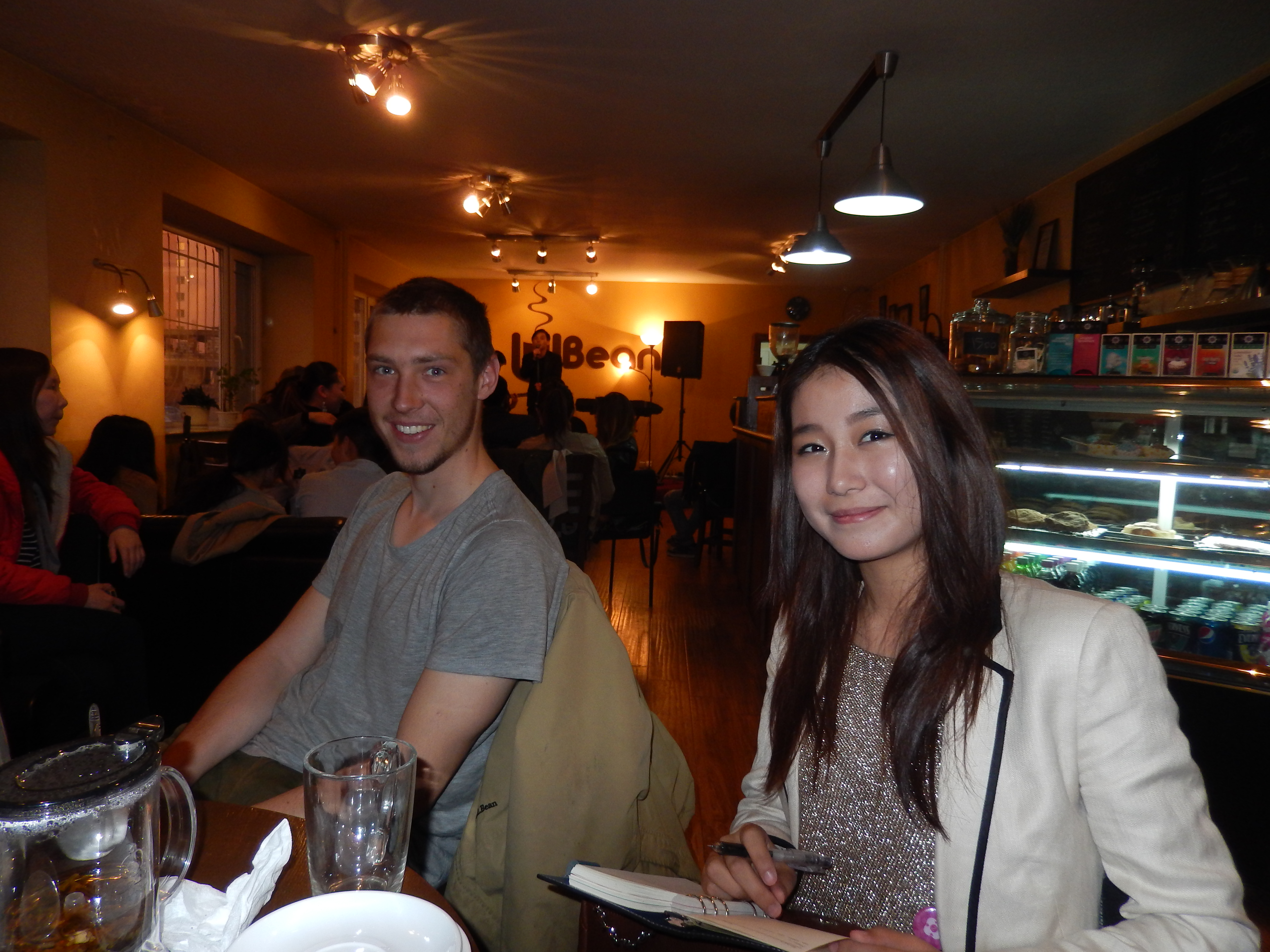
A cafe where I go so frequently they know me by name! I also walk on this street almost daily.

A cafe where I go so frequently they know me by name! I also walk on this street almost daily.

Another perk of the ISP is getting to interact with locals more. I interviewed around 1-3 people a day, and so I had to engage with Mongolians on a daily basis. I also used university students as my translators, so I had the opportunity to hang out with them between or after interviews. I learned so much from them, and it’s fun to hang out more as friends outside of interviews. I think that if ISP taught me anything, it’s how to begin to really live in UB. The rest of the SIT program was wonderful, but this time period definitely gives me more freedom, independence, and a look into what life here would be like if I didn’t go to university classes.

My friends Kit & Anni at an open mic night we went to as a group.

My friends Kit & Anni at an open mic night we went to as a group.


Austen in Ireland: Reflections of my Semester Abroad

June 9, 2014

After being back in the USA for two weeks, I figured I would finish up with some reflections from my semester abroad.

Looking back at my first blog entry, I’d hoped to really assimilate myself into the Irish culture.  I feel that I was able to do this to a certain extent, as I became a member of the UCD softball club and made good friends with many of them.

The UCD Softball Club

The UCD Softball Club

There was a mix of Irish, American, and Canadian, so I was able to meet Irish students as well as other Americans.  It was a really great choice to join this club and I enjoyed the social aspects of it too–the tournaments and the nights out in Dublin.  I also was able to enjoy the Irish culture outside of Dublin by visiting the cities of Galway and Cork.  These cities had a very different and more local feel to them than Dublin and were a nice change of pace.

However, I didn’t hang out with my Irish apartment mates as much as I had planned to at the beginning of the year.  I did spend a decent amount of time with them the first couple of weeks, getting to know them and such, but it seemed that they were very different from me and we did not have much in common.

Although we all got along very well, other than saying “hi” to them in the common room or the kitchen, I did not spend much time with them.  I played video games (FIFA) with the guys sometimes, but that was about it.  This is one of my bigger regrets of the semester.  However, I really was able to bond with most of the Irish people I met and they really were some of the nicest and funniest people I have met.  Their ability to enjoy life is really remarkable.

Another goal I had was to compare the different learning environments between the Irish universities and American universities.  Overall, I would say my classes at the University of Richmond were more challenging than the classes I took at University College Dublin.  The small class sizes at Richmond really require you to pay attention and not get behind in learning the material in class.

The larger classes at University College Dublin were held in lecture theaters and solely consisted of lecturing and very little class participation.   As for grading, there were very few assignments throughout the semester, and as a result, they counted for a fairly large portion of the class grade.  Through the whole first month, I did not really have much work at all.  Most of the classes had a sort of midterm essay assignment worth about 30% of the grade, and then a final exam worth about 70% of the grade.

However, there were some variations between the classes–one class had a couple of group assignments during the semester, another class had one large journal (7,500 words) for its sole assignment, and my Irish class had smaller continuous assignments as well as an oral exam.

The only stressful time during the semester was finals because there were so many exams occurring at the same time and they counted for a much larger portion of the grade than finals at Richmond.  It mainly consisted of essays so writing for a full two hours could definitely be demanding and intimidating.  Although I felt that I have learned many important things at UCD, my closer relationships with the professors at Richmond have allowed me to acquire more knowledge than when I was at UCD in Dublin.

Gaining my independence was also an important aspect of my study abroad experience.  Being an only child with somewhat sheltering parents, I felt that this would be a great experience for myself.  Although I did study abroad the previous summer as well, that was only for a month and this was for four months.

This study abroad experience definitely did help me become more independent, from planning trips across Europe by myself to cooking meals.  I definitely did miss my parents at times being halfway across the world from them but it was a great learning experience.

Also at the top of my list was being able to travel throughout Europe.  On my first blog post I made a list including the Cliffs of Moher, Amsterdam, Berlin, Prague, and Rome.  Although I did not make it to Prague and Rome, I did go to the Cliffs of Moher, Amsterdam, and Berlin!  Also other places I was able to visit included southern France, Munich, Liverpool, Newcastle, Belfast, Edinburgh and various places around Ireland.

Although I did not make it to some of the places I had hoped to visit (mainly Eastern Europe) I did travel a great amount and it was nice being able to visit some less-touristy cities such as Liverpool and Newcastle. It was nice meeting locals there too since they apparently loved Americans there.

Being able to travel and see new places has ultimately become more of an interest as a result of this trip and I hope to be able to do a Euro trip of some sorts next summer after I graduate.

Although I was very nervous and anxious about the semester I felt that I navigated along very well.  I was homesick at the start, but once I got acclimated and made friends the time flew by so quickly.  I still cannot believe how fast those four months have been.  I was really able to experience the Irish culture and all that it had to offer and I am sure to be there again in the near future.

Overall, saying I had the most memorable semester abroad is an understatement.  I not only had a fantastic time but I also was able to learn a lot more about myself from becoming more independent to also being more outgoing since I was in a new country and trying to meet new people.  It was a fantastic experience and I would most definitely do it again if I could.  The places I saw, the people I met, and the experiences I had contributed to the great memories I have of this semester.  Although I look forward to my senior year at the University of Richmond, I will always have an Irish part of me from these past four months.

Until next time, sláinte (cheers) Ireland.

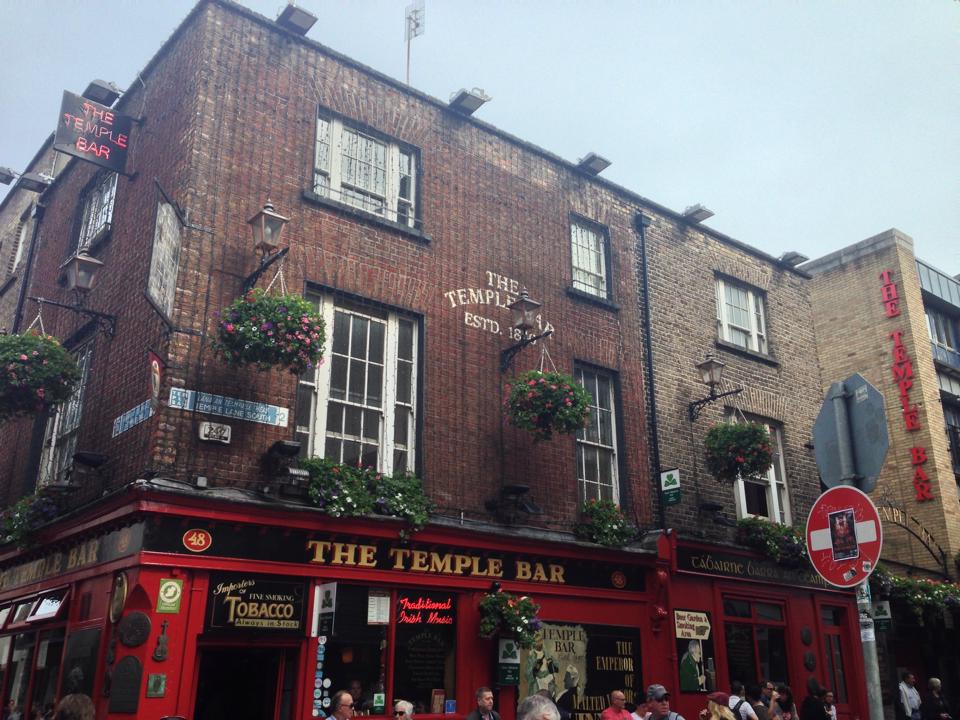
The Temple Bar

The Temple Bar

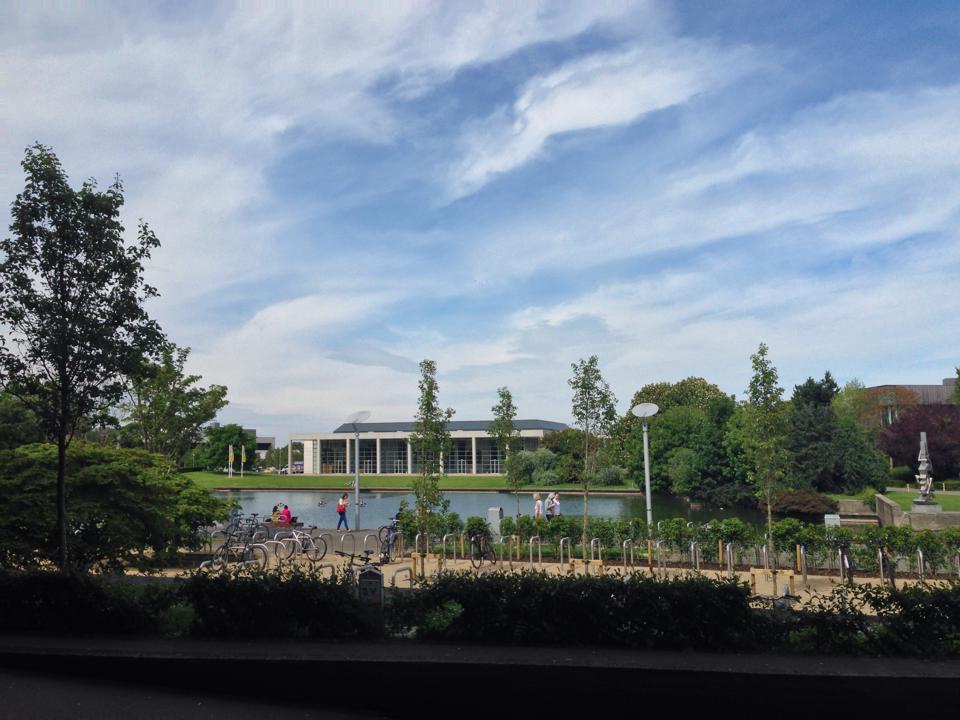
The UCD Campus

The UCD Campus

The River Liffey

The River Liffey


Kimberlee in Mongolia: Sainshand – Part 2

June 6, 2014

Another great memory I have from Sainshand is visiting all of the amazing museums, monasteries, and historical sites. Sainshand was filled to the brim with exciting sites! And they were made much more dramatic thanks to the desert weather. The wind was always blowing excessive amounts of sand into our faces. Sometimes, you couldn’t even see the color of the sky or the ground a few feet in front of you.

We went to a couple of monasteries filled with beautiful artifacts and statues. We even visited a rare female monastery, and briefly stayed there for a service. At the end of one tour, a monk had us lay down on the ground to meditate for half an hour.

A view of a monastery museum and prayer flags.

A view of a monastery museum and prayer flags.

My favorite part was the offerings we gave to them at some of the sites. In total, we had the option of offering to four different sites. But the catch was that you needed to pay for all of it yourself, or else it didn’t count. Therefore, I decided to only offer at one. The four options I had to offer were: water, candy/cookies, milk, and vodka. At 2 sites, we were instructed to wish for something at the same time. To offer we simply tossed or placed the drinks or foods on a specific part of the site. This was often tricky because of the temperamental wind. We had to face a certain direction while offering, and it sometimes meant that a good amount of the offering ended up on us!

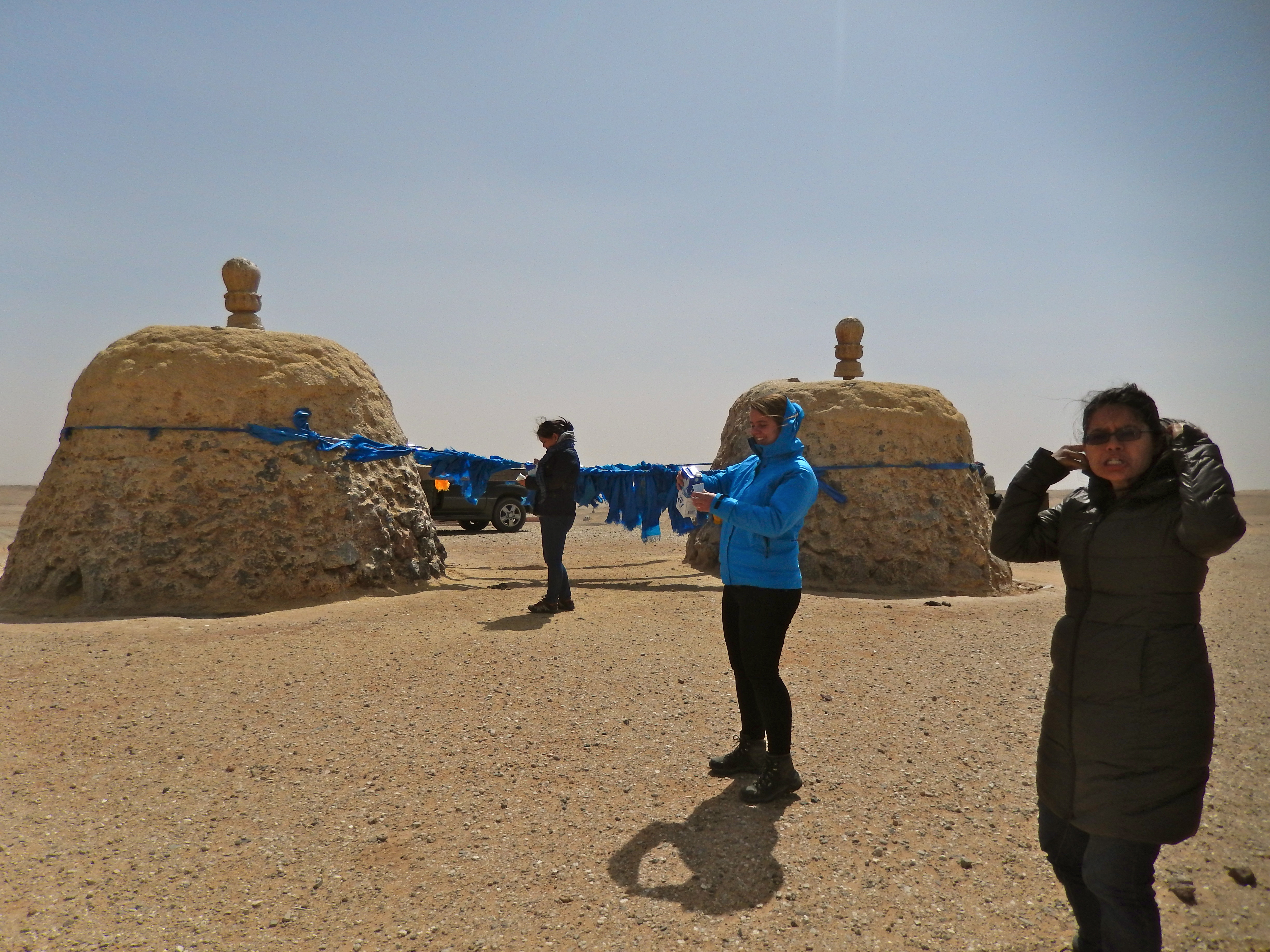
I ended up choosing the milk offering site, simply because I thought it was hilarious. The ovoo was in the middle of the desert, and was made of 2 sand breasts. “Ovoo” is a term used by Mongolians to refer to any holy site.

Our monk guide explained that this ovoo was a tribute to celebrate women and encourage fertility. I asked an SIT staff member if there was a deeper meaning and she said “no meaning- just boobs”. I think she was a bit confused as to why I was laughing so hard at that. I also thought it was funny how we were offering milk to 2 giant sand breasts. The men were instructed not to watch while we tried to avoid splashing ourselves with milk and overall enjoyed our time together as women. I would say that I’d prefer to offer milk to a breast ovoo than climb a mountain anyways!

The giant breast ovoo.

The giant breast ovoo.

There were two other memorable events that were unique to the desert environment. First, our monk showed us a dinosaur fossil! It was one of the most interesting things I’d ever seen. I knew that there were many dinosaur fossils in Mongolia, but I didn’t expect to actually see one in person. I even got to hold a piece of its spine! And who would have stopped us? It was just lying out in the open with no fences, guards, or any sort of monitoring device!

It was strange to see a precious dinosaur fossil with no protection. In fact, the monk told us that there used to be a baby dinosaur near it, but it was stolen less than a year beforehand! I can’t imagine a whole community knowing about a dinosaur fossil in the United States and not protecting it or giving it to a museum. It was a difficult concept to wrap my head around.

The other unique experience was the opportunity to visit a camel-herding family in the desert. I got to ride a camel for the first time in my life, and it was amazing. I don’t know what I was expecting, but I definitely wasn’t expecting the camels to be so tall. Or that I would ride them with a carpet saddle. Or that the humps were so soft and bouncy.

They even let us lead each other’s camels, so picture us running as fast as we could to make it fun for the other person. Lucky for me, Kit led my camel, and he ran for the whole time! Thankfully, there were two humps on either side of me that kept me nice and secure. Riding a camel had been on my bucket-list, and I was glad to have finally gotten to ride one.

This is me riding a camel with Kit leading me. To put the size of the camel into perspective, Kit is over 6 feet tall.

This is me riding a camel with Kit leading me. To put the size of the camel into perspective, Kit is over 6 feet tall.


Austen in Ireland: End of the Year – Cork, Liverpool, Belfast, and Finals

June 3, 2014

Right after getting back from Germany, I took the oral exam in my Irish class.  The Irish language was very difficult, but it was a neat experience learning another language.

The next day, I took a train ride to southwest Ireland to Dublin’s smaller sister–the city of Cork (Ireland’s second largest city).  Cork had a very different feel to it than Dublin with a laid-back attitude and with no tourists.  It was set on a nice river and had some beautiful architecture.  I would have argued that there were more pubs in Cork per capita than Dublin, which I thought initially was impossible.

We explored the city of Cork and ended up going to Blarney Castle.  A must while there was  ‘kiss the Blarney Stone.’ Kissing the stone is said to endow the kisser with the gift of the gab (or eloquence and skill at flattery).  The poison garden was another neat attraction at the Blarney Castle, which featured many lethal plants.

The following day, we took a day tour of the Ring of Kerry, a gorgeous attraction in the countryside of Ireland.  There were so many great landscape sceneries and also quaint Irish villages.  Although the weather wasn’t the greatest (fog really hindered our vision), the trip more than made up for it.

Ring of Kerry scenery.

Ring of Kerry scenery.

After getting back from this trip, I had my finals to conquer.  I had three finals in psychology, economics, and Irish.  My first final was a couple days after getting back from the Cork trip.  The whole experience of having to go off campus to an exam hall that fits 3,000 exam takers was intimidating.  I took a shuttle bus that UCD was running to the exam site and it took about ten minutes.

Once I entered the building, there were seat numbers for each exam taker at that time slot.  Once I walked into the exam room, it was overwhelming to say the least.  About 3,000 desks with uncomfortable chairs all lined up in many rows.  A lot different from Richmond, where exams are taken in classrooms.  The exam was fine but there were proctors walking up and down the rows about every ten seconds, which could get distracting.

Since I had over a week in between my first exam and other exams, I had planned a last trip to Liverpool and Belfast with my friends.

The city of Liverpool really surprised me.  It had one of the largest shopping areas I had ever seen and the dock area was very nice.  My friend and I had a jam-packed day.  We went to the Beatles exhibition, since no trip to Liverpool is complete without learning more about the Beatles.  Then, we went to three of Liverpool’s free museums.  We first went to the Merseyside Maritime Museum, where we learned much information about the maritime industry in Liverpool.  We then went to the International Slavery Museum, which explained the history of slavery in Liverpool.

Albert Dock, Liverpool.

Albert Dock, Liverpool.

The third museum we went to was the Museum of Liverpool.  This was a very interesting museum as it really explained the importance of the city, from the city’s large Chinatown to the rivalry between Everton and Liverpool Football Club.  Our next stop of the day was Anfield, the home of Liverpool Football Club, one of the most legendary soccer clubs in the world.  Our tour was fantastic and so was our very passionate tour guide.
Anfield, home of Liverpool Football Club.

Anfield, home of Liverpool Football Club.

We went into the press room where the manager talks to media after the matches, the home dressing room where Liverpool suits up, and the visitor dressing room.  We also were able touch the ‘This is Anfield’ sign which was an iconic part of the stadium.  After this, we went into the stadium and saw the field.  It was amazing being able to see this stadium and also sit right where the manager sits during the games.  It was pouring when we were outside in the stadium, but it didn’t dampen our spirits.  The tour was quite interesting and I was able to really learn a lot more about the history of Liverpool Football Club.  We also went to the museum and saw some of the trophies Liverpool had won.

We got into Belfast early the next morning and learned that there was a bike race going on in the city that weekend (the Giro d’Italia).  We got to our hostel and started our sightseeing in the Queen’s Quarter, which is where Queen’s University, Belfast is located.  This was a very beautiful campus with many historic buildings and nice greens.

Our next stop was the Ulster Museum, a National Museum of Northern Ireland.  It was such a large museum and very expansive.  It covered pretty much everything that had to do with the province of Ulster, where Belfast is located.  We then saw the Botanic Gardens, which had some interesting plants and flowers.  This day was so exhausting and we ended up resting afterward.

The Titanic Belfast exhibition was our main sight of the next day.  The Titanic was built in Belfast and the exhibition was amazing.  The exhibition had many interesting parts, including a ride (to see what it was like to work on building the Titanic) and also a virtual tour of the interior.  It was overall an excellent attraction.  Walking through the port of Belfast, it is apparent that Belfast had and still has a very large industrial part to it.

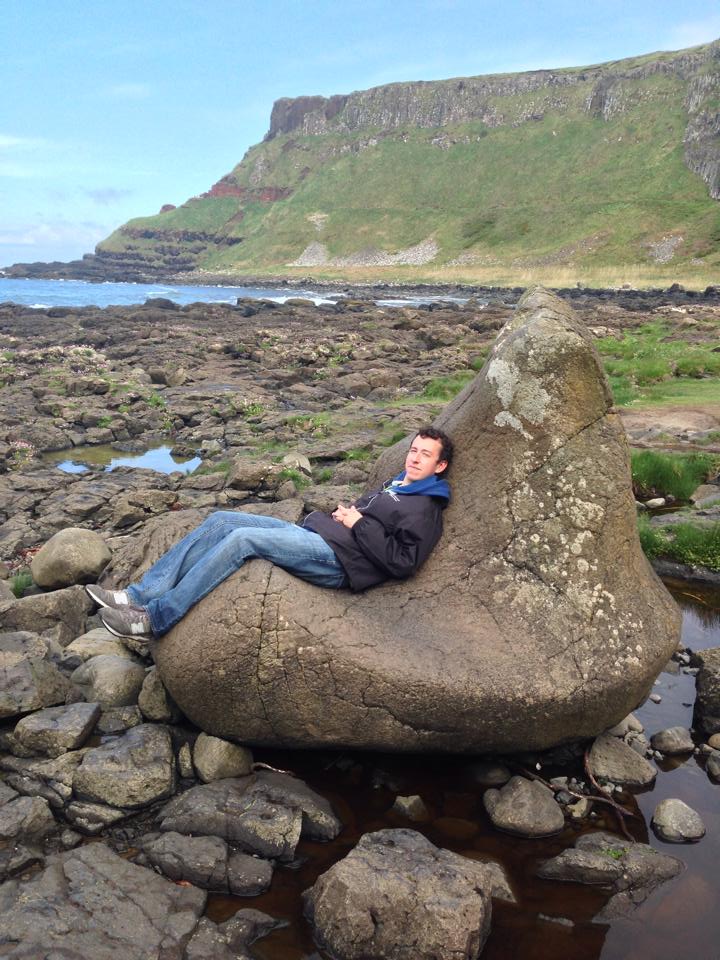
On our final day of the trip, we went on a tour to Carrick-a-Rede Rope Bridge and Giant’s Causeway.  Our first stop was the rope bridge and it was a somewhat frightening experience walking over a very shaky rope bridge, but the views of the sea from the island once you got across were really great. The main attraction was Giant’s Causeway though.  Giant’s Causeway is an area of about 40,000 basalt columns (mostly hexagonal), which are the result of an ancient volcanic eruption.  It is a UNESCO World Heritage Site.  Walking all the way out to the tip on the coast was magnificent but also tough as the rocks were quite slippery.

I found a nice rock at Giant's Causeway, Northern Ireland.

I found a nice rock at Giant’s Causeway, Northern Ireland.

This was really amazing and we walked back up top on the cliffs and were able to really appreciate the Giant’s Causeway Coast from up above.  When we got back to Belfast, we saw the Belfast City Hall, a marvelous building, before eating dinner and then heading back to our hostel since we were both leaving early the next morning.

Once I got back to Dublin, I studied pretty much the whole time before my last two finals.  It was a long day but I got through it and I soon realized that my time in Dublin would be coming to an end as I had to start packing.

I spent my last day sightseeing in Dublin.  I went to get my last fish and chips, to the Trinity Book of Kells exhibition and the Long Room, to the Science Gallery at Trinity College, to the Chester Beatty Library (religious history) and Dublin Castle.  I also just walked around the city, admiring the Irish atmosphere one last time.  I walked around O’Connell Street (I got souvenirs for many people), Grafton Street, and I ended up at pretty much where I started in Dublin, St. Stephens’ Green, a beautiful park right in the center of Dublin, and took some time to think of the great adventures and memories I will have from this semester.

I soon went back to the university and started packing.  Packing started off easy, but got more challenging when I slowly started running out of space. The next day (my last day in Dublin) was very much a relaxing day and I spent it packing and saying bye to friends I had made.  Although I had to get up early the next morning to leave, I figured I should spend one last night with the UCD Softball Club, as I made some of my closest friends in that group.  I ended up not getting to sleep until 4 a.m. that night and waking up at 6 a.m. but it was all worth it.

Saying my last farewells to the people, the campus, and the city of Dublin was challenging, but I know I will be back at some point in the future.  It was my most memorable semester so far and I would say the decision to study abroad (I decided last minute) was one of the best decisions of my college career.  It really opened up my eyes to another culture.  I am currently sitting at my home in the USA relishing the memories and wishing I were in Ireland.  I can’t believe I sometimes wished I were back in the USA when I was in Ireland.  I must have been crazy.


Austen in Ireland: The Deutschland Expedition

May 29, 2014

After finishing up the last week of classes and final essays, I went to Germany for five days with a friend since we had a “revision week” between the final week of classes and final exams.  My friend and I decided to visit Berlin and Munich, the first and third largest cities in Germany.  Our trip began with my flight to Munich and meeting my friend at the Munich airport.  It was surreal that the airport had a tennis court and an outside area in between the two terminals.

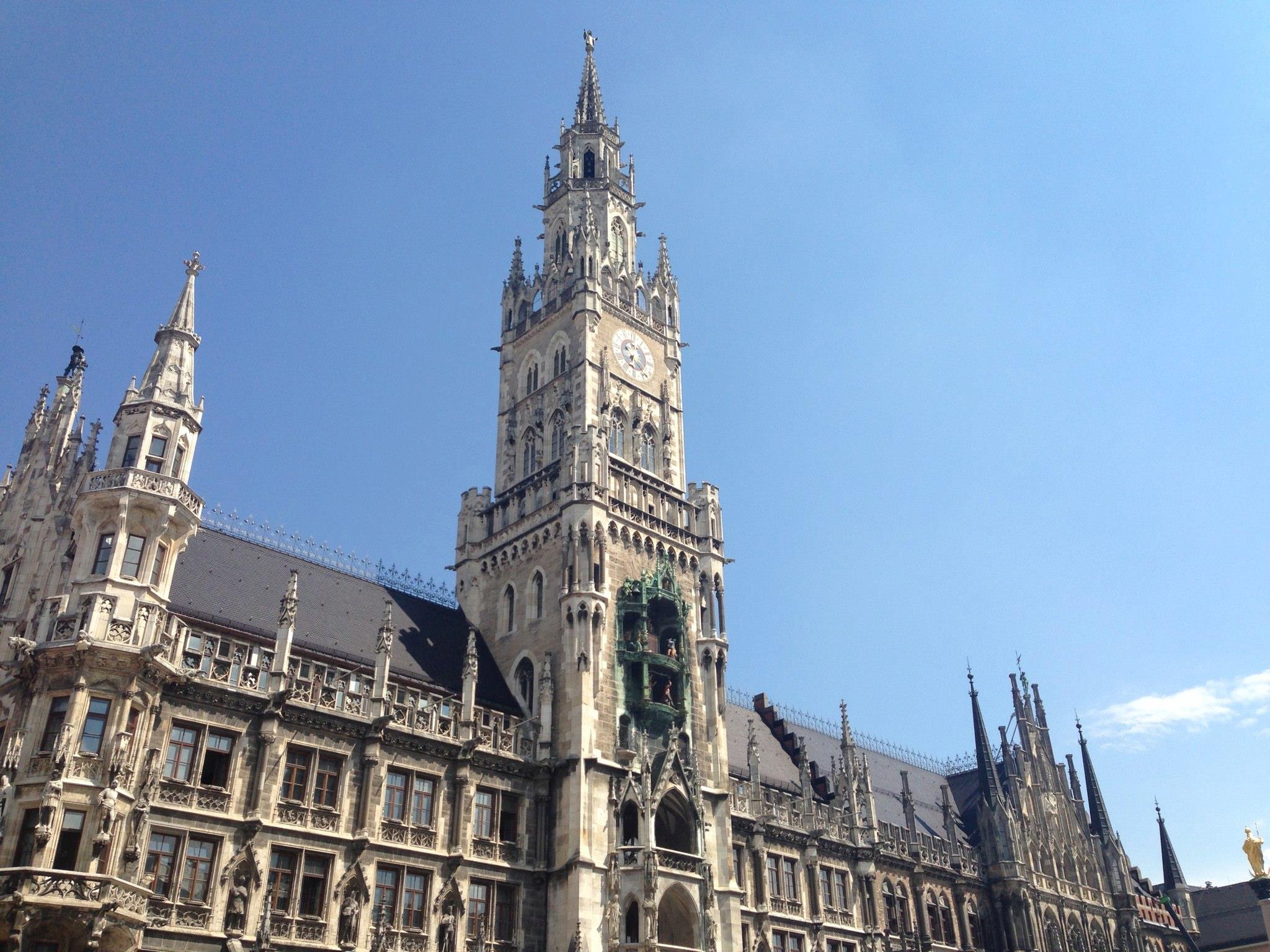
From the airport, we decided to explore, marveling at the magnificent Bavarian architecture around the city of Munich.  We went in the Residenz, the former royal palace of the Bavarian monarchs.  It was a very regal.

Marienplatz, central Munich.

Marienplatz, central Munich.

We also saw the English gardens, a large park in the city center.  It was an amazing sight seeing everyone enjoying their time on a weekday and not worrying about work.  We also experienced a beer garden, one of the must-sees when going to Munich, which was a fantastic and truly authentic German experience, including the food and beverages.

The next day, we took a day trip outside of Munich to visit the Bavarian castles of Linderhof and Neuschwanstein.  We first visited Linderhof, which was modeled after the famous Versailles chateau.  It had a similar hall of mirrors and the gardens around it were fantastic.  The castle was in such a picturesque setting in the mountains.  Our second stop was the very Bavarian village of Oberammergau.

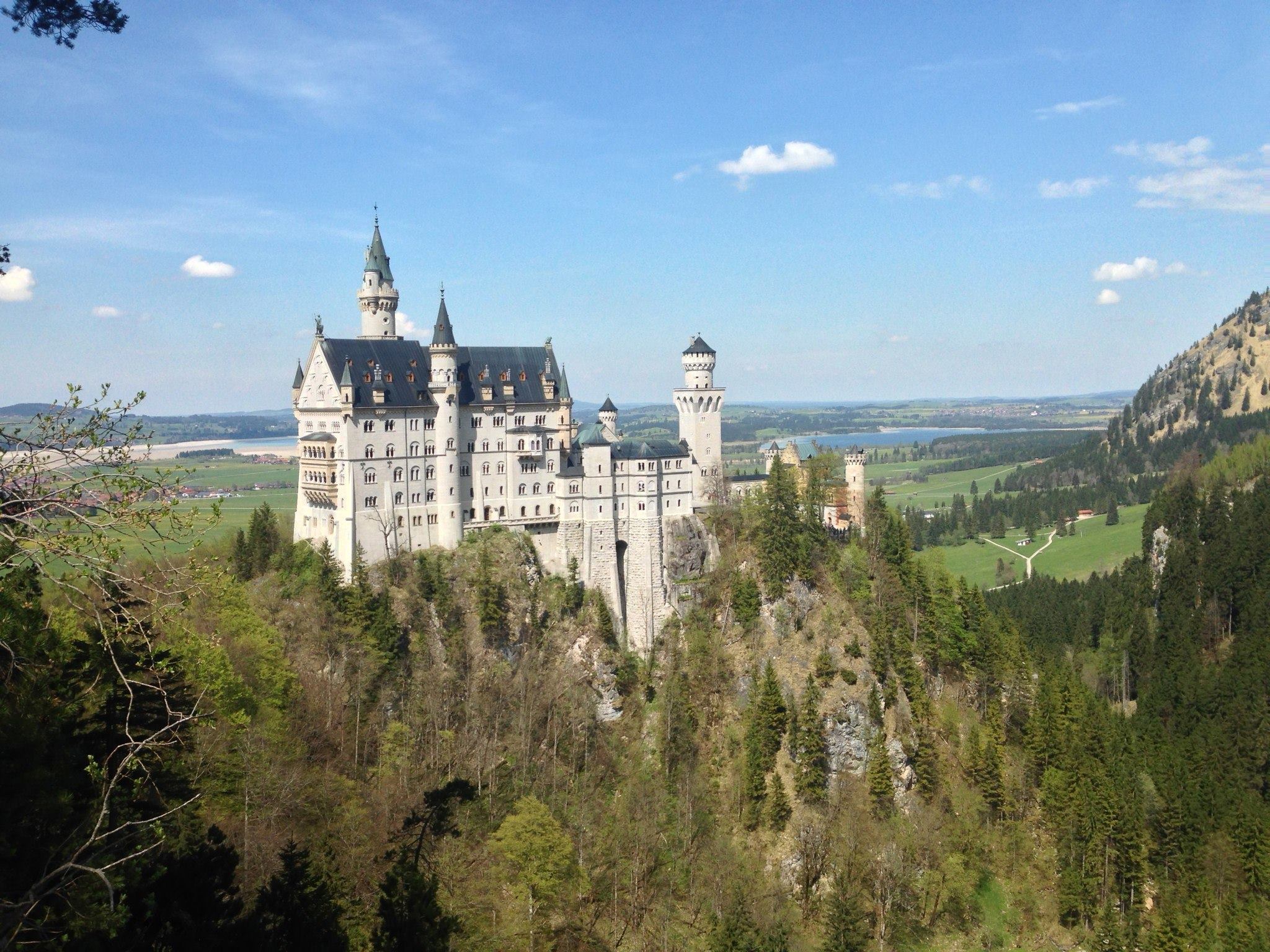
The main attraction was Neuschwanstein Castle, one of the most famous castles in the world. Ludwig II of Bavaria commissioned the palace as a retreat.  The setting of the castle is absolutely breathtaking.  The climb is thirty minutes up a steep hill, but it was very much worth it.  The castle was unlike anything I had seen before and the views of not only the castle but the landscape were magnificent.  The bridge overlooking the castle from above was such a great spot to see everything.

Breathtaking scenery of Neuschwanstein castle and the Bavarian landscape.

Breathtaking scenery of Neuschwanstein castle and the Bavarian landscape.

The next day we took a great tour through Munich and we were able to learn a lot more about the important history of the city.  We went up to the top of a church with terrific views of the city.

Our flight to Berlin was that night and we landed around 9 pm or so.  Berlin was a completely different city and the difference was apparent immediately.  Munich was a more historic and traditional city, while Berlin had more of a professional feel to it with its large business district.

We started our Berlin stay with a great tour of the city, which stopped at many of the famous sights such as the Brandenburg Gate (the former city gate), the Jewish Memorial, and the Berlin Wall to name a few.  Also, we explored Museum Island (a very nice area on the river with many museums) and the Berlin Cathedral.  The next day we decided to visit the concentration camp of Sachsenhausen, a concentration camp near Berlin used mainly for political prisoners.  It was a very eye-opening experience being able to see this camp, the living quarters, and even the extermination area.

Brandenburg Gate, Berlin.

Brandenburg Gate, Berlin.

On our last day in Berlin we decided to go to the top of the TV tower, which had a height of 368 meters.  The views were great out onto the city and a fitting way to end this epic expedition.  This journey was a neat adventure and also my farthest trip from Ireland.  It was great going to the homeland of my relatives as I have a large percentage of German ancestry.


Kimberlee in Mongolia: Sainshand Part 1-Reflection of Our Last Excursion

May 27, 2014

This past week was strange because it was the beginning of the many “lasts” in Mongolia. Although it was exciting to go on an excursion to a desert area in southern Mongolia, I kept remembering that it was the last time that we’d travel as a group. It was in the back of my mind as we went to the countryside, but I had to keep shaking it off because how can I live life with such sadness in the back of my mind? For me, a large component of study abroad is remembering that it is temporary, but continuing to push myself to live in the moment. It was, and is still hard, but I keep telling myself that I need to present in every moment.

However, the great part about it being the last excursion was the fantastic group dynamic. As there were only 8 of us, we were predictably close at the beginning. But I felt that this particular excursion was different than the others. After the trip, many of us talked about how we liked our trip to Sainshand the best out of them all. When I look back in my memory, I remember lots of roadtrips, dumplings, and laughter in those few days.

A view of Sainshand town.

A view of Sainshand town.

Perhaps it was the relaxed, comfortable atmosphere that surrounded our group. Because there wasn’t anything to do in Sainshand at night, we spent our nights laughing at comedy skits on YouTube, watching movies, and just enjoying each other’s company. Just imagine the 8 of us piled on top of a bed watching movies!

I gave countless head massages every night. In general, we had more free time than ever before. We never had to get up that early, so we had breakfasts leisurely in a small restaurant across the street from the hotel. We had large chunks of time to explore the tiny town during the day, and even found a pizza place to order pizzas from later.

A giant dinosaur statue we found and climbed together.

A giant dinosaur statue we found and climbed together.

A big highlight of the trip for me was getting the chance to ride on the train during the day. We rode a train at night to Erdenet, but it was very different during the day. First of all, our program was quite determined to get us to be productive during the train ride. We had both individual presentations and Mongolian language classes, which I thought was hilarious.

With the 8 students and 2 program staff, we were stuffed inside that tiny train compartment. But it was a fond memory for me because we were able to bond even more. We were also looking forward to the “buffet” our program had promised us, but it just turned out to be a lady serving ramen and sandwiches from a cart. We had fun eating our cheap, unhealthy foods while wrapped up in our blankets on our cots. It’s funny how sometimes the journey can be just as fun as the destination itself.

My friend Mara on the train.

My friend Mara on the train.


Kimberlee in Mongolia: Cashmere Party

May 12, 2014

NOTE: Some parts of this post are graphic and may be disturbing to some readers. Details have been retained to highlight the daily experience of this study abroad student and cultural norms in Mongolia, and a thoughtful cultural reflection on the topic rounds out this post.

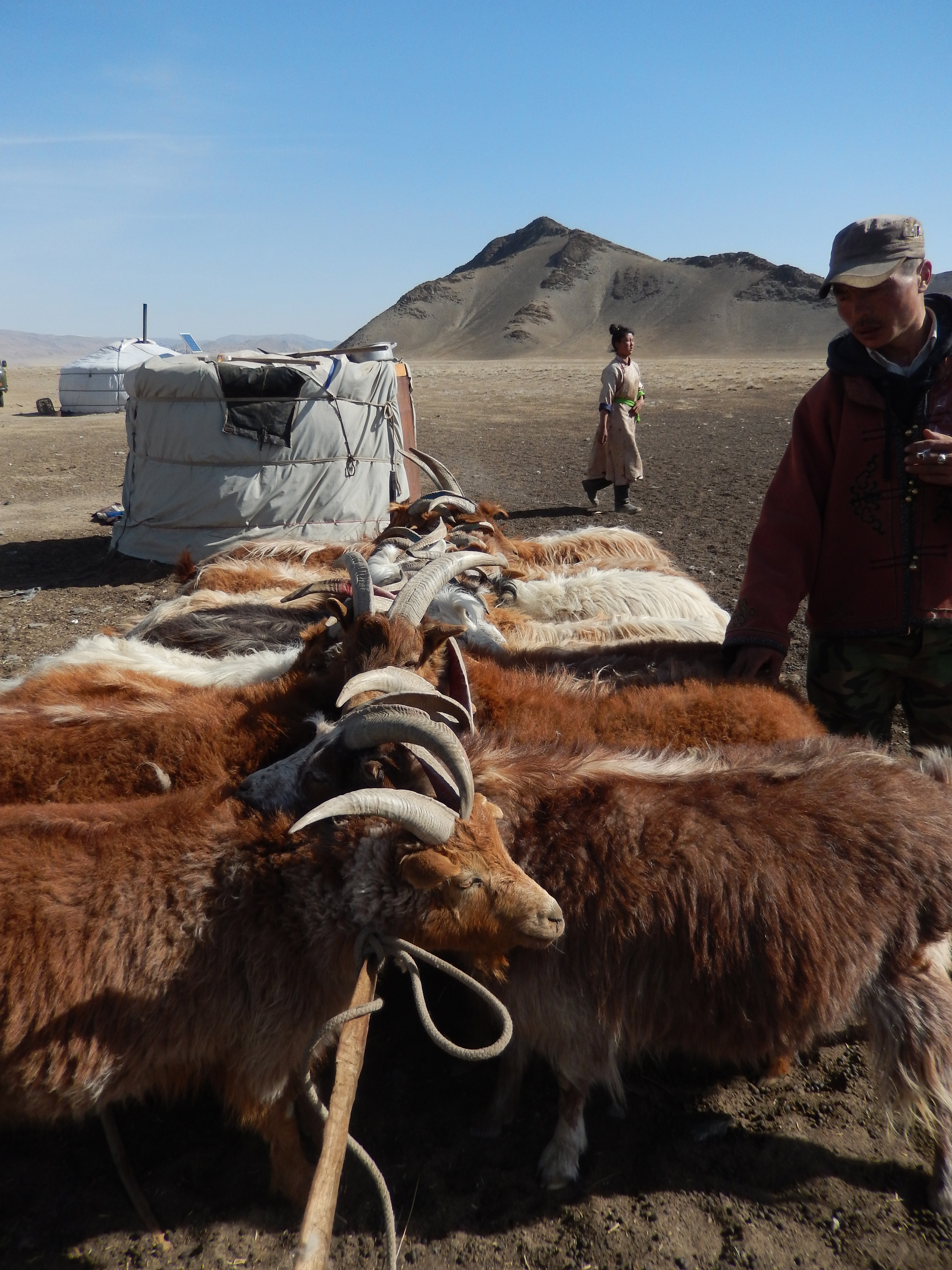
One of my favorite memories in the countryside was what I call the “cashmere party” that my host family threw. At first, it started as a regular day. But then, we herded some animals into the pen that we usually only use at night. Tsetseg and my host uncle immediately went in to drag out some specific goats. Of course, I had no idea what was going on. All I knew was that I was supposed to smack the rumps of the stubborn goats. As we brought out each goat, we tied them head-to-head on a rope next to the pen.

Tsetseg with a particularly stubborn goat. Thankfully, it was small enough to pick up.

Tsetseg with a particularly stubborn goat. Thankfully, it was small enough to pick up.


Some of the goats that were tied-up.

Some of the goats that were tied-up.

When we had around 15 goats all tied-up, they brought out the metal combs to begin brushing. When a comb was full of cashmere, we would drop it into a giant bucket and resume our work. There were a lot of ticks in the bucket by the end. Each goat took 2 people about 20 minutes to brush. It was hard labor! The coats turned out to be thicker than I expected, and with each tug, the whole body of the goat would rock to the rhythm.

The reason why I call this the “cashmere party” is because 15 minutes into the process, a jeep pulled up and dropped off about 10 members of their extended family. They each grabbed a goat and went at it. It was kind of hilarious. You could tell that they were just making some small talk while vigorously brushing 6 or 7 goats at a time. It gives a whole new meaning to the phrase “family reunion.”

Some of the extended family brushing goats.

Some of the extended family brushing goats.

The arrival of the family members also meant that they expected to get some fresh meat to bring back to town. So I saw a sheep get slaughtered. It was one of the most surreal things I’ve ever seen. I can’t believe that I’m 20 years old and have never seen an animal die before! Technically, women aren’t supposed to see the process because an old wives tale states that we’ll become infertile. But I got to see it anyway.

I can’t explain the fear I felt when I saw them drag it up to the ger, and my host mother made a throat-slashing motion. I knew that I had to watch it – both because I was morbidly curious, and also because I didn’t want them to think that I couldn’t handle it. It turned out to be less worse than I’d anticipated. They slaughtered it the traditional way, which meant they laid it on its back, sliced its stomach open, and pinched an artery. After it was over, they brought out multiple buckets for the organs. They only threw away a couple of parts, and put everything else into small buckets to take home. I was going to offer to help, but I just couldn’t! Maybe if I was able to wash my hands within the next week of being there.

Still, it was a process that I was “glad” to witness. Not surprisingly, no one, not even the toddlers, gave the process a second glance. I’m guessing it’s normal to have a sheep slaughtered in front of your ger.

I think that the most important lesson I learned from both witnessing this process and my nomadic homestay experience as a whole is that for many Mongolians, their animals are their lives. They rely on them for everything. Their animals’ meat and milk are their main source of food; their skins are for their clothing and home, and their animal products generate their whole income. As you may imagine, there is nothing that goes to waste. Every part of the animals is used as a precious resource, and I say from personal experience that their lives are not taken in vain.

Even with my host family in the city, we’ve eaten every part of the animal because this mentality seems to have continued into the lives of some urban Mongolians. I find this to be an interesting mentality that is different from the culture of most Americans. When I think of mainstream meat at home, I think of miserable animals laced with antibiotics, confined to a factory, and hidden from the public eye. As a society, I think that we often disrespect the lives of animals, and view them as only living to be eaten by us. Even when they are slaughtered, only certain meats are publicly displayed in stores, and we are often disgusted by the thought of eating most parts of the animal like the heart, intestines, and brains. But here in Mongolia, these parts are not thrown away, but used and even cherished in some ways.

Perhaps this is tied to the fact that they are often eating their own herd animals. They watched many of them be born, cared for them as babies, and protected them as adults. And then, they watched them continue the cycle by giving birth as adults. My host family knew each of their animals by heart, and cared for them like their lives depended on them, which they did. I think that because of their reliance on their animals, Mongolians have come to respect their lives in ways that I never could have imagined. I learned from conversations with my host family that because many Mongolians are Buddhist, they believe in the full circle and the connection of all life. A beautiful practice I learned about was how Mongolians traditionally slaughter a goat. Before they begin to cut, they lay a single blade of grass onto its stomach to symbolize that the goat is being returned to nature.

Interestingly, I have met some foreigners who practice vegetarianism everywhere except in Mongolia because of the way animals are raised here. They are often against the cruel treatment of animals in the west, and they tell me they find peace in knowing that the animal is free in nomadic life and is respected with a less painful death. But sometimes I wonder, are the animals really “free”? I personally still struggle with the question of whether or not the relationship between the herders and the animals is symbiotic, or if the animals are not gaining anything substantial in return. After all, at the end of the day, they are being raised to be killed. We explored this topic in a class discussion, and I still wonder about who is benefiting more. Clearly, the herder relies on their animals for everything, but the animals are also gaining protection from predators, guidance to the best rivers and pastures, and even medicine.

I can’t say that I’ve had all of my questions about this topic answered, but I have come to view the lives of animals differently. There is something incredibly special about this historical and relationship, but I personally fear that the trend of globalization will one day reach Mongolia and disturb this way of living. The number of Mongolians moving to the city is increasing every month, and the nation itself is starting to become less flexible for herders. Even seemingly innocent changes, like the development of private property, is making life increasingly difficult for nomadic families. I can only hope that the demand for the animal products they produce will become higher, and will encourage families to continue this ancient lifestyle. I hope that I will never need to wryly tell my grandchildren that I was able to witness nomadic lifestyles before they disappeared from earth.


Austen in Ireland: Animals, Softball, and the Parents

May 6, 2014

After St. Patrick’s Day, I had a week to relax and attempt to start working on my copious amounts of assignments due in April.  Once school started again, it seemed apparent that the second half would be more intense with the large number of assignments, finals worth up to 70% of my grade in some classes, and on top of that, trips to see more of Europe.

The weekend following the break, a friend and I went to the Dublin Zoo.  I hadn’t been to a zoo in about eight or so years and Dublin had a great zoo supposedly so I figured I had to go.  I was amazed by the size of it, as you could easily spend a whole day there.  They had so many different types of animals, but I was disappointed that they didn’t have sloths as well.

After this, we went to a Gaelic football match in Croke Park where County Dublin took on County Mayo.  It was one of my favorite experiences of the semester so far because the sport was really fast-paced and entertaining.  It ended up being a draw with Dublin staging a come-back and also having a chance to win it at the end.  I wish I could see a hurling match (the other sport big here) but I don’t think I’ll get a chance to.

Croke Park

Croke Park

The first weekend in April the UCD Softball Club had their “Intervarsities.”  Intervarsities is a tournament where other softball clubs around Dublin and Ireland come for the weekend and we play.  It was overall some great fun.  I played seven games over the course of the two day tournament, so I was exhausted to say the least.  It was great being able to meet people from other clubs as well as getting to know people from the UCD Softball Club better.  My UCD team ended up losing the third place game, but the UCD 1 team ended up winning the tournament.

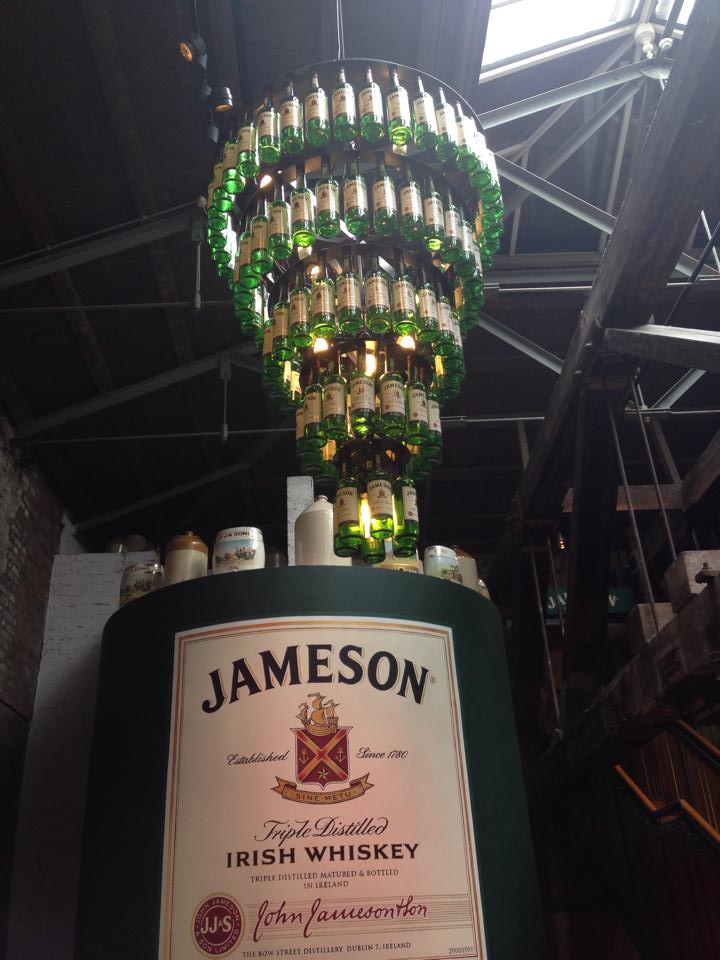
The next weekend my parents came to visit me in Dublin.  I really enjoyed taking them around and being able to show off my knowledge of the city was definitely rewarding.  I realized how much I had missed them.  I showed them some attractions in the city of Dublin, such as Temple Bar with all of the pubs.  My dad really enjoyed having traditional Irish food and Guinness while in Dublin.  We also went to the Jameson Distillery that Friday which was a fun experience.

Jameson

Jameson

I showed them the UCD campus and they were amazed at the facilities and the size of the campus.  I wanted to see a UCD soccer game before I left so my parents and I went to see them play Dundalk right on the UCD campus.  Unfortunately, UCD lost but the fans were definitely entertaining.  I showed them around the city and we saw the Dublin Castle. My mom and I also had a chance to go inside St. Patrick’s Cathedral, a very impressive cathedral.

St. Patrick's Cathedral

St. Patrick’s Cathedral

The next day, we continued our tour of Dublin and I showed them around Trinity College in the city center of Dublin, the National Gallery of Ireland, and the Natural History Museum.  Needless to say, I had a very long weekend.  The last day before they left, they helped me prepare for the long trip back in less than a month and then we took a walk along the River Liffey and then up O’Connell Street.  I wish I had time to show them some of the Irish countryside but it was an overall fun weekend getting to see them.  It didn’t hurt that the weather was beautiful!