The Finer Things in Thai Life

April 30, 2012

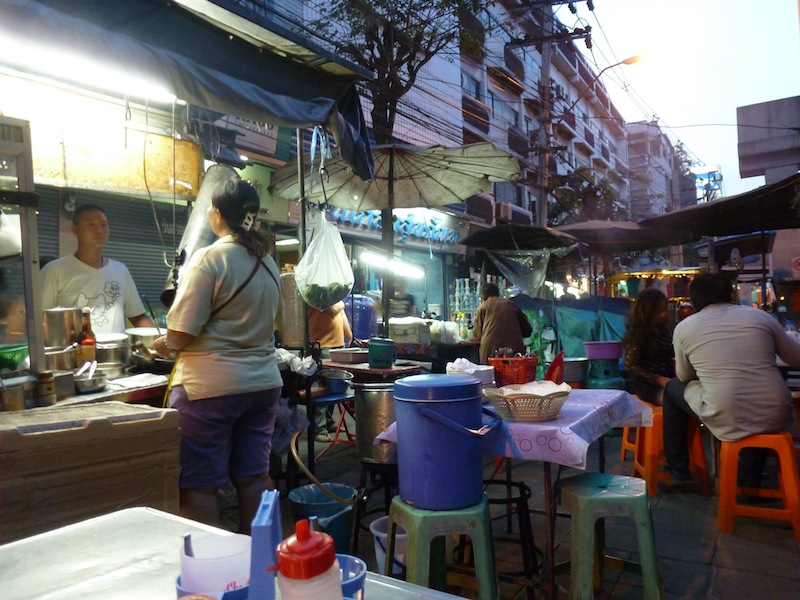
Thai people like to enjoy the finer things in life–those things come cheaper here than in the US, and after reflecting on the whole semester, I have realized that those small things that make life just a little bit more comfortable, really are available everywhere-and its difficult not to get hooked.  It is guaranteed that when you look around walking on the street, most people you see have some drink, some plastic bag, some coffee drink, or some food in hand.  Some of the most delicious food I have ever had in my life is at your fingertips on the streets at any time of night, clothing stalls fill the markets and streets all around the city providing cheap and very stylish clothing (which for the most part none of us foreigners fit into because Thais are tiny), and there is always some shake, or some delicious drink available within minutes.

This fact is particularly emulated in an area of the city called Siam.  Siam is the hub for shopping in Bangkok, for foreigners and Thais alike.  There are four or five huge malls, some connected, all within a block or two of one another.  Most of the malls contain every chain restaurant and type of food you can imagine, as well as every brand name shop you could imagine.  “The Pride of Bangkok,” as it is literally tag-lined, is Siam Paragon. Paragon boasts fountains, and waterfalls, music, and ushers opening doors for you, as well as some of the most expensive brands available in Thailand.  As soon as you walk into one of Paragon’s eight floors, you just think “glam.” So going to the movies there last week was quite an experience! We went to the 4DX movie theater, a concept that is now all the rage in Asia. The newest movie to come out in 4DX is Titanic, and let me tell you it was a crazy experience! The 4DX experience is just like seeing a movie at universal studios–bursts of air when there were bullets, sprays of water in your face when the ship was going down, seats shaking all over the place, as well as 3D glasses–amazing!  You literally feel like you are in the movie at times.  All the facilities are incredibly clean, and for Thai people it seems that going to see a movie there is really a glamorous event. There is no shortage of expensive food and Thai popcorn flavors, and certainly no shortage of well-dressed Thais.  To give you a better sense of the ambiance there, I would have felt under dressed in jeans!

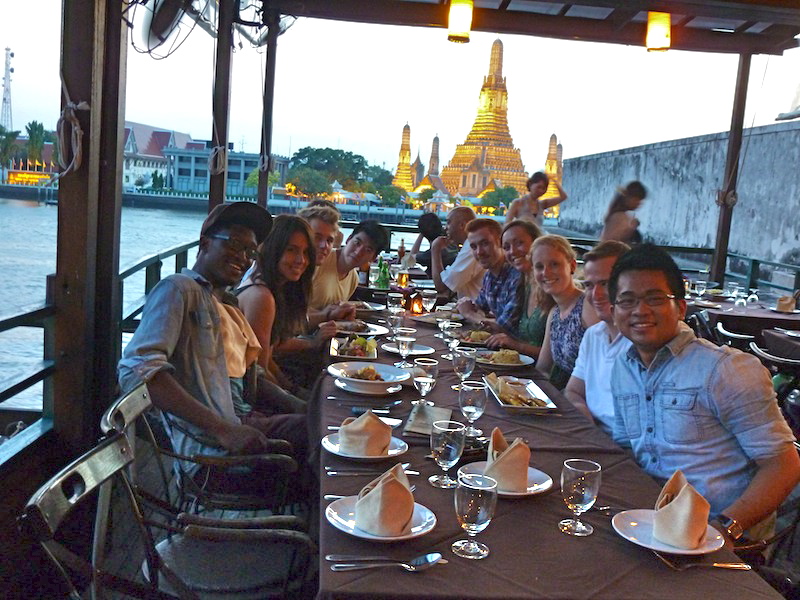
Another amazing aspect of living in Bangkok is the endless number of food options–literally every type of international food you could imagine can be found here: Thai, Japanese, Chinese, Mexican, International, American, French–the list goes on! Often the best part of the dining experience is the view that you have–whether its the skyline of Bangkok, a little side street in which you have found a hidden gem, or a beautiful view over the Chao Phraya river and the surrounding temples.  Thais have become so accustomed to this consumer lifestyle, which is so normal for so many in Thailand, that they don’t realize that this type of accessible luxury isn’t commonplace worldwide, not even in the US.  After almost four months here I have certainly become accustomed to the lifestyle here! I can get an entire mango, or an entire pineapple completely cut and peeled on the street for $1.  I can find any type of smoothie, at any time of day, for less than a dollar. Street food is often better than restaurant food, and there is always something new to try!  I will definitely miss the food here in Thailand! Included are some pictures of my food adventures this week–enjoy!


Happy Thai New Year!

April 23, 2012

This past weekend I celebrated Songkran, the official Thai New Year (Thais observe the Buddhist calendar).  Students were given two days off from school forming a nice four-day weekend, so of course in true exchange-student style, this only meant an opportunity to travel.  The plan had been to go to Laos, but last minute travel changes, and completely sold out tickets for all of the days surrounding Songkran, instead sent me to Koh Tao, a small island off of the east coast of the Thailand.  Songkran is the most important holiday for Thai’s, so most locals leave Bangkok to go back to their “hometown,” wherever that may be.  We were disappointed we weren’t able to go to Laos, but Koh Tao was not a bad second choice!

Songkran itself is often described as one, huge, non-stop waterfight: and that is EXACTLY what it is.  We left from Khao San road on Thursday evening, the night before the official day of celebration.  Khao San is the official backpacker haven, so Thursday night the Songkran festivities had already begun.  We had a short walk on the actual Khao San road, but little did we know what was in store for us: one BIG water fight.  Involving baby powder.  What? Yeah, that’s what we thought too.  But part of the Songkran fun is mixing baby powder with water to create a nice white paste that you smear all over yourself, and strangers.  Let me try and set the scene for you: loud music…waterguns…buckets of water…young Thais and foreigners (but mostly Thais) jumping up and down in the streets throwing water everywhere…store owners and their children outside their shops throwing water on everyone…small children with squirt guns…small plastic pouches around each persons neck protecting valuables…hoards of people running through the streets…I’m walking, I’m hoping that people will take pity on a dry girl clearly prepared for travel, but no luck: squirt gun in the back, slap on the cheek smearing baby powder all over my face, shoved in all directions; no mercy.  Needless to say, in a country where the locals are so kind, normally shy and very conservative, this was a side of Thailand I had never seen before. (and because of the water….sadly I have no pictures of the whole event).

Koh Tao (a seven hour bus ride, and a two hour boat ride away) was also crazy the day we arrived, the official Songkran holiday.  Imagine there being no social rules about pouring water onto strangers, or drenching them with a water gun.  Everyone we walked by had a water gun in hand, many of them with a water supply on their back.  It was hilarious.  Those riding on motorbikes, small children, families: no one was spared.  Needless to say after Songkran was over things quieted down a lot –  and from there on we enjoyed an amazingly relaxing weekend: lying on the beach, enjoying the INCREDIBLE views, venturing over to a nearby island with an amazing viewpoint, and snorkeling.  We had delicious meals on the beach, and saw some of the most beautiful sunsets I have ever seen!  Koh Tao is known for its scuba diving, and  while we didn’t have the time or the money to scuba dive, the snorkeling was breathtaking: just two feet off-shore on my first venture into the water and there was a school of about twenty rainbow fish: neon orange, yellow, pink, green, and blue: truly magnificent!

Enjoy the pictures from my trip!

Koh Tao

Samantha in Koh Tao


Cooking with Poo and Thai Massage

April 23, 2012

What a FANTASTIC weekend! I checked two things off my Thai bucket list that I have been wanting to do since arriving in Bangkok: a cooking class, and a Thai massage.

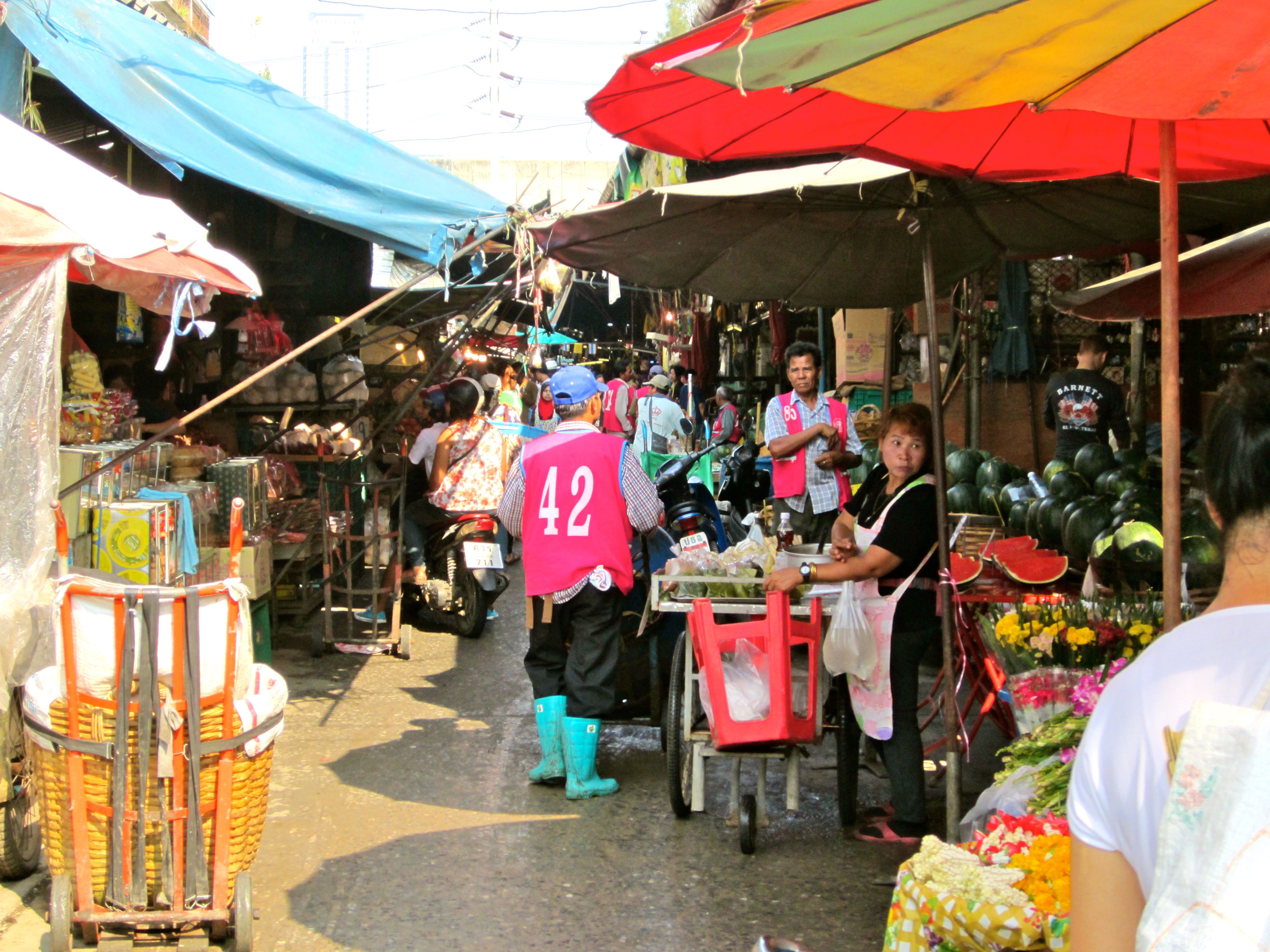
This morning I cooked with Poo and it was fantastic! Poo is an incredible Thai woman living in one of Bangkok’s slums, Khlong Toei.  She was given a microfinance loan through the “Helping Hands” organization, and using that loan she has become incredibly successful operating her cooking school.  The morning started off with a small tour of Klong Toei’s market.  It is an extensive market with everything and anything you could imagine.  We started by going through what Poo called the “Issan” area.  Issan is a Northeastern province in Thailand, and the food there is quite different than the food in Bangkok.  That row of the market has everything and anything strange you could imagine: live frogs, skinned frogs with hearts still beating, an endless assortment of bugs, eels, catfish, cow innards, skinned chickens etc… I did not once breathe in through my nose that entire walk. The rest of the market contained more “normal” items – beef, vegetables, and every possible exotic fruit.  Poo explained that most stall owners start work at 2am, and don’t stop until 6pm, they only way they can scrape by to make a living.  This market is incredibly cheap and has a wide variety of foods.  As a result it is the source of product for many of the street vendors and many of the hotels in Bangkok.  What an experience!

market

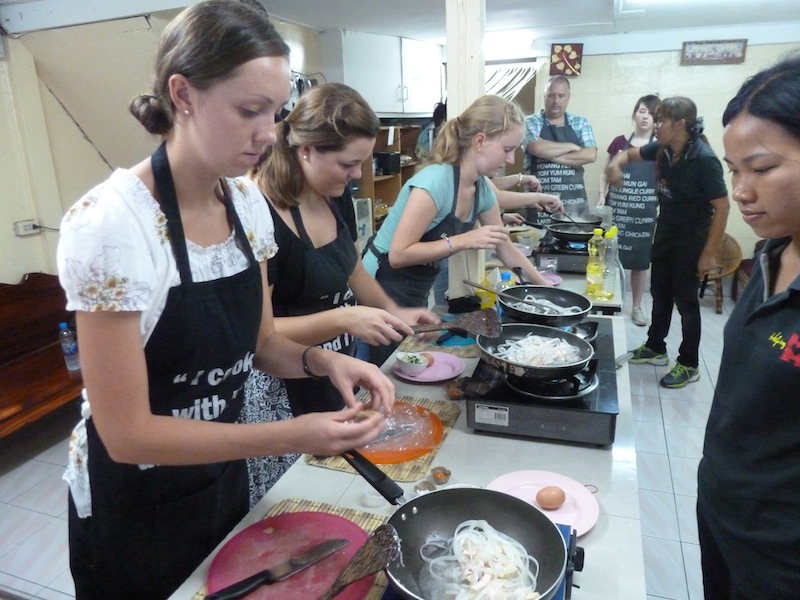
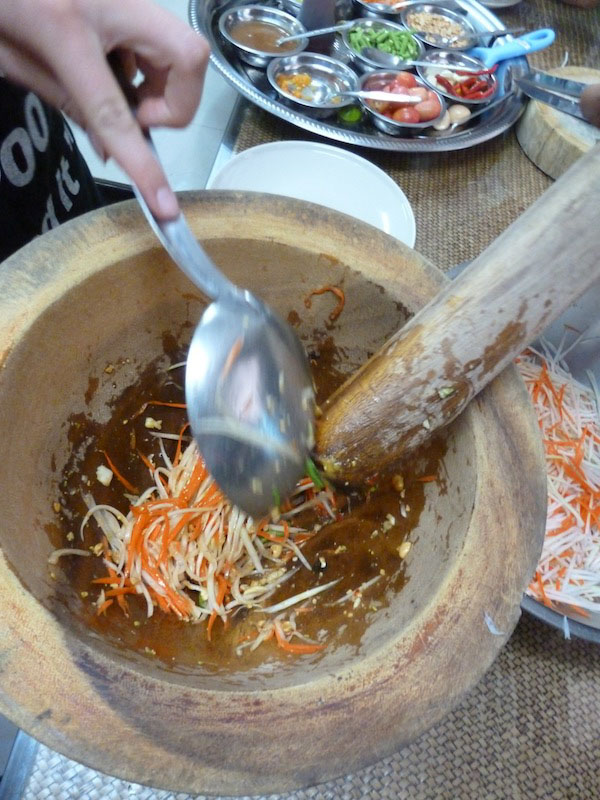
The second portion of the morning was the actual cooking.  The class is not meant to transform you into a Thai chef, but it gives a nice introduction to basic Thai dishes and lets you cook your own portion each time.  We cooked three dishes: Som Tham (papaya salad), Tom Yam (a delicious spicy soup with many different flavors), and Pad Thai.  The food was delicious, and now that we know how easy it is to make these foods it is definitely something I will take back to the US with me.  The only obstacle in the US: trying to find all of the ingredients.  What was most fascinating to me, is realizing what goes into the dishes I have been eating all semester.  For example, one of the strongest flavors in Tom Yam soup, comes from lime leaves.  Before putting the lime leaves into the pot, we broke the leaves apart which emitted the strongest and most delicious smell.  All the taste from this dish comes from breaking a green leaf apart–AMAZING!  Part of the fun of the experience was Poo herself.  She is a hilarious and kind woman, with completely broken English, yet she is sweet, enthusiastic, and eager to share her story, and the story of Klong Toei.  She explained to us that following her great success, she has also seen a change in the people in her community, and deliberately tries to uplift them as well.  For example, some of the ingredients we used to cook were handed to us in small cups made of banana leaves.  Poo said she purchased these from a woman in her community who is very sick and strapped for cash, so she thought she could help her by buying her product.  For each need of her business, Poo employs a member of her community, and tries to evenly distribute where she buys things so that as many people in the community can benefit from her success.  It truly is an incredible project.

The other event of the weekend was getting a Thai Massage: two hours for $12.  Yes, really, it’s that cheap.  But my goodness, that was a massage like nothing I have ever experienced.  First of all, I was in pain the first 45 minutes.  My masseuse literally dug her feet/fingers/hands into ever inch of my leg, almost as if she was trying to separate every muscle fiber.  Because the massage is two hours, the women can thoroughly cover every part of your body.  They also stretch you in every which way which was quite intense, because they completely ignore whether you are flexible or not.  They are also very hands on – you are lying on a mattress, and they sometimes use their whole bodies, for example contorting you around them to stretch you.  Not necessarily relaxing in the same way as a typical massage, but I certainly feel like I had a work out! Our fantastic evening massage ended with some Thai tea, before heading home.  I have to say I feel so content after such a fantastic long weekend.  Yes, some people may complain that Bangkok is crowded, or that the city is too dirty and smells bad, but I love the fact that there is never a dull moment in Bangkok: there is always something new to do, something to learn, and something incredible to experience, and I LOVE it!


Waterfalls and a little bit of history

April 9, 2012

I just got back from an amazing weekend getaway in Kanchanaburi, Thailand.  Kanchanaburi is about two hours (by bus) northwest of Bangkok.  The city itself is quite small – it is most frequented by visitors on their way to Erawan Falls, but the city does boast its own attractions– for example, the Bridge over River Kwai, which we visited the morning we arrived.

The bridge was commissioned by the Japanese during World War II in order to secure a better supply route between Thailand and Burma.  The bridge was built by both local Thais and prisoners of war, thousands of whom died during its construction.  The bridge is primarily famous because of the movie “The Bridge over River Kwai.”  There is not much really to see– it is quite literally a bridge over a river–not too thrilling.

The rest of the day we saw two more sites: temple caves and a World War II allied cemetery. The temple was an incredible labyrinth of underground, natural caves–very claustrophobic at some points! Each cave contains a shrine or Buddha.  Near the caves, our tuktuk driver took us to see the most incredible view of Kanchanaburi – the beautiful river surrounded by greenery and mountains on either side.  The natural beauty in Thailand is magnificent, and that was particularly evident this trip.  After spending so much time in a city, it is refreshing to see a more rural side of the country.

Our last stop of the day was to an allied war cemetery, which serves as the resting place for many of the soldiers killed building the bridge.  It was actually quite intense walking around and seeing all the name plaques – reading the quote written on the headstone, each name and nationality engraved, and particularly reading the soldier’s age; most were between 20 and 25, around the same age as I am.  I have to admit after my four months in Thailand I don’t know that much about its role in World War II so this was certainly a glimpse into some of Thailand’s history.

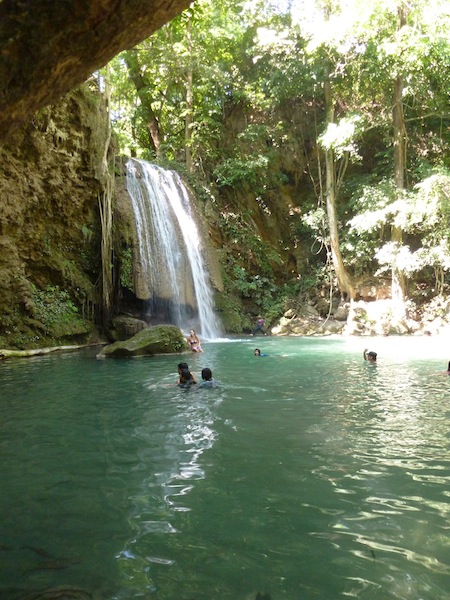
The next day we made the trek to Erawan National Park, located two hours from Kanchanaburi.  We had no idea how incredibly beautiful the national park would be! We literally spent four and a half hours walking along a path through the jungle, passing waterfalls as we went.  There are seven primary waterfalls that make up the national park, though there are small ones spread throughout.  There were tons of people – both international and Thai – and like everyone else, we walked from one waterfall to another and jumped in whenever we couldn’t stand the heat anymore.  It was incredibly beautiful, and so nice and peaceful to spend an afternoon just walking through nature, and enjoying it.

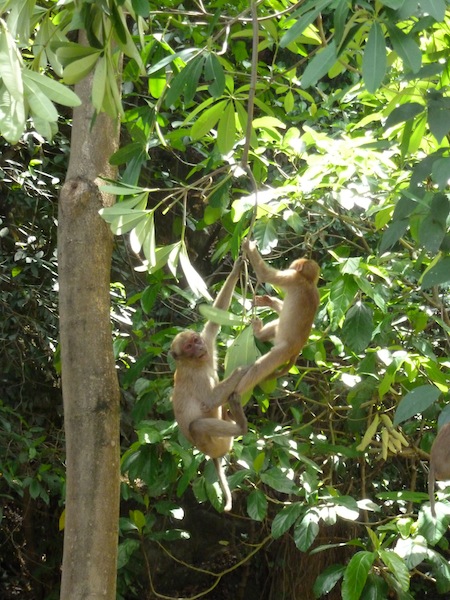
The most intense part of the trek was the 7th waterfall – much less crowded than the others because not as many people make it that far up.  As we approached the waterfall, the friend I was with, Rebecca, pointed out the monkeys overhead.  We had seen signs throughout our trek warning us to be careful of the monkeys because they can be dangerous, but hadn’t actually seen any monkeys until this point.  They were adorable climbing all over the branches, a mother and her babies.  While we were swimming in the waterfall, however, a large monkey got a little too close for comfort and started hissing at anyone who came too close.  It then went over to someone’s backpack, unzipped it, and started pulling out every piece of clothing in there and flinging it to the side.  Just as we were leaving, Rebecca pulled out a bag of peanuts, and within .2 seconds, the monkey was right in front of her, looking threatening as ever, moving exactly as the peanuts moved.  Completely scared, Rebecca just threw the bag of peanuts at the monkey – as we hurried off, we looked back to see the monkey rip the bag of peanuts open, and one by one, pop peanuts into its mouth, as he sat on the ground looking for his next target.


Outside of the Classroom

April 2, 2012

One of the primary reasons I came to Bangkok was to be able to work with Step Ahead, an integrated community development organization that works in many capacities in Thailand.  Step Ahead’s work includes programs in one of the slums in Bangkok, called Khlong Toei.  There, Step Ahead runs a microfinance loan project, organizes sports activities for children, runs health clinics, and much more.  I, however, am primarily working with Step Ahead in a marketing capacity, helping them to market the products of their purse project.

The purse project is located in Pattaya, Thailand, where it is estimated (and this is a low estimation) that 25% of all residents are in some way involved in the sex industry.  Therefore, just by virtue of being born in Pattaya, residents are at risk for sexual exploitation.  Identifying this need, Step Ahead created Itsera, a brand of high-quality handmade bags, made by women in Pattaya.  This project was created as a prevention mechanism; the hope is that by earning a good wage making these bags, the women will be able to avoid the trap of sexual exploitation.

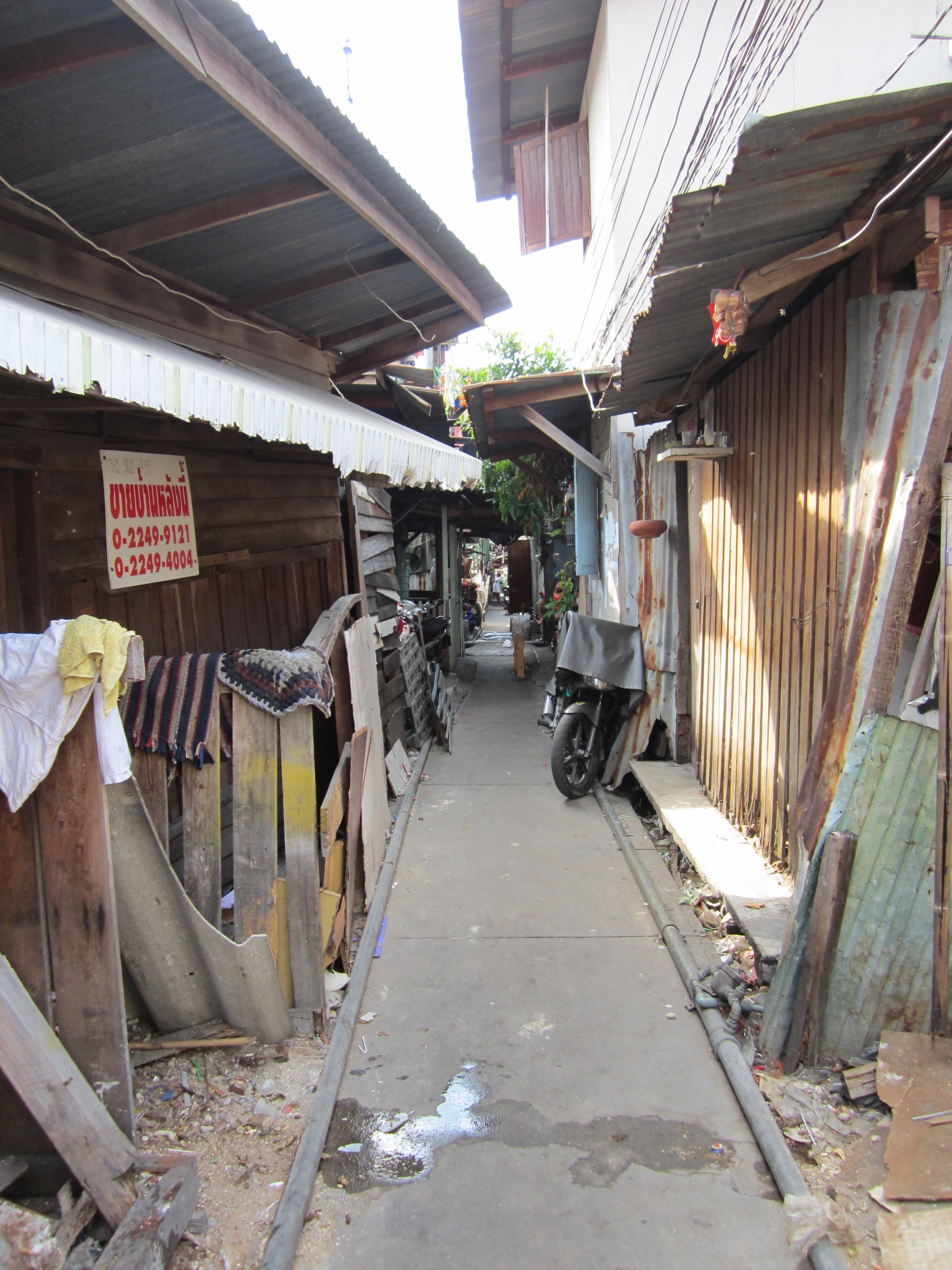
Despite being focused on marketing for Step Ahead, I had the chance to visit Khlong Toei last week.  It was so interesting to see where Step Ahead works, most of all because I spent last semester living and working on the edge of a slum in Kenya.  I could not help but make comparisons between the two in my mind.  To be honest, the slum that we saw here was much more permanent and formal compared to the slum in Kenya.  Most of the slum had paved roads weaving in and out, closed homes with roofs overhead, some people even living in permanent structures, most shacks having electricity and plumbing.  There are even a few small businesses that operate within the slum — for example, we walked by computers and washing machines, which residents can pay to use.  Not to say that Khlong Toei isn’t still very much a slum community, but it was certainly an interesting comparison to Kibera, in Kenya.

During our walk through the slum, we met one of Step Ahead’s clients, a single father with three children.  He has used a microfinance loan that he received from Step Ahead to run a chicken-foot business.  He sells chicken feet, which are a delicacy in Thailand.  School is not in session at the moment, so he and his three children were all sitting around and extracting the bones and nails from the chicken claws with the aim of selling them at the market.  It is refreshing to get a glimpse into the social issues that many Thai people are facing.  After a semester in Kenya where I only studied health and development, I have been craving that knowledge and interaction here.

Earlier this week, I was also able to attend a Needeed event.  Needeed is a new non-profit organization, which seeks to bring together professionals from the expatriate community here in Thailand.  The aim is to have organizations present at monthly meetings and identify volunteer opportunities within that organization. The hope is that expatriates with particular expertise would be able to fulfill those volunteer opportunities.

The meeting was really incredible…after the visiting organization presented, we had a brainstorm session — all 25 attendees.  It was almost magical to watch all of the ideas flying around – not only were there many nationalities in the room (Hungarian, American, Belgian, Australian, French, British), but there were also an incredible variety of different professional backgrounds represented.  There was a woman who had previously been involved in public policy, a nurse specializing in neonatal care, a psychologist doing her masters degree on post-partum depression and PTSD in Congolese refugees, a woman involved in the hospitality business – the list really goes on.  Most of these women are in Thailand because of their husbands’ jobs, and they are all well-educated and have a lot of experience in some professional capacity. Needeed seeks to bring together these untapped talents to make a difference for non-profits.  It truly is incredible to be able to not only experience another “side” of Thailand, but to meet so many fascinating people and explore potential career possibilities at the same time!


Transported back in time…

April 2, 2012

I just came back from the most incredible trip to Myanmar (formerly Burma, but the United States chooses to use the name Burma as a political statement against the current Burmese government).  I have to admit, before arriving in Bangkok I was not at all aware of anything going on in Burma.  Nothing. Nada. Zilch. It was not until a dinner with friends in Bangkok, who are passionate about Burma, that I learned about the fascinating country and its political situation.  When you think of the world’s worst dictators, many of you may think of Kim Jong Il of North Korea, or Hugo Chavez of Venezuela, but did you know that Burma is one of the world’s worst dictatorships, responsible for some of the world’s worst human rights attrocities?  It is only in the past year that Myanmar has been creating better relationships with the West, and that the West has been easing some of the sanctions and boycotts against the country. But as many people told us, though progress undeniably has been made, in reality, things may not be so picture-perfect.

What really sparked my interest in this country, before my visit, was the story of Aung San Suu Kyi, depicted in the recently released film “The Lady.”  Suu Kyi is the leader of Burma’s opposition party.  Her father led Burma to freedom from Britain in 1947, only to be assassinated shortly after, leaving the country in the hands of a dictator.  Though she grew up in Burma, Aung San Suu Kyi later married an Englishman and had been living in England with her two children when she became the leader of the opposition party in Burma.  Though she claimed victory in a general election in 1990, the ruling party refused to accept the results and placed her under house arrest, where she spent 15 years, living away from her family in England and therefore sacrificing her life with her children and her husband.   Aung San Suu Kyi was released in 2010, and is a candidate in the Burmese parliamentary election to be held on April 1st.

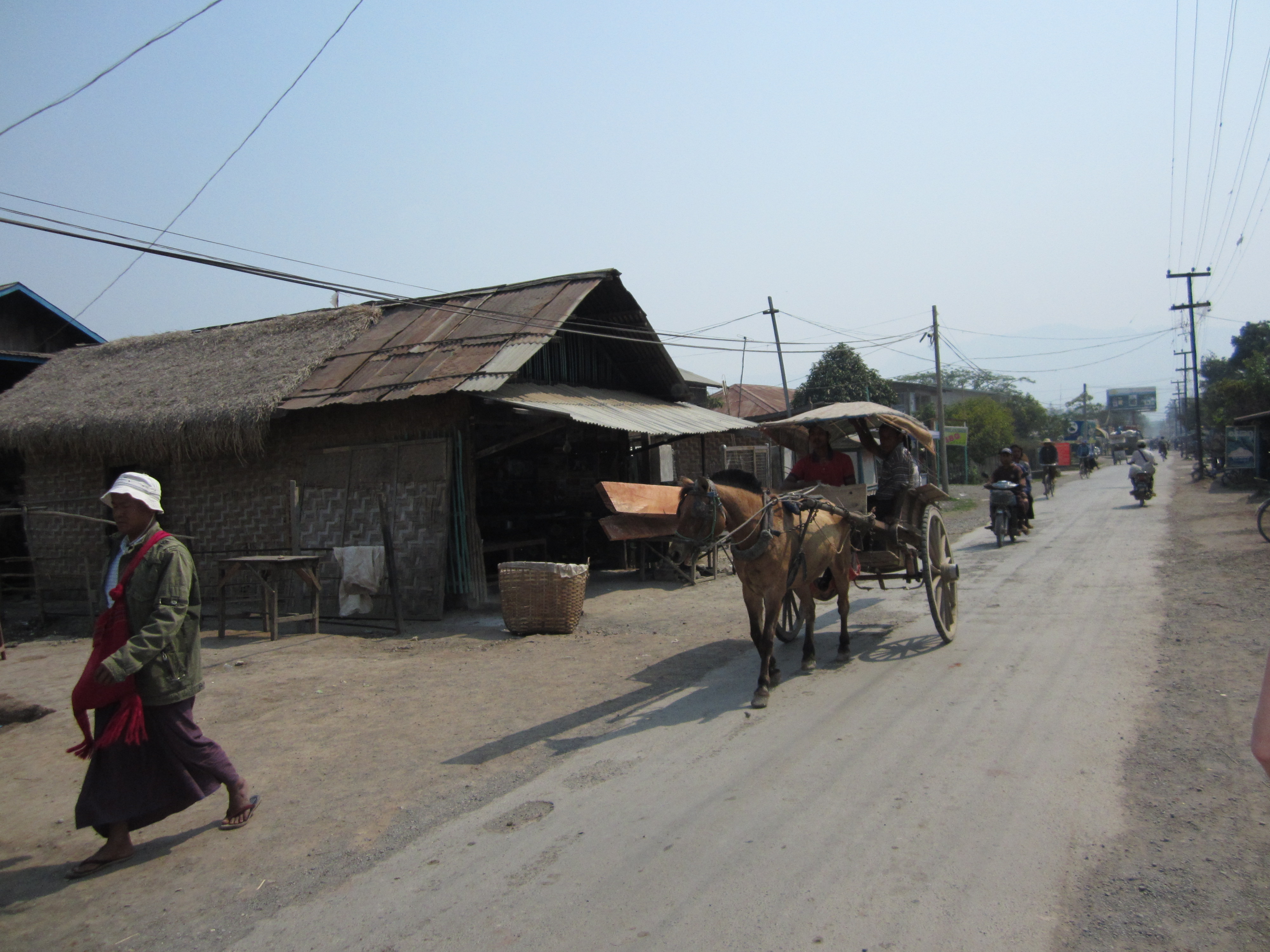
Needless to say, this country is fascinating, and it is in the midst of one of its most critical times in history, so I definitely had to see this for myself.  On top of that, because Burma has literally been shut off from the world for so many years, we were told it was like going back in time to Asia 100 years ago.  Until recently, the Burmese did not have access to news from outside of Burma (purposefully controlled by the government).  A cell phone there costs around $1000, and the down payment for internet in your home is $2,000.  In most places outside of the capital, a “taxi” is a horse-drawn, or ox-drawn carriage.

Because we spent five very packed days around the country, I will give you the highlights of our trip:

1)     Yangon (formerly Rangoon, and formerly the capital of Myanmar).

There is not much to see in the city.  We spent only a few hours our first day, and a few hours our last day, exploring the Yangon.  Other than the Shwedagon Pagoda, an impressive and revered Buddhist religious symbol, there really wasn’t much to do.  The city is quite run down, and much less developed than Bangkok, understandably so.

2)     Kalaw

Kalaw is an incredible mountain town, which we reached through a 12-hour overnight bus from Yangon.  We arrived at 2am, with no hostel booked, and no plan at all – it didn’t take us long to find the “Winner Hotel,” but the temperature had dropped overnight, so it was freezing.  In Kalaw, we did a trek into the mountains with two tour guides who were both 21 years old, named GuGu and Chaw Su.  We spent the whole day wandering through the mountains – the trek was not difficult, which was fantastic, because it not only gave us a chance to talk with the girls and learn about their lives in Burma, but it also gave our guides a chance to stop and point out different plants and crops along the way.  It is truly incredible what is grown in the mountains there! We saw oranges, pears, raspberries, gooseberries, ginger, cabbage, papaya, banana, pineapple, and much more! We stopped in two villages and two monasteries along the way, each time having a chance to (through our guides) talk with the families we met, sit down for tea, ask them questions, and laugh with them.  It was truly fantastic to be able to talk and interact with native people in a non-touristy setting.

In Kalaw, we also had delicious food – a broad-bean, peanut, tomato, and onion salad, noodle soup, and curry.  While curry in Thailand is coconut milk-based, Burmese curry is largely oil based, so it was interesting to try the different foods.

3)     Inle Lake

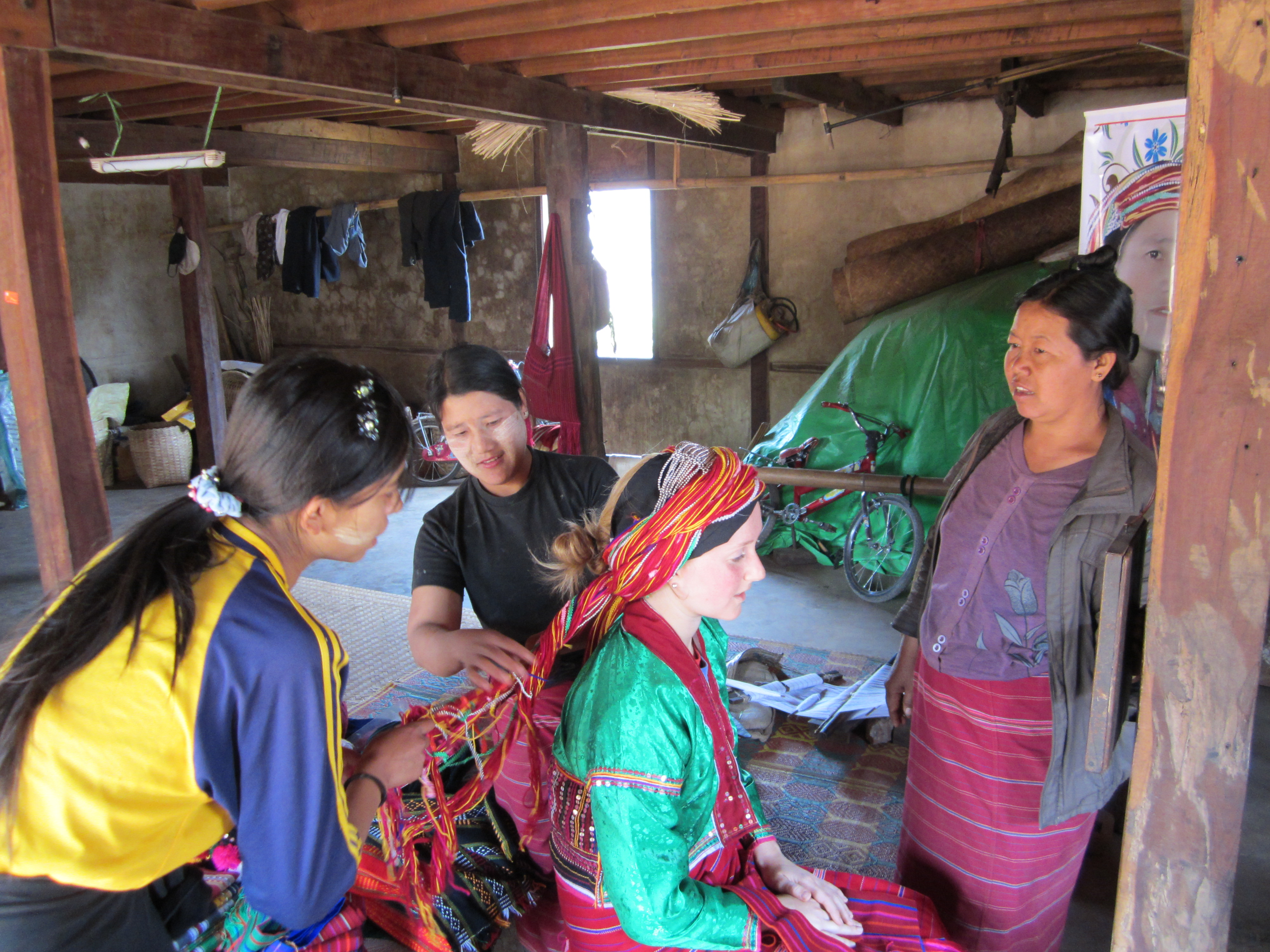
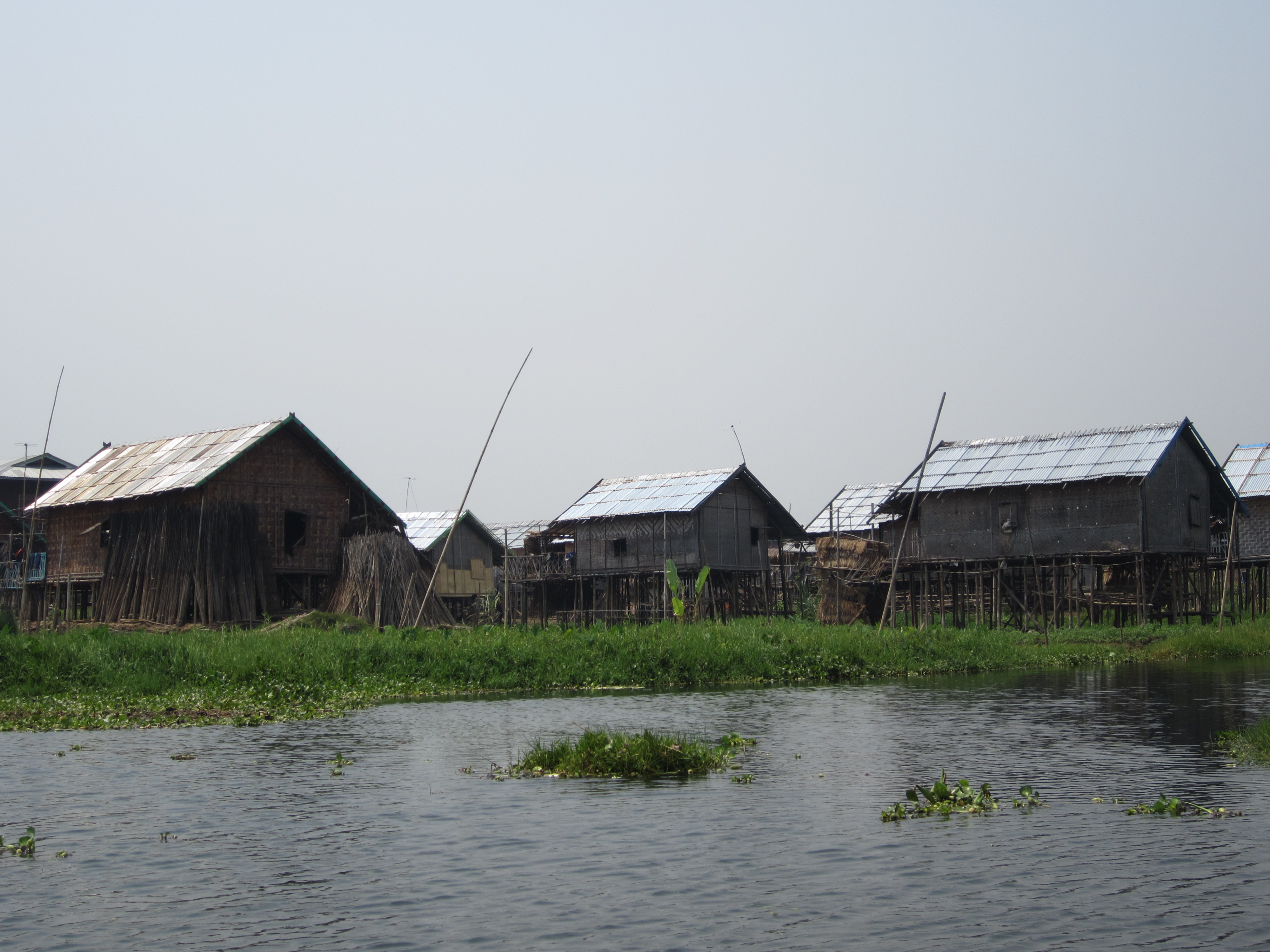
Just a two-hour drive from Kalaw, Inle Lake is one of the most popular destinations for tourists.  Similar to Kalaw, the town itself is very small, and very primitive, boasting half-paved, half-mud streets lined with small hostels, small houses, and shacks.  We spent an entire day (8 hours) on a boat ride around Inle Lake.  It was one of those long “typical” Southeast Asian boats, propelled by a motor.  The lake is enormous, so it was a 2-hour boat ride to our first destination.  Throughout the day we made many stops, including: a shop where silk is produced, a shop where cigars are made, a delicious restaurant, a paper making shop, a silversmith, and a few more destinations. Inle Lake is entirely made up of small villages, comprised of houses and buildings, which are on stilts.  Therefore, to get to each new shop, we had to go by boat, which is how locals get around as well.  The post office, for example, is a small house on stilts in the middle of the water.  Surrounding the villages are also endless fields of rice and other crops.  So throughout our day we observed men and women working to harvest and plant their crops.  We were able to stay out on the lake for the sunset, which was absolutely magnificent.

Before our 15-hour bus back to Yangon from Inle Lake, we rented bikes and biked in the area, again surrounded by endless rice fields; I’ll let the pictures do the talking, because it was absolutely breathtaking!  I came back from the weekend completely happy and refreshed; though I was exhausted, it was refreshing to have seen such an untouched nation, and to have been able to experience another country  knowing so much of its history and current political issues.  Even more importantly, we were able to fully interact and speak with locals to hear their perspectives, and those moments are what made the trip so incredible.

Below are some photos from the trip:


Midterms: No Fun

March 16, 2012

Yes….another blog post about school.  School has been consuming much more of my time than usual these past two weeks because I have had midterms!  Which has meant two weeks of catching up on the whole semester.  The way midterms are administered at Thammasat was very interesting though, and something I personally would love to see implemented at UofR for final exams.

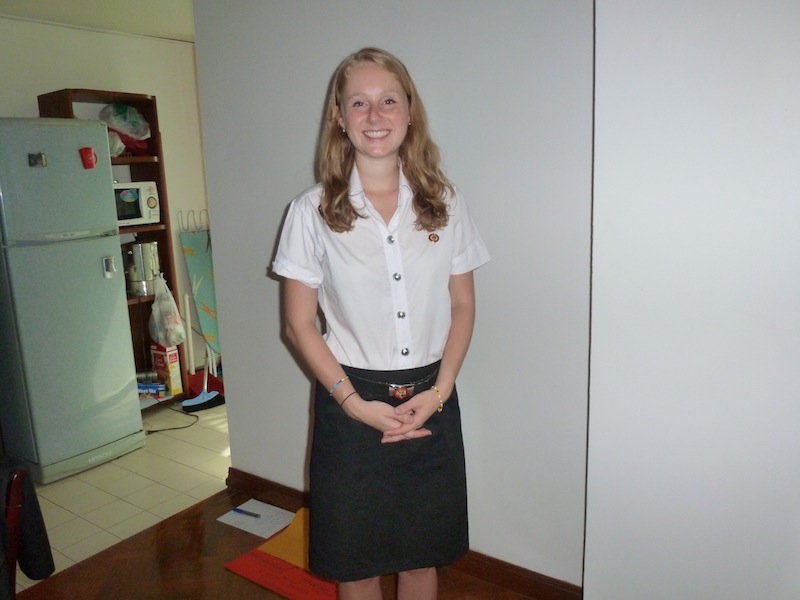
Midterms at Thammasat are scheduled just like finals at Richmond: one week is set aside with no class (usually) and three-hour midterms scheduled throughout the week.  Students are required to wear full uniform to midterms.  When you show up the day of the exam, the classroom is closed, but there is a class list outside with a corresponding number next to each name.  The numbers are completely randomized, and are not known until before the exam.  Once you walk into the classroom ten minutes before the exam, each place has an exam and answer notebook already set down, with the place number right next to it.  So after entering the room you must gather your necessary exam materials (pens, pencils, calculator, ID card, water, etc…) show the proctors that your cell phone has been turned off, and place your bag at the front of the classroom.  Then you find your number and corresponding seat, and can start the exam.  The places, however, are set far apart so that there is no possible way to cheat on the exam, which personally I find fantastic.  In one exam, we even each had our own table.  On the whiteboard at the front of the room is projected a countdown for the time left of the exam, and for the last half hour, last fifteen minutes, and last five minutes, an automated voice reminds you of the time left.  Two proctors monitor the exam and continuously walk around the classroom in and out of every aisle to make sure there is no cheating.  You are not allowed to use the restroom, and once finished, you leave your exam on the table and leave the room, while the proctors come and collect your completed test.  The only downside in this system is that the professor is not there to answer questions about the exam.  I would love to see this system implemented at Richmond for final exams.

Now that midterms are over, however, I am off to Myanmar (Burma) for five days! I will leave you with a photo of me in my Thammasat uniform:


The Classroom Culture

March 12, 2012

After two and a half months of studying abroad in Thailand, it seems fitting to actually blog about the studying part of this experience.  The much-discussed stereotype about studying abroad is that the classes will be easy and there will be no work.  Well, clearly those students did not study at Thammasat in the BBA program. There is definitely work, and classes are not at all something you can blow off…it will eventually catch up with you.  So here are four of the most notable differences between University of Richmond courses and Thammsat BBA courses (Disclaimer: the academic faculties at Thammasat are very different from one another, so this blog post only applies to the BBA program).

1.  Unlike Richmond, there is not much day-to-day homework at Thammasat, but classes are very much oriented around case studies and group projects. While I don’t have to worry about day to day homework in each class, there is always a group project meeting that I have to attend – and this has been the case since the first day of school, not just something that has crept up at the end of the semester.  While sometimes the group projects are overwhelming, doing case-based learning is extremely helpful for applying what we are learning in class and understanding “real-world” examples.

2. Attendance is extremely serious.  The rule is that if you miss more than 30% of a class, then you are not eligible to take the midterm or the final.  Because all of my classes are three hours long, I am allowed to miss three classes throughout the whole semester – which seems like a lot, but when I’d love to be traveling around Southeast Asia most weekends, those missed classes can add up quite quickly.  During the first fifteen minutes of each class, a few BBA administrators sit in the hallways, each assigned to watch over one clipboard as students sign in for their respective courses. Students are required to sign in wearing a full uniform — otherwise, they are considered absent.

3.  Regarding class format, most professors use the typical PowerPoint lecture model.  I learned very quickly that Thais love PowerPoint.  In the US, it is sometimes encouraged for students to ditch PowerPoint and find a more creative way to prepare a presentation, but here it is mandatory to use PowerPoint for presentations.  I have to say, though, the presentations that Thai students create are incredible, and much more creative than anything I have ever done with PowerPoint.

4. Classroom culture.  This has been one of the biggest paradoxes of my time in Thailand.  I have remarked in previous posts about how Thai people are so respectful, and how they value hierarchy and respect their elders and teachers.  Yet the actions of the students in classes do not seem to fully reflect these values.  Students talk throughout the class, they constantly text on their phones (above their desks, in plain sight!) Some even take calls and just stick their heads under the desks while on the phone. Most students are constantly checking their email or Facebook on their iPads or laptops.  Some will leave classes in small groups and come back with Starbucks or other drinks in hand.  And throughout class, there are students continuously walking in and out of the room to print something, get a snack, or take a phone call.  I have had only one professor actually address this behavior in class, on one occasion.  I would never be comfortable acting so informally in a class at Richmond, and professors at UR strongly discourage this behavior.  Certainly an interesting nuance of classroom culture compared to Thai culture in general.

Note: I don’t have any pictures relating to this blog, but enjoy some of the pictures from around the city these past few weeks.


A Different Side of Bangkok

March 2, 2012

For the first time in weeks, I did not travel this past weekend.  Granted, it was because I had a huge group presentation and midterms to study for, but still, it was quite an event.  Sadly, studying took up most of the weekend, and there was a lot of studying required, because, truth be told, I have not been great at keeping up with school work here. With it being 96 degrees every day, so many places to visit, and so many delicious types of food to discover, it sort of feels like I am on summer vacation.  It’s just so difficult to concentrate with so many fun things to do.  So to have midterms now is like having exams in the middle of summer vacation… which is not easy.

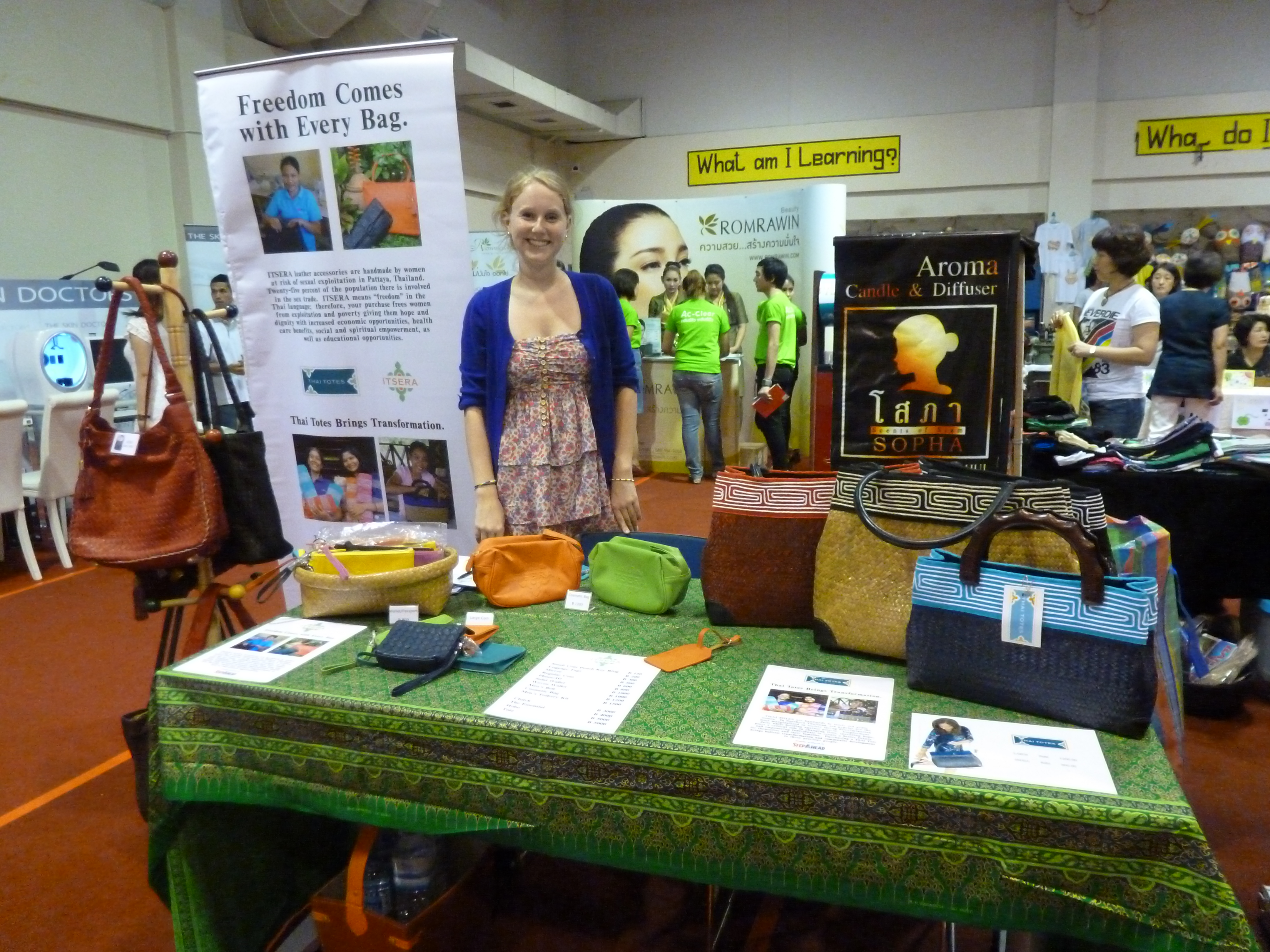
Nonetheless, I spent Saturday at an event for my internship. I am interning part-time with Step Ahead, a fantastic NGO headquartered here in Bangkok.  Step Ahead was founded by John and Kim Quinley, whose daughter, Carter Quinley, graduated from Richmond this past May.  Step Ahead is a community development organization that works all over Thailand with various populations.  One of their projects is a “Purse Project” that works with women in Pattaya, Thailand.  One in four people living in Pattaya are involved in the sex industry, so this purse project aims at prevention: to prevent poor women from being sexually exploited by giving them an alternative way to make a stable living by making these leather purses.  The products are beautiful — the link to the website is stepahead.myshopify.com.

As part of this internship, my roommate and I went to the International School of Bangkok for a Food Fair event to sell these Itsera bags; the event revolved around a huge room filled with large stands representing the nationalities of  students at ISB, each serving their own traditional food.  So, for example, at the “Israel” stand they were serving falafel, and at the “American” stand, there were delicious brownies, cookies, and apple pie.  Next to this large room was a smaller room where we were selling our bags along with other vendors.

All in all, this was quite a different side of Thailand.  Addie and I live in a very local Thai neighborhood, so we don’t see foreigners on our side of the river often.  ISB, however, is located in a planned community (there is literally a sign at the entrance gates that say “Planned Community”).  It’s like magic; as soon as you pass the guards and drive through the gates you are literally in what looks like an American suburb. There are clusters of gorgeous houses that all surround their own pools; there is a country club, a shopping center, and – get this – golf carts.  The residents get around the enclosed neighborhood (which includes the international school) in golf carts.  Literally, the outside of the school is lined with golf carts belonging to residents. I attended an international school when I lived in Holland when I was younger so this was a bit nostalgic, remembering a similar event we held at my school, overflowing with nationalities from around the world.  But, my goodness, this was also reminiscent of the Stepford Wives.  Nonetheless, I am extremely grateful to be able to experience so many different sides of life in this wonderful city.


The Temples of Angkor Wat: Cambodia

February 24, 2012

This weekend, I took my first international trip to one of Thailand’s neighbors, Cambodia.  Specifically, we went to Siem Reap, which is the center for all of the tourism surrounding Cambodia’s famous Angkor Wat.  The journey to get there is not exactly quick; it began with a four-hour minivan ride to the Cambodian border, then about one hour spent actually crossing the border, an hour spent waiting at the bus station, a two-hour minivan ride to Siem Reap, and then a 20-minute tuk tuk ride to our hostel.  All in all, about a ten-hour journey door to door.  We arrived in Siem Reap Saturday afternoon and left early Monday afternoon – it may seem crazy to some of you to travel to Cambodia for such a short time, but a) with the very strict attendance policy at Thammasat it is the only way I can travel, and b) we really felt we did not need any more time in Siem Reap.  So here are the notable highlights:

1) Cambodia is not Thailand.  It may seem obvious, yes, but I have always had a magical view of Southeast Asian countries – friendly, smiling people always willing to help you, greenery everywhere, rice fields lining both sides of the road.  I assumed that the hospitality and kindness that are normal in Thailand would also be present in Cambodia.  But from the second that we stamped out of Thailand and started the visa/entry process into Cambodia we immediately noticed a change in atmosphere.  The guards at the border were not friendly whatsoever, and immediately after officially entering Cambodia we were overwhelmed by men trying to get us to go into their taxi, or in their minivan to Siem Reap.  We have very much become accustomed to Thai courtesy and friendliness; in Thailand I never have to worry about being scammed.  But Cambodia is known for its scams, particularly at the border, so we had to be extremely cautious.  There is even a “fake” border that has been set up.  Literally, a building was built complete with guards, and signs, and visas.  They bribe tuktuk and minivan drivers to bring tourists to the fake border, who then pay a lot of money for what may or may not be a valid visa.

2) Siem Reap is essentially the main city where tourists go in order to see Angkor Wat and the surrounding temples.  The city provides a stark contrast between wealth and poverty – while there are five-star hotels lining both sides of the streets, between those manicured lawns and marble entryways are dirt roads filled with children, running around begging tourists for money.  It was a surprising and uncomfortable reality.  Despite the hotels everywhere, we opted for a much more modest accommodation in a fantastic hostel near the old town, for only $3 USD per night.  Saturday evening we had traditional Khmer red curry for dinner, which was easily the most delicious curry I have had since landing in Southeast Asia.

3) The temples.  The temples of Angkor Wat are located about a 20-30min tuktuk ride from Siem Reap.  The area surrounding the temples has been well preserved, so instead of endless hotels and restaurants, Ankor Wat is surrounded by beautiful forest.  We hired a tuktuk for the whole day (only $15) and left Siem Reap at 5am to see the sunrise over Angkor Wat.  We were joined by many tourists, but the early start was completely worth it – Angkor Wat is incredible and utterly breathtaking.  It is an expansive structure (only pictures can do it justice) that is considered to be the largest religious structure on earth; some place Angkor Wat in the same category as Machu Picchu and other wonders of the world.  It is this fact that I could not get over.  Construction of the temple was started in the year 1112 by the king of the Khmer empire at the time.  It is thought that he created the Hindu temple, which ended up being changed to a Buddhist temple, in dedication to the Hindu god Vishnu.  It took 37 years to complete. The thing is, in my lifetime, I have visited many castles that immediately strike any visitor by their opulence and grandeur.  For example, the Château de Versailles, in France, created by King Louis XIV, is just ridiculously extravagant.  But Angkor Wat was not created for the purpose of living, it was purely in dedication to a Hindu god.  It is purely religious — that’s just hard to fathom, because it is so big!  Though commoners used it for prayer throughout the year, our tour guide explained that the king usually only visited it once per year.

4) Angkor Wat is not the only temple to see. We also visited Ta Prohm, which is the only temple in the area that has not been protected against the jungle.  It is therefore covered with trees and roots that have wound their way around the ruins.  Fun Fact: Ta Prohm was featured in the film “Tomb Raider.”  We then visited Ta Keo, and Bayon, and ended our day by going back to Angkor Wat and having a guided tour of the temple.  I am definitely glad we spent the $3 for a tour guide, because it is not easy to understand the meaning of the temple without some history and explanation. We spent nine hours, from 5:30 am to 2:30pm on our feet visiting temples.  And it was completely worth it.

All in all, Cambodia was incredible – once I realized that Cambodia has only been out of Civil War since 1998, it became very clear as to why there is such a stark contrast between wealth and poverty in Siem Reap.  Cambodia is very much still recovering from the Khmer Rouge regime, and as of now the country relies heavily on tourism, which is why so much money has been poured into hotels and restaurants in Siem Reap, but nowhere else.  I would have loved one more day to travel the six hours to Phnom Penh, the capital of Cambodia, to learn more about the history of the country as well as to see some of the museums there chronicling Cambodia’s recent history.  But otherwise, by the end of our stay we felt we had seen all there was to see in Siem Reap. I have to say, after a nine-hour trip  back to Bangkok which included one very offensive, drunk Irish man, who didn’t stop talking for our four hour-minivan ride, offended every race and religion represented in the van, swore every other word, smoked in the van, threatened to kill most of us, and almost assaulted one of the guys in our minivan – it certainly felt good to be back “home” in Bangkok!