Diego in Brazil: A day in Ipanema

November 8, 2013

It’s been exactly three months since I first came to Rio de Janeiro. Before starting my study abroad program I had spent the last half of July working in Lima and the Peruvian Amazon. On August 5th I finally took a bus to Lima’s airport and flew during the night to the Galeão International Airport in Rio. Just yesterday I was having dinner with my host family and we talked about that first day when I moved into their apartment.

Three months and today is the first day I post an entry about a trip in Rio! As I have written several times before, one of my main goals for my program was to avoid becoming yet another tourist in this city. I understand why many friends tend to disagree with my goal, but having this objective in mind was a mix of previous experiences in other regions of Brazil, some geography and sociology classes, and the desire to have a different approach towards one of the world’s most dynamic metropolis.

After countless conversations with my host family, classmates, professors, and many people I have met so far, I finally felt ready to visit and write about some of Rio’s neighborhoods. So here it goes.

Last weekend I packed a backpack and left my apartment early in the morning. I took a bike (every month I pay about $4.00 to have access to one of Rio’s biking programs) and began my trip to a neighborhood in Rio’s southern area: Ipanema. I had planned to visit a number of places that my host family had suggested, but I mainly wanted to spend a day walking around Ipanema’s streets without a set destination.

Ipanema1

A small market with great fruit in Ipanema.

You may recognize the name Ipanema. The song “Garota de Ipanema” (“The Girl from Ipanema”), written and composed by João Gilberto and Stan Getz in 1962, made the name of this neighborhood widely known (here’s a version of the song for you to enjoy:

I biked for about 25 minutes before reaching Ipanema and left my bike to start walking. My host family truly wanted me to visit the Praça Nossa Senhora da Paz and the Igreja Nossa Senhora da Paz, so that is where I went first. Thinking about this entry I stopped to look for “good” pictures but in the end decided to submit the ones with cars, buses, and people walking through the church and park. In my experience, contrasting images of nature, people, and culture is one of Rio’s main characteristics.

Ipanema2

Not a great picture of the Nossa Senhora da Paz church, but the contrast is certainly common in Rio’s streets.

I bought two oranges from a street market and sat in the park to read “Perto do Coração Selvagem” (Near to the Wild Heart) by Clarice Lispector – a fantastic writer. Unfortunately it was a rainy day so reading outside was not a great plan. I entered a small shop to buy water and asked if they had any suggestions for my trip. The guy in the shop sent me to visit the theater Rubens Correa and the cultural center Laura Alvim, and of course I followed his instructions. As I visited these and other places I kept asking people if they had any suggestions for my day in Ipanema. I ended up having lunch in a sandwich-shop with incredible natural juices and a nice couch to read.

I finished Lispector’s book in the afternoon and kept walking. The weather had not improved much but several people were now in the beach (my guess is that the temperature never dropped below 70 degrees.) I knew friends and family would appreciate a picture or two from Ipanema’s beach so I walked by the beach for about forty minutes. When I finally reached the end of Ipanema (where Copacabana starts) I took another bike and began my trip back to my apartment.
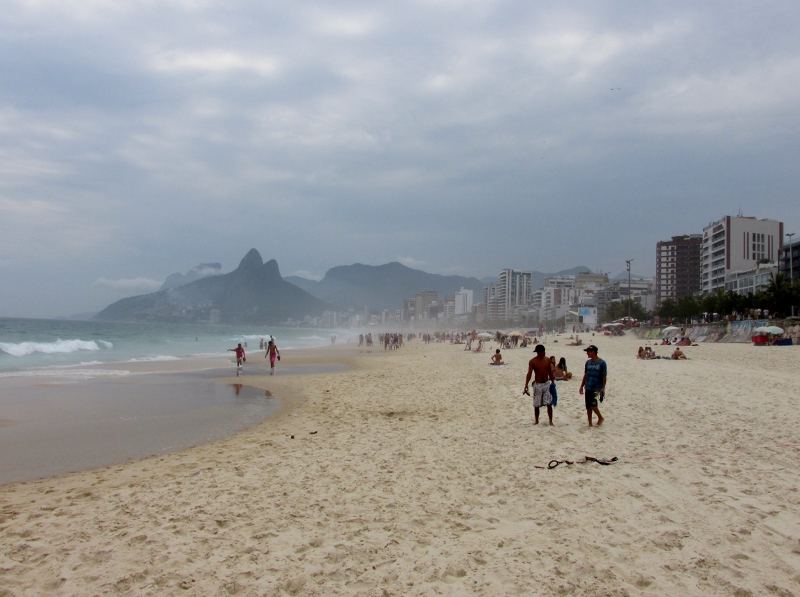
Ipanema3 (2)

And of course, Ipanema’s beach on a cloudy day.

As I walked through this neighborhood I kept thinking about my “don’t be a tourist” goal. Was it worth it? Did it make any sense to wait some time before going on these trips? Would reading Lispector’s book in a sandwich-shop have been any different two months ago? Well, I suppose any “evaluation” of my goal will have to come from my overall experience in Rio de Janeiro. Two months ago I wouldn’t have known that, following a common cultural dynamic in the country, Lispector’s modern language had been widely criticized throughout Brazil as an attempt to move away from other more traditional styles. It may seem as small detail, but understanding why different literary circles in Brazil reacted differently to “Perto do Coração Selvagem” is the result of countless conversations during these three months.


Alyssa in New Zealand: Reaching new heights

October 8, 2013

How high can you possibly imagine hiking? Personally I find it hard to imagine.  At this point, it is hard to believe that there is a limit to how high I can climb, for tramping (another word for hiking in New Zealand) has become an addiction. If there wasn’t an end to the trails, I would certainly venture higher through the mountains.

Two weekends ago, I tramped to the height of 1,250 meters, which can be reached on the Sealy Tarns Track. My friends and I were planning on doing the tramp to Mueller Hut, which is 1,800 meters high and the halfway point to the summit of the highest mountain in New Zealand, Mount Cook. However, our plans were foiled once we were informed that there was too much snow blocking the track. As disappointing as it was, we weren’t going to let that prevent us from going up. I became determined to go as far up as I could.

The higher you go, the more you see. The more you see, the better the view is.

mount cook11 (1 of 1) (1)

The view that we were rewarded with after climbing 1,810 steps to the top of Sealy Tarns track

So much can be achieved by reaching the top. Not only have you tested the limits of your fitness, but you have also tested your drive to complete the challenge. In order to get to the top, we had to climb 1,810 steps. As I arrived at the top of Sealy Tarns track, I found myself completely surrounded by a new level of nature. The weather was still brisk enough that snow capped the peak of every mountain. Mount Cook was fighting to reveal itself to us through the thick clouds. The depths of the valley seemed never ending and the glacial waters below were reflecting several different shades of blue even with the grey skies above, all the way from navy to turquoise.

DSC_0475

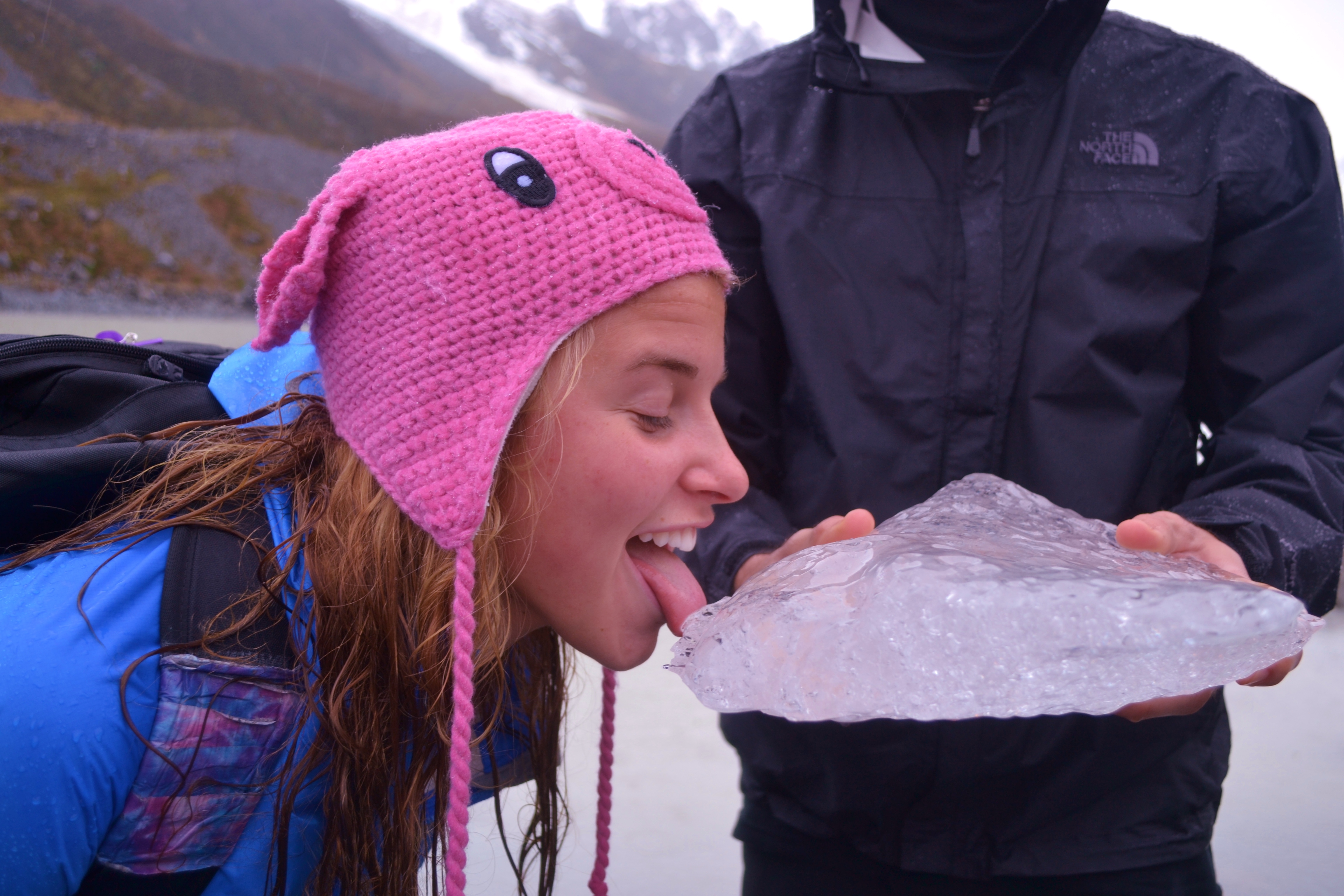
Tasting some of the glacier ice that is over hundreds of years old

I was so enamored by what I had seen, I was unsure of what my next adventure should be.  I kept thinking that nothing could possibly be better than what I just accomplished. After returning to Dunedin and talking to my neighbors about my weekend, they told me about their plans for the following weekend. Although I wasn’t particularly close with them, I decided to join, as the plans were to hike in Wanaka and go bungee jumping (even though it is not an activity covered by the insurance the UR OIE provides, and they advise not to do so, it’s been something on my bucket list that I’ve been keen to do for my entire life).

roy20 (1 of 1)

The new group of friends that I have recently acquired

As I am usually embarking on trips with only my flatmates and a select few of other internationals, traveling with my complex neighbors was something new to me. There were some that I have never even met or seen before. However, by the time the weekend was over, it seemed like we all had known each other since the start of our arrival in the country. I now find it hard to believe that I haven’t spent time with them before. It has become much easier to make friends, for we all have the same motives to explore and make the best of our time in a country that has so much to offer.

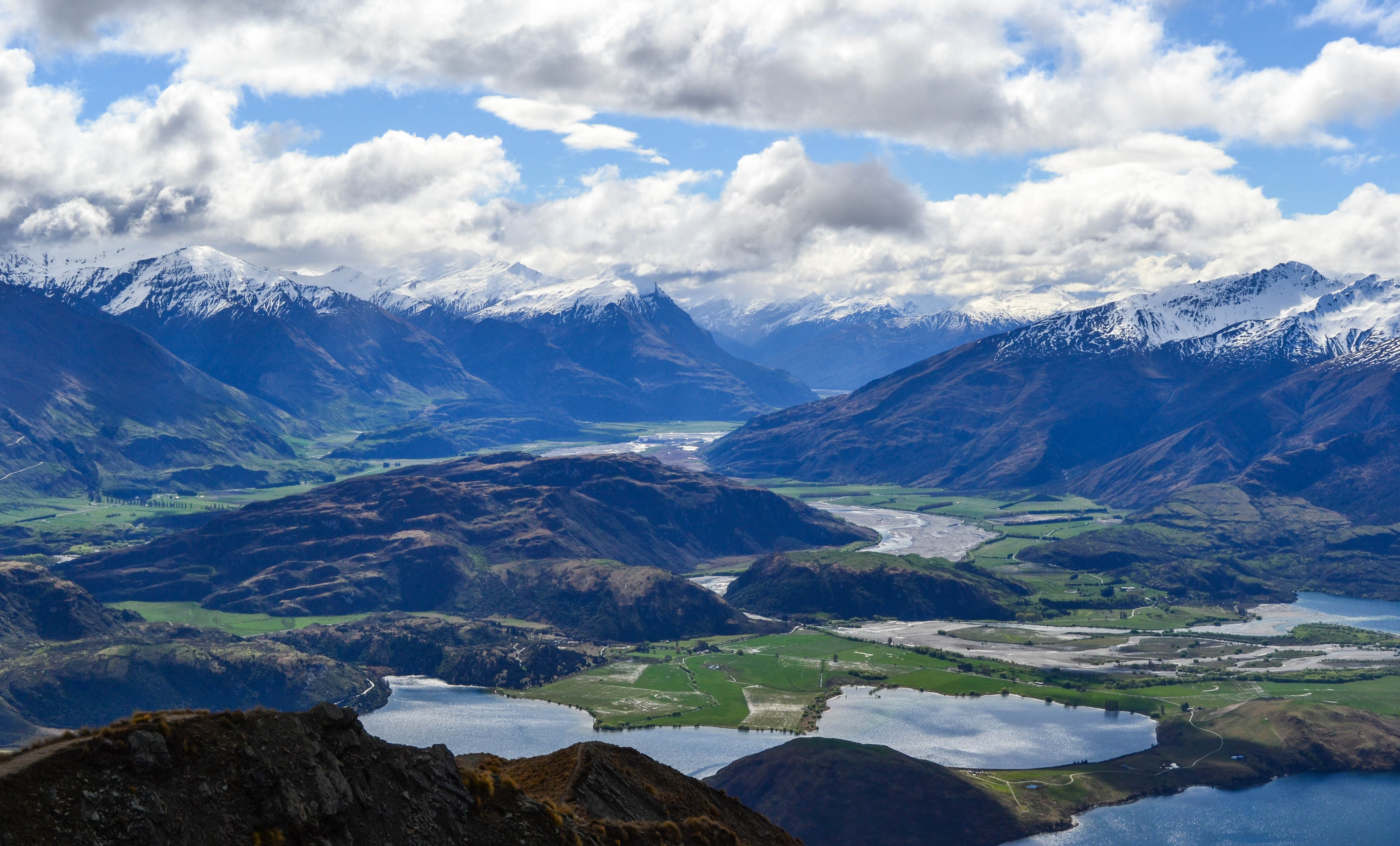
I reached an even higher peak in Wanaka when hiking on the track Roy’s Peak. There was a view the entire time we hiked. The track was open and offered an incredible scene of Lake Wanaka and the mountains surrounding it the entire way through. As we gained height in the clouds, the valley continued to expand right in front of our eyes. We passed several grazing areas and sheep as we made our way to the top.

After tramping for a little over two hours, we reached the summit, which is 1,600 meters. Clouds completely blocked every direction that we looked, leaving us slightly disappointed. Just as we were about to give up on the view, a huge gust of wind came through and blew every single obstruction away. Everything was revealed and the entire valley was crystal clear. There were countless elements that were in front of our eyes. From the pastures to the lake to the mountains, we were completely immersed in an environment like no other. Not thinking that anything would ever compare to Mount Cook, I was certainly convinced otherwise as I looked at the beautiful and encompassing scene of Wanaka.

roy19 (1 of 1) (1)

The crystal clear view of Wanaka from the summit of Roy’s Peak

Just when I think that I’ve seen it all, I immediately realize how wrong I am as I keep embarking on new journeys. Each destination is so unique that they cannot be compared to one another. None of them are remotely the same, but each place is equally as spectacular.

The following day was the when the thrill of adventure really presented itself. A bus transported two of my new found friends and I to the large canyon where we would bungee jump. As we approached the cable car that hung above the canyon, I caught a glimpse of how far I would be jumping. My nerves didn’t begin to hit me until I was actually standing at the edge of the platform, seconds before my fall.

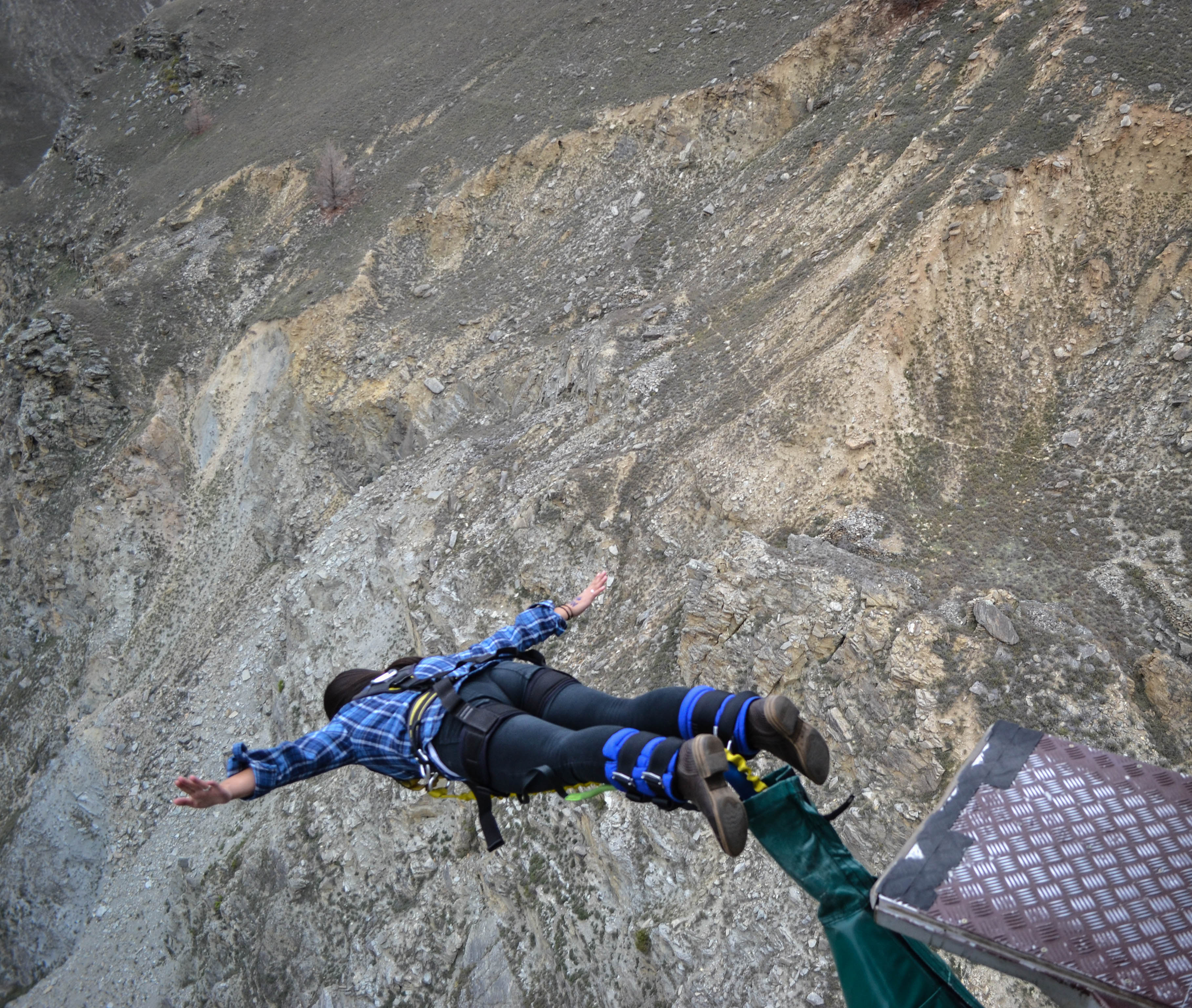
As the overseer counted down to 1, I leaned forward, trying to manage of all the thoughts and emotions going through my head. For a split second, I lost all control of everything that was in my mind. I couldn’t think of anything except for the fact that this was actually the craziest thing that I’ve ever done. Jumping off completely stable ground and into open air was going against all human instincts. I barely had time to think about being scared. However, once I gained momentum, I never felt so exhilarated. It turned out to be a 9 second fall, for the drop is 134 meters (440 feet). The fall was long enough for me to realize that I was in fact free falling. I never wanted that feeling to end. Before I knew it, the cable retracted and I began to bounce, indicating that it was over. As I was being pulled up, I finally had time to collect my thought and all I could think of was that I have never been more happy with what I had just experienced.

bungy15 (1 of 1)

A 440 ft drop and 9 second fall

Even though I have hiked to heights that are extremely higher than 134 meters, the distance of the fall seemed greater than anything that I had tramped at that moment. Just when I thought I had befriended a decent amount of people here in Dunedin, more have come into the picture and my social circle has expanded.

There is no limit to anything. The only limit that exists is the one that you impose on yourself. A maximum may exist, but there is no reason for you to not alter let alone increase it. If such an opportunity presents itself, the best thing that you could do is to step out of your comfort zone and exert a change in your life. Nothing is monotonous in New Zealand. Everything is always changing around me, and it encourages me to take advantage of what’s there. You never really know what you’re going to encounter until you’re actually there. The worst that could happen is not experiencing it for yourself.


Mel in Chile: The North

September 25, 2013

(Warning: the pictures for this blog post are awesome.)

I ended the last blog post with a picture of the Atacama Desert I took from the plane right before we landed in Antofagasta. During the next five days we (the 13 students in the SIT program) traveled through the driest desert in the world. The purpose of the trip was to bring life to the lectures about the Chilean economy. We were to do this in two ways: three days exploring the copper industry and two days in a small village which in the past two decades has become almost entirely economically dependent on tourism.

The itinerary included two classes at a university in Antofagasta- one explaining the importance of mineral mining that is done in the region for the Chilean economy, and the other one focused on the social and environmental implications of the industry. Other major experiential learning components of the trip involved a two-hour tour of one of the biggest copper mines in the world, and an informal lecture/discussion with an anthropologist in San Pedro de Atacama. The anthropologist is also from an Atacameño community, which is the indigenous group in San Pedro de Atacama.

First up, the two lectures at Universidad Catolica del Norte in Antofagasta and the visit to the Radomiro Tomic mine in Calama:

The lectures were widely different but also complimentary. The first one was on the regional economic development of Antofagasta and the second one was on the economy and human rights. Fear not, this blog will not be a drawn out summary of the lectures. I mention them because they add to the perspective I am gaining about Chile and help to shape my experience here.

The region of Atacama is rich in minerals. There is an immense area including the south of Peru and parts of Bolivia that are lucky enough to be on the fault line of Pacific and South American tectonic plates that endow the countries with a rich variety of minerals. Unfortunately, this also generates what I judge to be modern colonialism.  Foreign investment pours into mineral rich regions like Antofagasta, international companies begin to mine, make unbelievable profits while draining regional resource wealth, and at the same time secure support from the national government . Open and unregulated markets seem to be the unspoken rule for developing countries. Many economists say this generates jobs for the local communities but it hardly seems to be the case for such a highly technological industry like copper mining. I learned that for every million dollars of investment in the copper mining industry in Chile, only one direct job is created.

Another issue is the danger of an export-driven national economy based on natural resources. How far away are we from developing a sustainable substitute for copper? How much longer until the minerals run out? What if the costs associated with mining and refining copper become greater than the market value of this resource?  Who will suffer from these probable future events? Will it be the CEOs of international corporations or the national economy dependent on the mineral? What about the effects on communities who for 100 years have been dependent on jobs related to the mining?

That is for you to ponder (I like to imagine I have thousands of avid readers.)

After the lectures we traveled to Calama and had a free afternoon of shenanigans until the next day when we visited the Radomiro Tomic copper mine. According to the booklet (more like book) the communications department gave the group, “each day the mine extracts 600,000 metric tons of material.” In the Radomiro Tomic mine, and I think throughout the region of the Atacama where most mines operate, only 0.5% of the rock is copper. I will not continue listing facts about the mine because those can be accessed from anywhere. My personal experience in the tour was a very overwhelming one. The number 600,000 metric tons sounds ridiculous when you read it and I do not imagine it produces a specific image in anyone’s mind. After the rock is leached and the copper has been extracted, the rest of the rubble is simply taken to the dumping site. It was at this point that I understood the mountain-like formations a bit further away were rubble.  During the time that we were on the observation site at the mine, they had planned an explosion to the left of where we were standing. We heard the sound, the ground shook, and within minutes the sky was covered in dust. To stand on the edge of  one of the biggest mining sites in the world was nothing but extraordinary and to be honest I do not think my mind will ever fully psychologically process the sheer size of the mining pit. It is bizarre to “see” what it means to extract 600,000 metric tons of rock per day.

0

The mines

The next most significant part of the trip was our stay in San Pedro de Atacama and the anthropologist, Jimena, who spoke with us about the implications of the recent tourist boom for the indigenous community. A couple of comments about San Pedro de Atacama itself: it looks like a movie set. You walk around and see an “authentic” typical village in the dry highlands of Chile with its dirt roads, adobe walls, and low “houses”, but it’s as if the place is too manicured. The adobe walls and the dirt roads are perfectly rustic. Then you actually notice the people walking around and it is all western tourists. What looked like “houses” are actually hostels (very expensive,) touring agencies that will take you to do 136,455,478 activities you can do in the desert that include everything from sand surfing to star gazing.

0-2

San Pedro de Atacama

We met with Jimena in the afternoon. She started with telling the history of the Atacameño people and how things were when she arrived during the period in the 1990s when the tourism boom had just begun. The first comment she made about the change of lifestyle in the village was how tourism had brought some drugs to a place where they had never before been used. She also spoke extensively that national and international travel agencies harvest the profits from tourism. In her view, the normal lifestyle of her indigenous group is being “commoditized” and its “rustic” image sold to western tourists. At the same time, most of the locals have been pushed to the outskirts of the village to make room for the shops, agencies and hostels, which essentially sell their lifestyle.

I stayed half an hour after the discussion was over and everyone had left to talk more with her. Without a doubt, I can say this was one of the greatest conversations I have had.

hike-1

I went on a hike with a friend through the mountains right outside of San Pedro (not with a touring company)

sunset-1

Later on that day, the entire group took a hike up a mountain in Valle de la Luna to watch the sunset. One of the most beautiful places on Earth


Rhiannon in India: A Trip to the Beach

September 17, 2013

This weekend was another holiday, so Jennie, Romi, and I took a long overdue vacation south to Pondicherry and Chennai. After traveling north to the bustling capital a few weeks ago, we wanted a more relaxing destination – and we got it!

After we finished classes on Thursday, we boarded another Sleeper train with a 14-hour ride to Chennai ahead of us. Now, if you know anything about Bollywood or Indian pop culture, you are probably wondering if we traveled on the Chennai Express. Chennai Express is a very popular movie in India right now featuring two of Bollywood’s most famous actors – and it takes place on a train to Chennai. Unfortunately, our train was called Charminar Express rather than Chennai Express, but we took a few movie-like photos anyway.

Chennai Express

Before our trip to Chennai, we had a Chennai Express photo shoot

Even though we were in the most budget option of Sleeper compartments once again, the whole trip was very enjoyable. Truthfully, we were delighted to have seats on the train at all because, when we booked our trip online, we received RAC tickets (sort of like waiting list spots) and didn’t get our confirmed seats until two days before our trip! If we had boarded the train with RAC tickets, we would have had to share our bunks for the entire 14-hour ride, and we may have been separated. Luckily, after two weeks of watching our waitlist numbers get closer to zero on the website, we finally received our confirmed tickets and boarded the train to find three full bunks just for us.

One of the best parts of the train ride was the company we had in our compartment. An older Telugu-speaking couple sat across from us and, although we could barely communicate using English, somehow we shared food, laughed, and interacted with each other and had a wonderful time that night. There was also a young man in an RAC seat nearby that spent over an hour giving us suggestions for things to do in Pondicherry and Chennai. He seemed really enthusiastic to share information about temples, beaches, and festivals with us. Even after everyone had gone to sleep in their bunks, the old man and a younger man nearby, although strangers before the trip, sat up and chatted over chai for half the night.

After sleeping through the night in my little bunk on the train, I woke up early, waved good morning to the old lady across from me, then looked out of the little crack of the window visible from my bunk. I could not believe my eyes. The scenery was probably one of the most beautiful things I have ever seen! We were in the middle of green patty fields and marshlands, and every once in a while we passed through a village of small houses and huts. We passed people in the fields playing an early-morning game of cricket, and others in the villages getting ready for work. The train was following the coast, so in the distance I could see the Bay of Bengal, dotted with colorful sailboats. The best part was that the sunrise was reflected in all of the water collected in the fields and marsh from the monsoon rains.

When we pulled into the Chennai station, we had a quick breakfast and headed straight to the bus station to catch a three-hour bus south to Pondicherry. Pondicherry was a French settlement until the 1950s, so there is still a lot of French influence there (now mostly in terms of tourists), especially in the French quarter, a quaint little neighborhood on the beach. As we drove into Pondicherry, I noticed lots of flags that were a mix of the French and Indian flags. In the French quarter, all of the street names were French, many people spoke French, and people even said “salut” or “bonjour” to us on the street. We also had plenty of French food, coffee, and chocolates in the many French cafes all over the area. It was like we were in a totally different India! Being there reminded us of how many different cultures there are to see in India, and how no two are alike.

Colorful Pondicherry

All of the streets in the French Quarter were lined with colorful houses and hotels

Without a doubt, my favorite part of Pondicherry was the beach. In the French quarter, the coastline is mostly rocky, but still has a few sandy spots as well. We spent our first afternoon walking along the waterfront watching kids play in the water, although it is technically not allowed because of the strong current and pollution. We didn’t swim there, but our hotel owner told us about a cleaner beach seven kilometers south of the French quarter called Paradise Beach, so on Saturday we hopped in an auto and went there for the afternoon. We were a bit unsure about what we would be doing because it is uncommon in India to swim at the beach, but we left the hotel with open minds and lots of food for a picnic. But to our surprise, Paradise Beach was almost completely deserted, so we jumped in the water for a swim! We picnicked and played Frisbee for a while, but all of a sudden black cloud started rolling in from over the ocean. Within 15 minutes, the wind picked up, the sky got dark, and it began to rain so hard we thought it was hailing. We ran back to our auto and got back to our hotel safe and sound, so now we can say that we survived a monsoon on the beach at the Bay of Bengal!

Rocks in Pondicherry

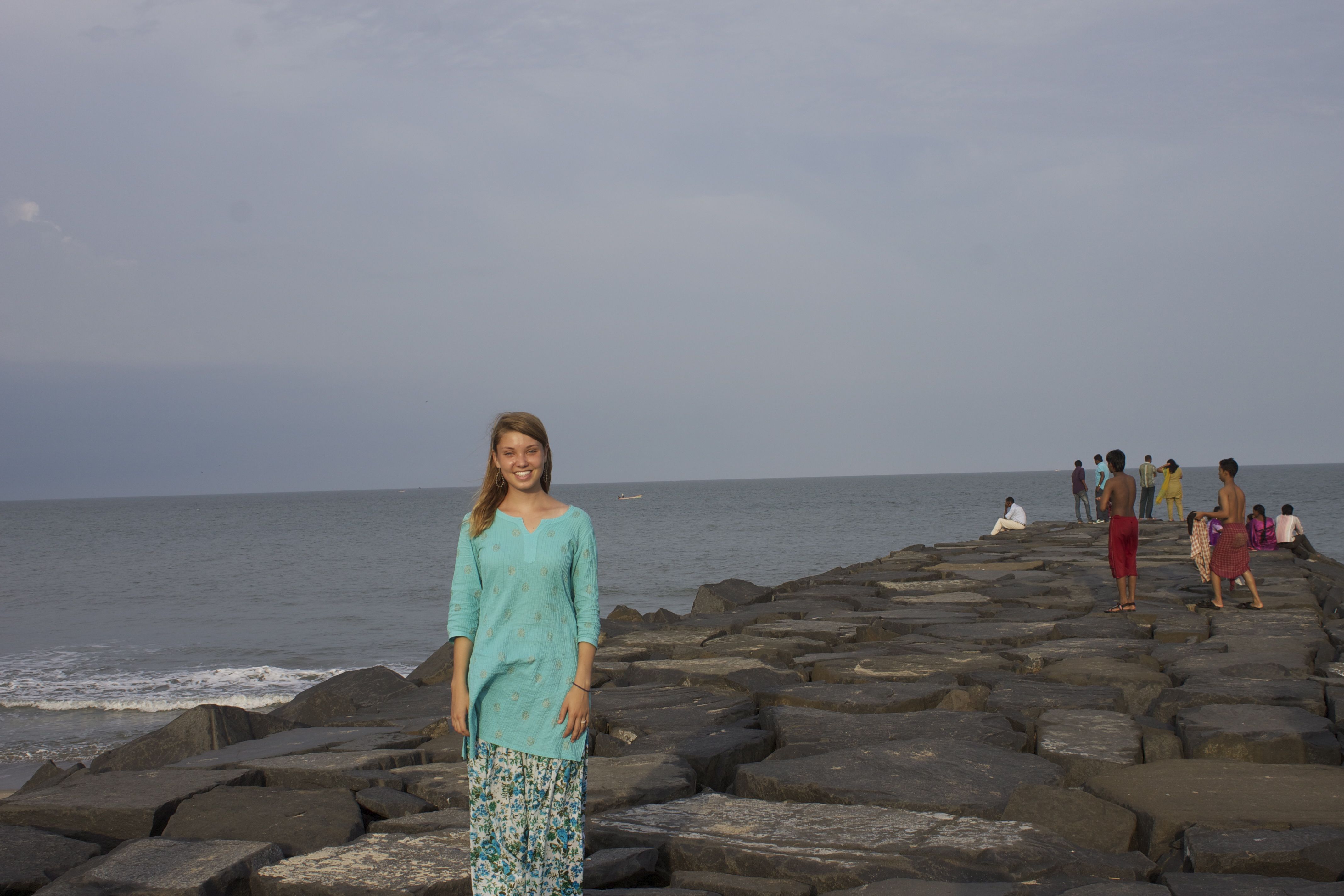
The rocky coastline of the French Quarter

On Sunday, we went back to the bus station and caught a bus back to Chennai. The next day was Ganesha Chaturthi, the beginning of a long festival to celebrate Lord Ganesha’s birthday. Ganesha is the Hindu god whose head resembles an elephant, and he is the god whom Hindus pray to first because he takes away obstacles in life. The story of Ganesha (as told by my host mom) is that his mother, Parvati, wanted a son so she made Ganesha out of sandalwood while her husband Shiva, the destroyer god and Ganesha’s father, was out of the house. Parvati put life into Ganesha and put him in front of the door to protect the house from intruders. When Shiva came back from hunting, Ganesha wouldn’t let him in, and not knowing that Ganesha was his son, Shiva cut off his head, which flew into the jungle. When Parvati realized what had happened, she explained to Shiva that he had killed their son and ordered that he go into the jungle to find Ganesha’s head. Shiva went out and returned with an elephant head instead and brought Ganesha back to life.

To celebrate on Monday, we went to a temple in Chennai and offered some flowers to Ganesha. During the festival, statues of Ganesha are put up in neighborhoods all over India, and people put small statues in their houses as well. There were six- to ten-foot tall Ganesha statues on all the roads and vendors were selling small clay statuettes in all the market areas. While we were in an auto on our way to the temple, a parade of people passed by with a mobile Ganesha shrine, so our auto driver parked the auto and ran over to receive prasadam (offered food and coconut water). When we returned to Hyderabad that night, we were surprised to find our neighborhood transformed with large, colorful Ganesha shrines on all the street corners complete with floodlights and loud music.

Mobile Ganesha Chennai

The mobile Ganesha passing our auto in Chennai

The trip this weekend was so relaxing and beautiful, but now I have a busy week ahead of me. Our apartment building will be celebrating for the Ganesha festival every night this week with poojahs (devotions) and lots of food. I will post soon about all of the festivities going on right here in Hyderabad!

Happy Ganesh Chaturthi!


Mel in Chile: Santiago

September 13, 2013

Week #2. I’ve had the chance to walk around the city a lot this past week. In fact, I walked from my house in Providencia to the University which is close to Estación Central. It takes about an hour and fifteen minutes.

In general, I try and walk anywhere that will be within an hour or so and feel comfortable saying I have seen many areas of the city and walked through similar streets several times. Although, I should disclose that I have only been through the “safe” and usually nice areas of Santiago. In other words, all of my comments about the city refer to the middle/upper-middle class regions and are not a full representation of all of Santiago.

Okay.

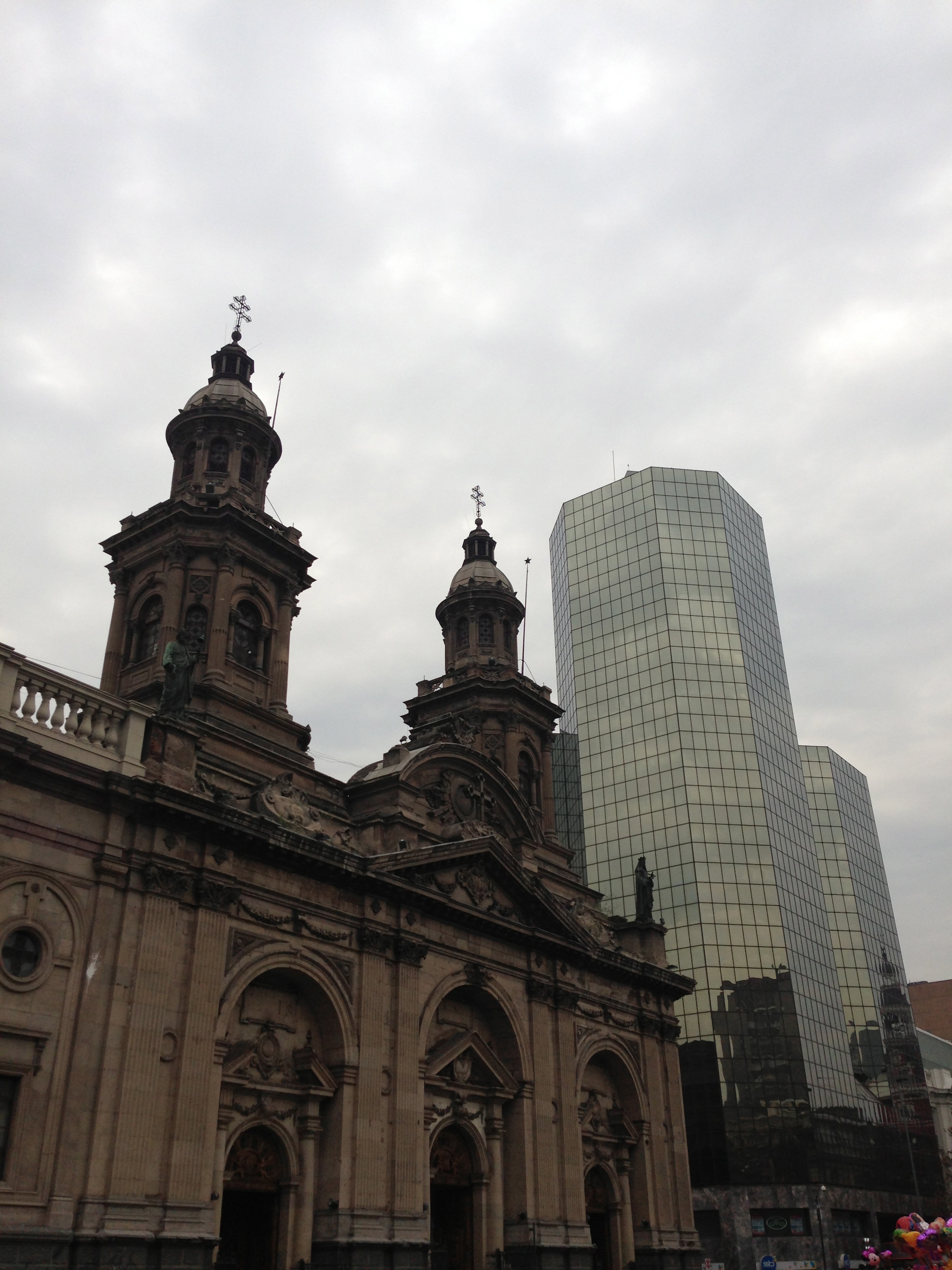
The past week and a half I walked around central Santiago confused. The architecture of the buildings seemed almost awkward. Actually, not the architecture of each individual building, rather the collective appearance of several buildings positioned close to each other. When I look one way on Avenida Providencia I see an old building with a structure screaming 18th century Spain which I imagine this to be the case in many Latin American countries. Then I look the other way and see the modern building of “Fundacion Telefónico” which holds various cultural events like theater plays and galleries. Across the street, on Plaza Italia, and I see the overbearing residential skyscraper marking it’s territory on central Santiago.

IMG_1891

On the left is the Metropolitan Cathedral of Santiago built in 1748. To the right, stands a perfect example of the many skyscrapers piercing the Santiago sky today.

Sometimes I feel I am in Spain, sometimes London and at other times even Tirana! Tirana, for the few of you who might not know (joking, I know most of you don’t know) is the capital of Albania. This is where I was born, grew up for the first ten years of my life, where most of my family lives and where I have spent many of my summers since migrating to the United States.

All last week, as I found myself in different areas of the city, I thought “What is going on here? Santiago must be confused. Is it colonial? Is it modern? Does it have its own identity? Its own niche?”

I am not suggesting cities, or even the tiniest municipality, is, or needs to be, homogeneous. Santiago is big. Of course it is diverse. I do not expect the architecture of every single part of the city to be identical. I also do not want to reduce an incredibly diverse city of almost seven million inhabitants to one single identity. That is not what I tried to do.

With that said, I still contend Santiago is a special place.

I spent the past week and a half trying to understand how the different structures and diverse architecture tell the story of Santiago.

The colonial architecture obviously comes from the colonial period. Easy. At first glance, the skyscrapers filled with offices of foreign enterprises contend that Chile does enjoy a developed economy, sophisticated financial structure and plenty of foreign investment. These are the buildings that proudly show the international community “Hey, we have made it!”. The modernity is celebrated not only by the elite who benefit from an open and deregulated market, but from also a working class who hope swallow their objections in hope that trickle down economics will eventually…well, trickle down to them.

On the contrary, the buildings are also an uncomfortable symbol  of the seventeen years of military dictatorship that aggressively implemented neoliberal economic  reforms. The reforms made possible  the most stable macro-economy in Latin America, but also created severe inequality in earnings, education, and healthcare to name a few. Consequently, for many, the modernity, the high-rises, and the “booming” economy also represent classicism, racism, and enforcement of prejudices and the further entrenchment of the degrading stereotypes that sustain them. The disrespect of human rights for seventeen consecutive years during the dictatorship which carried out a neoliberal economy and replaced citizens with consumers, and the current systematic neglect of key functions of a democratic government and civil society are oftentimes seen as an unjustifiable sacrifice for macroeconomic success.

But, this isn’t meant to be a history lesson.

So friends, I walked around for a week and a half thinking Santiago was confusing me because of how incredibly diverse the architecture is. As I thought this, I came to a street crossing. The light was red for the vehicles, but that isn’t what’s important. In front of the stopped cars was a man on top of those high unicycles, dressed as a clown, and juggling. He was putting a show for the cars during the few minutes they wait at the red light.

That is when I realized, the city isn’t confused.

It is unbelievably eclectic.

There is a fusion of past and present. The struggles and the victories. Protests on one side of town and celebrations on the other. Business men in suits and students marching in the streets. A musician playing his fiddle in the subway train and a woman dressed as if ready for a fashion show, having an extensive conversation about the current health of her nail-beds. September 11th 2013, the fortieth anniversary of the military coup, will undoubtedly result in riots across the streets (No worries, I will be in the north, and more that safe), then a week later, everyone will celebrate the fiestas patrias with friends, family, barbecues, and late night parties.

But, these “extremes” should not come as any surprise. It sort of runs in the country. Geographically speaking, Chile can make even the most experienced National Geographic photographer go “Huh. I have never seen anything like that before.” There are the Andes, an entire coast line in the Pacific, the world’s driest desert, glaciers, enormous lakes, valleys, rivers, grassland, and finally, the eclectic metropolitan city of Santiago.

Right now, I am on a plane flying north for an excursion with my program. The plane is going over the Atacama desert, the driest and highest desert in the world, and in the background I see the snow capped Andes.

Chile defies geographical norms.

IMG_1919

Birds eye view of the mountainous Atacama desert.


Alyssa in New Zealand: Mid-semester break

September 4, 2013

It is important to take advantage of the environment you’re in, but it is also vital to not let yourself forget about the other places that surround you as well. There is much to discover and explore, but we can’t let ourselves be distracted by what’s only in front of us. Leaving the U.S. two months ago was my first step towards new journeys. After having been in New Zealand for seven weeks, it was time to put my life in Dunedin on pause and venture to the neighboring country, Australia.

Once mid-semester break arrived, my flatmates and I were constantly on the move for the entirety of the trip, beginning to end. Driving to Christchurch was our first endeavor, for that was where our flight was departing from. The three hour plane ride brought us to one of the most famous cities in the world, Sydney. Right away we started exploring, touching many aspects of the city such as the Sydney Opera House, Hyde Park, Darling Harbor and the Harbor Bridge. The climate was so different compared to what we have been used to in Dunedin that we made our way out to Manly Beach the following day in order to enjoy the warm weather.

bridge

Sydney Harbor Bridge at night


Shortly after, we flew north towards even warmer weather to Cairns. I was caught off guard by the heat, for the thought of having weather in the 80’s seemed foreign to me at that time. It didn’t take long for me to change into shorts and t-shirts. Our first adventure consisted of the Great Barrier Reef. We boarded a boat that took us out an hour from the shores of Cairns and were provided with snorkeling gear. As I jumped off the boat into the ocean, I didn’t feel one sting of coldness from the water because the air was so tropical. Looking underwater was incredible, for the amount of marine life that was directly below me was overwhelming in a sense that I felt as if I needed to see everything. Whether it was in a form of coral or fish, color completely surrounded me. Every aspect of the reef was unique. Not one fish looked like one another and each corner presented a wide arrangement of vivid hues.

josphine

Josephine Falls in Cairns

Cairns had much to offer on land as well. We ventured our way into several different rainforests running into several waterfalls, lakes and other different kinds of nature. There were also several beaches that were easy to access around the city as well. Each day in Cairns beheld a different adventure in front of us. It felt as if we were seeing the most authentic parts of Australia regardless of what kind of setting we were in.

waterfall

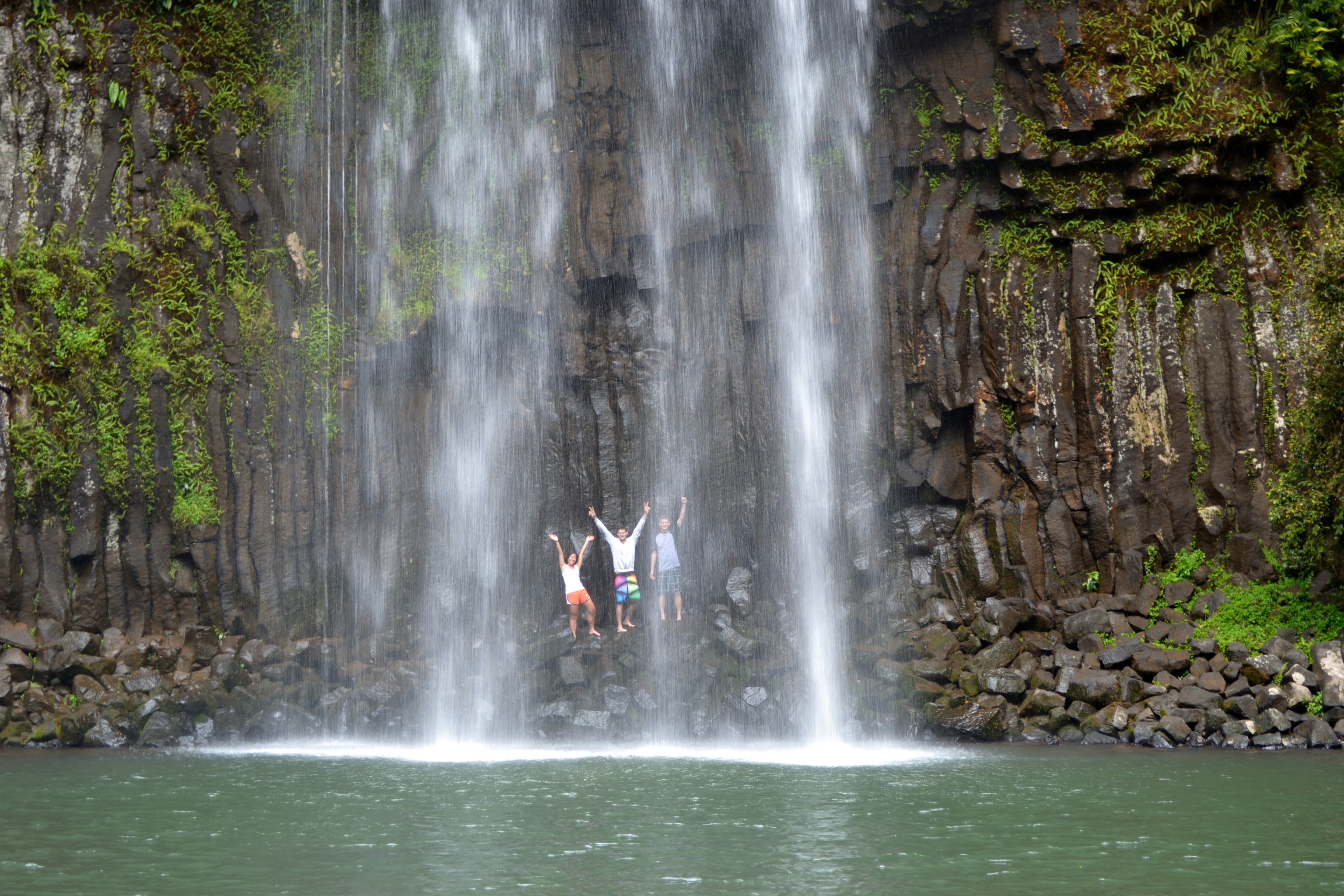
My flatmates and I ventured our way to under the waterfall at Milla Milla Falls in Cairns

Knowing we couldn’t stay in Cairns forever, we began to travel south towards Brisbane. On the way, we stopped at the Whitsunday islands for a day trip. Nothing could have prepared me to anticipate such a view. Expectations are never accurate, for no sense of what you are going to see can perfectly depict what is actually there. Pictures almost do Whitsundays no justice. With the water having 20 different hues of blue, the scenery is unable to be replicated by any other location. The silica sand on the beach was so soft that you could exfoliate yourself with it (which I most certainly did). Paradise would be an understatement to describe what it was like. Thinking about going back at the end of the day became a concern, for every inch of my body was reluctant to leave.

Whitsunday

Whitsundays islands

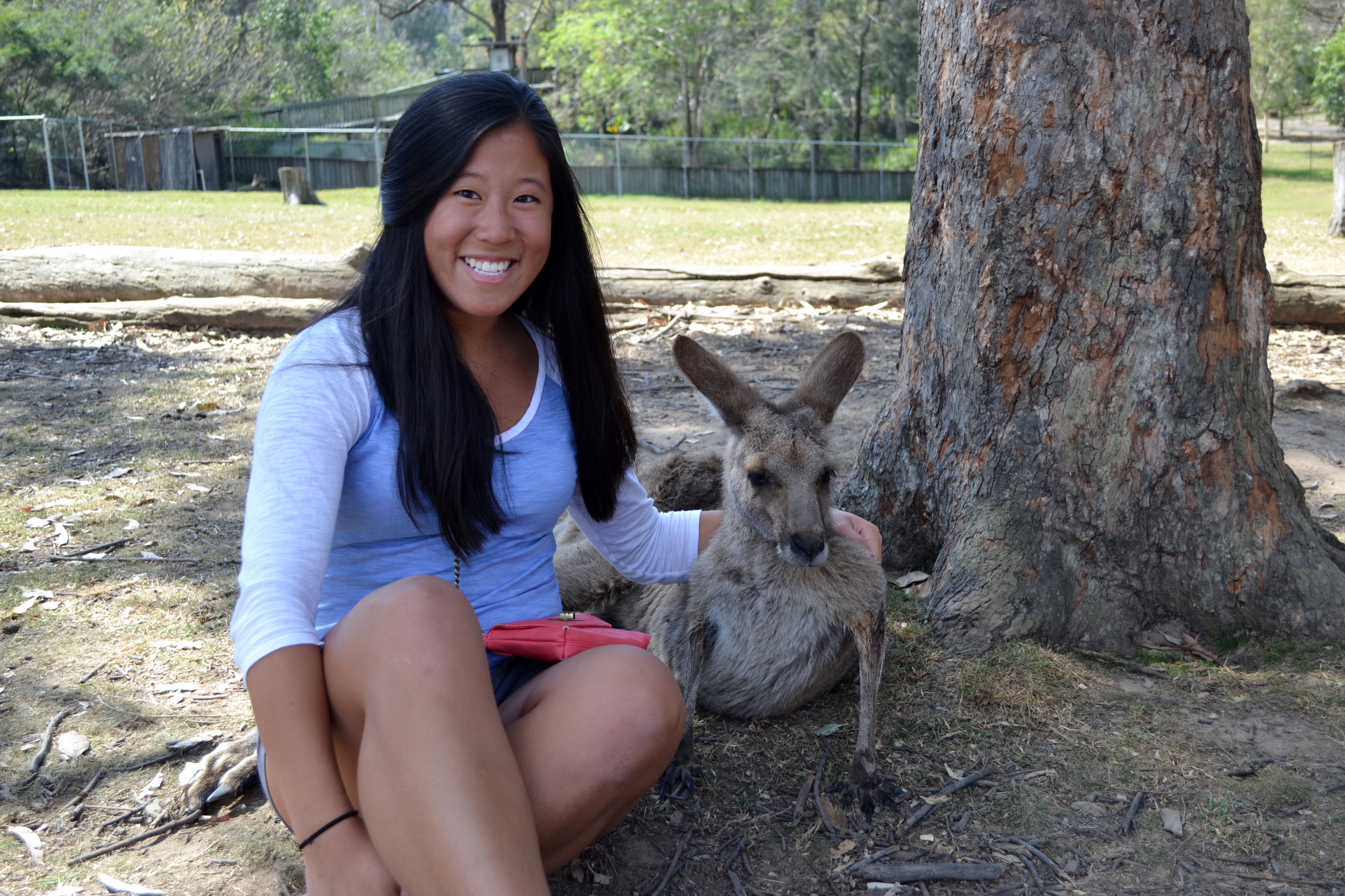
We finally arrived in Brisbane, which was our last stop on our trip but it didn’t necessarily mean we were slowing down. We utilized our time by visiting Long Pine Sanctuary, the first and largest koala bear sanctuary in Australia. The entire place was enriched with all kinds of Australian life such as koala bars, wombats, dingoes, crocodiles and kangaroos. To our delight, we were easily able to enjoy our time with the kangaroos up close in such a way that we were allowed to fully interact and pet them. The animals showed very little sign of discomfort, and they were very welcoming to visitors. Kangaroos were lounging everywhere in this field waiting for attention and consolation.
kangaroo

The kangaroos were more than welcoming when they were approached by visitors

Every beginning has an end, and finally we flew out from Sydney back to Christchurch. Having been in Australia for ten days, we were ready to return to New Zealand. A change of scenery is always enjoyable, but returning to what you’re familiar with always generates a sense of comfort. Being away from my home in Dunedin has made me appreciate how at ease I actually am in New Zealand.

Having Australia being so nearby was such a convenience, for there was most likely no other time when I would go there besides being abroad now. Opportunities aren’t always available. You can’t expect for them to present themselves at any time. If it’s there, you can either take it now or sometimes even never. Fears or distress shouldn’t obstruct your true desires. Visiting Australia had always been one of mine for as long as I can remember, yet I was always worried about money and time management. However, studying abroad presented the perfect chance for me to go and it undoubtedly became one of the most remarkable trips of my life.

Life has now resumed back in Dunedin, and it’s almost like nothing has changed. I am more than halfway throughout the semester and I am already fearing that the end is going to arrive sooner than I think. Such a thought only reminds me that there is still so much more for me to do and see. Nevertheless, I am already more than satisfied by the amount of things that I have done thus far. It’s almost impossible to see and do everything that New Zealand has to offer down to the last piece of nature. However, it is possible to fully appreciate all that has been seen and done.


Mel in Chile: A Lens

September 3, 2013

It has been exactly a week. The most interesting aspect of “the life of a university student” is that political affiliation is a big part of the identity of public universities. Chile is an incredible place to study political systems as it is the only place in the world where a socialist government was elected democratically and without military intervention. This government was overthrown in a military coup only a few years after it was established. The years of Pinochet’s military dictatorship brought the implementation of strict neoliberal economic reforms and fast privatization of important industries. Many will argue it was precisely this period of free markets and capitalist ventures which brought Chile the macroeconomic “success” it currently enjoys. It is considered one of the most stable economies in Latin America. However this same period of military dictatorship also carries painful memories of vast and blatant human rights abuses the government committed against dissidents. Leaders of socialist parties were assassinated, thousands  of civilians who opposed the neoliberal reforms were tortured as political prisoners, and thousands more would simply disappear; they are called the “desaparecidos”. It is without a doubt that Chile’s “economic miracle” came at heavy price.

The bittersweet taste of “macroeconomic” success is not simply nested in the past. Chile continues to be a country with one of the highest margins of income inequality in South America. Access to health care and higher education (along with other industries) is concentrated in the hands of elites. I imagine many will remember the student led protests in 2011.

I apologize! This was not meant to be a history lesson on Chile’s economic and political evolution. I started the blog with the statement that university life for students in Santiago is very interesting. I have found that the universities in the city have a strong political identity. After only two days in the city, I heard from other Chilean students which universities were rightist and which were leftist. After walking around other campuses in the city, I also began to see the role of politics in the university.

This group of SIT students has come to study politics and economics in Chile at an incredibly special time. September 11th will be the 40th anniversary of the military coup in Chile. My host family, professors, and other students say there are many things that go on around the city. At USACH (my university), as in other universities, there are forums, discussions, panels and other events the university has organized. There are also events that will take place throughout the city. My group will actually be traveling to the North for our first excursion so we will be away from all the activity.

Then on November 17th Chileans will vote for their president.  It will be the first presidential election in which voting is voluntary.

In conclusion, I feel very lucky to be in this program during such a specific time in Chile. I am not simply here taking classes, making friends, and sightseeing. I have the opportunity to “experience” the country through a specific lens. I walk around the metropolitan areas of Santiago and I don’t simply see huge skyscrapers housing foreign companies. I also think about the implications of such economic growth. When I am in the university campus I don’t just see other university students. I think of how their identity as students was formed through the movement, and how they help form the identity of the university.

IMG_1743

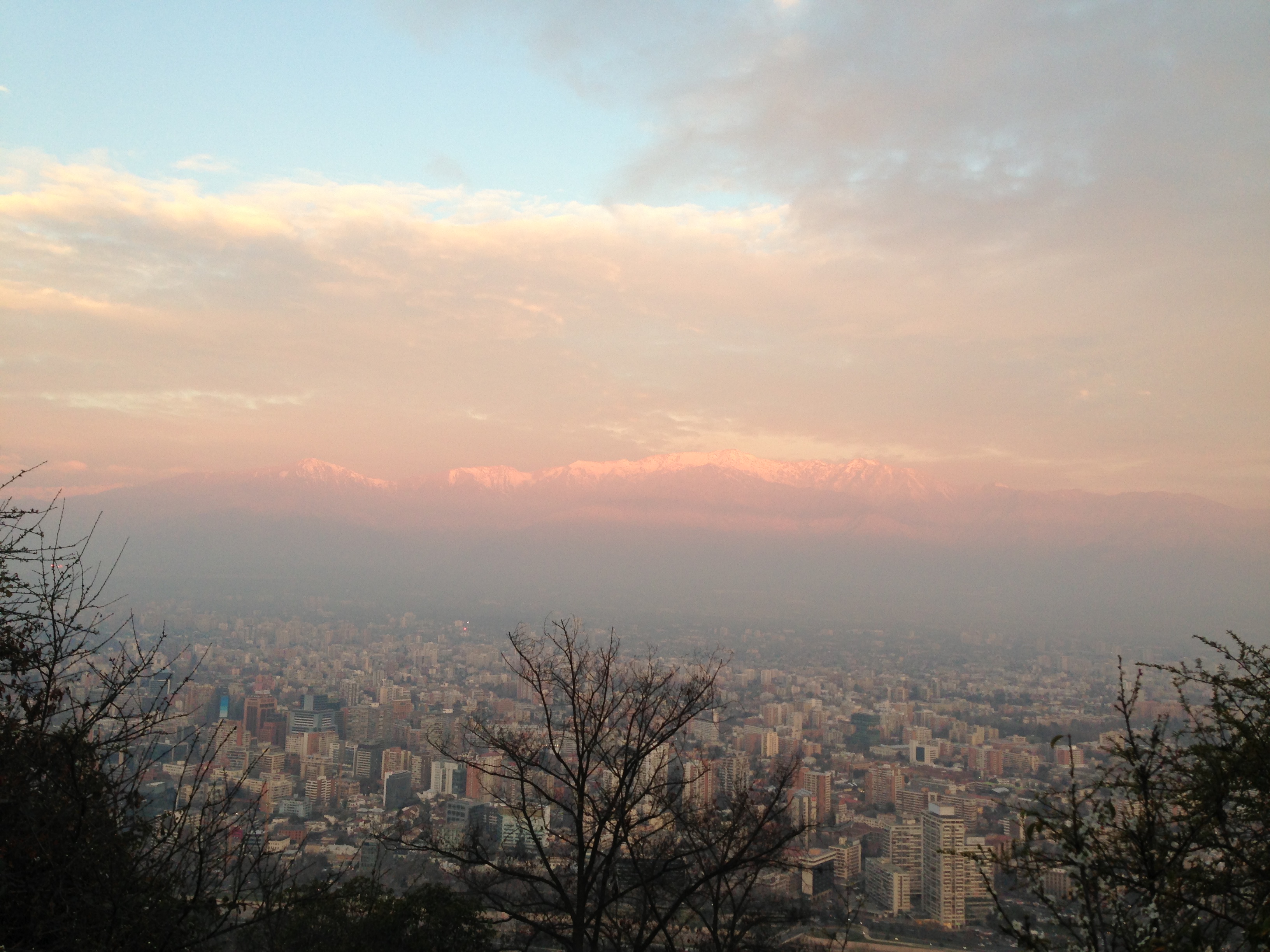
This is a view of Santiago from the San Cristobal hill. Note the Andes in the background!

It has been incredibly helpful to have this lens. Another student studying abroad in Brazil and writing for the Traveloges for UR mentions how easy it is for study abroad students to be “tourists”. Being a “tourist” is not bad. I am already planning a backpacking trip to Patagonia after the program is over with another friend studying in Valparaiso and I will do as much traveling as I can. That is to say, if you have the opportunity to travel you should take advantage of it. However you should also take advantage of the fact that studying abroad gives students an opportunity to create a lens. It gives students the opportunity to travel not to simply visit places and appreciate their presence in space but to also see what isn’t physically there.

I can feel myself becoming poetic as I sit in the cozy kitchen of Pedro and María on this cold night in Santiago, Chile.

Better to stop now before I start writing of the wisdom of the wind and the courage of the sun or something.

Have a great week everyone 🙂


Rhiannon in India: A Weekend in Delhi and Agra

August 19, 2013

After a month in India, I finally had a weekend free to do some traveling outside Hyderabad with my friends! Until now, our weekends here have been occupied by activities in Hyderabad – seeing historical sites, hiking through rocky terrain, shopping in the old markets, watching Bollywood movies, cooking Indian food… But because Thursday was Independence Day here in India, my friends and I took advantage of the long weekend and flew to Delhi! Our program directors were going to take our entire group to Hampi, a historical city in a nearby state, but because of the recent Telangana decision that I talked about in my last post, they decided to postpone our trip to a later date. Although we were disappointed, they assured us that it would be fine to travel anywhere independently as long as we didn’t take roads through the areas of agitation. What resulted from their announcement Monday afternoon was a mad rush to decide what we would be doing to take advantage of this rare opportunity: a long weekend. Within hours of the announcement on Monday, my friends Kate, Romi, Jennie and I had booked our flight to Delhi and were already reading our guidebooks for ideas!

It took hours of last-minute planning, but before we left Hyderabad, we had our travel plans intact and a list of all the interesting things to do in Delhi. We even booked an early 3-hour train from Delhi to Agra so that we could spend Independence Day visiting the Taj Mahal! We left Hyderabad early Wednesday morning and arrived in Delhi with a whole afternoon open to explore. With Lonely Planet as our roadmap for the weekend, we explored the area around our hotel and found a great restaurant that served all-you-can-eat North Indian thali, a to-die-for meal that anyone visiting India must try. For four days straight, we did one thing after another and tried to fit in as many activities as possible. But instead of listing all of them here, I’ll just give the highlights.

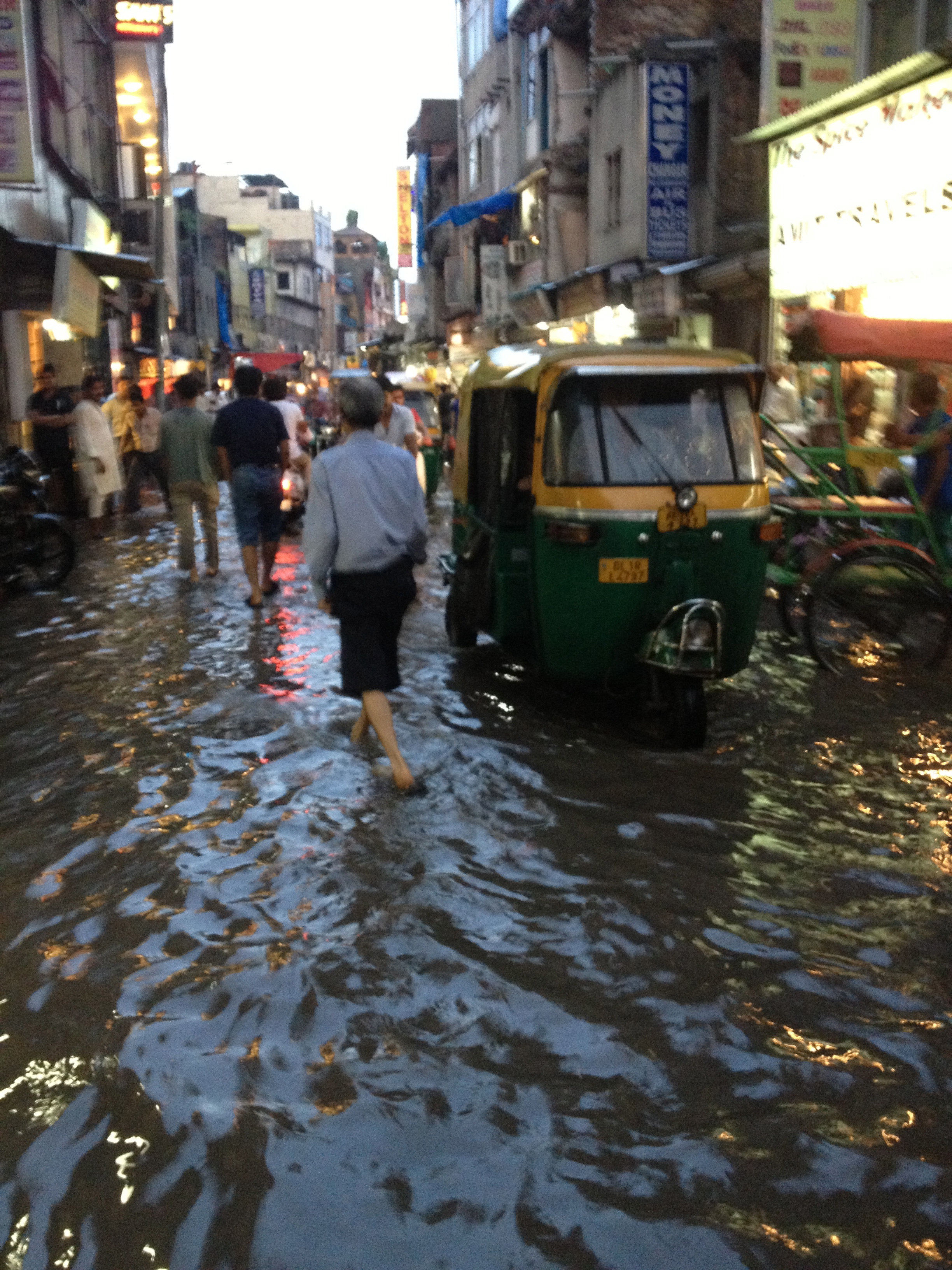
Getting from place to place may be the most mundane part of traveling for most people, but as I have explained in earlier posts, transportation in India often brings new and exciting experiences. During our last dinner in Delhi, we thought back over our 4-day trip and counted at least ten modes of transportation that we had used: planes, taxis, walking, auto rickshaws, bicycle rickshaws, city buses, sleeper buses, metros, sleeper trains, and we added, jokingly, swimming, because the monsoon was so bad in Delhi that the streets were covered in water half way to our knees. Every time we walked to and from our hotel, we had to wade through a “puddle” the size of a football field that poured into some of the shops near the road!

Flooding in Delhi

Flooding in Delhi

The sleeper train was definitely a new experience for me this weekend. When booking a long-distance train in India, there are so many options that choosing can be really overwhelming! You can choose between General (the cheapest option), Sleeper, 3 A/C, 2 A/C, and 1 A/C (the most expensive). You don’t need to book a General ticket ahead of time, but for this reason, you never know what will happen and you may have to stand for the entire trip. Because we booked our train so last-minute, the only option for us (besides the General compartment, which we were advised not to take) was the Sleeper. The benefits of the A/C compartments are that they have air conditioning and that they provide increasing levels of space, comfort, and privacy. When we entered the Sleeper compartment early Thursday morning, we found our “seats,” which actually resembled 3-level bunk beds. We slept the whole way and the trip was over in a snap! I wonder now why all transportation isn’t like this.

Sleeper Compartment

Sleeper Compartment

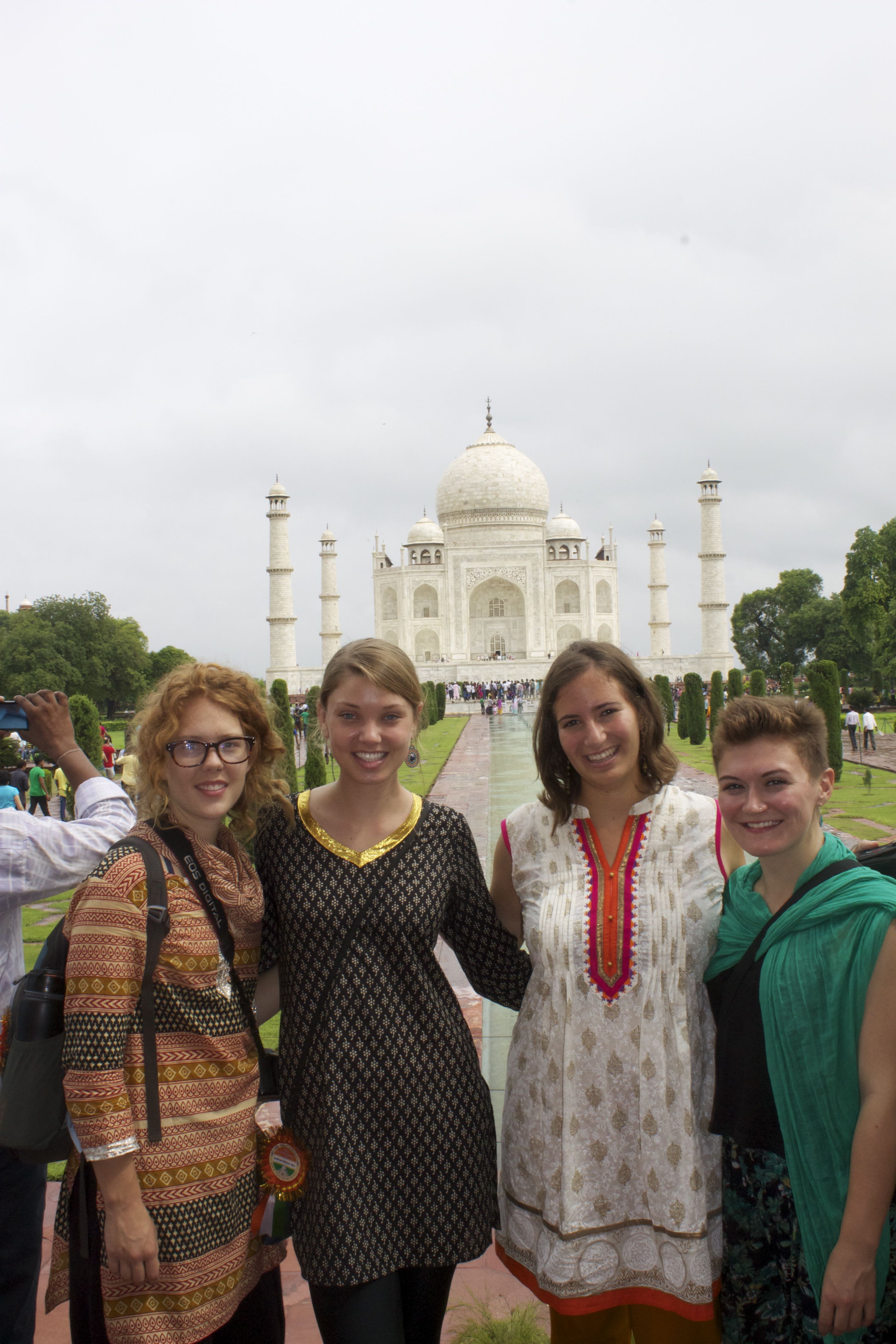
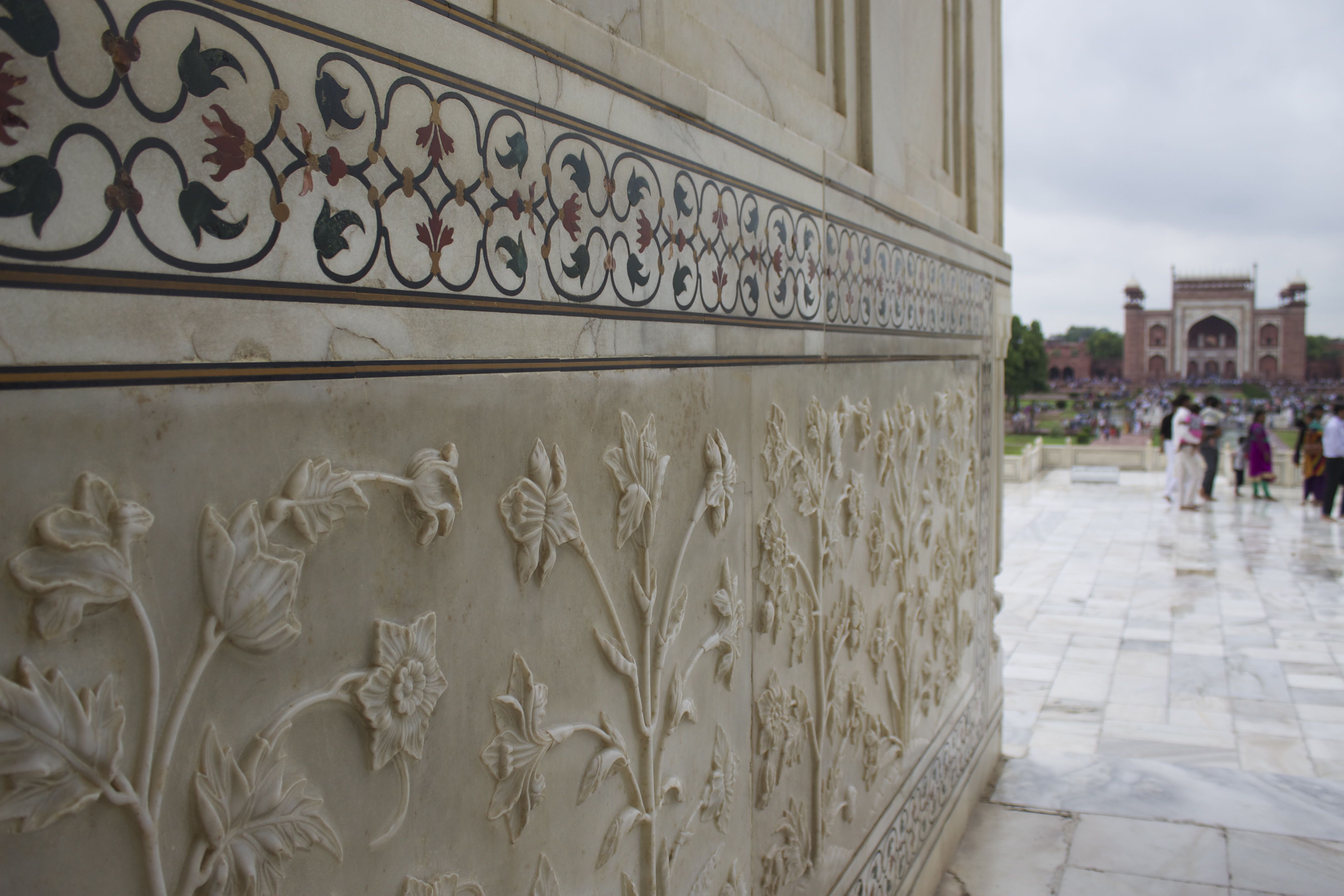
The main highlight of our trip was obviously seeing the Taj Mahal. I was a little skeptical before hand, but the Taj is even more magnificent than I could have ever imagined! Not only is it huge and glowing, but every inch is beautifully decorated with such ornate stone inlay that it is impossible to capture in a photo. We spent a whole morning at the Taj walking around the grounds and taking in the experience of being at one of the Wonders of the World! Our entire trip was a lesson on the history, culture, and religions of Delhi and Agra. We also visited many other magnificent structures in Delhi and Agra – the “Baby Taj,” two Red Forts, the Lotus Temple, numerous tombs of kings and emperors, and many shrines of religious leaders. It is difficult to count all of the sites we visited because many of them were tucked away among residential and market areas.

Taj Mahal

Our group at the Taj Mahal

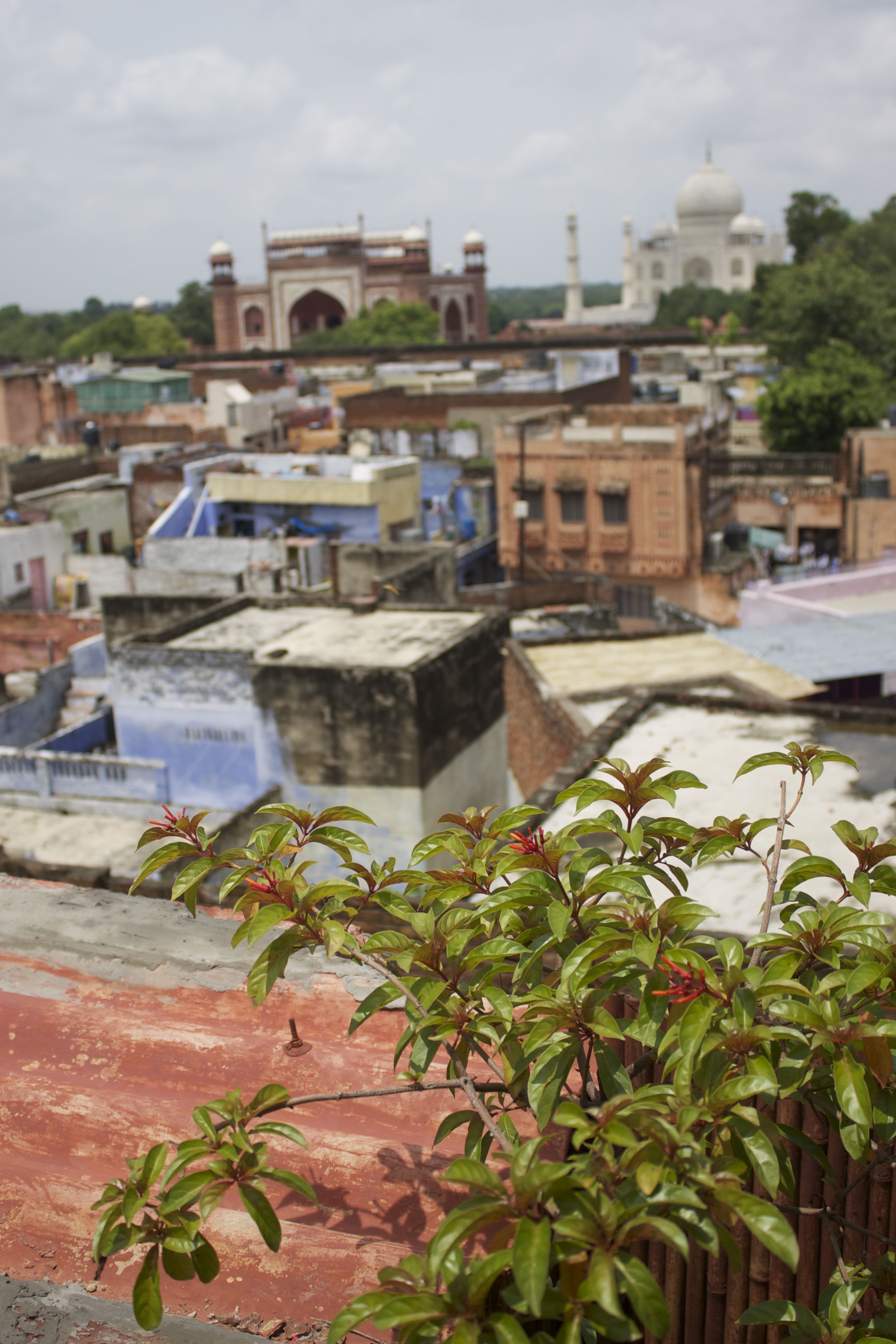
Rooftop view of the Tah

Rooftop view of the Taj Mahal

Taj Inlay and Ornamentation

Taj Mahal inlay and ornamentation

Baby Taj

Baby Taj

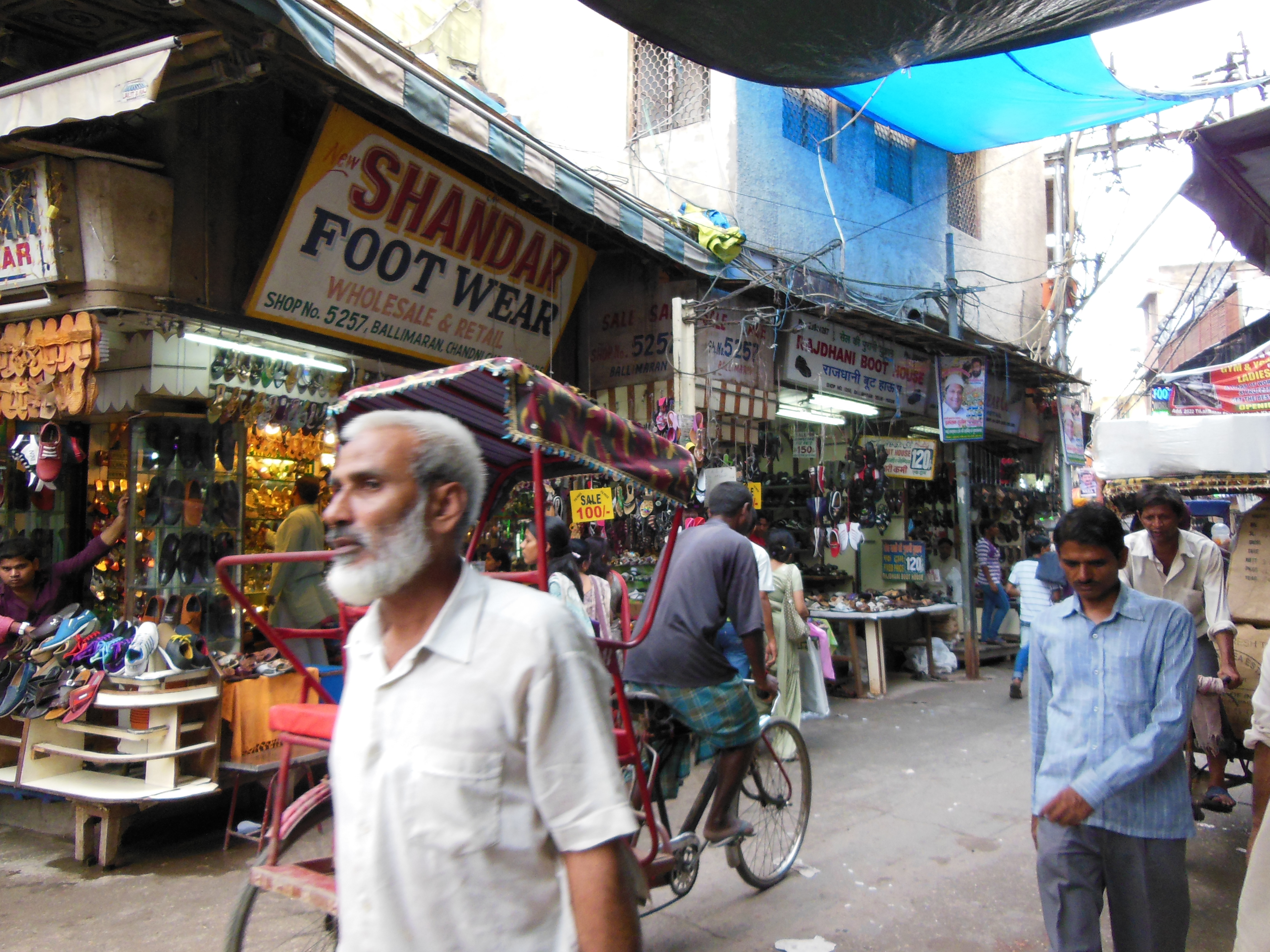
Another highlight of the trip, and the best part in my opinion, was exploring through the markets. On Wednesday, we went to a craft market in Delhi and spent the whole evening wandering through the handmade art and jewelry. On Friday, we went to a vast market called Chandi Chowk in Delhi that is supposedly the oldest running market in all of India. It is called Chandi Chowk, or Moonlight Square, because the Mughal emperor could see the moon’s reflection in a channel running through the market from the Red Fort at night. When we arrived we stayed on the main road, but we soon realized that there were small alleyways branching off in all directions that were packed with a maze of shops and vendors. The best part about the market was that it was divided into sections based on the merchandise being sold. There was one section lined with at least 20 shops selling tea and spices, and another alleyway that had nothing but shoes as far as you could see. We were in heaven!

Spice Market

Spice Market

Shoe Street

Shoe Street

We also visited a market in a Tibetan neighborhood just outside New Delhi. It was so interesting to see the immediate contrast when we arrived in the Tibetan area because it really felt like we were in a different area of the world. The vendors were selling winter clothes and Buddhist items, and the people were even dressed differently. We went to a restaurant and ate a Tibetan dumpling soup called Thenthuk, which was a refreshing change from the Indian meals we had been eating the whole trip.

Tibetan Market

At the Tibetan Market

I am so glad that we made the spur-of-the-moment decision to go to Delhi because the whole weekend was packed with exciting activities, new places, and a ton of good food. Just when I thought I was getting to know India pretty well, I found that North India is a completely different place from Hyderabad. This trip put an image into my mind of India as a patchwork of different cultures. They are all sewn together into one nation, yet each one remains distinct – from north to south, east to west, and even down to the very neighborhood. I know now that it would take a lifetime to experience all of the cultures, places, and people of India, and I am only here for one semester!


Alyssa in New Zealand: Seeing the country

August 9, 2013

It doesn’t take much effort to see beautiful parts of New Zealand. One could even say that it’s not necessary to venture out to the most iconic parts of the country. I haven’t traveled very far from Dunedin yet (four hours maximum), but I am still impressed by everything that I have seen. Each portion of New Zealand has its own kind of magnificence to it; hiking (they call it “tramping”) and camping beyond civilization this past weekend has definitely proved that.

The new adventure began last Friday when Malachi, Andras and Edward (another Kiwi host) and I decided to explore and sight see before we embarked on our weekend tramp. After much anticipation, I finally got to see my first Lord of the Rings movie sites. What surprised me most about them was they were located near such a quaint, remote area called Arrowtown. Walking through the central part of town was somewhat comparable to walking through a ghost town of the Old West. The shops were juxtaposed very closely together consisting of tourist souvenirs such as Maori greenstone (similar to jade, except much more rare and valuable) and The Ring replicas from Lord of the Rings (ranging up to $200).

As we made our way through town, I didn’t see how it would be at all possible to reach the LOTR sites. The area was so small and it seemed like there wasn’t too much to see. However, we figured out soon that we have to venture out a little further to the outskirts of Arrowtown in order to reach our destination. After making our way through open forests, we finally arrived at the area that we were all familiar with having seen the same exact site in the movies several times (it’s typically considered a well-known scene in the movie). You can’t underestimate the potential of anywhere, for you never really know what it has to offer. The fact that this setting for the movie was found near such a humble town convinces me that anywhere in New Zealand beholds some sort of unique aspect. Nothing should be overlooked.

one of the sites where Lord of the Rings was filmed

One of the sites where Lord of the Rings was filmed

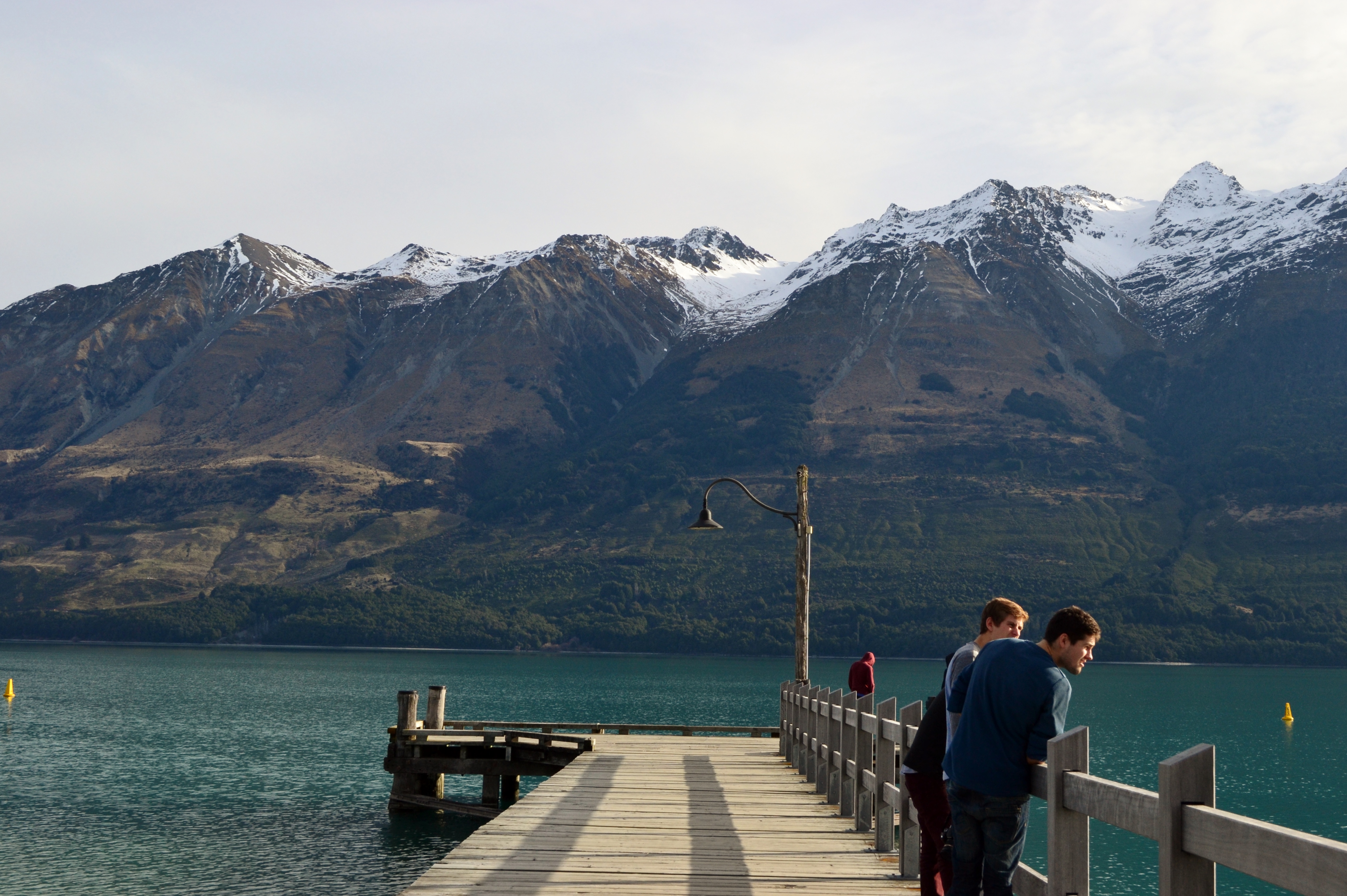
The explorations continued after we left Arrowtown and headed to Glenorchy so that we could access incredible views of the well known Lake Wakatipu. I can safely say that this area has been my favorite so far. It presented a new kind of peace and seclusion. The water was so still that the reflection of the mountains in the distance was highly distinguishable. Even though the sun was beating down hard for the wintertime, the snow on the mountains were barely affected. The entire scenery almost seemed somewhat fake, but I had to keep reminding myself that what I was seeing was not an illusion in the slightest.

A view of Lake Wakatipu on the way to Glenorchy

A view of Lake Wakatipu on the way to Glenorchy

Andras and Malachi looking out at Lake Wakatipu in Glenorchy

Andras and Malachi looking out at Lake Wakatipu in Glenorchy

I finally got a little taste of the Queenstown culture that all other international students have been constantly raving about. I now understand where all the hoopla comes from because the town itself is unmistakably full of life and excitement. Around every corner, there’s always something to do or see. The landmark that we were really looking forward to visiting was Fergburger, a recognized burger bar in New Zealand. Nothing could prepare me for the amount of food that I was about to eat, for it was the largest, yet most delicious burger that I’ve ever had. Andras ordered a burger that was practically the size of my entire head (the Hungarian was quite hungry). For the remainder of the night, we proceeded to take advantage of Queenstown by engrossing ourselves in the animated environment.

The following morning, we made our way to Wanaka in order to begin another adventure. Edward had organized a group of 27 people to hike through Mount Aspiring Park for the weekend. It’s not a well-known trek, but it allowed us to explore the less touched parts of the country. As we made our way to the starting point, we found ourselves driving further and further away from society and becoming more immersed in isolated nature. The mountains seemed to be getting bigger and the grasslands greener. Everything became more exaggerated. When we finally arrived to our starting point, it was clear that we were in a completely new environment.

Mount Aspiring Park

Mount Aspiring Park

The trek to our hut was about 2.5 hours one way. Throughout the hike, rain was coming down and it showed no mercy, yet the wetness barely seemed to phase us. Conversely, the only things that were on my mind were my surroundings. The only thing that the hut provided to us were beds. However, it was soon discovered that the beds were inaccessible due to the fact that the room was locked. Once again, none of us seemed affected by this misfortune, for we weren’t going to let it ruin the trip. Instead, we looked on the bright side and found that each others’ company was all we needed to enjoy our stay out in the depths of the mountains.

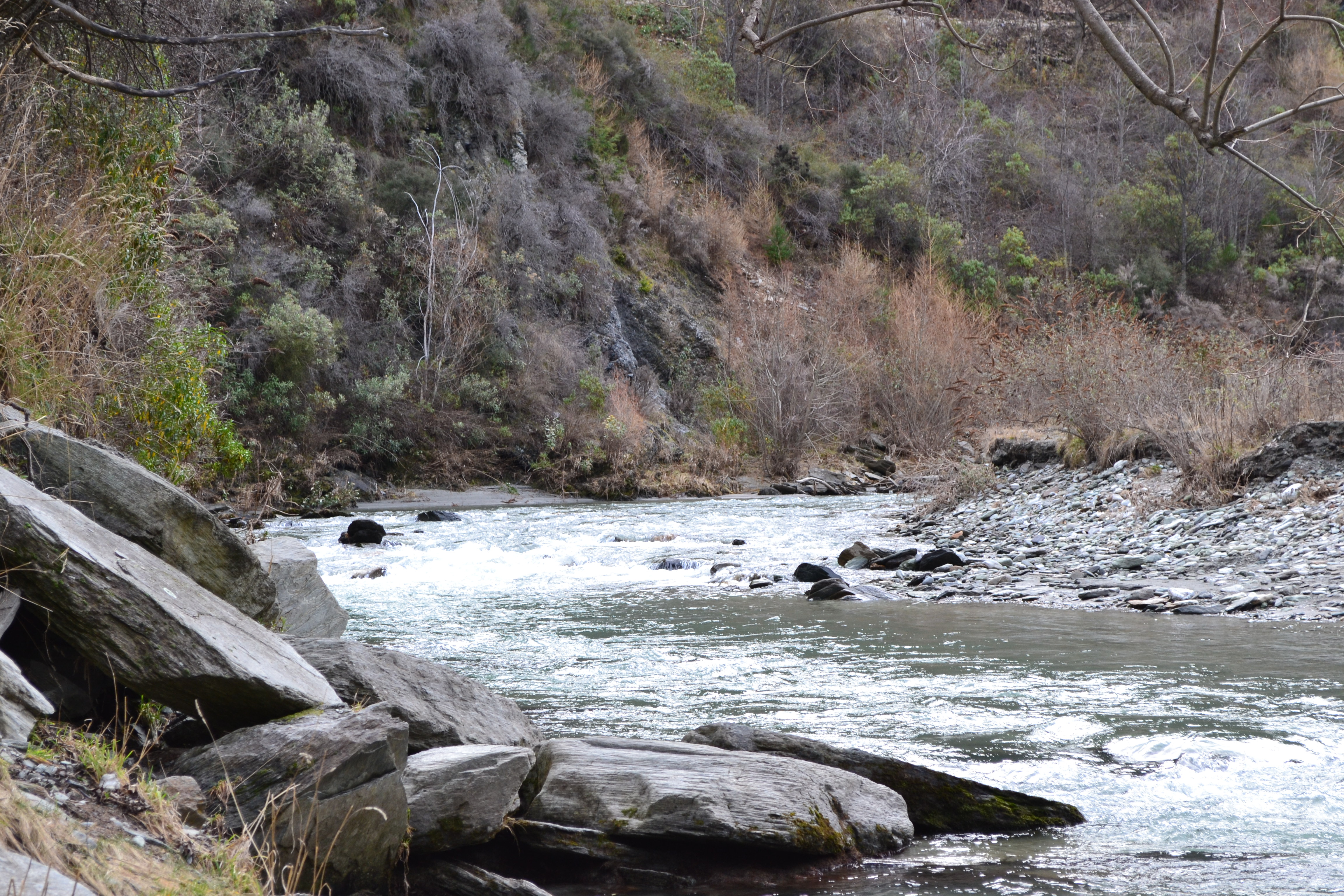
The following day, the rain continued to come down for our hike up the Rob Roy Glacier. After our 50 minute ascent, we were presented with a vast glacier and fresh waterfall. We even witnessed two avalanches. It felt so surreal finally seeing nature in action in person. For the first time on the trek, I became phased by what was in front of me.

Waterfall near the top of Rob Roy Glacier

Waterfall near the top of Rob Roy Glacier

I still find myself meeting new people with every experience. Going into the tramp, I knew a total of 8 out of the 27 people. Now that the weekend has ended, I have come out of it knowing at least 15 of those people total. Many of them in the group were Kiwi hosts and international students. After familiarizing myself with them, it’s clear that we all have the same motives. New Zealand has provided much insight into a completely new world and we have only become more motivated to explore it.

Even though we didn’t venture out to the most prominent area of the country, I was still moved by what was surrounding me. There is no doubt that I will eventually see the more well-known parts of New Zealand. However, there is nothing wrong with visiting the unconventional parts of the country for the time being, for they all have something extraordinary to offer.


Rhiannon in India: Orientation Week

July 17, 2013

After 3 flights, a night in the Mumbai airport, and a harrowing cab ride (traffic here is crazy!), I arrived at my dorm in Hyderabad at 6 a.m. on Tuesday morning. I am staying at the International House on campus with 13 American students in my group and many more from around the world. The dining hall at the house prepares authentic Indian food for us, but thankfully holds back on the spiciness and gives us purified water that our sensitive stomachs can handle. I love the food and all of the unique spices here! A local restaurant owner came to talk to our group and explained that Indian food is unique because of its many spices that must be mixed in a specific order, much like chemistry. He told us that, historically, widows in India were often confined to communal homes (watch Deepa Mehta’s Water to see it in action), so they spent time experimenting with spices and came up with these scientific mixtures. According to the restaurant owner, an Indian meal usually includes between 5 and 50 different spices!

One of the first things I noticed when I arrived in Hyderabad was that the weather is wonderful! May is the hottest month of the year in this part of India, so by now, it has cooled down to a temperate 84 degrees Fahrenheit. To make it better, the monsoon rains don’t hit Hyderabad nearly as badly as they do up north.

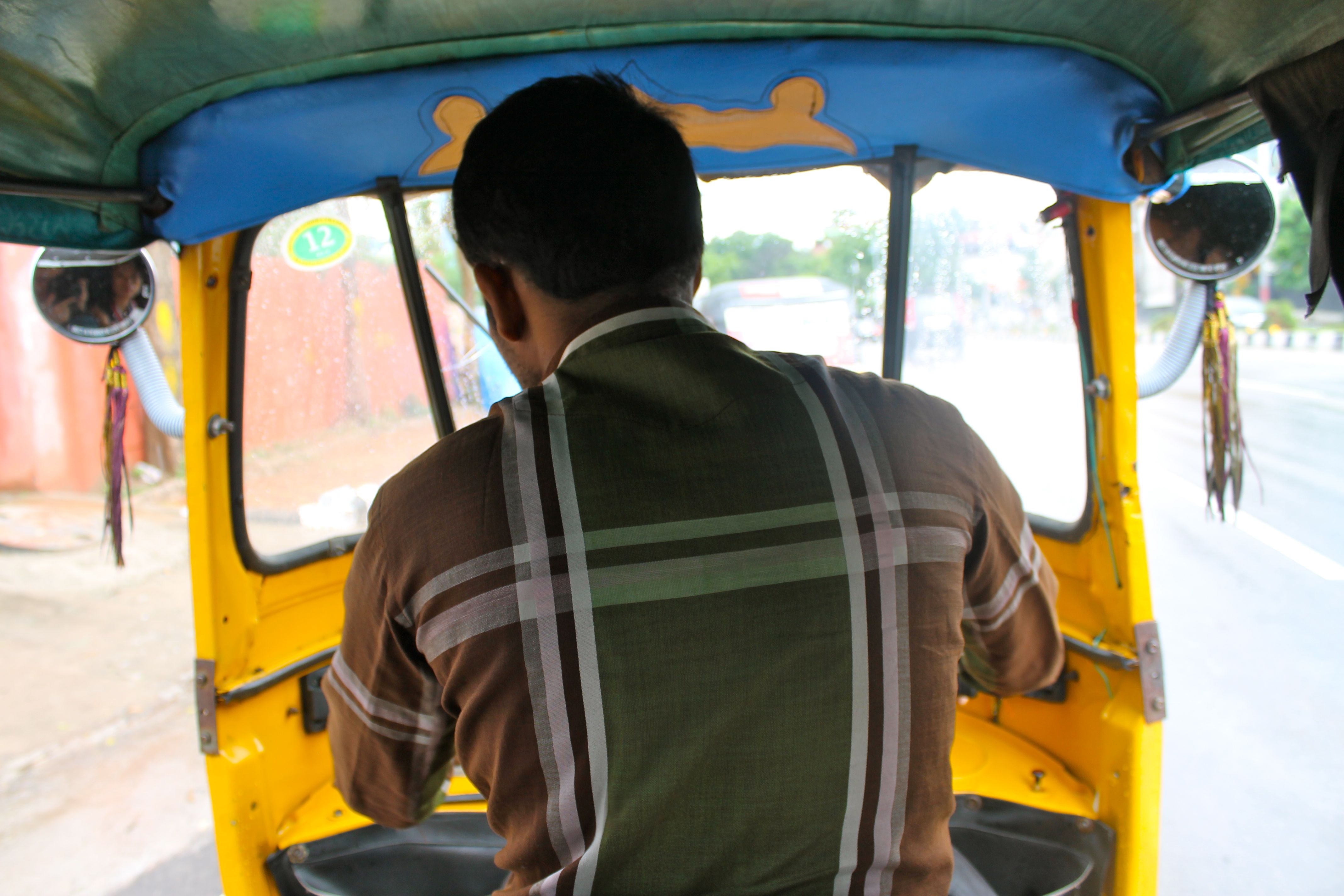
Orientation this week has been a whirlwind of lectures and excursions around the city. We have already discussed many interesting topics such as food, transportation, and living as a woman in India. After learning about transportation in Hyderabad, we split into small groups for a hands-on navigation exercise. Lead by our language peer tutors (Indian students who will be helping us with language practice this semester), we spent the afternoon taking auto rickshaws, buses, and direct autos all over the city to get used to navigating and bargaining. This just happened to be an afternoon when the monsoon was in full force here in Hyderabad, but splashing through puddles on the auto rickshaws made the day even more exciting! My friend Jennie and I, with our peer tutor Salomi, took two “sharing autos” to a restaurant for lunch, then a “direct auto” to the mall to shop for some Indian clothing. Both types of autos are open-air rickshaws, but sharing autos are cheaper because the drivers pack as many customers in as possible as they drive along a set route. Direct autos will take you exactly you want to go, but they are more expensive.

Auto Rickshaw

Here’s an auto rickshaw

Inside Auto Rickshaw

The view inside an auto rickshaw

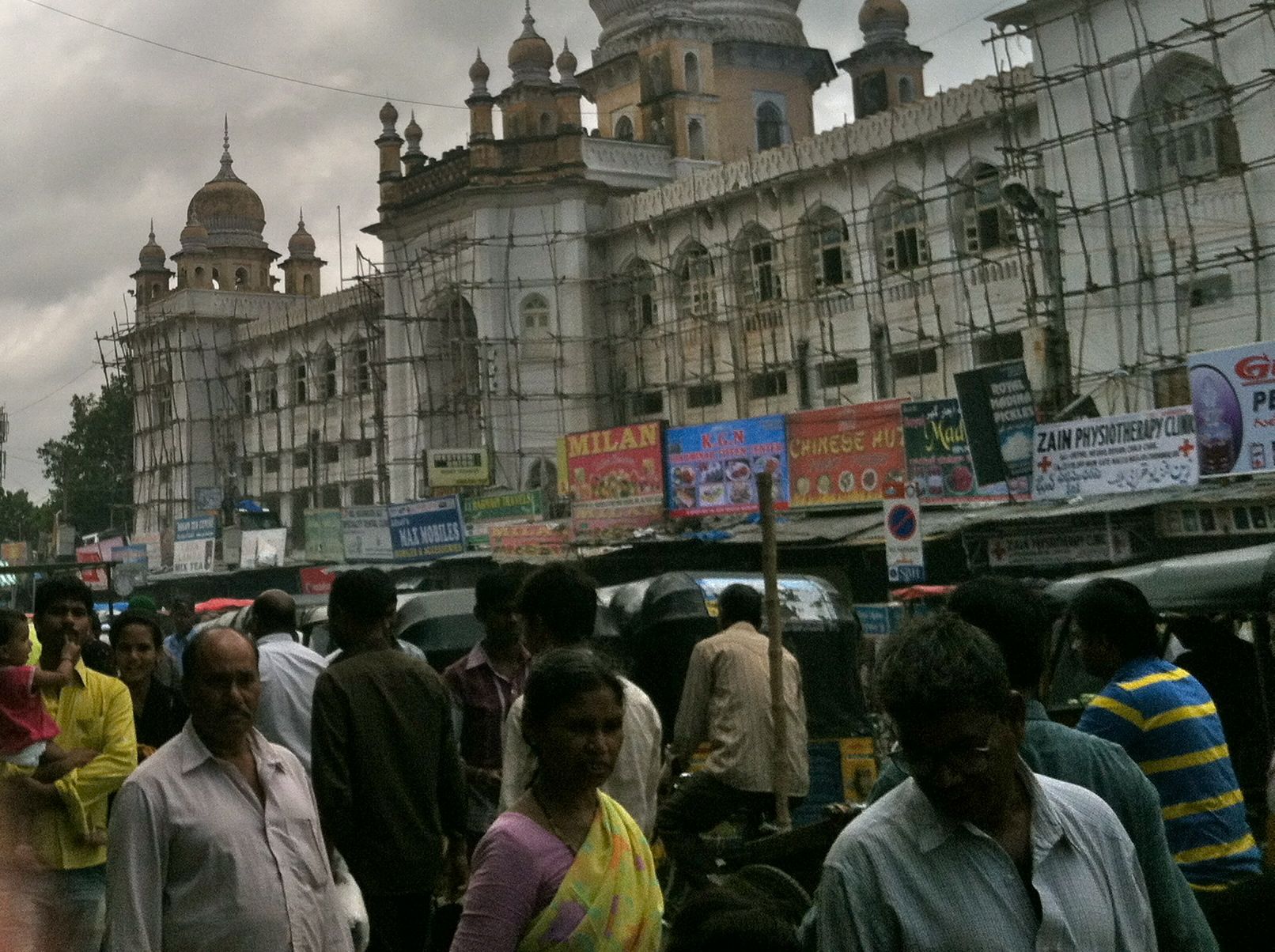
One of our trips that stood out most this week was to the Old City, which is often considered “downtown” Hyderabad. Because Hyderabad was never fully colonized, there is no trace of urban planning as there is in other Indian cities. The bustling streets of the Old City seem too narrow for traffic, but somehow cars, bikes, motorcycles, and pedestrians seem to pile on top of one another between never-ending rows of shops. Local women say that the Old City is the best place to shop for anything shiny or sparkly, including saris and bangles.

Old City

The Old City of Hyderabad

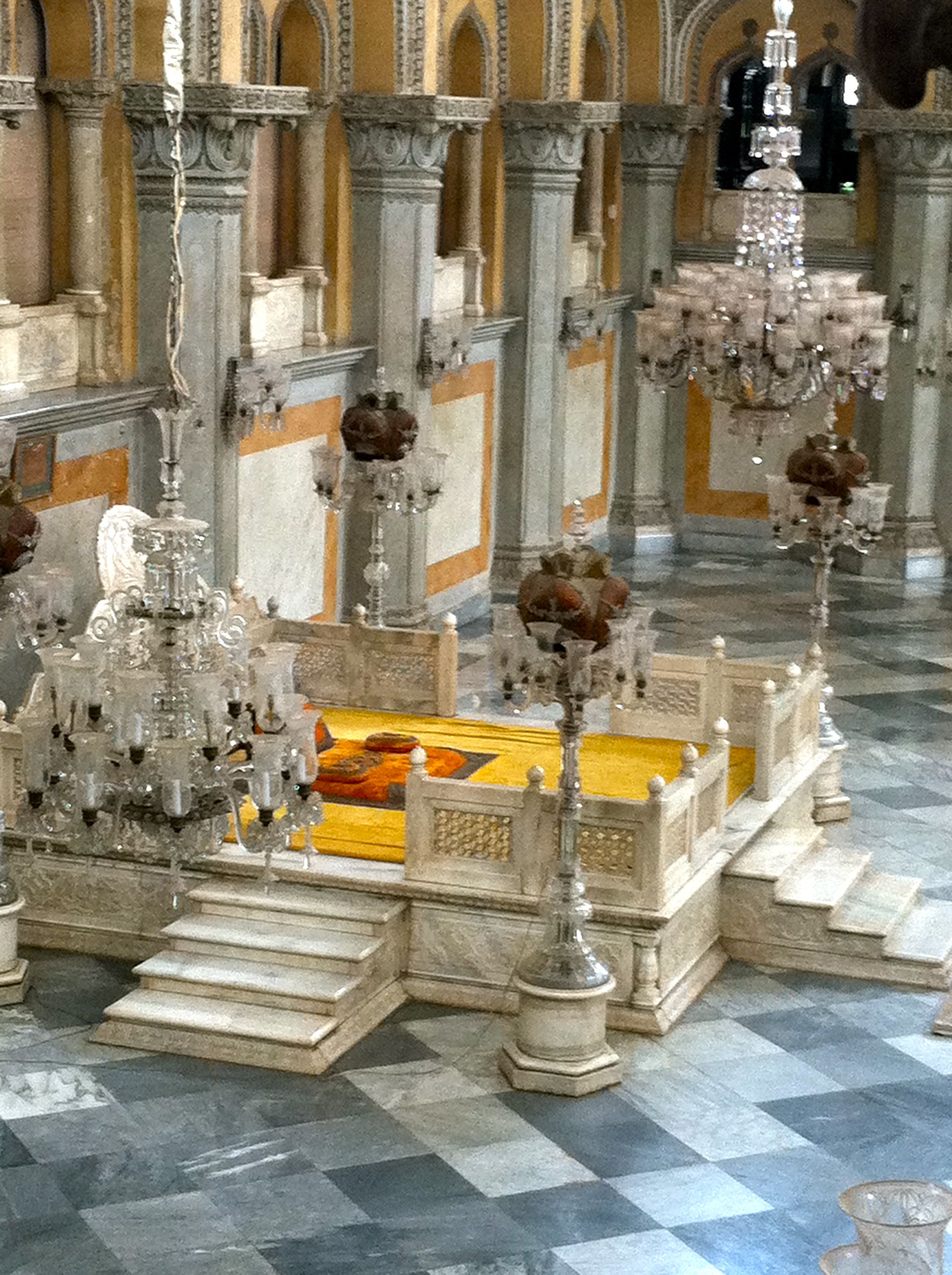
While we were in the Old City, we visited its most prominent landmarks: Chowmahalla Palace, Charminar, and Mecca Masjid. Chowmahalla Palace is an estate with four palaces, which were home to the Nizam monarchy from the late 1800s until Indian independence in 1947. The palaces, now turned into museums, are magnificent and reminiscent of a time much earlier than when they were actually used. The high ceilings are covered in ornate carvings and chandeliers, and in one of the main rooms there is even a large thrown where a prince may have sat less than 70 years ago! As we walked through the gardens of the estate, we could hear the call to worship being played over loud speakers from the Mecca Masjid mosque near by.

Chowmahalla Palace

Me at Chowmahalla Palace

Chowmahalla Throne

Chowmahalla Throne

Mecca Masjid

Mecca Masjid

Although I am staying on campus now, I will be moving into a home stay next week! I will be living with my friend Jennie and an Indian mother and daughter in an apartment about 30 minutes from campus. I am anxious to meet the family because my program directors say they are very welcoming and exciting to live with. I was a little nervous about the commute at first, but now that I am getting used to using autos and busses, I’m not so worried. Hopefully Jennie and I will have similar schedules and will be able to ride to and from campus together most of the time.

Tomorrow I will go to my first class at an Indian university! I will be “shopping for classes” at first, so I’ll just go to a few different ones each day until I decide which ones I like and which professors I can understand. I am excited to start classes because it will give me an opportunity to meet Indian students and hopefully engage in some events or clubs on campus.

I can’t believe I have only spent one week in Hyderabad! I have seen and done so many things this week that it is difficult to put it all into words, but hopefully as the semester continues, it will all get easier to process. Despite what a great week I have had, my semester really has yet to begin!