Barbados, Week 7: Partying with the Hindus

March 16, 2012

This past Sunday, March 11th, was Phagwa, the Hindu celebration of their New Year and the coming of Spring.  This was not something of which I had any knowledge, however, until my Cultural Studies professor told us about it last week.  The fact that there were Hindus in Barbados had never even occurred to me, and thus my curiosity was piqued.  I knew nothing of Hinduism, except that it had its origins in ancient India/Asia, and wanted to see how they expressed their thankfulness and positivity toward a new year.

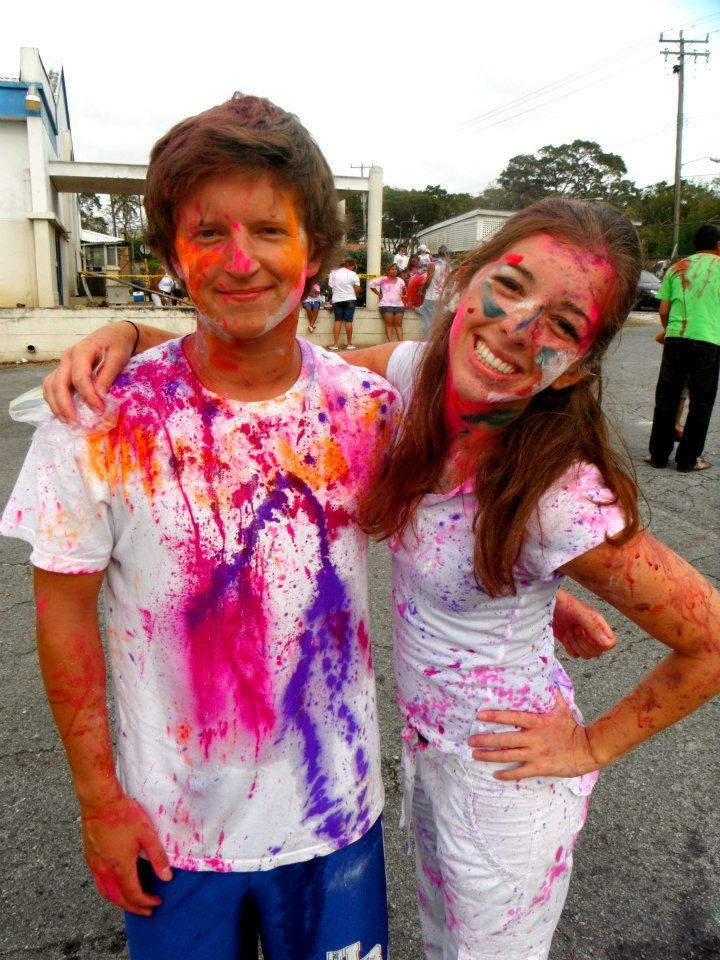
As it turns out, they do so by dousing each other in colored powder and splashing each other with paint for the greater part of three hours!  Would not have been my first guess as to the method of celebration, but it was a lot more fun than any of the students expected.  We were told to wear old clothes, and somehow everyone got the idea in their head that it would be best to wear all white; when 15 white kids wearing all white clothes piled out of the van upon arriving at Phagwa I had to laugh- it looked like we were ready for Halloween.

No sooner had we stepped out of the shuttles than people began patting us on the face with baby powder and welcoming us to the celebration.  Now we looked really, really white.  The festival was held in the parking lot behind the Hindu temple, with a large tent at the back of the lot providing shade for those who wished to sit down or simply had enough of getting paint thrown at their face.  On another side of the lot one could find tables upon tables of traditional Indo-Caribbean food and drink.  Wanting to eat my food without fear of paint contamination, that’s where I went first.  My meal consisted of curried rice and potatoes, spinach, yams, and an unknown spicy dressing.  Most people know to only take small portions of unknown foods, but I decided it was a good idea to take three heaping spoonfuls of the spicy dressing and slather it all over my rice.  Besides all of the fascinating religious and cultural things I learned during Phagwa, I think one of the most important lessons learned was that American “spicy” food and Indian “spicy” food are not on the same level…not even close.

Then things got colorful.  More people began arriving with liter bottles filled with water-based paint and bags of powder.  As musicians played what I assumed to be Hindu music on stage, everyone began running around and dousing each other with as much paint as possible.  I didn’t have any paint, unfortunately, but I bought a few bags of colored powder and went around to friends and strangers alike and attacked them with a barrage of color, albeit gently.  The gesture was returned tenfold as I was covered head to toe in red, blue, orange, pink, and green paint and powder within minutes.  When I finally looked at myself in a car window, I very closely resembled an Oompah Loompah (from Charlie and the Chocolate Factory).

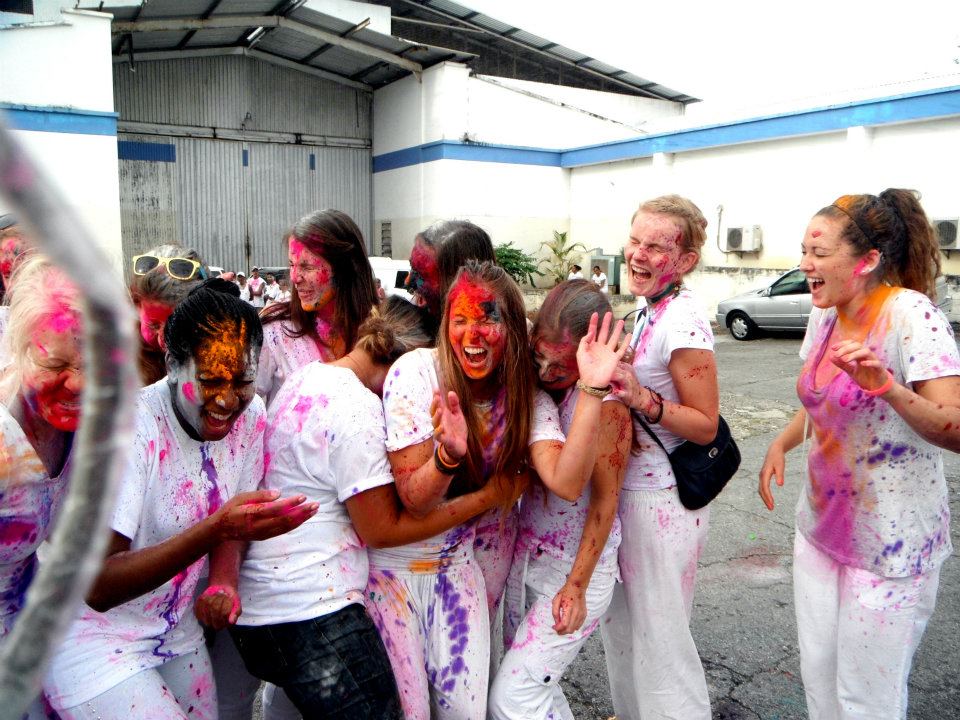
Later in the celebration they brought on a pretty eccentric performer who proceeded to take the stage and make jungle animal noises.  Supposedly he was trying to provide some context for his next displays of skill, as he demonstrated how to break open coconuts as they had done in the jungles of Guyana before the advancement of modern technology.  For his next act he proceeded to place a chicken on his head and play some rhythmic drum lines as the crowd cheered him on and danced.  I, personally, was equally impressed with the chicken’s ability to balance on the man’s head the whole time.  Before we left Phagwa, the temple pundit allowed our group to check out the Hindu temple, which featured detailed drawings and almost-life-sized statues of what I can only imagine were their sacred dieties.  A very cool experience, considering he even let us inside looking like a rainbow had exploded all over us.


Jerusalem: Steeped in Faith

March 12, 2012

On the 26th of February, I went on the  International School’s tour of Jerusalem.  It was the longest touring day of my entire life.  Leaving campus at 6:30 A.M, we had a beautiful two hour drive through farmland, small cities, and the Judean Hills to Jerusalem.  Approaching Jerusalem, it was hard to believe I was actually going to see the city that has existed for centuries in the imaginations of Jews, Christians, and Muslims as a city of great holiness and significance to their faith.  Jerusalem is the object of songs, poetry, paintings, and religious longing for so many throughout the world, and I now had an opportunity to experience it for myself.

Somehow, though, the reality is quite different from the idealized images and feelings many have come to associate with Jerusalem.  The tension is almost tangible, and as we visited King David’s tomb, the site of Jesus’ Last Supper (a former church that has now been turned into a mosque), the Western Wall, and the Church of the Holy Sepulchre, I realized the extent to which the people and faiths of Jerusalem live intertwined with each other, yet are distanced by the conflict and perpetual state of unsettled feelings between the varied groups within the city.  Jerusalem is a mixture of so many different people, with such widely varied backgrounds.  Israeli soldiers carrying guns walk through the streets across from Catholic nuns in their habits, and groups of American tourists with their huge cameras and enthusiastic tour guides make their way through the vibrant, lively Arab market.  I was struck by how you can often tell what group someone is affiliated with by their clothes or head coverings – Orthodox Jewish married women wear a different head covering than the hijab of Muslim women, and Hassidic Jews in their tall black hats stand out from the other Jewish men wearing kippahs, or smaller head coverings.  The clothes they wear identify the differences they have with each other, making the religious and cultural divisions within the city physically apparent.

In both my Biblical Theology and Literature of the Shoah (Hebrew word referring to the Holocaust) classes, we have discussed the idea of memory, and how it influences and shapes people and nations.  Reflecting back on my time in Jerusalem, I realize that national memory is one of the factors that make Jerusalem so important.  Jews pray at the Western Wall because it is a tangible piece of their national memory. The Wall is all that remains after the destruction of the Second Temple, but it stands as a symbol of what they have survived as a people.  Jerusalem is full of symbols, from the Dome of the Rock standing on the site of Mohammed’s Night Journey as recounted in Muslim tradition, to the Mount of Olives, turned white by the graves of Jews awaiting the Messiah’s arrival.  Made up of physical locations that past events or promises for the future have made crucially important to so many, it is no wonder Jerusalem is one of the most fought over places on earth, historically and today.

Sometime before this semester ends, I want to visit Jerusalem again, but this time to take it slower, letting the experience sink in more deeply.  I need a fuller picture in order to begin to understand the city.  There was a lot I didn’t see, and a lot I need to see again before I can begin to process the full significance of what Jerusalem stands for.


Belonging

February 24, 2012

In Hebrew, there is no “to be” verb in the present tense.  I studying Hebrew.  Kind of awkward, right?  My brain always wants to stick another word in there, forcing the sentence to comply with my English-centered demands.  I’ve realized I am expecting more than just the language of Israel to fit my idea of what is ‘right’.  I want the washing machines to wash my clothes like they do in the US, I want my salad dressing to taste like it does in the US, I want to just walk in and out of a shop on the street without being hassled by the overbearing shop owner, I want people to wait politely in line at the bus stop instead of always shoving their way to the front. But there is something really amazing about realizing the rest of the world doesn’t do everything exactly like you do.  And when you can get over trying to find the American equivalent for everything, you allow yourself to truly become a part of your host culture.

Last weekend, two friends and I traveled to Sefad, a small, heavily religious city a couple hours by bus from Haifa.  Winter probably isn’t the best time to travel to Sefad — it was cold and rainy most of the time, and it even snowed!  The owner of the hostel we stayed in was really excited about the snow, so it was hard to be annoyed at it for spoiling our plans.  Israel really treasures its water, so I have really tried to have a good attitude about the copious amount of rain we have gotten the past couple of weeks.  Despite the weather, we managed to have a nice, cozy time, except for two hours on Saturday when our power was out due to the rain. Sefad is beautiful, and I was amazed by the height and beauty of the mountains surrounding the city.

When I arrived back in Haifa late Sunday afternoon, just as the sun was setting, I realized how much I have come to love this city.  I feel like I have really become a part of Haifa’s diverse, beautiful community.  I don’t miss UR like I thought I would.  There is so much to discover and accomplish here, both in my language learning ambitions and in growing as a person.  The surreal feeling I have had since arriving here has started to fade, and in its place has grown a sense of belonging and permanence.   For a country whose right to exist is constantly questioned by the international community, and one that seems to stand perpetually on the verge of international conflict, life in Haifa is surprisingly rhythmic and normal.  Falling into that rhythm has been one of the greatest things I have ever experienced.


Shabbat Shalom

February 10, 2012

There is something really intriguing about a country that truly takes a day of rest.  Every Saturday in Israel, shops and businesses close down, buses don’t run their normal routes, and most of the people you see are taking their children to the playground or having a peaceful walk.  After three intensely packed, exciting weeks of classes, tours, making friends, and finding a rhythm to life in a new place, taking this time for reflection and processing has felt more needed than ever before.

Even though it takes more advanced planning to make sure you have all the groceries and things you need before the stores shut down late Friday afternoon, I love the feel of Shabbat.  In my opinion, it limits you to the most meaningful ways of spending your time, whether it is time spent growing closer to God or building meaningful relationships with the people around you.  Last night, I had a quiet dinner with three friends, and it was a wonderful time spent talking through the challenges and joys of our time in Israel thus far.

Last Shabbat, three friends and I hiked from the university to the beach.  We left the university around noon, and made it to the beach just after sunset, after five intense hours of scrambling down the rocky trail running through the national forest that parallels to the city almost all the way to the beach.  At least it was all downhill!  At one point, we came to a fork in the road and were unsure of the way.  Luckily, there was an Israeli family who had stopped for a break right there on the path, and we were able to get some directions from them.  But it wasn’t just a quick exchange like an encounter would have typically been in the US; they engaged in further conversation with us, asking how long we would be in Haifa, and when they found out we were students, asked what we were studying.  I feel like this interaction exemplifies the relaxed, relationship-oriented atmosphere of Shabbat.  Overall, though, Israelis have been incredibly helpful and generous in all the encounters I have had with them so far.

One thing about adjusting to Israeli culture that has been interesting is that there is not one, but many cultures for me to adjust to.  Within the international school, there are students from all over the world, each with their own perspective on life and Israel, and within Israeli culture itself, there are many differences.  The respectful, gentle personalities of my Arab roommates contrast with the more blunt and outgoing personalities of the Jewish Israeli roommates some of my American friends live with.  It is quite a culture study!  At times, it feels like I am studying abroad in multiple countries at once.

I have been learning Hebrew at an alarming rate, although I’m still trying to get confident enough to practice in front of people outside of class.  I have been trying to order at the little sandwich counter on campus in Hebrew whenever I have a break, and the guy who runs it always smiles to himself as I struggle through the words.  I am getting better, though!  Although I have realized more than ever that learning Hebrew is a lifelong process.  But I’m taking this as a challenge, to see how much I can learn in the few short months I am here. We just have one week left of Ulpan (my intensive Hebrew class) — I can’t believe how it has flown by!  This has been the most intense language learning experience of my life, but also a very fulfilling one.  Next week, we start our regular semester classes, and the Ulpan group of 97 people will be joined by about 25 more international students, but we will also lose some students that were here just for the Ulpan.  That will give me even more to get adjusted to, but I am excited about meeting even more new people!

Ruins of the ancient city of Caesarea — some of which weren’t uncovered until 1992.

Hummus in Akko, an old crusader city just north of Haifa.

Me on our epic hike!


The Mosaic

February 6, 2012

Shalom all!  I have arrived in ארץ ישראל, the Land of Israel!  Many things are exactly as I expected, but there have also been some surprises.  For starters, I wasn’t prepared for how beautiful Haifa would be!  All the pictures I looked at before I arrived don’t even come close to conveying how amazing it feels to look out over the city, the mountains, and the Mediterranean Sea on my walk to class.  The University is situated on one of the highest points of the city, so you can see everything from here.  Someone even told me on a clear day you can see all the way to Lebanon, but I have yet to hear that from an official source.  We also haven’t had too many clear days yet, as it is the rainy season right now. We have a rain shower or thunderstorm almost every day, and it is usually overcast–  although still beautiful!

The incredibly diverse mosaic of peoples and cultures blending together in this beautiful city are unlike anything I have ever experienced.  The university is a microcosm of this.  My intensive Hebrew class is made up of six Korean students, one Japanese student, a grandfather from Vermont,  four Europeans (mostly PhD or graduate students), and six Americans.  It has been fascinating to learn of the different cultural backgrounds and motivations that have brought us all together in a classroom in Israel.  From the Japanese student of theology wanting to learn Hebrew in order to read Biblical texts in their original language, to the Political Science PhD student from Belgium interested in the political conflicts of the Middle East, our motivations for studying Hebrew are as widespread as the countries we come from.  The fast pace of the class has been overwhelming at times, but today when I took the midterm, I realized how satisfying it was to take an exam that involved reading a story and answering questions entirely in a language that two weeks ago I knew almost nothing about.  I’m really looking forward to having a working knowledge of Hebrew, and at the rate I am going, I am hopeful that it won’t be too long before I can navigate places like the grocery store with ease.  Even simple things like buying laundry detergent have been difficult. I almost bought bleach…oops! That would have been a disaster.  And I have to guess a lot when I am ordering food.  Although, the other day, I ordered coffee in Hebrew — I was quite proud of myself!

Last week the Madrichim (the social activities coordinators for the international students at the University of Haifa) took us on a tour of Haifa.  We explored the Arab Quarter, which included a large shouk, or outdoor market, with piles of fresh fruits and vegetables, fish, bread, spices, dried fruits, nuts, and olives.  We also went to the (reputedly) best falafel shop in Haifa, and a shop with delicious Arab sweets dripping in honey.  On a street running through the Arab colony, we saw the remains of their celebration of the “Holiday of Holidays” during which they celebrate Chanukah, Christmas, and Eid al Adja, the holidays of the three monotheistic faiths, all in one.  We also toured the central shrine of the Baha’i faith, and the German Colony, which was originally established by the Templars.

I am really excited about exploring the many layers of Haifa.  On Tuesday, the Madrichim took us on a hike to Elijah’s cave, believed to be the site of Elijah’s stay on his way to confront and defeat the prophets of Ba’al on Mt. Carmel.  During the hike, we passed a couple of bunkers built by the Israelis several decades ago, intended to be a last defense in case of attack.  So, side-by-side, you have Elijah’s cave standing as a remnant of ancient Israel and the spiritual battles that took place in the land, and the bunkers, evidence of the modern State of Israel’s current reality.

The adjustment to living abroad has been harder than I expected.  It is like the awkwardness of the first week of freshman year, but intensified by the new and foreign cultures and languages surrounding me.  It really helped that I was warmly welcomed by my five Arabic-speaking apartment mates, who have been fixing me delicious food and are eager to practice their English with me.

I am so blessed to have this opportunity to study here, and  I am eagerly looking forward to the friendships I will make and the many amazing experiences I will have over the next four months!


Home is behind, the world ahead…

January 16, 2012

Hello there!  I’m Rebekah, and I am a junior geography major at the University of Richmond. I’m from Syria, Virginia, a small town in the foothills of the Blue Ridge Mountains.  I love hiking, learning languages, archaeology, and Biblical history.  This semester, I will be studying at the University of Haifa in Haifa, Israel.  I was drawn to Israel because of its rich cultural, religious, and political significance in the world today.  Founded in 1948, the State of Israel is home to a wide variety of Jewish people with heritages from all over the world, as well as Muslims, Christians, and other religious sects, creating complex dynamics of culture and national consciousness.

A few weeks ago, I called the Israeli Embassy to ask about something on the student visa application that was confusing me.  The questions were in Hebrew, with English translations, and they were ordered like this:

Category of residence permit:                             Dates of previous stays in Israel:

I said to the receptionist who answered the phone, “I’m confused by this question.  Which ‘category of residence permit’ would a student visa fall under?”  to which she replied, after a moment’s pause, “See the question to the right, ‘dates of previous stays in Israel’? It is asking what category of residence permit you had during any previous stay in Israel.”

Oh, right.  I knew that.  Read the questions from right to left, just like the Hebrew language is read from right to left.  I have a feeling this won’t be the only time this confuses my Indo-European brain.

A popular travel saying goes, “when you pack, lay out all your clothes and all your money.  Then take half the clothes and twice the money”.  I keep reminding myself of that as I try to cram four months’ worth of clothes — for weather ranging from chilly and rainy to hot and dry, and for occasions ranging from dining at nice restaurants to backpacking in the Galilee — into one suitcase.

On Monday, the 23rd, I begin a Hebrew Ulpan, an intensive language program that will meet for five hours of class (with an expected three hours of homework) five days a week for the first three weeks of my time in Haifa.  Even though the intensity is a little intimidating, I am really excited at the prospect of completely immersing myself in a language, with no other classes to distract me.

My younger brother observed the other day, “Life is like a grapefruit.  It’s up to you how much you get out of it.”  I thought that was quite wise, and have adopted it as my motto for this trip.  I know I could take a passive approach to my time abroad, clinging as close as possible to what is familiar and comfortable, or I could actively immerse myself in the language and culture, seeking to gain as many experiences and life lessons as I possibly can in a few short months.  I want to squeeze this grapefruit for all it is worth.

Am I nervous? Maybe a little.  This won’t be my first solo international travel, but it will be the first without a familiar face to greet me at the other end.  But I am much more excited than nervous.  I’m excited about the people, the language, and the beautiful land with all the incredible spiritual significance it holds.