Rhiannon in India: A South Indian Adventure

December 12, 2013

As I wrote in my last post, I have been traveling around South India for the past two weeks on a lightening-speed tour of Kerala and Karnataka. Kerala, one of the southern-most states in India, is often considered a country apart from the rest of India, and better yet, “God’s Own Country.” In Kerala, my friend and I visited Kochi, the seaside state capital; Munnar, a chilly hill station among the Western Ghats; and Alleppey, the go-to town for boat rides on the backwaters. After two overnight bus rides north to Karnataka, we visited Udupi, home to many Hindu temples and the birth place of the dosa; Hampi, a tourist haven surrounded by beautiful landscapes and ancient ruins; Bangalore, the bustling business hub of the south; and Mysore, a smaller city known for its palace and yoga ashrams. The whole experience has been a whirlwind of historical sites, markets, beaches, and mountains, and I am already having trouble keeping everything straight in my memory. However, there are a few exceptional experiences that I am confident will stand out in my mind for years to come, and those are the ones I would like to share here.

IMG_6337

The tea plantations in Munnar

One of our first stops in Kerala was Munnar, a bumpy, nauseous five-hour bus ride from Kochi, tucked within the Western Ghats. As we approached Munnar on the summit of a hill, the air quickly got cooler, the scenery got greener, and I was immediately happier. Tata, a multibillion-dollar Indian corporation, owns most of the land surrounding Munnar and has turned it into profit by covering the land with tea plantations. From the road, the tea fields look like a rolling, rippling, sea of perfectly manicured green hills, occasionally peaked by a rocky summit. We spent two days touring the beautiful tea plantations and other areas around Munnar, including waterfalls and a wildlife sanctuary where we saw the rare grizzled giant squirrel, but sadly missed out on the rumored mountain goats and wild elephants. The whole time we were in the mountains, I was in awe at how many different foods are grown there – tea, coffee, bananas, sugar cane, black pepper, papaya, coconuts, and many more.

IMG_6326

A village near Munnar

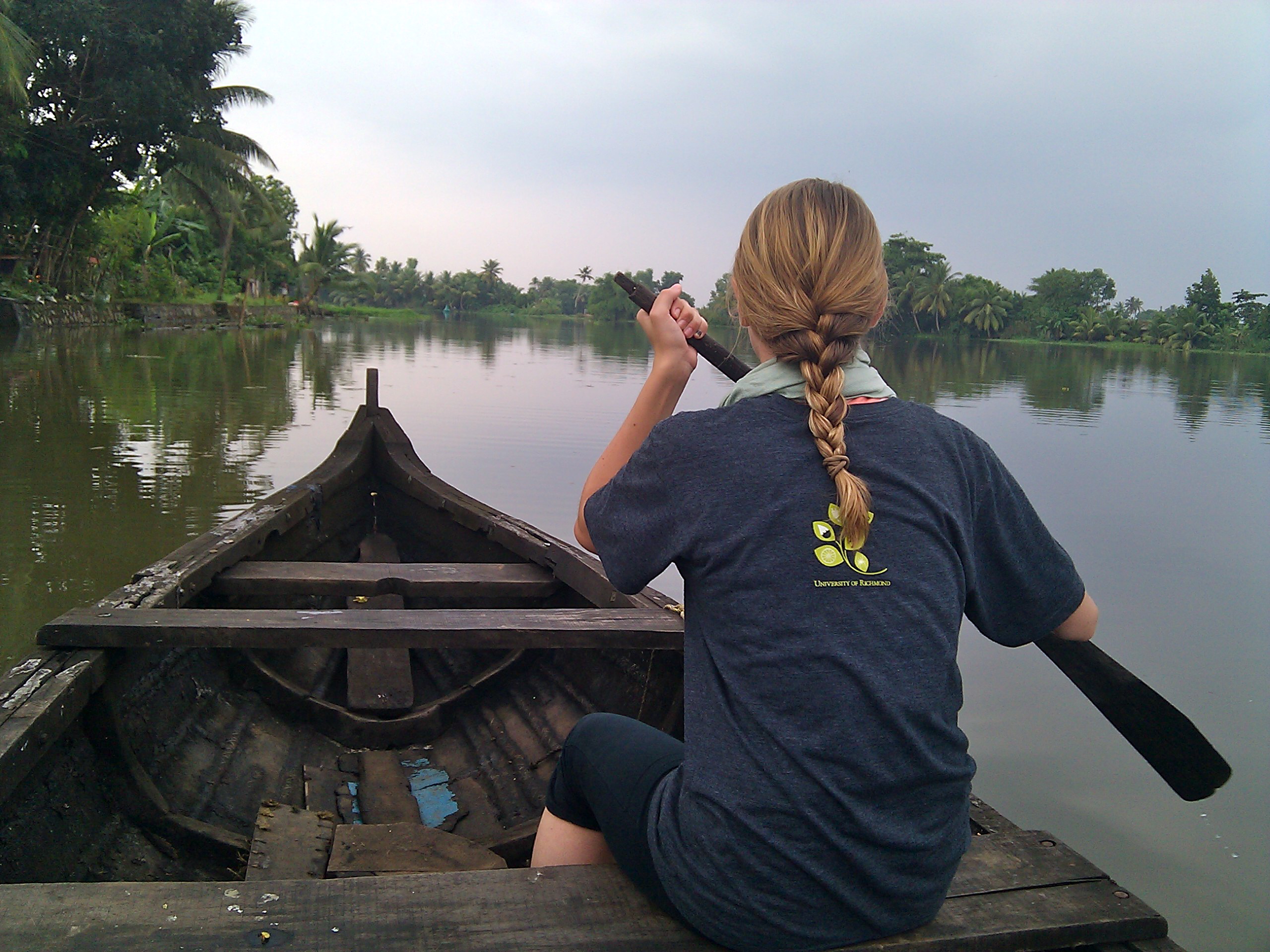
We left Munnar in the hopes of catching a once-daily direct bus to Alleppey, but when we got to the bus station, we were informed that the bus had been cancelled that day. Instead, we took three separate buses, zigzagging our way in the general direction of our destination, finally giving up in a small town and sharing a taxi with a nice Canadian couple for the last hour. When we finally got to our hotel late in the evening, the hotel owner told us that the cheaper room that we had reserved was actually taken, but graciously gave us a more expensive room for the same price. Little did we know at the time that it was an off-site cabin in the middle of a rice field that took 30 minutes in an auto and a boat ride to get to! Despite our confusion getting to our “room” after a long day of bus riding, staying in the cabin was an awesome experience. We were right on the edge of a backwater canal in a long row of village houses, right across the water from a man named Babu who had a canoe and would take us on canoe rides for 200 rupees an hour. We spent a lazy morning canoeing through the village with Babu, who knew everyone and had to stop every 15 minutes to talk to his friends along the water. That afternoon, we rented kayaks and toured some of the most beautiful areas of the Alleppey backwaters.
IMG_20131124_093745

Canoeing in the backwaters near Alleppey

IMG_6412

Sunset over the Arabian Sea at Alleppey Beach

Traveling through South India these past two weeks has been one of the most exciting and interesting times of my life, and I am amazed at how much I have learned in such a short time. As my return home quickly approaches, I hope that I will be able to make the most of my experiences here – especially what I have learned about how different cultures can be, but at the same time how similar we are as people. It continually surprises me that, although the details of daily life may be different from country to country or even region to region in India, we have much more in common than what may be seen on the surface. Now that these two weeks are over, I can’t wait to see my friends and family once more in Hyderabad, then head back to Raleigh, North Carolina!


Mel in Chile: A lot of time in a few places

December 3, 2013

Last week I went back to Valle Elikura, the location where we engaged in a home stay about a month ago with my study abroad program.

I went back this time because of two main reasons. My research project is an analysis on the experience with community-based tourism in the area. I gave some interviews when I was there with the group but as my research developed and I had a better grasp of the topic in question, I naturally developed questions that were more analytical. Ready with my informed consent forms, I walked down to the bus station as if I was walking to my deathbed, to buy tickets for the overnight nine-hour bus ride to Cañete. My journey would not end there; from Cañete I needed to take another hour-long bus ride to Valle Elikura.

Nevertheless I arrived in Valle Elikura early Sunday morning. Silvia was my host mother when we traveled with my group and I had called her prior to my coming to ask if I could rent the cabin again. She cheerfully agreed and told me she would also provide all three meals. Silvia had left the house early to come meet me at the location where the bus form Cañete dropped me off.

I arrived at the cabin fourteen hours after I left my home in Santiago.

I took the rest of Sunday to rest. Valle de Elicura is an incredibly peaceful place. My room in Santiago faces a very busy street so I was more than happy to trade in the noise of 8 am traffic for the chirping of birds.

I began Monday by starting my work right away. As I greeted familiar faces in Valle de Elicura I felt more and more comfortable every time I spoke with someone I had previously met. This is when I suddenly and pleasantly realized that coming back to visit a place for the second time is an entirely new experience. I enjoyed going back to the river where I ran by on my first visit. After some exploring I found a beautiful meadow. As I lay in the grass, tranquil, away from noise, distractions and other people, I could not help but feel as though I was inside my own conscience. I allowed myself to bathe in this beautiful solitude.

I stayed in Valle de Elicura until Wednesday. I ate all of my meals with Silvia, Lautaro, and Kata (Silvia’s husband and granddaughter). I enjoyed staying with Silvia’s family the first time, but this was even better. It is precisely what I referred to in the above paragraph. I went to visit the people I had interviewed a month ago. The feeling of familiarity, of “Hey! It’s nice to be here again. Nice to see you, how is everything?” is something that feels incredibly warm for me.

Many people have a thirst for constant travel; to hike through as many beautiful mountains as possible, to visit vibrant cities, to jump around countries and see different cultures.

I imagined I would have the same mentality during my study abroad semester in Latin America.

I can assert with confidence that I belong to the other group. I found that I subscribe to the spend- a- lot- of- time- in- a- few- places  philosophy of travel.

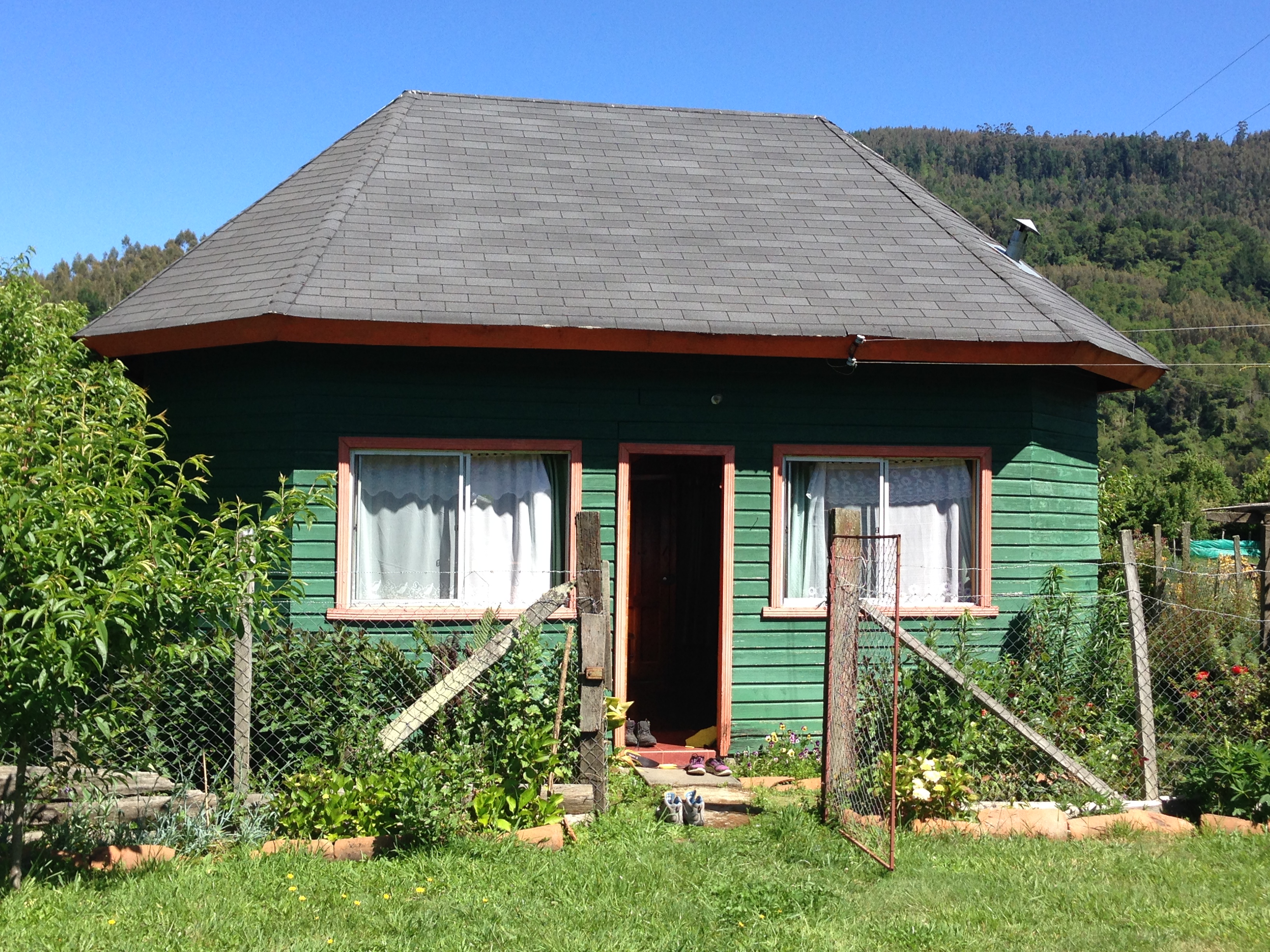
cabin

Silvia’s cabin in Valle de Elicura


Rhiannon in India: A Trip to the Beach

September 17, 2013

This weekend was another holiday, so Jennie, Romi, and I took a long overdue vacation south to Pondicherry and Chennai. After traveling north to the bustling capital a few weeks ago, we wanted a more relaxing destination – and we got it!

After we finished classes on Thursday, we boarded another Sleeper train with a 14-hour ride to Chennai ahead of us. Now, if you know anything about Bollywood or Indian pop culture, you are probably wondering if we traveled on the Chennai Express. Chennai Express is a very popular movie in India right now featuring two of Bollywood’s most famous actors – and it takes place on a train to Chennai. Unfortunately, our train was called Charminar Express rather than Chennai Express, but we took a few movie-like photos anyway.

Chennai Express

Before our trip to Chennai, we had a Chennai Express photo shoot

Even though we were in the most budget option of Sleeper compartments once again, the whole trip was very enjoyable. Truthfully, we were delighted to have seats on the train at all because, when we booked our trip online, we received RAC tickets (sort of like waiting list spots) and didn’t get our confirmed seats until two days before our trip! If we had boarded the train with RAC tickets, we would have had to share our bunks for the entire 14-hour ride, and we may have been separated. Luckily, after two weeks of watching our waitlist numbers get closer to zero on the website, we finally received our confirmed tickets and boarded the train to find three full bunks just for us.

One of the best parts of the train ride was the company we had in our compartment. An older Telugu-speaking couple sat across from us and, although we could barely communicate using English, somehow we shared food, laughed, and interacted with each other and had a wonderful time that night. There was also a young man in an RAC seat nearby that spent over an hour giving us suggestions for things to do in Pondicherry and Chennai. He seemed really enthusiastic to share information about temples, beaches, and festivals with us. Even after everyone had gone to sleep in their bunks, the old man and a younger man nearby, although strangers before the trip, sat up and chatted over chai for half the night.

After sleeping through the night in my little bunk on the train, I woke up early, waved good morning to the old lady across from me, then looked out of the little crack of the window visible from my bunk. I could not believe my eyes. The scenery was probably one of the most beautiful things I have ever seen! We were in the middle of green patty fields and marshlands, and every once in a while we passed through a village of small houses and huts. We passed people in the fields playing an early-morning game of cricket, and others in the villages getting ready for work. The train was following the coast, so in the distance I could see the Bay of Bengal, dotted with colorful sailboats. The best part was that the sunrise was reflected in all of the water collected in the fields and marsh from the monsoon rains.

When we pulled into the Chennai station, we had a quick breakfast and headed straight to the bus station to catch a three-hour bus south to Pondicherry. Pondicherry was a French settlement until the 1950s, so there is still a lot of French influence there (now mostly in terms of tourists), especially in the French quarter, a quaint little neighborhood on the beach. As we drove into Pondicherry, I noticed lots of flags that were a mix of the French and Indian flags. In the French quarter, all of the street names were French, many people spoke French, and people even said “salut” or “bonjour” to us on the street. We also had plenty of French food, coffee, and chocolates in the many French cafes all over the area. It was like we were in a totally different India! Being there reminded us of how many different cultures there are to see in India, and how no two are alike.

Colorful Pondicherry

All of the streets in the French Quarter were lined with colorful houses and hotels

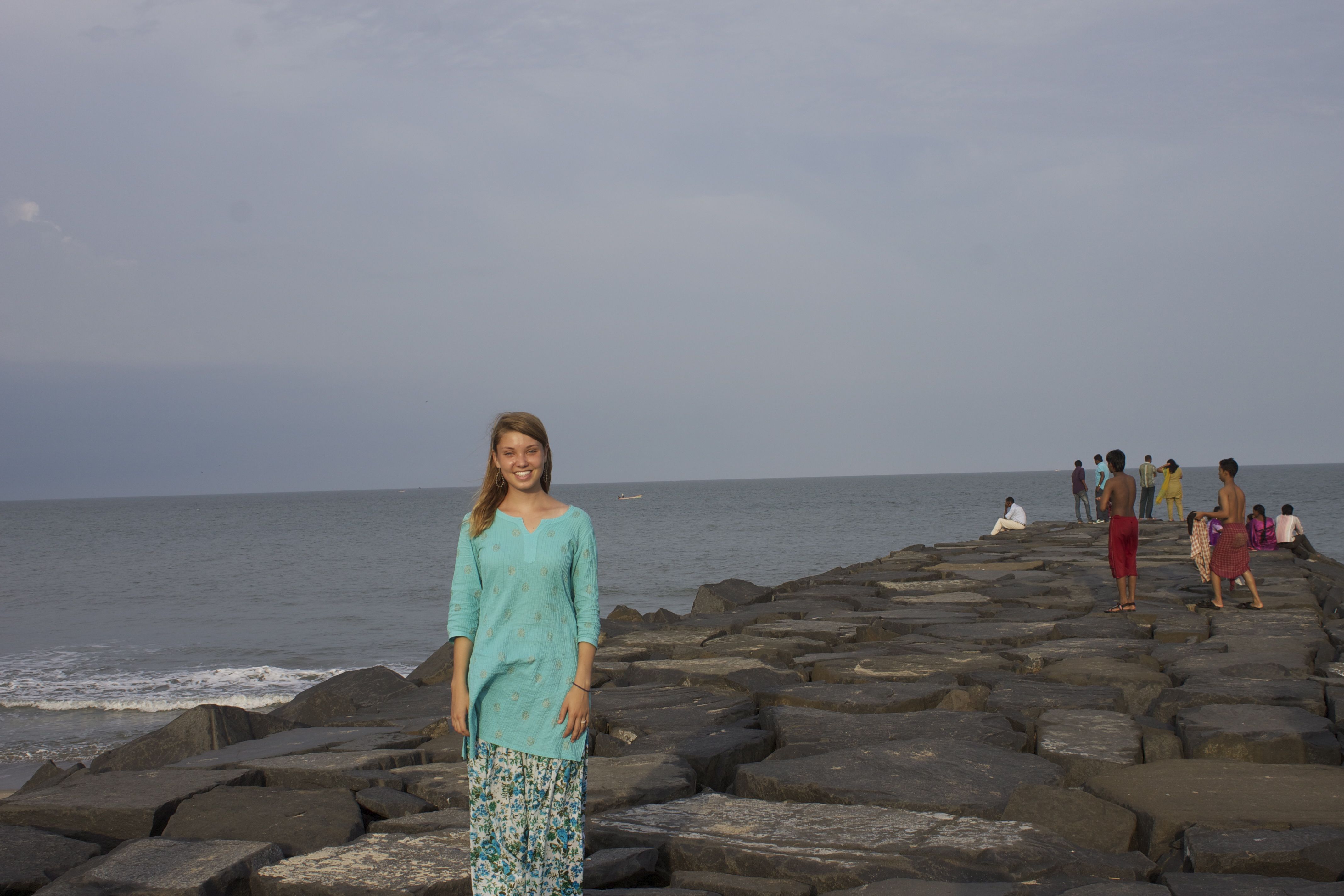
Without a doubt, my favorite part of Pondicherry was the beach. In the French quarter, the coastline is mostly rocky, but still has a few sandy spots as well. We spent our first afternoon walking along the waterfront watching kids play in the water, although it is technically not allowed because of the strong current and pollution. We didn’t swim there, but our hotel owner told us about a cleaner beach seven kilometers south of the French quarter called Paradise Beach, so on Saturday we hopped in an auto and went there for the afternoon. We were a bit unsure about what we would be doing because it is uncommon in India to swim at the beach, but we left the hotel with open minds and lots of food for a picnic. But to our surprise, Paradise Beach was almost completely deserted, so we jumped in the water for a swim! We picnicked and played Frisbee for a while, but all of a sudden black cloud started rolling in from over the ocean. Within 15 minutes, the wind picked up, the sky got dark, and it began to rain so hard we thought it was hailing. We ran back to our auto and got back to our hotel safe and sound, so now we can say that we survived a monsoon on the beach at the Bay of Bengal!

Rocks in Pondicherry

The rocky coastline of the French Quarter

On Sunday, we went back to the bus station and caught a bus back to Chennai. The next day was Ganesha Chaturthi, the beginning of a long festival to celebrate Lord Ganesha’s birthday. Ganesha is the Hindu god whose head resembles an elephant, and he is the god whom Hindus pray to first because he takes away obstacles in life. The story of Ganesha (as told by my host mom) is that his mother, Parvati, wanted a son so she made Ganesha out of sandalwood while her husband Shiva, the destroyer god and Ganesha’s father, was out of the house. Parvati put life into Ganesha and put him in front of the door to protect the house from intruders. When Shiva came back from hunting, Ganesha wouldn’t let him in, and not knowing that Ganesha was his son, Shiva cut off his head, which flew into the jungle. When Parvati realized what had happened, she explained to Shiva that he had killed their son and ordered that he go into the jungle to find Ganesha’s head. Shiva went out and returned with an elephant head instead and brought Ganesha back to life.

To celebrate on Monday, we went to a temple in Chennai and offered some flowers to Ganesha. During the festival, statues of Ganesha are put up in neighborhoods all over India, and people put small statues in their houses as well. There were six- to ten-foot tall Ganesha statues on all the roads and vendors were selling small clay statuettes in all the market areas. While we were in an auto on our way to the temple, a parade of people passed by with a mobile Ganesha shrine, so our auto driver parked the auto and ran over to receive prasadam (offered food and coconut water). When we returned to Hyderabad that night, we were surprised to find our neighborhood transformed with large, colorful Ganesha shrines on all the street corners complete with floodlights and loud music.

Mobile Ganesha Chennai

The mobile Ganesha passing our auto in Chennai

The trip this weekend was so relaxing and beautiful, but now I have a busy week ahead of me. Our apartment building will be celebrating for the Ganesha festival every night this week with poojahs (devotions) and lots of food. I will post soon about all of the festivities going on right here in Hyderabad!

Happy Ganesh Chaturthi!


Diego in Brazil: Biking in Rio de Janeiro

September 3, 2013

I never expected biking to become my favorite activity in Rio de Janeiro. It wasn’t until I moved to Rio that I realized I hadn’t had the chance to live in a city where biking is encouraged and the right infrastructure exists. About two or three weeks ago my host-mother suggested that I could bike to and from PUC, my host university, every morning and afternoon. I thought it was a fantastic idea (from a social, environmental, and financial perspective, biking is the way to go!) but first I needed to make sure I had a bicycle, a safe path to take, and, of course, the time to do it.

I initially thought about buying a used bicycle. I had seen countless bike racks (bicycle stands) in Rio de Janeiro’s Zona Sul (where I am living,) so I thought buying a used bike was a reasonable plan. I told my host-mother about my plan but she quickly suggested it would be better to subscribe to BikeRio first. Needless to say, I had no idea what she was talking about, so I asked her to explain. BikeRio is a sustainability project led by the city’s Prefeitura (similar to a City Council,) the Itaú Bank, and the bicycle system SAMBA. The project relies on approximately 60 stations with twenty bikes each located throughout Rio’s Zona Sul and some other neighborhoods. BikoRio’s main objective is to provide a low-cost transportation alternative for people who move around these urban neighborhoods. “That’s exactly what I need,” I told my host-mother, and I had no idea that I was about to expand my image of Rio de Janeiro by simply joining a biking program.

Using BikeRio is incredibly simple. You pay a $4.00 monthly fee and gain the right to pick a bike from any station and use it for an hour. After you return to the bike to any station, you can wait fifteen minutes and pick another bike. The project also has an app for iPhone, iPad, etc., where you can check if the closest station to you has any available bikes. And in case you are wondering, every bicycle I have used so far has been in perfect condition.

“Great, I now have a bike,” I thought, but I also needed to find how to safely get to PUC and then home every day. The first days that I biked to my University I took the route that my bus usually takes. At that point, that route was the only one I knew and taking it was quite necessary to avoid getting lost. With time I have found countless ways to get to PUC in the mornings and come to my apartment in the afternoon. However, and I say this without a doubt, the safest and most enjoyable route to take is around the Lagoa (Rio’s lagoon.) The city’s Zona Sul now has several biking paths and lanes that can take you across this part of the city crossing only some major roads. This past Friday and today in the afternoon I went biking without a particular destination, and I reached some very interesting and new places in the neighborhoods surrounding the one where I live.

DiegoBrazil4

Biking is becoming increasingly popular in Rio de Janeiro’s Zona Sul

So I have a bike (well, several) and a safe way to get to and from PUC every day, but do I really have the time? Going by bus to my University saves me a total of 40 minutes per day in comparison to taking a bike. Now, if I were to base my transportation choice purely on how much time it takes out of my day, I would have to go for the bus. However, the benefits I get from biking are definitely greater than what I could get out of those 40 “extra” minutes each day. Those benefits impact my health (both physical and mental, since I have found that biking can clear my mind for a while,) my perception of Rio de Janeiro (you certainly become part of the “biking community,”) my finances (I calculated that I save approximately $68 per month if I take a bike instead of the bus,) and many social and environmental aspects of the city. From a holistic point of view, and as I said in the beginning, biking is the way to go!

I am looking forward to biking beyond Rio de Janeiro’s Zona Sul. I recently met some Brazilian students at PUC who go biking for fun every weekend, so I am truly excited about joining them this coming week. Buying a used bike is still an attractive plan…


Diego in Brazil: A new routine

August 26, 2013

Moving to a new place certainly has its advantages. Although feared by many (I suppose), one of my favorite aspects of settling in a new city/town is finding a new routine. Based on how everything developed this past week, I will dare to say that some sort of order is entering my life here in Rio de Janeiro. Don’t get me wrong, I pretty much depend on avoiding settling for a repetitive routine, knowing that I should not unpack my suitcase because in a matter of weeks I will be changing places, and even accepting that people I meet will stay around only for some time before I go back home or they continue their journeys. Yet these are precisely the thoughts and needs that make finding a routine so great sometimes.

From Monday to Thursday I spend about 8 hours each day at my host university, the Pontifícia Universidade Católica do Rio de Janeiro (PUC). I have two or three two-hour classes each day, and I normally stay to have lunch and dinner at the University’s cafeteria. On Monday and Wednesday I start with States, Politics, and Development in Latin America, continue with “Poverty and Social Inequality, and end the day with Geography of the Contemporary World. In between my classes I manage to escape to the University’s gym for a one-hour yoga class. On Tuesday and Thursday I go to only two classes: Brazilian Foreign Policy and Portuguese.

Exchange students at PUC have the option to choose certain courses that are taught in English. I originally considered taking some of these classes, but in the end decided to go for only courses in Portuguese. Being a native Spanish-speaker certainly gives me some advantage to learn Portuguese, but it is not by any means a guarantee that I will magically be able to communicate effectively. While I had never taken a Portuguese class before coming to PUC, I spent about a month and a half working in the northwestern region of Brazil this past summer. Sadly I did not find myself in the urgent need to speak Portuguese since many of those that I worked with spoke Spanish. However, my time in the Brazilian Amazon did help me to get used to Portuguese sounds, main endings, pronunciation, and so on. This, plus a lot of motivation and desire to learn Portuguese as soon as possible, pushed me to avoid English courses and go straight for those in Portuguese. I am afraid I will have to wait for my first tests to see how that turns out.

DiegoBrazil3(1)

PUC has a very warm atmosphere

It is an exciting time to be studying in Brazil. Next to Brazil’s socioeconomic changes in the last decade and the country’s growing economic and political influence around the world, social sciences at Brazilian universities have developed and expanded significantly. My impression so far is that my professors at PUC are much more concerned with theoretical and structural approaches to a social question than my professors at Richmond. I would say two different reasons explain what I have seen. On the one hand, the recent expansion of social studies in Brazil has led to very active debates on theories, appropriate methodologies, and other type of “larger” questions. On the other hand, Latin American social thinkers have traditionally chosen structural over particular explanations for social and political topics. To give you an example, while last semester at UR my international relations class started with readings on contemporary political structures, my Brazilian Foreign Policy course at PUC has been reading about Brazil’s foreign policy since the late 19th Century, several theoretical approaches to foreign policy, and discussions on how the study of foreign policy has developed in Brazil during the past twenty years.

Both inside and outside the classroom, the atmosphere at PUC is incredibly dynamic and welcoming for new students. As I walk towards the cafeteria, I come across hundreds of students eating, drinking coffee, and chatting in the University’s two main buildings. A friend at PUC recently invited me to a women’s rights group that meets every Tuesday to watch films, discuss, and organize for several events. Needless to say, I am incredibly excited to join them this coming Tuesday. While student-run groups may not be as common at PUC as in some US colleges, joining activities such as yoga has definitely given me a space to meet Brazilian students at PUC in a more relaxed environment.

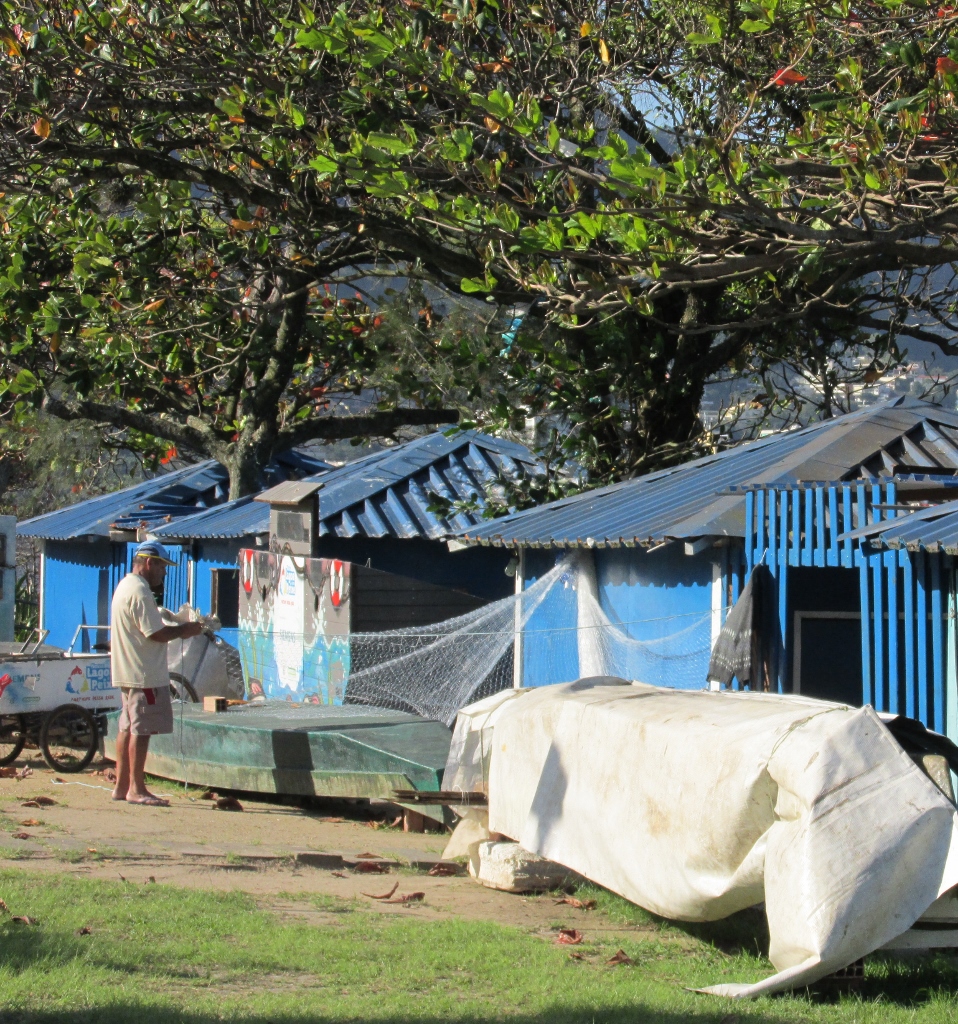
Whenever possible I bike home at the end of each busy day. On Thursday I chose to bike around the Lagoa Rodrigo de Freitas, a lagoon in Rio’s Southern Zone, and had the great pleasure to talk for some minutes with some local fishermen who have established a small community next to the Lagoa. Biking home from PUC around the Lagoa takes only about 25 minutes, and now that I met these local fishermen I will be definitely trying to avoid taking the bus more often.

DiegoBrazil3(2)

A fishermen community next to the Lagoa, a lagoon in Rio de Janeiro’s Southern Zone

As I said, there are some great things about finding a new routine!


Rhiannon in India: A Weekend in Delhi and Agra

August 19, 2013

After a month in India, I finally had a weekend free to do some traveling outside Hyderabad with my friends! Until now, our weekends here have been occupied by activities in Hyderabad – seeing historical sites, hiking through rocky terrain, shopping in the old markets, watching Bollywood movies, cooking Indian food… But because Thursday was Independence Day here in India, my friends and I took advantage of the long weekend and flew to Delhi! Our program directors were going to take our entire group to Hampi, a historical city in a nearby state, but because of the recent Telangana decision that I talked about in my last post, they decided to postpone our trip to a later date. Although we were disappointed, they assured us that it would be fine to travel anywhere independently as long as we didn’t take roads through the areas of agitation. What resulted from their announcement Monday afternoon was a mad rush to decide what we would be doing to take advantage of this rare opportunity: a long weekend. Within hours of the announcement on Monday, my friends Kate, Romi, Jennie and I had booked our flight to Delhi and were already reading our guidebooks for ideas!

It took hours of last-minute planning, but before we left Hyderabad, we had our travel plans intact and a list of all the interesting things to do in Delhi. We even booked an early 3-hour train from Delhi to Agra so that we could spend Independence Day visiting the Taj Mahal! We left Hyderabad early Wednesday morning and arrived in Delhi with a whole afternoon open to explore. With Lonely Planet as our roadmap for the weekend, we explored the area around our hotel and found a great restaurant that served all-you-can-eat North Indian thali, a to-die-for meal that anyone visiting India must try. For four days straight, we did one thing after another and tried to fit in as many activities as possible. But instead of listing all of them here, I’ll just give the highlights.

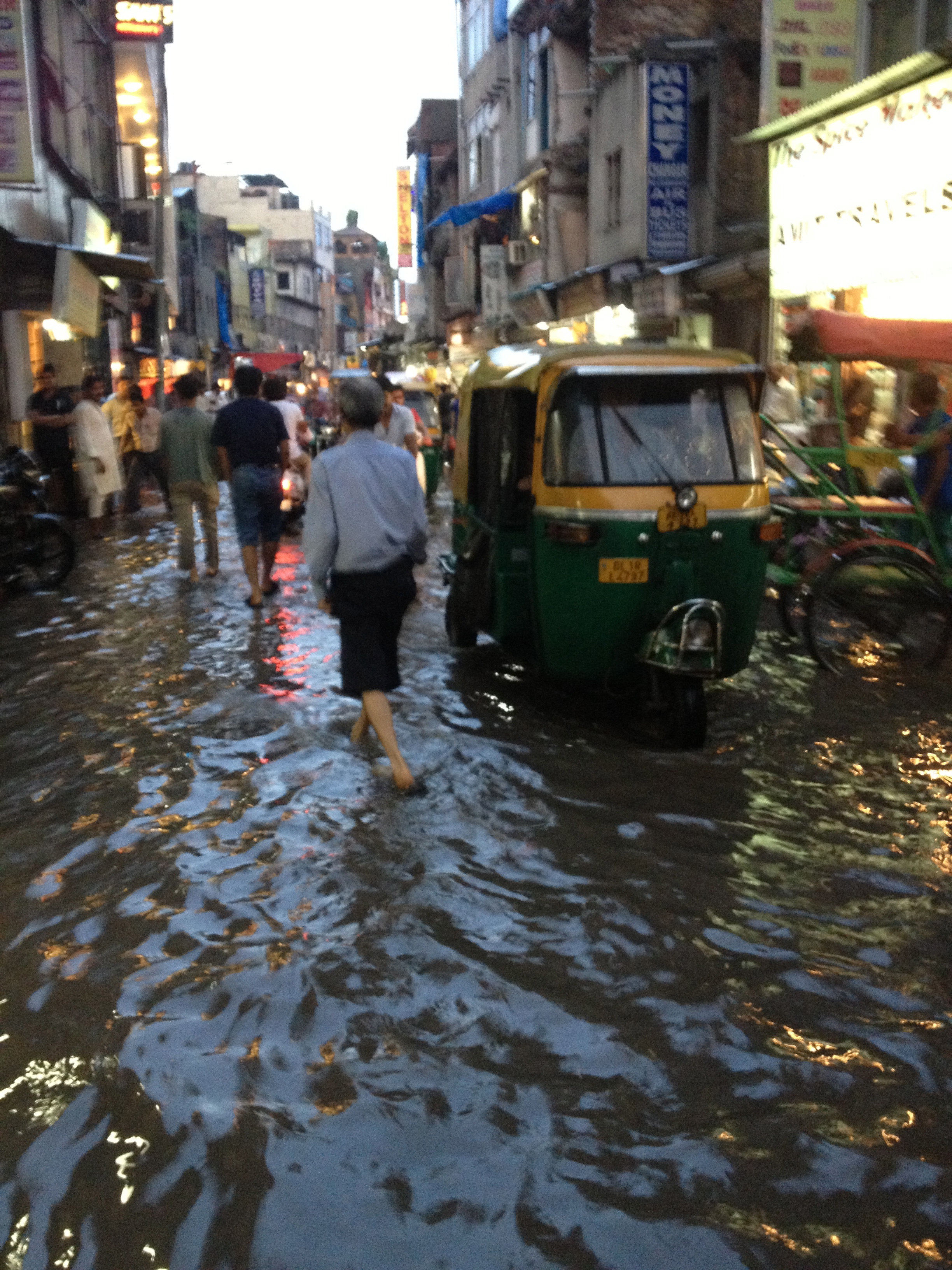
Getting from place to place may be the most mundane part of traveling for most people, but as I have explained in earlier posts, transportation in India often brings new and exciting experiences. During our last dinner in Delhi, we thought back over our 4-day trip and counted at least ten modes of transportation that we had used: planes, taxis, walking, auto rickshaws, bicycle rickshaws, city buses, sleeper buses, metros, sleeper trains, and we added, jokingly, swimming, because the monsoon was so bad in Delhi that the streets were covered in water half way to our knees. Every time we walked to and from our hotel, we had to wade through a “puddle” the size of a football field that poured into some of the shops near the road!

Flooding in Delhi

Flooding in Delhi

The sleeper train was definitely a new experience for me this weekend. When booking a long-distance train in India, there are so many options that choosing can be really overwhelming! You can choose between General (the cheapest option), Sleeper, 3 A/C, 2 A/C, and 1 A/C (the most expensive). You don’t need to book a General ticket ahead of time, but for this reason, you never know what will happen and you may have to stand for the entire trip. Because we booked our train so last-minute, the only option for us (besides the General compartment, which we were advised not to take) was the Sleeper. The benefits of the A/C compartments are that they have air conditioning and that they provide increasing levels of space, comfort, and privacy. When we entered the Sleeper compartment early Thursday morning, we found our “seats,” which actually resembled 3-level bunk beds. We slept the whole way and the trip was over in a snap! I wonder now why all transportation isn’t like this.

Sleeper Compartment

Sleeper Compartment

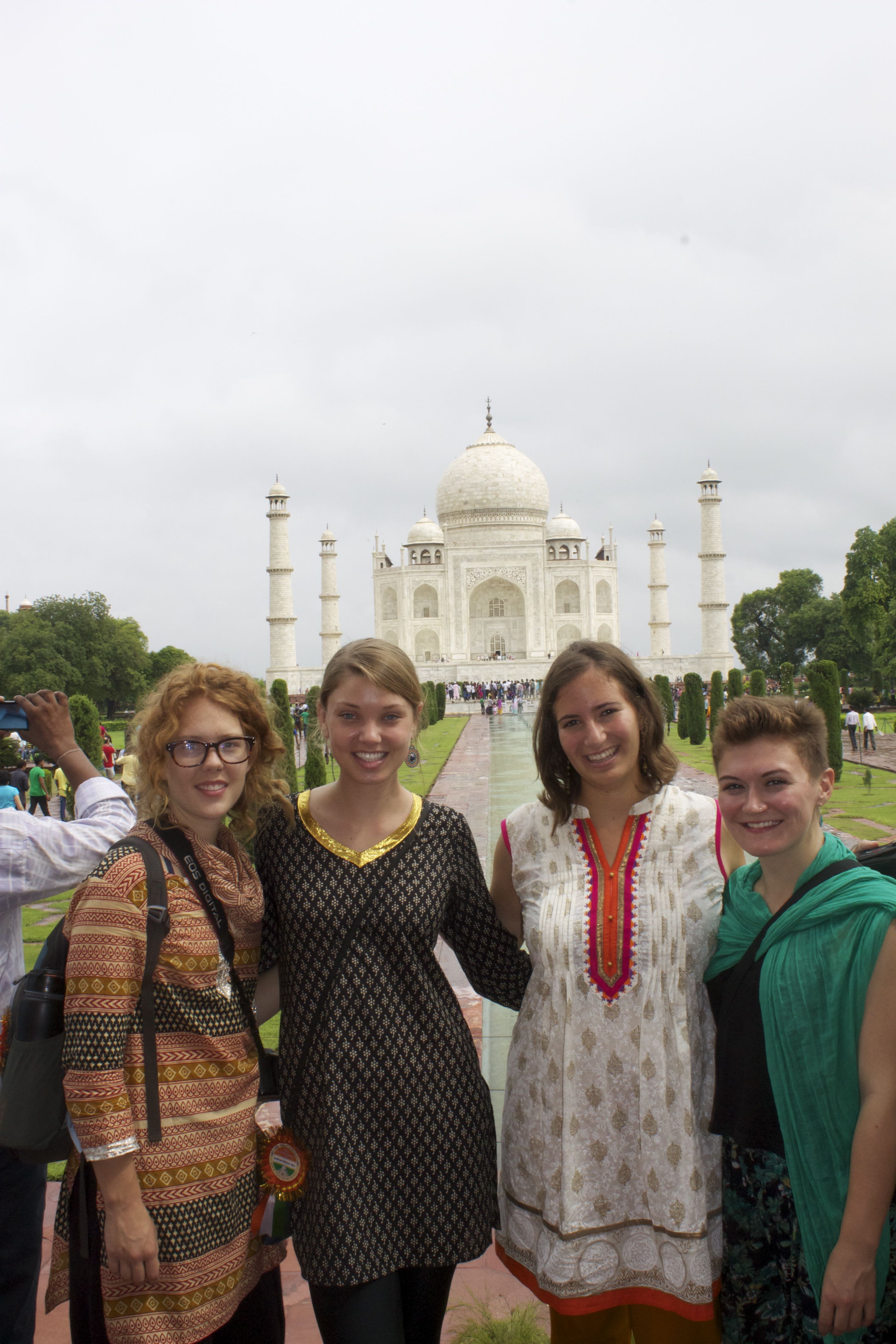
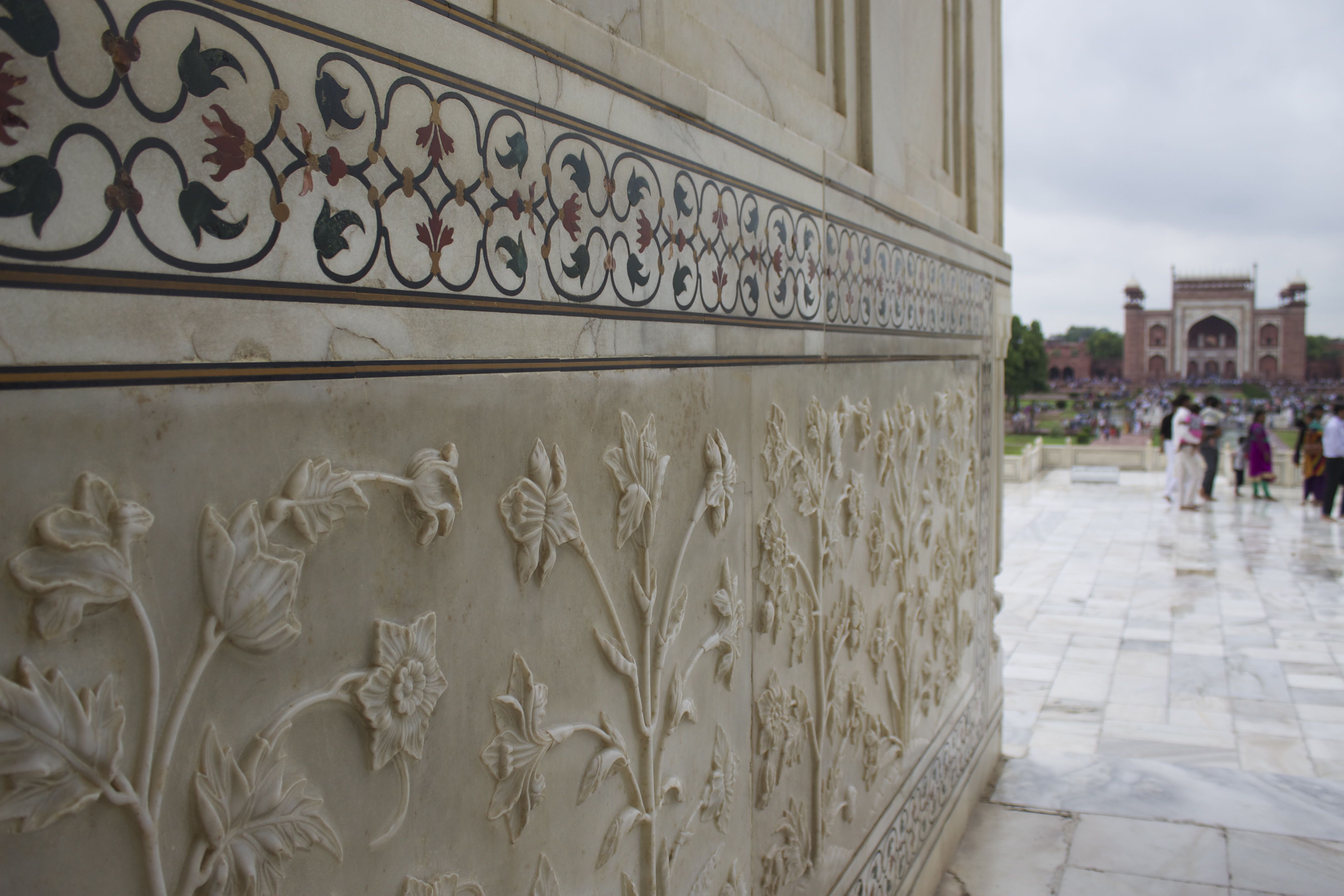
The main highlight of our trip was obviously seeing the Taj Mahal. I was a little skeptical before hand, but the Taj is even more magnificent than I could have ever imagined! Not only is it huge and glowing, but every inch is beautifully decorated with such ornate stone inlay that it is impossible to capture in a photo. We spent a whole morning at the Taj walking around the grounds and taking in the experience of being at one of the Wonders of the World! Our entire trip was a lesson on the history, culture, and religions of Delhi and Agra. We also visited many other magnificent structures in Delhi and Agra – the “Baby Taj,” two Red Forts, the Lotus Temple, numerous tombs of kings and emperors, and many shrines of religious leaders. It is difficult to count all of the sites we visited because many of them were tucked away among residential and market areas.

Taj Mahal

Our group at the Taj Mahal

Rooftop view of the Tah

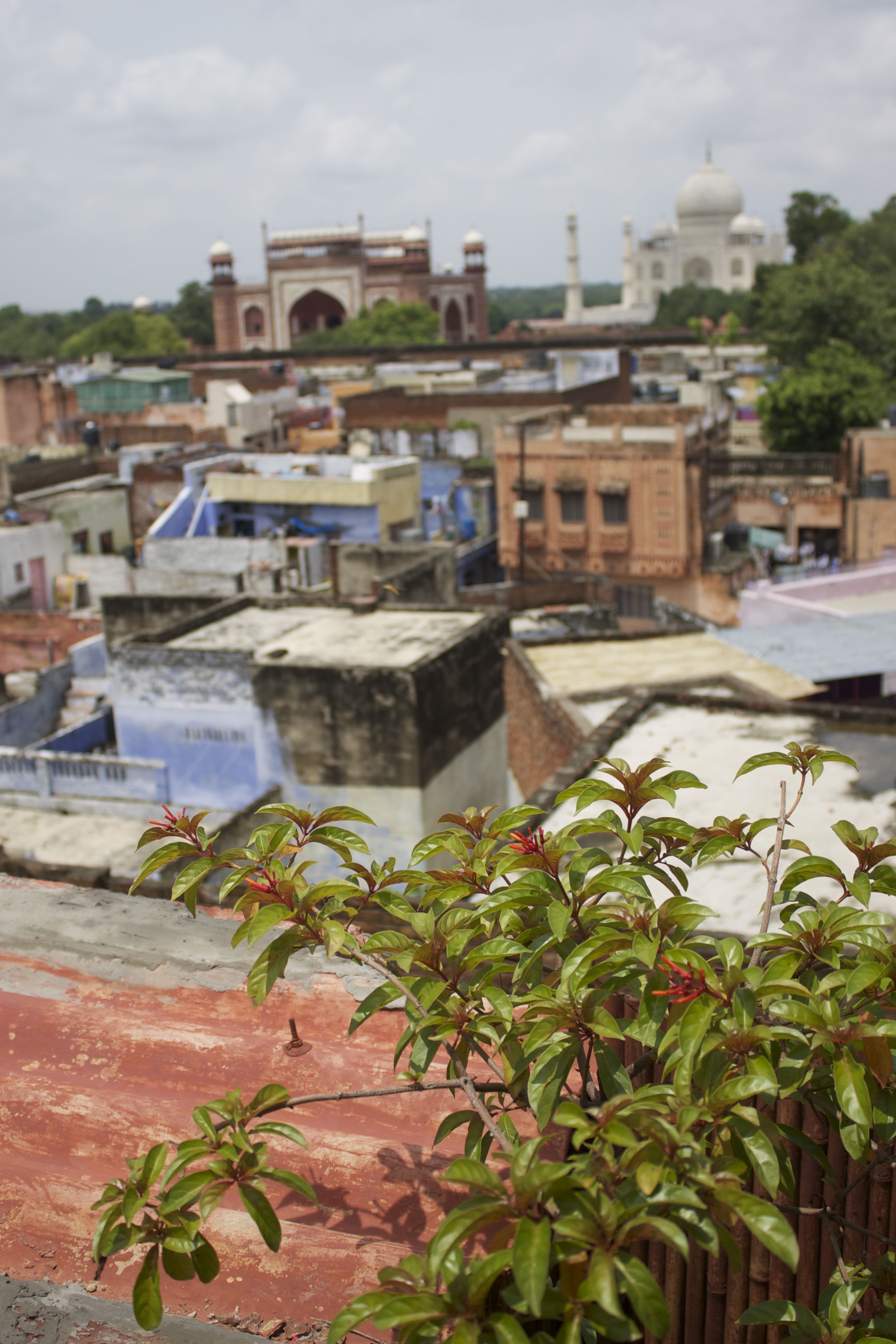
Rooftop view of the Taj Mahal

Taj Inlay and Ornamentation

Taj Mahal inlay and ornamentation

Baby Taj

Baby Taj

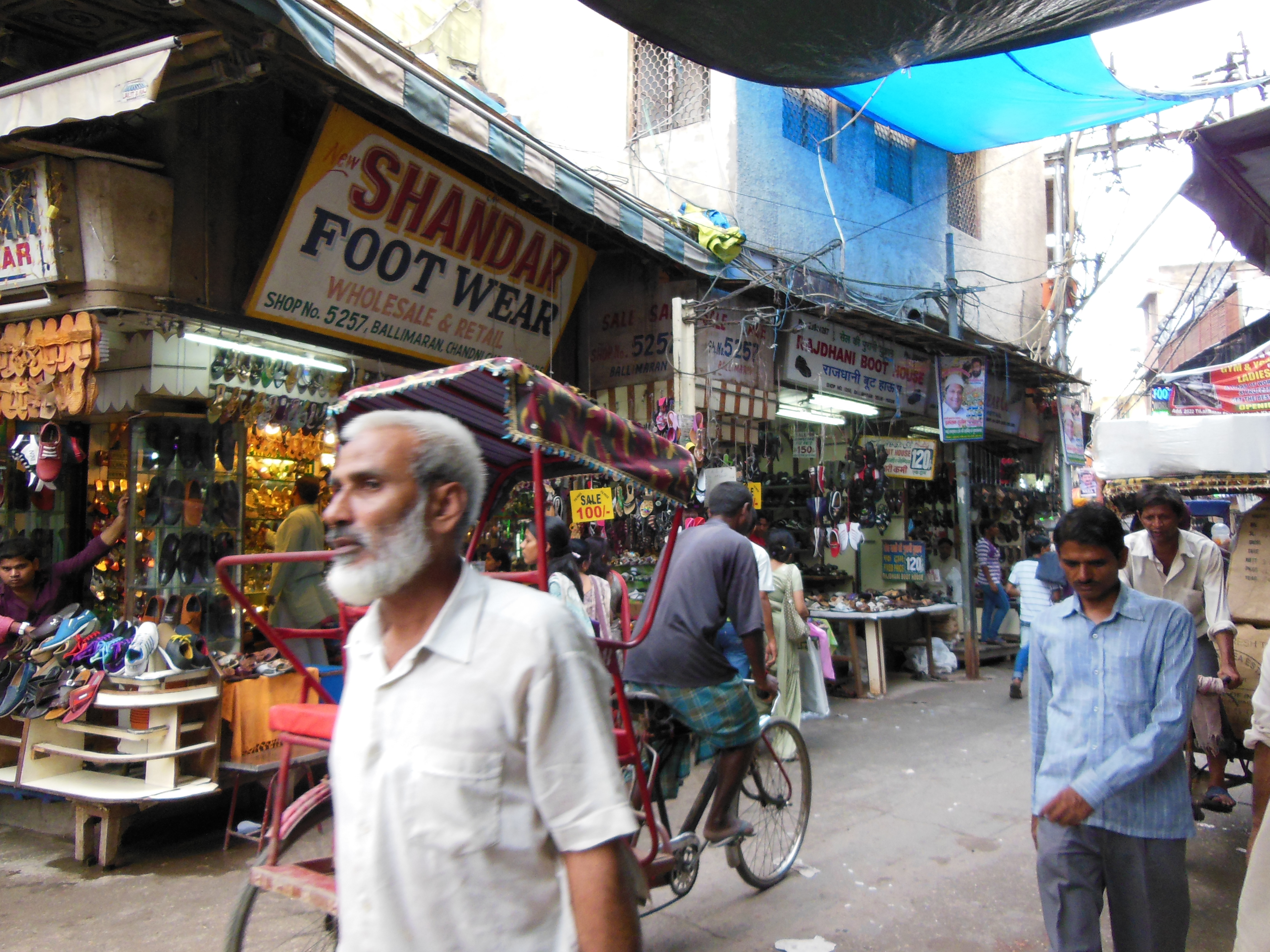
Another highlight of the trip, and the best part in my opinion, was exploring through the markets. On Wednesday, we went to a craft market in Delhi and spent the whole evening wandering through the handmade art and jewelry. On Friday, we went to a vast market called Chandi Chowk in Delhi that is supposedly the oldest running market in all of India. It is called Chandi Chowk, or Moonlight Square, because the Mughal emperor could see the moon’s reflection in a channel running through the market from the Red Fort at night. When we arrived we stayed on the main road, but we soon realized that there were small alleyways branching off in all directions that were packed with a maze of shops and vendors. The best part about the market was that it was divided into sections based on the merchandise being sold. There was one section lined with at least 20 shops selling tea and spices, and another alleyway that had nothing but shoes as far as you could see. We were in heaven!

Spice Market

Spice Market

Shoe Street

Shoe Street

We also visited a market in a Tibetan neighborhood just outside New Delhi. It was so interesting to see the immediate contrast when we arrived in the Tibetan area because it really felt like we were in a different area of the world. The vendors were selling winter clothes and Buddhist items, and the people were even dressed differently. We went to a restaurant and ate a Tibetan dumpling soup called Thenthuk, which was a refreshing change from the Indian meals we had been eating the whole trip.

Tibetan Market

At the Tibetan Market

I am so glad that we made the spur-of-the-moment decision to go to Delhi because the whole weekend was packed with exciting activities, new places, and a ton of good food. Just when I thought I was getting to know India pretty well, I found that North India is a completely different place from Hyderabad. This trip put an image into my mind of India as a patchwork of different cultures. They are all sewn together into one nation, yet each one remains distinct – from north to south, east to west, and even down to the very neighborhood. I know now that it would take a lifetime to experience all of the cultures, places, and people of India, and I am only here for one semester!


Diego in Brazil: Settling or Being a Tourist?

August 19, 2013

“Walking is a virtue, tourism is a deadly sin.” Bruce Chatwin

I wonder if it is possible to move to and establish in a new place without becoming a tourist the first few days or weeks. The countless “so how close to the beach do you live?!” questions that come through emails and phone calls from friends abroad make me think twice about how I should see Rio de Janeiro. I will get to that in a second, but first some words on this past week.

When I arrived to Rio’s international airport Galeão I realized how little time I had had to think about studying abroad. My summer internship in the Brazilian and Peruvian Amazon had ended just three days before and I still had (and have) many documents and reports to write. PUC-Rio’s (my host university) staff met exchange students at the airport the morning I arrived and in a matter of minutes we were on our way to our respective host family’s place. My host-mother came out of the apartment to receive me with a hug and a warm “Bem-vindo Diego!” She showed me my new room and before I even noticed we were in the kitchen telling each other stories about our lives with a cup of coffee. After living in Norway and the US for four years, I can’t describe how that first morning made me think of home in Guatemala. “All Brazilians are friendly” may be an exaggeration, but my experiences in Rio de Janeiro and the Brazilian Amazon so far have shown me the incredibly welcoming side of this culture.

Every morning at 8:30 a.m. I cross the street in front of my apartment to take a bus to PUC, usually with my German flat-mate who is also an exchange student at PUC. The twenty-five minute ride to PUC seems nothing compared to the hour and a half or even two hours some local students take to get from their homes to the university. Most exchange students at PUC live in Rio de Janeiro’s Zona Sul (“South Zone”) which includes the city’s richest neighborhoods and most famous beaches. I had some trouble deciding what I wanted to write in this entry about Rio de Janeiro. I could describe my neighborhood’s busy streets, Copacabana’s beaches or even the scenic path I take when I bike from the university back to my apartment in the afternoons, but I would certainly be describing just a small section of Rio de Janeiro’s reality.

Diego in Brazil Entry 2 (800x600)

My neighborhood in Zona Sul at night

I continue to wonder – is it possible to move to and establish in a new place without becoming a tourist the first few days or weeks? Tourism continues to exploit the same discourses that built Brazil’s image abroad as an exotic, happy, and social destination. In addition, a tour around the city’s favelas (typically described as low-income shanty towns) is now part of some tourists’ plans for their visit to Rio de Janeiro. These two contrasting touristic destinations (Copacabana’s famous beaches vs. some of Rio’s poorest areas) seem to dominate the tourism-related advertising I have seen around the city and online. And the conversations I have had with foreign and local students at PUC make me think such discourse is not strictly limited to tourism, but goes as far as influencing how Rio’s residents present their city to others.

Is it possible then to “experience” Rio de Janeiro under a different scheme? I have my doubts. Getting to “know” a new place is, of course, a subjective experience, yet I truly hope I find a way to step back from the common descriptions of Rio de Janeiro and settle as a student as soon as possible. My first “solution” was to read Brazilian literature with stories that take place in this city. I recently finished reading “Quando ia me esquecendo de você” [“When I almost Forgot About You”] by Maria Silvia Camargo, and as I thought about this entry I struggled to avoid presenting you with a typical “Zona Sul” description of Rio de Janeiro, an exotic presentation of the city’s high levels of socioeconomic inequality, or Camargo’s romantic view of Rio’s atmosphere. How we position ourselves within and in relation to a new space will certainly determine our views and experiences regarding such place. I just hope that in the next couple of weeks I find a position that allows me to take a step away from becoming yet another tourist in Rio de Janeiro.


Rhiannon in India: Classes and a New Home in India

July 25, 2013

This has been yet another crazy week in India because I just moved into my new home stay and started classes at the university! This feels like the real start of my study abroad experience — finally living with an Indian family and going to classes at an Indian university. As I mentioned in my last post, I am staying in an apartment with my friend Jennie and our host family, Nivedita and Prerna. Nivedita, the mother, is an art teacher at a school in Hyderabad, and Prerna, her daughter, is 14 years old and goes to the same school. Nivedita and Prerna have been so kind and welcoming to us. They took us to the zoo on Sunday and drove us around the neighborhood so that we could learn how to get to the bus stop.

View from homestay

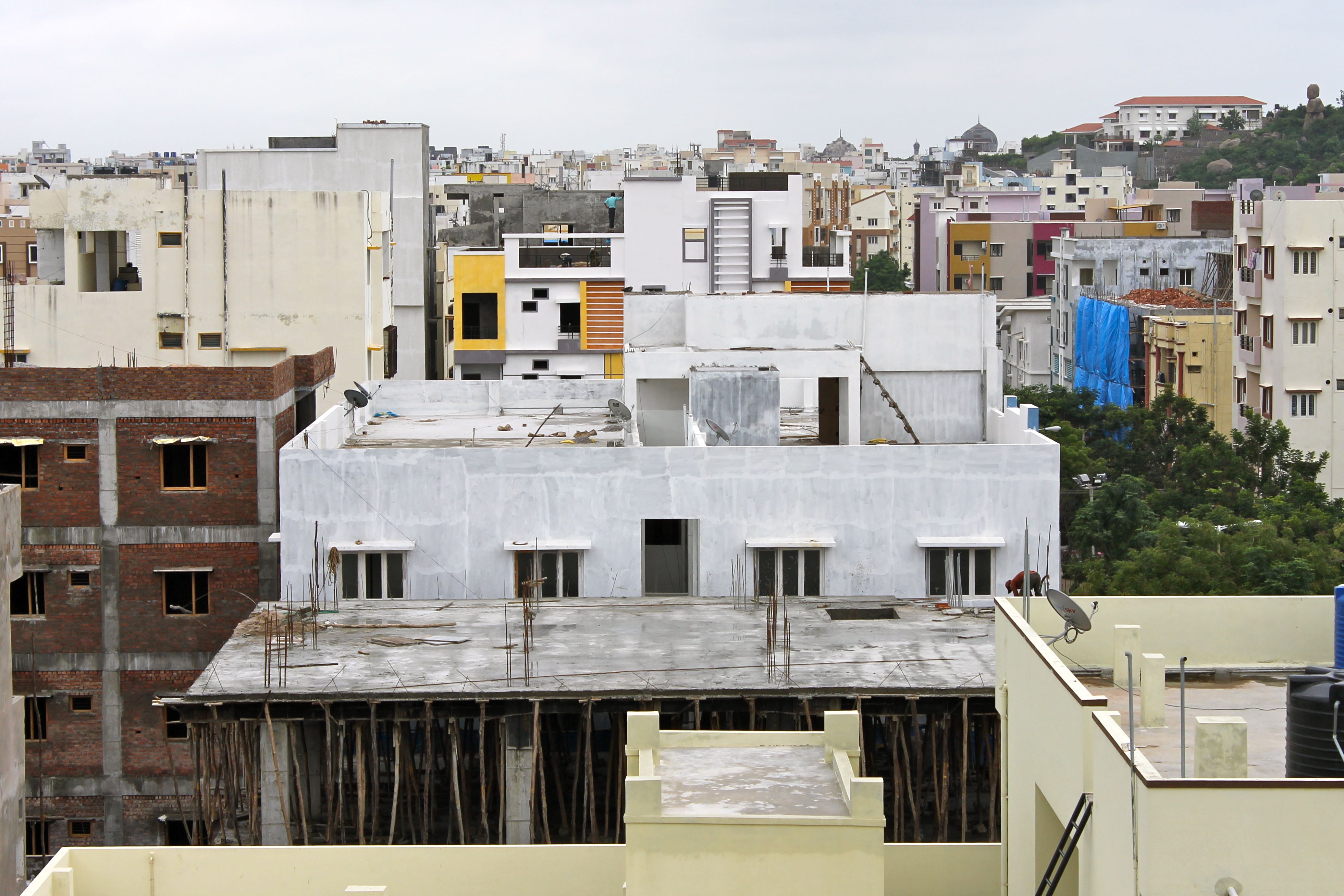
The view from my homestay

Homestay room

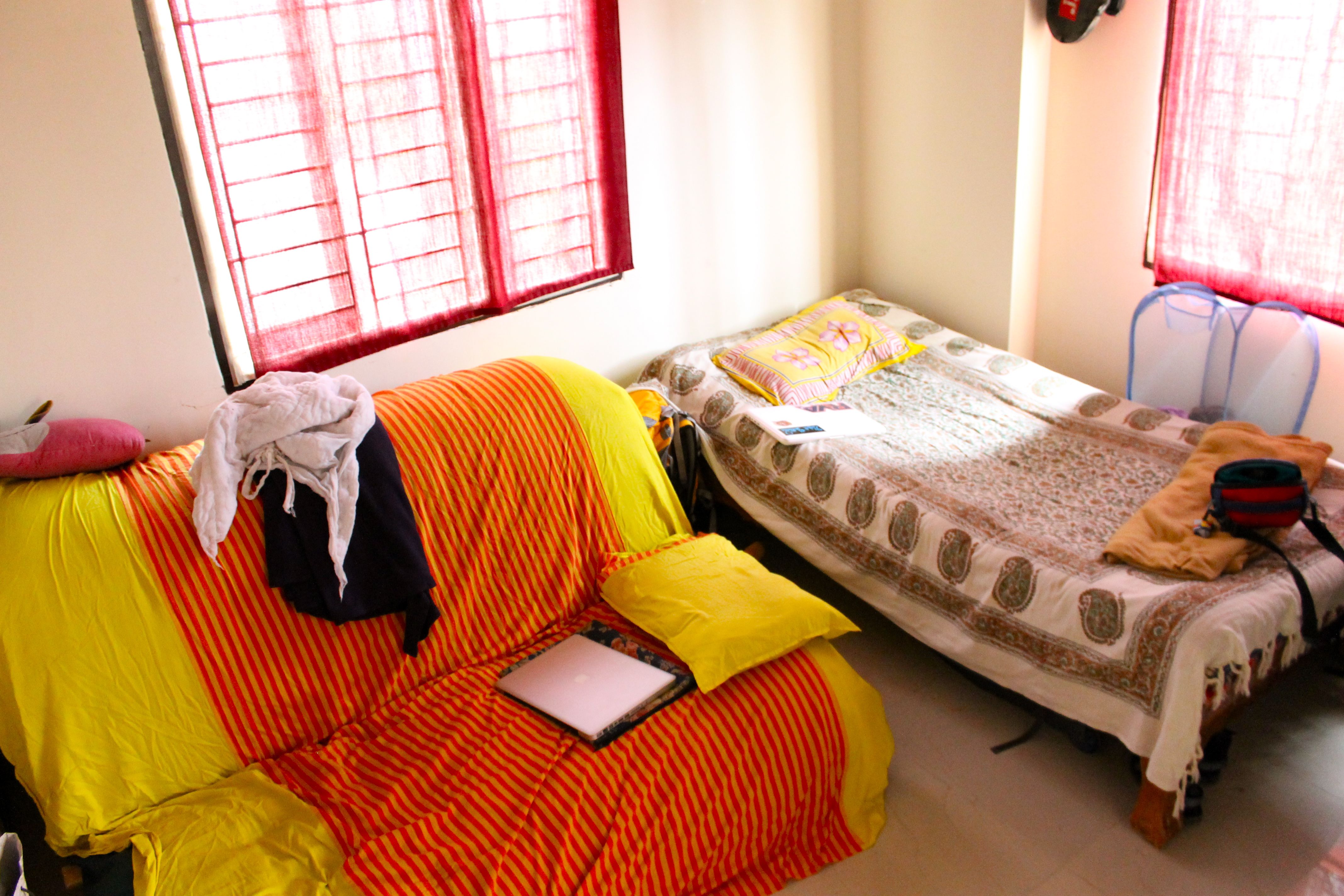
My room in my homestay

In the mornings before school, Nivedita packs us a breakfast-to-go and we start our commute to campus. Getting to and from school is probably the biggest adventure of our day! After taking the car with Nivedita and Prerna to the Manikonda intersection, a rickshaw to the main road, a bus to campus, and a bike to class, the commute takes about an hour and really wakes us up at 8 in the morning. Although it takes a while, traveling this route every day is an exciting way to see the city and integrate into the community.  Come along on my morning commute in the video below!

Breakfast

Breakfast-to-go!

Monday was my first real day of classes at the university, and so far the classroom setting has been quite a different experience from classes at Richmond. There is no “master list” of classes at the university, so departments and professors schedule classes whenever they see fit – and sometimes change them. Classes generally run for an hour on the hour, so there is no time to get between classes that are back to back. I was late to a few classes on my first day, but it is more common here for students to walk in and out of the room while class is in session. I have noticed that some things in India (class schedules, traffic rules, etc.) are much more relaxed than in the U.S., while there are other social expectations such as respecting the professor and dressing modestly that are much more strict. Because of this, I am starting to realize that when one of my professors said, “India is a nation of paradoxes,” he wasn’t just talking about its many cultures and languages. I am still processing this paradox and haven’t really made sense of it yet, but it seems that both systems work well despite how differently they are approached.

Now that classes have started, I have been struggling to decide how to balance my time in India among school activities, traveling, and volunteering. University clubs and volunteer groups have a large presence on campus here, and I hope to meet other students by joining something soon. I am also planning to take sitar lessons, which should start within a week or so.

Luckily, I don’t have class on Fridays so I will be able to travel to new places in India on the weekends. There are many cities in South India that have been recommended for weekend trips, such as Hampi, Goa, and Mysore to name a few. But since the majority of India’s vast population is rural, an Indian experience would not be complete without visiting a village or two along the way. Unfortunately, many of the great destinations in India are in the north, which are just too far away to visit during the semester, so I’ll have to wait for a long holiday weekend or until exams are over in November. It is impossible to see everything in such a diverse country in only five months, but I hope that in my short stay I will have a chance to see Darjeeling, the Taj Mahal, Varanasi, and Delhi.

I have also been thinking about volunteering for an NGO in Hyderabad called Sankulp. Sankulp works with victims of sexual violence in Hyderabad and supports them through the court process, therapy, and finding safe housing. As a more preventative measure, the organization also goes into schools to educate young girls and boys about sexual violence issues. The women at Sankulp are documenting the stories of the victims they meet, so I hope that I can get involved by transcribing these stories into English for a book they hope to publish in the future.

Looking back over the past two weeks, I am astounded at how much I have seen and experienced. Now that I am settling in, things such as navigating, haggling, and communicating that used to seem impossible are now getting easier. I know that I will always look like a foreigner here, but I hope that by the end of the semester I will be able to live like a local in Hyderabad.

Mera blog padhane ke liye shukriya!  [Thank you for reading my blog!]


Rhiannon in India: Orientation Week

July 17, 2013

After 3 flights, a night in the Mumbai airport, and a harrowing cab ride (traffic here is crazy!), I arrived at my dorm in Hyderabad at 6 a.m. on Tuesday morning. I am staying at the International House on campus with 13 American students in my group and many more from around the world. The dining hall at the house prepares authentic Indian food for us, but thankfully holds back on the spiciness and gives us purified water that our sensitive stomachs can handle. I love the food and all of the unique spices here! A local restaurant owner came to talk to our group and explained that Indian food is unique because of its many spices that must be mixed in a specific order, much like chemistry. He told us that, historically, widows in India were often confined to communal homes (watch Deepa Mehta’s Water to see it in action), so they spent time experimenting with spices and came up with these scientific mixtures. According to the restaurant owner, an Indian meal usually includes between 5 and 50 different spices!

One of the first things I noticed when I arrived in Hyderabad was that the weather is wonderful! May is the hottest month of the year in this part of India, so by now, it has cooled down to a temperate 84 degrees Fahrenheit. To make it better, the monsoon rains don’t hit Hyderabad nearly as badly as they do up north.

Orientation this week has been a whirlwind of lectures and excursions around the city. We have already discussed many interesting topics such as food, transportation, and living as a woman in India. After learning about transportation in Hyderabad, we split into small groups for a hands-on navigation exercise. Lead by our language peer tutors (Indian students who will be helping us with language practice this semester), we spent the afternoon taking auto rickshaws, buses, and direct autos all over the city to get used to navigating and bargaining. This just happened to be an afternoon when the monsoon was in full force here in Hyderabad, but splashing through puddles on the auto rickshaws made the day even more exciting! My friend Jennie and I, with our peer tutor Salomi, took two “sharing autos” to a restaurant for lunch, then a “direct auto” to the mall to shop for some Indian clothing. Both types of autos are open-air rickshaws, but sharing autos are cheaper because the drivers pack as many customers in as possible as they drive along a set route. Direct autos will take you exactly you want to go, but they are more expensive.

Auto Rickshaw

Here’s an auto rickshaw

Inside Auto Rickshaw

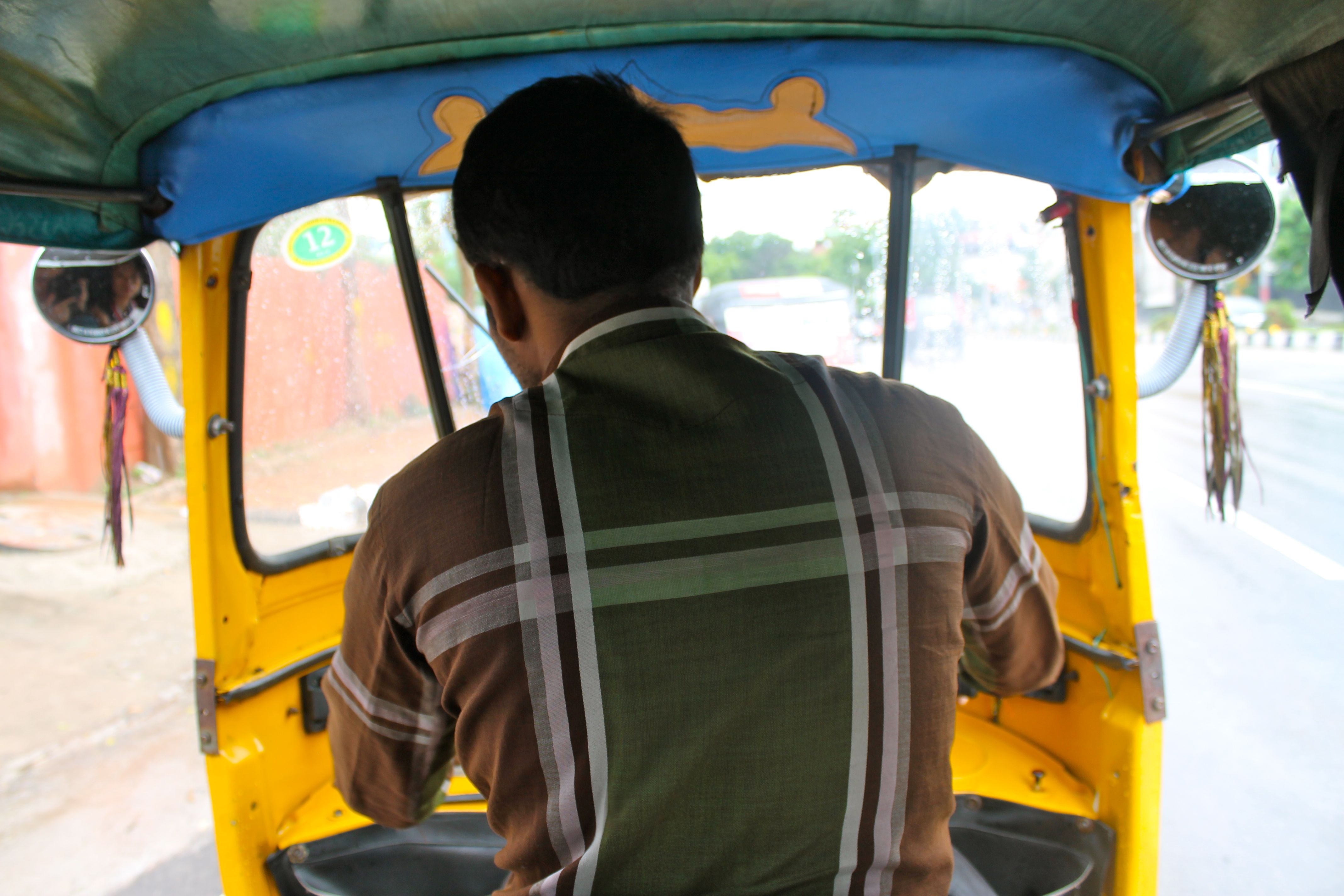
The view inside an auto rickshaw

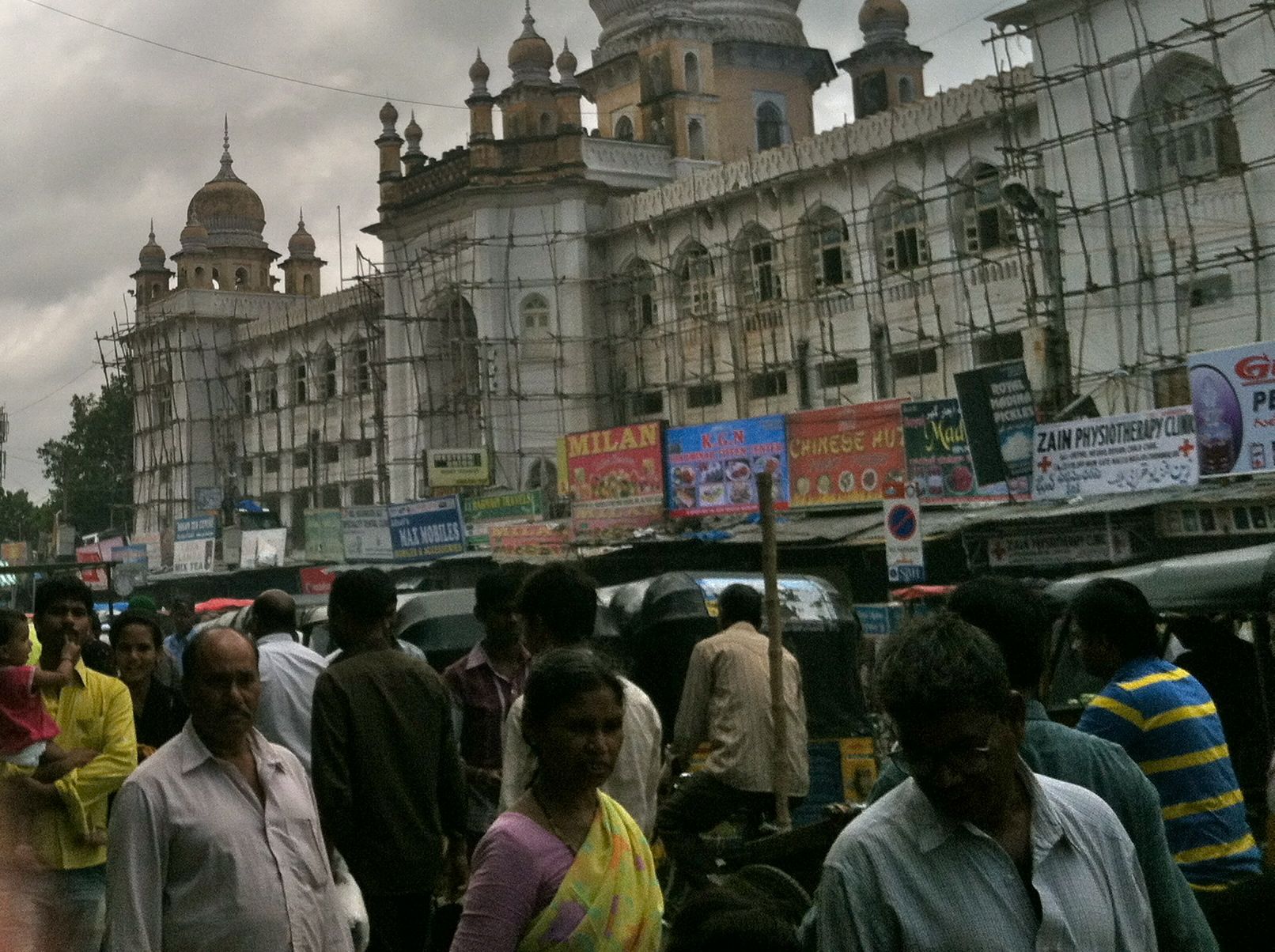
One of our trips that stood out most this week was to the Old City, which is often considered “downtown” Hyderabad. Because Hyderabad was never fully colonized, there is no trace of urban planning as there is in other Indian cities. The bustling streets of the Old City seem too narrow for traffic, but somehow cars, bikes, motorcycles, and pedestrians seem to pile on top of one another between never-ending rows of shops. Local women say that the Old City is the best place to shop for anything shiny or sparkly, including saris and bangles.

Old City

The Old City of Hyderabad

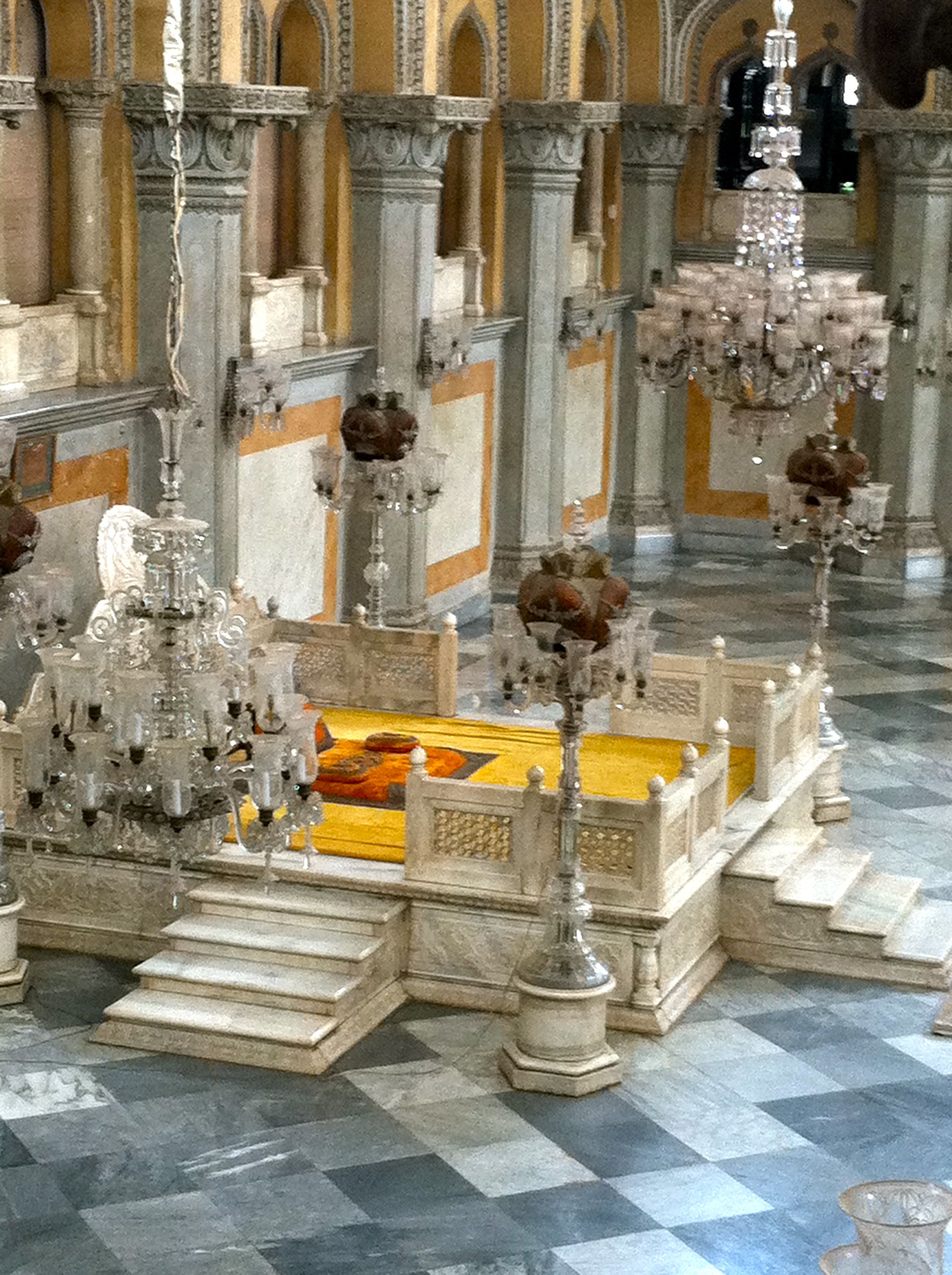
While we were in the Old City, we visited its most prominent landmarks: Chowmahalla Palace, Charminar, and Mecca Masjid. Chowmahalla Palace is an estate with four palaces, which were home to the Nizam monarchy from the late 1800s until Indian independence in 1947. The palaces, now turned into museums, are magnificent and reminiscent of a time much earlier than when they were actually used. The high ceilings are covered in ornate carvings and chandeliers, and in one of the main rooms there is even a large thrown where a prince may have sat less than 70 years ago! As we walked through the gardens of the estate, we could hear the call to worship being played over loud speakers from the Mecca Masjid mosque near by.

Chowmahalla Palace

Me at Chowmahalla Palace

Chowmahalla Throne

Chowmahalla Throne

Mecca Masjid

Mecca Masjid

Although I am staying on campus now, I will be moving into a home stay next week! I will be living with my friend Jennie and an Indian mother and daughter in an apartment about 30 minutes from campus. I am anxious to meet the family because my program directors say they are very welcoming and exciting to live with. I was a little nervous about the commute at first, but now that I am getting used to using autos and busses, I’m not so worried. Hopefully Jennie and I will have similar schedules and will be able to ride to and from campus together most of the time.

Tomorrow I will go to my first class at an Indian university! I will be “shopping for classes” at first, so I’ll just go to a few different ones each day until I decide which ones I like and which professors I can understand. I am excited to start classes because it will give me an opportunity to meet Indian students and hopefully engage in some events or clubs on campus.

I can’t believe I have only spent one week in Hyderabad! I have seen and done so many things this week that it is difficult to put it all into words, but hopefully as the semester continues, it will all get easier to process. Despite what a great week I have had, my semester really has yet to begin!


Alyssa in New Zealand: Arriving, Orientation

July 8, 2013

It is important to not let fatigue and uncertainty overwhelm you when you’re trying to figure things out. While being forced to completely revise my entire itinerary due to several flight delays and issues, I reminded myself to not let stress overcome me. Right from the moment I stepped off the plane in Auckland, everything started to happen so quickly. I felt somewhat foolish walking around the airport with all of my luggage, but there were at least fifteen other people that were in the same exact boat as I was. After going through customs, I had to be redirected to another flight, for I had missed my last connection to Dunedin. This put me very behind schedule…to say the least.

Instead of taking a direct flight to Dunedin, I had to fly to Queenstown instead and then take a 3.5 shuttle bus ride to Dunedin. The other option was to take a direct flight to Dunedin nine hours later. At that point, I just wanted to get to my final destination. It seemed as if the first option seemed to be the most efficient one. That being said, I sprinted to the gate and boarded the flight to Queenstown.

In the end, my decision turned out to be the wisest one. The two hour flight barely seemed like two hours long, for my eyes were glued to the window the entire time. This must be the scenic route, I thought as we flew, but it was just a typical course. I watched the geography of the country become a reality. As the plane entered the south island, I became anxious to see more of the country. The surrounding mountains of Queenstown were extraordinary. The closer the plane came to landing, the more impressive and surreal they became. I hadn’t even walked off the plane and I was already significantly impressed by what was before my very own eyes. Once we landed and the doors of the plane were lifted, a small wave of brisk air hit my face almost immediately, indicating that it was winter.

I was even more awed by the scenery from our shuttle bus ride to Dunedin. The rolling hills and vast lands were nothing like I’ve ever seen. Pictures could not do it any justice, no matter how hard you tried (I was unable to take any because my phone was on its way to dying and my camera was inaccessible. Besides, the driver’s driving was quite reckless in a way that made it difficult to stay stabilized and get a decent image. Although I do admit, the roads were fairly hilly and windy due to the geography).  I began to appreciate winter in a completely new way.

And never before in my life have I seen so many sheep. Left and right, hundreds of them were grazing. I must have seen at least 2,000 throughout the duration of the drive (that’s most likely an underestimate). Apparently, there are approximately 60 million sheep in New Zealand, which is 15 times the amount of people.

I was overcome by my first surge of nervousness once the shuttle driver dropped me off at my address. I didn’t see my house instantly, which concerned me. So there I was standing out all alone in the streets of Dunedin with all my bags in the darkness and cold air. Fortunately, it only took three minutes for me to figure out that I had to walk down an alley to get to my flat, making it a slightly more secluded area.

As I opened the doors of my new home, a wave of housewarming smell overcame my senses. Lucky for me, my Kiwi host, Jenny, was currently in the process of cooking my flatmates and me a home cooked meal, which consisted of my first New Zealand lamb and vegetables. My flatmates, Erling from Norway and Andras from Hungary, were all there to greet me as well. I don’t know what was more shocking to me: the immediate welcoming nature of the flat or that it felt like 11:00 pm when it was actually 7:00 pm.

ALyssa home

My new home in Dunedin


Alyssa room

My room

Many of the Kiwi hosts have done their best to make all the international students feel at ease throughout the first week. Since a majority of the international students live in close vicinity, it is a very tight knit community and it has been easy to become close with one another. My friend Lee is a one minute walk from my flat, so it’s nice to have a familiar face very close by. Everyone has come to New Zealand for many different reasons and interests; yet, we all have the same intention of getting out and wanting to see the country. Whether it be a potluck dinner or a party, different flat areas will host events almost every night, inviting everyone in the area, for the Kiwis genuinely want to meet and befriend as many people as they can.

Orientation has been fairly simple and straightforward so far. There was a two hour meeting the first day, providing the basic, important information to all the students. Following that, everyone had to go through Course Approval, which required students to obtain all of the necessary signatures from professors in order to officially enroll for their class. This semester, I will be taking Evolution, Microbiology and Musicianship Skills (for my General Education Visual Arts requirement).

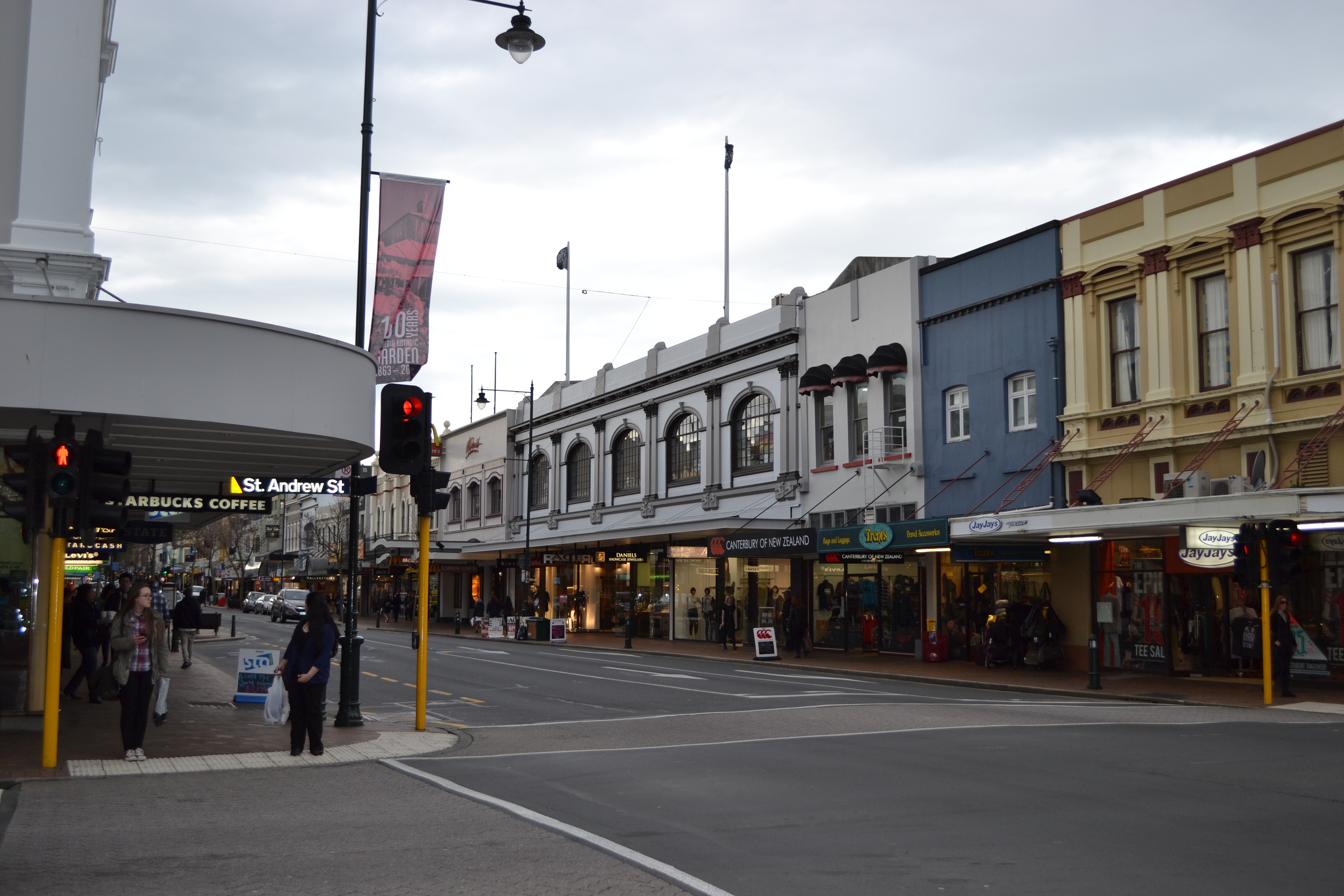
I’ve had many chances to walk around the city of Dunedin in the past few days. I was not expecting the surrounding area to be so busy and urban-like. It is very different from what I’m used to, but I’ve adapted to this new way of living without difficulty and I enjoy it. The only thing that I find challenging is grocery shopping and making my own meals, for I was a never a chef to begin with (Erling likes to give me a really hard time about my poor cooking skills, which really helps support the American stereotype, sorry). Regardless, everything I need to live is easily accessible and a simple ten minute walk away.

Dunedin

Dunedin!

It feels strange celebrating the Fourth of July outside the United States. It’s difficult to honor America when you’re surrounded by people who are currently oblivious to this holiday. I’m sure that they are aware of what the holiday is. But if they were reminded that today was the day, it would just be passing information to them. To have no parades, cookouts or fireworks on the Fourth of July just seems so out of the ordinary to me. But then again, I’m in a a different world. In New Zealand, Independence Day isn’t on their calendar.

Instead of sitting on the shores of the harbors of Boston and watching the fireworks jet off into the night sky, I found another way to celebrate the Fourth with all of the other Americans that are here. After all of the Independence day festivities that took place here in Dunedin, I figured that it’s not necessary to be in the United States to celebrate the holiday. Leaving home and getting over here was quite gruesome and hectic, but so far that journey has definitely been worth it.