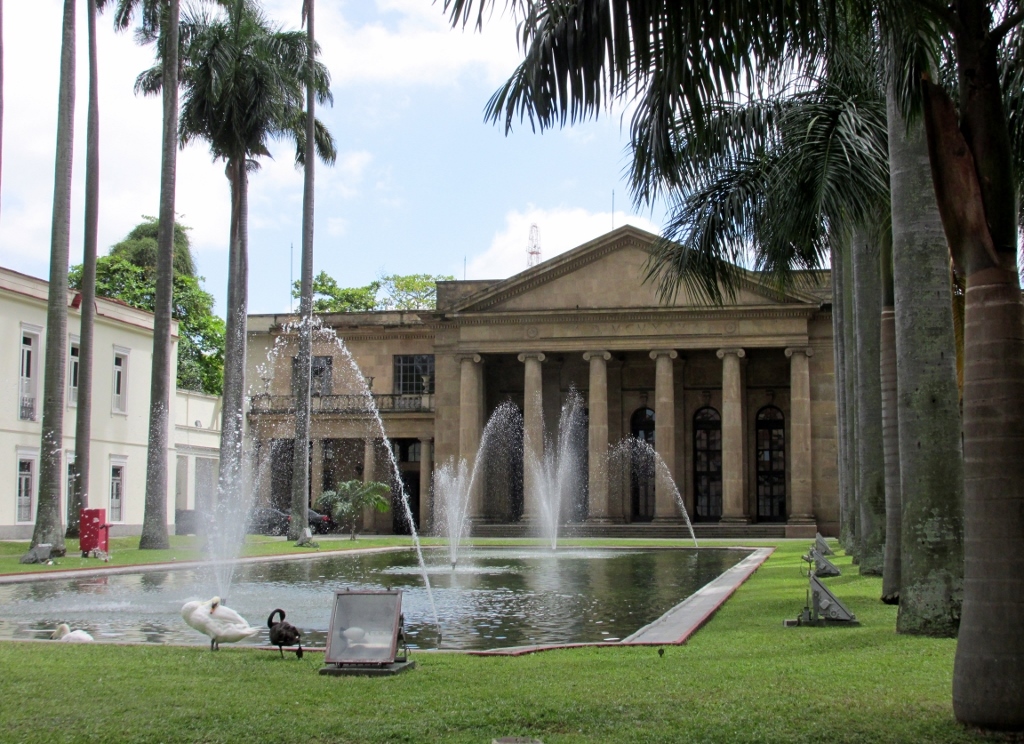
Most of you are probably wondering who I’ve been hanging out with here in Edinburgh or if I even have friends at all…Anyone that’s studying abroad can tell you that their greatest fear is not making any friends. I certainly felt anxious about the type of people I’d meet. The good news is that like freshmen year, every exchange student has the “new” factor in common. You also strangely feel close to the other exchange students simply because everyone is experiencing the same fears, cultural shocks, and excitement over the little (often touristy) moments like you.
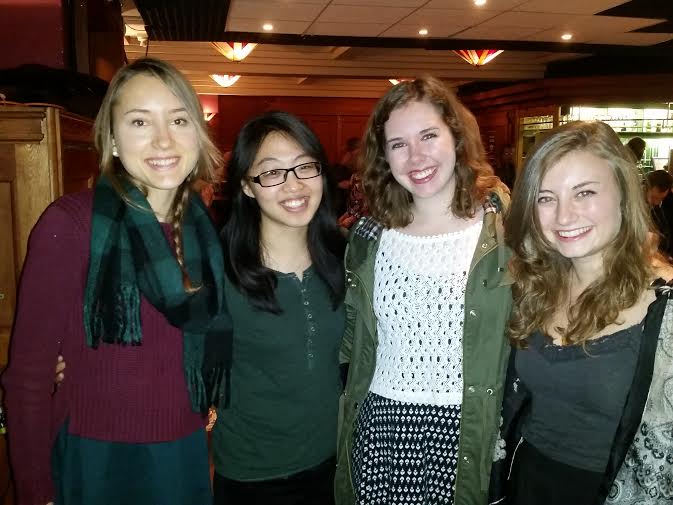
Tess, Kara, me, and Meghan at Burns Night
I’m pretty sure it was for kids, but we really wanted to try the costumes at Stirling Castle
The girls from the Parliamentary Program!
On the other hand, it’s really difficult to meet Scots here in Scotland – how can this be? Here at the University, the best way to get to know other Edinburgh students is to join societies (clubs). So far, I’ve only really joined the Music Society. This is mainly because the societies I’ve wanted to join always seem to conflict with a tour or meeting I have as part of my program. But hopefully I’ll be able to join at least one more society.
I’ve also noticed that 99.9% of the time, societies socialize by going to pubs – even after church! After mass, the President of the Catholic Student Union invited everyone – students and non-students – to join them for wine. I admit, I was caught off guard. But I had to remind myself that the drinking culture is different here; it’s much more common to go out and grab a few drinks with friends.
Other than pubs, I’ve also met Scots at museums or walking along the beach wall:
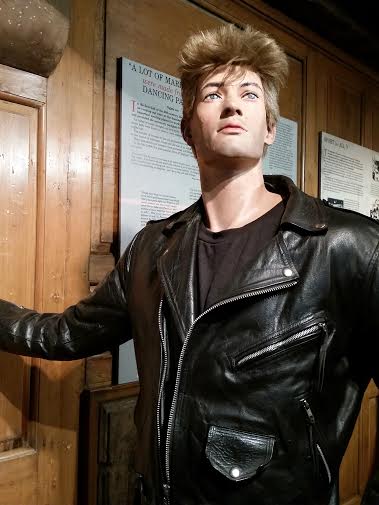
Met him at the People’s Story Museum (a museum telling the stories of the ordinary people of Edinburgh)
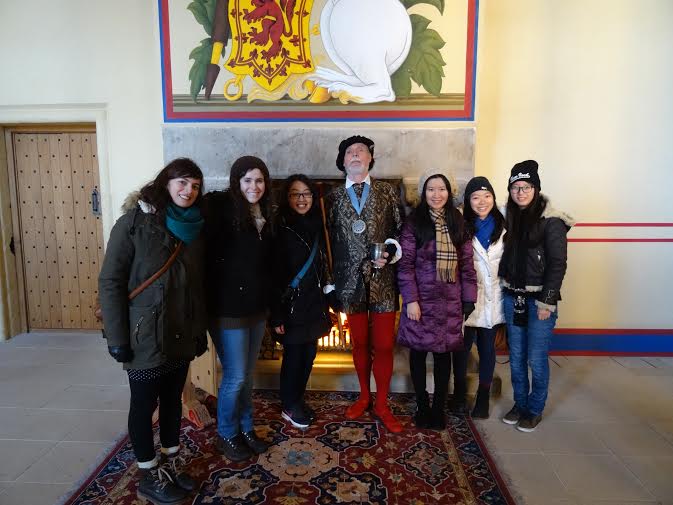
Met him at Stirling Castle
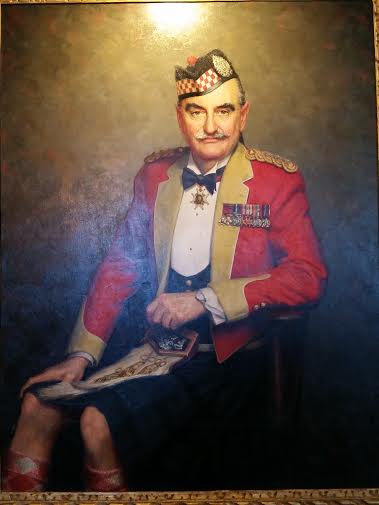
He was my favorite. I met him at the Regimental Museum
The only Scot I haven’t yet met in a pub is my MSP (Member of the Scottish Parliament), Richard Simpson. I’m really excited to work with him because he’s involved in a lot of healthcare issues ranging from chronic illnesses to healthcare inequalities which are issues that I’m also interested in researching. He also said that I would have a few opportunities to travel to visit his constituency which is going to be a great way to get to know Scotland even better!
The new Parliament building, usually referred to as Holyrood
Something that I didn’t consider before coming here is what it means to be Scottish versus British versus English. I embarrassingly didn’t realize that Scotland is not a country. Rather, it’s called a state because it’s part of the United Kingdom.
Okay so let’s work from a micro to macro level. People in Scotland are Scottish, but they’re also British because they are part of Britain, which consists of the main island including Scotland, England, and Wales. But people in England are English, but also British. People in Wales are Welsh but also British. Then what about people in Northern Ireland?
I met someone from Northern Ireland a few days ago (not surprisingly, at a pub) and he told me this: If they’re Protestant, they’ll generally call themselves British, but if they’re Catholic, they’ll generally call themselves Northern Irish or Irish.
As you can see, it can get very, very confusing. But this confusion has also made me think about the importance of preserving your identity within a union of states like the United Kingdom. For those who don’t know, Scotland recently voted on whether or not they wanted to break away from the United Kingdom. Although it didn’t pass, coming here has made me realize how much Scotland prides itself in its unique history, culture, and independence.
Scotts Momument in the heart of Princes Street, dedicated to Sir Walter Scott.
I’m certainly learning a lot about how Scotland fits within the rest of the UK and likewise, how the UK fits in with the European Union (which is also anticipated to come up to a vote soon!). It’s a great time to be here as a politics student especially as the UK General Election is less than 100 days away!
The diversity in Scotland and the UK is also one of the reasons why I’m falling more in love with the state/city every day. Edinburgh is really a hub of diversity. But I’ve come to realize that being in a diverse place no longer means seeing people simply of different ethnicities/races. Rather, the more modern diversity is defined by people of cross-cultural backgrounds and multiple identities – the Pakistani-British, the Polish-Scottish, or the Asian-Australians. It’s a concept that I think we, as Americans, still have much to explore and I, as an Asian-American, have a lot to learn from.
Til next time, cheers!
My Asian-Australian friend Jackie and I celebrating our (semi) successful nutella cupcakes!
“Hope is definitely not the same thing as optimism. It is not the conviction that something will turn out well, but the certainty that something makes sense, regardless of how it turns out.”
— Vaclav Havel
***
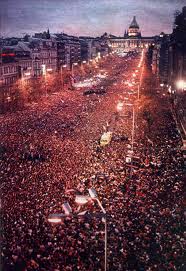
People packed Národní Třída on the morning of November 17th for the Struggle of Freedom and Democracy Day’s celebrations. Beatles music blared as people mingled, listened to speeches, held signs, and chanted many things I couldn’t understand.
One of the first people I spoke with was a local street artist. Despite his broken English, he seemed to enjoy my company. He even offered me some of his breakfast wine, which he was drinking out of a beer bottle.
I asked him several questions about the holiday and his views on the Czech Republic’s current state, and he passionately answered each. As I was getting up to go, he had one more thing to tell me, as if he hadn’t made his message clear.
“Czech Republic is freedom,” he told me. “I am freedom.”
Although the Czech Republic may be, using his words, “freedom,” it is potentially facing another era of political instability, which was on full display on this holiday.
***
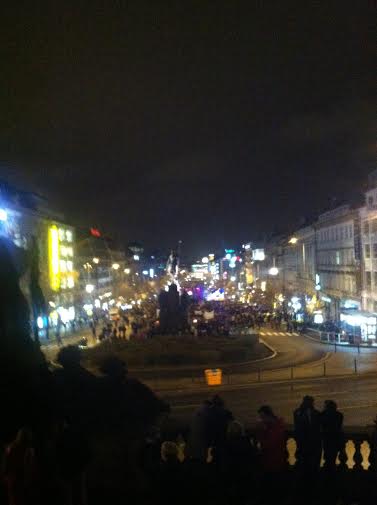
This year’s holiday had a greater significance than typical years, since it marked the 25th anniversary of the incident that led to fall of communism in Czechoslovakia. Parts of the city center were blocked off all day where a variety of memorials, musical events, and other festival-like attractions were held. At night, the festivities climaxed with an epic concert in the city’s most famous square – the same square where thousands and thousands of civilians rallied against the communist regime 25 years earlier.
Wenceslas Square, the Times Square of the Czech Republic, was as packed as I have ever seen it for the large concert on Monday night. But…
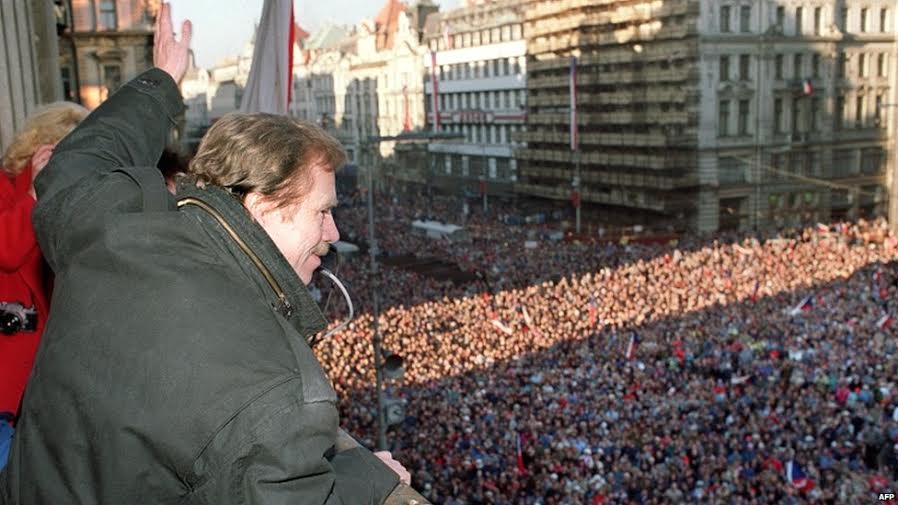
Vaclav Havel, one of the greatest leaders in recent history, speaking to his followers in December 1989.
November 17th marks the beginning of the Velvet Revolution. On Nov. 17th 1989, thousands of Czech students gathered in the city center to commemorate another assembly, one 50 years earlier protesting Nazi fascism that resulted in more than 1,000 Czechs being sent to concentration camps. The 1989 demonstration started off as a state-sponsored event, but it quickly turned to a riot against the current government. Violence ensued, policemen beat students, and the Velvet Revolution began.
The Velvet Revolution was, for the most part, a peaceful movement that resulted in the overthrow of the communist government. Led by Vaclav Havel, A Czech version of Nelson Mandela who was honored by America and placed in Statuary Hall on Thursday, Czechoslovakia moved into a new era. Less than a year after the Nov. 17th movement, the Czechs held a democratic election. The Czech Republic and Slovakia had a peaceful split in 1993, and moved forward into a much more open time period. And everyone lived happily ever after, right?
Not exactly.
The holiday’s demonstrations, the vandalizing of the Lennon Wall, and, most importantly, Miloš Zeman’s continued idiotic antics intruded on what was supposed to be a gleeful day of remembrance, while demonstrating the Czechs current political instability.
***
Let’s meet President Zeman. Since Zeman won the presidential election last June – I can’t comprehend how he won – he has found different, and sometimes innovative, ways to anger his people. I have yet to meet a young Czech person who has anything nice to say about their president, and for good reason. He’s not just a drunkard; he makes appearances in public drunk. He doesn’t just have a dirty mouth; he used, what Czechs have told me, the dirtiest word in the Czech language to describe the heroic Russian band Pussy Riot. He doesn’t just look the other way from oppressive regimes; he endorses them — he supports Russia and not Ukraine; he supports China and not Taiwan.
Czech people have had enough Zeman, and they made sure outsiders knew that when the world briefly focused on the small Central European nation for its historic holiday. The Czech people believe they have given their president enough warnings. He has, in terms of soccer football, already earned a yellow card. So on this day, thousands of Czechs assembled around the city to give Zeman symbolic red cards, representing their desired ejection, removal, explosion – whatever word you like best – of their president.
At a different event, some protestors took advantage of an opportunity to chuck eggs at Zeman. As you can see in the video below, his guards used umbrellas to shield Zeman as he spoke. I don’t have a word-for-word translation from his speech, but a Czech friend helped translate the speech for me. Zeman’s main gist: I’m not scared of you. You weren’t part of the Revolution. I was part of the Revolution. You cannot scare me.
You don’t need to even know what he is saying to sense the large disconnect between him and his people. Just listen to his unsympathetic tone and the passionate crowd.
Talk about a charismatic leader!
Zeman’s unjust rule and unfound sympathy managed to overshadow what was supposed to be a day of remembrance of all those who fought for freedom, especially Vaclav Havel.
And yet, Zeman’s actions were not even the wildest part of the day.
***
The Lennon Wall has served as Prague’s greatest symbol of freedom since the 1980s. Throughout his life John Lennon preached the importance of freedom, peace and liberty – a message that struck the Czech youth when, at the time, they lacked all three qualities. So students would graffiti the wall, at the risk of punishment, to illuminate their dreams. Even after communism fell, the Lennon Wall lived on, serving as a reminder of how lucky we, the Western world, are to have peace and freedom, how difficult freedom can be to achieve, and, most importantly, that many people still do not have their natural liberties. The Wall constantly changes, but it is always beautifully decorated with beautiful messages. That is, however, until the night of Nov. 17.
Here’s a picture of the wall before that night:
Lennon Wall Before
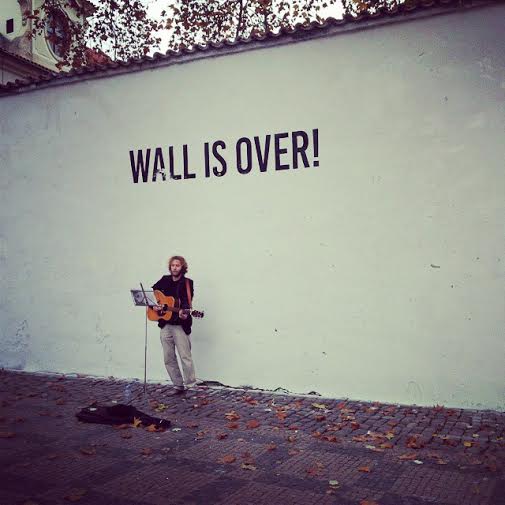
And here’s what it looked like after:
Lennon Wall After
So many questions, fueled with anger, arose: Who did this? Why did they do this? Is the wall gone forever?
The answers, luckily, are much more positive than some people, including myself, feared.
Prague Service, an anonymous group of art students, painted the wall white and added the message “WALL IS OVER!” Their reasoning was, in the best interpretation, fantastically hopeful, or, in the worst interpretation, justifiable; in a statement, they said they wanted “to provide free space for new messages of the current generation.” In essence, it was a symbolic call to action for young people. If you don’t like your government, don’t sit back and complain. Make your voice heard, one way or another.
Two friends and I went to the Wall the following night, and, not surprisingly, many people were already leaving their mark on a wall that was no longer white. Was the Wall what it had been before? Of course not. But it was already well on its way back.
Less than 24 hours after the Wall had been erased, dozens of people helped start the process of establishing a new Lennon Wall.
My friends and I hung around the wall for a while talking to some of the people there, reading the messages, and, of course, writing our own messages. While I watched people paint the wall from a few yards back, I began speaking with one of the young people there who brought out loads of paint for others to use. He offered me some of his beer, and I hesitantly asked, “Are you sure?”
“Of course,” he replied “It’s Lennon Wall!”
How could you not take a sip after that?
***
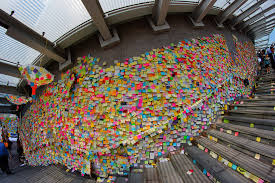
Monday was a day full emotions. Tears of joy and tears of sadness; cheers of ebullience and cheers of disdain. But, most importantly, it was a day of celebratory remembrance. Not long ago, Czechs would be severely punished for speaking out against the regime. And now they can hold mass demonstrations against their elected leader, jeer his speech, and, although probably not allowed, get away with throwing eggs at him! The Czechs may not be happy with the current administration, but at least they can voice their opinion – a right many people around the world still lack. Look at, for example, Hong Kong, where its current foundation of a revolution was somewhat inspired by the Czech Republic.
The Hong Kong Lennon Wall looks much different than Prague’s, but they both carry the same hopeful messages
The Czech Republic is far from perfect (Is any nation near perfect?), but, at least, as the street artist told me, “Czech Republic is freedom.”
… It was nothing compared to the events that took place in the same square 25 years earlier.
***
Selfie of the week:Because I am an egotistical millennial, here is the selfie of the week:
Doug and I bought a one-way ticket to a city in the Czech Republic where the Czechs were hosting Iceland in a Euro 2016 qualifier five hours before kickoff. We didn’t have tickets, a place to stay, or a way to get home. But, as you can see, everything worked out.
For the past couple of months I’ve been writing this blog to share some of my thoughts and feelings about studying abroad in Rio de Janeiro. When I chose to study at PUC-Rio, Brazil was witnessing some of the largest protests the country has experienced since the early 1990s. The country’s middle-class went out to the streets to demand cheaper public transportation, better public services, less corruption, and an end to excessive spending on international mega-projects.
As soon as I came to Rio de Janeiro people back home and in Richmond began asking me about the protests – especially whether I was attending some of them. My major, focusing on social justice and political movements in Latin America, strongly influenced my decision to move to Rio de Janeiro during such an important period in the country’s recent history. I suppose friends and family expected me to attend these protests, but as a matter of safety and based on some personal ideas on social movements I decided not to attend.
I still wanted to find a space to interact with some of the political actors in these protests. I’ve been studying Brazilian politics and I could not ignore the largest socio-political movement that has impacted the country since the severe political crises of the 1990s. My host mother was not particularly interested in anything related to politics, so I turned to my host University.
Early in the semester I met some people studying Political Science, Philosophy, and Social Work. I joined them several times for lunch and asked countless questions about the protests, political movements at PUC-Rio, and suggestions to learn more about the current political situation. They were all really interested in the movements and most of them had already participated in at least one protest.
I was really surprised that all of them were frustrated at how little political activity and organizing goes on at PUC-Rio. According to them, most student-led political movements originate and develop at public universities. They told me that students’ apathy is a combination of the university’s attitude towards political protests and the socio-economic level of most students at PUC-Rio.
I must admit I was disappointed with how things developed in the beginning. I attended some meetings of different student groups on campus but I didn’t come across much information about the protests. Luckily, this all began to change when PUC-Rio held elections for several student governments (each major sector of the university has its own student government.)
I approached some people campaigning inside and outside the university and found several students who were active members of different social movements in the city. From members of the communist party to members of the Catholic Church, the people I met quickly showed me how diverse and little coherent the protests in Rio de Janeiro were. I was truly happy that I had finally found a way to learn about the protests without putting aside my decision of not joining them.
I obviously can’t claim that I know much about these social movements. It’s been only some weeks since I began meeting students who participate in these protests. One of the most positive aspects of all of this has been the number of invitations I’ve received to attend several events related to the protests and other political movements.
The picture I’m attaching to this entry is from a student-led debate on police brutality. For privacy reasons I’m not describing each participant in the panel but I wanted to show you how PUC-Rio can be a useful space to learn about Rio’s politics. I’m not entirely sure what the future of today’s social movements in Rio de Janeiro will be. For now, I’m incredibly glad I met several students who were willing to teach me about the recent protests and to share with me some of their hopes for the near future.
An incredibly interesting debate at PUC-Rio on social protests.
Some days ago we closed our SIT Chile: Political Systems and Economic Development study abroad semester. During November I had been working hard (or hardly working?) towards the thirty-page research paper that we submit at the end of a semester abroad with SIT. I have to admit the month of research was an incredible opportunity to test out my ability to work independently. The only deadline to keep in mind was December 4th.
November was full of activities and my schedule looked busy even though I did not have classes. I needed interviews for my research and when you are in Latin America scheduling interviews/any meeting situations with people will prove to be a difficult process. I also chose a topic for my research that I had not studied through classes at Richmond or study abroad. It was a critical analysis of community-based tourism in Valle de Elikura within a mix of post-colonial/anthropological/orientalist theoretical frameworks. I spent half of the month simply looking for articles and reading as much material as I could so I developed a strong background before I started the actual writing.
I sometimes wonder what will happen with the thirty-three-page research paper I wrote in Spanish. It is difficult to convince myself that it will be useful for a class in Richmond since I know the rest of my time will be devoted to fulfilling business class requirements. If I want to use the paper anywhere in the US I would need to translate the entire thing to Spanish. So I sometimes ask myself “Why did you chose to do something ‘irrelevant’? Why didn’t you choose something that is more related to what you study at UR? Chile is would have been a fantastic country for research in any neoliberal related topic.” I am lucky I do not have to think very far to find my reasons. The truth is that I absolutely loved my topic. More importantly I enjoyed the journey of learning something entirely new, processing it, and then applying it as analysis to my fieldwork. I realized I was also wrong to refer to my work as “irrelevant”. This may sound cliché but I understood from personal experience how seemingly distinct areas of study are actually not as unrelated as we sometimes imagine. My research project gave me an opportunity to relate tourism, anthropology, orientalist theory, post colonial theory, Foucault’s notions of relations of power, and basic demand-supply relations within a capitalism economic structure. My study abroad experience allowed me to step back and explore the relationships between different disciplines. I would strongly argue that a study abroad experience is essential to a liberal arts education.
My certificate from Universidad de Santiago de Chile!
Some minutes ago I finished my first in-class presentation on Brazilian Foreign Policy. I could feel all of my Portuguese vocabulary just flying away from my mind minutes before my presentation. I’m the only exchange student in my class and even my group seemed a little nervous not knowing how I was going to do. “What’s the summary of what you’ll present?” asked one of them. I suspect she was somehow testing my Portuguese…
But enough of that. The presentation went incredibly well and I’m happy to feel capable of improvising and analyzing Brazil’s involvement in Latin America during the Cold War in front of a large group. How did it happen? I’m still not entirely sure, but the topic is so interesting that I decided to share with you some history that has traditionally been ignored.
Read any history book on the political landscape of Latin America during the late 60s and early 70s and you will most likely be led to believe that Brazil played an almost-insignificant role in other countries’ politics. Historians and political scientists have typically pointed at the US for its involvement in the region as a hegemonic power interested in sabotaging any left-wing political victory in Latin America. A different language, culture, and history of colonization are all factors that have led us to conclude that Brazil hasn’t really focused its Foreign Policy on Latin America.
While most of the above may be true, it turns out most books won’t be precisely teaching you what really happened between 1965 and 1975. Brazil’s former president Médici – military dictator between 1969 and 1974 – believed that the ideological war in Latin America at the time was an internal conflict, consequence of the poverty and inequality that have historically characterized the continent. Médici concluded early in his time in power that any solution to the region’s ideological war would also have to be internal. During his administration Brazil participated in the overthrow of a democratically-elected leftist president in Bolivia, the weakening of Uruguay’s most important leftist coalition, and the training of military forces that would eventually overthrow Salvador Allende in Chile.
In 1971 Médici visited former president Nixon to motivate him to get even more involved in Latin America. Records of the meeting show that Médici left Washington quite unhappy about Nixon’s decision to not drastically increase the economic and military aid given to Bolivia’s and Uruguay’s right-wing regimes. It turns out that between 1970 and 1974 Brazil took the lead in the “fight against communism” in Latin America and constantly tried to get the US to pay more attention to the region. In September 11th of 1973, Salvador Allende suffered a coup d’état in Chile and this meant that, according to the Brazilian Foreign Minister at the time, the Southern Cone’s revolutionary “snowball had been reversed.”
A number of internal and external factors led Brazil to shift its attention away from the region after 1974. Pinochet in Chile and Geisel in Brazil would lead, respectively, the two countries on different paths towards a harsher military rule and more relaxed policies. It wasn’t until the 1990s that Brazil would regain such strong interest in Latin American politics.
Next semester I will start writing my thesis back in Richmond. I have decided to give a more historical touch to my examination of the Brazilian-Peruvian international border in the Amazon region. As it turns out, Brazil’s involvement in Latin America has been much more important than what I once thought. Among all of the academic lessons I have gained while studying abroad in Brazil, this may be the one that will have the greatest impact in years to come.
If you are interested in reading more about Brazil’s involvement in Latin America between 1970 and 1975, you can follow this link (http://dx.doi.org/10.1080/14682745.2011.641953) to the article by Tanya Harmer (2012) that was the basis of my presentation and this blog entry.
Alright, before all of the other study abroad students look at this title and feel themselves overcome with jealousy, I should explain.
I am not doing a traditional exchange program with a university in Chile. Technically I go to Universidad de Santiago de Chile, but that is only true in part. The School for International Training (SIT) is an independent organization that offers themed study abroad programs around the world. The program I am participating in right now is called “Chile: Political Systems and Economic Development”. All of the students in SIT programs take classes together. For example, my program has thirteen students and all of our lectures are in a classroom of just SIT students; we do not have classes with Chilean students as part of the program. With that said, I am not lying when I say I am done with classes. One of the characteristics of SIT is the month long independent research project students work on during the last month of studies, so for me this means November. Today we are starting a ten-day excursion in southern Chile where there are high concentrations of Mapuche communities (Chile’s biggest indigenous group). The drive will be about ten hours and we will do this during the night. The purpose of this trip is to engage in dialogue with the Mapuche community and the community leaders about Mapuche political participation, economic development, and the struggles over land rights that the government sells to multinational forestry corporations, and the Mapuche perspective of identity within a nationalist country that marginalizes indigenous identity.
We will return from this trip in late October. During the next couple of days I need to create a research proposal and make the decision to reside in Santiago for November or relocate to a place that would be more useful for my work. Then November will come and I will be in full swing on my independent research.
Now that I am done advertising for SIT, I would like to express some thoughts on how it feels to be finished with classes.
Time has passed by faster than anyone can understand until they participate in a similar study abroad arrangement. Of course this is because we literally have less time in the classroom with the excursions and the independent month. However even taking into consideration those circumstances, I still feel it is honest to say time passed very quickly.
I have truly enjoyed the group with which I spent the past two months. There are only thirteen students so we had the opportunity to become close to one another. I can say that all of them are people I would have chosen to be friends with under different circumstances. We learned about Chile together, we learned a different language, we explored Santiago, and we traveled to magnificent places and came back to hotel rooms discussing them under the lens of social progress. We sat in class together every day for the past two months learning and exchanging ideas. It goes without saying I will miss the group.
We are all meeting at the metro station in two hours to start our journey to the south. I feel ready for this next experience.
Stay tuned 🙂
This is a picture of almost all of us…we cannot be contained within the dimensions of one photo! This is in Valle de la Luna, in the North of Chile.
I have been writing in this blog for some weeks now, and so far I have tried to stay away from portraying Rio de Janeiro under the same lens you may find in other type of stories about Brazil. I came to Rio almost seven weeks ago with the goal of avoiding becoming yet another tourist in this incredibly dynamic city. To accomplish that, I decided I would stay away from visiting some of the city’s most impoverished neighborhoods at first. From what I heard before coming here and what I have seen so far, this what many outsiders do when visiting Rio de Janeiro.
In recent years, the ‘Favela Tours’ have become major touristic attractions for foreigners. A quick search online for these tours will show you what these companies advertise: “interact with local people, see the happiness that comes out of these slums, and learn about the city’s socio-economic problems.” Most of the exchange students I have met at PUC-Rio have already ‘visited’ some of these favelas, yet when I ask them what the difference between their visit and these popular favela tours is there seems to always be an uncomfortable pause in the conversation.
Certainly many people would disagree with my approach to settling in Rio de Janeiro. Living in Rio’s Zona Sul (the city’s richest area) with a host-family, attending a private university as an exchange student, and interacting mainly with Rio’s middle-class will not show you much about other regions of the city. But this is precisely my point: what exactly is to be “shown” about these marginalized neighborhoods? I share many foreigners’ desire to learn about and interact with Rio de Janeiro’s diverse population. But can we find a more just way of learning about the country’s social diversity when we have the time and resources to do so? Would it be possible to suppress our ‘inner explorers’ until we find a social position or activity that will contribute to the lives of those from whom we seek to learn? In other words, could we approach a new social reality as foreigners and complete strangers while respecting the humanity of those who suffer from inequality and discrimination in the city? I truly want to believe we can.
One of my first steps in finding a more conscious way to learn about Rio de Janeiro was paying attention to how Rio’s residents talk about the city’s socio-economic inequality. My main source of information and perspectives is my host University. I must say that my perspective on how PUC-Rio talks about poverty, culture, and racial discrimination in Rio de Janeiro and Brazil is highly determined by a very particular set of students. As in any other university, you will find some differences between those who discuss social exclusion for two hours in a sociology course and those who take more technical courses. Among the many perspectives and ideas I have heard in my classes so far, the most common thought that I keep encountering is that “poverty in Brazil has color.”
Poverty and race relations in Brazil have drastically changed in the recent decade, and according to one of my professors, class conversation on these topics is shifting and constantly adapting. The World Bank states that Brazil saw its poverty rates dropped from 21% in 2003 to just 11% in 2009, and despite recent protests in Brazil’s biggest cities, statistics show that poverty continues to drop in the country. I have heard many students arguing that race relations in Brazil are also changing, yet by 2012, 70% of those living in poverty were Afro-Brazilian. Programs and new systems such as university quotas based on race have been established in the country, but as recently as last year statistics showed that only 2.2% of Afro-Brazilians can access higher education. Rio de Janeiro mirrors some of these relationships present in the rest of Brazil.
Let me go back to my point of respecting marginalized populations as we seek to learn about a new place. I want to ask, how fair is it to enter these communities as ‘travelers’ seeking to gain experience and then return to our safe and comfortable accommodation in the nicest areas of the city? Why would we take the freedom to pay our way into these favelas to witness the marginalization of countless families and communities for the sake of experience? As I wrote in one of my first entries, my goal for the semester was to find a position that allowed me to interact with Rio’s diverse population while contributing to these communities. I have been looking for some math and reading teaching programs that go directly to groups of kids and young students inside or near Rio’s poor neighborhoods. If everything works out in the next few weeks, I will hopefully join one of these programs for the rest of the semester. Is it a perfect solution to my questions? Of course not. Yet I want to believe that we can make an effort to grow as exchange students while respecting and contributing to the lives of those who welcome us in their cities and homes.
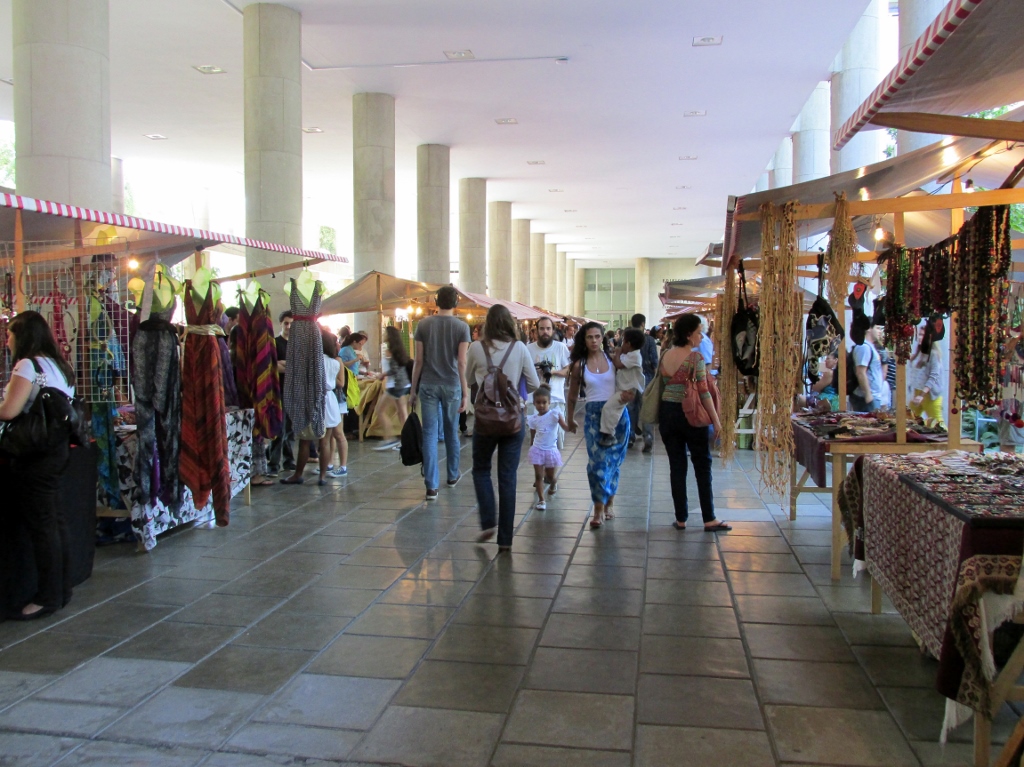
PUC-Rio has been an interesting place to learn about racial and social dynamics in Brazil. Just last week the University hosted a fair with many people who came to sell their products. The activity had a strong focus on racial and ethnic diversity, and I was happy to join other exchange students who were also interested in learning more about this complicated topic in Brazil.
One of the booths at the Brazilian fair
Maybe six months will not be enough to fully grasp how PUC-Rio talks about inequality in Rio de Janeiro, but so far I have at least had the opportunity to learn some interesting perspectives from the University.
The fair gave me new perspective on Brazilian diversity
(Warning: the pictures for this blog post are awesome.)
I ended the last blog post with a picture of the Atacama Desert I took from the plane right before we landed in Antofagasta. During the next five days we (the 13 students in the SIT program) traveled through the driest desert in the world. The purpose of the trip was to bring life to the lectures about the Chilean economy. We were to do this in two ways: three days exploring the copper industry and two days in a small village which in the past two decades has become almost entirely economically dependent on tourism.
The itinerary included two classes at a university in Antofagasta- one explaining the importance of mineral mining that is done in the region for the Chilean economy, and the other one focused on the social and environmental implications of the industry. Other major experiential learning components of the trip involved a two-hour tour of one of the biggest copper mines in the world, and an informal lecture/discussion with an anthropologist in San Pedro de Atacama. The anthropologist is also from an Atacameño community, which is the indigenous group in San Pedro de Atacama.
First up, the two lectures at Universidad Catolica del Norte in Antofagasta and the visit to the Radomiro Tomic mine in Calama:
The lectures were widely different but also complimentary. The first one was on the regional economic development of Antofagasta and the second one was on the economy and human rights. Fear not, this blog will not be a drawn out summary of the lectures. I mention them because they add to the perspective I am gaining about Chile and help to shape my experience here.
The region of Atacama is rich in minerals. There is an immense area including the south of Peru and parts of Bolivia that are lucky enough to be on the fault line of Pacific and South American tectonic plates that endow the countries with a rich variety of minerals. Unfortunately, this also generates what I judge to be modern colonialism. Foreign investment pours into mineral rich regions like Antofagasta, international companies begin to mine, make unbelievable profits while draining regional resource wealth, and at the same time secure support from the national government . Open and unregulated markets seem to be the unspoken rule for developing countries. Many economists say this generates jobs for the local communities but it hardly seems to be the case for such a highly technological industry like copper mining. I learned that for every million dollars of investment in the copper mining industry in Chile, only one direct job is created.
Another issue is the danger of an export-driven national economy based on natural resources. How far away are we from developing a sustainable substitute for copper? How much longer until the minerals run out? What if the costs associated with mining and refining copper become greater than the market value of this resource? Who will suffer from these probable future events? Will it be the CEOs of international corporations or the national economy dependent on the mineral? What about the effects on communities who for 100 years have been dependent on jobs related to the mining?
That is for you to ponder (I like to imagine I have thousands of avid readers.)
After the lectures we traveled to Calama and had a free afternoon of shenanigans until the next day when we visited the Radomiro Tomic copper mine. According to the booklet (more like book) the communications department gave the group, “each day the mine extracts 600,000 metric tons of material.” In the Radomiro Tomic mine, and I think throughout the region of the Atacama where most mines operate, only 0.5% of the rock is copper. I will not continue listing facts about the mine because those can be accessed from anywhere. My personal experience in the tour was a very overwhelming one. The number 600,000 metric tons sounds ridiculous when you read it and I do not imagine it produces a specific image in anyone’s mind. After the rock is leached and the copper has been extracted, the rest of the rubble is simply taken to the dumping site. It was at this point that I understood the mountain-like formations a bit further away were rubble. During the time that we were on the observation site at the mine, they had planned an explosion to the left of where we were standing. We heard the sound, the ground shook, and within minutes the sky was covered in dust. To stand on the edge of one of the biggest mining sites in the world was nothing but extraordinary and to be honest I do not think my mind will ever fully psychologically process the sheer size of the mining pit. It is bizarre to “see” what it means to extract 600,000 metric tons of rock per day.
The mines
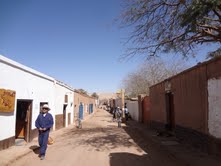
The next most significant part of the trip was our stay in San Pedro de Atacama and the anthropologist, Jimena, who spoke with us about the implications of the recent tourist boom for the indigenous community. A couple of comments about San Pedro de Atacama itself: it looks like a movie set. You walk around and see an “authentic” typical village in the dry highlands of Chile with its dirt roads, adobe walls, and low “houses”, but it’s as if the place is too manicured. The adobe walls and the dirt roads are perfectly rustic. Then you actually notice the people walking around and it is all western tourists. What looked like “houses” are actually hostels (very expensive,) touring agencies that will take you to do 136,455,478 activities you can do in the desert that include everything from sand surfing to star gazing.
San Pedro de Atacama
We met with Jimena in the afternoon. She started with telling the history of the Atacameño people and how things were when she arrived during the period in the 1990s when the tourism boom had just begun. The first comment she made about the change of lifestyle in the village was how tourism had brought some drugs to a place where they had never before been used. She also spoke extensively that national and international travel agencies harvest the profits from tourism. In her view, the normal lifestyle of her indigenous group is being “commoditized” and its “rustic” image sold to western tourists. At the same time, most of the locals have been pushed to the outskirts of the village to make room for the shops, agencies and hostels, which essentially sell their lifestyle.
I stayed half an hour after the discussion was over and everyone had left to talk more with her. Without a doubt, I can say this was one of the greatest conversations I have had.
I went on a hike with a friend through the mountains right outside of San Pedro (not with a touring company)
Later on that day, the entire group took a hike up a mountain in Valle de la Luna to watch the sunset. One of the most beautiful places on Earth
Week #2. I’ve had the chance to walk around the city a lot this past week. In fact, I walked from my house in Providencia to the University which is close to Estación Central. It takes about an hour and fifteen minutes.
In general, I try and walk anywhere that will be within an hour or so and feel comfortable saying I have seen many areas of the city and walked through similar streets several times. Although, I should disclose that I have only been through the “safe” and usually nice areas of Santiago. In other words, all of my comments about the city refer to the middle/upper-middle class regions and are not a full representation of all of Santiago.
Okay.
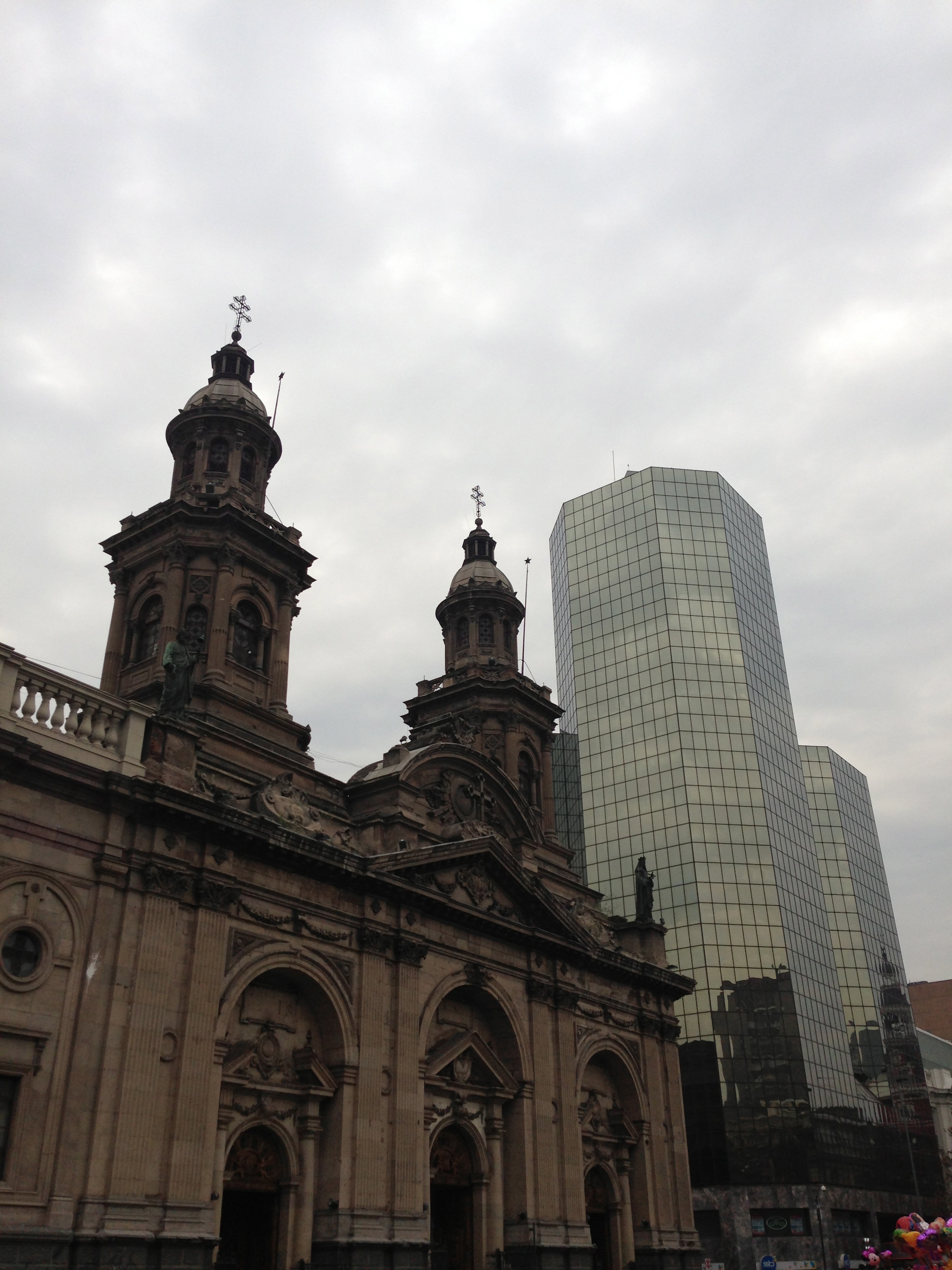
The past week and a half I walked around central Santiago confused. The architecture of the buildings seemed almost awkward. Actually, not the architecture of each individual building, rather the collective appearance of several buildings positioned close to each other. When I look one way on Avenida Providencia I see an old building with a structure screaming 18th century Spain which I imagine this to be the case in many Latin American countries. Then I look the other way and see the modern building of “Fundacion Telefónico” which holds various cultural events like theater plays and galleries. Across the street, on Plaza Italia, and I see the overbearing residential skyscraper marking it’s territory on central Santiago.
On the left is the Metropolitan Cathedral of Santiago built in 1748. To the right, stands a perfect example of the many skyscrapers piercing the Santiago sky today.
Sometimes I feel I am in Spain, sometimes London and at other times even Tirana! Tirana, for the few of you who might not know (joking, I know most of you don’t know) is the capital of Albania. This is where I was born, grew up for the first ten years of my life, where most of my family lives and where I have spent many of my summers since migrating to the United States.
All last week, as I found myself in different areas of the city, I thought “What is going on here? Santiago must be confused. Is it colonial? Is it modern? Does it have its own identity? Its own niche?”
I am not suggesting cities, or even the tiniest municipality, is, or needs to be, homogeneous. Santiago is big. Of course it is diverse. I do not expect the architecture of every single part of the city to be identical. I also do not want to reduce an incredibly diverse city of almost seven million inhabitants to one single identity. That is not what I tried to do.
With that said, I still contend Santiago is a special place.
I spent the past week and a half trying to understand how the different structures and diverse architecture tell the story of Santiago.
The colonial architecture obviously comes from the colonial period. Easy. At first glance, the skyscrapers filled with offices of foreign enterprises contend that Chile does enjoy a developed economy, sophisticated financial structure and plenty of foreign investment. These are the buildings that proudly show the international community “Hey, we have made it!”. The modernity is celebrated not only by the elite who benefit from an open and deregulated market, but from also a working class who hope swallow their objections in hope that trickle down economics will eventually…well, trickle down to them.
On the contrary, the buildings are also an uncomfortable symbol of the seventeen years of military dictatorship that aggressively implemented neoliberal economic reforms. The reforms made possible the most stable macro-economy in Latin America, but also created severe inequality in earnings, education, and healthcare to name a few. Consequently, for many, the modernity, the high-rises, and the “booming” economy also represent classicism, racism, and enforcement of prejudices and the further entrenchment of the degrading stereotypes that sustain them. The disrespect of human rights for seventeen consecutive years during the dictatorship which carried out a neoliberal economy and replaced citizens with consumers, and the current systematic neglect of key functions of a democratic government and civil society are oftentimes seen as an unjustifiable sacrifice for macroeconomic success.
But, this isn’t meant to be a history lesson.
So friends, I walked around for a week and a half thinking Santiago was confusing me because of how incredibly diverse the architecture is. As I thought this, I came to a street crossing. The light was red for the vehicles, but that isn’t what’s important. In front of the stopped cars was a man on top of those high unicycles, dressed as a clown, and juggling. He was putting a show for the cars during the few minutes they wait at the red light.
That is when I realized, the city isn’t confused.
It is unbelievably eclectic.
There is a fusion of past and present. The struggles and the victories. Protests on one side of town and celebrations on the other. Business men in suits and students marching in the streets. A musician playing his fiddle in the subway train and a woman dressed as if ready for a fashion show, having an extensive conversation about the current health of her nail-beds. September 11th 2013, the fortieth anniversary of the military coup, will undoubtedly result in riots across the streets (No worries, I will be in the north, and more that safe), then a week later, everyone will celebrate the fiestas patrias with friends, family, barbecues, and late night parties.
But, these “extremes” should not come as any surprise. It sort of runs in the country. Geographically speaking, Chile can make even the most experienced National Geographic photographer go “Huh. I have never seen anything like that before.” There are the Andes, an entire coast line in the Pacific, the world’s driest desert, glaciers, enormous lakes, valleys, rivers, grassland, and finally, the eclectic metropolitan city of Santiago.
Right now, I am on a plane flying north for an excursion with my program. The plane is going over the Atacama desert, the driest and highest desert in the world, and in the background I see the snow capped Andes.
Maybe it’s time for an “It’s been a month!” post, so here it goes!
A month and two days ago I was going by bus to the international airport in Lima. I had just finished a 10-week research/internship project in the Brazilian and Peruvian Amazon and I hadn’t really had the time to prepare for Rio de Janeiro. Now that I look back and think about that last week in Peru, I realize that I hadn’t built solid expectations for what could happen in the following months.
I guess typically these posts reflect on how time flew by, but it seems as if the opposite has happened for me. As I look at the calendar all I can think of is “has it only been a month?!” Don’t get me wrong, I have found an incredibly interesting combination of classes at PUC (my host-university,) a bi-weekly yoga class, two daily bike rides to and from my University, a lovely home with my host-family, the environment to learn Portuguese, and great people. When I say that it surprises me that I have been in Rio only for a month is precisely because of how well established I feel already. To show how far I have got in settling in Rio de Janeiro, I want to tell you about two very common topics in conversations among Brazilians: family and bureaucracy.
One of my favorite aspects of studying in Rio de Janeiro has been encountering a culture that highly values social networks. Similarly to other Latin American countries, you will find in Brazil that family and friends form a person’s safety network and may go as far as forming part of someone’s identity. In my Poverty and Social Inequality class at PUC, we have been discussing how social integration in Brazil happens mainly through these social networks. Western social thought has typically valued social integration through a person’s career and professional development over social networks. However, research conducted across socio-economic classes constantly shows that Brazilians will, on average, protect their social networks over seeking new employment opportunities.
I have felt incredibly comfortable living in this environment (I’ll blame my Guatemalan background,) and experiencing these social interactions again is making me want to go back home for some years to recover some of those networks!
Navigating a new place as an immigrant without strong social networks can be tough at times. This past Thursday I went to Brazil’s Federal Police to register as a foreign student (a mandatory procedure for all non-Brazilians who stay in the country for more than thirty days.) I stood in line for four hours, and when I finally managed to present my documents I was told my mother’s name did not match the police’s system. I didn’t get more than a “you cannot register until you fix this.” I came back home incredibly frustrated. The only exciting aspect was that I now needed to go to the Ministry of Foreign Affairs to correct my immigration documents. As you may remember from my initial posts, my favorite course at PUC is precisely Brazilian Foreign Policy, so the trip was not bad at all. “You can’t fight Brazilian bureaucracy,” replied my host-mother when I told her my story, “that’s why you always need to know someone.”
It was quite a trip to the Ministry of Foreign Affairs this past Friday