Jackie in Switzerland: A Weekend of Adventure

April 6, 2015

Disclaimer: No photo shopped postcard photos were used in the making of this post. They are all actually real, no matter how unbelievably perfect they appear to be.

This weekend, I embraced my inner Swiss and decided to fill my time with some outdoor activities! On Friday, I participated in an indoor rock climbing event organized by the ESN, which is the group that makes events specifically for exchange students. I have only been rock climbing a few times before, but I was excited to try again. It turns out that I am horrible at it, as in, bad enough that two 4-year old Swiss kids were mocking me because I couldn’t make it up the wall. I eventually made it up to the top of some of the walls, but I spent most of my time “chalking up” my hands and trying to act like I knew what I was doing.

This is a picture of the people who actually knew what they were doing

This is a picture of the people who actually knew what they were doing

One of the weirdest things about this event was that it included three free beers as part of the cost for participating. I am getting used to the European mindset that alcohol is not necessarily bad, and that most Europeans drink a glass of wine with friends in order to enjoy the drink, and not to get drunk. I didn’t even consider the fact that our school was sponsoring an event that served alcohol until I realized how odd this would be at Richmond. This is just one of the things that I’ve gotten used to here that will be totally different when I get back home!

After attempting to climb and falling a few times, I decided that rock climbing was not quite my thing, but I got to meet some awesome people.

Expectation
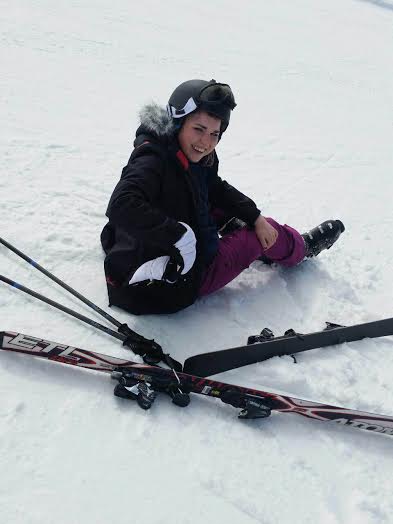
Expectation

Reality

Reality

On Saturday, I decided to try my hand at skiing and that was even MORE disasterous than climbing. I am not exaggerating when I day that I spent more time laying in the snow trying to stand up after falling than I did actually standing on my skis. My brilliant friend Amanda was an absolute pro and went down from the very top of the mountain. I did my best, but in the end I actually cheated and took the lift down the mountain (whoops). To be fair, I had to  I’m giving myself credit for at least trying, I think it would be a study abroad sin if I live in Switzerland for 4 months and don’t even try to ski!

Ceci n’est pas une carte postale. It’s real!

Ceci n’est pas une carte postale. It’s real!

My friend Amanda was an absolute pro, she made it all the way down and she hasn’t skied in years!

My friend Amanda was an absolute pro, she made it all the way down and she hasn’t skied in years!

Apart from the actual skiing, the view was absolutely incredible and I just cannot put into words how amazing it was to just be there and soak it all in. I see the mountains everyday going to school, but being on the very top was something totally different. I will definitely never forget it!

You don’t see this everyday (unless you study abroad in Switzerland! ;)

You don’t see this everyday (unless you study abroad in Switzerland! 😉

I should probably mention that I am actually terrified of heights and did not realize how absolutely frightening the ski lift would be. Really, it is just a tiny little box held up thousands of feet in the air by a little cable. Totally not scary at all. Even at the top of the mountain, I was so scared looking down and seeing how high up we were. They say that studying abroad helps you overcome your fears, and that is the truth.

Absolutely terrified in the ski lift.
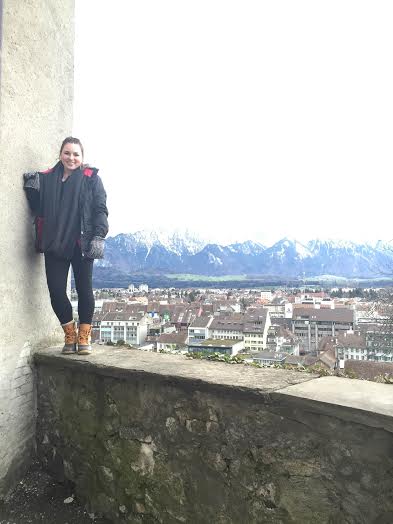
Absolutely terrified in the ski lift.

This is a beautiful background, but more importantly, you cannot see the fact that I was terrified. This ledge was about 200 feet from the ground below and after some serious peer-pressuring, my friends convinced me to face my fears and climb up for the picture. It was totally worth it.

This is a beautiful background, but more importantly, you cannot see the fact that I was terrified. This ledge was about 200 feet from the ground below and after some serious peer-pressuring, my friends convinced me to face my fears and climb up for the picture. It was totally worth it.

Finally, I figured I couldn’t end my weekend of adventure with a lazy Sunday, so I decided to go hiking with the exchange group on Sunday! We took the train to Interlaken, which is a notoriously sporty region of Switzerland. The hike was great and pretty relaxing until we got to the last half hour. We were running late and had to practically run up the steepest part of our whole hike. Despite the pain in my legs, the view from the top of the mountain was worth it, once again.

After spending the whole day in the woods, I realized that I’m not so much of an outdoorsy girl, but I still had fun!
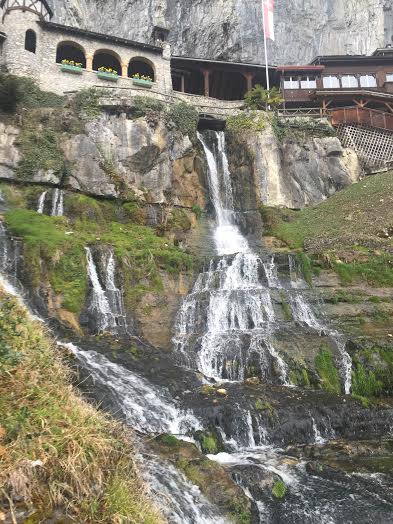
After spending the whole day in the woods, I realized that I’m not so much of an outdoorsy girl, but I still had fun!

These are the kind of things that you think people exaggerate about when they describe Switzerland’s natural beauty. I can attest: it’s really real.

These are the kind of things that you think people exaggerate about when they describe Switzerland’s natural beauty. I can attest: it’s really real.

After a long weekend of nature sight-seeing in Switzerland, I am looking forward to exploring something new for Spring Break! This week, I will be going to Nice, France and then to Venice and Milan in Italy! I have never been to Italy before, so I am really excited to see what it is like! Speaking French every day is becoming more and more comfortable for me, so I think it will be strange to find myself in a country with a foreign language. I will definitely be taking a lot of pictures and videos! Be prepared for a fan-girl freak out in my next post, I am already anticipating the pizza, pasta, gelato food coma.

Another amazing Switzerland weekend with amazing friends!

Another amazing Switzerland weekend with amazing friends!

P.s. I forgot to mention how cool it is that John Kerry and other world leaders are here in Lausanne for the Iranian Peace talks! I have actually seen heightened security in certain places in the city. I just learned that the talks are being held at EPFL, another University in Lausanne that is right next to UNIL. Even more, my apartment building is between the city and EPFL, so I see the entourage of secured vehicles pass by our building every day. It is really cool to be in a city that has so much international attention and importance right now!


Jackie In Switzerland: More lakes and mountains (still beautiful)
March 25, 2015

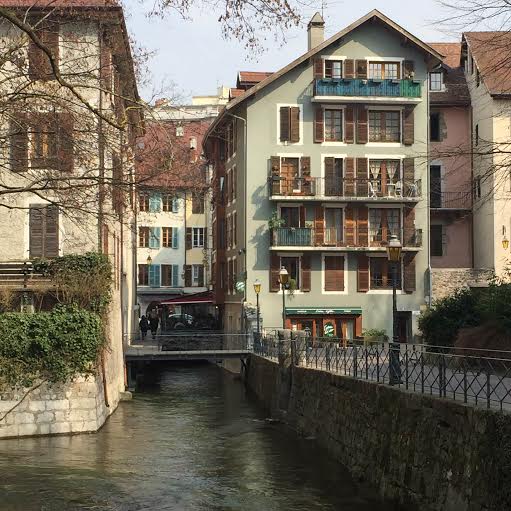
After so many weeks of hard work in Lausanne, I decided that it was time to get out of the country for a little break! My friend Ayumi and I picked the small French town of Annecy to spend the past weekend. We had heard that people called it “Little Venice” and it definitely did not disappoint. Canals and rivers crossed the entire city, with countless walking bridges that gave the most perfect picture of the old, colorful buildings which lined the canals. Just when we thought it couldn’t get any better, we found the lake. You would think that a giant lake would be easy to find, but it took us about 5 minutes to get completely lost, and then another 45 minutes of walking to find it. And it turns out, it was about 15 minutes from our Airbnb! We are clearly seasoned travelers.

This town definitely felt like Venice with all of the tall buildings lining the canals. It was the perfect place to spend a relaxing weekend!

This town definitely felt like Venice with all of the tall buildings lining the canals. It was the perfect place to spend a relaxing weekend!

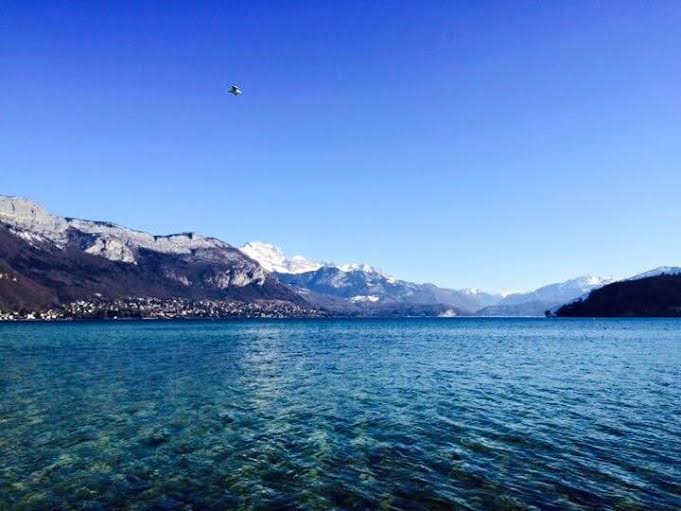
That being said, the view was worth all of the exhausted-walking in the world. I hate to be repetitive, but I really don’t think that I will ever get sick of mountains and water. We sat in front of the lake and ate our nutritious breakfast of cheesy quiche and macarons (which, by the way, are my absolute favorite food on the entire planet) and got to look at this amazing view. The weather was beautiful and so many families were out enjoying the lake with their families. We couldn’t stop talking about how lucky we were to be experiencing this, and how unreal it felt. It finally hit us that we are really here, thousands of miles from home, seeing the things we dreamed about seeing for our entire lives. At the same time, I can’t help but think of all the places I still have to see, all of the places that are on my list and all of the incredible places that haven’t even made it onto the list (yet).

For as much as I love food, I have to say that macarons are my favorite food in the entire world, no exaggeration. Here, there are 2 raspberry macarons, a salted caramel and a violet macaron.

For as much as I love food, I have to say that macarons are my favorite food in the entire world, no exaggeration. Here, there are 2 raspberry macarons, a salted caramel and a violet macaron.

As much as I would love to eat macarons for breakfast, the quiche was so fresh and amazing that it was almost as good as macarons for breakfast (almost).

As much as I would love to eat macarons for breakfast, the quiche was so fresh and amazing that it was almost as good as macarons for breakfast (almost).

Voilà our view from breakfast! This was about the moment when we realized how awesome our lives are.

Voilà our view from breakfast! This was about the moment when we realized how awesome our lives are.

And now onto a slightly embarrassing confession. During our time in Annecy, surrounded by all the beautiful canals and bridges and old buildings, we spent a solid hour in Monoprix, the French equivalent of Target. We had gone in to find snacks, and we left with about 100 euros worth of groceries to take home. I have not mentioned this before but Switzerland is PRICEY. For the first time in my life, I have to shop like a real adult and unfortunately after a month in a half here, I can tell you which brands sell the cheapest pasta sauce per gram (I really sound like a middle-aged mom now and its beginning to scare me). When we finally got to France and saw that everything is about 3 times cheaper, we went absolutely crazy. We came to France for the mountains, but the best find was the cheap groceries.

Words do not do justice to my love for Monoprix.

Words do not do justice to my love for Monoprix.

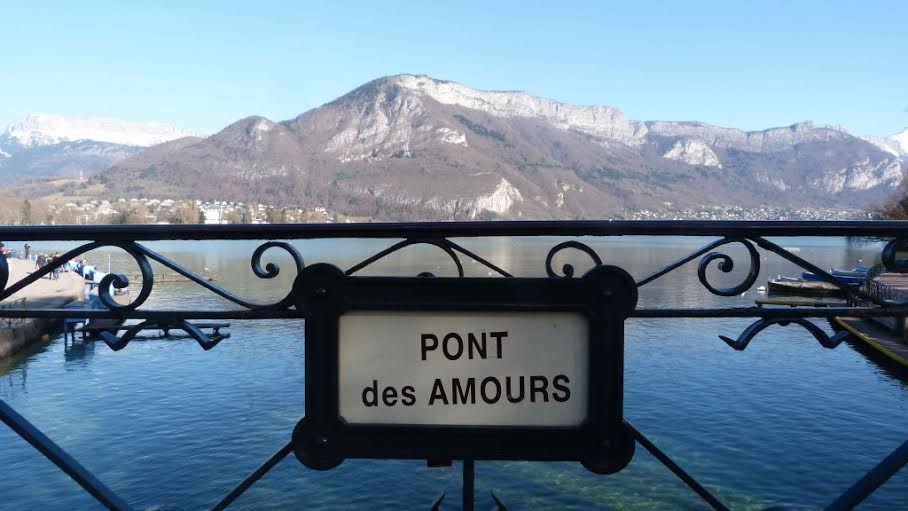
After calming our thrifty grocery-shopping selves down, we finally got back to the city. We visited all of the little boutiques in town and really just walked around to see all of the amazing old architecture and bridges. Of course, we got a classic tourist picture on “Le pont des amours” and another with the mountains and lake in the background.

[Picture of the city] Caption: Annecy felt like the perfect historic little town, each building had its own character.

[Picture of the city] Caption: Annecy felt like the perfect historic little town, each building had its own character.

So touristy, but so pretty.

So touristy, but so pretty.

With all of our walking and shopping, we were starving and decided to have dinner in a French fast-food restaurant, Quick. I know it sounds weird to pick fast-food while in France, the center of all culinary genius, but all we really wanted was a burger and fries. As an American, I am proud to report that McDonald’s is a much tastier choice for greasy, unhealthy food, even though Quick was throwing some major shade with the caption on their boxes.

This phrase was all over Quick. It means ‘This isn’t the American burger’. Cue the fast food burger battles.

This phrase was all over Quick. It means ‘This isn’t the American burger’. Cue the fast food burger battles.

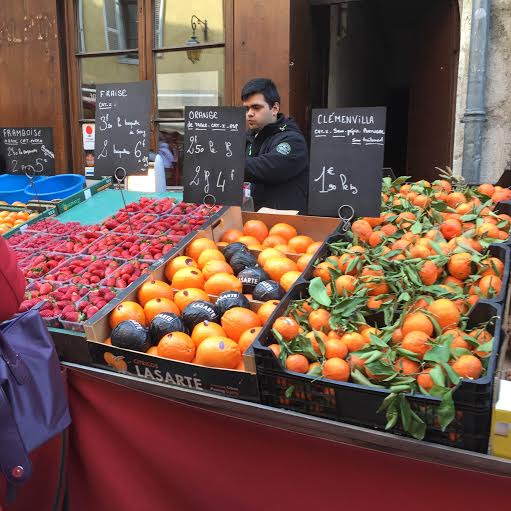
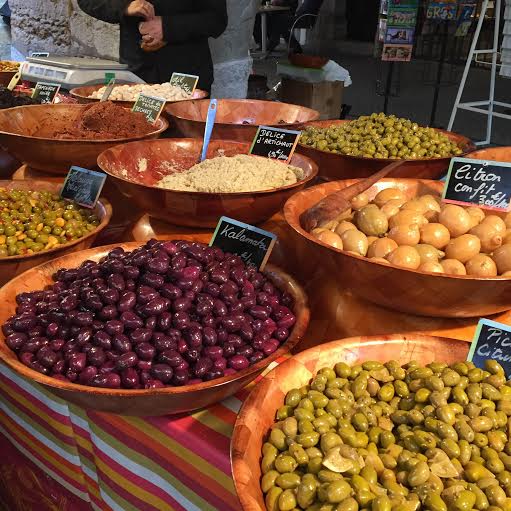
On the more sophisticated side of food, we also visited the Sunday market in Annecy, which was special because almost everything is closed in Switzerland on Sundays. We were expecting a small market with mostly fruits and vegetables, but what we got was so much more. Throughout the streets, there were stands with cheeses, meats, pastries, spices, and wines in every direction. The market was amazing because of all of the food, but even more so because all of the people. It was easy to see that this market was a weekly event that brought the whole town together each week to enjoy lazy Sundays together. The French use a term called “la convivialité” that is basically all that makes life enjoyable and happy. This market was the definition of convivialité!


unnamed-4

unnamed-5

unnamed-6

unnamed-7

All in all, we had a great relaxing weekend in Annecy, and it made us really appreciate how lucky we are to be spending a whole semester in one of the most beautiful places in the world. That being said, on Sunday afternoon, we were beyond relieved to be heading to our temporary ‘home’ in Lausanne, high prices and all.

Loving Annecy, but looking forward to making it home!

Loving Annecy, but looking forward to making it home!


KyungSun in Scotland: Storm Warning

March 17, 2015

They say homesickness abroad is inevitable and it finally hit me this past weekend.

I bought a ticket to the Isle of Skye, one of Scotland’s most beautiful islands, where we spent 2 nights and 3 days exploring waterfalls, cliffs, and beautiful lakes/rivers. It was supposed to rain all weekend, but I figured I could tolerate Scotland’s weather by now. Plus, Scotland is notorious for quickly changing weather and I prayed that we would see some flashes of sunshine. Unfortunately, we only saw sun on the last day of the trip.

Going into the weekend, I was burdened with a lot of things going through my head. I was dealing with personal issues from home, figuring out my summer internship, in the midst of planning spring break travels around Scandinavia, and trying to arrange my living situation next year with my roommate. I had hoped that going out to see some of Scotland’s Highlands would help me clear my head. There’s something about being in a spacious landscape that always makes me feel a sense of freedom. It’s like my problems become minuscule when compared to the massiveness of land before me.

Three Sisters Mountains in Glencoe

Three Sisters Mountains in Glencoe

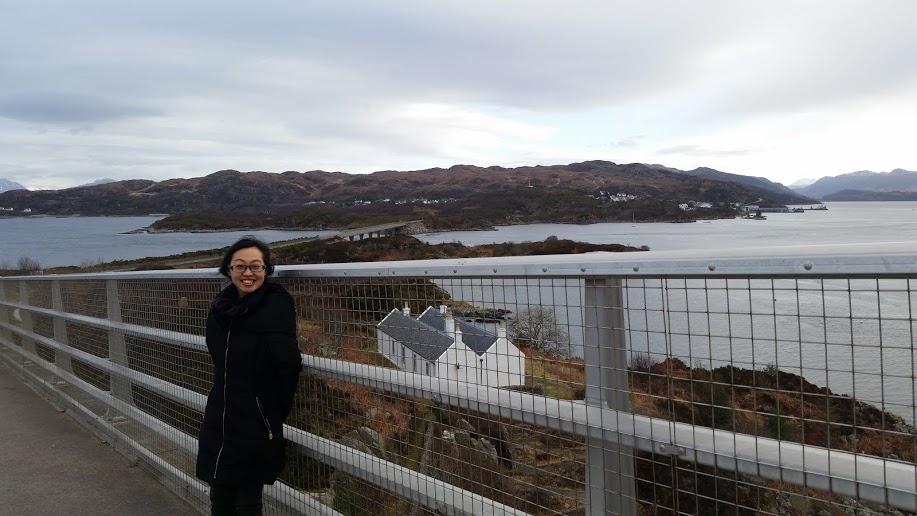
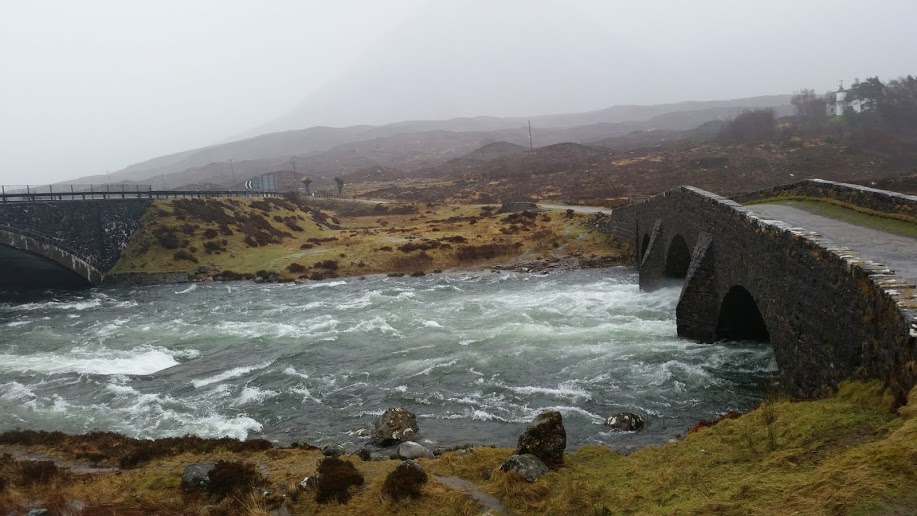
Crossing the Skye Bridge

Crossing the Skye Bridge

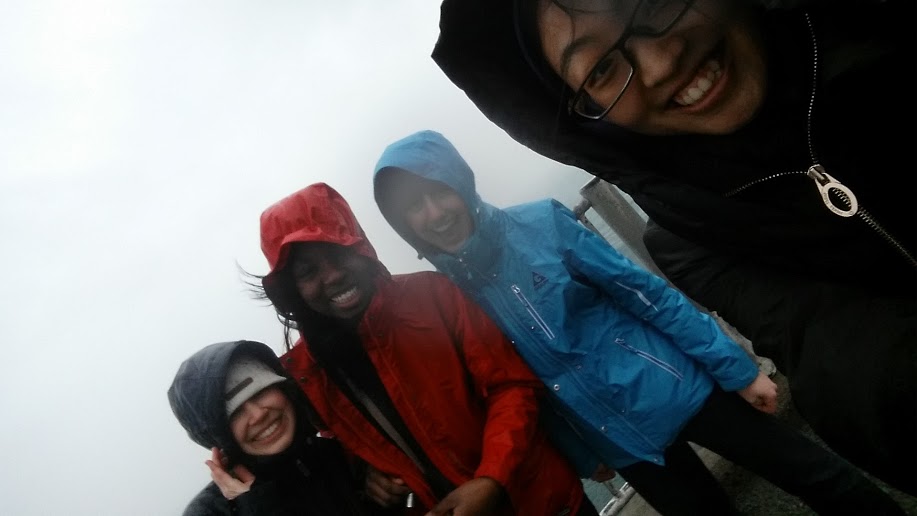
Although I saw some amazing views, the weather definitely made it difficult to fully enjoy them. Winds reached about 27 mph and we had continuous rain. Our tour guide said that it was the worst weather he has seen in the island and highlands in all of his 6 years doing the tours. It certainly wasn’t an uplifting fact, but every time we made another stop, I made an effort to brave the storm to see the views. I also got to know a lot of other exchange students simply because of the bad weather. We all suffered the stickiness of wet socks, drenched clothes, and the struggles of taking decent photos amidst freezing, high winds.

 Braving the storm!

Braving the storm!

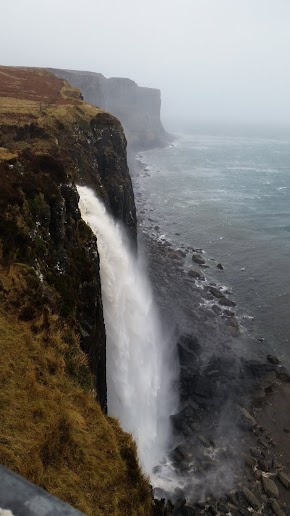
Kilt Rock

Kilt Rock

However, our tour guides from Haggis Adventures still made the trip a lot of fun. Our two guides – Heather and Andy – constantly joked back and forth and even had us sing along to our favorite ’90s classics, including “I Want It That Way” by the Backstreet Boys. My favorite part was when they told fun stories about the islands like the story of a river that supposedly makes you more beautiful if you wash your face in it for seven seconds. With them, I felt like I had actually gotten to know Scotland better rather than just seeing pretty views. On the last day when the weather finally cleared, they even took us back to Glencoe (where we were originally supposed to go but had to sacrifice due to the weather) even though it was above and beyond what they were paid to do.

Believe it or not, Andy once lifted a tree 2x his size for a competition!

Believe it or not, Andy once lifted a tree 2x his size for a competition!

Andy says he is the living proof of the water's powers

Andy says he is the living proof of the water’s powers

Passing through Glencoe

Passing through Glencoe

The thing is, I didn’t know anyone on the trip. I was both excited and dreading this fact. On one hand, I was excited to get to know the other exchange students. But on the other hand, I just wanted to be in the presence of old friends where we could have comfortable silence. I’m usually a very outgoing person, but with all the things running through my head and the stormy weather, it was difficult having to “be on” all the time. During the moments when we were just riding the bus with nothing to do, I was overcome with sadness. I missed my mom’s cooking and longed for some warm stew. I wished my friends were here to talk through the problems I was having. I just wanted a sense of familiarity. For the past two months, I’ve been constantly been experiencing one new thing after another trying to make most of my time here. As fun as it is, it is also exhausting and I had reached a point where I just wanted to be in the comfort and relaxation of home. I didn’t want to leave Scotland, but I wish there was a way to transport my house here.

So that I don’t dwell in this homesickness for too long, I’ve been skyping friends from back home. I’ve also made sure to have more meaningful conversations through letters and postcards rather than through facebook messaging. On Thursday morning, I leave again for another adventure to Ireland for St. Patrick’s Day weekend. This time I’ll be going with my flatmates who have become my close friends and my sense of familiarity in Scotland. Until then, I plan on taking things slow in this race to make the most out of my abroad experience, enjoying my time at Holyrood (Parliament), and finding downtime like my new favorite animal, the Harry Coo.

Harry Coo otherwise known as the Highland Cows

Harry Coo otherwise known as the Highland Cows


Diana in Copenhagen: Time to be Spontaneous

October 27, 2014

After spending about two and a half months in Copenhagen I have started to get comfortable in my life abroad here…too comfortable. I’ve adopted a normal routine consisting of cooking, grocery shopping, going to class, going out, making it to the gym on occasion, traveling, and watching Netflix. Somewhere along the line I lost the passion to explore my surroundings and seek out all the amazing things I have at my fingertips in Copenhagen. This realization came with an overwhelming sense of guilt and worry that I was taking my short time here for granted.

So I decided to get off my butt and do something.

A friend was feeling a similar way and we made a plan to be spontaneous, that’s not too contradictory is it? We decided to simply get on the metro and ride it until we saw fit. Originally unsure of our final destination, we got off at the Kongens Nytorv stop and started walking.

This dropped us onto the longest pedestrian street in the world, Strøget. The street is packed with shops of all varieties, ranging from the more affordable stores like H&M and Zara to ones like Emperio Armani and Burberry that will make your bank account cry. I ventured into a few stores but even the “cheap” ones were pricier than I would have liked (remember how expensive Copenhagen is), and I wasn’t really in the mood to shop anyway.

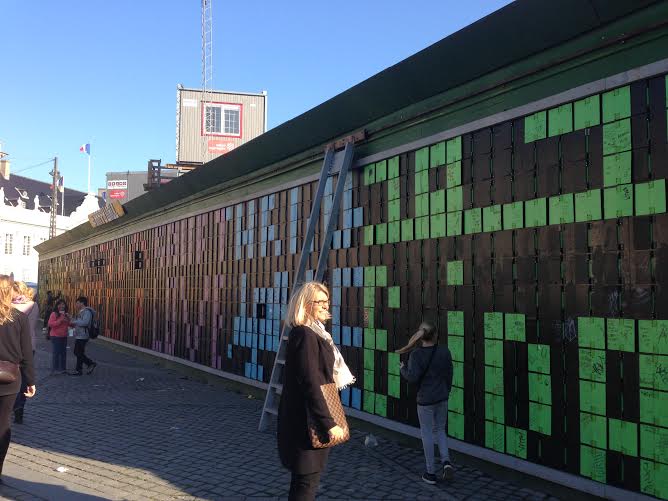
This walking tour also took us to something called the “Happy Wall” which is an interactive art piece made of brightly colored wooden boards. Visitors can flip the boards between colored and black sides to create their own vision, whether it be a message, a picture, or a symbol. Many also sign the wall with happy thoughts and well-wishes. It is a really cool piece in the middle of the city and acts as a glowing representation of Copenhagen’s renowned happiness. If you’re not aware, Denmark was voted the happiest country in the world in both 2012 and 2013, and fell to a more-than-respectable third place standing in 2014.

The Happy Wall

The Happy Wall

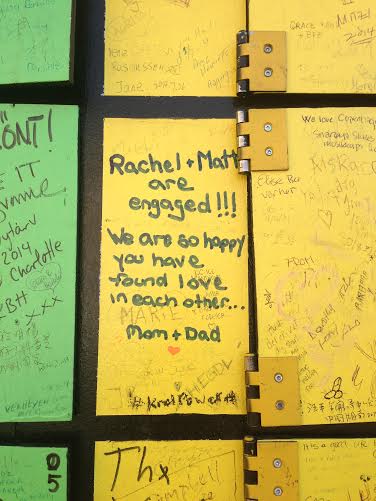
One nice message I saw.

One nice message I saw.

For lunch we got sandwiches at a small shop that offered a student discount and took them to one of the most beautiful spots in the city. If you have yet to see the picturesque colored houses lining the canals of Nyhaven you have done a shockingly impressive job at avoiding Instagram. It’s practically a requirement for visitors to snap a photo of the vibrant homes along the water, and it’s not difficult to see why. Nyhaven is a stunning place that was bustling on this beautiful Saturday afternoon. We became mere faces in the crowd of both tourists and locals alike out enjoying the scenery on a nice fall day.

Many people were out enjoying food and drinks by the canal.

Many people were out enjoying food and drinks by the canal.

My favorite thing we encountered that day though, was an open-air photography exhibit called Copenhagen Green. Right off Kongens Nytorv Square, there were rows of pictures depicting scenic locations around the city where you can visit for free. There were images of water sports and nature centers as well as gorgeous cemeteries and parks. Not only are the people of Denmark happy, they are very eco-friendly as well. Denmark is one of the “greenest” countries in the world so the fact that their capital city boasts such beautiful sanctuaries was no real surprise.

The best part about this exhibit was that each photograph provided a description of the location. Outlining activities you can do at each place, the photographs made each look enticing enough to visit that day. Of course, our theme of spontaneity continued and we followed one photo’s posted directions to our next stop.

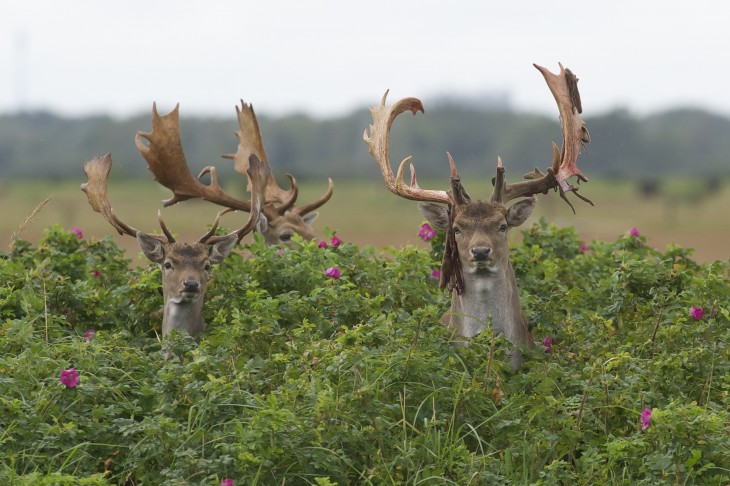
The photograph advertising the Amager Nature Park.

The photograph advertising the Amager Nature Park.

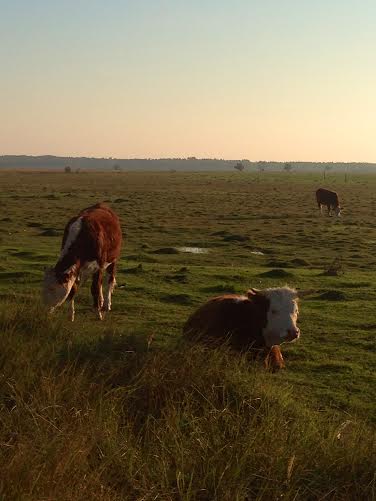
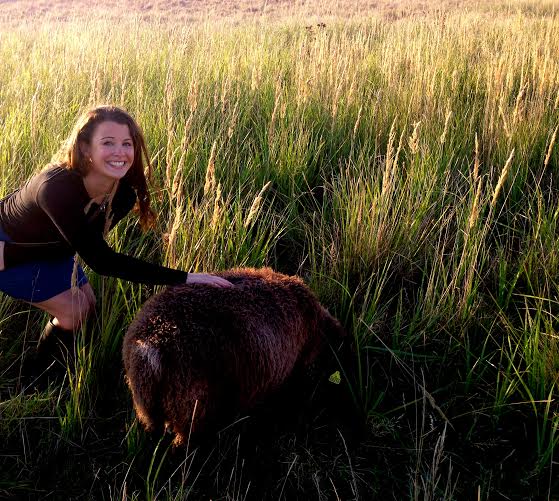
We found our way to Amager Nature Park, the last stop on one of the two metro lines Copenhagen has. I wasn’t quite sure what to expect from the exhibit’s photo showcasing curious deer-heads, but what we found was beautiful. The park was expansive and made home to many animals. On a backdrop of the silhouetted city, various cows, deer, sheep, and horses meandered around the spacious green and we could walk right up beside them. The juxtaposition of the wildlife with the nearby city was beautiful and I felt lucky that happenstance had brought me there.

unnamed-5

unnamed-4


I loved the contrast this green open area had with the city. This is a great example of what Copenhagen can offer being a small and eco-friendly city.

I loved the contrast this green open area had with the city. This is a great example of what Copenhagen can offer being a small and eco-friendly city.

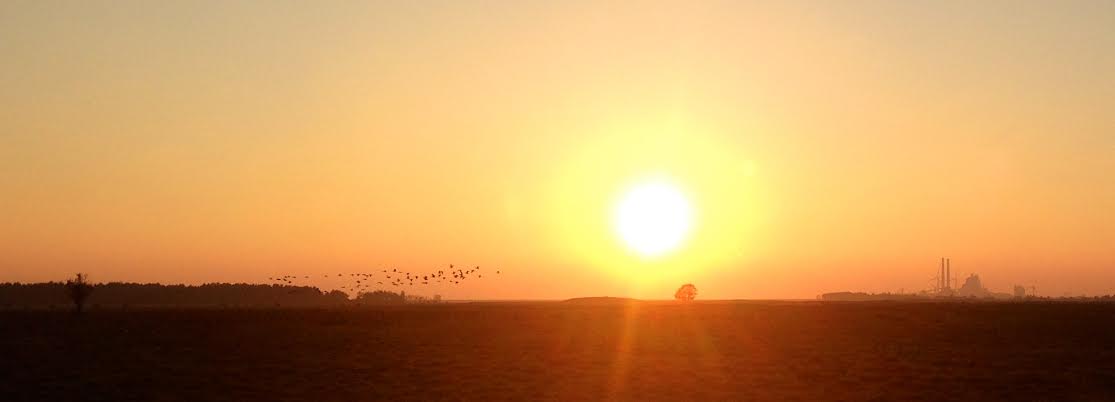
As dusk approached it got a bit too cold to be outside, but we didn’t head back before witnessing a gorgeous sunset over the Nature Park. A flock of birds flying through the sunset made for a cliché day’s end but I can’t say I didn’t enjoy the cheesiness. It was a great culmination to a day that successfully revived my curiosity and appreciation for the city I’ve made my temporary home.

A beautiful end to the day.

A beautiful end to the day.


Diana in Germany Week Six: Ecology and Management of Forests

October 20, 2014

My second class of the semester is already over! Also about 35% done my stay in Germany to put things in perspective. So these past few weeks in Ecology and Management of Forests in Southwestern Germany and the Swiss Alps we have gone on field excursions a total of 6 times, and they were all amazing.


Schauinsland

Our first excursion was an all day hike at the nearby Shauinsland hill. We took a bus up the mountain to save time, and we made it to the summit by foot shortly afterwards. There is a tower on top, but we decided not to climb as it would not have offered more of a view that foggy morning. Here we discussed how the Black Forest, Rhine River Valley, and Vosges Mountains were formed by the shifting of tectonic plates millions of years ago.

As we walked down through the hill paths we stopped to talk about the economy, the shift from grazing meadow to coniferous forests for timber, and the forest diebacks Germany experienced in the late 1900’s. We saw beech trees that are naturally predominant in this area and also many Douglas firs that have been introduced for timber and tree coverage.

Unfortunately I did not bring my camera on this trip, so no photos. Sorry!!


Rhine River Valley

Our next field trip brought us to the border of France and Germany, which is delineated by the Rhine River itself. It was intriguing to see that the land and vegetation were different on opposite sides of the river!

​The Rhine River. France on the left and Germany on the right. In class a point was made how the banks look different and have different vegetation.

​The Rhine River. France on the left and Germany on the right. In class a point was made how the banks look different and have different vegetation.

We studied the signs of flooding that frequently occurs in riparian areas. For instance, there were trees that were slanted and buildup of vegetative litter that had been carried by floodwaters. Closest to the rivers there were only new grasses and sometimes no vegetation at all since species had not been able to establish since the last flood. Trees were further up the banks. The rocks also gave it away. Smaller, finer sediment deposits higher up on the banks because it travels in the water whereas the largest rocks stay put near the river.

​Flood waters made these trees bend and stay slanted.

​Flood waters made these trees bend and stay slanted.

Our next stop on the trip brought us to the side channel of the Rhine. Here we discussed the human impacts that literally shaped the river. Way back when there were many small side channels and more bends in the river. The riparian areas were relatively undisturbed and stretched a lot wider geographically than they do currently. All of this changed through a serious of straightening and damming projects. Now there are only two major channels with fewer curves. This was wonderful economically as it straightened and shortened the river, so shipping and boating took shorter periods of time. Unfortunately it exposed villages to flooding and destroyed huge areas of riparian habitat.

To reduce flooding and promote a more natural ecology, the Integrated Rhine Program was established. So far 3 out of 13 projects have been completed. It takes a long time to restore riparian ecosystems, but one step at a time things should improve.


Coventwald

Forestry relies on scientific research nowadays and Coventwald is one such research forest. Our guide for that day has been studying chemical deposition rates in the forest depending on tree type/amount of tree cover. The factors that increase chemical deposition in forests are the leaf area index and age of the trees. basically chemicals in the air (a lot now input by industries and humans) stick to leaves and then when it rains the chemicals wash off the leaves and deposit themselves into the soil. When soil chemistry changes, some trees are not as suited to the environment.

​​​This is an example of the equipment used to get water out of soil.

​​​This is an example of the equipment used to get water out of soil.

The major results of the studies so far have been the following:

  • Higher deposition under canopy and in soil of spruce trees than under beech trees
  • Soils are becoming more acidic
  • Nitrate levels have decreased

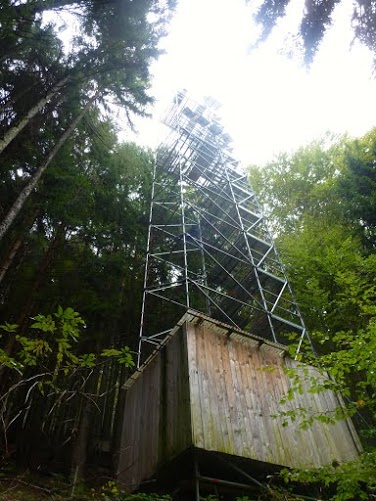
The coolest part of the trip was walking up a research tower. We had an amazing view from there, but it was scary! The stairs were wet, so walking up to and down from the top made me think I was on Fear Factor or The Amazing Race. At the top I also pondered the fact that my father would never be able to be there (he is pretty afraid of heights).


​We got to go on top of the research tower at Coventwald! 11 flights of stairs was a work out. On top, we could feel the tower moving in the wind.

​We got to go on top of the research tower at Coventwald! 11 flights of stairs was a work out. On top, we could feel the tower moving in the wind.

Swiss Alps

7am sharp this past Monday my class gathered outside of the Konzerthaus in Freiburg to start our 4 hour bus drive to Disentis, Switzerland. When we arrived in the Alps it was absolutely pouring (which is why I don’t have pictures from this first day of the trip FYI). To make a long day short, the class hiked hard terrain up into Scatlé forest that has been untouched by humans since before the 13th century, which makes it extremely unique. Very few tourists go through it and only a few researchers interact with the forest at all. We were out there for a long time with no facilities, so I unfortunately had to “interact” with the forest. You got it… I peed in a primeval forest. Soaking wet, we made it back to our hostel for showers and a great dinner with schnitzel, vegetable soup, and caramel flan. We were all very grateful to be warm and dry indoors.

Our second day welcomed us with beautiful weather. The excursion for that day consisted of taking a cable car up to the top of a mountain and walking back down it, similar to what we did during the Shauinsland excursion. Our speaker for the day had an extremely thick Swiss German accent and I could barely pay attention to anything said. That was fine because the surrounding area was gorgeous!

​The cable car we took our second day in the Swiss Alps.

​The cable car we took our second day in the Swiss Alps.

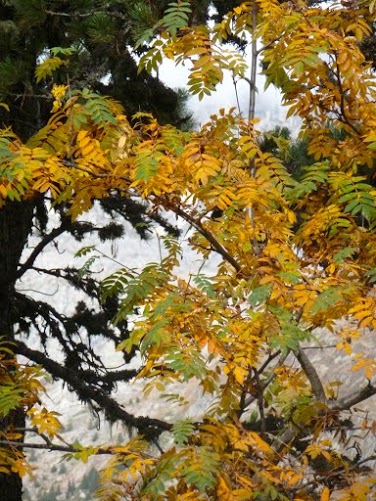
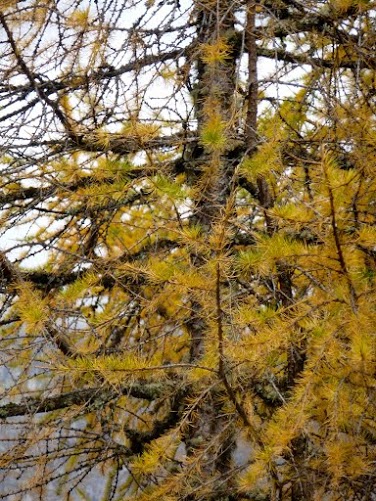
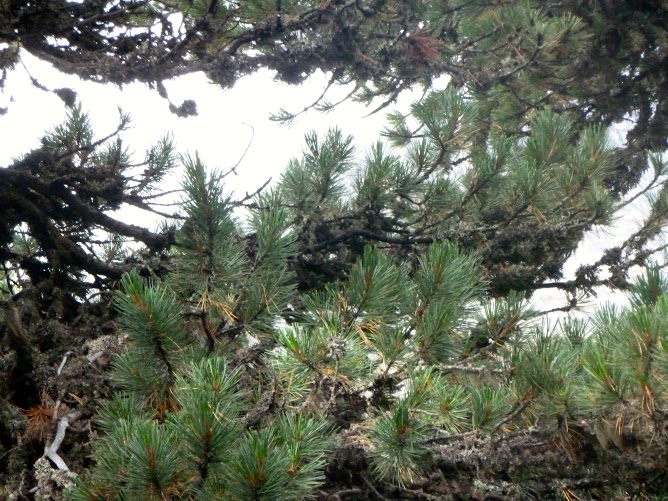
The final day of our trip started very early. We left our hostel at 7am and then had a few hours on the bus to sleep. We arrived at Aletsch mountain, which is the most beautiful natural place I have been so far during my study abroad experience. There were trees turning yellow and conifers that were green. The tops of the mountains are covered in snow. We even got to see Aletsch Glacier and, off in the distance, Matterhorn! We had to rush through our hike a bit because of the bus driver wanting to get back to Freiburg (about 6 hours away at this point).

​Mountain ash​

​Mountain ash​

​Larch​

​Larch​

​Swiss Stone Pine​

​Swiss Stone Pine​

​Aletsch Glacier​

​Aletsch Glacier​

​A stunning view from the top of the Alps.

​A stunning view from the top of the Alps.

On the way home our bus drove onto a train… it carries cars and busses. I had never even heard of this mode of transportation before! (Have you?) At 8pm, all us tired students made our way off the bus and back to bed.


Last Day of Class

The last day of class we started with a student presentation on the ways forests are managed all around Europe. However the most interesting part was that our teacher then spent the rest of the class period asking us for our critical input about the course. He took notes about our suggestions and what things we liked best. At University of Richmond we’re supposed to fill out forms online with our evaluation of a class, but this was such a more rewarding experience. Having a conversation as a class with a teacher and hearing what the teacher thought of our suggestions gave me a huge feeling of independence and control over my education.


Next Post

Alright guys I have to admit it – homesickness has finally gotten to me a tiny bit. I want to devote a blog post to what things I do to handle those feelings and about how my relation to home has changed a lot since I came to Freiburg.


Austen in Ireland: Weekends in Galway and Edinburgh

February 17, 2014

So the past two weekends I went on two different trips: one to Galway, Ireland with the International Student Society at UCD and the other to Edinburgh, Scotland to see friends from UR studying abroad at the University of Edinburgh.

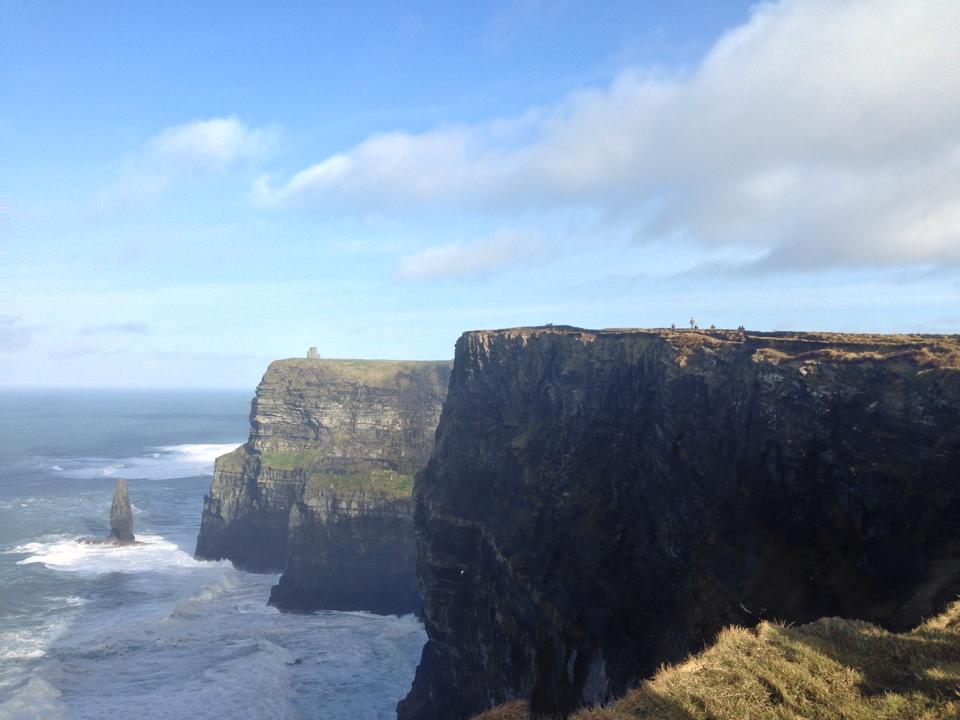
My trip to Galway started early on a Friday morning with a bus ride heading to the west coast of Ireland, where Galway is.  Our first stop on Friday was Clonmacnoise, a famous monastery on the way to Galway.  It was in a beautiful setting on the water.  We then arrived in Galway late afternoon and took a walking tour of the city.  The city is great and looked like a more cultural and less tourist-y version of Dublin.  It also has a great amount of history as explained by our awesome tour guide.  For dinner, some of us from the group had dinner at a very Irish place, where most of us had fish and chips.  It was delicious!  We then went on a pub crawl, where we went to four pubs and one nightclub.  There were some great pubs.  On Saturday, the amount of flooding caused a detour from our planned sites so we went to a small Irish town, which was nice but didn’t have much to see.  We then got back to Galway, where we went out to dinner on Saturday at an American diner and got American food- my first American food in Ireland!  On Sunday, we went to the Cliffs of Moher, probably my favorite place that I have been to so far this semester.  The cliffs were absolutely breathtaking and definitely a must-see when in Ireland.  Our next stop was the city of Limerick, which was quite nice with a river in the middle- similar to Dublin- and had a lot to see.  I definitely could have spent a lot more time than our hour allotted.  We then went to Moneygall, a small town where President Obama’s ancestors are from.  The town is all decked out with Obama memorabilia (there’s even an Obama café) and we went to the pub where Obama had a pint when he visited (which had even more Obama items on the walls).  I was exhausted when we got back on Sunday night but I still went to downtown Dublin to see the Super Bowl that night with a couple friends.

Cliffs of Moher

Cliffs of Moher

The trip to Edinburgh was even more memorable.  I left early Friday morning to catch my 12:30 Ryanair flight from Dublin to Edinburgh.  It was probably the shortest flight I’ve ever been since we were in the air for only 45 minutes.  Luckily my Ryanair experience was pretty unforgettable.  Once I arrived in Edinburgh, I met up with my friends studying abroad there (I know 4 UR students there).  We immediately climbed up a hill to catch views of Edinburgh.  I realized Edinburgh is very different from Dublin because Edinburgh is much more hilly compared to the flat Dublin and Edinburgh was much more a historic city.  I got a mini tour of the campus of the University of Edinburgh and was especially amazed by their eight floor library.  For dinner, I had some haggis (a Scottish specialty) as well as Irn Bru (a famous Scottish soft drink).  Both items were so great; I wish Ireland had these.  We went to a pub near the University popular with students, which had a live band with pretty good music.  On Saturday, we went to Edinburgh Castle (where there were some sieges during the Wars of Scottish Independence), which was beautiful and had some great history museums, where I learned quite a lot about the history of Scotland.


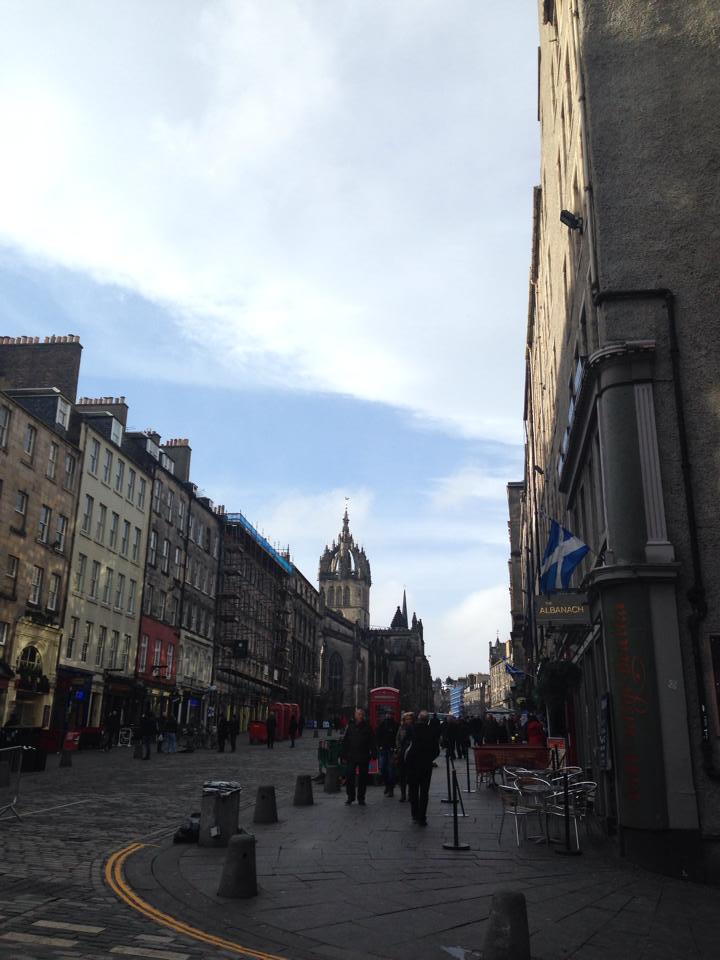
Edinburgh Street

A street in historic Edinburgh

We then went to the Holyrood Palace, which is where the Kings and Queens of Scots have lived since the 16th century.  For dinner that night, I had fish and chips with the Scottish rugby game on the TV in the restaurant, so a very Scottish night to say the least.  Sunday, I climbed up Arthur’s Seat (a hill with excellent views of the city) with my Richmond friend and his Scottish roommate.  They are experienced climbers so they wanted to go up the more difficult route where, given my lack of fitness, I almost fell down the cliff about four times.  I made it up somehow though and the winds were some of the strongest I’ve ever experienced, but the views were so worth it.  Going down was easier but it was so muddy and I didn’t have boots, so with my clumsiness, I fell not once, but twice right in the mud so my clothes got really muddy.  Our last stop of Sunday was at the National Museum of Scotland, which was a magnificent building; that had collections on pretty much everything, including animals, clothing, cars, and almost anything related to Scotland.  We only had about an hour because it closed pretty early but I could have definitely spent a whole day there.  Monday morning, waking up at 5:00, I caught my 8:00 am flight with an hour delay (I had a window seat without a window) and got back to Dublin in one piece.

Richmond Edinburgh

Richmond takes over Edinburgh

I look forward to what my future travels have in store for me!


Rhiannon in India: A South Indian Adventure

December 12, 2013

As I wrote in my last post, I have been traveling around South India for the past two weeks on a lightening-speed tour of Kerala and Karnataka. Kerala, one of the southern-most states in India, is often considered a country apart from the rest of India, and better yet, “God’s Own Country.” In Kerala, my friend and I visited Kochi, the seaside state capital; Munnar, a chilly hill station among the Western Ghats; and Alleppey, the go-to town for boat rides on the backwaters. After two overnight bus rides north to Karnataka, we visited Udupi, home to many Hindu temples and the birth place of the dosa; Hampi, a tourist haven surrounded by beautiful landscapes and ancient ruins; Bangalore, the bustling business hub of the south; and Mysore, a smaller city known for its palace and yoga ashrams. The whole experience has been a whirlwind of historical sites, markets, beaches, and mountains, and I am already having trouble keeping everything straight in my memory. However, there are a few exceptional experiences that I am confident will stand out in my mind for years to come, and those are the ones I would like to share here.

IMG_6337

The tea plantations in Munnar

One of our first stops in Kerala was Munnar, a bumpy, nauseous five-hour bus ride from Kochi, tucked within the Western Ghats. As we approached Munnar on the summit of a hill, the air quickly got cooler, the scenery got greener, and I was immediately happier. Tata, a multibillion-dollar Indian corporation, owns most of the land surrounding Munnar and has turned it into profit by covering the land with tea plantations. From the road, the tea fields look like a rolling, rippling, sea of perfectly manicured green hills, occasionally peaked by a rocky summit. We spent two days touring the beautiful tea plantations and other areas around Munnar, including waterfalls and a wildlife sanctuary where we saw the rare grizzled giant squirrel, but sadly missed out on the rumored mountain goats and wild elephants. The whole time we were in the mountains, I was in awe at how many different foods are grown there – tea, coffee, bananas, sugar cane, black pepper, papaya, coconuts, and many more.

IMG_6326

A village near Munnar

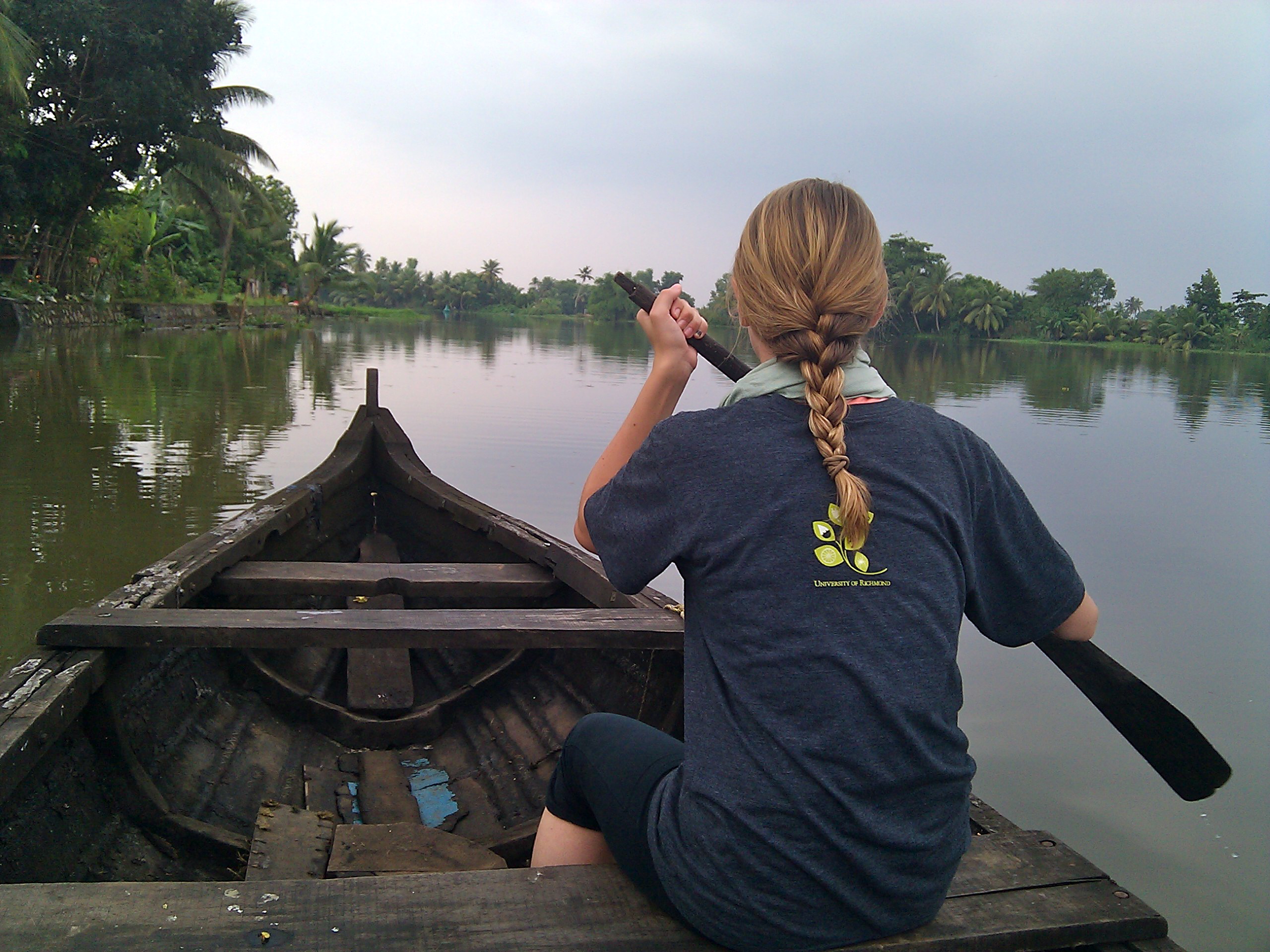
We left Munnar in the hopes of catching a once-daily direct bus to Alleppey, but when we got to the bus station, we were informed that the bus had been cancelled that day. Instead, we took three separate buses, zigzagging our way in the general direction of our destination, finally giving up in a small town and sharing a taxi with a nice Canadian couple for the last hour. When we finally got to our hotel late in the evening, the hotel owner told us that the cheaper room that we had reserved was actually taken, but graciously gave us a more expensive room for the same price. Little did we know at the time that it was an off-site cabin in the middle of a rice field that took 30 minutes in an auto and a boat ride to get to! Despite our confusion getting to our “room” after a long day of bus riding, staying in the cabin was an awesome experience. We were right on the edge of a backwater canal in a long row of village houses, right across the water from a man named Babu who had a canoe and would take us on canoe rides for 200 rupees an hour. We spent a lazy morning canoeing through the village with Babu, who knew everyone and had to stop every 15 minutes to talk to his friends along the water. That afternoon, we rented kayaks and toured some of the most beautiful areas of the Alleppey backwaters.

IMG_20131124_093745

Canoeing in the backwaters near Alleppey

IMG_6412

Sunset over the Arabian Sea at Alleppey Beach

Traveling through South India these past two weeks has been one of the most exciting and interesting times of my life, and I am amazed at how much I have learned in such a short time. As my return home quickly approaches, I hope that I will be able to make the most of my experiences here – especially what I have learned about how different cultures can be, but at the same time how similar we are as people. It continually surprises me that, although the details of daily life may be different from country to country or even region to region in India, we have much more in common than what may be seen on the surface. Now that these two weeks are over, I can’t wait to see my friends and family once more in Hyderabad, then head back to Raleigh, North Carolina!


Mel in Chile: A lot of time in a few places

December 3, 2013

Last week I went back to Valle Elikura, the location where we engaged in a home stay about a month ago with my study abroad program.

I went back this time because of two main reasons. My research project is an analysis on the experience with community-based tourism in the area. I gave some interviews when I was there with the group but as my research developed and I had a better grasp of the topic in question, I naturally developed questions that were more analytical. Ready with my informed consent forms, I walked down to the bus station as if I was walking to my deathbed, to buy tickets for the overnight nine-hour bus ride to Cañete. My journey would not end there; from Cañete I needed to take another hour-long bus ride to Valle Elikura.

Nevertheless I arrived in Valle Elikura early Sunday morning. Silvia was my host mother when we traveled with my group and I had called her prior to my coming to ask if I could rent the cabin again. She cheerfully agreed and told me she would also provide all three meals. Silvia had left the house early to come meet me at the location where the bus form Cañete dropped me off.

I arrived at the cabin fourteen hours after I left my home in Santiago.

I took the rest of Sunday to rest. Valle de Elicura is an incredibly peaceful place. My room in Santiago faces a very busy street so I was more than happy to trade in the noise of 8 am traffic for the chirping of birds.

I began Monday by starting my work right away. As I greeted familiar faces in Valle de Elicura I felt more and more comfortable every time I spoke with someone I had previously met. This is when I suddenly and pleasantly realized that coming back to visit a place for the second time is an entirely new experience. I enjoyed going back to the river where I ran by on my first visit. After some exploring I found a beautiful meadow. As I lay in the grass, tranquil, away from noise, distractions and other people, I could not help but feel as though I was inside my own conscience. I allowed myself to bathe in this beautiful solitude.

I stayed in Valle de Elicura until Wednesday. I ate all of my meals with Silvia, Lautaro, and Kata (Silvia’s husband and granddaughter). I enjoyed staying with Silvia’s family the first time, but this was even better. It is precisely what I referred to in the above paragraph. I went to visit the people I had interviewed a month ago. The feeling of familiarity, of “Hey! It’s nice to be here again. Nice to see you, how is everything?” is something that feels incredibly warm for me.

Many people have a thirst for constant travel; to hike through as many beautiful mountains as possible, to visit vibrant cities, to jump around countries and see different cultures.

I imagined I would have the same mentality during my study abroad semester in Latin America.

I can assert with confidence that I belong to the other group. I found that I subscribe to the spend- a- lot- of- time- in- a- few- places  philosophy of travel.

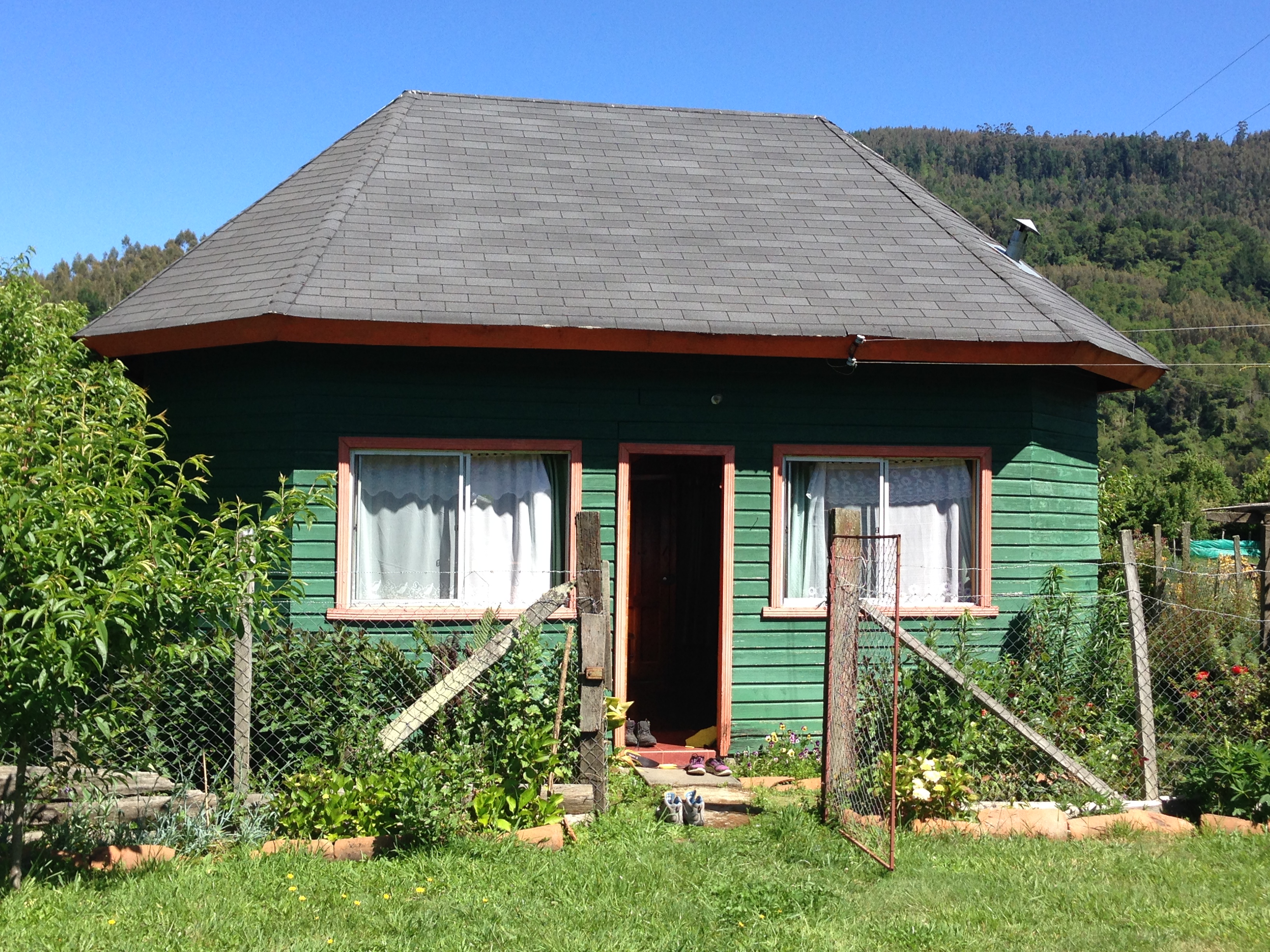
cabin

Silvia’s cabin in Valle de Elicura


Alyssa in New Zealand: The end

November 12, 2013

It seems that I’m constantly on the move. I never run out of things to do no matter where I am. And it’s saddening to think that this will all come to an end very soon. The day I fly out from New Zealand is going to approach quickly and I won’t realize this until the actual moment comes.

The past couple of weeks have progressed much quicker than I thought. It felt liberating to finally finish my last exam because from that point on, I did not have to worry about schoolwork anymore. All I had to think about was what I was going to do with my remaining time in the country. I took advantage of my free time right away. I had made plans to leave after my exam to travel the north part of the South island, which was a 900 kilometer trip from Dunedin.

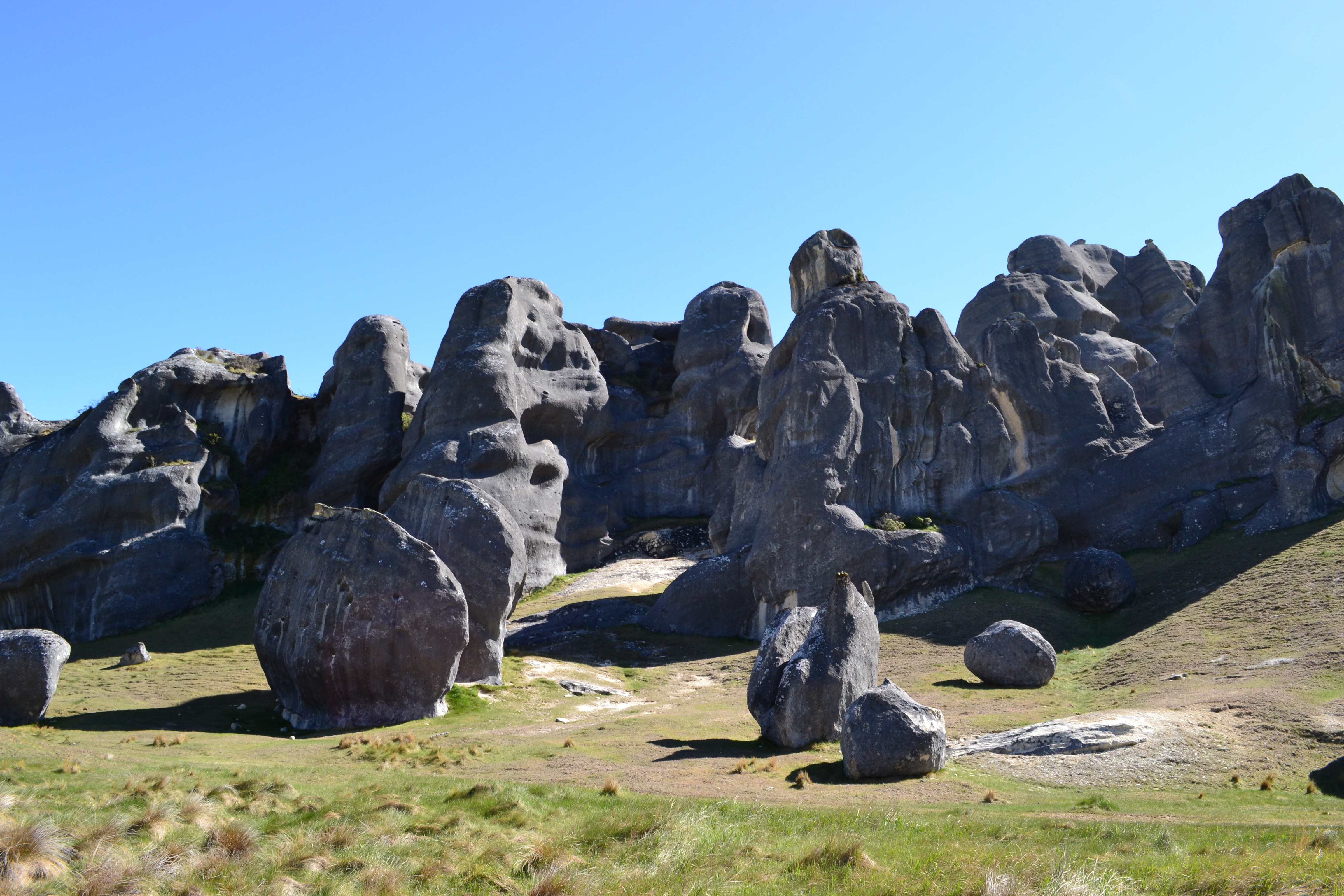
As my three friends and I drove in the northern direction, we made stops along the way. After five hours of driving, we ventured out to Castle Hill, which had been named the “Spiritual Center of the Universe” by the Dalai Lama. The location seemed to be at absolute peace and serenity. As we walked towards the entrance, we were greeted with vast green land which was completely occupied by several limestone boulders. Each stone varied in size, for they ranged from 8 to 40 feet. The area was the epitome of New Zealand’s climbing scene. Every corner we turned, there was a new bouldering opportunity that we were drawn to. It became our glorified playground and my favorite place that I’ve visited in New Zealand.

DSC_0012

Castle Hill

DSC_0010

The ideal location for climbing and bouldering

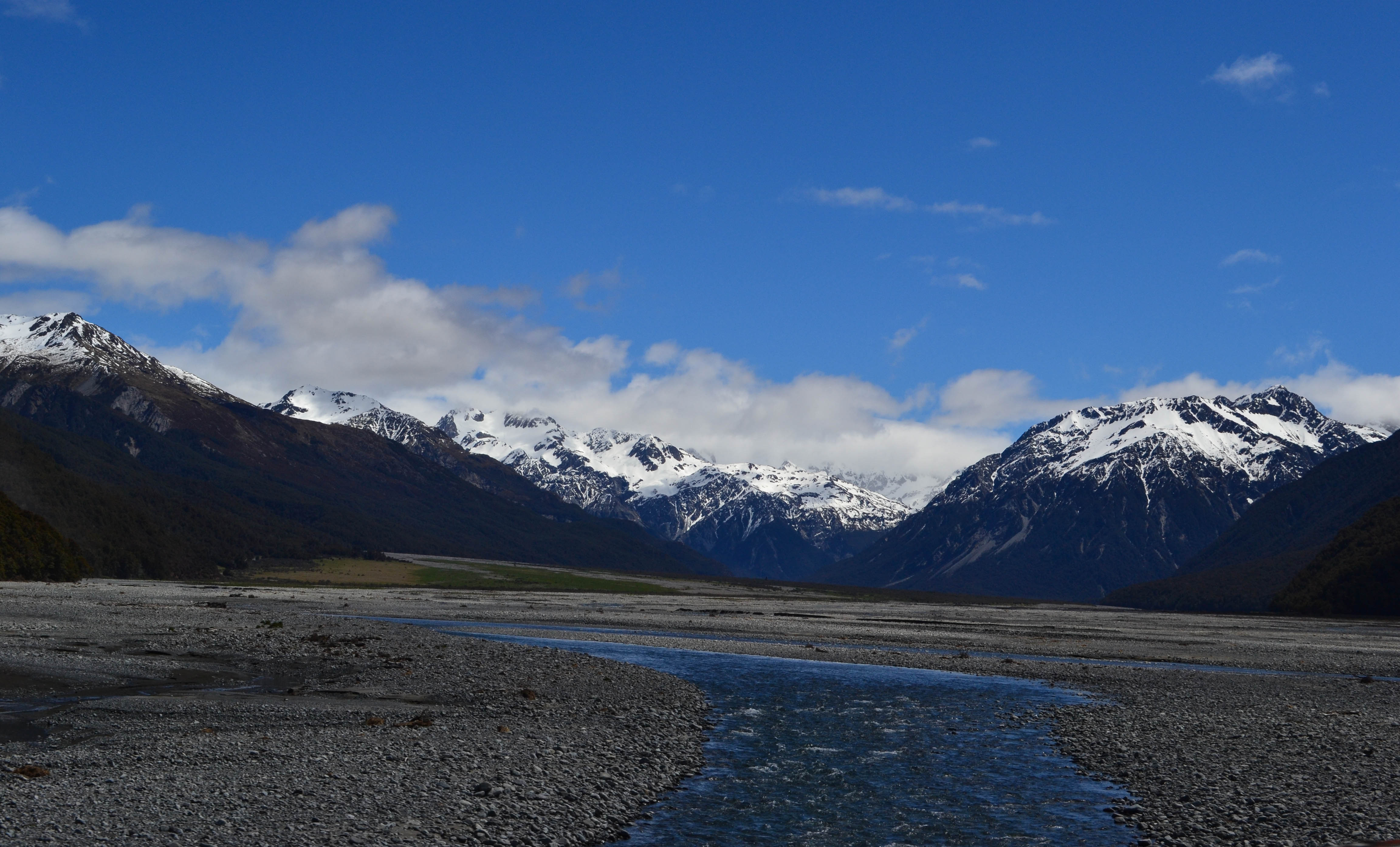
As we proceeded north, we drove through Arthur’s Pass National Park, a scenic highway route. The further we immersed ourselves into the valleys, the more impressive and vast the mountains became that surrounded us. Just when you thought you couldn’t imagine anything bigger, something even more immense came along. Such remarkable scenery reminded me of how much I haven’t seen, and I became more than grateful to find myself venturing out to places that I had never thought about encountering.

Abel Tasman National Park was our final destination, for we wanted to tramp one of the Great Walks, the coastal track. It is located in the northwestern part of the island. The weather was noticeably different from the weather in Dunedin. The temperature was warmer and the sun wasn’t constantly hiding behind the clouds. The track as a whole was fairly easy mostly because there was very little elevation. As we hiked the track, we came across several different accesses to beaches, which made it even more enjoyable. One could almost say that it was more relaxing than a strenuous activity for us.

abel (1 of 1)

As we drove through Arthur’s pass, I captured this shot when we were crossing over a bridge

DSC_0073

Arthur’s pass

Once we finished the track, we traveled east to Picton so that we could start another tramp, the Queen Charlotte track. Since we didn’t have the time or stamina to do the entire track, we decided to start in the middle where we would get the best views of the Marlborough Sounds. As we reached to an elevation of just over 400 meters, we concluded that we could have not picked a better spot to be on the track. Out of 71 kilometers, we chose the perfect place.

abel9 (1 of 1)

Marlborough Sounds

After six days, we made our way back to Dunedin. The thought of leaving has finally become a reality now that my packing has begun. My flight to return to home is November 21st and I leave Dunedin with my flatmates on the 10th. For those remaining 11 days, we will be traveling the entire North island. It will be our last and final stretch of traveling in New Zealand. The Auckland airport will be where we depart back to our home countries.

Tonight is my last night in Dunedin. The town has become not only the place where I reside, but it has also become my home. Traveling around in New Zealand would not have been the same if I had not been with the people that I have met here. As I’ve gotten to know them, they have become an important aspect in my life as we have all supported each other regardless of the fact that we are all from extremely different places and cultures. We all came to New Zealand for our own yet similar reasons, all of which have naturally forced us to make the experience much more meaningful in a way we never imagined.

Expectations are never met. We can never be absolutely certain about anything until we have experienced it for ourselves. Thus, it is best to go in without any expectations or set plans. Keep an open mind. You never know what changes and occurrences will present themselves, for it could potentially be for the better in the end. If you knew everything that was about to happen to come, to what degree would you actually enjoy it?

Seeing that this is my last blog post for the semester tells me that the journey is finally coming to an end. I highly enjoyed writing about my study abroad experience. It has been recorded and now I have something to always look back on to reflect the entire semester. Thank you for providing me with this opportunity, Richmond; you have helped me make my memories and experience permanent.

With my last words, I will say that if you have any desire to study abroad, do it. Some inconveniences may present themselves, but they can be solved. As cliché as it sounds, the experience as a whole is unlike anything you could ever imagine and there is no reason for anyone to miss out on that. No one should be deprived from seeing the world.

To consider myself lucky is an understatement. Thank you to everyone who has made my time more than enjoyable over here in New Zealand. As for all the other study abroaders, it will soon be time for us to go back home and return reality back at school.

Not all those who wander are lost.”
J.R.R. Tolkien, The Fellowship of the Ring


Mel in Chile: The South Part 1

October 25, 2013

The South: Part 1

I have finally returned to Santiago from the ten-day excursion with my study abroad program. If I was promoting SIT before, I am really promoting them now! The excursions are valuable because they contextualize our lectures, readings, and discussions. The excursions allow us, as students, to move closer to the reality of the theories and discourses we are exposed to in an academic environment.

The title of this blog is “The South: Part 1” because I will divide our trip into three parts. For the first two days we traveled to Ralco, a town in the Biobío region, and stayed in cabins with the other students in our program. The next five days we participated in a homestay in small village called Valle Elikura. During this time we learned about the practice of communal tourism, engaged in discussions with community members, and heard stories of struggles and achievements of the Mapuche group. As we bid our temporary homestay families farewell in Valle Elikura, we spent the last two days around the city of Concepcion. These last days we visited a coalmine, the industrial complex of a forestry company, and had two lectures at Universidad de Concepcion.

Worry not; all of the above events will be described in detail in the upcoming posts.

So this particular post is about the first part of our excursion. We left Santiago at 10 pm on the evening of Sunday, October 13. We drove through the night and arrived to our cabins in an area just outside of Ralco at six am on a very chilly Monday morning. Biobío is the eighth region in Chile bordered by the Pacific Ocean to the west and the Andes in the east.

We all devoured breakfast like hungry wolves that morning and headed out to find our cabins. I am not a car/bus/airplane sleeper so I was tired. I planned to claim my bed and sleep well into the afternoon.

As I was wobbling through the grass, sandwiched in between the two backpacks I was carrying, I looked to the left and felt like I had been zapped awake by an electrical force. I saw the most bizarre and beautiful mountain. The peak looked like it had been split in three pieces by a lighting bolt. I thought, “Alright, this deserves some attention.” I dropped off my things in the room and, without any sleep, decided to look for a trail.

As fate would have it, there weren’t any trails leading up the mountain and the forest was too dense to create my own, so my intended hike turned into a nature walk.

The pictures will speak on behalf of the scenery much better than I will be able to describe it in words so I will not continue with descriptions.

cabins

These are the cabins we stayed in while in Alto Biobío

mountain

This is what our research methods class looked like Tuesday afternoon. The mountain is in the background.

I wanted to talk about what I enjoyed in Ralco. The town has a strong representation of Pewenche people, a group ethnically related to the Mapuche indigenous group in Chile. We were going to visit the Pewenche museum in Ralco. The last time we visited a museum trying to show “indigenous culture” we were in San Pedro de Atacama. It was an incredibly disappointing experience. Until recently the museum (in San Pedro) had an open display of a mummified body of an individual who belonged to the Atacameño group (the indigenous group in San Pedro de Atacama). The Atacameño community denounced this as incredibly disrespectful to their ancestors and an inappropriate display of the Atacameño people in general for many years. The mummified body was not removed until recently. I am positive I spoke of this in my blog post after the trip to San Pedro, but to recap; tourism in San Pedro is almost entirely based on foreign agencies. The indigenous culture is commoditized for consumption of western tourists, and the community itself is outside of any discourses and dialogue on how tourism of their region and culture is carried out. In literal terms, they are also physically outside of the center of the village. The center is now only for restaurants, tourist agencies, and hostels. It maintains a manicured “rustic” image of an “indigenous village” in order to supply tourists with the preconceived notions we have of exotic places. An anthropologist who works at the museum in San Pedro told us she will hear guides tell entertaining stories of Atacameño history to their groups that are incredibly far away from the history as told by the Atacameños themselves.

For this reason, when we were told we were going to a museum that exhibited Pewenche people and their culture, I was a bit weary and irritated.

When we entered the museum, however, I encountered a much different dynamic.

For starters, the museum was relatively small. The two people who worked there told us they were Pewenche. The young man let us know he would guide us through the museum. The museum didn’t have any displays of “ancient artifacts” produced from archeological digging sites. One section had photographs of different Pewenche people from Ralco with a caption of something they wanted to share about the Pewenche culture. Another area displayed Pewenche cuisine, including the instructions of how the food could be prepared. The other wall displayed and explained fruit and vegetables typically used by the Pewenche people in Ralco.

In the middle there were four wax figures of Pewenche males dressed in ceremonial attire, imitating a dance. Our guide told us next month he would dress in that way and participate in this dance.

This museum was a display of a living culture. The Pewenche people in Ralco designed it. They controlled the displays. Most importantly, they control the dialogue of how people outside the culture would consume what the museum exhibits.

We also visited a dam in Ralco. The building of dams is a big struggle the communities and environmental activists have in the Biobio region. I remember in my Environmental studies region we learned about the pros and cons of building dams. I particularly remember we had an exam on “clean” forms of energy so I diligently studied the flashcards of pros and cons I had created for the types of alternative energy we would have on the test. It was…a dejavu moment (i think?) to stand on the dam. I would look to my left and see a huge reservoir and look to my right and only see a tiny river. We also went inside the dam, into the control room to see the technological face of the structure. We also saw the various components of the dam, like the turbines the water turns and the magnetic sheet above it. As far as my understanding goes, the water from the river turns the turbine which causes positive and negative electrons in the magnetic sheet to move, which then generates electricity.

river

This is the river side

reservoir

and this is the reservoir side.

inside a dam

This is a section inside the dam where the crew controls….stuff.

The first part of our trip in Alto Biobío was incredibly valuable. I was incredibly happy with the museum. I also felt comfortable knowing I was not “consuming” images of an ethnic group that were built by people outside said group. It was also interesting to visit the dam and visualize not only the “pros and cons” that I kept thinking about, but also gain an understanding of how the structure functions internally.

Physically speaking, the area is incredibly beautiful

It is my second favorite museum in Chile.

Stay tuned for Part 2!