서울의 노래: Classes, Museum, and Karaoke (posted by Indira in South Korea)

March 29, 2013

It has already been over a month since I got to Seoul and I really feel as if I’ve been here for much longer. It is funny how you can feel well-connected with a place and yet discover new things and faces of that place every single day. Seoul is definitely one of those places: being a huge city, you can always discover new corners, little shops, and amazing restaurants where you least expect to find them.

Past week was a little preview of how the next weeks are going to get: not enough time for all the exploring, traveling, and schoolwork I want/need to do. Last week I had my first assignments to hand in and I was pretty busy with school. It is now that I feel the big change from the system in Sweden – instead of focusing on one class at a time, I am all over the place, balancing 4 courses. This is actually good, as it will me help me get on track by the time I am back in Richmond. Speaking of Richmond, the fact that I will be returning to Richmond for my senior year is starting to hit me. The housing selection and coming course registration definitely make me feel nervous. On the one hand, I am excited to go back to Richmond and see all the people I haven’t seen in almost a year, but I also don’t want this year abroad to end, and most of all  – the thought of me being a senior in August is rather scary.

Being abroad is one of the best things an undergraduate student can do and I would recommend it to everyone. It is unbelievable how much you learn about yourself and the world. The most amazing thing is the first-hand experience: sightseeing, learning the language, understanding the culture, meeting the people. I also love how all of my courses foster the first-hand experience. Even though I take a wide range of courses we always focus on Korea as our main example thereby gaining in-class knowledge, but as soon as you walk out of the lecture halls you can easily realize you are in the world you just read or heard about and you can go and explore it all. For my US-Korea relations class, for instance, the professors gave us 2 hours of lectures off so we could go the National Museum of Korean Contemporary History located near the City Hall. A few of my classmates and I went to the museum and actually had so much fun exploring the contemporary history of our temporary home. One of the most fascinating things in the museum was the 38th parallel that divides US and USSR zone. There were also a lot of other things to see and learn about Korea and how it has changed and progressed. There was even a huge section devoted to the technology development (including a super big screen where you could watch K-Pop videos, including “Gangnam Style”).

 The 38th parallel, an imaginary line dividing the US and USSR zone (South and North Korea)

The 38th parallel dividing the US and USSR zone (South and North Korea)

I also really liked the part of the museum that represented the President’s office. We spent quite some time there taking pictures and looking around.
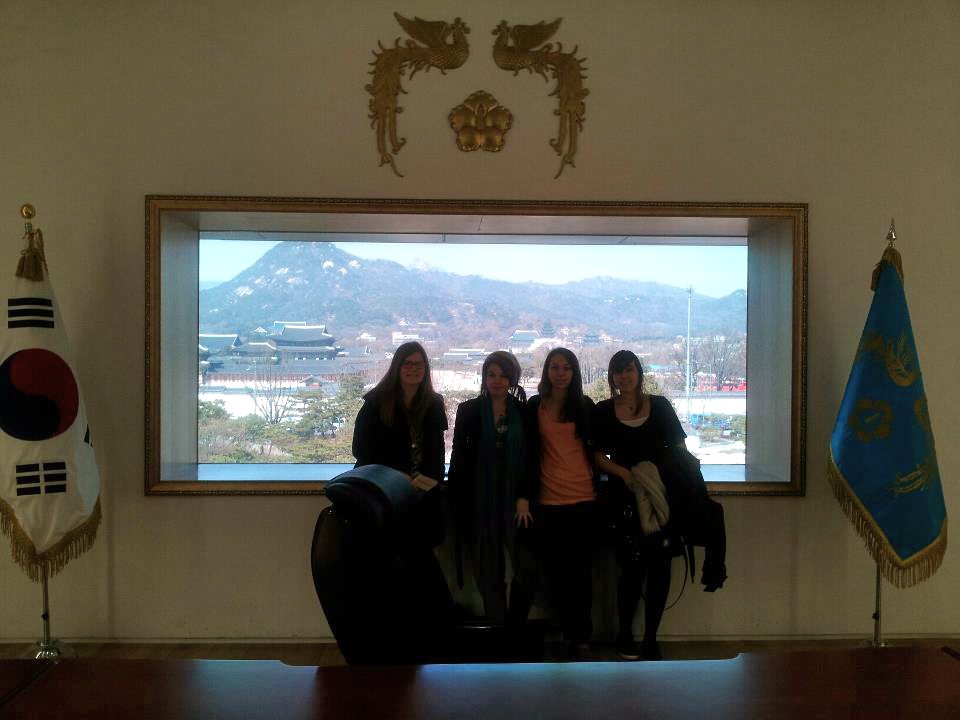
President's office in the National Museum of Korean Contemporary History

President’s office in the museum

And last week I went to the karaoke room with a group of my friends. Basically you rent a room for as much time as you want (usually 1 or 2 hours gives you enough times you sing your heart out), pick your song(s) and sing no matter how good or horrible you sound. It is actually quite entertaining and a great way to meet new people and bond with them!

Karaoke with some of my exchange student friends in Seoul

Karaoke with my friends

It is great when you find little things like karaoke rooms and a trip to museum to make your day. Seoul definitely is soulful, all you have to do is keep your eyes open! 🙂


Highs and Lows (posted by Jimmy in England)

March 20, 2013

It is funny how in the course of two weeks you can go from incredible highs to devastating lows.  On my last weekend before spring break, I took a three day trip into London with a few friends.  I have been to London before, but only for day trips.  Oxford is an hour and a half drive west of London, so buses conveniently run through the night.  This time, I wanted to fully experience one of the most influential cities in the world.  We stayed at the Club Quarters Hotel in the financial district, located within a five minute radius of the Thames, St. Paul’s Cathedral, and the Tower of London.  When we settled in, I Googled “shows in London” looking to find a theatre performance for the evening, since London theatre is rivaled only by Broadway.  However, the first thing that came up was “One Direction Concert-Tonight, 7:30p.m.”  One Direction is the British version of the Backstreet Boys, and they are one of the biggest boy bands in the world right now.  They have a few hit singles and their fan base tends to be 11-16 year old girls.  Don’t judge me when I say that we impulsively bought tickets 20 rows from the stage for the concert that night!  My friends and I quickly grabbed some food and took the tube to O2 arena, one of the major concert venues in Southeast London.  I will be honest; these guys draw an unbelievable crowd.  It was the first concert of their new tour and it was packed.  I will gladly swallow my pride and say that this was one of the best experiences of my time at Oxford.

One Direction Concert, at the O2 stadium in London

One Direction Concert

The next morning we set out to do all of the ‘touristy’ stuff.  We attended Mass at St. Paul’s Cathedral, visited Trafalgar Square, the Tower of London, Buckingham Palace, Westminster Abbey, Big Ben, the National Gallery and the London Eye.  Needless to say, it was a LONG day.  The architecture and beauty of the city is absolutely incredible.  London is such a historic place and these landmarks speak to its amazing past.  The following day, we took a 20 minute bus ride north of London to Warner Brothers Studios where we went on a four hour tour of the making of Harry Potter.  I was a little skeptical when the ticket said that it would take 4 hours, but after having been through it, I completely understand why they say that.  We made it through in 3 hours and 45 minutes, and I felt like we were going very quickly.  The studios are amazing.  They have props from every movie, the original sets, costumes, and everything that you could imagine.  They even serve you Butterbeer! ( For what it is worth, I thought it was disgusting). After the tour, we headed back to Oxford and I spent my last week in the lab.

London Eye, a ferris wheel built in celebration of the millennium, from Buckingham Palace

London Eye from Buckingham Palace

One of the sets for Harry Potter, at Warner Brothers Studios

One of the sets for Harry Potter

On Saturday, March 9th, I flew into Richmond to be with the basketball team for Senior Night against Duquesne and the Atlantic 10 Tournament in Brooklyn.  We left for Brooklyn on Tuesday and had our first game on Thursday at noon against Charlotte.  As much as the previous weeks had been my best time at Oxford, this game was by far the most devastating sporting experience of my life.  If you have not seen the highlights on ESPN or Richmondspiders.com, I suggest that you do.  Let me paint the picture: we were up 63-60 with 5.9 seconds to go.  It was Charlotte’s ball, and they were inbounding it underneath their basket and had to bring it up the court and shoot a three before time expired to try and tie the game.  When teams are in this situation, they have two options- they can either play defense and let the team shoot a 3, or they can foul and send them to the free-throw line where the odds of tying the game are very slim.  In order to tie the game, they would have to make the first free-throw, miss the second, get the offensive rebound, and score all in 5.9 seconds.  All smart coaches foul in this situation because they are almost always guaranteed a win.  In fact, I have never seen a situation where the team fouled and then lost.  I have seen countless situations where the team does not foul, and the opposing team hits a three, sends it to overtime, and wins.  Coach Mooney, one of the best coaches in the country, decided that we should foul.  We fouled them with 4.9 seconds left in the game and sent one of their players to the free-throw line to shoot a one-and-one.  The player made the first shot, and after the ball had gone in the basket, there was a tie-up between one of our players and one of the Charlotte players.  At the end of the tie-up, our player extended his arm and as a result their player fell to the ground.  A technical foul was immediately given, and the officials met at half-court for two minutes to go over the call.  After the meeting, they decided to issue the technical, which resulted in two more shots (and the other one-and-on free throw) to Charlotte.  At the end of the free throws, Charlotte was up 64-63 and had the ball as the result of the technical.  Crazier things have happened in sports, so we still had a chance to win.  We were down by one and planned on fouling, so that they would have to go to the free-throw line, and make two free-throws.  We still would have had a chance to win. They inbounded the ball to half court, and we fouled.  However, the player that we fouled did what every player in these situations does.  He threw up the ball after we fouled him in an effort to gain three shots (since he was behind the three-point line because he was standing at half-court).  In these situations, the refs never award the player three shots; they always call the one-and-one.  However, the ref awarded Charlotte three shots, and as a result our coaches were a little angry.  We received two more technicals for arguing the call, knowing that our fate was locked in when they were given three shots.  At the end of it all, they were given 3 shots for the original foul, and 2 for each technical, giving them 7 more free throws.  In a five second span, they shot 11 free throws and turned a 3 point loss into a 5 point win, ending our hopes at the Atlantic 10 Title and turning us away from the NCAA Tournament.  It was absolutely heartbreaking.

I am five days removed from the game, and it still burns. I am currently on spring break and have travelled home to Buffalo, New York.  I will visit Richmond soon for the UR Business Pitch Competition.  We have entered Chance To Play into the competition and hopefully we can receive positive feedback.  On April 17th, I head back to England for my final 8 week term.

Finish each day and be done with it. You have done what you could.  Some blunders and absurdities no doubt crept in; forget them as soon as you can. Tomorrow is a new day.  You shall begin it serenely and with too high a spirit to be encumbered with your old nonsense.-Ralph Waldo Emerson


Bernin it up! (posted by Pierre en Suisse)

February 22, 2013

Bonjour à toutes et tous! This is to say, hello to all ! This is typically how emails that I receive from the University begin. For those of you who are not familiar with the French language, toutes and tous both mean “all,” so essentially I just said hello to all! However, in French there are also the different genders. As such, it is necessary in various circumstances to use both the masculine and feminine forms when sending mass emails or writing to many people! It doesn’t happen all the time, but it does often with official emails. Hope you enjoyed your free French lesson of the day!

What a whirlwind the past two weeks have been. To sum it up really fast before reading on, I have experienced fondue and the festival known as Carnaval. Within the course of a quick four days, I feel as if I got a lot of Swiss culture really fast, but it was all amazing! I will start with the food.

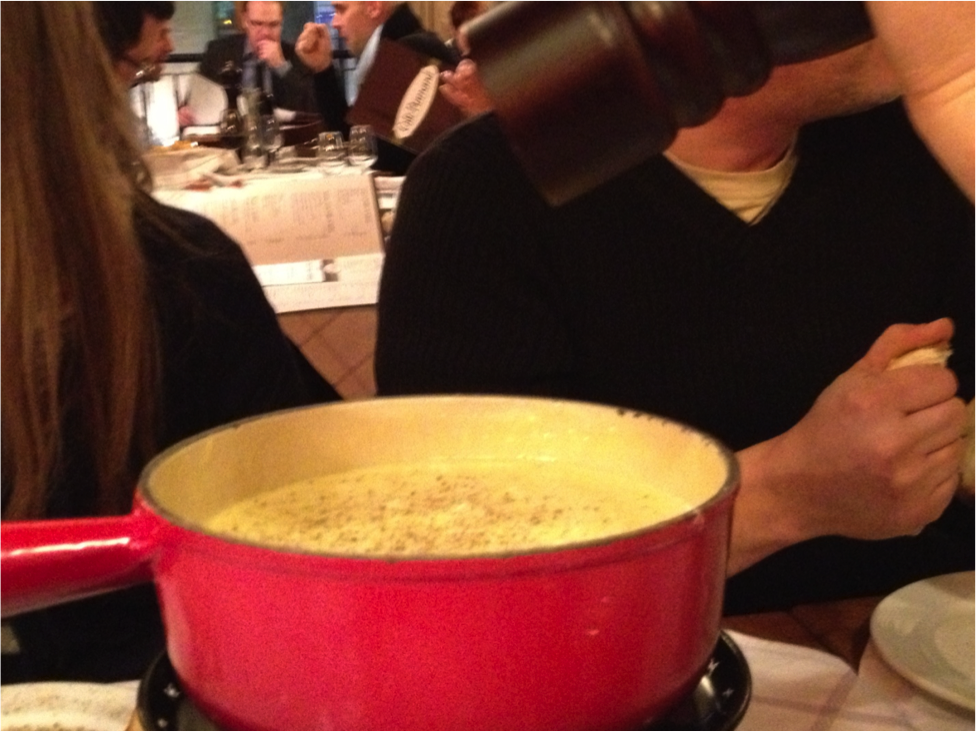
Last week, I went out to fondue with my cours de vacances class, which you may remember reading about in my last entry. Fondue is a very traditional Swiss meal. It is not the typical chocolate fondue that we like to think of using fruit, although one can find it. Rather the Swiss eat bread, a mixture of cheese, and then finish the meal off with wine or tea. The cheeses most typically used are gruyere and emmenthal, melted together in a pot. At the restaurant, we were presented with a plate of bread, and it is your job to take a piece, break it up, put it onto the “fork” and cover it in cheese.

Cheese for the fondue! Bread is dipped into this pot

Cheese for the fondue!

The utensil used was something that I’m used to roasting marshmallows on. It is also critical to make sure you don’t delicately or lightly cover it just to taste the cheese. It was completely obvious to all Swiss people around me that it was my first time eating fondue. I was instructed by a friend who comes from the German part of Switzerland to completely sink the piece of bread into the cheese, then pull it out and let the excess cheese fall off. One also must pay close attention that the bread doesn’t fall off of the “fork” because then the person who lost it needs to either sing or do some other embarrassing task that the table decides. Luckily, this didn’t happen to me. When the cheese is all gone, there is usually some burned cheese left on the bottom of the fondue bowl. According to the fondue experts, this is the best part, and cannot be left! I tried it and must say I loved it. While this entire meal is going on, you need to drink either white wine or tea with the fondue. Otherwise, your stomach is going to be left to digest a block of cheese. While it was very filling and unlike anything else I’ve ever eaten, I did absolutely love it and I am excited for the next time I’ll get to try it!

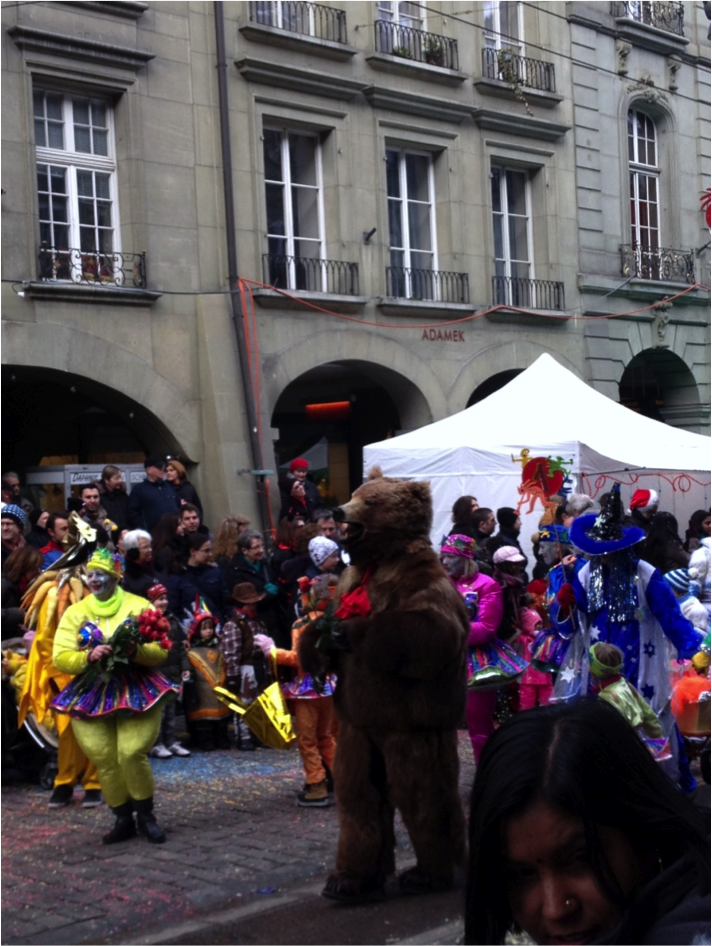
The food experience certainly doesn’t stop there. This weekend I also got to go to a Swiss festival known as Carnaval! It is very similar to the idea of Mardi Gras, though it happens throughout the country on various dates, beginning anywhere from the weekend before Ash Wednesday to the end of May in some cases. On Saturday morning, a friend and I hopped on a train and headed into Bern for Carnaval in the Swiss capitol city. After a breathtaking train ride through the mountains, we arrived in the city, without a single idea of where to go! Our friend who had planned it wasn’t able to go at the last minute, so we had to improvise in order to figure out where to go. The one thing we did know about Carnaval is that people would be dressed in very colorful costumes. Luckily, we saw some people dressed up for the party and followed them from the train station into the city, until we found where we were supposed to be. Along the way, we saw some of the famous sites such as the Swiss Parliament building, and the most elaborate clock tower I have ever seen (so far). Included in this tour was trying probably way too much food that we found at various street vendors lining the main street of the festival. We ate things such as tarte flambée, crêpes, and of course, German sausage. With our stomachs filled, we lined the street with the rest of the carnaval-goers! In Bern, it is tradition to commence carnaval celebrations with a freeing of the bear that had been captured and held in prison for its winter sleep, and so the parade begins with the bear leading the way.

The carnival parade starts when the bear comes marching through the street!

Parade starts when the bear comes marching through the street!

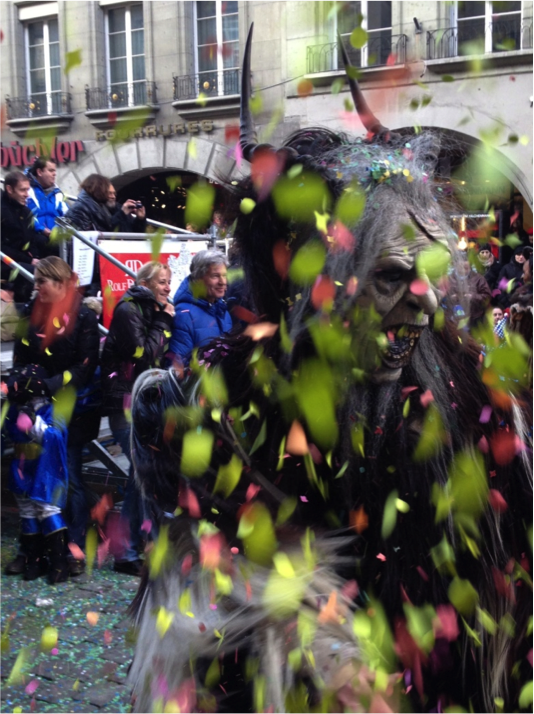
After the mascot passes through the street, there are marching bands dressed unlike anything you will ever see in your life, playing all kinds of music, and throwing candy to the crowds. There is also a lot of confetti throwing. If you ever go to a Carnaval in Switzerland, don’t be surprised when a kid maybe as young as six year old looks up at you, takes a handful of confetti from a bag, and throws it right up at you with a huge triumphant smile. People usually have confetti of their own to throw right back at whoever throws it at them, but my friend and I didn’t know about this before everything began, so we generally just laughed with surprise when we would get covered in all sorts of colors. I absolutely loved Bern! The city was truly quite beautiful and the festival was amazingly fun!

So many colors at the carnival parade!

So many colors!

There were many creatures like this who also joined in throwing confetti throughout the parade

There were many creatures like this who also joined in throwing confetti

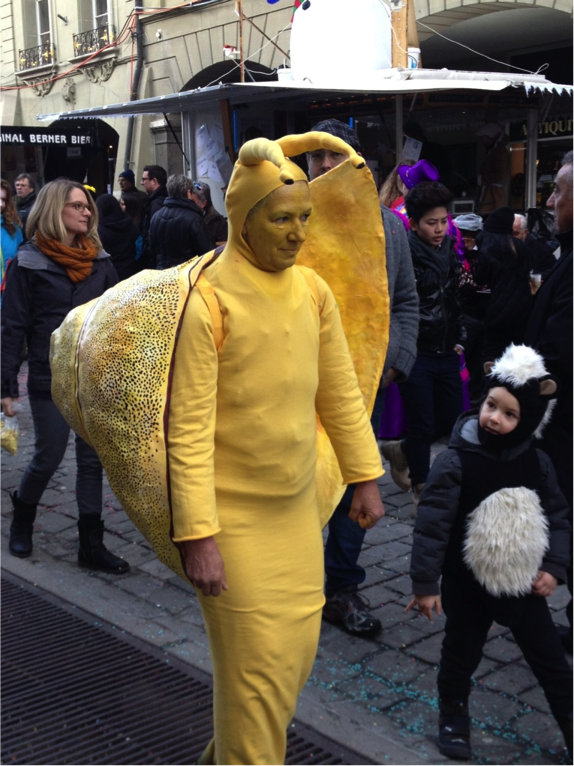
Probably my favorite site at Carnaval was this lady, who was dressed like a snail and walking at the same speed as a snail (despite kids throwing confetti at her the whole time).  A good idea of the carnival atmosphere

Probably my favorite site at Carnaval was this lady, who was dressed like a snail and walking at the same speed as a snail (despite kids throwing confetti at her the whole time)

This week has been the first week of classes. Stay tuned for my next post to hear about just how very different of an experience trying to get settled into classes here at a large university has been, and also to get a glimpse of some photos of the Alps, as this weekend I’m headed skiing! Thanks for reading, and à bien tôt!


Uppsala: A Journey of Discovery (posted by Indira in Sweden)

January 4, 2013

The time truly flies by. It’s already 2013. 2013… it feels really weird to write that number. Since it’s the New Year we all makes wishes and hopes as compared to the previous year(s). I was thinking really hard, but my 2012 was good on so many levels that I honestly didn’t want it to end. My semester abroad in Uppsala definitely plays a huge role in that.

Today when I checked my Facebook there was an entry saying: “Graduated from Uppsala University” and then it hit me – wow, that was really it. The best semester yet is over, but I learned so much about Sweden, as well as other countries, traveling, people, my major, and most importantly about myself. The last 5 months in Uppsala have truly been a journey of discovery. I started learning a new language, learned how to cook (I’m really proud of this one), figured out how to live on my own, mastered the art of constant cycling, made friends from all over the world, survived Swedish winter (which involved -7F temperatures and a major snowstorm), travelled a lot, attended a Nobel Lecture, took some amazing classes, gained the experience of living in Sweden, and so much more. It’s really hard to remember everything I went through over the past semester. Sometimes it feels like August was just yesterday, but then again when I think of everything that has happened since, August seems so far away.

The Swedish summer truly is amazing: You learn to appreciate every second of the sunshine, enjoy countless barbecues in parks and on the rooftops, and buy a bike. Uppsala looks absolutely breathtaking in summer – there is green everywhere, city parks and squares look stunning, and people are so happy.

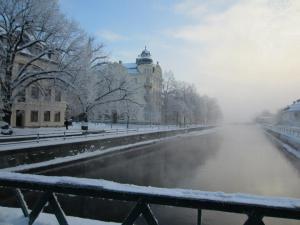
A scene of summer in Uppsala

Summer in Uppsala

Fall is no less impressive: Uppsala puts on new clothes and amazes everyone with its colors. The whole city looks like it came from a fairytale scene. Golden and red leaves, somewhat pleasant cold, and warm sunshine, as well as rain create a perfect atmosphere to spend hours in cafes drinking some hot beverage, eating cake or a cookie, talking to friends, watching people, or simply studying. Fall In Uppsala has it charms for sure!

A beautiful scene of fall in Uppsala

Fall in Uppsala

Before you can notice, the rain is replaced by a snow layer and golden leaves are nowhere to be seen. That is a sign that another glorious season has arrived in Uppsala – Winter makes a grand entrance and it doesn’t cease to impress. It is not hard to enjoy Swedish Winter even with the cold and snow: Glögg, Julmust, fikas, sledding down the Flogsta or Uppsala caste hill, cycling in the snow adventures, and snowball fights can definitely make anyone enjoy Uppsala even during its most cruel months.

A scene of winter in Uppsala

Winter in Uppsala

Seeing Uppsala change through the seasons is like seeing yourself grow fonder and fonder of this place, but also seeing yourself grow as a person. There is something magical about it. I feel Uppsala is home. But that is not the only reason why someone would want to study abroad in Sweden; the list of things one can love about Uppsala is very long:

  • Uppsala University is an old and prestigious university
  • Diverse classes
  • Great professors: knowledgeable and chill (you can go for fika with them)
  • Mixed student body: a lot of internationals from all over the world and Swedes from every part of Sweden
  • You are very much in charge of your in class experience: some classes are not mandatory and you choose your seminar groups
  • One class at a time system: you take only one class and you focus on it for about a month, take the final exam and then move on to the next course
  • Campus makes up most of the city and the buildings are in different parts: great way to explore the city
  • Each building is unique in its own way and has a story to tell
  • Attend Nobel lectures: Need I say more?
  • Chance to make friends from all over the world
  • New culture, language, traditions
  • Everyone speaks English: In the beginning when I needed help with something I would always first ask if the person spoke English but then I would just go over and ask for help right away. Basically everyone is bilingual in this country
  • Flogsta: you get to live in the most amazing and fun accommodation area ever! Ever thought of a 500 person Halloween party in two corridors? Well, that is how wonderful Flogsta is. The party was even featured in the local newspaper!
  • Your corridor: you corridor-mates become your family and your corridor your new home. Corridor dinners and parties are definitely one of the best part of dorm life in Uppsala.
  • Cycling: you get to cycle everywhere, anytime. And you’re gonna love it. Seriously.
  • Ekonomikum: Most amazing place to study, chill, or simply get some snacks
  • Blåsenhus: probably my favorite building. One part of the building looks like a spaceship hovering over the entrance hall. Great place to study or get fika
  • Carolina Rediviva: the most beautiful library ever. Even if you don’t have to study, you simply go there to hang out since it’s so cozy
  • FIKA! Forget Starbucks or whatever you consider to be “the best coffee ever” because I’m sure nothing beats Swedish fika. Just imagine great coffee/tea with amazing pastries, cookies and cakes, cozy kaferummet atmosphere, and the warmth of the people around you while it is snowing outside. And you get to do this for hours every day. One of those “I don’t think life can get any better” moments!
  • Kanelbullar: Oh, sweet love o’ mine! Cinnamon buns/rolls that simply taste great. Oh, and there is a day dedicated solely to this delicious treat: Kanelbulledag.
  • Marabou: best chocolate ever! Don’t even try to argue it. I mean it.
  • Music: Do you love house? Electronic music? Well, then Sweden is a heaven for you. Everyone makes music (I don’t think it’s even possible to keep count of how many people who make music I’ve met) and Sweden’s home to Avicii, SHM, Adrian Lux, Alesso, Lykke Li and many others.
  • Student nations: It’s really hard to explain, but once you get here you’ll get it. BEST thing ever! Every university should have them.
  • Great night life!
  • Stockholms nation’s lunch: make sure you get there at 12 sharp otherwise you’ll spend some time waiting for the deliciousness prepared by the Stokcholms nation’s Kökmästare
  • Värmlands nation’s bread: I don’t think I ever had better bread. Definitely worth going for the lunch at Värmlands. Make sure you start queuing at noon.
  • Gasques: there is a gasque for everything (newbies gasque, Halloween gasque, Fall gasque, Christmas gasque, Lucia gasque, and even Doomsday gasque)
  • Uppsala: it’s a student city so literally everyone is organized in a way that serves the students.

I think those reasons are more than enough to make anyone want to study abroad in Uppsala. I couldn’t have asked for a better semester. Coming to Uppsala was one of the best decisions I ever made. I fell in love with the city, country, and the people – I plan to go back one day. Maybe even sooner than I think. I actually remember my first month in Sweden when I met so many international people who live/work in Uppsala and they kept telling me that one day I will be back to Uppsala (or at least Sweden) for whatever reason, and could quite possibly make this place my home. I sure hope they are right, but right now I should focus on Seoul.

In less than two months I will start a new adventure on the other side of the world; with new people, a new system, new language, new culture. It is frightening, but also exciting. Knowing that the new adventure awaits around the corner makes me miss Uppsala a little bit less. New year – new adventure. And I’m more than ready to embrace it in the fashion of the words of one of my German friends: “Vollgas!”. 🙂


Uppsala Celebrates: Nobel Prize Laureates and Sankta Lucia (posted by Indira in Sweden)

December 19, 2012

Uppsala, being a very old city (it was founded in the 13th century), respects traditions in a way that integrates tradition with the modern-day setting the city has. Student life itself is a big part of the traditions that made Uppsala what it is today- a university city that each student cherishes. Over the last week two important traditions that are specific to both Uppsala and Sweden took place: Nobel Prize laureates opening lectures at Uppsala University and the Sankta Lucia celebration.

It is a tradition that some of the winners of the Nobel Prize hold open lectures at Uppsala University in connection to the festivities that take place in Stockholm. First there is a reception with the Vice Chancellor and lunch at Uppsala Castle, and then the much appreciated and well-attended open lectures by the guest laureates. This year I had tremendous luck to be in Sweden when Prof. Serge Haroche and Dr. David J. Wineland (Physics), Prof. Shinya Yamanaka and Sir John B. Gurdon (Medicine), Prof. Alvin E. Roth (Economics), and Prof. Robert J. Lefkowitz (Chemistry) paid a visit to Uppsala University. Unfortunately, all the lectures were at the same time so I was forced to choose only one to attend. In the end I decided to go and see the lecture by Professor Roth and learn more about Game Theory. First of all, the lecture started at 10.30am and we had to get there super early (a few of my friends and I got to Ekonomikum (the place where the lecture was to be held) at 9am, got breakfast at the cafeteria there and patiently waited for the lecture hall to open) in order to secure a seat. There were incredibly many people interested in all the lectures and getting a seat was truly a privilege. The lecture itself was amazing. Prof. Roth’s lecture on The Theory and Practice of Market Design was definitely one of the most fascinating lectures I have atteneded. I have to emphasize that I have very poor background in economics (I only took a Microeconomics class at UR last year), but I really enjoyed the way Prof. Roth explained the work he won the Nobel Prize for. I never thought I’d attend such an important lecture given by a person who shaped Economics so much and it’s all thanks to being an exchange student at Uppsala University this semester. This is definitely another highlight I would add to my study abroad experience in Sweden!

Lecture at Uppsala University by Prof. Roth, Economics Nobel Prize Laureate, who talked about Game Theory

Lecture at Uppsala University by Prof. Roth, Economics Nobel Prize Laureate

Another important tradition (and experience for me) was the celebration of St. Lucia that takes place on December, 13th. Ever since the late 18th century Sweden celebrates St. Lucia (or St. Lucy) around Christmas time. St. Lucia’s Day is nowadays celebrated by a girl dressing in a white dress with a red sash round her waist and a crown of candles on her head. Lucia walks at the head of a procession of women and men, the ‘maids’ and the ‘star boys.’ Being the Lucia is a very honorable role and as far as I understood, a girl who is to be chosen as a Lucia needs to be very beautiful and to sing well. Everyone in the procession is dressed in long white dresses and some of the procession members also wear white pointy hats (we were told about this back in August. When we first heard the part about the long white dresses and pointy hats Swedes would respond to our confused looks by saying: “Oh no, no – it’s not what you think we mean. That’s just a part of the Lucia tradition.” Also, everyone recommended we attend Lucia events since that really is a big deal in Sweden). The tradition also involves singing traditional Lucia songs (such as the song “Sankta Lucia” which is really nice) and eating sweet, saffron-flavoured buns (lussekatter) and gingerbread cookies best enjoyed with glögg.

There were so many events all over the Sweden for Lucia. In Uppsala, there were concerts in the Domkyrkan (Cathedral), Lucia processions in various Univeristy buildings (I was lucky to see the one in Ekonomikum).  All the processions, no matter how big, involved Lucia, maids and star boys. There were multiple Luciagasques as well. I didn’t attend any, but I went to an after-party of the Luciagasque in Snerikes Nation and there were so many people wearing shiny decorations that are usually part of the Lucia costumes.

Another highlight of this semester is actually related to the celebration of Lucia. Every year there is a big Lucia Concert held in Friends Arena in Stockholm and International Committee at Uppsala University organized a trip for the students who were interested to see it. It was amazing! Friends Arena was full and the performances were really great.

Lucia Procession, which I attended, with Lucia in the middle of the stage

Lucia Procession with Lucia in the middle of the stage

There was an orchestra and choirs singing and playing. Multiple groups performed: Elementary and middle school children, high schoolers, and some university students. I really enjoyed the concert.

Now I’m kind of doing the final countdown. Just a few days left in the place I consider to be “a home away from home.” It is really sad to get so many invitations to the Farewell Parties since it means that I might never again see some of the people I spent so much time with this semester. I remember when I attended the orientation with the previous participants of the exchange program with Uppsala University back during the Spring semester at UR: I was told that I would be really sad to leave and that I’d probably want to stay a year in Sweden. At that point I thought that would be impossible, but now those words echo in my head. Leaving is really hard, but I will use the days I have left in the best way possible in order to wrap up my Sweden experience the right way. After all, next semester I will be in South Korea and that’s a great reason to put a smile on my face. 🙂


Uppsala goes fancy: Norrlands Nation’s Höstgasque and Gasque 101 (posted by Indira in Sweden)

November 23, 2012

As I mentioned in some of my previous posts, Uppsala is a meeting point for many contrary and contrasting things. Last week it was new and old. I was a part of a tradition so specific for Uppsala University students and so deeply embedded in the history of the student organizations here known as the nations, and yet so modern that still it occurs every semester.

The student life at Uppsala Uni is organized around 13 nations each representing a city or a region/county in Sweden. One can work in the nations, go for fika, study in nations’ libraries, meet friends, watch sport matches, go to the pub, attend concerts, participate in open mic and karaoke nights, go to the club there, take part in the gasque, as well as do many other things. But, let’s focus on the gasques (or gasks as they are called in Swedish). A gasque is basically  a formal dinner with an after-party. During the gasque you eat, drink, make toasts, and most importantly – sing. Yes, sing. Quite a lot, actually. Singing is basically the most important part of the gasque: You sing before making toasts, when drinking snaps (a celebratory tradition), when starting the dinner, when the dinner is almost finished, and for any other reason you could possibly propose to sing. And singing during the gasque is rather fun. Most of the songs are in Swedish, but you get a Songbook so you can follow and sing along. It’s also very easy to get the rhythm. Some songs even have their own little choreographies: My favorite song so far is one for which you stand up on your chair and sing and once the song is finished you should not sit in the chair since it means bad luck and you will fail all your exams. All in all, gasques are fun events where you get amazing food and meet new people, as well as familiarize yourself with Uppsala University and the nations’ traditions.

Höstgasque is the most formal of all the gasques during the Fall semester (höst means Fall in Swedish). The dress code is tail coat for the guys and ball gown for the girls. Ever since I heard of this gasque I made the decision to attend one, and I did so last week. A friend of mine plays in Norrlands nation’s orchestra so she attended the gasque and I joined her. All the members of the orchestra had dinner in a special room, but they followed all the gasque traditions.

The dinner table before the gasque started, a Swedish University tradition

The dinner table before the gasque started

There was a lot of singing, toasts, speeches, and chatting. I got to meet the members of the orchestra who were all Swedes. It was great practicing my Swedish and learning more about Sweden. Apart from that I enjoyed the food a lot – I ate moose for the first time ever. That was a whole new experience. We also played a game: All of us had a “top secret mission” that we had to fulfill during that evening. My task was to be obnoxiously loud after every toast and speech, applaud as loud as possible, and compliment the speech or toast. It was so much fun doing that! Other people had to propose toasts on every possible occasion, or start a conversation about music etc. It was a good way to bond with the people sitting near you at the table.

 Some of the members of the orchestra, which, played during the gasque, at the after-party

Some of the members of the orchestra

After dinner, the orchestra played and other gasque guests danced waltz and polonaise – that is how formal Höstgasque is! The formal dance continued during the after-party as well since more classical and jazz music was played. This is the typical after-party for these formal gasques in all nations.  Below is a video of the orchestra that played:

My friend and I decided to go for a full Höstgasque experience and went to the after-parties in two other nations  – Värmlands and Östgöta. The whole atmosphere made me feel like I travelled back in time. It was definitely an experience I am happy I was able to have. Attending the Höstgasque is definitely going to be one of the highlights of my semester abroad in Uppsala.


Social Events Overload in Uppsala: International Gasque, Birthday, Kanelbulledag and a Stolen Bike (posted by Indira in Sweden)

October 19, 2012

Last week was so overloaded with social events. Every single day there was something going on and so many times I would just come to my room to drop off my bag and in 5 minutes I would be on the move again. I am not complaining though – I enjoy this rhythm that allows me to experience as much of Sweden as possible (especially taking into consideration that half of the time I’m supposed to study abroad in Uppsala has already passed).

One of my friends, Marine, had her birthday a few days ago so we organized a birthday dinner for her (it was a pot luck style dinner where everyone brought something). I made a traditional Bosnian dish called “sataraš” and I was happy to see that people liked it. We had a really great time talking over the dinner, and then we had our own private concert: two guys played guitars and sang for about an hour before the clock struck 12. It was a really nice bonding experience!

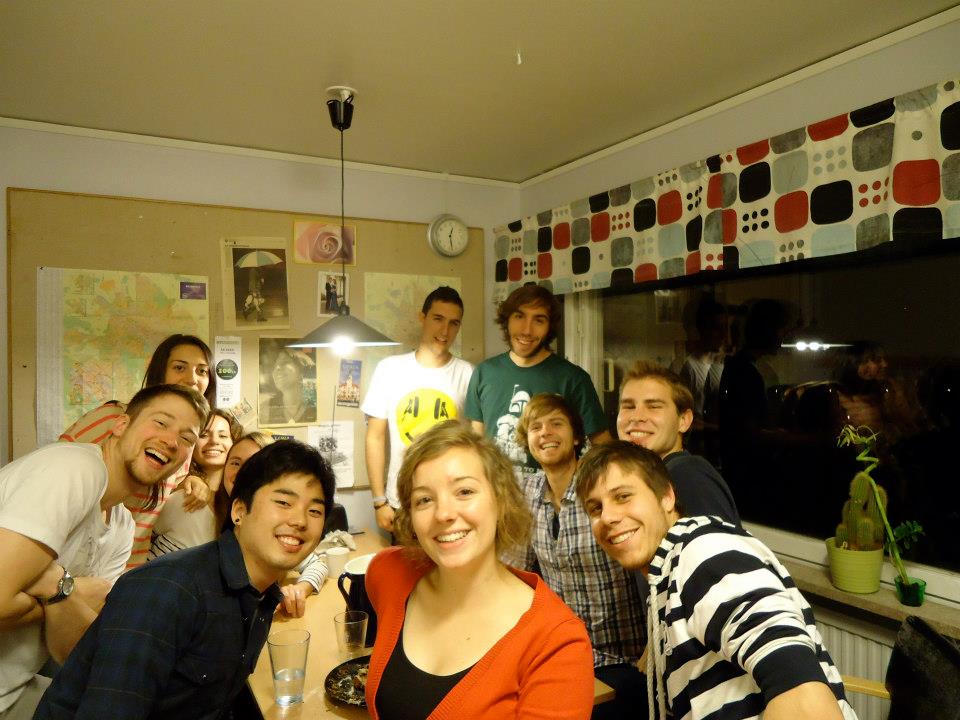
My friend's Birthday Dinner, celebrated with a potluck

My friend’s Birthday Dinner

On Thursday last week it was the official Kanelbulledag (cinnamon bun day – Swedes really love their Kanelbulle and I know why: they are super delicious and go really well with fika!). It is a tradition that on the Kanelbulledag Swedes make homemade Kanelbulle, so my Swedish corridor-mates organized the event. We all got together and enjoyed some quality time together while making some delicious cinnamon buns. 🙂

Kanelbulle, a swedish cinnamon bun

Kanelbulle

On Friday we had the long awaited International Gasque. As I wrote earlier, gasque is a formal 3 or 5 course dinner where all the students dress up and have a nice meal, drink snaps and sing songs, as well as enjoy the entertainment. The International Gasque was very long, lasting 6 hours (6pm-midnight). There was some stand up comedy, a choir performance and skits to make it all incredibly enjoyable. After all the delicious food was eaten, all songs sung, and the entertainment program finished, there was an after party with Karaoke and a live band. I really enjoyed karaoke since so many people came on stage and everyone was having fun, not really caring about how well (or bad) they could sing. The live band was also very good. They were singing mainly popular mainstream songs that brought everyone to dance. All in all, it was a great night! I was really happy to be part of it all!

International Gasque: a picture of the seating arrangement for the dinner

International Gasque: Seating arrangement for the dinner

The twist came later on. The night, unfortunately, ended not so well for me. On our way back home when I wanted to get my bike, it was not there. I couln’t believe that someone had stolen my bike! We were all warned that this might happen, but I was always optimistic about it. It took 2.5 months for my bike to get stolen. At first I was really sad because I went through so many adventures on that bike (including me falling off it multiple times, and over-inflating the tire so it exploded). By now I have accepted what happened and got a new bike (I was really lucky that a friend of mine had 2 bikes, so he let me borrow one for the rest of the time I’m in Sweden). Life goes on!

The week ended with me trying to cook (and actually succeeding)! I cooked Bosnian for 7 of my friends. I made three traditional dishes and they all turned out amazing! I am happy I got a chance to learn how to cook. Those are the skills one will always need and find useful. 🙂

Of course, apart from many events in Uppsala, our classes went on. My only class for this month, Critical Perspective on Sustainable Development in Sweden, started integrating more study group work in the course. We divided into a few groups and now we will work within those groups on the case studies of interest. My study group (which is, by the way, very international. We are 5 people: Swede, Japanese, Korean, German and I) is working on urbanization and we will be looking at two districts in Stockholm in oder to see how sustainable they are. In the end we plan to come up with a list of recommendations for other districts in Stockholm, as well as other cities that are looking into urban resilience.

It was truly a good week with a lot of things going on and very little free time, but it all made my week much better! I guess that is the point of study abroad – do as much as possible and enjoy whatever country you’re in. 🙂


Week 1: Aprovechar: to take full advantage of (posted by Kati in Spain)

August 28, 2012

An announcement over the plane’s loudspeaker wakes me from my comatose state, “…flying south to Santiago. We will arrive in approximately one hour. The temperature at our destination is 27 degrees.”

Flying south? Santiago de Compostela is north of Madrid. I look out the window and see tan hills dotted with little green bushes, not the rolling green hills of Galicia that I was hoping to see. Panicking, I yank my overstuffed backpack free from under the seat in front of me and begin to excavate for one – any – of my three guidebooks. I find maps of Spain in all of them, but none of them have Santiago labeled. I open the airplane magazine to find a flight map, and my panic subsides as I see that Santiago de Compostela is the only Santiago that Iberia Airlines flies to from Madrid. I am on the right flight; the pilot must have misspoken. Whew.

A short hour later we descend through fluffy white clouds, soaring over the greenest countryside I have ever seen. After collecting my bags, I push my trolley out into the soft, fresh Galician air. After hours of travel, I am finally here.

PIcture out of window flying over Santiago de Compostela

Flying into Santiago de Compostela

A cabbie rolls his little white car forward to meet me. He is rocking a plaid flannel shirt, black Ray Bans, black skinny jeans, a graying mustache and matching hair, and a cigarette, which he promptly puts out. His accent rolls and lilts like the road we drive towards Santiago. His pronunciation reminds me of an Irish brogue just as the Galician song on the radio reminds me of Celtic music I have heard at home.

The cabbie drops me off outside of a heavy glass and iron door squeezed between an oriental clothing shop and what looks like a garage entrance. I ring the bell, and after a minute an older woman with brownish-red hair and a sweater draped over her shoulders carefully makes her way down a flight of stairs into the apartment lobby. With a big smile that crinkles her eyes, Pepita opens the heavy door and bustles me and my bags inside.

The apartment is spacious and filled with natural light. The floors are beautifully constructed from cherry wood, and although upon first inspection the kitchen appears to be in disarray, I quickly learn that everything has its place and its purpose. I am shown from my bedroom to the kitchen where Pepita has prepared a Spanish tortilla. It’s a solid disk the size of a frying pan created from eggs, milk, potatoes, and onions. Without pausing for breath in her story about an adventure she had in an airport, Pepita flips the whole tortilla onto a plate and sets it in front of me. Forty-five minutes later when I have only managed to eat half of it, she cuts me another quarter and insists that I finish.

Pepita reminds me a lot of my own grandmother. She is kind and gentle beyond words, but she is a force to be reckoned with. She is a teacher/administrator at a local high school, and she is full of stories and life lessons. Five minutes after welcoming me into her home, Pepita quizzed me on my beliefs about abortion, dating, and children, and she proceeded to tell me that no one, absolutely no one, should have children before they are thirty years old. In the mornings, Pepita serves me “English” tea: I am of British descent, and so I should, therefore, prefer English tea. She is always finding ways to make me more comfortable and more at home.

Colleen, a fellow Richmonder and my roommate for our two-week orientation period, arrived on Sunday. She is lovely and just as excited to be in Spain as I am. We are extremely similar, which makes living together an absolute pleasure. Our adventures are always full of laughs, and no day is complete without a somewhat uncomfortable cultural learning experience.

We have the best teacher, Juan, for our intensive Spanish immersion class. In class we practice grammar with exercises such as interviewing fictional characters, solving murder mysteries, writing fake roommate adds, completing TV scripts, and debating current events. We also learn how to imitate Spanish spoken with a thick French accent, the difference between tortas and pasteles, the best beaches in Galicia, and what not to miss in Santiago.

Traditional Santiago almond cake, the Torta de Santiago

Smiles all around after two big bites into the Torta de Santiago

In addition to our academic orientation, Colleen and I are orienting ourselves to daily life in Santiago. We spend part of every afternoon and every evening after dinner wandering the stone streets of the city, and we discover little treasures during our walks. We have fallen in love with the Torta de Santiago, which is essentially almond pound cake with powdered sugar. We have compared prices, quality, and quantity of food in supermarkets around the city. We have investigated the rates of different mobile phone companies and compared packages. We have spent time in bookshops, bakeries, little corner stores, oriental markets, parks, culture centers, and art museums. We have gone to mass, attempted Galician dancing, and toured the buildings of the university (University of Santiago de Compostela (USC)). We have experienced Santiago nightlife (until 5:30am, which is considered early!) under the protective wing of Antonio, Pepita’s son and father of two. We have become friends with students from Kazakhstan, Tajikistan, Georgia, Germany, Brazil, Japan, Italy, and South Korea, and we cannot wait for the 40,000 full-time university students to arrive on campus.

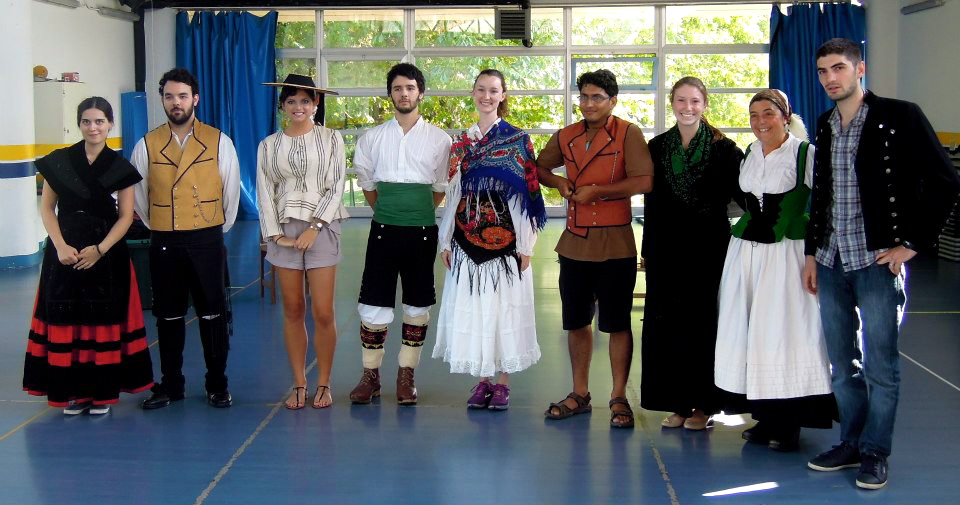
Dressed in traditional wear for a Galician dance and music class

Kati dressed in traditional wear for a Galician dance and music class

The past seven days have been a wonderful introduction to life in Spain, and I am so happy to be here.

Quote of the Week: “The key question to keep asking is, Are you spending your time on the right things? Because time is all you have.” ~Randy Pausch (The Last Lecture)


Exploring Sweden (posted by Indira in Sweden)

August 22, 2012

The past week was all about learning more about Sweden firsthand; through food, music, people and traveling.

Sweden is a beautiful country and when blessed with nice and sunny weather (which we were very lucky to have over the past week) it definitely reveals its vibrant and vivid side. This country is like the pieces of kaleidoscope glass – they shine and surprise you with a new image in no time.

This week I was lucky to experience so many new sides to Sweden through the cultural part of the IBS program. First of all we had a lecture (and a practical part) about the Swedish food where we learned more about the holidays in this country and how food makes them special. We also talked a lot about the differences in the diet in the north and the south of the country. Since, of course, words don’t really have a taste, especially when you use them to describe food you never had in your life, we had samples of the most typical Swedish dishes such as köttbullar (meatballs) with lingonberry jam, reindeer (yes, real Swedish reindeer), herring, salmon, and typical Swedish cookies one usually has with fika. At the end of the day I was able to say: Swedish food is amazing!

Swedish food: Köttbullar and reindeer

A few days after the Swedish food, we had a 3-hour long presentation on Swedish music by four musicians from the Uppsala region. They presented traditional, classical, as well as modern Swedish music.  The most interesting part was the performance on the nyckelharpa (traditional Swedish instrument that sounds so nice) and the ABBA impression (we had the performers dress up as the ABBA members and sing their songs). It was really fun being a part of this presentation since I learned so much about the way Swedish music evolved and developed.

Swedish music: both musicians are dressed in the traditional costume from the Uppsala region and the women is holding the nyckelharpa.

We ended the week by going to two Swedish cities on Saturday and Sunday. On Saturday we went to Stockholm (it’s really close, about 40 minutes by train) so we could attend the Stockholm’s Kulturfestival (you can read more about it here: http://kulturfestivalen.stockholm.se/EN/index.php). It was amazing! We saw performances by Catalan, Swedish and Finnish artists. I am really happy we made it there on Saturday since it was the last day of the festival – definitely a well spent day!

On Sunday we went to a city named Gävle. Since it is a small city and not really a popular tourist destination we had a choice of doing an individual walking tour which turned out to be quite a success! We saw an amazing park, river, old bridge, prison museum, sunning town hall and much more. I’ve noticed that Gävle and Uppsala are very alike, but they have different vibes: Uppsala is more exuberant (but not as much as Stockholm!) and yet tamed in a way, while Gävle seems to be more of a nice small town (almost a suburb) that reminds me of a mystery box that hides all the beautiful spots that have to be discovered. Either way, I really loved visiting both of the cities. 🙂

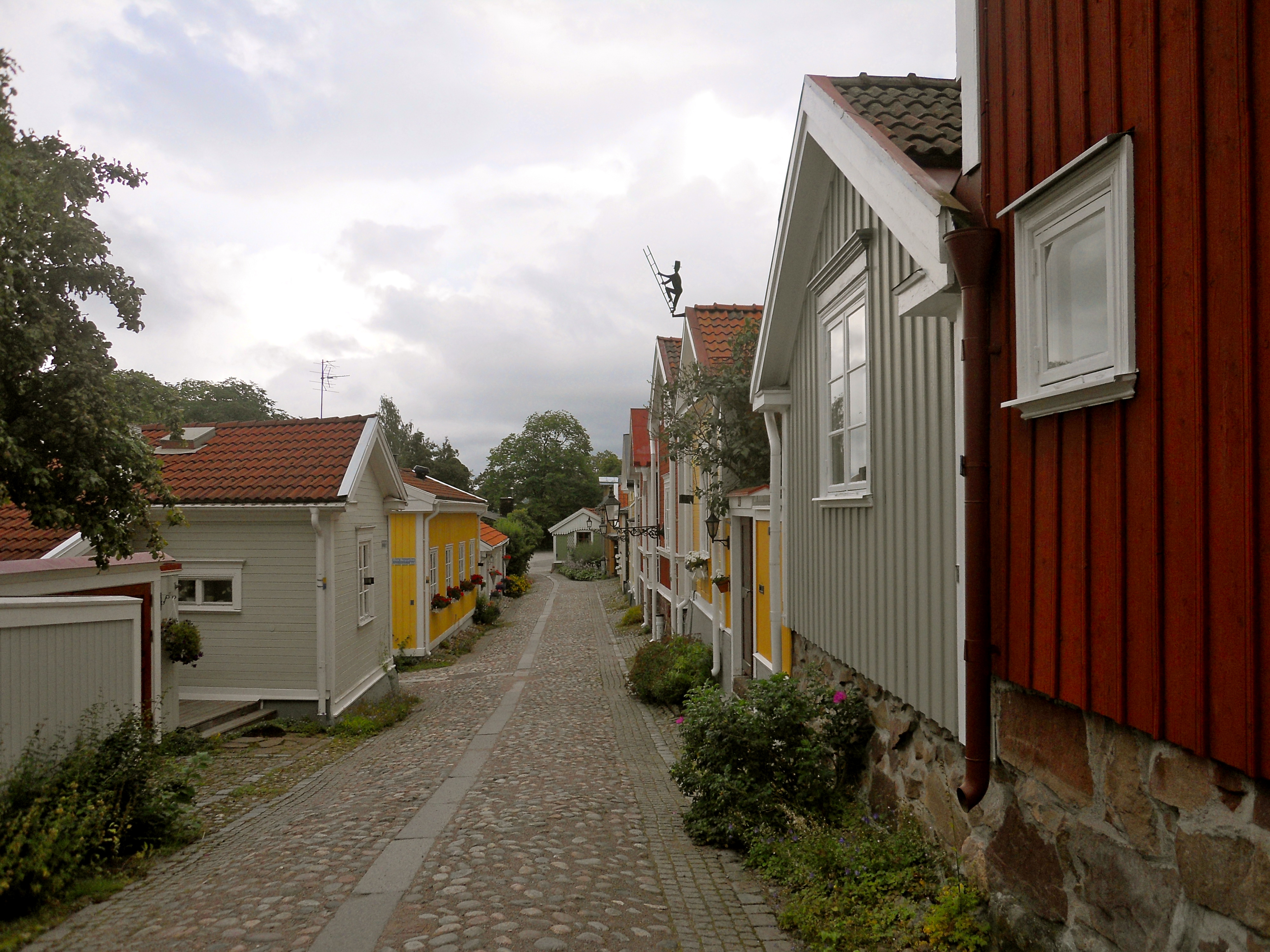
Gävle

People are also a big part of the exchange program. Not only am I meeting a lot of international students (there are not a lot of Americans, which makes Uppsala University a perfect place to make friends with people of other nationalities and backgrounds), I am also making a lot of Swedish friends. Don’t let the stereotype about Swedish coldness scare you – they are amazing people with interesting stories. And they are very funny too! There are a few Swedes who live on my corridor and I really like them; they are all so helpful and they do their best to make me feel at home. Swedes you meet at the social events are also very nice and talkative (I haven’t really experienced that famous coldness yet). After all, talking to people is the best way to learn about the country and its traditions, but also to find out more about the wonders this country hides.

Every day I am more and more happy that I have chosen Uppsala University as my study abroad destination since I am getting the best of both worlds – high quality education and amazing cultural exchange that will mark my college experience in a great way.


Barbados, Week 14: Reggae on the Hill

May 23, 2012

It’s exam time at UWI, and the blocks have become pretty quiet now that everyone is holed up inside studying.  However, not even exams could stop me from buying a ticket to one of Barbados’ biggest days in music, Reggae on the Hill.  I’m not going to pretend like I know the history of the concert or when it started, but if I had to compare, I’d say it was like a Barbados-sized Woodstock.  Obviously I’ve never been to Woodstock either, so I suppose I’m going out on a bit of a limb there too.  Point is, there was a ton of hype about the all-day concert, and when some friends and I cabbed over we started hitting traffic miles down the road from Farley Hill National Park, where the concert was taking place.  Some of the biggest names in Reggae music were scheduled to perform that afternoon, but I only recognized one artist, Chris Martin, winner of 2005’s “Digicel’s Rising Stars” (think Caribbean version of American Idol).

Security was pretty tight for an event of this scale, and I was a little surprised when I encountered a TSA-like pat-down before being allowed entry into the park.  Speaking of which, they couldn’t have picked a better spot for the concert:  the park was covered with huge trees providing cover from sun and rain, with a comfortable lawn perfect for spreading out a chair or blanket for the 8 hour show.  Knowing that the hill would get progressively  packed as the night went on (naturally, Bajans would be expected to arrive on “Bajan” time) we decided to take advantage of the myriad of different food vendors set up on the outskirts of the park.  Fish, chicken sandwiches, and hamburgers abounded and, unlike concerts in America, they didn’t even jack up the prices just because they knew they could.

Reggae has come a long way from its beginnings in 1960s, but the spirit for which the music stands was still evident in the crowd at Farley Hill.  From its birthplace in Trenchtown in Kingston, Jamaica, it has taken over the Caribbean and disseminated to every corner of the globe.  The genre was heavily influenced by Rastafari such as the legendary Bob Marley, and many people in the crowd were waving the Rasta Flag, a triple layered green, yellow, and red flag with the Lion of Judah in the center.  The audience, although clearly excited for each artist, was notably more laid back than a typical American concert in which some of the most popular musical artists of the year were present.  There was no pushing, shoving, or raucous jumping up and down, but rather everyone gave each other sufficient space to actually breath and enjoy the concert in their own space.  Below I have included a YouTube video of one of my favorite songs of the concert, enjoy:

Jah Cure – Call On Me

If you’re a Marley fan, it’s not a guarantee you’ll dig these tunes as well, but it’s catchy, contemporary reggae at its finest and an interesting example of how far the genre has come in 50 or so years of innovation and development.  I will admit, I missed American rock, rap, and top 40 for a good month or so after I arrived in the Caribbean and refused to embrace these types of songs until much longer than my exchange counterparts.  I ignorantly insisted that “they all sound exactly the same” and couldn’t even understand a word of the lyrics.  However, there came a point where I found myself bobbing my head and tapping my foot to the beat as I realized that as much as I tried to convince myself that I didn’t like the music, it had seeped into the part of my brain that overruled cultural attachment.

The sun set behind the hill, it started to pour rain, and the line-up of reggae artists continued to perform their sets with exuberant energy.  I looked back at the hill that had been dotted with people only hours before and saw that the hill was absolutely packed.  The young, married, and old alike had taken out their umbrellas and were determined to fight the downpour in order to finish out the most celebrated concert of the year.  I think that’s what struck me most about the concert. The fact that, while concerts in America are generally populated with a homogenous crowd, its demographic depending on the band playing, Reggae on the Hill was able to bring together Rastas, students, couples, and older people alike to enjoy the concert.  I may have been slightly more stressed the first day or two of studying for exams, but it was one hundred percent worth it for the experience.