Diana in Copenhagen: My First Week

August 29, 2014

Hello from Copenhagen!


After I had less than 48 hours to get ready and pack, I somehow made my way to Logan airport in time for my big European sendoff. I waddled around the airport equipped with a backpack “carry on” that was about the size I am, a tote bag “purse” heavier than most children I’ve seen, and a suitcase that tested the airline luggage worker’s strictness on weight limits. I was ready to begin my journey.

Me at the gate at Logan

Me at the gate at Logan Airport

To be fair, the said journey had a rocky start when I found that I was the lucky one placed at a middle seat with a broken screen on the seven-hour flight to Germany and, of course, the air conditioning on the flight was broken. Alas, things started to look up once a flight attendant restarted my screen and the AC finally started working.


The flight from Germany was short though, and before I knew it I was touching down in my new home. The Copenhagen weather welcomed me with rain, which I’ve learned is not surprising. Rare is a day here where there’s not a single shower—something I have yet gotten used to. On a brighter note, I walked into the lobby area of the airport to a smiling Dane waiting there to greet me.


This semester I’ll be attending Copenhagen Business School (CBS) and they have a program that matches its exchange students with a Danish student to show us the ropes. I greeted my buddy Kristoffer with a hug and spent the entire metro ride to my dorm asking him all of my questions about Denmark. Topics of conversation ranged from what Danish food is (apparently lots of heavy foods), Danish clothing (all black everything), and Danish people (extremely happy but not often outwardly friendly).


Time went quickly and soon we were walking into my dorm Kathrine Kollegiet in a municipality called Frederiksberg. The dorm room is for exchange students only and my hall has students ranging from Connecticut to China, so I’m even expecting dorm living to be a multicultural experience. My single here is huge too! I’ve got a kitchenette, two big windows that open to a playground area, and my own bathroom. The kitchenette with two burners, a small sink, and a microwave is…quaint. It’s served me well to make pasta, grilled cheese, and eggs so far but we’ll see how far I can survive on those meals. I’m hoping to write a food entry later once I get more creative!

My single in Kathrine Kollegiet

My single in Kathrine Kollegiet

The bathroom really surprised me though, because in Denmark they don’t differentiate the shower from the rest of the bathroom. The “shower” is really just a curtained off corner of the room. Just a curtain—yep. Getting used to this has been interesting, but I guess the system has its perks? I never need to worry about tripping on the little lip on the ground when getting in and out of the shower and I can put my foot on the toilet to shave my legs with ease. The whole room gets soaked though; I can only defend the system so much. Outside of this odd cultural design difference, I’ve truly enjoyed playing house so far and I know it will grow my independence tenfold.

The shower area

The shower area

I arrived in Denmark a week earlier than most to take something called a “Danish Crash Course” consisting of classes to help familiarize us with the Danish language. While I’m still quite the novice (this is a nice way of telling you I can say hello, thank you, and goodbye), this course was an easy way to get to know people. Now comes the real orientation week where we have the opportunity to meet even more students and hear about life at CBS. I’ve loved my time in Denmark so far and can’t wait to have more adventures.


Thanks for reading!


Kimberlee in Mongolia: ISP Period

June 11, 2014

We are now at the point of our program where all of us students pick our own topic of interest and research it for a month. Our Independent Study Project (ISP) allows us to go anywhere to study anything for four weeks, and gives us a great deal of independence and control over what we want to learn about Mongolia. At the end of the four weeks, we have a 25-50 page paper and oral presentation due. The other students are researching a variety of topics, including: accessibility for people with disabilities, how climate change affects herders, street cleaning, emergency medicine in the countryside, and the use of the traditional Mongolian characters in modern society.

I first decided to study distance education in Mongolia, but soon decided that the topic was a bit too outdated. The further I researched distance education in Mongolia, the more I realized that most of the projects were conducted from the 1990’s to around 2007. I could continue to research and interview people on these past projects, but I decided to change my topic to technology in the Mongolian education sector. As you might guess, this topic is huge. I’m covering both the formal and informal education sectors, and it ranges from teacher training to e-learning to changes in classroom culture. It’s large, but I find it so interesting and don’t want to cut anything out.

My main research methods have been attending a conference, conducting 26 individual interviews, and observing classrooms. It was pure luck that the day our ISP research began was also the beginning of a 2-day international conference on technology in education in Mongolia. It was great to be able to experience it, and thankfully, most of the slideshows were in English. At the end of the conference, we were given a CD filled with each presenter’s individual Powerpoint or research papers. I don’t think it can get more helpful than that!

One of the best parts of my ISP time is getting to know Ulaanbaatar city on my own terms. I get to make my own schedule and plan what I want to do during my days, and I love having the opportunity to explore during my free time. The longer I live here, the more I realize how much I love it. This is the first time I’ve gone to a new city and explored it thoroughly on my own, and I love knowing the area so well. The city is relatively small (1.5 million people), but big enough to discover new areas! It’s strange to come from a smaller town in Maine and to realize how much I have fallen in love with this city. I never thought I would like to live in a city so much. This is something new that I discovered about myself abroad! I know that I’m going to miss UB when I have to leave.

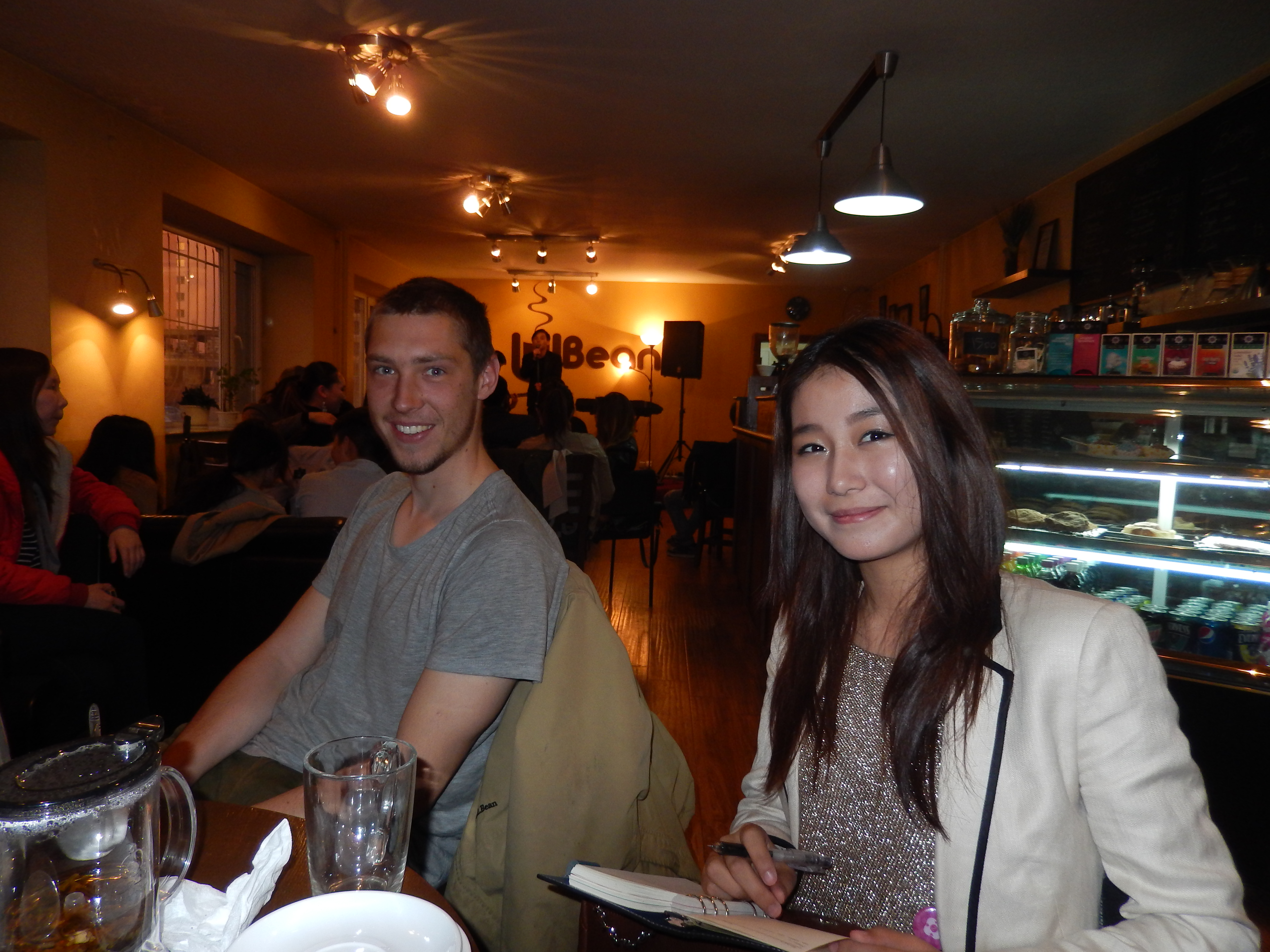
A cafe where I go so frequently they know me by name! I also walk on this street almost daily.

A cafe where I go so frequently they know me by name! I also walk on this street almost daily.

Another perk of the ISP is getting to interact with locals more. I interviewed around 1-3 people a day, and so I had to engage with Mongolians on a daily basis. I also used university students as my translators, so I had the opportunity to hang out with them between or after interviews. I learned so much from them, and it’s fun to hang out more as friends outside of interviews. I think that if ISP taught me anything, it’s how to begin to really live in UB. The rest of the SIT program was wonderful, but this time period definitely gives me more freedom, independence, and a look into what life here would be like if I didn’t go to university classes.

My friends Kit & Anni at an open mic night we went to as a group.

My friends Kit & Anni at an open mic night we went to as a group.


Austen in Ireland: End of the Year – Cork, Liverpool, Belfast, and Finals

June 3, 2014

Right after getting back from Germany, I took the oral exam in my Irish class.  The Irish language was very difficult, but it was a neat experience learning another language.

The next day, I took a train ride to southwest Ireland to Dublin’s smaller sister–the city of Cork (Ireland’s second largest city).  Cork had a very different feel to it than Dublin with a laid-back attitude and with no tourists.  It was set on a nice river and had some beautiful architecture.  I would have argued that there were more pubs in Cork per capita than Dublin, which I thought initially was impossible.

We explored the city of Cork and ended up going to Blarney Castle.  A must while there was  ‘kiss the Blarney Stone.’ Kissing the stone is said to endow the kisser with the gift of the gab (or eloquence and skill at flattery).  The poison garden was another neat attraction at the Blarney Castle, which featured many lethal plants.

The following day, we took a day tour of the Ring of Kerry, a gorgeous attraction in the countryside of Ireland.  There were so many great landscape sceneries and also quaint Irish villages.  Although the weather wasn’t the greatest (fog really hindered our vision), the trip more than made up for it.

Ring of Kerry scenery.

Ring of Kerry scenery.

After getting back from this trip, I had my finals to conquer.  I had three finals in psychology, economics, and Irish.  My first final was a couple days after getting back from the Cork trip.  The whole experience of having to go off campus to an exam hall that fits 3,000 exam takers was intimidating.  I took a shuttle bus that UCD was running to the exam site and it took about ten minutes.

Once I entered the building, there were seat numbers for each exam taker at that time slot.  Once I walked into the exam room, it was overwhelming to say the least.  About 3,000 desks with uncomfortable chairs all lined up in many rows.  A lot different from Richmond, where exams are taken in classrooms.  The exam was fine but there were proctors walking up and down the rows about every ten seconds, which could get distracting.

Since I had over a week in between my first exam and other exams, I had planned a last trip to Liverpool and Belfast with my friends.

The city of Liverpool really surprised me.  It had one of the largest shopping areas I had ever seen and the dock area was very nice.  My friend and I had a jam-packed day.  We went to the Beatles exhibition, since no trip to Liverpool is complete without learning more about the Beatles.  Then, we went to three of Liverpool’s free museums.  We first went to the Merseyside Maritime Museum, where we learned much information about the maritime industry in Liverpool.  We then went to the International Slavery Museum, which explained the history of slavery in Liverpool.

Albert Dock, Liverpool.

Albert Dock, Liverpool.

The third museum we went to was the Museum of Liverpool.  This was a very interesting museum as it really explained the importance of the city, from the city’s large Chinatown to the rivalry between Everton and Liverpool Football Club.  Our next stop of the day was Anfield, the home of Liverpool Football Club, one of the most legendary soccer clubs in the world.  Our tour was fantastic and so was our very passionate tour guide.
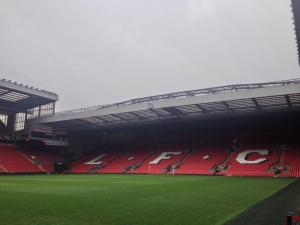
Anfield, home of Liverpool Football Club.

Anfield, home of Liverpool Football Club.

We went into the press room where the manager talks to media after the matches, the home dressing room where Liverpool suits up, and the visitor dressing room.  We also were able touch the ‘This is Anfield’ sign which was an iconic part of the stadium.  After this, we went into the stadium and saw the field.  It was amazing being able to see this stadium and also sit right where the manager sits during the games.  It was pouring when we were outside in the stadium, but it didn’t dampen our spirits.  The tour was quite interesting and I was able to really learn a lot more about the history of Liverpool Football Club.  We also went to the museum and saw some of the trophies Liverpool had won.

We got into Belfast early the next morning and learned that there was a bike race going on in the city that weekend (the Giro d’Italia).  We got to our hostel and started our sightseeing in the Queen’s Quarter, which is where Queen’s University, Belfast is located.  This was a very beautiful campus with many historic buildings and nice greens.

Our next stop was the Ulster Museum, a National Museum of Northern Ireland.  It was such a large museum and very expansive.  It covered pretty much everything that had to do with the province of Ulster, where Belfast is located.  We then saw the Botanic Gardens, which had some interesting plants and flowers.  This day was so exhausting and we ended up resting afterward.

The Titanic Belfast exhibition was our main sight of the next day.  The Titanic was built in Belfast and the exhibition was amazing.  The exhibition had many interesting parts, including a ride (to see what it was like to work on building the Titanic) and also a virtual tour of the interior.  It was overall an excellent attraction.  Walking through the port of Belfast, it is apparent that Belfast had and still has a very large industrial part to it.

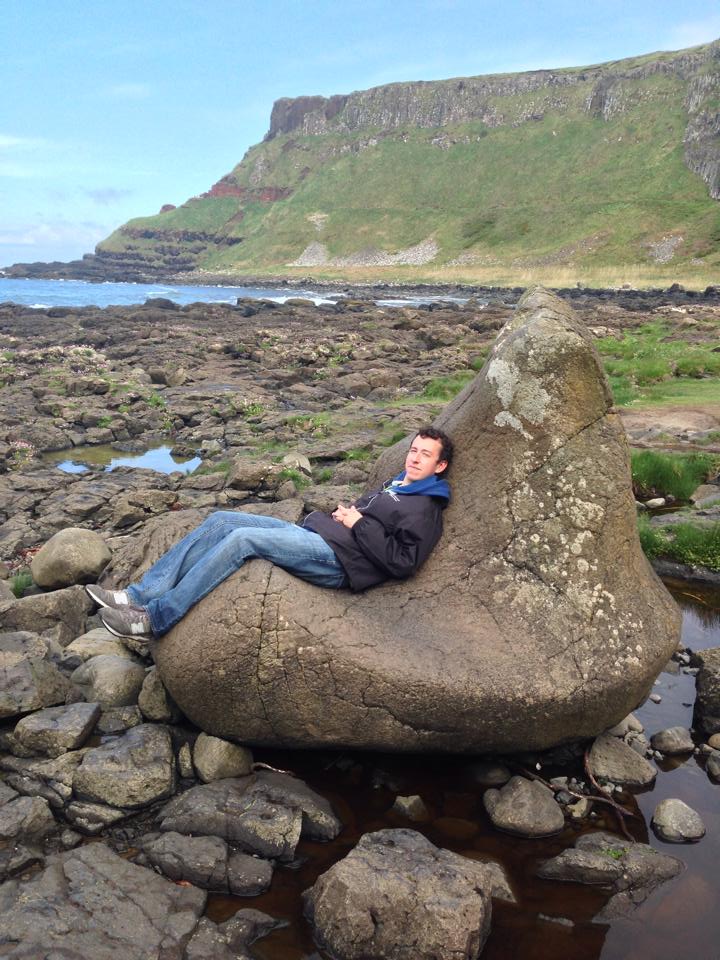
On our final day of the trip, we went on a tour to Carrick-a-Rede Rope Bridge and Giant’s Causeway.  Our first stop was the rope bridge and it was a somewhat frightening experience walking over a very shaky rope bridge, but the views of the sea from the island once you got across were really great. The main attraction was Giant’s Causeway though.  Giant’s Causeway is an area of about 40,000 basalt columns (mostly hexagonal), which are the result of an ancient volcanic eruption.  It is a UNESCO World Heritage Site.  Walking all the way out to the tip on the coast was magnificent but also tough as the rocks were quite slippery.

I found a nice rock at Giant's Causeway, Northern Ireland.

I found a nice rock at Giant’s Causeway, Northern Ireland.

This was really amazing and we walked back up top on the cliffs and were able to really appreciate the Giant’s Causeway Coast from up above.  When we got back to Belfast, we saw the Belfast City Hall, a marvelous building, before eating dinner and then heading back to our hostel since we were both leaving early the next morning.

Once I got back to Dublin, I studied pretty much the whole time before my last two finals.  It was a long day but I got through it and I soon realized that my time in Dublin would be coming to an end as I had to start packing.

I spent my last day sightseeing in Dublin.  I went to get my last fish and chips, to the Trinity Book of Kells exhibition and the Long Room, to the Science Gallery at Trinity College, to the Chester Beatty Library (religious history) and Dublin Castle.  I also just walked around the city, admiring the Irish atmosphere one last time.  I walked around O’Connell Street (I got souvenirs for many people), Grafton Street, and I ended up at pretty much where I started in Dublin, St. Stephens’ Green, a beautiful park right in the center of Dublin, and took some time to think of the great adventures and memories I will have from this semester.

I soon went back to the university and started packing.  Packing started off easy, but got more challenging when I slowly started running out of space. The next day (my last day in Dublin) was very much a relaxing day and I spent it packing and saying bye to friends I had made.  Although I had to get up early the next morning to leave, I figured I should spend one last night with the UCD Softball Club, as I made some of my closest friends in that group.  I ended up not getting to sleep until 4 a.m. that night and waking up at 6 a.m. but it was all worth it.

Saying my last farewells to the people, the campus, and the city of Dublin was challenging, but I know I will be back at some point in the future.  It was my most memorable semester so far and I would say the decision to study abroad (I decided last minute) was one of the best decisions of my college career.  It really opened up my eyes to another culture.  I am currently sitting at my home in the USA relishing the memories and wishing I were in Ireland.  I can’t believe I sometimes wished I were back in the USA when I was in Ireland.  I must have been crazy.


Kimberlee in Mongolia: Sainshand Part 1-Reflection of Our Last Excursion

May 27, 2014

This past week was strange because it was the beginning of the many “lasts” in Mongolia. Although it was exciting to go on an excursion to a desert area in southern Mongolia, I kept remembering that it was the last time that we’d travel as a group. It was in the back of my mind as we went to the countryside, but I had to keep shaking it off because how can I live life with such sadness in the back of my mind? For me, a large component of study abroad is remembering that it is temporary, but continuing to push myself to live in the moment. It was, and is still hard, but I keep telling myself that I need to present in every moment.

However, the great part about it being the last excursion was the fantastic group dynamic. As there were only 8 of us, we were predictably close at the beginning. But I felt that this particular excursion was different than the others. After the trip, many of us talked about how we liked our trip to Sainshand the best out of them all. When I look back in my memory, I remember lots of roadtrips, dumplings, and laughter in those few days.

A view of Sainshand town.

A view of Sainshand town.

Perhaps it was the relaxed, comfortable atmosphere that surrounded our group. Because there wasn’t anything to do in Sainshand at night, we spent our nights laughing at comedy skits on YouTube, watching movies, and just enjoying each other’s company. Just imagine the 8 of us piled on top of a bed watching movies!

I gave countless head massages every night. In general, we had more free time than ever before. We never had to get up that early, so we had breakfasts leisurely in a small restaurant across the street from the hotel. We had large chunks of time to explore the tiny town during the day, and even found a pizza place to order pizzas from later.

A giant dinosaur statue we found and climbed together.

A giant dinosaur statue we found and climbed together.

A big highlight of the trip for me was getting the chance to ride on the train during the day. We rode a train at night to Erdenet, but it was very different during the day. First of all, our program was quite determined to get us to be productive during the train ride. We had both individual presentations and Mongolian language classes, which I thought was hilarious.

With the 8 students and 2 program staff, we were stuffed inside that tiny train compartment. But it was a fond memory for me because we were able to bond even more. We were also looking forward to the “buffet” our program had promised us, but it just turned out to be a lady serving ramen and sandwiches from a cart. We had fun eating our cheap, unhealthy foods while wrapped up in our blankets on our cots. It’s funny how sometimes the journey can be just as fun as the destination itself.

My friend Mara on the train.

My friend Mara on the train.


Kimberlee in Mongolia: Lessons from my Nomadic Homestay

April 21, 2014

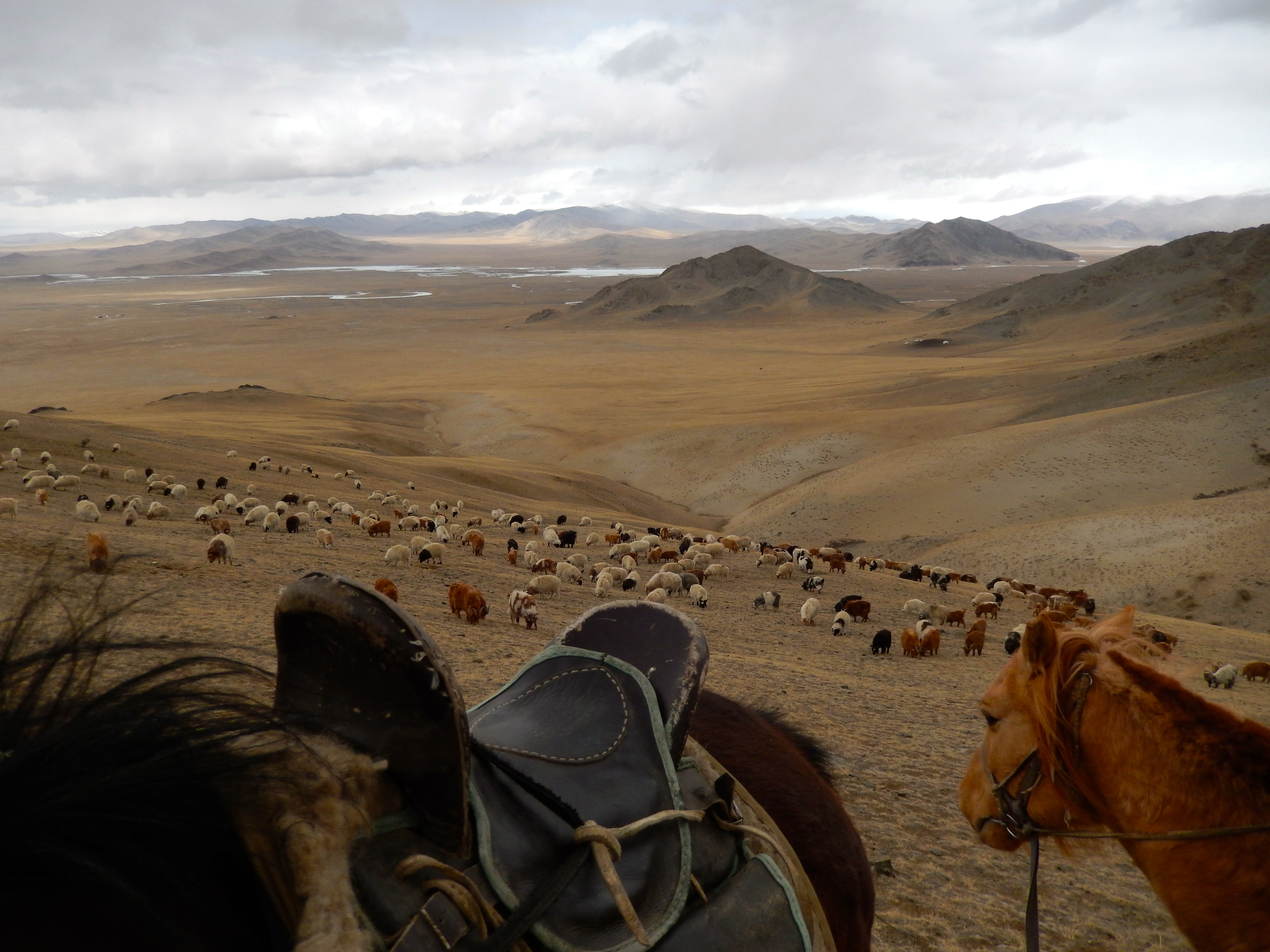
It feels strange to be sitting here at my computer and trying to find a way to explain these past 2 weeks. Each of the over 800 pictures that I took have their own story to tell, and there are a million moments that I want to share. I have to admit that I’ve been putting off writing about my experience because explaining 2 weeks of my nomadic homestay is impossible to condense. How do I accurately describe how it felt to spend my days telling time by the sun? How it felt to sit in the grass and only hear the sound of hundreds of animals chewing? Or what it was like to watch a goat give birth on a mountain?


DSCN1374

How can I fully explain how it felt to see this view everyday?


I ended up surprising myself with the amount of unexpected lessons that I learned. If you had asked me at the beginning to outline my expected challenges, only half would have been accurate. I probably would have mentioned challenges like: not bathing for 2 weeks, having no internet connection, the Mongolian language barrier, and the food. However, I would say that out of these challenges, the only one that turned out to be true was the language barrier. But even this was not as challenging as I thought. I became an expert mime by the end.


The challenges that I ended up having were completely different than I anticipated, which I think is the beauty of this experience. During my lows, I tried to accept these difficulties and get something out of it. The biggest challenge that I dealt with was boredom. The chores were not always exciting. Learning to herd was a beautiful experience, but there were days when 10 hours of herding became less exciting. Sometimes I would make up poems in my head, which made me understand why storytelling and singing are important to Mongolian herding culture. Other times I thought about life and all of it’s complexities (as stereotypical as that sounds). I can’t imagine another time in the near future where I’ll nothing to do but simply think for 2 weeks straight. As our academic director said: “Boredom is starting to become a luxury”.


DSCN0988

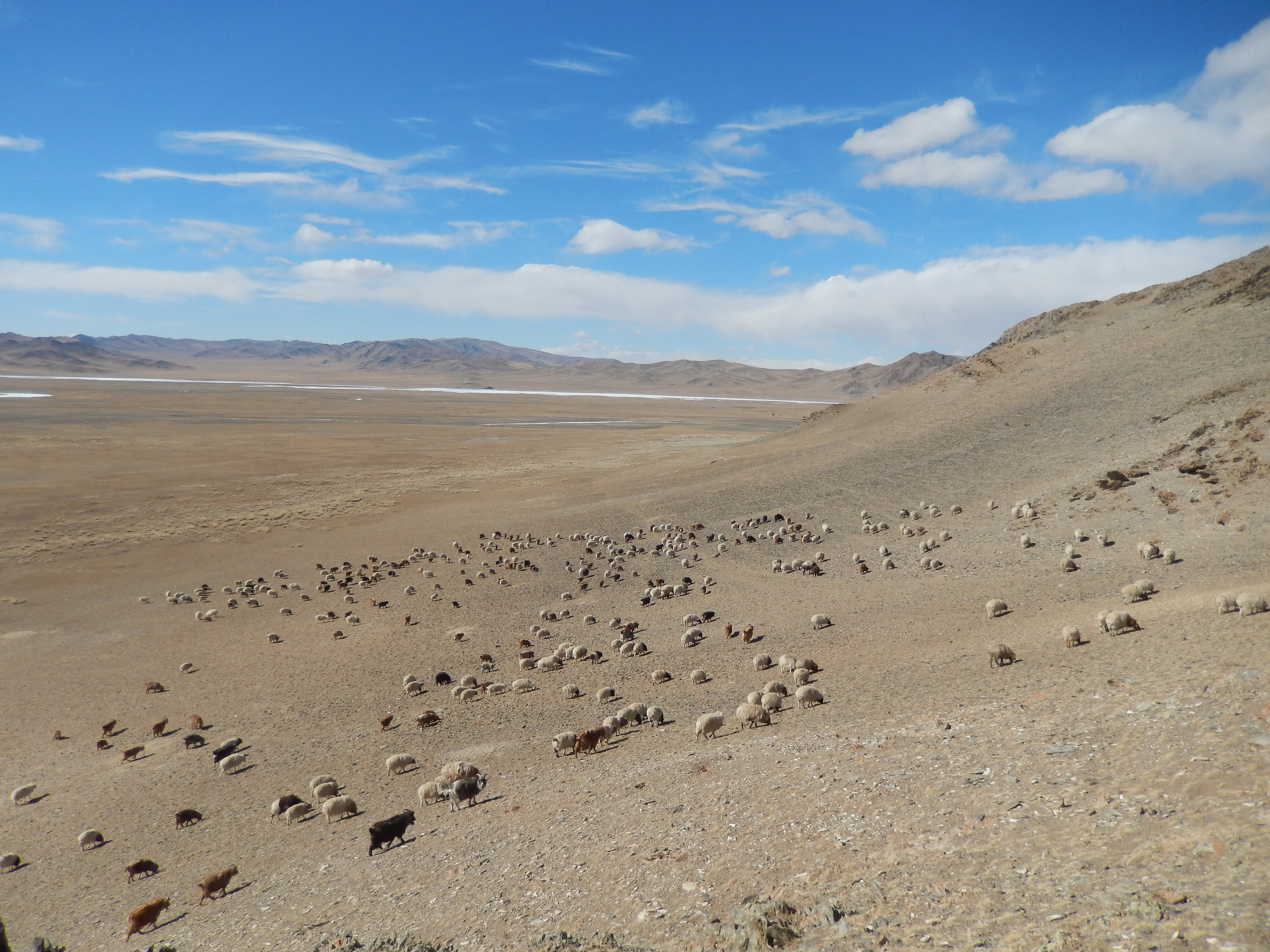
At least I experienced boredom while looking at this beautiful scenery

Along with boredom, the extreme feeling of isolation was incredibly overwhelming and unexpected. I anticipated isolation in a different way. I thought that being disconnected from the internet would be isolating, but I mostly felt isolated from the group and people who speak the languages that I understand. I wanted to process with someone in words, and yet I had to deal with all of my emotions on my own. This was independence at its most extreme. It was difficult to deal with, but it was completely worth the struggle.


One thing I can say for certain is that this homestay was twice as difficult as my rural Ugandan homestay. In Uganda, I had a fellow student as a host sibling, my family spoke English, and our whole group lived in the same village. Here, the closest student to me was at least a 45-minute walk away. It was also only 5 days in Uganda, compared to almost 2 weeks in Mongolia. I didn’t experience any boredom or feelings of isolation, which was my biggest challenge here. But I will say that I think that I got more out of this experience partly because of the unexpected challenges I faced.


Once I was able to bond well with my family, I immediately found a great amount of joy. When I look back in my memory, I first think of my positive experiences: playing cards, brushing goats for cashmere, playing with the toddler, seeing the sunset while herding, and catching baby goats. Even though I had lots of lows, it was well worth my time and energy to work through them by myself. The whole time I lived there, I never felt like I’d made a better decision than coming here to Mongolia.


DSCN1447

DSCN0851

DSCN0886

When I look back at my time there, this is what I see in my mind


Kimberlee in Mongolia: A Sunny Saturday

March 31, 2014

After almost a week separated from my host family, it was so nice to finally have the chance to spend time with them again. Who knew that after two weeks I’d be so attached to them? What an incredible feeling to have already formed strong bonds.

I began my day with a short trip to a conservation center/museum with Tuugi’s 7th grade class. We basically watched a 45-minute video on the deterioration of Mongolia’s environment and later wandered around many stuffed Mongolian animals. Although the tour was in Mongolian, most of the signs were also in English. That made it a lot easier for me to be engaged with the museum’s artifacts, and it was interesting to learn about the endangered species unique to Mongolia. The center was entirely funded by the Japanese government, so everything inside was covered in “From the People of Japan” stickers. Fun Fact: Japan is Mongolia’s biggest foreign aid provider

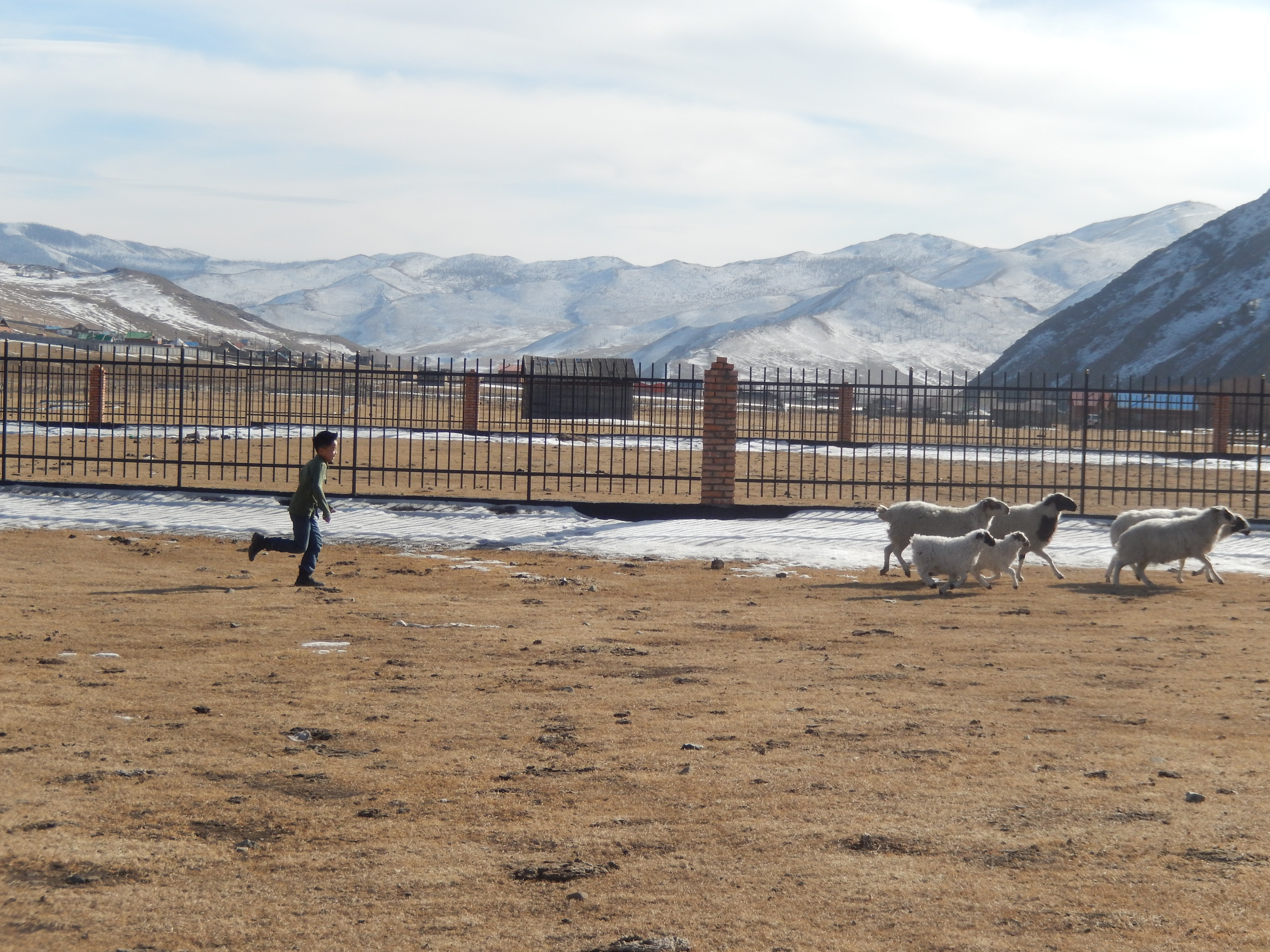
After lunch, my host family decided to visit some family members in the countryside. We drove about an hour outside of the city to a little village wedged between the mountains. It was absolutely stunning. We pulled up beside a giant herd of sheep and goats, and the kids immediately sprinted out to start chasing them.


DSCN0559

Temuujin chasing after the sheep


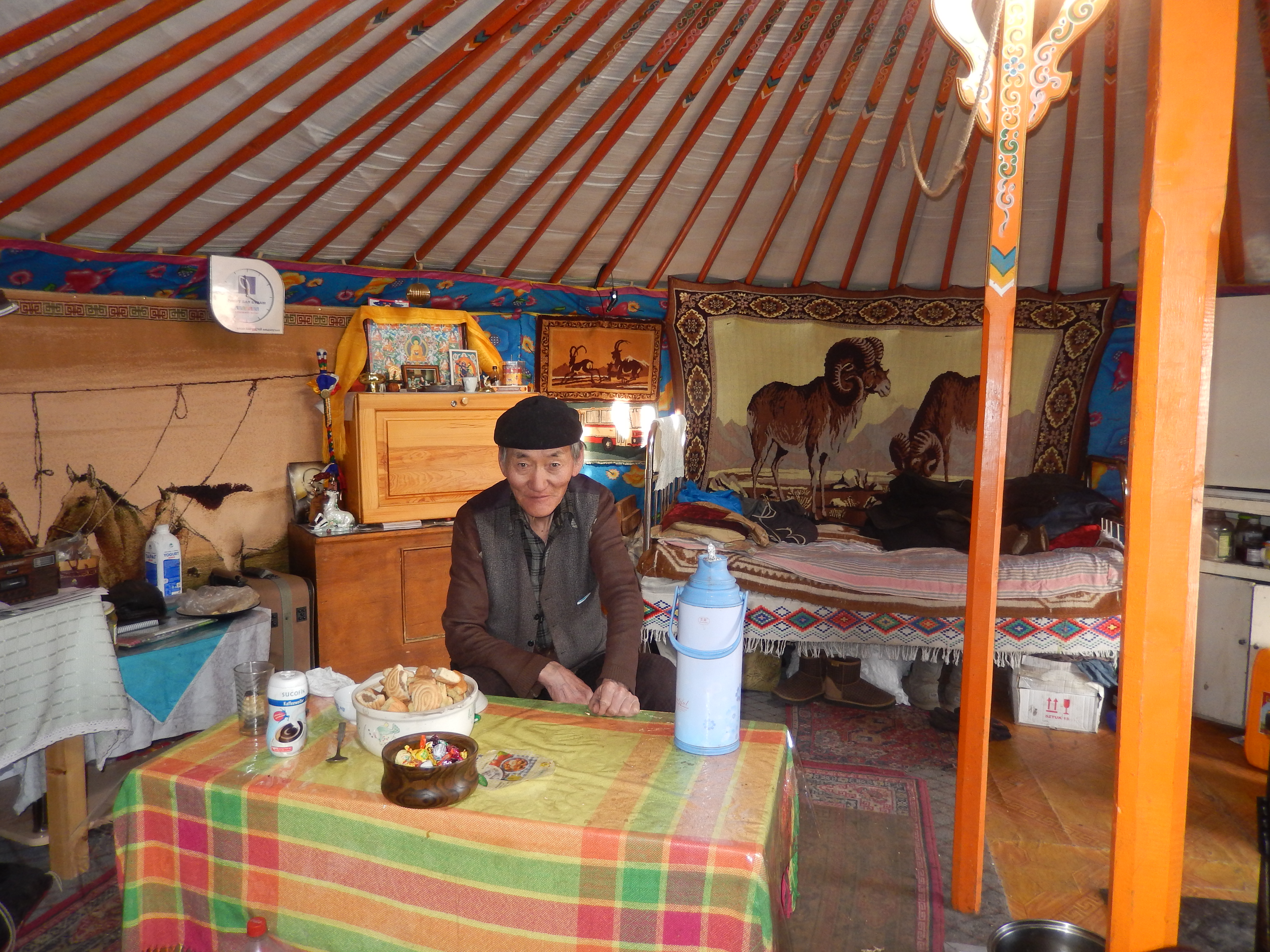
After the kids (both the human and the goat ones) became too exhausted to play anymore, we were invited into the ger for some tea and cookies. It was incredible to finally be inside of a ger. It was a lot larger, brighter, and sturdier than I imagined. There were lots of tapestries of horses and rams, and there was even a TV run by solar panels. All I could think about was what it must be like to wake up every morning in a ger to an amazing view outside your door. I guess I’ll be finding out what it’s like soon.


DSCN0594

The view from inside the ger.


It was also there that I finally figured out that we were visiting Grandma’s late husband’s sister. Because we had stopped by without calling (which seems to be a typical practice), we had just missed her driving into the city. Instead, we were hosted and shown around by her husband. I was able to introduce myself in Mongolian, but I missed hearing his name in his response. He was very hospitable, and gave us a mini-tour of their barn and animals.

Most of the animals were scared of humans, but there was this one goat in particular that kept following us around. He would always be nudging my arm while I was trying to pet another animal or take a picture. He was the only “billy” (male goat) of the herd, and was the father of all the baby goats running around, so I called him “Papa Goat”.


DSCN0579

Papa Goat and the traditional Mongolian ger

We started to drive home just as the sun was setting, and it was a beautiful backdrop to what was truly a wonderful day. Tuugi, Temuujin, and Tulga all passed out on top of me in the backseat of the car, and it was nice to have some quiet time for reflection after a busy day. Looking back, we technically hadn’t done a lot, but it was a fun and fulfilling day. I count myself very lucky to have a host family that is always looking out for me and introducing me to new things. Simply put, it was the kind of day where I knew that I had made the right choice in choosing Mongolia.


Austen in Ireland: My Classes so Far

February 10, 2014

I’ve been really busy recently and haven’t even been able to post about my classes!  I am taking six modules (which are what they call classes here in Ireland).  I am taking three psychology modules: Lifespan Development, Counseling Psychology, and Visual and Social Cognition.  These are all relatively large classes of between 50-100 students (two are in lecture theatres) so it’s a lot different than Richmond.   Visual and Social Cognition seems like the most interesting to me of these classes as it’s topics are the closest to my interests in psychology.  For these classes, there are not too many assignments over the course of the semester so the few assignments count for a large portion of the grade, a significant difference from the US.

For my other three modules, I am taking a variety of topics.  For one, I am taking Health Economics, which will count as an elective class for my economics minor.  It seems like an interesting class because it incorporates economics, political science, and psychology topics.  I am also taking Irish for beginners.  This is my smallest class of about 20 students with all international students, which is a nice change from my other classes.  Irish is a difficult language so far and I’m not the best at foreign languages to begin with.  I find the class really interesting though so it should be a fun experience.  The last module I have is called Discovering Ireland: Landscape and it consists of just two field trips.  There are no lectures, we just go on the two trips and make journal entries about our observations from the landscape, buildings, etc. since it is an archaeology class.  I’m really looking forward to class because it seems like it will be a great excuse to see new areas of Ireland!

Overall, I’m looking forward to my classes and seeing what else I will be learning.  It is interesting to see the different teaching styles in Ireland, as there is virtually all lecturing and no class participation because of the much larger class size.  There are, however, smaller tutorial sections that meet a few times a semester for a couple of my classes that go over the topics in a smaller group.

photo (1)

The UCD campus!


Diego in Brazil: Final exams at PUC-Rio

December 3, 2013

Yesterday I had my first final exam at my host university. I would not say that my time in Rio de Janeiro simply flew by, but I certainly feel that the second half of the semester was somehow much shorter. It seems as if just two weeks ago I was writing my mid-term exams. Yet here I am, about two weeks away from closing this experience abroad. As with my post about mid-term exams, I am posting pictures of PUC-Rio’s campus. This time I took two pictures right outside the main campus entrance.

IMG_0796 (800x600)

The main entrance to PUC’s central campus. Several public buses either go through or end their routes right in front of these doors, making the campus quite accessible.

This week I wrote my Portuguese final exam. It was incredibly short and I suppose PUC simply wants to test how much its foreign exchange students are learning. Rather than bombarding us with fifteen or twenty exercises on the same topic, my professor asked us to complete about twelve sentences in total that tested whether we can use different tenses and conjugate verbs. She also gave us a short reading and asked us to answer two short questions. Tomorrow we will have the oral section of my exam in which we will discuss racism in Brazil.

All of my other classes (Geography of the Contemporary World, Political Economy of Latin America, Brazilian Foreign Policy, and Poverty and Social Inequality) are mainly based on academic readings. Final grades in each class heavily depend on how students do in final exams, so I suppose my professors will be asking for two or three long, essay-type answers for each exam.

Interestingly enough, my four classes (or maybe my four professors) have different approaches to tests. Today my Poverty and Social Inequality professor distributed six essay questions for us to prepare at home, each relating to a particular text we read during our course. For our exam she will choose three of the six questions and ask us to develop a relatively long response for each. While this may seem rather simple, she expects us to incorporate our in-class debates into our responses, turning our exam into quite an interesting exercise.

My Brazilian Foreign Policy class will also have a “traditional” exam. We will be given three essay prompts that ask us to compare different authors, theories, and historical periods. This will certainly be my heaviest exam in terms of the amount of content I will need to prepare and study. Luckily, this has been my favorite course at PUC-Rio and it will be quite interesting to look back and realize how much I have learnt about Brazil and Latin America through this class.

The exciting moments of my next two weeks will most likely come during my Geography and Political Economy exams. These two professors have a very interesting approach to final exams. They both believe that having students simply reproduce what they have already read in academic texts does not show how much they have learnt. Instead, we will be given a newspaper article (or an image in the case of Geography) to analyze using the theories and arguments we have studied so far. My professors’ objective is to determine whether students have developed the skills to put new knowledge in practice.

This was probably not the most entertaining post of my semester, but I wanted to give you an idea of how different academic systems may be abroad. About 60% of my final grade for each class will be based on these exams. My experiences at the University of Richmond and at PUC-Rio have been different in this aspect, yet I am confident both systems have allowed me to learn immensely.

I will definitely let you know how my exams go!

IMG_0797 (800x600)

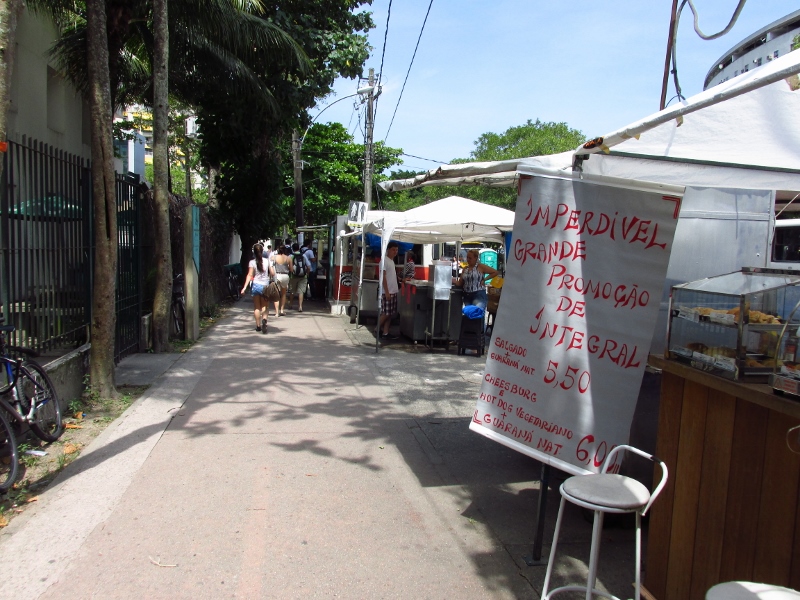
Step outside PUC’s campus and you will find several options for a quick lunch or even some Acaí (a highly popular “drink” made from the fruit of a particular palm tree.)


Rhiannon in India: Missing Life in Hyderabad

November 22, 2013

Right now, I am on a plane on my way to Kochi, Kerala. As I wrote in my last post, I am spending the next two weeks travelling through the southern states of Kerala and Karnataka, known for their coastlines, mountains, and coconuts. As soon as my Hindi exam ended today, I rushed home to pack my things and headed to the airport, eager to finally escape school life and being an amazing adventure. But this excitement came at a price. I have been so engulfed by exams and planning for this trip, I had not realized that I would be seeing many of my friends for the last time today. When we left the exam room this afternoon, many of my friends and I realized that our end-of-semester travels would be separating us until it was time to go home in December. We said our goodbyes, but it seemed so rushed and unexpected that it left me feeling strange about leaving for my trip. I know I’ll see many of my American friends again, whether it be in India before we leave or once we are back home, but these goodbyes made me realize something even worse. Even though I’ll be in India for a few more weeks, I will never be in the daily routine that I developed earlier this semester. I may never get to experience the little things that became so normal and part of my everyday life, like being greeted by the familiar auto-wallahs in our neighborhood, riding my bike to class with two flat tires, or eating a pound of rice at my favorite canteen on campus. So although I am thrilled to start my two-week trip, it is a bittersweet excitement.

I know I’ll miss every experience, every interaction, and every person at some point when I get home, because it is often the little things that come to mind first when I am reflecting on my stay in India. Nevertheless, there are a few people that I will really miss having as a part of my everyday life once I am home.

The first is my host family – Nivedita, my host mom, and Prerna, my host sister. Looking back on the semester, I feel so lucky to have been placed with this host family. Nivedita and Prerna were always so kind and patient with us when we would ask endless questions about Indian culture. Nivedita would always let us crowd around her in the small kitchen while she was cooking dinner to watch and write down recipes. She would also spend hours after dinner telling us the religious stories about different gods behind all of the holidays we were celebrating, and was the primary source behind many of my blog posts this semester. Prerna was also a very good source of information when it came to understanding the ins and outs of Indian culture. We really got to bond with Prerna when she came with us on a long weekend trip to Mumbai. She had never been to Mumbai before, so we all went together to explore the big city, see some sites, and go shopping for “western” clothes. My favorite part about hanging out with Nivedita and Prerna was when we go on trips with them. Last weekend, Nivedita’s sister and her two kids, Sanskar (12) and Isha (5), were visiting us from Pune to pick up Nivedita’s mom, who we called Aji (grandma in Marathi). While they were all staying with us, we went for a day trip to a town to the north of Hyderabad called Warangal, known for its farmland and historic temples. We spent the whole day hopping from site to site in the taxi while we had the best time hanging out with the family, especially the two kids, Sanskar and Isha. Everyone welcomed us into the family and treated us like we were one of them, especially Isha, who attached herself to Jennie and me the whole day.

Family at Warangal

Our host family at a temple in Warangal

Jennie Sanskar Isha rice field jumping

Jennie, Sanskar, Isha, and I jumping in a rice field near Warangal

I am also fortunate to have had the opportunity to meet the neighbors in our apartment building. One of the first people we met when we moved into the apartment was Moulali, the watchman. A middle-aged Telugu man, he knew very little English (and I knew even less Telugu), but somehow we always managed to communicate about where our host family was, what he was having for dinner that night, where we were going, and when we’d be back. Every time we came into the carport, where he and his family lived in a small room, he would yell, “Namaste!” and fold his hands dramatically. He was always extremely energetic, and my best memory of Moulali was when Jennie and I gave him a flower for him to give it to his wife, Narasimha. He took the flower, then sang and skipped all the way across the carport to his wife to give it to her.

Moulali and Narasimha

Moulali and Narasimha, the watchman and maid for our apartment building

Throughout the semester, we formed a close relationship with the other family on our hall, spending many afternoons or weekends hanging out in their apartment watching TV, or eating lots of snacks, and playing with their two kids Binnu (9) and Quiny (5). Madhu and Sandiya, the parents, were so kind and welcoming to us, and now seem like an integral part of our host family. We also became really close with the family living in the “penthouse” apartment on the roof. They also had two kids, Lalith (14) and Spandana (9), who we also spent a lot of time with. Lalith, a super smart rubix cube master, would always hang out in our apartment and tell us about the things he was learning in school. Spandana loved to come over to color or learn English songs from YouTube on our laptops. As the semester went on, our three families spent more and more time together, sharing meals, going to the park, and even doing sunrise yoga on the roof.

Binnu and Quiny Diwali

Binnu and Quiny in their Diwali outfits

There are many other people I will miss as well. I will miss spending evenings with Jennie doing homework, making cookies, and watching old episodes of Disney channel shows. I will miss traveling to new, exciting places with my friends from CIEE. I will miss meeting with my peer tutor Rajini twice a week to attempt at speaking Hindi. I will miss going to dinner and concerts with my friends from Hyderabad. And the list goes on.

Rajini

My peer tutor Rajini and me at our normal meeting spot in front of the library

Of course, I could list just as many, or more, things that I miss from home right now too, and I’m excited to go back to my family and friends in America. But now that my time in India is coming to a close, I wish that I could stay here for a little longer and prolong the end to these wonderful experiences I have had this semester.


Diego in Brazil: Exams at PUC-Rio

October 18, 2013

[Taking pictures of my classes during exams was not a real option for this post, so I am sharing with you some pictures of PUC’s campus during a beautiful rainy day in October.]

Picture 1 (800x572)

This is where you can find the International Cooperation Office – a fantastic and very helpful team!

Five classes and five mid-term exams. One of my major concerns about studying abroad at PUC-Rio without having taken some Portuguese classes was writing exams. Your time is limited, looking up words in a dictionary may make you lose some valuable minutes, and what you write simply may not make much sense.

Apart from my Portuguese language class, four of the courses I am taking at PUC strongly rely on reading, writing, and analyzing texts. I knew in every class I was going to be asked to write an essay as a response to a question. I was nervous, definitely. But how did it go in the end? Well, I am not sure yet. But let me tell you what my experience was with these exams.

I hope you read one of my previous posts in which I wrote about PUC’s grading system. To summarize that post I can say that PUC grades students mostly based on two exams per semester, allowing those who study here to have some space to work and have internships outside their time at the university. This made me think during the first two months of my semester that my exams would be very heavy in terms of content and would require me to carefully do the assigned readings for each of my classes.

And yes, I was right. Two of my professors told me that what we had done in class was not extremely important for the exam. “Everything will be based on the readings,” my professors told me. I spoke to my four professors before the exams to get an idea on how I should go about studying, and every single one of them told me to simply do the readings and not worry about their in-class lectures.

Picture 2 (800x600)

One of my favorite places to read on campus

Coming from UR, this was quite a new approach for me. I could not understand how my professors’ great in-class lectures were not important for my exams. I have four classes on Brazilian Foreign Policy, Latin American Politics, Contemporary Geography, and Social Inequality. If you are into social sciences, imagine how fantastic it has been to see professors teach how these topics relate to Brazil (of course, being in Rio de Janeiro and doing all of this in Portuguese makes it ten times better.) But hey, “that does not really matter as long as you do the readings” seemed to be the general rule.

My experience at UR has been quite different. Of course, you always need to do the readings and get through those assigned books. Yet you can expect your exams to also include some questions about discussions, projects, papers, assignments, and many other aspects of your courses. Both at PUC and UR I was asked to analyze a particular subject based on what we had done in my course. The difference is, and this is just my impression based on my first round of tests, that at PUC you can do well in those exams by attending classes, preparing each reading, and learning the dry, classing theory for each course.

Now, before I close the post, let me be really clear that I am not suggesting you should not go to classes when you are abroad. I can guarantee you that your exams will not go well if you pretend you can read 15 papers before your test and sit there analyzing a new question in two hours. Understanding how my professors tackle each question in class using our readings was essential to write my exams. How did my tests go? Well, I still have not got results back, but let’s all hope everything worked out.

Picture 3 (800x600)

PUC’s main road on campus. It was a beautiful rainy day in October