Uppsala, we love you! (posted by Indira in Sweden)

August 14, 2012

I can’t believe that another week of classes, fun and sightseeing is over. We are all always very busy and have barely any free time, so it feels unbelievable to me when I have to sit down and reflect on the past week.

First of all, my Swedish is getting better. I was so proud of myself when I went grocery shopping and managed to talk to the cashier in Swedish! I really feel that the past two weeks of intensive Swedish classes are starting to pay off: I can watch Swedish TV programs or listen to people talk and I’m able to understand a bit (hey, it’s a progress!). It really is a great feeling! After only two weeks of classes, I’m able to say that there are some fundamental differences in the teaching systems here and at UR. Here everything (by everything I mean the final grade) depends solely on your final exam and attendance (you can’t miss more than 15% of classes), while homework and class participation contribute only in a way that you don’t really have to review the class material per se. Otherwise, I feel that we are all a bit more independent here in Uppsala. This applies not only to the classes, but to the other activities as well.

It is us, the students, who organize events, picnics, parties and trips. The school as an institution is far less present, which is probably a result of the fact that Uppsala University does not have a campus that is similar to the UR one – it is spread all across the city and there is less isolation. The entire city is the campus (Uppsala is traditionally known as a university city) and yet the city is a place you don’t necessarily have to relate to the University.

It might sound like an almost dysfunctional system where students are not connected at all, but I feel that this level of independence makes us bond more both among our exchange group and with local students. Meeting every morning to ride bikes to school together, picnics that gather both international and Swedish students, and fika (drinking coffee/tee/hot chocolate with some pastry or cake) in the multiple cafes around Uppsala allow us to make friends on few different levels.

rooftop BBQ

Rooftop BBQ with friends

I find it also interesting that I meet new exchange students every day! Today, for example, we went on a tour to Stockholm and I met few new people. We always get a chance to experience Sweden from a highly international perspective due to our diversity.

And Stockholm is an amazing city! The royal palace, architecture, difference between the north and the south part of the city, museums, as well as the countless cozy cafes are all welcoming and make one fall in love with the Swedish capital instantly. Stockholm is definitely a place I plan to go back to (that won’t be hard since it’s only a 45 minute drive away from Uppsala).

Stockholm

Stockholm

So far my time here has been better than I could have ever dreamed of. I did have my fears about the new environment, people and system, but it is all working out exceptionally well. Every new day is a new adventure that makes me feel more at home and more attached to Uppsala.

I’m off to do my Swedish homework and tomorrow is the Swedish food festival. Definitely looking forward to tasting some typical Swedish dishes.


Barbados, Week 13: Farewell Dinner Reflection

May 14, 2012

Toward the end of the year every spring semester, members of the Frank Worrell Hall council organize and put together a farewell dinner for those students living on campus.  Everyone gets all dressed up, and the dinner features song, dance, a speech and hall “spoof awards.”

As an exchange student this year, I was asked to give a reflection on my time spent at the University of the West Indies and I readily accepted.  I love blogging of course, but I enjoy delivering my thoughts to a guaranteed audience even more.  I presented the third and final reflection of the night, and unlike the other speakers, this was not completely off the cuff for me – I had written down a two page speech in the 20 minutes before my final class.  Not having time to print it out, I arrived at the dinner with my entire laptop under my arm.

Below is the video that my friend from California, Camille, took of the reflection speech.  And yes, toward the end that is the sound of audience members crying.


Reflection week part 2: Cheese & Delftware

April 30, 2012

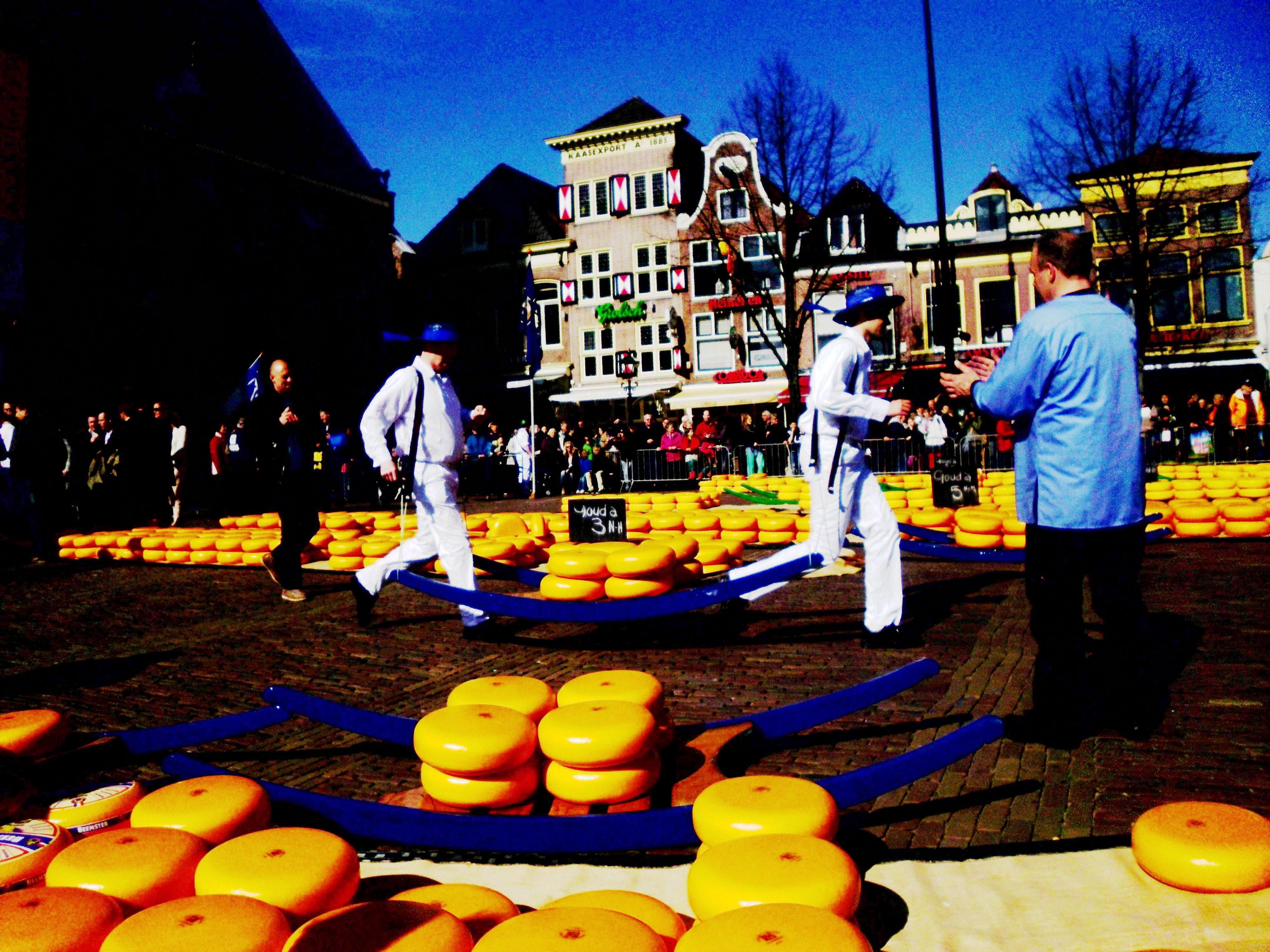
Hello everyone.  So as I told you last week, I spent the first part of my reflection week in Berlin with one of my Sorority sisters.  We had a nice few days and it was really hard to say goodbye and get on separate planes.  I don’t think I realized just how much I missed my friends and family until I had to say goodbye in the airport.  After parting ways I went back home to Maastricht to relax for a few days and mentally prepare for period 5 (the second part of the semester and my new classes).  The day after I got home a friend asked me if I wanted to go to Alkmaar and Delft with her for a day trip.  I said “why not”, so we got up early and headed up north (still in The Netherlands) to Alkmaar.  Alkmaar is known for its traditional cheese markets.  They open in April and we were going on the first day they were open to see the cheese markets in action.  People were dressed in what seemed to be traditional clothes.  Two men ran back and forth across the market carrying cheese on what looked like a sled (see picture below).

It’s funny because before I left to come to The Netherlands, I stumbled across a TV show that was about traveling around The Netherlands (specifically Holland, which is a province in the north).  One of the places they went was Alkmaar.  These TV shows were a little dated, but the cheese market looked the same.  It was kind of cool visiting a place you’d seen on TV since that doesn’t happen very often; at least not for me.

After tasting a variety of some of the best cheese I’ve had in my entire life we got back on the train and headed to Delft.  On the way to Delft my friend and I literally jumped out of our seats and moved to the seats across from us because saw tulips!  So many colors and there fields of them everywhere!  It was so pretty.  Since the weather was just starting to warm up, most plants hadn’t bloomed yet so it was nice seeing all the colors.

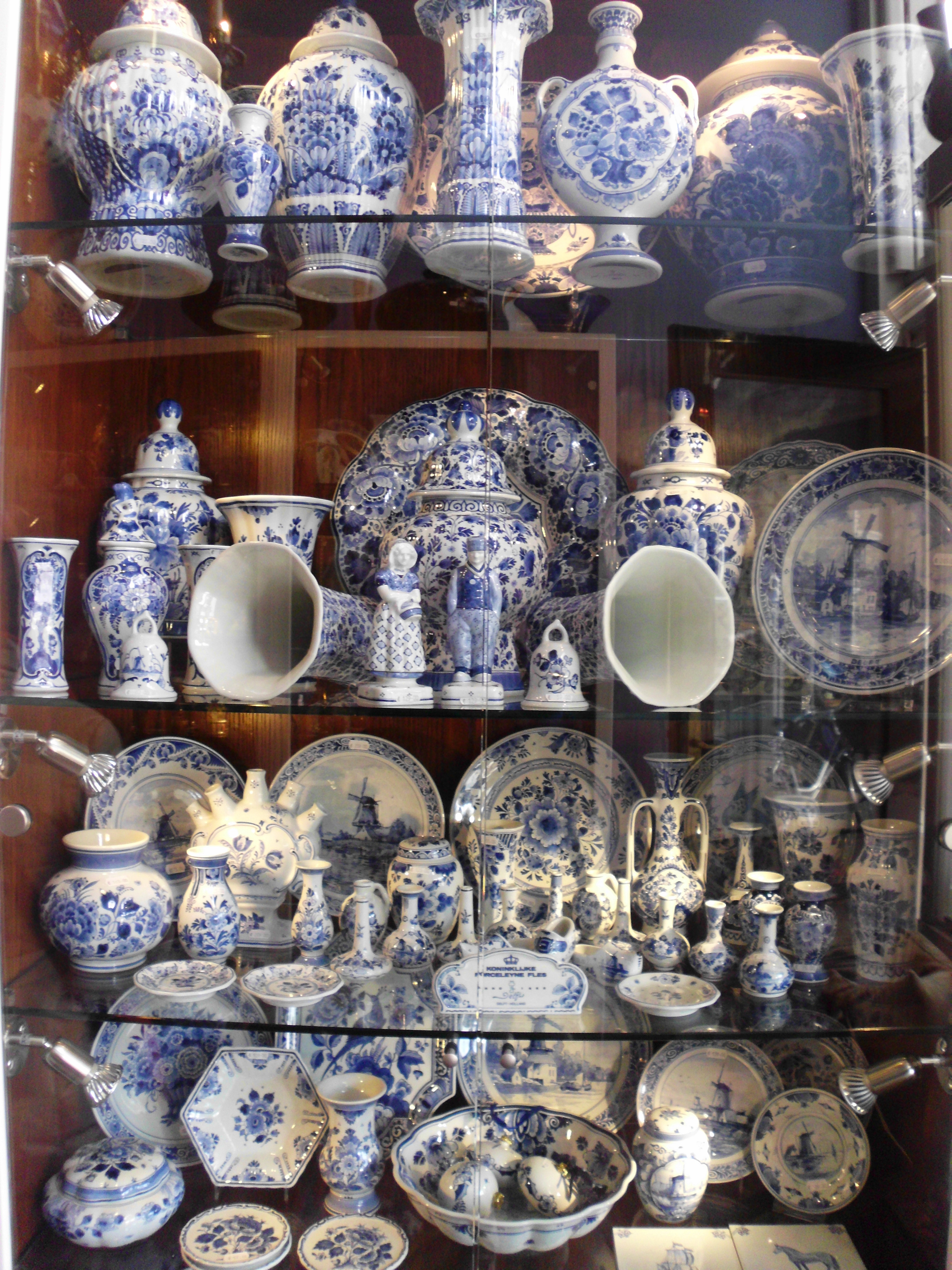
After the fields of tulips, we made it to Delft, is known for its blue and white Delftware.  It’s pretty funny because during orientation at UCM, one of the speakers told us how the majority of the things The Netherlands are known for don’t actually come from here.  One of the examples was tulips which are apparently Turkish.  Another example was the Delftware pottery which he said is from China.  I figured since I can’t go to China, I’ll go to Delft.  They have several museums dedicated to showcasing the Delftware and of course just about all of the souvenir shops claim to have “The Best Delftware” or to be “The original Delftware”.  I took a picture of a variety of it so you have an idea of what it looks like and what types of things are made.

My favorite place was probably Alkmaar for the simple fact that you could taste cheese (for those of you who don’t know me very well, I absolutely love cheese).  After a very long trip, we made it home.  For the next two days I relaxed and started preparing for the next period’s classes.  This period I’m taking Theorizing Terrorism: A Philosophical Approach, Rights of the Child, and Strategy and Negotiation Skills.  So far, and it feels really weird saying this, but I really like my Theorizing Terrorism course; I think it may be my favorite.  Although we have deep discussions and terrorism isn’t a light, fluffy subject to talk about I’m learning a lot from this course.  For example, as an American, my idea of what/who is a terrorist is heavily defined by 9/11, but this course is causing me to think outside of that isolated incident and look at terrorism from different angles in order to shape my personal definition of terrorism.

Ok well I guess I should end on a lighter note than terrorism so with that being said, I recommend a trip to Alkmaar; cheese and music everywhere!


Barbados, Week 11: Joining the Tennis Team

April 23, 2012

When I first came to Barbados for study abroad, joining a sports team on campus was literally not even on my priority list.  I hadn’t played any sort of organized team sport since high school, and it didn’t seem realistic to me that I would start up again on a Caribbean island three quarters through my collegiate career.  But mid-February rolled around, and a couple things began to happen:  I started to become socially and physically complacent, and I started to put on some pounds.  Luckily, one of my hall-mates walked by me one day, tennis racket in hand, and a solution began readily forming itself.  Eager to figure out what opportunities there were to play tennis on UWI campus, I discovered that there were Intermediate level practices every Monday.  Recognizing that joining the tennis team would solve both of my current issues, I told him I’d be there next Monday ready to go.

I cannot speak for all of UWI sports, but from what I have experienced and heard, sports practices are a bit different at American colleges as opposed to the University of the West Indies.  If you want to play sports on the varsity level in the United States, you’re going to most likely have to be recruited, regardless of the sport.  Practices are generally everyday, with strict workout regimens and rules about attendance and conduct.  If you play football for the University of Richmond, for example, you’re more or less eating, sleeping, and breathing Richmond Spiders Football.  Here at the University of the West Indies, multiple exchange students have just shown up at practice and walked on the basketball, field hockey, and volleyball teams.  The sports facilities on campus consist of a field hockey field, the cricket oval (duh), cricket batting cages, an indoor “coaching center”, one tennis court, one basketball court, and a soccer field down the road.

Now one thing I need to make clear before I continue is that I am in no way saying that UWI sports are a joke compared to collegiate sports programs in the United States, but rather that they have a refreshingly laid back approach toward most of their sports programs.  You won’t find UWI students having meltdowns or burn-outs over sports-related stress (save cricket, maybe), like many United States’ students will have before they even get to the collegiate level.  I find most students with which I talked about their experience playing sports for UWI love it, and some even get the chance to play in games throughout the Caribbean.

Tennis practices, however, are tough.  If I had managed to convince myself that I wasn’t out of shape before I joined the tennis team, well, that changed fast.  The Intermediate level team is composed of about 10-12 students, about 9 boys and 3 girls, on any given practice day.  Needless to say the coaches have a tough job trying to get 12 players sufficient playing time on one court, but they do a great job of creating a program beneficial for everyone.  They’ll have four stations, for example:  One station will be a ground-stroke or volleying drill, another two will be some sort of cardio exercise (think burpees or frog jumps), and the last might be hitting against “the wall” (the tennis court is right next to the indoor coaching center).  The Intermediate group was a great bunch of people and I made friends quickly, but one of the coaches, Raymond, decided I needed a bigger challenge.  Thus about three weeks after joining the team I was bumped up to the Advanced group.

The multi-sport court used for our tennis practices.

Now, I’m a competitive dude and was  thrilled about getting more playing time with the Advanced group, but I was also pretty nervous.  What if I showed up on Wednesday and just got absolutely thrashed?  Well, it turns out a little bit of pressure can go a long way when it comes to motivating me.  I crushed a red bull after my Wednesday night class and headed over for my first practice with the Advanced group.  This was a smaller, more intense group, with only about 4-6 players per practice day, and it quickly became apparent that they were good.  But as I said, I was extremely determined not to embarrass myself, and I played my guts out for two hours in an attempt to win their respect.

A month later, and I am like a giddy child before Wednesday and Friday night tennis practices.  The coaches really want to see us improve, and are extremely constructive in their advice.  One of them even plays on the Davis Cup Team for Barbados!  I feel incredibly fortunate that I am more or less getting semi-private lessons twice a week for free.  And my teammates are awesome- we’re all extremely competitive but it doesn’t take much for us to break down and start laughing when someone shanks a ball over the fence.  It’s not uncommon for us to stay an hour later after practice hours and just hit around, even though we’re all exhausted from the two hours of drills and cardio beforehand.  There have been many incredible things that I’ve done and seen in Barbados, but I would say joining the UWI tennis team has had the biggest impact upon my study abroad experience thus far.


Barbados, Week 10: Life on Campus- UWI, Cavehill

April 6, 2012

A strange thing has happened in the beginning stages of my third month studying abroad:  I have begin to think of Barbados as my home.  The first two months of my study abroad experience were often a constant, ever-progressing comparison to how my life normally would be back home.  Yet now that all these irregularities, cultural differences, and lifestyle changes have been successfully synthesized into daily norms, something finally clicked.  I no longer wake up surprised to hear the boisterous beeps and buzzes of constant traffic directly outside my window, nor do I freak out if a scheduled event or bus is half an hour late…or an hour late, for that matter.  I’ve begun to compile a master playlist of island Soca, Dancehall, and Pop songs that I’ve heard enough times to sing in my sleep.  I’ve even caught myself looking at large groups of sunburnt tourists, fresh off the cruise ship, thinking “Here come the Americans…”

So after weeks of making everyone green with jealousy over tales of cross-island adventures and a weekend trip to St. Lucia, it is only fair that I also give everyone a taste of what it’s like 80% of my time in Barbados, on campus.  Put bluntly, University of Richmond’s (Virginia, United States) campus seems like Yellowstone National Park in comparison to Cave Hill.  UWI, Cave Hill has prime real estate at the top of a long hill overlooking the Caribbean, and no space is left wasted; One of the dorms connects to the cafeteria, which connects to the student guild, which connects to the health office, which connects to the bookstore.  While Americans like to number their classrooms in numerical order, classrooms at UWI have fun distinctions such as LT1, LR1, LH1 (lecture theater 1, etc).  After the first week of mistakenly stumbling into every room possible, I actually think i’ve probably been in more rooms than not on campus.  Students, for the most part, come to class on time and NEVER pack up before the professor is finished, even if class time is over.  I was amazed at this phenomenon, because American students are almost always packed up and ready to go at least five minutes before class is over.

Some things I love about school here?  My professors.  They are engaging, personable, and brilliant people whose work can be found in academic journals throughout the Caribbean.  Also, the cafeteria food.  Save for Oistins Fish Fry, one of the best fish steaks I’ve had all semester long came from none other than Cave Hill Campus Cafeteria.  It probably cost me less than US$5.

Some things I don’t love about school here?  The library. After getting used to one of the nation’s chillest, most comfortable libraries —  Boatwright Memorial Library at UR — the Cave Hill Campus Library just has a hard time stacking up.  While Boatwright not only lets you bring a day’s worth of food into the library for a studying marathon, it also lets you bring in your entire bag, making it easier to study for multiple subjects in one sitting.  Now, there’s nothing necessarily wrong with the Cave Hill Library, but it’s more of a no-nonsense establishment.  Wanna take your entire bag in?  Nope.  You turn in your bag for a card at the front entrance and then proceed to clumsily drop your 4 books, computer, calculator, and glasses as you’re somehow supposed to open the entrance door.  Wanna bring food and water in so your mind is properly fueled?  Nope. You can chug your water bottle outside and then throw it away before entering.  Would you like to borrow a book for an hour and then return it to the shelf?  Nope.  First, please fill out every single detail possible about the book before handing the slip to a library employee who will take twice as long as you would to find the book.  Then, wait patiently as they scan your card and stamp your info slip and give you back a copy.  It’s good to have physical memoirs to remind yourself that you did, indeed, study, in case you ever forget.

Sorry about the library rant, but it was a long time coming.  To tip the scales back in UWI’s favor, however, are the students.  I have the incredible opportunity to go to school with and talk to people from Barbados, St. Lucia, Dominica, Antigua, the Bahamas, Guyana, Belize, Trinidad, Finland, Sweden, Denmark, Germany, and Canada.  Most Caribbean students I’ve met have displayed a cheerful, laid-back attitude and, like most other university students, are constantly laughing and looking to have fun.  It’s truly rare to find a loud, in your face, attention-craving student from the Caribbean, and most are very down to earth people.  I advise learning some Caribbean expressions and honing one’s listening skills, however, because understanding the different dialects has been one of my biggest challenges while abroad.  I can’t tell you how many times I’ve answered “Where are you from?” with “My name’s Ryan” or just “…yes…”.  I’m getting better at understanding the nuances of the Bajan dialect though, and may or may not have tried it out on a couple of occasions.

There’s probably another 1,000 words I could say about life on campus at The University of West Indies, but there’s no point in continuing to talk about the library.  Jokes aside, I moved up to join the Advanced Team in tennis last week, so I guess I can now say I’ve played tennis on the collegiate level?  Cross that one off the bucket list.  I’ll be taking some pics and giving you the lowdown on that next week, though, so stay tuned.


Barbados, week 9: Carnival Chaos

March 30, 2012

The most hyped weekend of the year, at least for college students, is now in the books: Carnival, or KadUWIval as it is formally called, came with much fanfare and it certainly proved to be one of the most culturally different experiences of which I had the pleasure of being a part.  You see, back in the United States, there are parades, and there are circuses, and there are parties, but never has one event been so bold as to combine elements of all three.  It was one of those special times where you don’t really know what something truly IS until you’re smack in the middle of it, going “Ohhh… so THIS  is carnival”.

I may have taken some liberty with my previous statement, as, in reality, if one searches for UWI and/or Barbados on YouTube, videos of Carnival are the first thing that appears.  Carnival, for the avid YouTube video consumer, should be the first thing one will have known about Barbados before actually being there.  My experience was a little different, however.  I was walking across the campus lawn, noticing a greater buzz of activity surrounding the area than normal, when a tall Bajan guy approached me, “Hey man, you jumpin’ for Carnival?”  “Jumping? Uhm, no, I don’t think so, man, what exactly is it?”

Simmz,  as I would later find out he was called, gave me the rundown on how it would work.  First, you join a ‘band’.  This is the group you will be organized into and ‘jumping’ with at the beginning of Carnival.  Each band has specific outfits the members wear, with different costumes for girls and guys.  The Carnival parade starts down near the cruise ship port in Bridgetown and ends on campus in Cave Hill.  What takes place during ‘jumping’ is this; the bands line up behind a huge truck stacked with speakers and posters, and once the music starts and the truck tires begin to roll, you have nonstop dancing, socializing, and picture-taking until the sun goes down and one finds themselves back at UWI.

I liked what Simmz told me, so I signed up for Carnival with his band, Island Army.  Now, usually, friends confer with friends before choosing his/her band, but since I didn’t really know what was going on and if there was a deadline or not, I dismissed the notion of conferring before choosing.  After all, Simmz had approached me out of nowhere and wanted me to be in his band — who am I to deny such adamant recruitment?  It turned out to be a good choice, anyways, as I talked to my Bajan friends Devito and Quaisy and they, as well, had joined Island Army.  The rest of the exchange group students had either joined the Halls Band or a band called Island Roots.

Fast forward three weeks, and it’s the morning of Carnival.  Girls are running around freaking out about how small their outfit pieces turned out to be, and the guys are still sleeping because all they have to do is wear their band t-shirts.  Carnival, I was beginning to realize, is maybe 5% about the guys and 95% about the girls.  No one is lining up to see me in my t-shirt — they’re there to check out the girls in their hot pink or leopard print outfits.  And as far as the outfits are concerned, less is definitely more.  Feminists may decry the event as objectifying women, but I think it is 100% cultural that they dress like that, and I don’t think you’ll find many Bajans that’d say otherwise.

Now, as far as the dancing that went on…well, that was cultural, too, I guess.  Caribbean women know how to dance — as children they are dancing soon after they can walk.  It’s no timid “I don’t really know how to dance, and I’m scared that people are looking at me” type of dancing one might frequently encounter in the United States, but a more full-bodied expression of rhythm and feeling.  I’m not going to lie, it was a little nerve-wracking for someone not completely sold on his own dancing ability to dance with exotically dressed, beautiful Caribbean women, but I was set on partaking in Carnival to its fullest, so dance I did.  For nearly three hours.  But Carnival was also a time of fraternizing with friends as well, and it was fun to see all the people I’ve met in the past two months out on the same street having fun together.  You begin to feel like maybe you’re not so much of a stranger after all when a friend comes up to you every five minutes and tries to get another girl to dance with you.

The Carnival procession finished up on UWI campus, and there everybody immediately remembered what they somehow forgot for the previous six hours: I’m incredibly hungry.  I had another “American” moment when I thought the contents of a yellow bottle was obviously mustard and so doused my hotdog in it.  It was Bajan hot sauce, and thus I proceeded to eat one of the spiciest hotdogs of my life.  But the day was far from done.  A big draw for a lot of the UWI students was the Carnival after-party, with one of the parking lots being craftily turned into a penned-in version of the last five hours’ various activities.

I liked Carnival for two reasons: One, nothing, or at least nothing I am aware of, exists like this in the United  States’ Northeastern region.  Nothing.  Two, it was a genuinely fun time dancing and socializing out in the beautiful Caribbean sun.

In fact, some past exchange students had flown down just to relive the epic weekend that is Carnival.  God-willing I save up enough money, I hope to be that guy next year.


The Classroom Culture

March 12, 2012

After two and a half months of studying abroad in Thailand, it seems fitting to actually blog about the studying part of this experience.  The much-discussed stereotype about studying abroad is that the classes will be easy and there will be no work.  Well, clearly those students did not study at Thammasat in the BBA program. There is definitely work, and classes are not at all something you can blow off…it will eventually catch up with you.  So here are four of the most notable differences between University of Richmond courses and Thammsat BBA courses (Disclaimer: the academic faculties at Thammasat are very different from one another, so this blog post only applies to the BBA program).

1.  Unlike Richmond, there is not much day-to-day homework at Thammasat, but classes are very much oriented around case studies and group projects. While I don’t have to worry about day to day homework in each class, there is always a group project meeting that I have to attend – and this has been the case since the first day of school, not just something that has crept up at the end of the semester.  While sometimes the group projects are overwhelming, doing case-based learning is extremely helpful for applying what we are learning in class and understanding “real-world” examples.

2. Attendance is extremely serious.  The rule is that if you miss more than 30% of a class, then you are not eligible to take the midterm or the final.  Because all of my classes are three hours long, I am allowed to miss three classes throughout the whole semester – which seems like a lot, but when I’d love to be traveling around Southeast Asia most weekends, those missed classes can add up quite quickly.  During the first fifteen minutes of each class, a few BBA administrators sit in the hallways, each assigned to watch over one clipboard as students sign in for their respective courses. Students are required to sign in wearing a full uniform — otherwise, they are considered absent.

3.  Regarding class format, most professors use the typical PowerPoint lecture model.  I learned very quickly that Thais love PowerPoint.  In the US, it is sometimes encouraged for students to ditch PowerPoint and find a more creative way to prepare a presentation, but here it is mandatory to use PowerPoint for presentations.  I have to say, though, the presentations that Thai students create are incredible, and much more creative than anything I have ever done with PowerPoint.

4. Classroom culture.  This has been one of the biggest paradoxes of my time in Thailand.  I have remarked in previous posts about how Thai people are so respectful, and how they value hierarchy and respect their elders and teachers.  Yet the actions of the students in classes do not seem to fully reflect these values.  Students talk throughout the class, they constantly text on their phones (above their desks, in plain sight!) Some even take calls and just stick their heads under the desks while on the phone. Most students are constantly checking their email or Facebook on their iPads or laptops.  Some will leave classes in small groups and come back with Starbucks or other drinks in hand.  And throughout class, there are students continuously walking in and out of the room to print something, get a snack, or take a phone call.  I have had only one professor actually address this behavior in class, on one occasion.  I would never be comfortable acting so informally in a class at Richmond, and professors at UR strongly discourage this behavior.  Certainly an interesting nuance of classroom culture compared to Thai culture in general.

Note: I don’t have any pictures relating to this blog, but enjoy some of the pictures from around the city these past few weeks.


A Different Side of Bangkok

March 2, 2012

For the first time in weeks, I did not travel this past weekend.  Granted, it was because I had a huge group presentation and midterms to study for, but still, it was quite an event.  Sadly, studying took up most of the weekend, and there was a lot of studying required, because, truth be told, I have not been great at keeping up with school work here. With it being 96 degrees every day, so many places to visit, and so many delicious types of food to discover, it sort of feels like I am on summer vacation.  It’s just so difficult to concentrate with so many fun things to do.  So to have midterms now is like having exams in the middle of summer vacation… which is not easy.

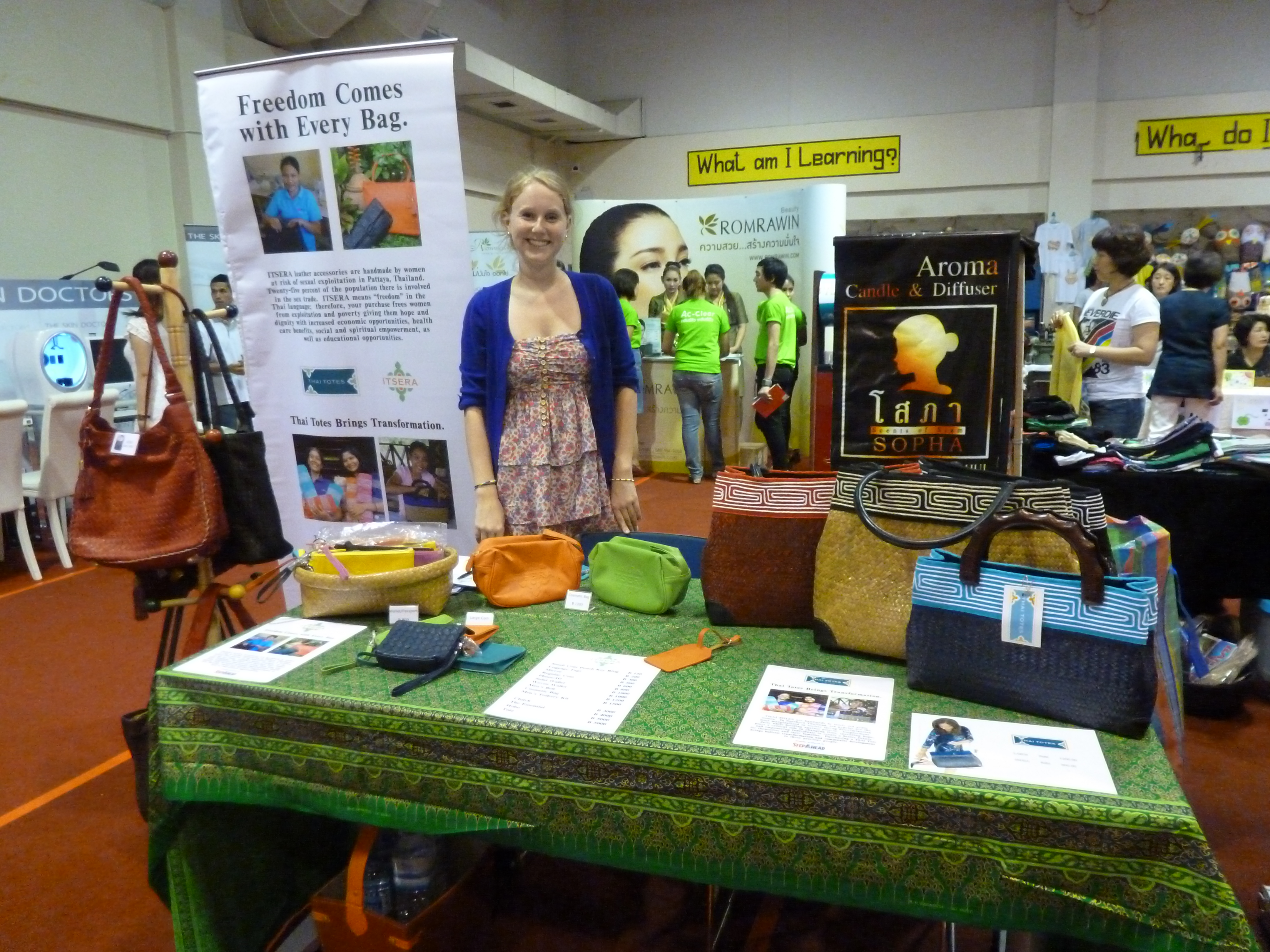
Nonetheless, I spent Saturday at an event for my internship. I am interning part-time with Step Ahead, a fantastic NGO headquartered here in Bangkok.  Step Ahead was founded by John and Kim Quinley, whose daughter, Carter Quinley, graduated from Richmond this past May.  Step Ahead is a community development organization that works all over Thailand with various populations.  One of their projects is a “Purse Project” that works with women in Pattaya, Thailand.  One in four people living in Pattaya are involved in the sex industry, so this purse project aims at prevention: to prevent poor women from being sexually exploited by giving them an alternative way to make a stable living by making these leather purses.  The products are beautiful — the link to the website is stepahead.myshopify.com.

As part of this internship, my roommate and I went to the International School of Bangkok for a Food Fair event to sell these Itsera bags; the event revolved around a huge room filled with large stands representing the nationalities of  students at ISB, each serving their own traditional food.  So, for example, at the “Israel” stand they were serving falafel, and at the “American” stand, there were delicious brownies, cookies, and apple pie.  Next to this large room was a smaller room where we were selling our bags along with other vendors.

All in all, this was quite a different side of Thailand.  Addie and I live in a very local Thai neighborhood, so we don’t see foreigners on our side of the river often.  ISB, however, is located in a planned community (there is literally a sign at the entrance gates that say “Planned Community”).  It’s like magic; as soon as you pass the guards and drive through the gates you are literally in what looks like an American suburb. There are clusters of gorgeous houses that all surround their own pools; there is a country club, a shopping center, and – get this – golf carts.  The residents get around the enclosed neighborhood (which includes the international school) in golf carts.  Literally, the outside of the school is lined with golf carts belonging to residents. I attended an international school when I lived in Holland when I was younger so this was a bit nostalgic, remembering a similar event we held at my school, overflowing with nationalities from around the world.  But, my goodness, this was also reminiscent of the Stepford Wives.  Nonetheless, I am extremely grateful to be able to experience so many different sides of life in this wonderful city.


Belonging

February 24, 2012

In Hebrew, there is no “to be” verb in the present tense.  I studying Hebrew.  Kind of awkward, right?  My brain always wants to stick another word in there, forcing the sentence to comply with my English-centered demands.  I’ve realized I am expecting more than just the language of Israel to fit my idea of what is ‘right’.  I want the washing machines to wash my clothes like they do in the US, I want my salad dressing to taste like it does in the US, I want to just walk in and out of a shop on the street without being hassled by the overbearing shop owner, I want people to wait politely in line at the bus stop instead of always shoving their way to the front. But there is something really amazing about realizing the rest of the world doesn’t do everything exactly like you do.  And when you can get over trying to find the American equivalent for everything, you allow yourself to truly become a part of your host culture.

Last weekend, two friends and I traveled to Sefad, a small, heavily religious city a couple hours by bus from Haifa.  Winter probably isn’t the best time to travel to Sefad — it was cold and rainy most of the time, and it even snowed!  The owner of the hostel we stayed in was really excited about the snow, so it was hard to be annoyed at it for spoiling our plans.  Israel really treasures its water, so I have really tried to have a good attitude about the copious amount of rain we have gotten the past couple of weeks.  Despite the weather, we managed to have a nice, cozy time, except for two hours on Saturday when our power was out due to the rain. Sefad is beautiful, and I was amazed by the height and beauty of the mountains surrounding the city.

When I arrived back in Haifa late Sunday afternoon, just as the sun was setting, I realized how much I have come to love this city.  I feel like I have really become a part of Haifa’s diverse, beautiful community.  I don’t miss UR like I thought I would.  There is so much to discover and accomplish here, both in my language learning ambitions and in growing as a person.  The surreal feeling I have had since arriving here has started to fade, and in its place has grown a sense of belonging and permanence.   For a country whose right to exist is constantly questioned by the international community, and one that seems to stand perpetually on the verge of international conflict, life in Haifa is surprisingly rhythmic and normal.  Falling into that rhythm has been one of the greatest things I have ever experienced.


The Ins and Outs of PBL and UCM

February 20, 2012

Before I begin telling you all about PBL and UCM, I’d like to congratulate everyone who was accepted to study abroad next fall!  For the future UCM students, I’m sure you’ll have a wonderful experience in The Netherlands.  With that being said, I thought this blog might be a good crash course so you know what to expect from the academic environment while you’re studying at UCM.

First thing’s first — UCM’s campus is noticeably smaller than UR.  The following picture helps prove my point:

This is a picture of the one and only building for UCM students.  Although there is a library which can be used by anyone who is a student in any of the faculties of University of Maastricht, this is the main building specifically for UCM students.

This is a picture of the common room.  It is the main place of socialization in the UCM building.  People meet up with each other in this area, wait between classes, have a snack, do homework, have meetings or receptions; it’s basically an all-purpose room.

Now that you have a general idea about the size of UCM, I’ll go into some detail, without overwhelming you, about PBL.  PBL, Problem Based Learning, is exactly what it says it is.  Before classes start, you receive a course manual/handbook for each course you are registered to take.  This manual includes the syllabus, compulsory reading, deadlines, and contact information for your tutor.  Each course generally has one lecture and two tutorials per week.  Both the lectures and the tutorials are two hours each.  Classes are longer at UCM compared to UR, because the semester is divided into two periods followed by a project period.  Each period, you are expected to take two courses and a skills course for Richmond to consider you a full-time student.   A few examples of skills courses are Research Methods, Presentations Skills, or Strategy and Negotiation.

Now that you have an overview of the logistics of how course work at UCM, I’ll tell give you some details about PBL itself.  You begin a lecture with a pre-discussion.  The discussion leader (a student in your tutorial group) will give everyone a few minutes to read a brief synopsis and thought-provoking piece on a topic that’s relevant to your course.  The students discuss it and come up with learning goals.  These learning goals are then used to guide the students’ at-home study session.  The next time the students meet again, they have a post-discussion about the reading and help each other answer the previous learning goals.  Everyone is expected to contribute to the discussion, and the tutorial groups are generally no more than about 8-10 students.

 All of the classrooms are colorful, but I think this is my favorite one.

It may take some getting used to, but overall, I think PBL is an interesting system, especially if you like to do self-study and speak in class.  Once again, I’d like to congratulate those of you going to UCM next semester.  I hope you have a wonderful time!