Week 2: Little Steps (posted by Kati In Spain)

September 4, 2012

This week has been focused on the administrative details of moving to Spain and matriculating in a university that has procedures and customs that are very different from those that I am used to. It has been a long week of ups and downs, and although Monday was a rocky start, Sunday was a perfect finish.

Ninety days before leaving for Spain I applied for a yearlong student visa via the Boston Spanish Consulate, following their directions to a T. After eight weeks of waiting, I was told that the Consulate is no longer permitted to grant yearlong student visas and that I would have to apply for residency at the local police station within thirty days of arriving in Spain, or else I would be deported. I waited a week after arriving to begin my residency application, as the director of my orientation program, the person I was told to ask for help, was on vacation until Monday. First thing Monday morning I went to the Cursos Internacionales Office to ask Carmen for guidance. She patiently explained to me her understanding of the application process, and she gave me directions to the police station. Colleen, my unconditionally supportive roommate, accompanied me.

By the time we arrived at the station it was one o’clock in the afternoon, and after being loudly hissed at and thoroughly evaluated by the male officers standing outside of the station, we were told that we would not be helped today and that we must come back early tomorrow. Feeling slightly dispirited, we continued with Carmen’s directions and made our way to the University’s International Relations Office, where my thoroughly confused advisor told me that I must have done something quite wrong on my original visa application and that I needed to fly to Madrid to speak with the U.S. embassy and bring her a written explanation as to why I did not have the correct visa. Thankfully, Michele Cox, the head of Richmond’s Study Abroad Office, was able to help me determine the best course of action, and so I returned to the police station early Tuesday morning.

My experience on Tuesday was much better than the treatment I received on Monday. The man who helped me sported a grey Canada T-shirt, jeans, and sneakers, and upon realizing that I hail from Boston, he immediately started talking about the Celtics, the Red Sox, and thick Boston accents. He gently told me that my application was not complete because I did not have my permanent Spanish address yet, that I needed additional photos, and that he had to add me to a deportation watch list until we could proceed with my application. Wednesday saw me back at the International Relations Office begging for my final address, and Thursday saw me modeling for an overly enthusiastic photographer as she snapped visa headshots from every angle possible. Finally, on Friday, I returned to the police station armed with a folder of paperwork and pictures, and Sarah, a USC graduate, accompanied me to help smooth the process. The same kind man helped me again, and after waiting in line, filling out more forms, traveling to the bank for a money order, waiting in line again, and finally being seen, I was told that I could return to the station in forty days to retrieve my extended visa. Halleluiah!

Despite missing several hours of class to deal with my visa, I successfully graduated from the Cursos Internacionales intensive immersion program on Friday. It feels strange that I will not be in class with my wonderful professor Juan or my new friends again! Although my grammar did not improve very much through the course, my speaking ability and my knowledge of Spanish culture and daily life improved at lot, and I am so glad that I took the class. On Wednesday I took a placement test for another intensive immersion course that begins in October, and I have high expectations for my experience!

Also dotted throughout this week have been preparations for class registration. Class registration for international students is an arduous process that is not well understood by anyone and is confusing for everyone. As with any university, the student peruses the rich course catalog and creates a list of classes that are of interest to her and fit with her major areas of study. She then emails and receives an almost immediate response from the heads of each relevant University of Richmond department to make sure that she will be able to transfer credit from the classes she is interested in back to Richmond. The student spends a few hours arranging various possible schedules with different combinations of the classes that she might like to take, and then she pursues a meeting with her academic coordinator at the University of Santiago de Compostela.

But this is where it gets tricky: international students are not assigned an academic coordinator. The student must select a home faculty even though she is taking courses across various faculties, ask the International Relations Office staff to craft her a new acceptance letter so that professors will allow her to take classes in multiple faculties, email the faculty secretaries repeatedly over the course of a week until she finally gets a response, schedule an appointment with the coordinator of each faculty, trek all over the city for appointments with each coordinator, and then beg each coordinator to answer her questions about class schedules, the language of instruction, final exams, and the class registration process, which is different for every faculty and not at all self-explanatory. Finally, with signed learning contracts, final acceptance letters, and certificates of matriculation, the student may finally register for her classes, receive a student ID card, and gain access to the Internet in the dormitory. Needless to say, I cannot wait to be done with this process and registered for the classes that I am so excited to take!

Keeping me well fed and sane as I wade my way though these processes is Pepita, my incredible host mother. Every day has begun with a piping hot cup of English tea, toast, various yogurts, and fruit, and every evening has concluded with an overwhelming amount of delicious food and an hour or two of Spanish TV game shows. After receiving my final address and dorm room number on Wednesday, Colleen and I wandered over to the residence hall to see if we could see our rooms. Unfortunately, my room was occupied by a summer student, but after much negotiating and pleading, the man behind the desk finally agreed to show us a room. We have certainly been spoiled by the wonderful dorms at Richmond, and the stark nature of these rooms made that clear. After much deliberation and conversations with all parties involved, Colleen and I asked if it would be possible for us to remain with Pepita for the rest of the semester. Sadly, after some tense last minute negotiating, it was determined that we have to relocate to the dorm or lose all of our housing deposit. We will really miss Pepita, her grandchildren, and her wonderful cooking and caring smiles, but upon hearing the news she made us promise to visit her, and as she hugged us and patted our backs she told us that we are always welcome in her home. Even though it is sad to leave Pepita, I know that we will have an equally beneficial cultural experience by living in the dorms and by participating in the many clubs, sports programs, and social events that are planned through the residence halls, and I am looking forward to meeting even more people my age!

One of the social resources Colleen and I have taken advantage of is the ERASMUS program. ERASMUS is a student-run social and academic resource for exchange students at universities across Europe. By joining ERASMUS Colleen and I have gained access to uniquely discounted trips to important places around Spain, specially organized group outings for tapas around the city, tours of Santiago in both English and Spanish, and to the buddy program, which has partnered us with a current USC student who will help us navigate the university and the city and answer any questions we might have. Plus we get a fancy ID card…how could we pass up that opportunity?

Saturday at the food market in Santiago, fruits and vegetables

Saturday at the food market in Santiago

On Saturday we spent the morning at an amazing open-air food market in Santiago, and we concluded our week with a perfectly lazy day on a beautiful beach in A Coruña, a city located a short train ride north of Santiago. We spent the morning walking along the port and the city coast from the train station to the Plaza de Maria Pita observing the gorgeous architecture and the beautiful coast. We ate lunch at a little Mexican restaurant that was the best bang for your buck in town, and the owner was so excited to have Americans in his restaurant because he believed that we could better identify with his experiences with violence and the drug trafficking in Mexico than could the Spanish. After lunch we continued on to the Tower of Hercules. The Ancient Romans built the tower almost 2000 years ago, and it is one of the oldest lighthouses in the world.
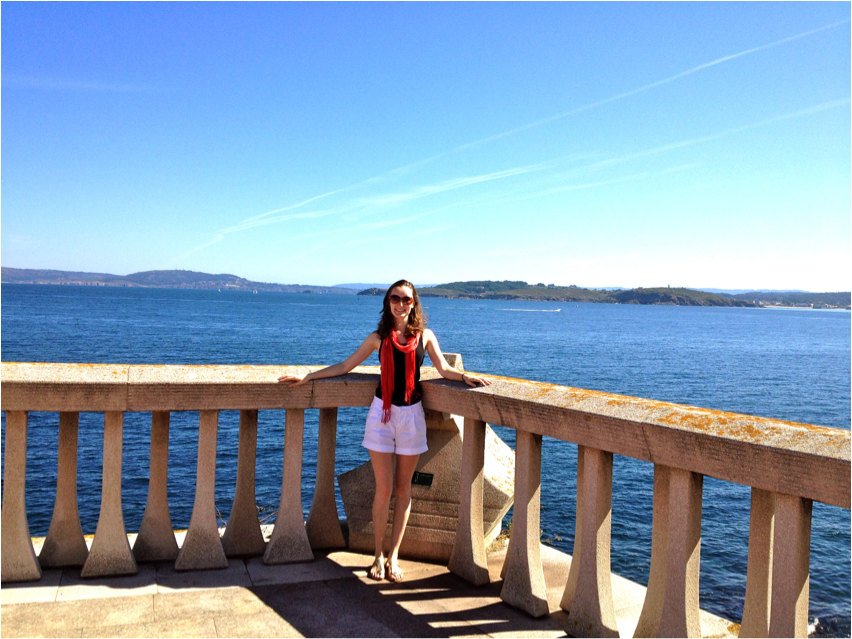
A picture at the A Coruña coast, a gorgeous view of the sea

Kati at the A Coruña coast

From the base of the tower we got an incredible view of the city and the coast, and then we continued on to a lovely little beach that is obviously a favorite of the locals. After a few hours of relaxing in the sand, refreshing ourselves in the water, and catching up on some sleep we wandered over to a little ice cream shop before catching the bus back to the train station. We all tried turrón ice cream, which tastes like almondy burnt sugar ice cream – so delicious! A sunny day with friends, ice cream, and ocean water was the perfect anecdote to a hectic week.

A perfect Sunday at the beach in Spain

A perfect Sunday

Quote of the Week: “Finish each day and be done with it. You have done what you could. Some blunders and absurdities have crept in; forget them as soon as you can. Tomorrow is a new day and you shall begin it serenely and with too high a spirit to be encumbered with your old nonsense.” ~ Ralph Waldo Emerson


Bike (mis)adventures and the Nations (posted by Indira in Sweden)

August 29, 2012

Last week was one of the funniest, most sleep deprived and adventurous weeks of my life.

First of all, I was busy studying and doing my Swedish homework since I had an exam this week. I can’t believe that four weeks of intensive Swedish classes are over. It just hit me today when I was walking out of the classroom saying “tack så mycket” and “hej då” that this class ends here. It is crazy how time flies when you’re enjoying something. Signing up for this course was definitely the best possible decision I could have made when it comes to my semester in Sweden. I got a chance to meet people in a smaller community and to find my way around. It is actually funny to see new exchange students who just got here walking around with maps not sure where building 7 or 3 is. Also, the smaller group of people (well, if you consider 120 people a small group) gave me an opportunity to get to know all of them better and to interact with them in a way that allowed me to learn more about their cultures, languages and personalities.

Picture of books used to study for Swedish exam

Studying for the Swedish exam

Most of the other exchange students have arrived in the last few days. It is insane how Flogsta (area where I live) became so lively in only a few days. Now I see so many people walking around and I meet new people in the corridors all the time. I also got a few new corridormates so we are now 8 (out of 12) in my corridor. It is much more fun to be around people when cooking or walking or cycling somewhere.

The arrival of the exchange students and the lively Uppsala also mean that international orientation week is starting. We already had a few events mainly related to administration, but we are also having many fun events (beer tasting, lindy hop class, live-music quiz, international fika and club nights are just some of many). I am really looking forward to meeting new exchange students and learning more about Sweden (even though I learned a lot during the past month I spent here).

A train ride with a group of exchange students

A train ride with some other exchange students

Apart from the last Swedish class and a lot of new incoming students, this week we also explored the nations. So, what are these nations everyone in Uppsala seems to be talking about? Even though I cannot come up with my own definition of them, I can summarize them in one word – AMAZING! Basically, a nation is “a place where you can feel at home with hundreds of other students – you may work there, you may have parties there, and you will definitely make friends there!”  There are 13 nations in Uppsala named after a region or city in the country and they are student unions of a kind (very similar to coed fraternities, but much more open since you can be member of one (or more) nation(s) and attend the events and activities of other nations too). Basically the entire social life of Uppsala University students in focused on the nations: There are clubs, pubs, restaurants, sport teams etc. in each nation. The whole idea behind the quest of exploring the nations was finding the one that best fits my interests. So far I have found a couple of nations I really like and I will definitely join one by the end of the week.

This has been an exhausting, yet amazing week that finished with an unfortunate, but extremely funny event.  If you are following my blog you should know that Sweden is big on bikes and that bikes and I don’t work well together. Well, I just proved that again today. I thought I was making true progress since it’s been a while since I last fell off the bike or hit someone, but no. There are more technical things about bikes that beat me. Today after the class I wanted to inflate the bike tire, but of course I overdid it. Two minutes into biking and I hear this strange noise, so I get off the bike and then a very loud “BAM!!!” happens. I was confused, amused, terrified and sad when I saw that my front tire simply exploded because I overinflated it. As I was on my way to the bike shop, I received an amazing piece of advice from my friend: “Go find someone from the Netherlands. They were born on bikes and they can definitely fix this.” And I did it! Short 2 hours later I got my bike fixed and delivered to my dorm. The Dutch are amazing! Sometimes stereotypes can be good.

Now I sail into a new adventure – orientation week and the start of real classes – with a new tire and another lesson learned. Hälsningar until the next week 🙂


Week 1: Aprovechar: to take full advantage of (posted by Kati in Spain)

August 28, 2012

An announcement over the plane’s loudspeaker wakes me from my comatose state, “…flying south to Santiago. We will arrive in approximately one hour. The temperature at our destination is 27 degrees.”

Flying south? Santiago de Compostela is north of Madrid. I look out the window and see tan hills dotted with little green bushes, not the rolling green hills of Galicia that I was hoping to see. Panicking, I yank my overstuffed backpack free from under the seat in front of me and begin to excavate for one – any – of my three guidebooks. I find maps of Spain in all of them, but none of them have Santiago labeled. I open the airplane magazine to find a flight map, and my panic subsides as I see that Santiago de Compostela is the only Santiago that Iberia Airlines flies to from Madrid. I am on the right flight; the pilot must have misspoken. Whew.

A short hour later we descend through fluffy white clouds, soaring over the greenest countryside I have ever seen. After collecting my bags, I push my trolley out into the soft, fresh Galician air. After hours of travel, I am finally here.

PIcture out of window flying over Santiago de Compostela

Flying into Santiago de Compostela

A cabbie rolls his little white car forward to meet me. He is rocking a plaid flannel shirt, black Ray Bans, black skinny jeans, a graying mustache and matching hair, and a cigarette, which he promptly puts out. His accent rolls and lilts like the road we drive towards Santiago. His pronunciation reminds me of an Irish brogue just as the Galician song on the radio reminds me of Celtic music I have heard at home.

The cabbie drops me off outside of a heavy glass and iron door squeezed between an oriental clothing shop and what looks like a garage entrance. I ring the bell, and after a minute an older woman with brownish-red hair and a sweater draped over her shoulders carefully makes her way down a flight of stairs into the apartment lobby. With a big smile that crinkles her eyes, Pepita opens the heavy door and bustles me and my bags inside.

The apartment is spacious and filled with natural light. The floors are beautifully constructed from cherry wood, and although upon first inspection the kitchen appears to be in disarray, I quickly learn that everything has its place and its purpose. I am shown from my bedroom to the kitchen where Pepita has prepared a Spanish tortilla. It’s a solid disk the size of a frying pan created from eggs, milk, potatoes, and onions. Without pausing for breath in her story about an adventure she had in an airport, Pepita flips the whole tortilla onto a plate and sets it in front of me. Forty-five minutes later when I have only managed to eat half of it, she cuts me another quarter and insists that I finish.

Pepita reminds me a lot of my own grandmother. She is kind and gentle beyond words, but she is a force to be reckoned with. She is a teacher/administrator at a local high school, and she is full of stories and life lessons. Five minutes after welcoming me into her home, Pepita quizzed me on my beliefs about abortion, dating, and children, and she proceeded to tell me that no one, absolutely no one, should have children before they are thirty years old. In the mornings, Pepita serves me “English” tea: I am of British descent, and so I should, therefore, prefer English tea. She is always finding ways to make me more comfortable and more at home.

Colleen, a fellow Richmonder and my roommate for our two-week orientation period, arrived on Sunday. She is lovely and just as excited to be in Spain as I am. We are extremely similar, which makes living together an absolute pleasure. Our adventures are always full of laughs, and no day is complete without a somewhat uncomfortable cultural learning experience.

We have the best teacher, Juan, for our intensive Spanish immersion class. In class we practice grammar with exercises such as interviewing fictional characters, solving murder mysteries, writing fake roommate adds, completing TV scripts, and debating current events. We also learn how to imitate Spanish spoken with a thick French accent, the difference between tortas and pasteles, the best beaches in Galicia, and what not to miss in Santiago.

Traditional Santiago almond cake, the Torta de Santiago

Smiles all around after two big bites into the Torta de Santiago

In addition to our academic orientation, Colleen and I are orienting ourselves to daily life in Santiago. We spend part of every afternoon and every evening after dinner wandering the stone streets of the city, and we discover little treasures during our walks. We have fallen in love with the Torta de Santiago, which is essentially almond pound cake with powdered sugar. We have compared prices, quality, and quantity of food in supermarkets around the city. We have investigated the rates of different mobile phone companies and compared packages. We have spent time in bookshops, bakeries, little corner stores, oriental markets, parks, culture centers, and art museums. We have gone to mass, attempted Galician dancing, and toured the buildings of the university (University of Santiago de Compostela (USC)). We have experienced Santiago nightlife (until 5:30am, which is considered early!) under the protective wing of Antonio, Pepita’s son and father of two. We have become friends with students from Kazakhstan, Tajikistan, Georgia, Germany, Brazil, Japan, Italy, and South Korea, and we cannot wait for the 40,000 full-time university students to arrive on campus.

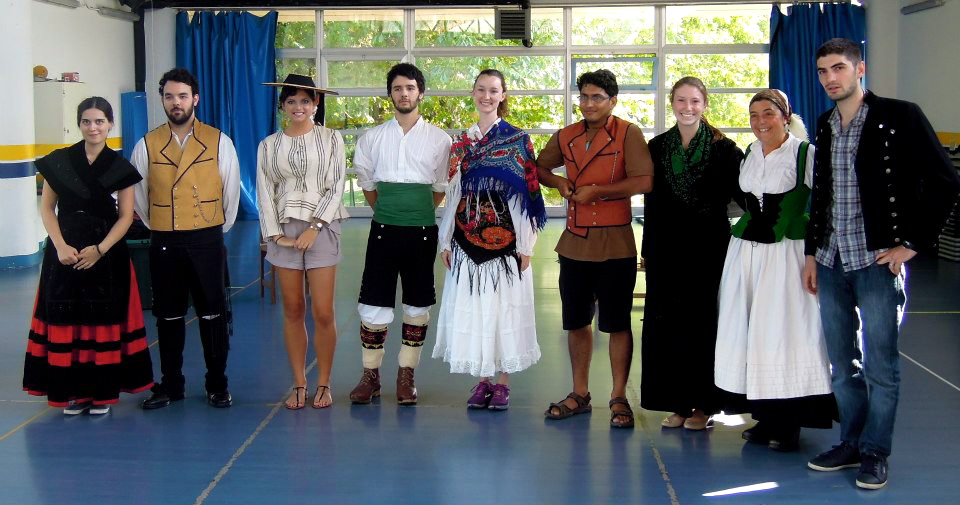
Dressed in traditional wear for a Galician dance and music class

Kati dressed in traditional wear for a Galician dance and music class

The past seven days have been a wonderful introduction to life in Spain, and I am so happy to be here.

Quote of the Week: “The key question to keep asking is, Are you spending your time on the right things? Because time is all you have.” ~Randy Pausch (The Last Lecture)


Exploring Sweden (posted by Indira in Sweden)

August 22, 2012

The past week was all about learning more about Sweden firsthand; through food, music, people and traveling.

Sweden is a beautiful country and when blessed with nice and sunny weather (which we were very lucky to have over the past week) it definitely reveals its vibrant and vivid side. This country is like the pieces of kaleidoscope glass – they shine and surprise you with a new image in no time.

This week I was lucky to experience so many new sides to Sweden through the cultural part of the IBS program. First of all we had a lecture (and a practical part) about the Swedish food where we learned more about the holidays in this country and how food makes them special. We also talked a lot about the differences in the diet in the north and the south of the country. Since, of course, words don’t really have a taste, especially when you use them to describe food you never had in your life, we had samples of the most typical Swedish dishes such as köttbullar (meatballs) with lingonberry jam, reindeer (yes, real Swedish reindeer), herring, salmon, and typical Swedish cookies one usually has with fika. At the end of the day I was able to say: Swedish food is amazing!

Swedish food: Köttbullar and reindeer

A few days after the Swedish food, we had a 3-hour long presentation on Swedish music by four musicians from the Uppsala region. They presented traditional, classical, as well as modern Swedish music.  The most interesting part was the performance on the nyckelharpa (traditional Swedish instrument that sounds so nice) and the ABBA impression (we had the performers dress up as the ABBA members and sing their songs). It was really fun being a part of this presentation since I learned so much about the way Swedish music evolved and developed.

Swedish music: both musicians are dressed in the traditional costume from the Uppsala region and the women is holding the nyckelharpa.

We ended the week by going to two Swedish cities on Saturday and Sunday. On Saturday we went to Stockholm (it’s really close, about 40 minutes by train) so we could attend the Stockholm’s Kulturfestival (you can read more about it here: http://kulturfestivalen.stockholm.se/EN/index.php). It was amazing! We saw performances by Catalan, Swedish and Finnish artists. I am really happy we made it there on Saturday since it was the last day of the festival – definitely a well spent day!

On Sunday we went to a city named Gävle. Since it is a small city and not really a popular tourist destination we had a choice of doing an individual walking tour which turned out to be quite a success! We saw an amazing park, river, old bridge, prison museum, sunning town hall and much more. I’ve noticed that Gävle and Uppsala are very alike, but they have different vibes: Uppsala is more exuberant (but not as much as Stockholm!) and yet tamed in a way, while Gävle seems to be more of a nice small town (almost a suburb) that reminds me of a mystery box that hides all the beautiful spots that have to be discovered. Either way, I really loved visiting both of the cities. 🙂

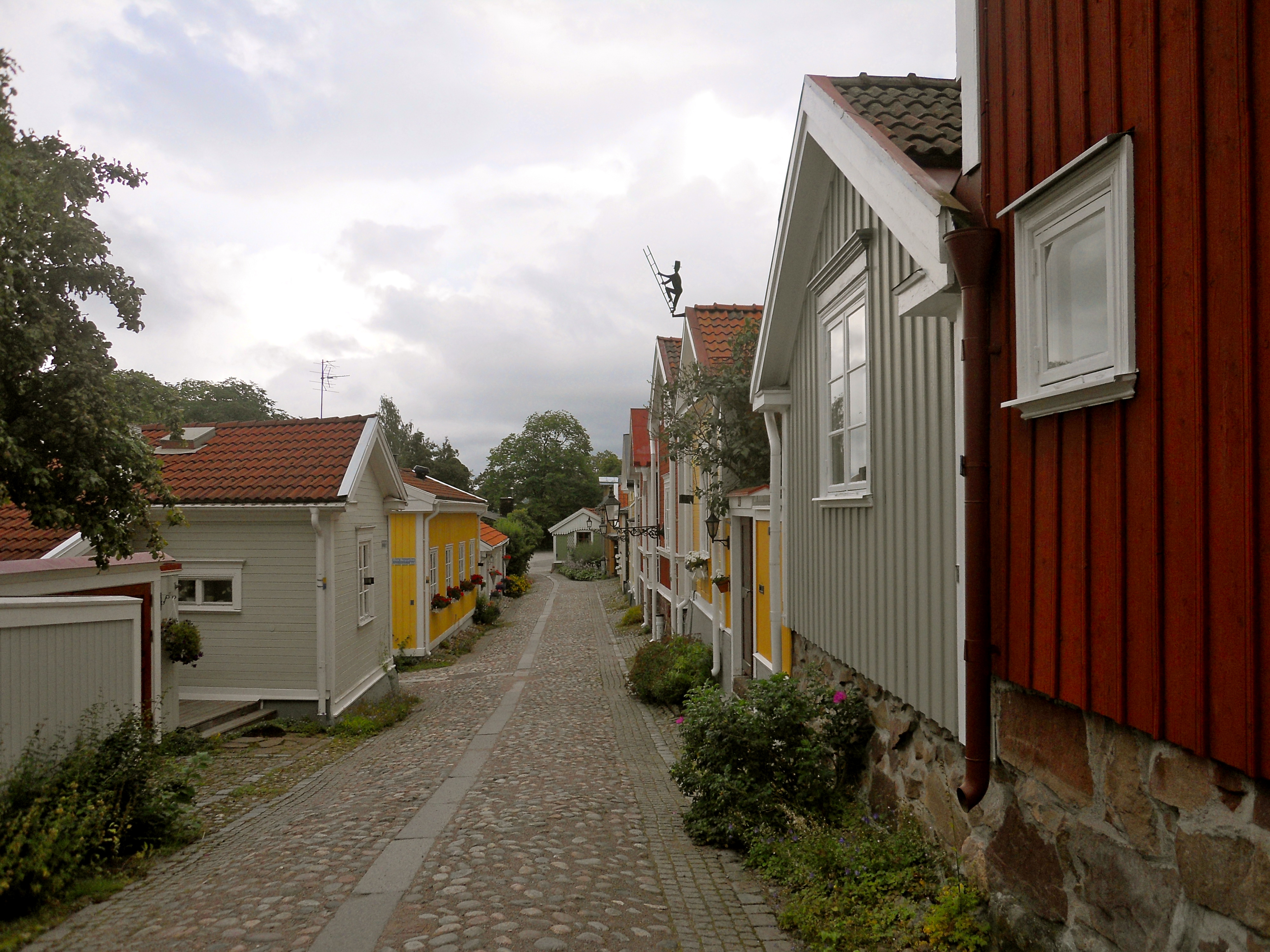
Gävle

People are also a big part of the exchange program. Not only am I meeting a lot of international students (there are not a lot of Americans, which makes Uppsala University a perfect place to make friends with people of other nationalities and backgrounds), I am also making a lot of Swedish friends. Don’t let the stereotype about Swedish coldness scare you – they are amazing people with interesting stories. And they are very funny too! There are a few Swedes who live on my corridor and I really like them; they are all so helpful and they do their best to make me feel at home. Swedes you meet at the social events are also very nice and talkative (I haven’t really experienced that famous coldness yet). After all, talking to people is the best way to learn about the country and its traditions, but also to find out more about the wonders this country hides.

Every day I am more and more happy that I have chosen Uppsala University as my study abroad destination since I am getting the best of both worlds – high quality education and amazing cultural exchange that will mark my college experience in a great way.


Uppsala, we love you! (posted by Indira in Sweden)

August 14, 2012

I can’t believe that another week of classes, fun and sightseeing is over. We are all always very busy and have barely any free time, so it feels unbelievable to me when I have to sit down and reflect on the past week.

First of all, my Swedish is getting better. I was so proud of myself when I went grocery shopping and managed to talk to the cashier in Swedish! I really feel that the past two weeks of intensive Swedish classes are starting to pay off: I can watch Swedish TV programs or listen to people talk and I’m able to understand a bit (hey, it’s a progress!). It really is a great feeling! After only two weeks of classes, I’m able to say that there are some fundamental differences in the teaching systems here and at UR. Here everything (by everything I mean the final grade) depends solely on your final exam and attendance (you can’t miss more than 15% of classes), while homework and class participation contribute only in a way that you don’t really have to review the class material per se. Otherwise, I feel that we are all a bit more independent here in Uppsala. This applies not only to the classes, but to the other activities as well.

It is us, the students, who organize events, picnics, parties and trips. The school as an institution is far less present, which is probably a result of the fact that Uppsala University does not have a campus that is similar to the UR one – it is spread all across the city and there is less isolation. The entire city is the campus (Uppsala is traditionally known as a university city) and yet the city is a place you don’t necessarily have to relate to the University.

It might sound like an almost dysfunctional system where students are not connected at all, but I feel that this level of independence makes us bond more both among our exchange group and with local students. Meeting every morning to ride bikes to school together, picnics that gather both international and Swedish students, and fika (drinking coffee/tee/hot chocolate with some pastry or cake) in the multiple cafes around Uppsala allow us to make friends on few different levels.

rooftop BBQ

Rooftop BBQ with friends

I find it also interesting that I meet new exchange students every day! Today, for example, we went on a tour to Stockholm and I met few new people. We always get a chance to experience Sweden from a highly international perspective due to our diversity.

And Stockholm is an amazing city! The royal palace, architecture, difference between the north and the south part of the city, museums, as well as the countless cozy cafes are all welcoming and make one fall in love with the Swedish capital instantly. Stockholm is definitely a place I plan to go back to (that won’t be hard since it’s only a 45 minute drive away from Uppsala).

Stockholm

Stockholm

So far my time here has been better than I could have ever dreamed of. I did have my fears about the new environment, people and system, but it is all working out exceptionally well. Every new day is a new adventure that makes me feel more at home and more attached to Uppsala.

I’m off to do my Swedish homework and tomorrow is the Swedish food festival. Definitely looking forward to tasting some typical Swedish dishes.


Amazing beginning of my adventure: Bikes, Rain, Swedish and Uppland (posted by Indira in Sweden)

August 6, 2012

It is funny how time passes: Sometimes it is just too slow, and other times way too fast. I’ve been in Uppsala for a bit over a week now and I don’t even know where to start explaining how I spent these few days in the north of Europe.

A short summary: I met many different people from all over the world, I got a bike and cycled over 80 km (about 50 miles) so far, I can hold a basic conversation in Swedish, I can go many places without checking the map every few blocks, and most importantly – I didn’t starve.

Uppsala is a neat medium-sized city (fourth by size in Sweden) that offers the best of both worlds: European architecture and system with a mixture of the US-like features. The very center of the city is the Cathedral (Domkyrkan) and all streets lead there. One can easily walk, bike or use public transportation to get anywhere. Shopping areas (mainly ICA and Ikea type of stores) are located outside the city, which reminds me of the US in a great manner. Uppsala really depicts what Swedes and my exchange program are like: relaxed and laid back.

Cathedral in Uppsala

The Cathedral

The group of the exchange students who are here for the one month language course are all great and each of them adds a special little something to the mix. It is very hard to find oneself in a group that has more than two people from the same country and the internationalism is on a rather high level. Funny thing is that even though we are all so different, we all get along extremely well. No matter if we are biking downtown, going on a city tour, to the lake, spontaneously decide to have a BBQ on the rooftop of our residence houses or just going grocery shopping, everyone keeps close and it’s all done in a socialist way (I guess we are learning fast). Even our Swedish language lessons are a group effort since we all help each other with the pronunciation, translation or homework. The use of the simple small Swedish words such as tack (thanks) or hej (hi) is also becoming a part of what is starting to define our semester- or year-long stay in Sweden.

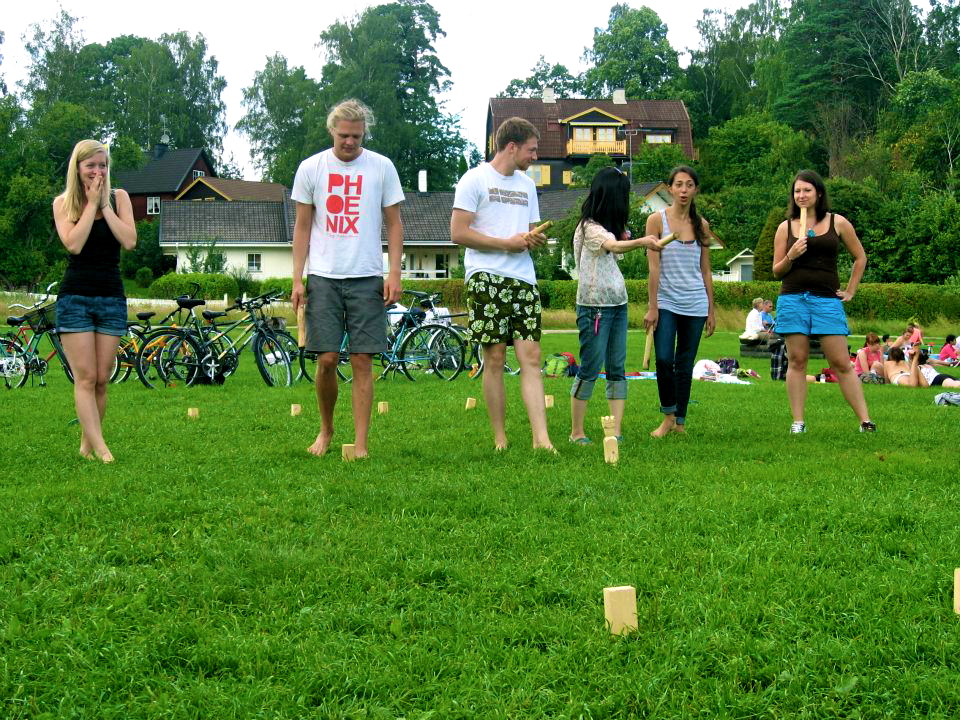
playing Kubb

Playing the game of Kubb at the lake

For me this experience abroad is a challenge in so many ways. First of all, I left my comfort zone one more time and I surely don’t regret it. Also the biking is a big part of the challenge. This was something I had to get used to on a daily basis, but after falling of the bike, hitting few people, and learning how to safely stop on the traffic light and mastering the turning on the street, I am proud to say that I am no longer a danger to the Uppsala biking society. Since there is no D-Hall, I have to cook on my own and it is a true success that a person with such poor cooking skills like me survives a week without actually being hungry. Little things like this will stay forever with me and remind me of a rather fun and a bit painful start of my Swedish adventure.

Sweden as a country is a great place to visit! Last Saturday I was on a tour of Uppland where we visited the Hammerby estate – summer residence of Carl von Linné, Skokloster and the small town of Sigtuna. This was a chance for bonding with other exchange students, as well as an opportunity to see places that one otherwise would never visit.

Even though everyone here is so relaxed, every day is well planned and thoroughly used mainly because of the rain. Sun and no rain are synonyms for the lake picnic or barbecue. We were very lucky this past weekend that we had a great weather, so it was a very active weekend that included a lot of biking and going places.

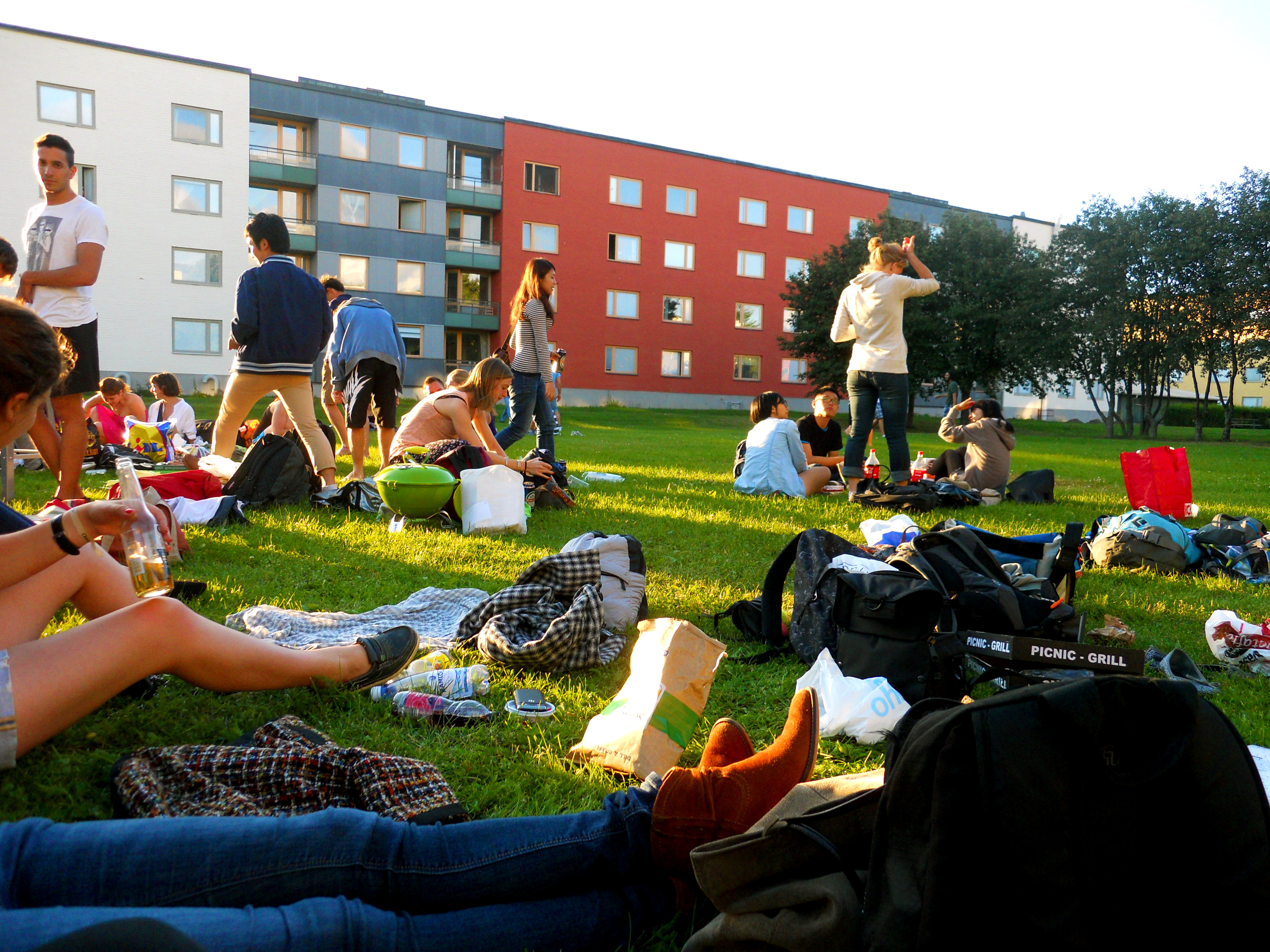
hanging out

Hanging out with other exchange students

It’s been only one week since I got to Uppsala but I already love it and always keep my mind open for the new experiences!


Barbados, Week 14: Reggae on the Hill

May 23, 2012

It’s exam time at UWI, and the blocks have become pretty quiet now that everyone is holed up inside studying.  However, not even exams could stop me from buying a ticket to one of Barbados’ biggest days in music, Reggae on the Hill.  I’m not going to pretend like I know the history of the concert or when it started, but if I had to compare, I’d say it was like a Barbados-sized Woodstock.  Obviously I’ve never been to Woodstock either, so I suppose I’m going out on a bit of a limb there too.  Point is, there was a ton of hype about the all-day concert, and when some friends and I cabbed over we started hitting traffic miles down the road from Farley Hill National Park, where the concert was taking place.  Some of the biggest names in Reggae music were scheduled to perform that afternoon, but I only recognized one artist, Chris Martin, winner of 2005’s “Digicel’s Rising Stars” (think Caribbean version of American Idol).

Security was pretty tight for an event of this scale, and I was a little surprised when I encountered a TSA-like pat-down before being allowed entry into the park.  Speaking of which, they couldn’t have picked a better spot for the concert:  the park was covered with huge trees providing cover from sun and rain, with a comfortable lawn perfect for spreading out a chair or blanket for the 8 hour show.  Knowing that the hill would get progressively  packed as the night went on (naturally, Bajans would be expected to arrive on “Bajan” time) we decided to take advantage of the myriad of different food vendors set up on the outskirts of the park.  Fish, chicken sandwiches, and hamburgers abounded and, unlike concerts in America, they didn’t even jack up the prices just because they knew they could.

Reggae has come a long way from its beginnings in 1960s, but the spirit for which the music stands was still evident in the crowd at Farley Hill.  From its birthplace in Trenchtown in Kingston, Jamaica, it has taken over the Caribbean and disseminated to every corner of the globe.  The genre was heavily influenced by Rastafari such as the legendary Bob Marley, and many people in the crowd were waving the Rasta Flag, a triple layered green, yellow, and red flag with the Lion of Judah in the center.  The audience, although clearly excited for each artist, was notably more laid back than a typical American concert in which some of the most popular musical artists of the year were present.  There was no pushing, shoving, or raucous jumping up and down, but rather everyone gave each other sufficient space to actually breath and enjoy the concert in their own space.  Below I have included a YouTube video of one of my favorite songs of the concert, enjoy:

Jah Cure – Call On Me

If you’re a Marley fan, it’s not a guarantee you’ll dig these tunes as well, but it’s catchy, contemporary reggae at its finest and an interesting example of how far the genre has come in 50 or so years of innovation and development.  I will admit, I missed American rock, rap, and top 40 for a good month or so after I arrived in the Caribbean and refused to embrace these types of songs until much longer than my exchange counterparts.  I ignorantly insisted that “they all sound exactly the same” and couldn’t even understand a word of the lyrics.  However, there came a point where I found myself bobbing my head and tapping my foot to the beat as I realized that as much as I tried to convince myself that I didn’t like the music, it had seeped into the part of my brain that overruled cultural attachment.

The sun set behind the hill, it started to pour rain, and the line-up of reggae artists continued to perform their sets with exuberant energy.  I looked back at the hill that had been dotted with people only hours before and saw that the hill was absolutely packed.  The young, married, and old alike had taken out their umbrellas and were determined to fight the downpour in order to finish out the most celebrated concert of the year.  I think that’s what struck me most about the concert. The fact that, while concerts in America are generally populated with a homogenous crowd, its demographic depending on the band playing, Reggae on the Hill was able to bring together Rastas, students, couples, and older people alike to enjoy the concert.  I may have been slightly more stressed the first day or two of studying for exams, but it was one hundred percent worth it for the experience.


Leaving Bangkok

May 21, 2012

I am writing now sitting at Suvarnabhumi Airport in Bangkok, waiting to board my flight to London.  I have finished my exams, I have said my “see you soon’s” I have done the absolute impossible (only thanks to my fantastic roommate) and have fit 5 months worth of purchases and clothing into only one checked bag (I am not pleased with my airline about this), and I took my last look at the beautiful Bangkok skyline from my bedroom window.

Yesterday and today, ironically, I had the best Thai food of this entire semester, food which I will definitely miss.  I am off to London now to spend a week traveling within Europe to visit family, and while I cannot WAIT to see my family, I am absolutely sad that I am already leaving Bangkok.  It is an incredible city that very quickly came to feel like home, and I could have easily continued on living here without hesitation.  It is very rare that a city can offer so much, from incredible food and cheap amenities, to fantastic weather and the kindest people you will ever encounter.  It will certainly be interesting, after this year of travel, to go back to the “real world.”

Once I am home back in US I will do one last blog post on how the readjusting is going.  Until then, for those who have never been to Thailand before, I highly recommend researching how you could make a trip to Thailand possible. Thailand has everything to offer, and is absolutely worth the trip half way around the world!


Bangkok to INDIA!

May 16, 2012

I just came back from some of the most incredible five days of my life.  I have had a pretty fantastic year filled with travel – by the time I land back in the U.S. on May 22 I will have conquered eleven countries on four different continents in nine months.  And still this past week was one of the most life-changing and memorable weeks of my entire adventure.

I was given the opportunity to visit Kolkata with a friend of mine who lives in Bangkok, and who has family friends who live and work in Kolkata.  I am in the middle of finals, so the decision to go was really because I was eager to visit the non-profit organizations that our hosts work for, and despite all my travels, India was still a country that made me a bit nervous about traveling to.  So all the more reason to go!  It’s funny though, because most people don’t go to Kolkata as a final destination.  So when I mentioned that I was traveling to India, specifically Kolkata, most people asked, but where are you really going?  And exactly as I was warned Kolkata itself is a dirty, dilapidated city, that is plagued with poverty; it is inescapable.  The thing is though, that once you see past the poverty, the dirt, and the grime, there is so much to discover in Kolkata, and so much hidden beauty.  I could write pages about how amazing the trip was, but I will summarize my trip into two parts: the high and the low.

The low point of the trip was the morning of Day 3.  We had just come from an incredible (and very early) morning visit to the Mother House, where Mother Teresa lived, died, and from where she did her incredible work.  Learning about her story, seeing pictures and reading quotes which give a glimpse into her life was truly incredible.  She started the organization the Missionaries of Charity. By bringing a focus to the poor and destitute in Kolkata she did something that no one in his or her time had braved to do.

Afterward we went to visit a temple in Kolkata, home to the goddess Kali, who symbolizes war, death, and destruction.  She is also the god associated with Kolkata.  From the moment we started walking to the temple, I didn’t have a good feeling.  There were people everywhere screaming at us, trying to get us to go this way or that way.  It was mass chaos, and there was a frantic and frightening energy.  We walked through the gate past a few guards with huge guns.  As we walked in one man warned us, quite bizarrely “Just do this one thing for me, go in and don’t involve anyone else in your experience.  And do not take off your shoes.”  Well we noticed that everyone waiting in line had no shoes on.  We circled the temple to get an understanding of our surroundings and where we should line up, and passed people who looked half-dead, lying on the floors everywhere. It was overwhelming.

We finally decided to take off our shoes, but knew to carry them in because if we left them outside they would be gone by the time we came back.  But as soon as we touched our shoes a woman came over screaming and frantic telling us “No! no! no!”  She truly looked insane, and would not let us pass.  After much confusion and anxiety, us three girls finally decided to leave.  We walked away – I was in the worst mood and just didn’t know what to make of the whole experience.  Depressing? Sad? Frightening? Unnerving? Disturbing? There was something.  That night when talking to our host, she explained that the temple is known for its heavy and dark atmosphere, and that they usually warn people about going there.  As recently as November, a child sacrifice of an eleven year old, was reported at that temple.  That was definitely my low.

I have two highs.  The first was our visit on Day 4 to an organization called Freeset. Freeset works by building relationships with women in the red light district Sonagachi (home to 10,000 women who work in prostitution).  Just as a comparison, 20% of users in Thai red light districts are foreign and only .01% in Kolkata, so 80% of users are local in Thailand and 99.9% in Kolkata.

while in Thailand 80% of customers in red light districts are natives, in Kolkata 99.9% are natives.  This leads to a huge stigma of women working the line.  As a result, women who would want to leave sex work, find it difficult to find work elsewhere.  So freeset provides employment for women who are coming out of prostitution or trafficking.  Freeset makes bags out of jute (typical of India).  The company actually gets 90% of its profit by filling custom orders; for example, to many grocery stores, including Whole Foods.  So next time you are at a Whole Foods check the bags there, and see whether they have a small Freeset label.

Our visit started with Freeset’s devotion time.  The organization is Christian based, and at the beginning of each morning all the women and staff come together and have worship time. It was in Bengali so of course I didn’t understand anything; but it was a beautiful and touching moment.  All of these women, dressed in their incredibly beautiful saris, surrounded by the employees who care so much about them and their children, joining together before the start of the day.  Throughout our tour we saw over and over again just how happy the women are there, but also how dedicated and down to earth the staff are.  It is incredible to see an organization that really is just as amazing as it sounds on paper.  Even more impressive is that Freeset is a business and fully sustainable.

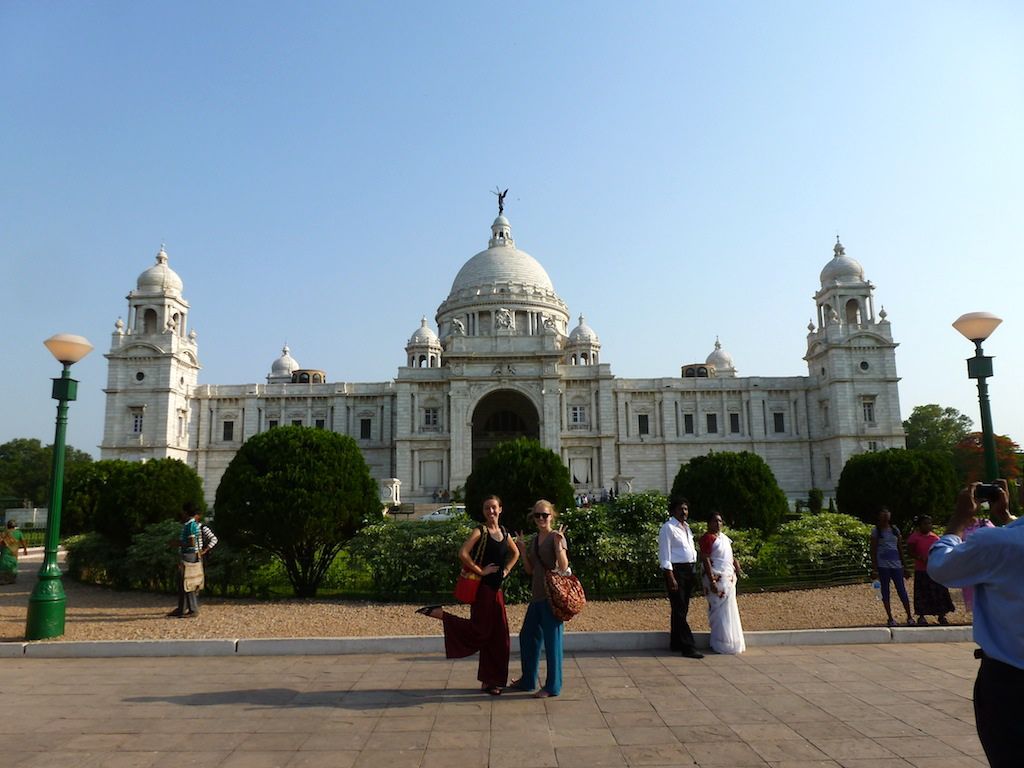
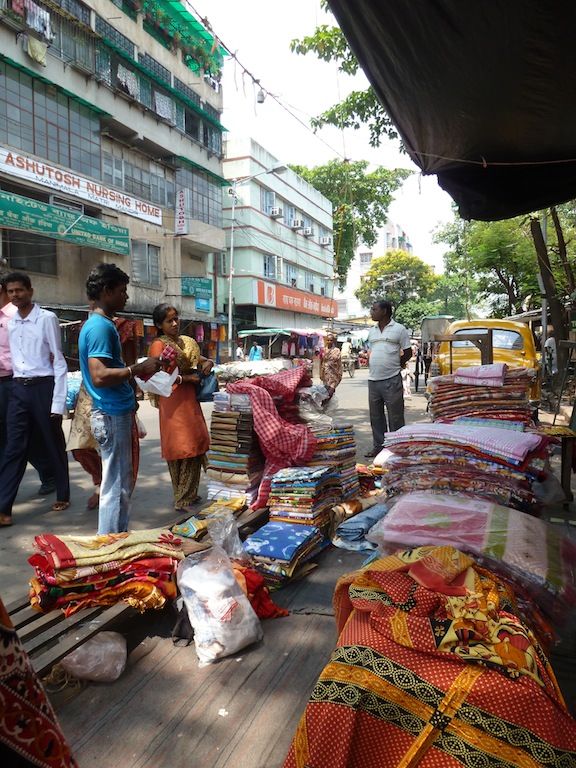
The second high of the week was talking with, and spending time with our hosts.  They are a young couple both working with human trafficking organizations.  They are well-educated, intellectual, fun, relaxed, down-to-earth, and have created a life in Kolkata doing this incredible work.  As someone who is completely unsure of what to do in the future, it was incredible to see such an example of a couple who are individually pursing their passions.  They took the time to talk to us about their work, and to give us advice for the future, and helped us to see a different side of Kolkata.  The week also included a bit of sight seeing, and observing the many sights to see in Kolkata – when you look beyond the intense pollution, you notice incredible european style buildings, and beautiful colors all around the city. The whole week was really an incredible way to end my semester in Asia!


Barbados, Week 13: Farewell Dinner Reflection

May 14, 2012

Toward the end of the year every spring semester, members of the Frank Worrell Hall council organize and put together a farewell dinner for those students living on campus.  Everyone gets all dressed up, and the dinner features song, dance, a speech and hall “spoof awards.”

As an exchange student this year, I was asked to give a reflection on my time spent at the University of the West Indies and I readily accepted.  I love blogging of course, but I enjoy delivering my thoughts to a guaranteed audience even more.  I presented the third and final reflection of the night, and unlike the other speakers, this was not completely off the cuff for me – I had written down a two page speech in the 20 minutes before my final class.  Not having time to print it out, I arrived at the dinner with my entire laptop under my arm.

Below is the video that my friend from California, Camille, took of the reflection speech.  And yes, toward the end that is the sound of audience members crying.