지평선: N Seoul Tower, Richmond Reunion, and Our Husky Friend (posted by Indira in South Korea)

April 24, 2013

Seoul is a big city and it is always interesting to go and explore different areas as each part of the city is very unique: Sinchon (where Yonsei University is located) is very busy and there are many young people, Ewha is full of cute little stores and shops as this is where Ewha Women’s University is located, Insa-dong is a touristy place, while Itaewon is very Western-like as most of the Westerners who work in Seoul live here, and Gangnam is very modern with skyscrapers everywhere. This city has so much soul and spirit that it is rather hard to comprehend it all. There is, however, one place where you can take a good look at the entire city of nine million people and enjoy the view of a place where modernism and tradition coexist – N Seoul Tower.

Last week a group of my friends and I decided to go to N Seoul Tower and see Seoul in its full beauty. It was really good that we had nice weather as the sunset was beautiful and the skyline was breathtaking. Getting to N Seoul Tower gave us a view of different parts of the city  as we had to go to the subway stop in Sinchon, walk through Myeondong, take a cable cart and finally hike up to the Tower. The best part of it all was seeing how different Seoul is and then getting a good view of the entire city, which makes you wonder how is it possible that so many diverse areas are so united and make this city what it is. The view is rather breathtaking – you can walk around in the 360° observatory platform and see the city from all the sides. We managed to see the sunset from the outside before we took an interesting elevator ride (they show you a short video clip that basically takes you from the Tower to outer space when going up, and when going down it takes you from the outer space to the Tower in Seoul in a mere 30 seconds) to the top of the Tower. This is definitely one of the top touristy activities I’d recommend to anyone (even though it took me over a month to do it). I’ll definitely go back to N Seoul Tower in late spring!
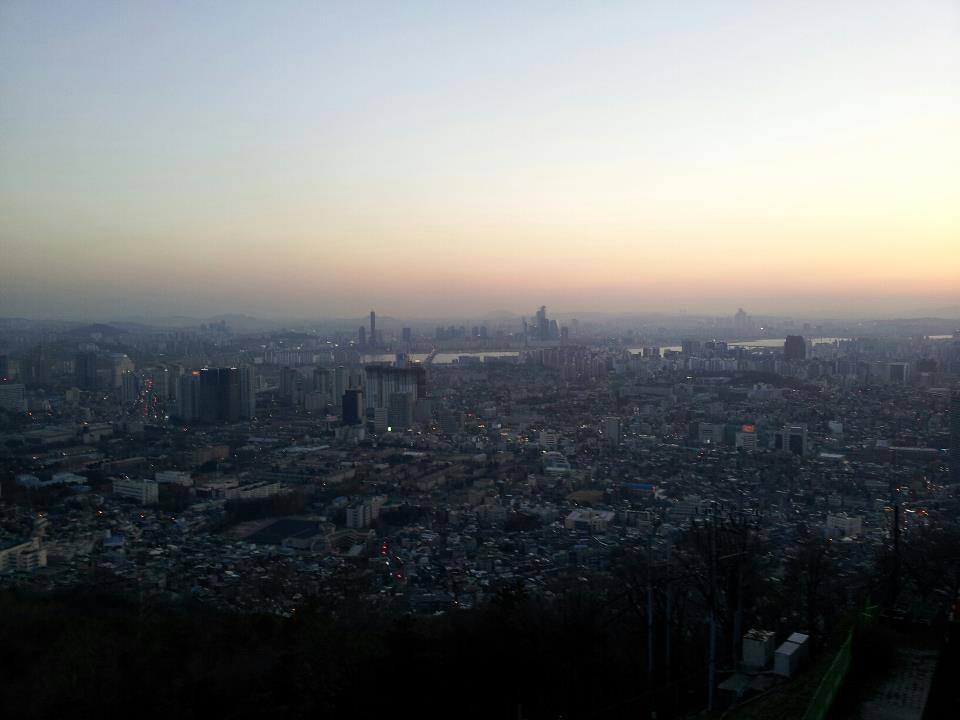
Sunset over Seoul from the N Seoul Tower

Sunset over Seoul

View on the City of Seoul from the N Seoul Tower one of the biggest tourist destinations in Seoul

View on the City of Seoul from the N Seoul Tower

Being so far away from Richmond doesn’t mean it’s impossible to find Richmond affiliated people in this part of the world. Since Ms. Leslie Stevenson from the CDC was on a conference in Seoul, she invited all the Richmond graduates and students currently in Seoul, as well as Yonsei students who either were, or are going, on an exchange to UR for a dinner in Gangnam (unfortunately no one thought of getting a group picture as we were all too excited for the reunion). It was really great having dinner in a Richmond spirit, as well as getting to know so many new people. I also enjoyed talking to three Yonsei girls who will be studying abroad at Richmond in Fall 2013. I tried to give them some advice and they seemed super excited to start their semester at UofR. Seeing Ms. Stevenson was also great! She accompanied my Leadership and the Common Good SSIR group trip to Spain in January last year and seeing her in Korea this year was just wonderful. It truly shows how global Spiders are!

Seoul is a diverse, modern, and global city full of surprises – you never know who you might meet/see. One of my favorite things in Sinchon is seeing a Husky dog that is usually chilling outside one of the numerous Korean restaurants in the area (supposedly since his owner works there or something of a kind). This big fluffy ball of fur is just about the most amazing dog ever. He is so friendly and playful and it is always great running into him when walking around Sinchon.

Husky dog we always see when walking around Sinchon.  He is the dog of a local restaurant owner

Husky dog we always see when walking around Sinchon

I have also noticed that as midterms are approaching (last week of April) I have more school work to do. The beautiful spring weather, blossom, and temperature of about 67 degrees is unfortunately hard to ignore. However, it is very much possible to stay on top of the schoolwork and also enjoy the life in Seoul. All it requires is a bit of sacrifice and hard work, but it is completely worth it.


여행: A Weekend Trip to Muuido and Silmido, Silkworms, and Korean Hospitality (posted by Indira in South Korea)

April 19, 2013

If you ever get sick and tired of Seoul (which is by any means absolutely IMPOSSIBLE) or you just need a couple of days away from the big city, the rush, and the notion of being busy all the time, you can always take a trip. A group of eight exchange students at my host University – including myself – decided to take advantage of a free weekend and go on a trip to a nearby island – Muuido. Muuido is a small island located about a 15-minute ferry ride from Incheon (which is a city located an hour subway ride from Yonsei University) and it is the perfect getaway place for a weekend: you can go hiking, climb the rocks on the beach, walk around, ride horses, go zip-lining and much more!

Our trip started with an early Saturday morning gathering in the SK Global House (one of the student dorms) lobby, meeting some people at the subway station, and a long subway ride to Incheon airport. From there we took a bus to the place where we hopped on a ferry that took us to Muuido. Upon our arrival we noticed many stands and Koreans willing to sell corncobs and silkworms (!). Being tourists, we got a cup-full of silkworms. A very bad idea, I may add. Only three of the people from our group were brave enough to try the silkworms: it must have been one of the worst things they have tried, according to their faces and their reactions (which made me happy to be one of the group who didn’t dare to try weird smelling silkworms). Unfortunately, the silkworm adventure did not end here. Right after we tried the silkworms, the bus that was supposed to take us to the other side of the island, where the beach is, arrived. So we got on it (with the cup of silkworms, which ended up being the worst decision possible). The bus was full! Crowded! It was so hard to stand while being pushed from all sides and, of course, my motion sickness kicked in, especially since the silkworm smell was so overwhelming. I honestly don’t know how I survived the 30 minute bus ride which definitely was the worst bus ride ever, but the torture stopped once we reached our bus stop close to the beach entrance. I have never felt move relieved or happier to get off a bus and get some fresh air!

My friends - Denis (France), Jina (Germany) and Mike (USA) - eating silkworms on our way to our weekend getaway

My friends – Denis (France), Jina (Germany) and Mike (USA) – eating silkworms

Since we arrived to the island during the low tide we used this chance to climb the rocks along the beach and enjoy some amazing views (despite the fact it was very cloudy) right after getting a quick lunch. It was so much fun climbing big rocks and racing to see who would make it to the top first. Afterwards we went on a three hour hike to the top of the island. That was a challenge for me. I am not really a person who does sports, but I very much enjoyed this hike. The reward – the view from the top – made me forget the pain and the thought of how sore I was going to be the next day. It also happened to snow for a couple of minutes while we were on the top, which made this experience so much more unique and special. When we got back to our huts on the beach we got dinner and then made a bonfire. It definitely was a day of new experiences and bonding with people I had met fairly recently (some of them I met that day).

Rocks we climbed along the beach on Muuido when the tide was low, on our first day on the island

Rocks we climbed along the beach on Muuido when the tide was low

The second day of our weekend trip we went back to the bus stop thinking we would have to endure another horrible bus ride in order to get to Silmido, a small island that you can walk over to when the tide is low. Luckily, we met the most amazing, generous, and hospitable group of Koreans ever. Jina, a German-Korean girl who speaks perfect Korean (it’s very useful to have her around as it is much easier to get by with someone who speaks the local language), approached the group of Koreans to ask them about the bus and they happened to be producers of a Korean TV broadcaster KBS, and after a short conversation they gave us traditional Korean snacks and offered us a ride to Silmido as they were heading there too. KBS had rented a whole bus for the crew and they had nine free spots on the bus, which worked out extremely well for us (there were eight of us). Their generosity did not stop there: once we arrived to Silmido they invited us to join their barbecue on the island. They were so welcoming and warm. I couldn’t believe that a group of people would be so nice to eight strangers they had just randomly met on an island. Afterwards we walked over to Silmido, picked up some trash (since it was what the KBS producers did), and then joined in for an afternoon of games (frisbee and a sport that is a mixture of volleyball and soccer). As if that was not enough, the KBS crew gave us a ride back to Seoul for free. We were all very much surprised and happy about meeting the greatest group of people possible. They definitely made our weekend trip that much more enjoyable.

Enjoying the barbecue provided by the KBS producers, the most generous and amazing group of people I have ever met.  KBS is a Korean television broadcaster

Enjoying the barbecue provided by the KBS producers, the most generous and amazing group of people I have ever met

Coming back to Seoul meant that we had to get back to school and our regular everyday duties and work, but this weekend will definitely be one of the best weekends in Korea. Not only have I experienced so many new things and seen a new side to this country I now call home, but I have also met an amazing group of people who will always be on my mind when I meet strangers that might need help or are on a search for good time. 🙂


Voyageur du Monde? (posted by Pierre en Suisse)

April 19, 2013

Zero: the number of foreign countries that I had ever visited before coming to Switzerland. Three: The number of countries I have visited (or lived in) so far by the time that I am writing this. Four: The number I will have reached by the end of this week when I head to another famous European destination! Compared to the “Pierre” I was before leaving the US, I am definitely on my way to becoming a voyageur mondial (global traveler)! This is far from being an actual title I can claim, I still have some other continents to get to, however it certainly feels this way, being so new to this whole traveling thing. After coming back from Italy during my Spring Break, I spent one day back in Switzerland before hopping on a plane to Barcelona!

I had quite a different experience in Barcelona compared to Italy, just from the standpoint of language. In Italy, I did not know a single word of Italian, which made me feel bad every time I needed to ask someone for English, and even worse when I was on a train and had no idea how to say “excuse me” or “I’m sorry!” However, after having a single year of Spanish combined with my French, I did pretty well in Spain. As Barcelona is in the Catalonian region of Spain, the people speak both Catalan and Spanish. Luckily, I was able to meet up with a friend I met at Richmond who comes from Barcelona and did a semester of exchange at U of R. She helped me out with some key phrases that I would need to know as well, and explained to me the language. She said that Catalan sounds like Italian, and has a lot of influence from the French language, such as some of the letters and even words, since the region is so close to the French border. Luckily, she also spent a great deal of time with me, showing me some of the streets and main areas that tourists would not normally go down on their own. In the sunlight, it was so easy for me to fall in love with such a beautiful place very quickly, when looking up around me and seeing the narrow streets lined by buildings with terraces and plants coming down from them, walking into a main square and seeing a group of people start performing a dance show, and then being introduced to the main tapas dishes of the region.

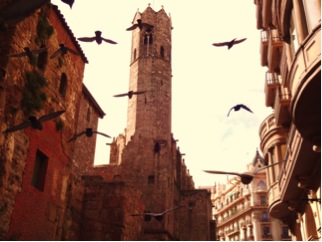
Managed to capture this image of the birds while in the oldest parts of the Barcelona. Completely fits my image of the stereotypical European image

Managed to capture this image of the birds while in the oldest part of the city. Completely fits my image of the stereotypical European image

My guide also explained to me one of the most notable features of the architecture in Barcelona. The modernist style is unlike anything I had ever seen before. Just like my friend told me, it is something you just have to see, and not anything that is easily explained, but with the help of my friends at Wikipedia I will attempt. The movement began towards the end of the 19th century, and combines very rich, ornate decoration and detail, while preferring curves over straight lines. One of the most famous sights in Barcelona, the Basilica I Temple Expiatori de la Sagrada Familia, designed by one of the most renowned modernist architechts, Antoni Gaudi, was designed and meant to feel like a forest on the inside, for example. Still unfinished, it was one of the most impressive sights I have ever seen!

Feel like you’re looking up into the tops of a manmade-forest? Well, this would be the inside of Gaudi’s famous Basilica, La Sagrada Familia!

Feel like you’re looking up into the tops of a manmade-forest? Well, this would be the inside of Gaudi’s famous Basilica!

Among other things that we did in Barcelona, aside from just seeing amazing architecture, I also got to tour the Olympic park where the city hosted the summer Olympics in 1992, in addition to finally seeing the beautiful Mediterranean Sea for the first time! While I know I am still so far away from being able to call myself a world traveler, it certainly is beginning to feel like it, having been exposed to two fairly different countries within the same week. Despite all the excitement of the travels, I still get beyond excited when I return to Switzerland, and feel back at ease with the language and get back to the certain degree of familiarity I have with what is still this foreign land. But in any case, the travels shall continue, so stay tuned for what is to come!

One of my famous images of the city, the fountains in this park were absolutely gorgeous!

One of my famous images of the city, the fountains in this park were absolutely gorgeous!


Fast Trains to Fun Travels (posted by Pierre en Suisse)

April 10, 2013

Last week was my University’s spring break, or Easter Vacation as it is called here. It could mean only one thing: time to hop on a train and travel somewhere outside of Switzerland for the first time! Where did I pick you may be wondering? Italy! One of Switzerland’s border countries as well as language regions, Italy is also from where my family originates. I am quite proud to say that I am one hundred percent Italian when at home in the states. However, as an American abroad in Europe, I have realized there is a very different conception of nationality here than in the US; whereas it is not that common to be completely of one heritage in the US, here in Europe, to say to someone I am a hundred percent Italian usually means absolutely nothing. It was an interesting realization when I first explained that to someone!

To go to Italy, I hopped on a train the afternoon my classes had ended, and after traveling four hours through mountains, tunnels, and past various lakes, I found myself at my final destination, in Bologna.  I am lucky to have a friend who is studying in Bologna whom I stayed with during my visit. No, Bolonga is not typically the first city that comes to mind when envisioning Italy, but I think it was quite an ideal destination. It is in the heart of the Emilia-Romagna region, and is home to some of the most famous Italian foods, such as the Bolognese sauce, the typical meat sauce that goes over some of the most stereotypically Italian pastas such as tortellini and lasagna, also specialties of the region. Tasting true Italian food was one of my main goals of the trip, and I definitely got my fill of it!

My first meal there was at a very traditional family-style restaurant that served the meal in different courses. Starting with anti pasti, the servers brought out massive plates that you take a bit of food from before passing it on to the rest of those at your table, until you have a full plate. This course can include things like prosciutto, salads, and other types of vegetables. Next up is the pasta course, called primi, followed by secondi, or the main dish of the meal, usually some kind of meat, and then finishing off with desert and then coffee. Due to the fact that we were already stuffed by the time we finished our primis, we decided not to get secondis, choosing desert instead. I won’t lie, even in Switzerland, the land of chocolate, I have never had more on my plate at one time than during this course, between the chocolate mousse, chocolate salami, chocolate sauce to go over one of the pastry, in addition to the other deserts. Don’t worry, Gelato came another time, I made sure I didn’t miss it when in Italy. After the experience I truly understood why my friend had warned me not to eat that day, knowing we would be having such a large meal at the restaurant.

My dessert plate at my first Italian restaurant!

My dessert plate

The next day, I found myself in Florence! My friend and I walked around the city and saw some of the major sights, such as the Basilica di Santa Maria del Fiore, but unfortunately due to the long line and my lack of foresight, we did not have a reservation to go to the Museum where the famous statue of David is located, in addition to the Palazzo Vecchio, or the old town hall of Florence. There, I found among many other things, a map room which happened to be one of my favorite parts. Despite my excitement of being in Italy, I couldn’t help but locate Switzerland and Lausanne on the map of the francophone world.

One of my favorite parts of Bologna: the food markets. Loved the ambiance and just looking at the selection! This is just one of the many fresh produce stands located in the market.

One of my favorite parts of Bologna: the food markets. Loved the ambiance and just looking at the selection! This is just one of the fresh produce stands.

Upon returning to Bologna, I got a full on view of what I envisioned to be Italy one morning when it was sunny. Walking through the city’s colored porticos with the sun burning off any morning dew and fog and shining through the arches, there was nothing else like it. Until that is I climbed up on top of one of Bolonga’s famous two towers and got a full view of the city’s red roof tops and green rolling hills in the distance. The combination of the true Italian food and these images definitely met my expectations of what Italy should be, and I will say I am ready for round two to come at some point down the line. That visit will be to Rome, almost certainly, and then later on I hope to get to Venice. But alas, I am back in the wonderful land of the Swiss, and life could not possibly be better.

A view of Bologna and some of the surrounding hills

Bologna and some of the surrounding hills


정신이 충만한: Big City Life, Spicy Food, Classes, and Uppsala Reunion (posted by Indira in South Korea)

March 8, 2013

It’s my second week in Seoul and I’m starting to get used to life in the big city. It is crazy how everything here seems to go so fast and everyone is in rush. The city is so lively and something is always going on whether its 4:00 a.m. or 4:00 p.m. It can be truly overwhelming. I find it funny that now I live in a city that has almost three times more inhabitants than my entire country. It’s really insane!

After days of fighting against the spicy food I’m starting to give in: I’m experimenting and testing how I react to certain spicy foods (many say they don’t find it spicy, but I have major issues eating it). It’s usually funny for the people I’m with – I can’t resist coughing and making faces when I eat something spicy. It’s going to be a long way before I’m able to eat kimchi (spicy fermented cabbage) like everyone else. But I’m getting there!

Last week I managed to go with a group of exchange students to the immigration office and apply for an alien card. Basically, anyone staying longer than 90 days in Korea must apply for one. We were stuck at the immigration office for about three hours. There is so much waiting and a gazillion administrative things to do. We were lucky to have Leo, an American-Korean student, to take us there and help us out. I really appreciate it when I have a Korean speaker around! It was also great that the person working at the counter figured out we were all exchange students from Yonsei so we didn’t have to go through the process individually, but as a group, which cut down our waiting time. It took us almost that entire day to sort the immigration things out, but we are finally done! All that’s left to do is to wait for the cards to be mailed to us. I really don’t think I’d be able to go through the whole process again!

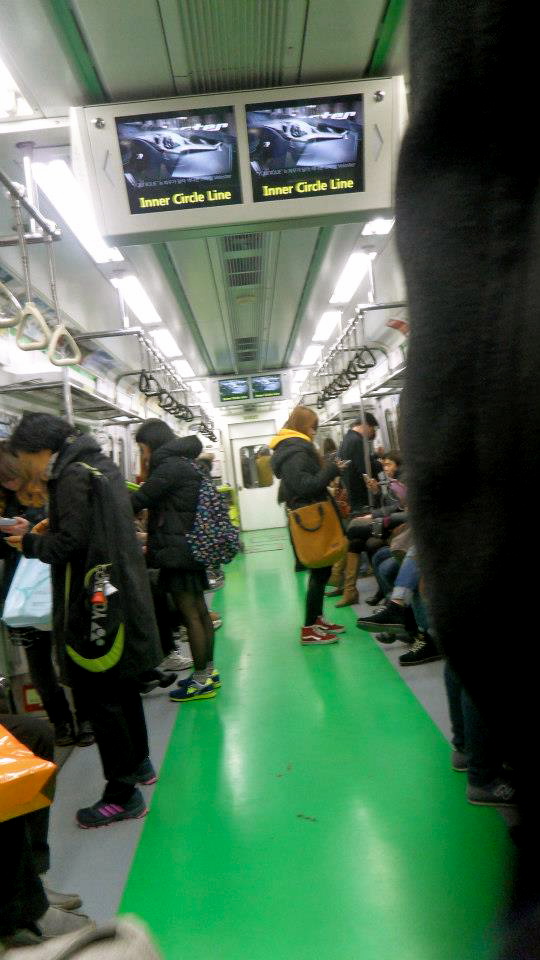
Subway in Seoul (on our way to the immigration office) to apply for our alien card

Subway in Seoul (on our way to the immigration office)

Before school started this week, the Yonsei International Committee organized many welcome events such as parties and dinner. There was even a party for all exchange students at the universities in Seoul so we could get to know more people.

There were also a lot of events held related to the Mentors Club. The Mentors Club is the equivalent of UR’s Ambassador Club: exchange students are paired up with a Korean student who will help them adapt to the new environment and show them the best of the Korean life, culture, language, and traditions. Mentors and mentees are then grouped in cells (groups of about 25 people) that do things together, go out for dinner, or attend some cultural events. Last Friday some of my cell members and I met for dinner to learn more about Korean cuisine and traditions. We had some dish with chicken and vegetables (relatively spicy I’d say, but nobody else really agreed with me) and then we had this huge pancake with sea food (I loved it! It was so delicious and not spicy at all so I was able to eat loads of it) and makkoli (very refreshing beverage made out of rice). It was really fun (apart from the fact I wasn’t able to eat much of the food we were served)! And my mentor is really amazing. His name is Junhyung and he’s a senior at Yonsei with a great passion for djing. He’s also the leader of the cell so he’s in charge of organizing events. I loved how during that cell evening we were all able to get to know each other better and to learn more about Korea.

Seafood pancake and makkoli, a Korean food that I really like!

Seafood pancake and makkoli

Inevitably all the tours, new climate and environment, and very cold weather took their toll on me and I got sick (I know I was in Sweden last semester in temperatures of -8F and I didn’t get sick, but Korea is something different). It was frustrating being in bed the past few days; I just got here and I wanted to go out, explore Korea, and meet new people, but instead I was chained to the bed by my fever and cough. At least I did get better in time for school!

This week is the first week of classes. Initially I was registered for four classes: US-Korea Relations, International Conflicts and Cooperation, Free Trade Agreements, and German Romanticism (this one has a funny story behind it). I thought of taking Beginner Korean, but I just wasn’t able to fit it in my schedule. That is why I will participate in FLE (free language exchange) where I will be paired with a person who will teach me Korean and I will teach them one of the languages I speak. I am really looking forward to the program to start!

All of my classes seem really good and I like them, particularly Free Trade Agreements as the professor seems to be so passionate and knowledgeable about the topic (she used to work in this field in the US, Korea, and China) and as I don’t really know much about anything related to economics, this will be a new experience for me. All the classes I am taking are in the “Study Abroad” department and basically all students in the classes are exchange and/or international students.

German would have been the only class I would be taking outside the “Study Abroad” department if it wasn’t for a big misunderstanding I had about this class. On Tuesday I was supposed to have my first German class and I went to the assigned classroom. The professor comes in and starts lecturing. IN KOREAN! I was so shocked. That was supposed to be a 300-level language class that at UR would be taught entirely in German, but Yonsei is apparently much different than UR when it comes to foreign languages. I was really sad as I was looking forward to my first German class in over a year. I had to improvise and get an override for the Modern Korean History class (also in the “Study Abroad” department). Now I am all set for the school!

Classes are structurally similar to UR classes as the final grade is based on attendance and participation, essays, projects, a midterm, and a final (unlike in Sweden where the final exam is 100% of the final grade). As this was the first week of classes we didn’t do much, just general introduction and course related explanations. Next week real lectures start.

The absolute highlight of this week was an Uppsala reunion I had with three Korean students I met while we were on exchange at Uppsala University – Taesung (he picked me up at the airport), Suji (she helped me get a Korean phone), and Eun Chong (back in Sweden we were in the same project group for one of our classes so we used to spend a lot of time together). In the spirit of the country (or the region) that bonded us, we went to the Scandinavian Design House near the Gangnam area (yes, like the “Gangnam Style” song). The was a Fika – Swedish Coffee Break café where we could get Swedish coffee, tea (or some other beverage) and typical Swedish cookies, cakes, and pastries (you can read more about the tradition of fika in the blog I was writing about my time in Uppsala last semester). We had kanelbulle and semla! They were so good – I really felt like I was partially back in Sweden. The most amazing part was seeing the three people who helped me make my decision about the spring semester study abroad destination and who helped me settle in once I got to Seoul. It was such a great afternoon and I had so much fun with Taesung, Suji, and Eun Chong. This was also kind of a farewell party as Taesung is leaving this weekend for Germany where he will be doing an internship until Fall.

My Korean friends who I met in Sweden - Teasung and Suji (Eun Chong left before we took the picture) - in front of the Fika place, where we enjoyed a typical Swedish tea time

My Korean friends who I met in Sweden – Teasung and Suji (Eun Chong
left before we took the picture) – in front of the Fika place

I guess now I have a bit more time to enjoy before the schoolwork kicks in, so I’m looking forward to the weekend! 🙂


Education and Experience (Posted by Blair in Ecuador)

February 25, 2013

We have now successfully made it through the first week of classes! For the SIT program, we have a Spanish Exam at the beginning of the semester, in which our language level is determined. In this SIT Ecuador program, the Spanish instruction is done through a program called Experiment in International Learning (EIL). EIL has a staff of Ecuadorian professors who have Spanish instruction education and experience. EIL also helped SIT with the homestay placements, so the Spanish classes sometimes incorporate specific interactions with the homestay families.

 The yellow bus gang is ready for our first day of school in Ecuador!

The yellow bus gang is ready for our first day of school!

On Monday, we were placed in our different classes; ours is the biggest class. We are seven girls sitting around our square table with Profe Vladimir at the white board at the front. School is in some extra classrooms of a state pre-school/childcare facility, so there is a picture of the pope and some holy crosses scattered throughout the room. The general class layout is a two hour segment of grammar, followed by an hour and a half of cultural learning, then a final hour of vocabulary and slang. We have breaks between each section and chow down some snacks brought by the EIL program, usually typical Ecuadorian food.

For instance, on Monday, we went over the subjunctive and conditional tenses, ate an Ecuadorian bread-wrapped-in-a-leaf snack called quimbolitos, read about the Incan history of the Valley of Los Chillos, then learned about the history of Ecuadorian slang and its connection to Kichwa, the language of the Incans.

On Wednesday, after learning about connecting words in the morning, we watched an Ecuadorian movie named “Qué tan lejos” about the journey of an Ecuadorian girl to get to Cuenca and break up a wedding. Throughout the whole movie, we were asked to write down Ecuadorian slang and our profe paused it every once in a while to make sure we were clear on what was happening. He also paused at points to talk about the Ecuadorian landscapes we were seeing and the different cultural aspects, such as the music, and political connections with the roadblock. We finished the day off with a game: each person chooses a Hispanic character, writes it on a piece of paper, and tapes it to their neighbor’s head. Everyone then has to ask questions to determine who they are. The best part was that our profe, the only guy in the room, was the only female character: Dora la Exploradora.

Class photo after the game, still with our character nametags which we used for the game in class

Class photo after the game, still with our character nametags

We also have special days that provide a different type of learning. On Thursday, we had a mini learning excursion into a nearby town, Sangolquí. We went to the church in the center plaza, where our professor told us about how the Spaniards used the Catholic church, from the architecture of the actual building to the masses and ceremonies held inside, to assert their control over indigenous Ecuadorians. Afterward, we went to the town park and library, where we read a bit about the history of the town and checked out the library. Sangolquí is a small town, much like Ashland, Virginia. However, its library is one floor of a tiny building with about 5 small bookshelves, 3 computers, and a stack of newspapers. Our profe was explaining that reading is not a popular activity among any age group, which is reflected in this library. We then went to the town market, where we spoke with some of the vendors about their sales, which have gone down significantly with the installment of a Wal-mart brand supermarket, MegaMaxi.

Profe Vladimir and class heading into Sangolquí Church as part of a class "field trip"

Profe Vladimir and class heading into Sangolquí Church

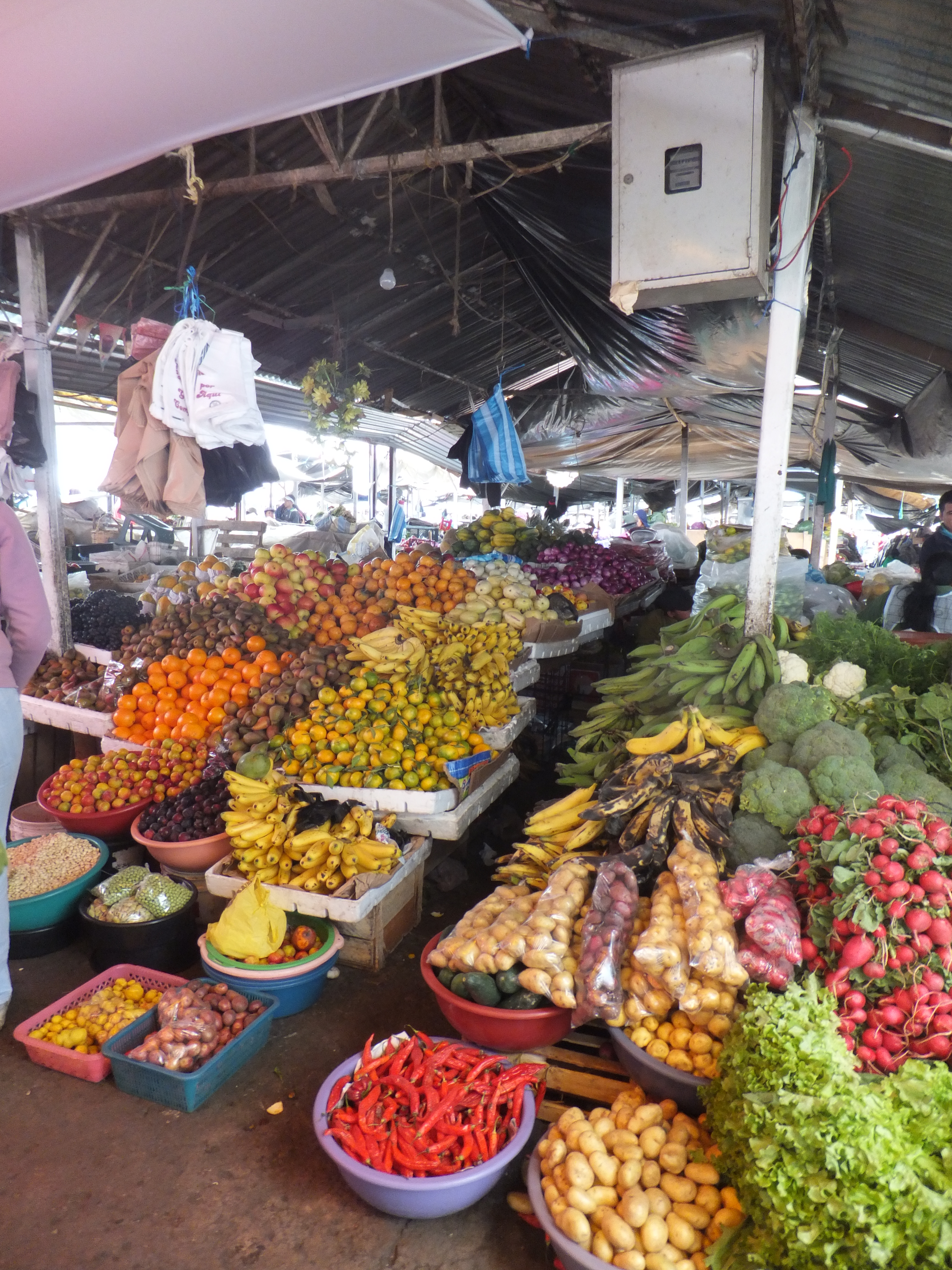
A tiny selection of the wide array of fruits, veggies, and other produce items at the main Feria of Sangolquí, a local market

A tiny selection of the wide array of fruits, veggies, and other produce items at the main Feria of Sangolquí

We also have had a couple academic seminars during this week. We have a 20 Questions activity that we have to complete throughout the semester. It is an opportunity for cross-cultural learning, with questions from “How much importance do people place on appearances?” to “What does it mean to be a part of a family?” and “How can you ascertain the importance of God in people’s lives?” There are four parts to the assignment: the first part is observations of how people naturally behave, followed by explanations of why this might be the case. The hard part is that we then have to talk with two or more people about what they think of our observations and explanations, but without simply asking them the question. The final section is reflections, in which we discuss how willing people were to actually converse on the subject and how the culture ties into the question and answers.

At first, I really felt this was a silly assignment, it seemed we could learn more simply observing and that the conversations would be uncomfortable. However, I have realized that the assignment leads to an essential learning and very informative conversations. People are generally very willing to talk about the question, they are often interested to know what I think and sometimes see an aspect of their own culture for the first time.

This program ensures that we are always learning. From waking up and insisting that I do not need to eat three pieces of bread with ham and egg along with my fruit and smoothie for breakfast, to navigating my way back home in the evening and attempting to discuss the day around the dinner table, Spanish class is the least learning of it all! More than just taking in information, we’re forced to analyze and use it every single day. I have to remember that my profe said that we do not throw things in Ecuador because it’s seen as rude, as well as the warning we received during a 20 Questions Seminar about lending things because you might not see them again.

The only source of knowledge is experience. -Albert Einstein 


Bernin it up! (posted by Pierre en Suisse)

February 22, 2013

Bonjour à toutes et tous! This is to say, hello to all ! This is typically how emails that I receive from the University begin. For those of you who are not familiar with the French language, toutes and tous both mean “all,” so essentially I just said hello to all! However, in French there are also the different genders. As such, it is necessary in various circumstances to use both the masculine and feminine forms when sending mass emails or writing to many people! It doesn’t happen all the time, but it does often with official emails. Hope you enjoyed your free French lesson of the day!

What a whirlwind the past two weeks have been. To sum it up really fast before reading on, I have experienced fondue and the festival known as Carnaval. Within the course of a quick four days, I feel as if I got a lot of Swiss culture really fast, but it was all amazing! I will start with the food.

Last week, I went out to fondue with my cours de vacances class, which you may remember reading about in my last entry. Fondue is a very traditional Swiss meal. It is not the typical chocolate fondue that we like to think of using fruit, although one can find it. Rather the Swiss eat bread, a mixture of cheese, and then finish the meal off with wine or tea. The cheeses most typically used are gruyere and emmenthal, melted together in a pot. At the restaurant, we were presented with a plate of bread, and it is your job to take a piece, break it up, put it onto the “fork” and cover it in cheese.

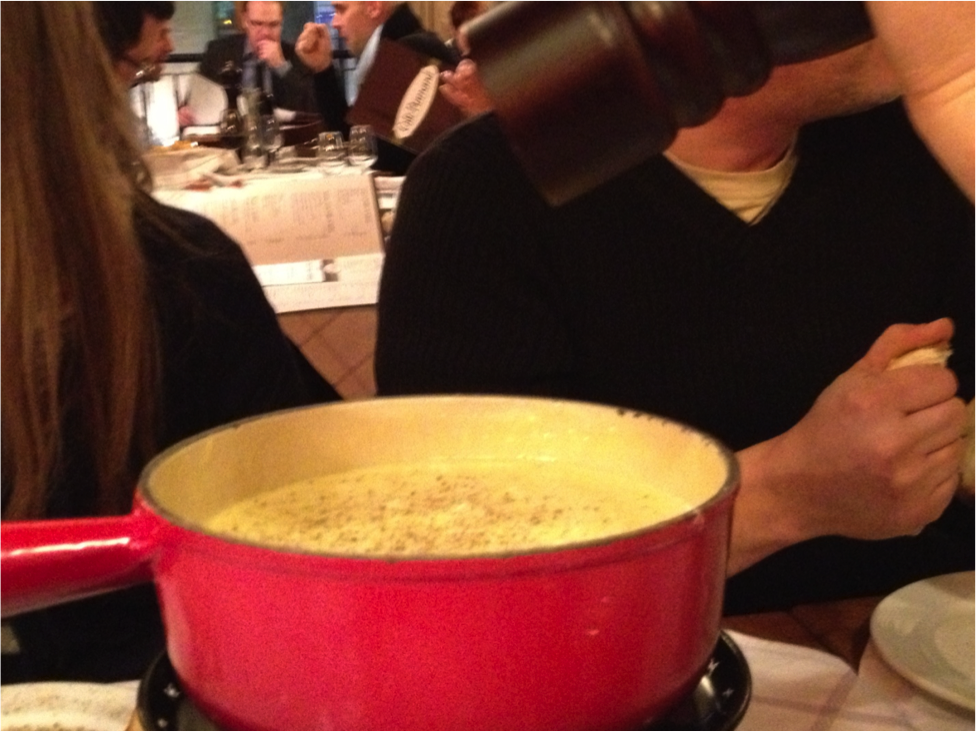
Cheese for the fondue! Bread is dipped into this pot

Cheese for the fondue!

The utensil used was something that I’m used to roasting marshmallows on. It is also critical to make sure you don’t delicately or lightly cover it just to taste the cheese. It was completely obvious to all Swiss people around me that it was my first time eating fondue. I was instructed by a friend who comes from the German part of Switzerland to completely sink the piece of bread into the cheese, then pull it out and let the excess cheese fall off. One also must pay close attention that the bread doesn’t fall off of the “fork” because then the person who lost it needs to either sing or do some other embarrassing task that the table decides. Luckily, this didn’t happen to me. When the cheese is all gone, there is usually some burned cheese left on the bottom of the fondue bowl. According to the fondue experts, this is the best part, and cannot be left! I tried it and must say I loved it. While this entire meal is going on, you need to drink either white wine or tea with the fondue. Otherwise, your stomach is going to be left to digest a block of cheese. While it was very filling and unlike anything else I’ve ever eaten, I did absolutely love it and I am excited for the next time I’ll get to try it!

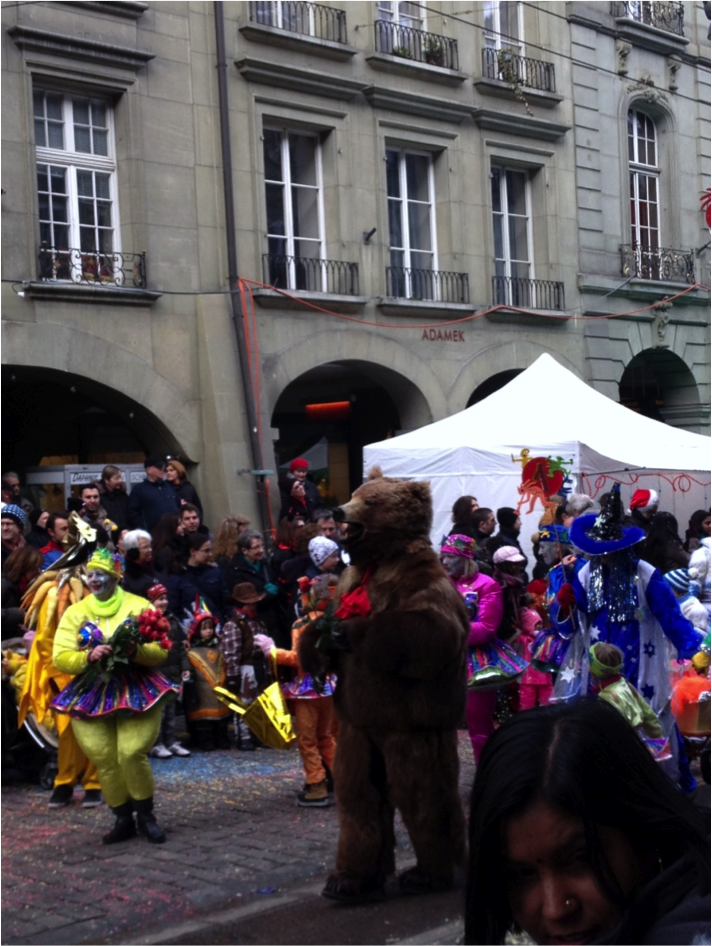
The food experience certainly doesn’t stop there. This weekend I also got to go to a Swiss festival known as Carnaval! It is very similar to the idea of Mardi Gras, though it happens throughout the country on various dates, beginning anywhere from the weekend before Ash Wednesday to the end of May in some cases. On Saturday morning, a friend and I hopped on a train and headed into Bern for Carnaval in the Swiss capitol city. After a breathtaking train ride through the mountains, we arrived in the city, without a single idea of where to go! Our friend who had planned it wasn’t able to go at the last minute, so we had to improvise in order to figure out where to go. The one thing we did know about Carnaval is that people would be dressed in very colorful costumes. Luckily, we saw some people dressed up for the party and followed them from the train station into the city, until we found where we were supposed to be. Along the way, we saw some of the famous sites such as the Swiss Parliament building, and the most elaborate clock tower I have ever seen (so far). Included in this tour was trying probably way too much food that we found at various street vendors lining the main street of the festival. We ate things such as tarte flambée, crêpes, and of course, German sausage. With our stomachs filled, we lined the street with the rest of the carnaval-goers! In Bern, it is tradition to commence carnaval celebrations with a freeing of the bear that had been captured and held in prison for its winter sleep, and so the parade begins with the bear leading the way.

The carnival parade starts when the bear comes marching through the street!

Parade starts when the bear comes marching through the street!

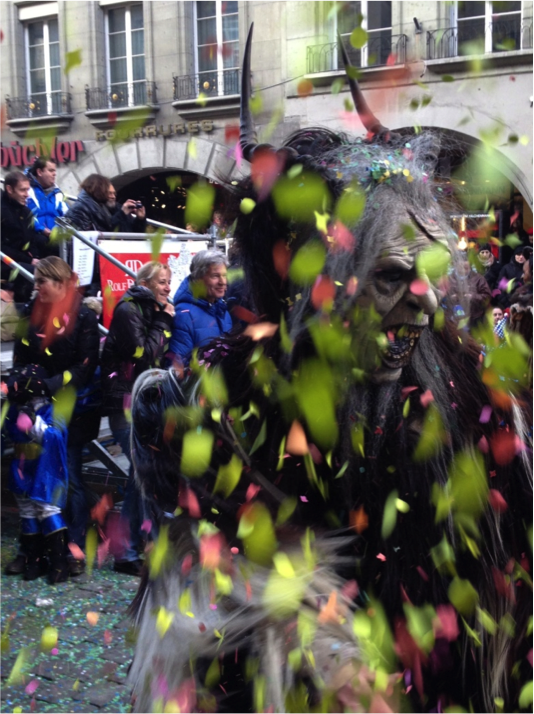
After the mascot passes through the street, there are marching bands dressed unlike anything you will ever see in your life, playing all kinds of music, and throwing candy to the crowds. There is also a lot of confetti throwing. If you ever go to a Carnaval in Switzerland, don’t be surprised when a kid maybe as young as six year old looks up at you, takes a handful of confetti from a bag, and throws it right up at you with a huge triumphant smile. People usually have confetti of their own to throw right back at whoever throws it at them, but my friend and I didn’t know about this before everything began, so we generally just laughed with surprise when we would get covered in all sorts of colors. I absolutely loved Bern! The city was truly quite beautiful and the festival was amazingly fun!

So many colors at the carnival parade!

So many colors!

There were many creatures like this who also joined in throwing confetti throughout the parade

There were many creatures like this who also joined in throwing confetti

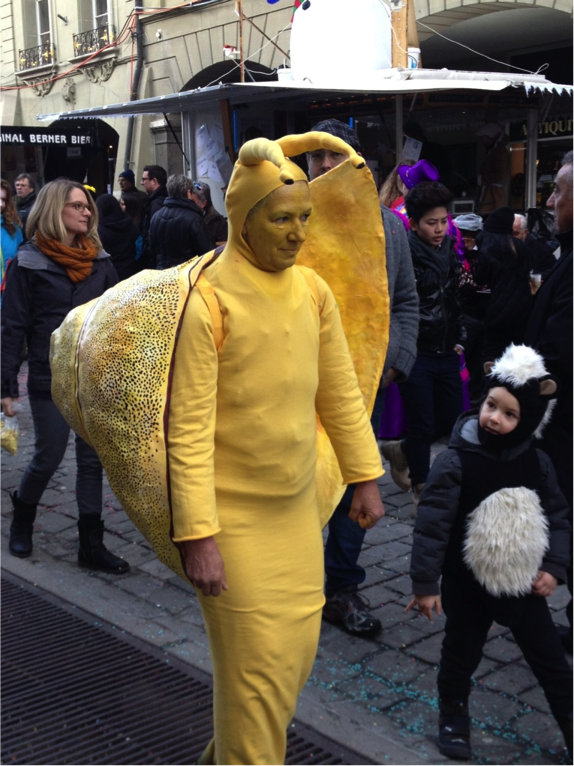
Probably my favorite site at Carnaval was this lady, who was dressed like a snail and walking at the same speed as a snail (despite kids throwing confetti at her the whole time).  A good idea of the carnival atmosphere

Probably my favorite site at Carnaval was this lady, who was dressed like a snail and walking at the same speed as a snail (despite kids throwing confetti at her the whole time)

This week has been the first week of classes. Stay tuned for my next post to hear about just how very different of an experience trying to get settled into classes here at a large university has been, and also to get a glimpse of some photos of the Alps, as this weekend I’m headed skiing! Thanks for reading, and à bien tôt!


Courses, Travels, and Cheese (posted by Pierre en Suisse)

February 13, 2013

Salut! I am now entering my third week here in Switzerland, and I can comfortably say that I’m getting settled into life here. Over the past two weeks, I have been participating in the University of Lausanne’s cours de vacances (vacation course). The course is designed for people of all ages and all levels of French who wish to improve their French language skills. There are three different levels, and I am in the class which is essentially been a preparatory course for taking classes in French at a Francophone university for students whose maternal language is not French. The class has students from all over the world; I have met people from the German part of Switzerland, Russia, Australia, Mexico, and other places, of a variety of ages as well. I am on the younger end of the spectrum, as the course is open to people of all ages who wish to improve their French. With such a diversity of people, it is pretty amazing to hear all the languages that can be spoken at once. One morning in particular, I remember reading an article in English while having a conversation in French at the same time, and hearing people speaking German around me; while all this was happening, one Russian girl even began speaking to another in Russian at one point to figure out how to say something in French. Yes, it can be a tad confusing at times but overall I think it is amazing.

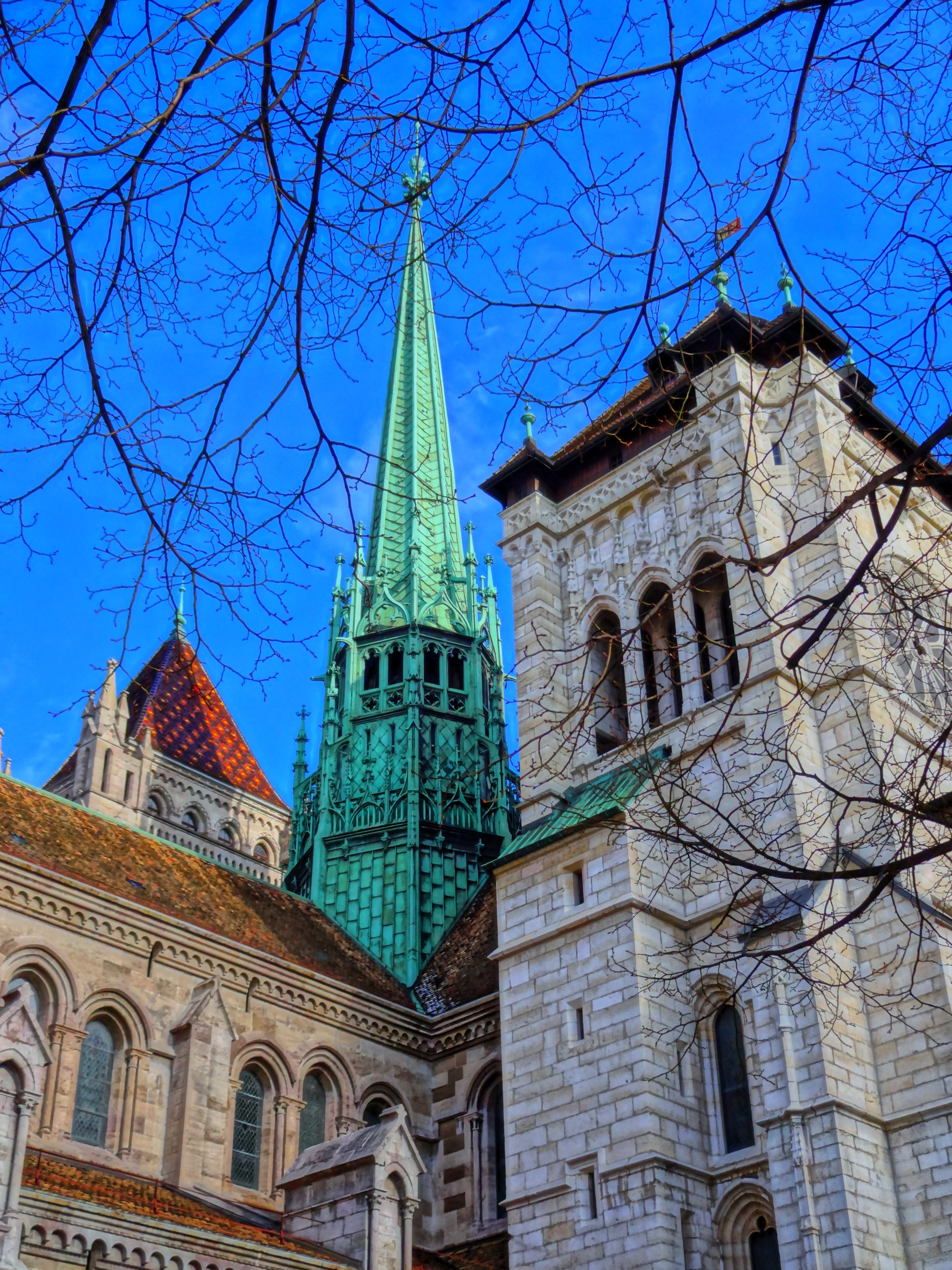
One day after class last week I hopped on a train to go to Geneva. The university has a program that pairs exchange students with Swiss students to introduce us to Switzerland and help us get adjusted as well. My partner lives in Geneva right now. Luckily, the Swiss rail system is incredible, and after a quick half hour train ride without a single stop from Lausanne and some really pretty views of the snow-covered Swiss countryside, I was back in Geneva! This time I got to see more than just the inside of the airport; I got almost a full tour around the city!  I learned quite a bit about the city that I didn’t realize before, such as the fact that the famous philosopher Jean Jacques Rousseau was born there, and not in Paris as many people believe. I got to see his statue, and also the entire city from the top of a church roof!

Statue of Jean Jacques Rousseau in Geneva!, because this is his birthplace

Statue of Jean Jacques Rousseau in Geneva

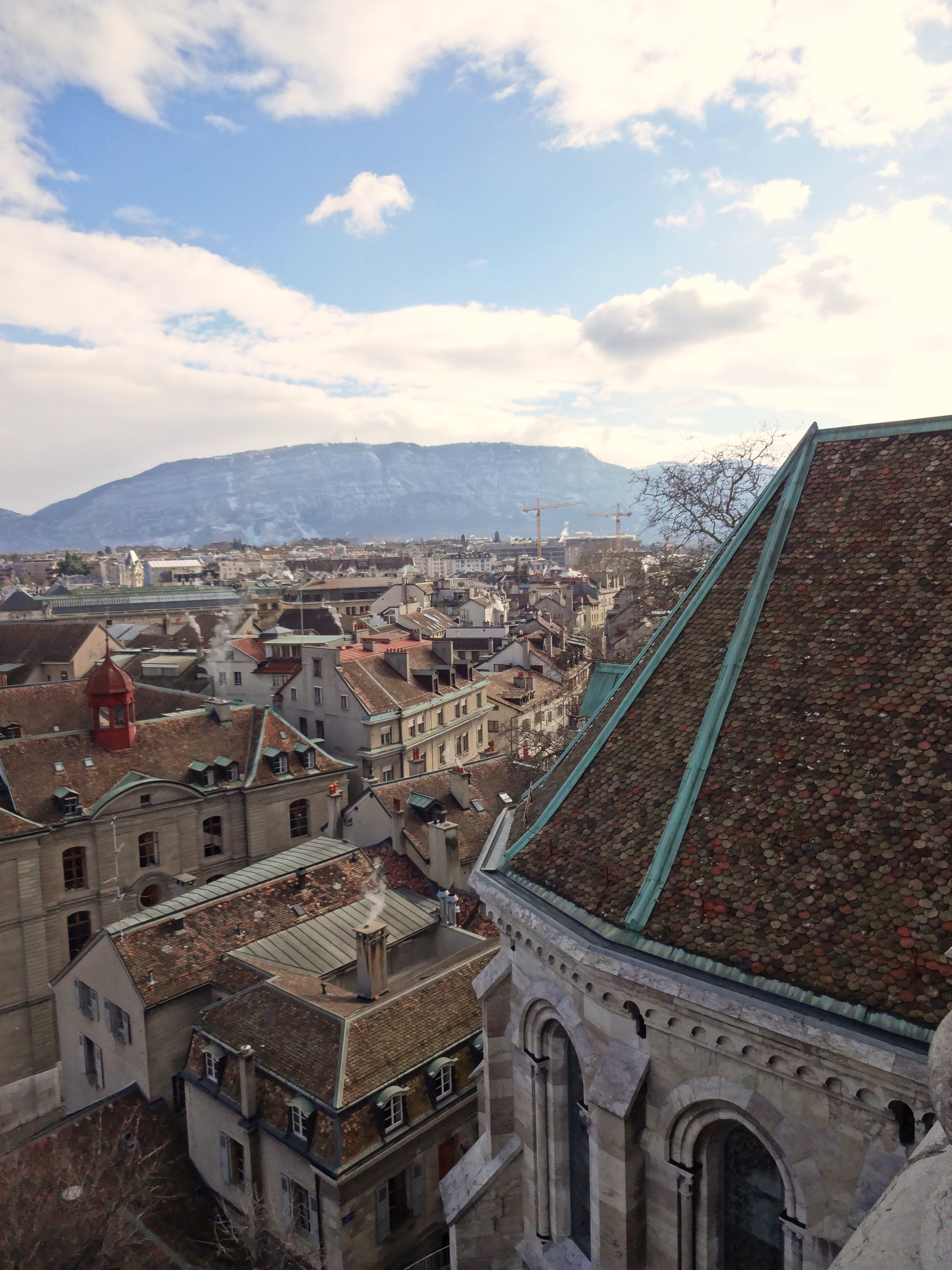
Went to the top of this church in Geneva and got a view of the entire city!  It's truly beautiful

Went to the top of this church in Geneva and got a view of the entire city

This is a rare occurrence in Switzerland at this time of year, because of how much it likes to rain and be cloudy in these parts during the winter. The city seems like quite a great place to live! There are a ton of parks, places to go swimming, and beautiful views.

View of Geneva from the top of the church! Made possible because of gorgeous weather

View of Geneva from the top of the church

The city’s public transportation network, just like that of the other places in Switzerland I have seen, was also quite interesting. There were buses and trams, which were a new site to me. I am extremely interested in urban studies, and as such it was really cool for me to see how advanced the city was in its transportation network. I’ve found that its the same in Lausanne. The metro lines are always running on time, and are so very clean and up to date. The buses even generally run on time, except for a few very rare times that they have been one or two minutes off in the morning rush to work and in my case, school. The Swiss stereotype of being on time definitely holds true!

I am also happy to report that the chocolate has been incredible, as I was expecting. I will admit I never go a single day without it. While prices of basically everything are really expensive here, the grocery stores always have bargain products which are still an incredible quality, and cost far less than the rest of the selection. I won’t lie though, going to the small patisseries and fromageries is my favorite shopping experience. My flatmate and I walked into a patisserie one morning for croissants for breakfast, and we essentially began drooling over everything we saw. The assortment of breakfast foods and breads just looked so good! The two ladies who I am assuming owned the store saw the looks on our faces and had to ask us if everything was okay, we were just so excited! We explained how we were here on exchange and this was our first time in Switzerland with a selection like what was there. We got pain au chocolate aka croissant-like bread filled with chocolate, and then a croissant au jambon which is a croissant filled with ham and cheese. Another time, I visited a small cheese shop, called a fromagerie to buy local cheese. I had asked a Swiss person for some advice on what to buy since there are just so many cheeses, and I wanted to try something really local to the area. Armed with some recommendations, I went in and was still overwhelmed, but I explained to the shop owner in French that I was American and I was here for studies and was investigating cheese. He helped me out quite a bit with the different types of cheeses and sold me two very traditional cheeses, called emmental and gruyere, just to start me off. He also explained to me that it would be a good idea to start off with lighter cheeses before moving on to the stronger stuff, so I really appreciated his advice! I made a second trip back there after I finished my first cheeses and they remembered my face and helped me buy other types after I told them what I liked! Can’t beat service like that!

Needless to say, life so far in Switzerland has been great! I am enjoying my time here immensely, and am really looking forward to next week when I will be starting real classes here at UNIL. I have some ideas of what I will take, but nothing set in stone just yet. More on that next time though!


Centers of the World (posted by Blair in Ecuador)

February 4, 2013

My first day at Quito’s 9,350 feet of altitude after a long flight began by meeting up with two girls from my SIT program (Camila and Teaghan) and two more whom they had met in their hostels. We headed to the Central Market in Centro Histórico/Old Town together to grab some breakfast before exploring the city. We were convinced that the soup we were being sold did not have actual sangre (blood), but rather an ingredient which they called sangre simply due to its color or consistency: silly assumption. We enjoyed the experience for what it was, got some extra iron in our oxygen-deprived bodies, and continued on to silly assumption number two!

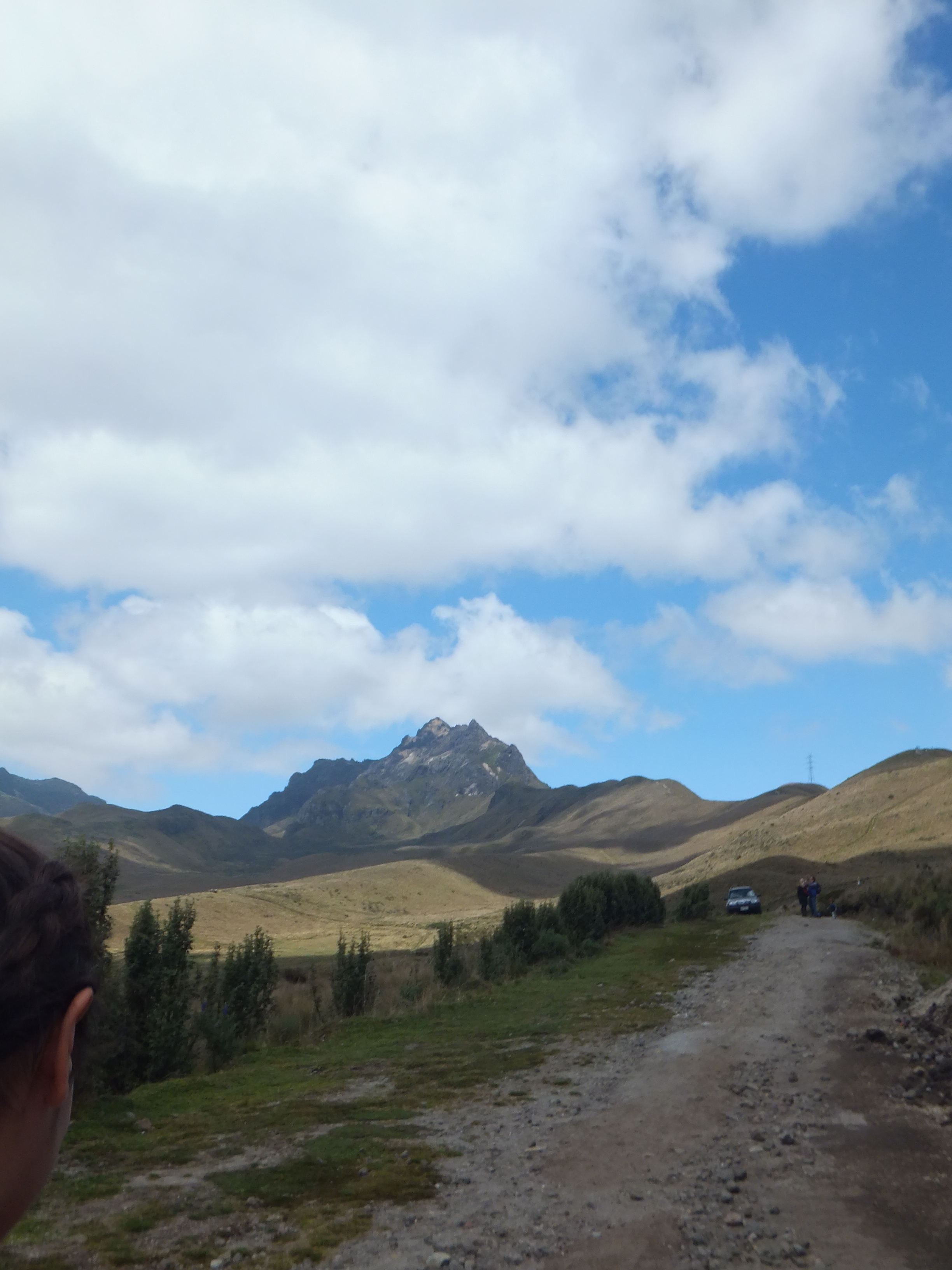
We hopped a taxi, filled it with one too many people, and went up a nearby mountain on the TeleferiQo (Quito slyly snuck their Q into that one, but it’s just like any other ski-lift style hanging cars that take you up a mountain). On the way up, I clearly remember saying to the group “Hey, maybe we should walk down on that trail, it looks like a good time.” I could hardly make it to the door of the hotel by the end of the afternoon. At the top of the TeleferiQo, I learned that we had plans to hike up higher so we started walking up. I had no idea that the plan was actually to climb the inactive volcano seen in this picture. Below is another picture showing how far we actually made it and how much relaxing had to be done.

Pichincha Volcano which we hiked near

Pichincha Volcano

Pichincha Volcano from our calling-it-quits point after we were too tired to continue

Pichincha Volcano from our calling-it-quits point

That night we met our academic directors and a bunch of the SIT group arrived in Quito! Our directors introduced themselves: Fabian, an Ecuadorian Anthropologist who seems to know absolutely everything about his country, and Leonore, a US citizen who moved to Ecuador to raise her children and who can tell some great stories. They asked us to pack a bag for a couple of days, fed us a delicious Ecuadorian corn-husk snack, and sent us off to bed. The next morning, we headed out to San Antonio de Pichincha, better known as the location of “La Mitad del Mundo,” a monument to the ‘center of the world’ with a line marking the northern and southern hemispheres; unfortunately, the line is in reality a bit off-center by current calculations.

Orientation in San Antonio consisted of reviewing schedules and expectations, health and safety guidelines, an introduction to experiential learning, lots of discussion about the homestays and cultures in which we will be living, an overview of the rules and regulations, etc. There was plenty of time to get to know one another a bit, as well as time to eat delicious typical Ecuadorian foods (we actually ate about five times a day!). We took advantage of the opportunity to practice our Spanish and to meet our first Ecuadorian friend, Roberto, the son of the Hostería owner. The directors had also set up a night to watch an Ecuadorian movie, a night to hear some Ecuadorian/Andean music, and a salsa class with Maestro Lucky! We also had a couple of “drop-offs,” in which we went to a certain part of town in groups to learn about the area; this observation and asking questions is a sort of introduction to what we will be doing with the Independent Study Project (ISP) later. Finally, we had the opportunity to talk with students from different universities of Quito about all sorts of topics: Ecuadorian slang, travel throughout the country, politics and religion, and everything in between.

Orientation also included a required reading of “The Green Banana,” a personal account by Donald Batchelder of “temporary difficulty, resulting in a discovery which resolved the problem while opening up a whole new perspective of shared belief and speculation.” He admits that the green banana had only ever been an unripe fruit to him, while the people whom he met had known of its properties and uses for years. The tale includes a rock which the people state marks the exact center of the world and how each person has his/her own center of the world; the author states, “Personal discoveries converge in a flow of learning moments, developing a healthy tug of war between that original center of the world from whence we come and the new center being experienced.”

Because of the orientation schedule, I did not get to visit La Mitad del Mundo monument in San Antonio. However, I believe my entire semester in Ecuador will be full of encounters of centers of the world, from the Intag Cloud Forest in northern Ecuador to the Rain Forest in the South, and that I have a lot of learning to do from all the people who I have the opportunity to meet along the way.  Donald Batchelder says it best: “Personal discoveries converge in a flow of learning moments, developing a healthy tug of war between that original center of the world from whence we come and the new center being experienced.”

Who knows, maybe I’ll even find a green banana or two along the way?

Quito from above: my home for the next few months

Quito from above: my home for the next few months while I study in Ecuador


You can read Donald Batchelder’s “The Green Banana” here: http://suzy-friendship.blogspot.com/2010/09/green-banana-donald-batchelder.html


Culture Shocked! (posted by Pierre en suisse)

February 1, 2013

Madames et Monsieurs:

Bonjour! As I write this, my first week in Lausanne, Switzerland, is coming to a close. It has been such an incredible week; trying to collect all of my thoughts in order to write this has been such a challenge! A French word that describes what I am currently experiencing is habitué (hah-bit-chu-ay; or go on google translate to hear it said if you like) which means, not surprisingly, to accustom, to get used to, or to habituate oneself. Fortunately, I can report that this process is going quite well!

No matter how well my adaptation here has been going, there is still a huge list of things that I could never have been prepared for. As silly as this sounds, I was not really prepared to start speaking French at first! I first realized this when I stepped onto the airplane and was greeted with “bonne soir monsieur!” rather than good evening, like I would have expected. When I stepped off the plane and was in the Geneva Airport, my first step was to go through customs; when the official was asking me to step forward in French, he had to repeat himself several times before it registered with me that I had to move. If I got into anyone’s way while walking through the airport, my gut reaction was to say “oh sorry!” after this happened several times though, I remembered that I should be speaking French instead, and say pardon! If you read my first post, Last night in the US, you may recall that I was very nervous to come here, since it is my first time traveling abroad. I was really afraid that I would have trouble getting from the airport itself to Lausanne. I did make it though, finally, and it was magnificent! I took a taxi from the train station to my hotel, and successfully had my first conversation in French with the taxi driver who did not speak any English.  I was so proud afterwards! After checking in at my hotel, I quickly set out to explore the city.

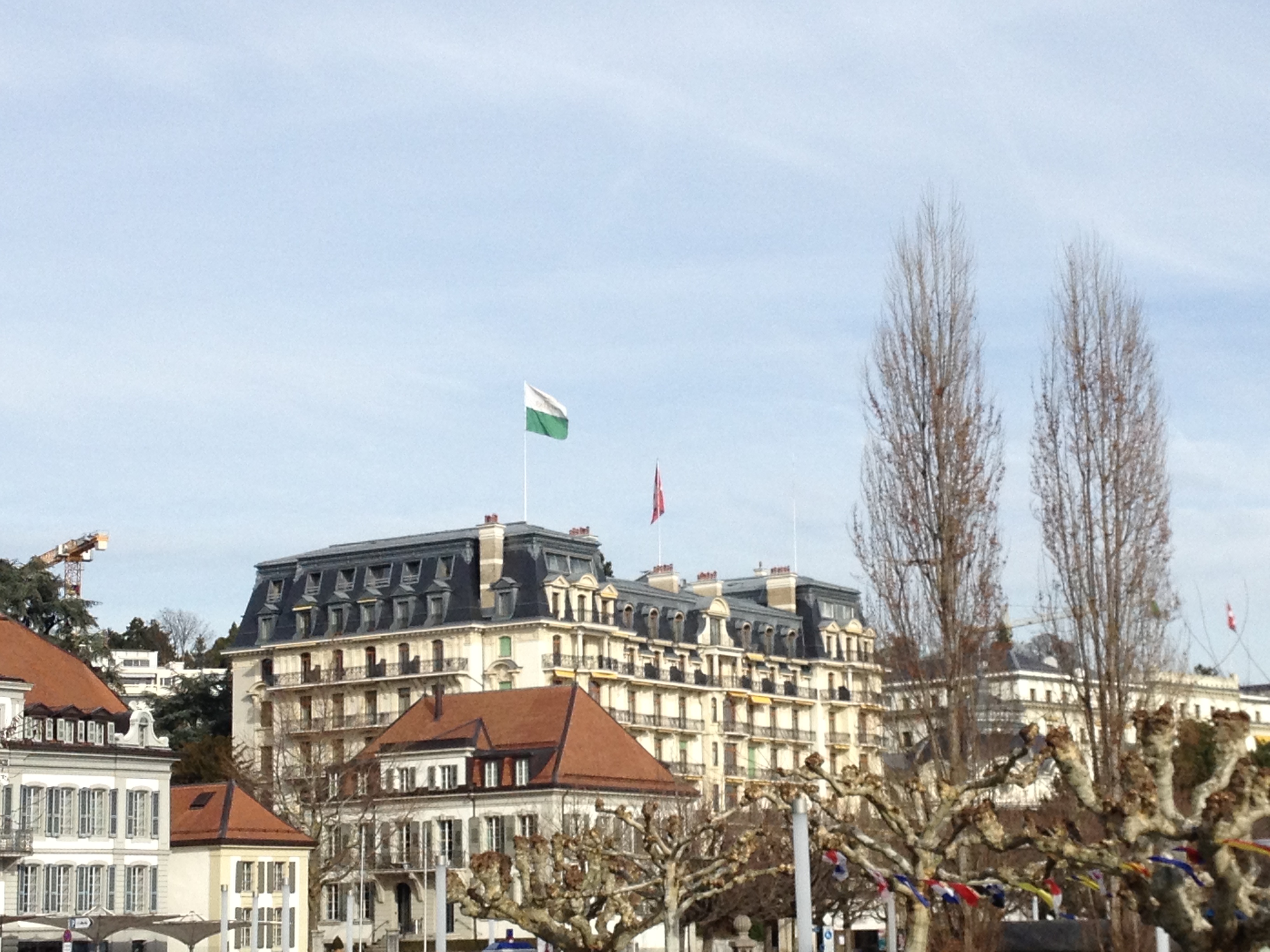
Beautiful buildings here in the heart of Lausanne!

Beautiful buildings here!

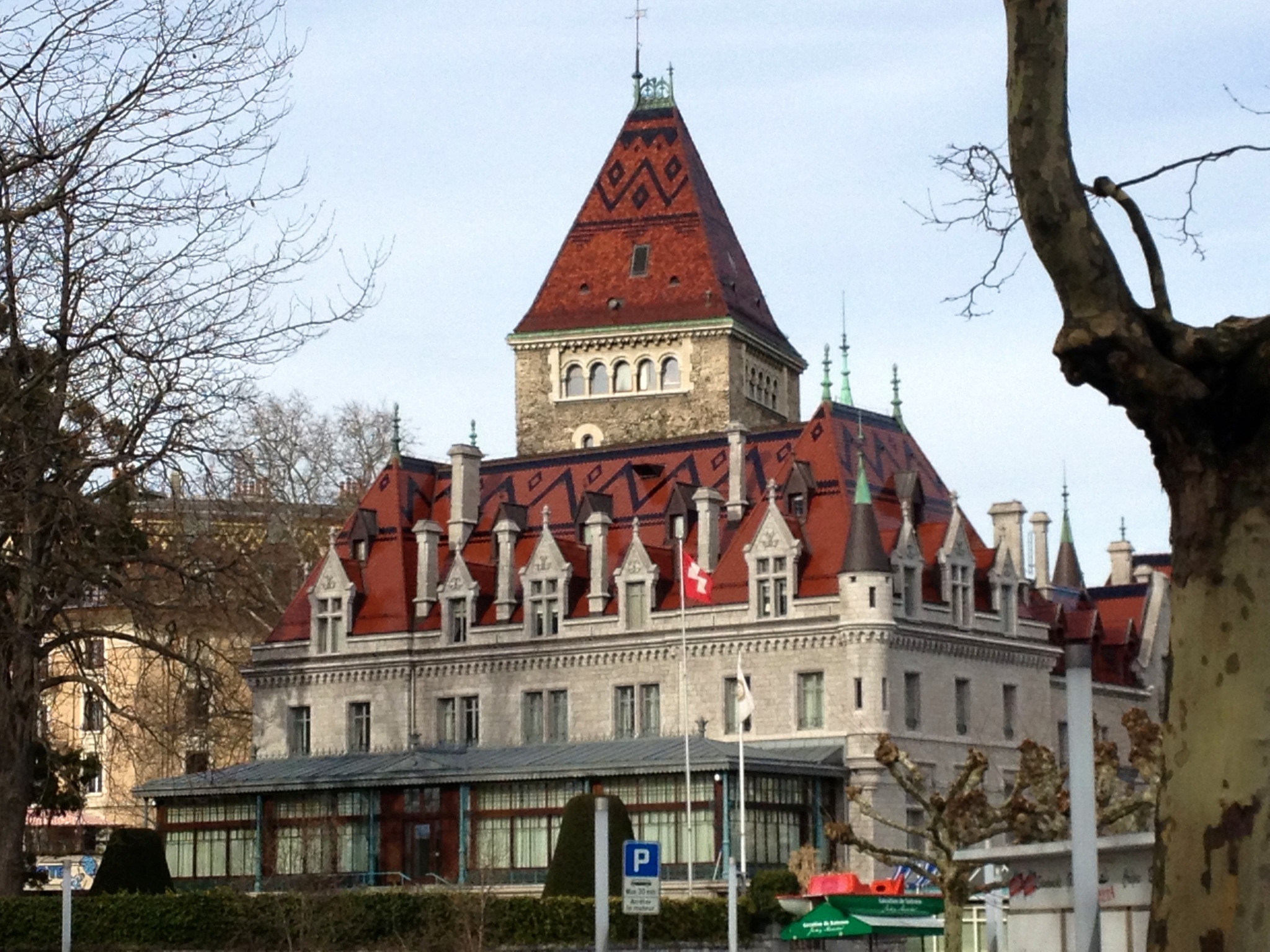
Another beautiful building, with such unique architecture!

Another beautiful building!

The buildings are a very interesting mixture between medieval architecture with some very modern twists here and there. However, amidst the cobblestone streets and pastel-colored buildings, there were so many people! Lausanne is a small city with about 300,000 people living there. However, walking through the streets, even on a Saturday and Sunday as I did the next day, it felt like I was in one of the busiest parts of New York City! Unfortunately on my first day, it was cloudy and I could not see the mountains. However, I reminded myself that there would be plenty of opportunities for this.

I don't think a picture will ever fully capture how beautiful these Swiss mountains are...ill keep trying though

I don’t think a picture will ever fully capture how beautiful these mountains are…i’ll keep trying though

The next morning, when I left my hotel room to go downstairs for breakfast, I am not lying nor exaggerating when I say the smell of fresh croissants greeted me. It was too good to be true, I thought, until I headed down and saw the breakfast display. It was as if I had never seen food before; I had no idea at first what to do to put a meal together. There were familiar things like fruit, bread, coffee, and nutella, but then there were other things that I was not expecting: swiss yogurt, which I discovered to be a bit more liquidy than the greek yogurt I usually eat at D-Hall but yet still so very delicious, different types of jams that I had never seen before, and various types of cheese spreads. I had never seen cheese like this at breakfast, so it really took me by surprise. When I chose a table, I noticed there was an empty jar in the middle. I had no idea what its purpose was at first, until I saw people around me putting things like food wrappers into them. This was how to get rid of my food trash, and to leave a clean plate for the staff to take away!

The list of surprises does not stop here. In the US, I am so used to having shops and stores, especially for food, open fairly late. Here in Switzerland, it seems like almost every store is closed by 7 pm, and it seems like anywhere for food that is still open after that is too expensive. It can be very difficult to find something after a certain time, so I have learned that planning ahead is very necessary. Another of my favorite differences is the vending machines for coffee that one can find spread out around the university. Even if you don’t have a cup with you, the machine will produce a small plastic cup for you if you ask for it. The coffee that is consumed here can fit in these cups. It is much more similar to an espresso than it is a typical Starbucks coffee. This also means it is much stronger, and for a coffee addict like myself, this has been an interesting adjustment. It has also been an adjustment for me to get used to the metro system here. It is not that the system itself is confusing, but the trains and buses at first can be a source of confusion. The doors don’t typically open by themselves; you must press a button at the nearest door to open it, or else you won’t get on the train. Before I learned this, I did miss a train once. I expected the door to open, and stood there staring at it, and nothing was happening. Eventually it just left the station, with me standing there feeling embarrassed. Luckily this hasn’t happened since then because I did learn quite quickly how the system works.

A brand new concept for me: coffee vending machines, right in my university!

A brand new concept for me: coffee vending machines

It is a huge understatement to say things are different here. Overall though, it is a great difference, and I know that in the coming months that I am here I will learn so much. I already notice my French improving a little bit, but it may also be that I am gaining more confidence in speaking with others. One of the main reasons that I chose to come to Lausanne rather than a large city like Paris was because I expected in a smaller city that there would be less people who would speak to me in English. This has held true, and there have been plenty of times where I would go to look for something like a cell phone and I would have no option but to speak French to understand my options. I think that this is going to be very beneficial in the end, even though at this point it can still be a bit difficult. But in any case, there are plenty more adventures and tales to come, but in the mean time, à bientôt!