Austen in Ireland: End of the Year – Cork, Liverpool, Belfast, and Finals

June 3, 2014

Right after getting back from Germany, I took the oral exam in my Irish class.  The Irish language was very difficult, but it was a neat experience learning another language.

The next day, I took a train ride to southwest Ireland to Dublin’s smaller sister–the city of Cork (Ireland’s second largest city).  Cork had a very different feel to it than Dublin with a laid-back attitude and with no tourists.  It was set on a nice river and had some beautiful architecture.  I would have argued that there were more pubs in Cork per capita than Dublin, which I thought initially was impossible.

We explored the city of Cork and ended up going to Blarney Castle.  A must while there was  ‘kiss the Blarney Stone.’ Kissing the stone is said to endow the kisser with the gift of the gab (or eloquence and skill at flattery).  The poison garden was another neat attraction at the Blarney Castle, which featured many lethal plants.

The following day, we took a day tour of the Ring of Kerry, a gorgeous attraction in the countryside of Ireland.  There were so many great landscape sceneries and also quaint Irish villages.  Although the weather wasn’t the greatest (fog really hindered our vision), the trip more than made up for it.

Ring of Kerry scenery.

Ring of Kerry scenery.

After getting back from this trip, I had my finals to conquer.  I had three finals in psychology, economics, and Irish.  My first final was a couple days after getting back from the Cork trip.  The whole experience of having to go off campus to an exam hall that fits 3,000 exam takers was intimidating.  I took a shuttle bus that UCD was running to the exam site and it took about ten minutes.

Once I entered the building, there were seat numbers for each exam taker at that time slot.  Once I walked into the exam room, it was overwhelming to say the least.  About 3,000 desks with uncomfortable chairs all lined up in many rows.  A lot different from Richmond, where exams are taken in classrooms.  The exam was fine but there were proctors walking up and down the rows about every ten seconds, which could get distracting.

Since I had over a week in between my first exam and other exams, I had planned a last trip to Liverpool and Belfast with my friends.

The city of Liverpool really surprised me.  It had one of the largest shopping areas I had ever seen and the dock area was very nice.  My friend and I had a jam-packed day.  We went to the Beatles exhibition, since no trip to Liverpool is complete without learning more about the Beatles.  Then, we went to three of Liverpool’s free museums.  We first went to the Merseyside Maritime Museum, where we learned much information about the maritime industry in Liverpool.  We then went to the International Slavery Museum, which explained the history of slavery in Liverpool.

Albert Dock, Liverpool.

Albert Dock, Liverpool.

The third museum we went to was the Museum of Liverpool.  This was a very interesting museum as it really explained the importance of the city, from the city’s large Chinatown to the rivalry between Everton and Liverpool Football Club.  Our next stop of the day was Anfield, the home of Liverpool Football Club, one of the most legendary soccer clubs in the world.  Our tour was fantastic and so was our very passionate tour guide.

Anfield, home of Liverpool Football Club.

Anfield, home of Liverpool Football Club.

We went into the press room where the manager talks to media after the matches, the home dressing room where Liverpool suits up, and the visitor dressing room.  We also were able touch the ‘This is Anfield’ sign which was an iconic part of the stadium.  After this, we went into the stadium and saw the field.  It was amazing being able to see this stadium and also sit right where the manager sits during the games.  It was pouring when we were outside in the stadium, but it didn’t dampen our spirits.  The tour was quite interesting and I was able to really learn a lot more about the history of Liverpool Football Club.  We also went to the museum and saw some of the trophies Liverpool had won.

We got into Belfast early the next morning and learned that there was a bike race going on in the city that weekend (the Giro d’Italia).  We got to our hostel and started our sightseeing in the Queen’s Quarter, which is where Queen’s University, Belfast is located.  This was a very beautiful campus with many historic buildings and nice greens.

Our next stop was the Ulster Museum, a National Museum of Northern Ireland.  It was such a large museum and very expansive.  It covered pretty much everything that had to do with the province of Ulster, where Belfast is located.  We then saw the Botanic Gardens, which had some interesting plants and flowers.  This day was so exhausting and we ended up resting afterward.

The Titanic Belfast exhibition was our main sight of the next day.  The Titanic was built in Belfast and the exhibition was amazing.  The exhibition had many interesting parts, including a ride (to see what it was like to work on building the Titanic) and also a virtual tour of the interior.  It was overall an excellent attraction.  Walking through the port of Belfast, it is apparent that Belfast had and still has a very large industrial part to it.

On our final day of the trip, we went on a tour to Carrick-a-Rede Rope Bridge and Giant’s Causeway.  Our first stop was the rope bridge and it was a somewhat frightening experience walking over a very shaky rope bridge, but the views of the sea from the island once you got across were really great. The main attraction was Giant’s Causeway though.  Giant’s Causeway is an area of about 40,000 basalt columns (mostly hexagonal), which are the result of an ancient volcanic eruption.  It is a UNESCO World Heritage Site.  Walking all the way out to the tip on the coast was magnificent but also tough as the rocks were quite slippery.
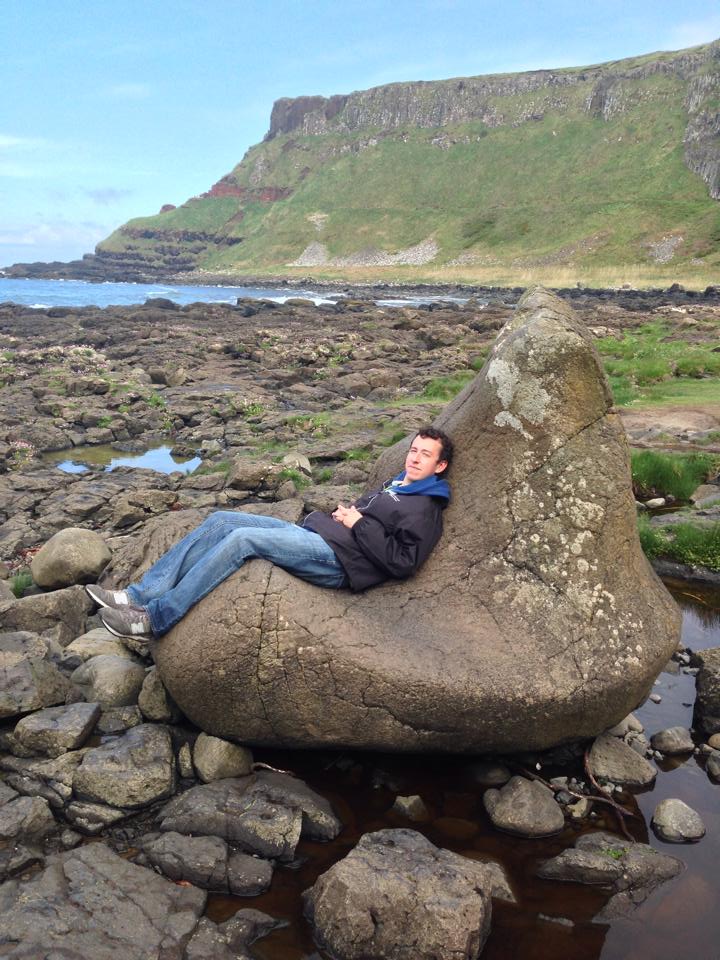
I found a nice rock at Giant's Causeway, Northern Ireland.

I found a nice rock at Giant’s Causeway, Northern Ireland.

This was really amazing and we walked back up top on the cliffs and were able to really appreciate the Giant’s Causeway Coast from up above.  When we got back to Belfast, we saw the Belfast City Hall, a marvelous building, before eating dinner and then heading back to our hostel since we were both leaving early the next morning.

Once I got back to Dublin, I studied pretty much the whole time before my last two finals.  It was a long day but I got through it and I soon realized that my time in Dublin would be coming to an end as I had to start packing.

I spent my last day sightseeing in Dublin.  I went to get my last fish and chips, to the Trinity Book of Kells exhibition and the Long Room, to the Science Gallery at Trinity College, to the Chester Beatty Library (religious history) and Dublin Castle.  I also just walked around the city, admiring the Irish atmosphere one last time.  I walked around O’Connell Street (I got souvenirs for many people), Grafton Street, and I ended up at pretty much where I started in Dublin, St. Stephens’ Green, a beautiful park right in the center of Dublin, and took some time to think of the great adventures and memories I will have from this semester.

I soon went back to the university and started packing.  Packing started off easy, but got more challenging when I slowly started running out of space. The next day (my last day in Dublin) was very much a relaxing day and I spent it packing and saying bye to friends I had made.  Although I had to get up early the next morning to leave, I figured I should spend one last night with the UCD Softball Club, as I made some of my closest friends in that group.  I ended up not getting to sleep until 4 a.m. that night and waking up at 6 a.m. but it was all worth it.

Saying my last farewells to the people, the campus, and the city of Dublin was challenging, but I know I will be back at some point in the future.  It was my most memorable semester so far and I would say the decision to study abroad (I decided last minute) was one of the best decisions of my college career.  It really opened up my eyes to another culture.  I am currently sitting at my home in the USA relishing the memories and wishing I were in Ireland.  I can’t believe I sometimes wished I were back in the USA when I was in Ireland.  I must have been crazy.


Urbanization in Ulaanbaatar

March 7, 2014

Our group had an interesting meeting with the head of Zorig Foundation in Ulaanbaatar. Zorig was a leader of the Democratic Revolution in Mongolia in the early 1990’s, and was an influential politician until he was assassinated. A main goal of the foundation is to focus on community development in Ulaanbaatar, and the head of the foundation lectured to us about the process of urbanization in Mongolia.

DSCN0173

Sükhbaatar Square at the center of Mongolia. These are some of the many new structures built in the city.

One of the most interesting aspects of the lecture was when we discussed the concept of “community” in Mongolia. As it’s a traditionally nomadic culture, there’s no word for “community” in the Mongolian language. Therefore, the concept of cities and Ulaanbaatar itself is a modern invention to Mongolians. Only about 2 generations of Mongolians have lived in Ulaanbaatar so far. The newness of the city and communities is important to keep in mind when discussing the issues within Ulaanbaatar.

Currently, about one-third of Mongolia’s population is nomadic, but about 30,000 people are moving into the city every year. The population of Ulaanbaatar has doubled since the 1990’s, and the city is overwhelmed with the sudden influx of people. Many of these new people are slightly mislead to believe that Ulaanbaatar is a city of multiple opportunities. Although there are many vacancies in employment, they require high-level degrees that formerly nomadic people aren’t often qualified for.

Many of these formerly nomadic families move into the “ger districts” on the outskirts of the city. In general, ger districts are the most vulnerable communities within Ulaanbaatar. Gers are the traditional homes that Mongolian nomads live in- imagine a sturdy, round “tent” with one room that everyone shares. It’s designed to disassemble quickly, and not so much to be connected to central heating or electricity. Therefore, many people in these ger districts have no access to running water and central heating, and generally have worse quality of life compared to those within the city.

DSCN0202

If you look closely in the background, you should be able to see the ger districts on the outskirts of the city.

Ulaanbaatar is the coldest capital in the world, and is also generally regarded as the second most polluted city. At first this may not seem directly connected, but it’s almost entirely caused by people heating their homes, most specifically in the ger districts. Many people heat their homes with coal because it’s abundant and cheap. This is the main reason why they use coal to heat their homes, and have therefore contributed significantly to the pollution of the city. Pollution is considered to be of the worst issues that Ulaanbaatar faces, and the destruction of the environment is a main theme in my SIT program.


Austen in Ireland: My Classes so Far

February 10, 2014

I’ve been really busy recently and haven’t even been able to post about my classes!  I am taking six modules (which are what they call classes here in Ireland).  I am taking three psychology modules: Lifespan Development, Counseling Psychology, and Visual and Social Cognition.  These are all relatively large classes of between 50-100 students (two are in lecture theatres) so it’s a lot different than Richmond.   Visual and Social Cognition seems like the most interesting to me of these classes as it’s topics are the closest to my interests in psychology.  For these classes, there are not too many assignments over the course of the semester so the few assignments count for a large portion of the grade, a significant difference from the US.

For my other three modules, I am taking a variety of topics.  For one, I am taking Health Economics, which will count as an elective class for my economics minor.  It seems like an interesting class because it incorporates economics, political science, and psychology topics.  I am also taking Irish for beginners.  This is my smallest class of about 20 students with all international students, which is a nice change from my other classes.  Irish is a difficult language so far and I’m not the best at foreign languages to begin with.  I find the class really interesting though so it should be a fun experience.  The last module I have is called Discovering Ireland: Landscape and it consists of just two field trips.  There are no lectures, we just go on the two trips and make journal entries about our observations from the landscape, buildings, etc. since it is an archaeology class.  I’m really looking forward to class because it seems like it will be a great excuse to see new areas of Ireland!

Overall, I’m looking forward to my classes and seeing what else I will be learning.  It is interesting to see the different teaching styles in Ireland, as there is virtually all lecturing and no class participation because of the much larger class size.  There are, however, smaller tutorial sections that meet a few times a semester for a couple of my classes that go over the topics in a smaller group.

photo (1)

The UCD campus!


Austen in Ireland: Orientation Week

January 27, 2014

So I’ve been here a week now and gone through orientation but it feels like I’ve been here so much longer with all that I’ve done!  Classes start tomorrow.

On Monday, I arrived in Dublin and took a bus to the UCD campus (luckily there were other study abroad students with me on the flight so I wasn’t completely lost).  I then checked in and unpacked all my stuff (two suitcases worth) for basically the rest of the day.  I also took a walking tour of campus to help me get adjusted to the campus, it’s a lot different from the brick buildings of Richmond because most of UCD’s buildings are concrete.  I then feel asleep at about 8 from the jetlag and slept for 12 hours!

On Tuesday, I went to IKEA (my first experience in an IKEA- it was possibly the biggest store I’ve ever been in) and purchased a bunch of things for my bathroom, bed, and kitchen.  I then went out into Dublin for the first time with some other students to eat dinner and go to a pub.  We went to a burger place and then went to a pub, where I knew I had to order a pint of Guinness, which was actually better than Guinness in the USA.  It was nice being able to see Grafton Street, the main pedestrian-only street with many shops in downtown Dublin.

Grafton Street

Top of Grafton street, a pedestrian-only street with mostly shops

On Wednesday, the actual orientation events began and they had an international student welcome.  It was in their biggest lecture hall of over 500 students so it was pretty intimidating compared to our small Richmond classrooms!  There then was an international student fair where they had some organizations with tables displaying their services to international students.  There was, for example, the career development centre as well as the library.  Also, there were the two main organizations that coordinate events and trips for internationals, the International Students’ Society (ISS) and Erasmus Student Network (ESN), which I joined for two euros each.  Both of these have trips and other events throughout the semester; I am hoping to go to Galway with ISS in a couple of weeks!

On Thursday, there were more orientation events.  There was one talk in the morning that was catered to study abroad students and laid out some tips about living on campus, safety, and how to register with immigration.  Then, in the afternoon there was an academic advisory for arts students (I’m technically an arts student).  This was centered more around academics and adding/dropping classes.  There was an Irish professor and he cracked joke after joke!  He went on about how they don’t allow guns on campus like in America or iPhones in class.  His jokes were sometimes borderline offensive but hilarious!  I then went to the on-campus pub after dinner, which was pretty nice and modern for an on-campus place.

Friday was finally a relatively down day for me.  I went to throw the Frisbee around with a friend for a little in the afternoon.  At night, the Erasmus Student Network held a pub crawl, so I decided to take that.  There were over 200 students on it, so we had a large group but we were divided into three groups.  We went to four pubs over the course of the night and it was really fun.  Some pubs were better than others but I would definitely return to a couple of them.

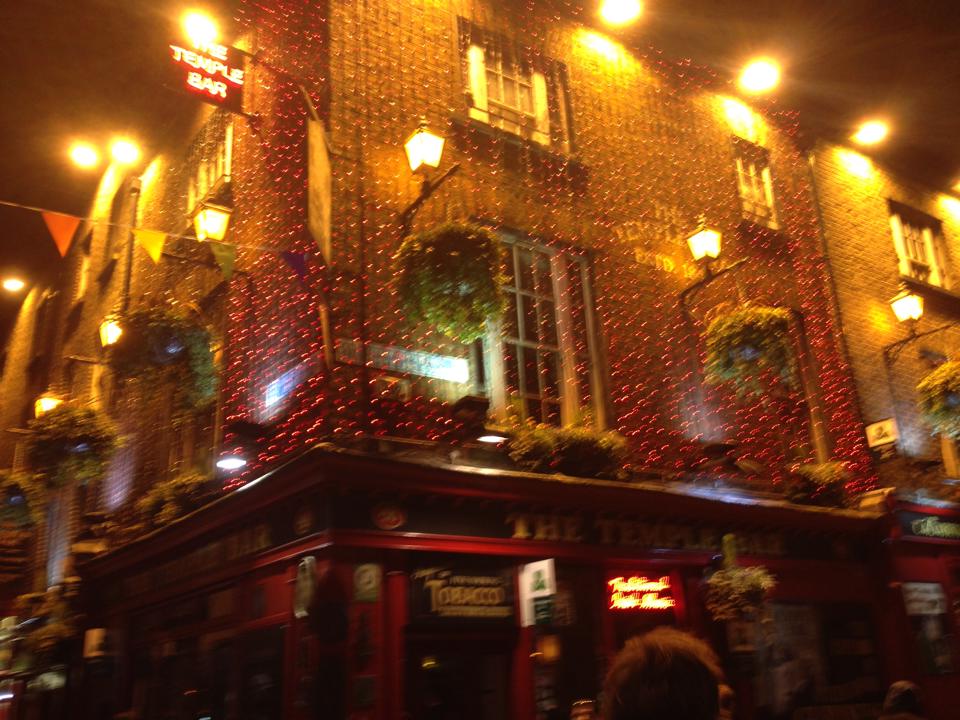
Temple Bar

Temple Bar is a world famous!

On Saturday, they held a “Discover Dublin” day trip so I decided to go on that.  In the morning, we went to the Guinness storehouse, a must-see when in Dublin.  It went over the process of brewing Guinness, which was really interesting.  There was a room at the top of the building at the 7th floor which had a 360 degree view of the city which was awesome to look at!  I had  delicious Guinness stew for lunch which and then we went to the “Guinness academy” where we learned how to pour Guinness, learning it is a two pour process.  We got certificates after we learned how to “pour the perfect pint of Guinness.”  For the second part of our day, we went to Croke Park, the fourth largest stadium in the world with over an 80,000 person capacity.  The all-Irish games are held here where all the counties of Ireland fight for the trophy in the sports of Gaelic football and hurling.  It was really neat learning about these two sports because I’ve never seen them before.

Croke Park

Croke Park: home of gaelic football and hurling; all Ireland games

For Sunday, I went on a Dublin walking tour of the city.  We saw St. Stephen’s Green, Trinity College, and many other sights in the city.  It was nice to finally be able to get my bearings somewhat.  I then finally got an Irish phone so I can now communicate with other students at UCD.

I’m looking forward to classes in one way but in another way I wish I could just discover Dublin, Ireland, and Europe for the next four months!


Mel in Chile: Is it really over?

December 19, 2013

Is study abroad really over? Well I didn’t have time to ponder on this question for too long. I left Santiago early on a Saturday morning. About a month ago my parents bought me tickets to visit my family in Europe. You cannot imagine my excitement!

So the reason I didn’t have much time to be melancholy about leaving my beloved Santiago was because in five days I was going to board a plane to London to visit my family! What’s more, two weeks after that I would board another plane to Albania to see the rest of my family. You can imagine on our goodbye dinner my emotions were a bit confused. I was extremely sad to leave my life in Santiago behind. On the other hand, I was absolutely ecstatic to see my family. Now that I have arrived in England, and am sitting in this lovely café in Reading, I feel I finally realize that yes it really is over. I will go back to Richmond on January 11th, not Santiago. To be completely honest, I am looking forward to going back to Richmond more than I can express in words. I think after working abroad in the summer in the Dominican Republic, and later studying abroad in Chile, I am looking forward to going back to a familiar and comfortable setting.

I am also a bit anxious. Even though I am coming back to a “familiar place” I wonder if it will be hard to adjust, if I will miss life abroad. When I get back I will dive into a full course load of core business classes. Registration was not too kind to me this semester. I have 8 am classes Mon/Wed/Fri and 9 am classes Tues/Thurs. I sometimes get worried I will be overwhelmed. When I think of all of this I seriously criticize myself for denying myself the opportunity to study abroad another semester in Santiago. It is at this precise moment that I realize why I initially decided to come back to UR.

I came back for the academics, for the resources we have (career center, center for civic engagement, common ground, free tutoring), to have access to professors and other mentors I have at the University, to spend more time with my friends. Most importantly I came back because I am excited to look for the ways I can become more involved in the Richmond community at this point in my academic career. Studying abroad helped me understand who I am and what I care for. I am looking forward to re-entering the Richmond community (both UR and the city of Richmond) as someone a bit different than when I left.

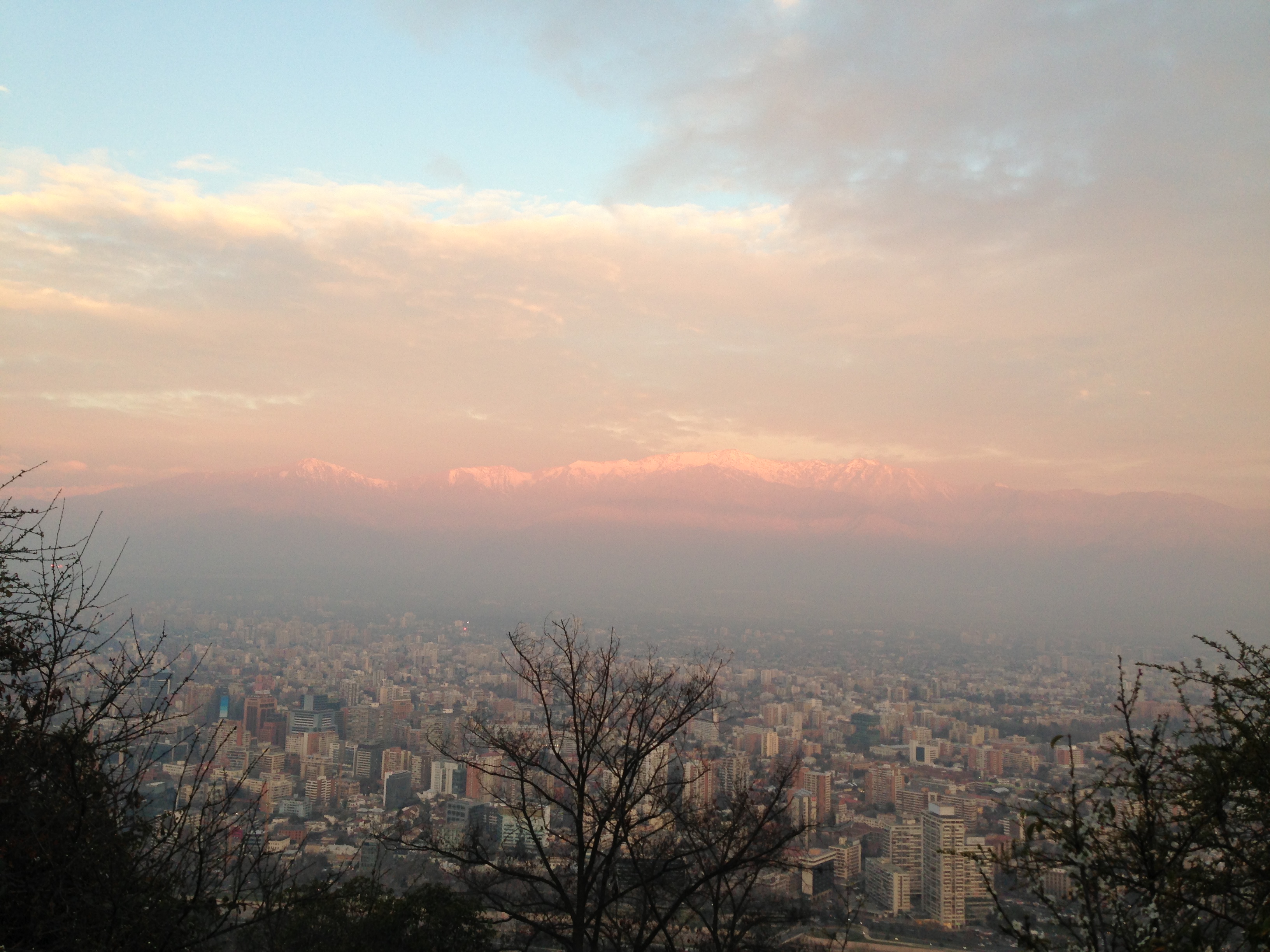
IMG_1743

I will finish this blog the same way I started it. This is a picture of Santiago as seen from the top of Cerro San Cristobal


Mel in Chile: Everything you want is right outside your comfort zone.

December 15, 2013

This is the post we have all been waiting for!!! THE END OF STUDY ABROAD YAYYY! That is in fact true. Some days ago I finished my study abroad semester with an SIT program in Santiago, Chile. I imagine the following text will be suspiciously similar to other testimonies of study abroadlings but I’ll do my best to make it a bit different. I will be honest.

In my last entry I talked about how the topic I chose for my independent study project was outside of what I have chose to study at UR. I was a bit nervous about writing so much on something incredibly new but I thought, “ Well this is one of the best opportunities I will have. The grades don’t count as long as I don’t completely blow it. Might as well!” The project was one of the most enjoyable activities I have overtaken. It was refreshing to read things outside of what I am usually exposed to but I was also lucky because I had the opportunity to link traveling for my personal pleasure to my research. It was sort of a multitasking situation.

It was only when I came home that I saw an article circulating around the Facebook community addressing college students who study abroad. It was an article from The Onion hinting, through their infamous satire, the message that study abroad was an excuse to party in Europe or meet cute Latinos in South America. Even more off putting than the article were the responses from fellow study abroaders affirming the overall message of the article! Now I will not make myself the “responsible” student who studied abroad only for the educational opportunities and the broadening of my perspective by living in another culture. I will be honest in saying some of the comments were funny but true. Like all articles form The Onion, it was genius.

On the other hand, I couldn’t help but remember all the times I had Skyped with friends and family and talked to them about how much I was learning during my study abroad semester. So when I read the article from The Onion I of course laughed but I also couldn’t stop this strange feeling of “Well that isn’t entirely true. Maybe not even the slightest bit true!” As I said before, I will not deny the Shenanigans, the traveling, the going out with other travelers that were passing by on their way to Patagonia, making new friends with my group, the salsa classes, enjoying the fiestas patrias…and well everything else that comes with study abroad. But…is that so bad? In my opinion, study abroad works best when students take complete advantage of what your city has to offer. We are used to learning only coming from academic spheres, everything from lectures, articles, classes, and books. If you are willing to accept it, an opportunity to study abroad is an opportunity to learn. To learn from people, the culture, other foreign exchange students, the host family, street performers, and everyone around you.  I would highly recommend taking an opportunity to study abroad. But it does not end there. Learning takes initiative and requires a person to be proactive and to be open to new concepts. You will be uncomfortable; you will miss UR, your friends, your professors and the resources offered at our university. The point is to see beyond your previous accommodations, stop comparing between your home and host institution and simply allow yourself to grow from the experience.

“Everything you want is right outside your comfort zone.”

– Robert Allen

The following are images of Chile:

gran torre

This is an image of the Gran Torre de Santiago- the tallest building in Latin America.

indomita vineyard

Old wine bottles at Indomita

isla negra

View from Pablo Neruda’s house in Isla Negra.

valledelaluna

We watched the sunset at Valle de la Luna. One of the most beautiful places on Earth.


Mel in Chile: The Final Project

December 10, 2013

Some days ago we closed our SIT Chile: Political Systems and Economic Development study abroad semester. During November I had been working hard (or hardly working?) towards the thirty-page research paper that we submit at the end of a semester abroad with SIT. I have to admit the month of research was an incredible opportunity to test out my ability to work independently. The only deadline to keep in mind was December 4th.

November was full of activities and my schedule looked busy even though I did not have classes. I needed interviews for my research and when you are in Latin America scheduling interviews/any meeting situations with people will prove to be a difficult process. I also chose a topic for my research that I had not studied through classes at Richmond or study abroad. It was a critical analysis of community-based tourism in Valle de Elikura within a mix of post-colonial/anthropological/orientalist theoretical frameworks. I spent half of the month simply looking for articles and reading as much material as I could so I developed a strong background before I started the actual writing.

I sometimes wonder what will happen with the thirty-three-page research paper I wrote in Spanish. It is difficult to convince myself that it will be useful for a class in Richmond since I know the rest of my time will be devoted to fulfilling business class requirements. If I want to use the paper anywhere in the US I would need to translate the entire thing to Spanish. So I sometimes ask myself “Why did you chose to do something ‘irrelevant’? Why didn’t you choose something that is more related to what you study at UR? Chile is would have been a fantastic country for research in any neoliberal related topic.” I am lucky I do not have to think very far to find my reasons. The truth is that I absolutely loved my topic. More importantly I enjoyed the journey of learning something entirely new, processing it, and then applying it as analysis to my fieldwork. I realized I was also wrong to refer to my work as “irrelevant”. This may sound cliché but I understood from personal experience how seemingly distinct areas of study are actually not as unrelated as we sometimes imagine. My research project gave me an opportunity to relate tourism, anthropology, orientalist theory, post colonial theory, Foucault’s notions of relations of power, and basic demand-supply relations within a capitalism economic structure. My study abroad experience allowed me to step back and explore the relationships between different disciplines. I would strongly argue that a study abroad experience is essential to a liberal arts education.

diploma

My certificate from Universidad de Santiago de Chile!


Diego in Brazil: Final exams at PUC-Rio

December 3, 2013

Yesterday I had my first final exam at my host university. I would not say that my time in Rio de Janeiro simply flew by, but I certainly feel that the second half of the semester was somehow much shorter. It seems as if just two weeks ago I was writing my mid-term exams. Yet here I am, about two weeks away from closing this experience abroad. As with my post about mid-term exams, I am posting pictures of PUC-Rio’s campus. This time I took two pictures right outside the main campus entrance.

IMG_0796 (800x600)

The main entrance to PUC’s central campus. Several public buses either go through or end their routes right in front of these doors, making the campus quite accessible.

This week I wrote my Portuguese final exam. It was incredibly short and I suppose PUC simply wants to test how much its foreign exchange students are learning. Rather than bombarding us with fifteen or twenty exercises on the same topic, my professor asked us to complete about twelve sentences in total that tested whether we can use different tenses and conjugate verbs. She also gave us a short reading and asked us to answer two short questions. Tomorrow we will have the oral section of my exam in which we will discuss racism in Brazil.

All of my other classes (Geography of the Contemporary World, Political Economy of Latin America, Brazilian Foreign Policy, and Poverty and Social Inequality) are mainly based on academic readings. Final grades in each class heavily depend on how students do in final exams, so I suppose my professors will be asking for two or three long, essay-type answers for each exam.

Interestingly enough, my four classes (or maybe my four professors) have different approaches to tests. Today my Poverty and Social Inequality professor distributed six essay questions for us to prepare at home, each relating to a particular text we read during our course. For our exam she will choose three of the six questions and ask us to develop a relatively long response for each. While this may seem rather simple, she expects us to incorporate our in-class debates into our responses, turning our exam into quite an interesting exercise.

My Brazilian Foreign Policy class will also have a “traditional” exam. We will be given three essay prompts that ask us to compare different authors, theories, and historical periods. This will certainly be my heaviest exam in terms of the amount of content I will need to prepare and study. Luckily, this has been my favorite course at PUC-Rio and it will be quite interesting to look back and realize how much I have learnt about Brazil and Latin America through this class.

The exciting moments of my next two weeks will most likely come during my Geography and Political Economy exams. These two professors have a very interesting approach to final exams. They both believe that having students simply reproduce what they have already read in academic texts does not show how much they have learnt. Instead, we will be given a newspaper article (or an image in the case of Geography) to analyze using the theories and arguments we have studied so far. My professors’ objective is to determine whether students have developed the skills to put new knowledge in practice.

This was probably not the most entertaining post of my semester, but I wanted to give you an idea of how different academic systems may be abroad. About 60% of my final grade for each class will be based on these exams. My experiences at the University of Richmond and at PUC-Rio have been different in this aspect, yet I am confident both systems have allowed me to learn immensely.

I will definitely let you know how my exams go!

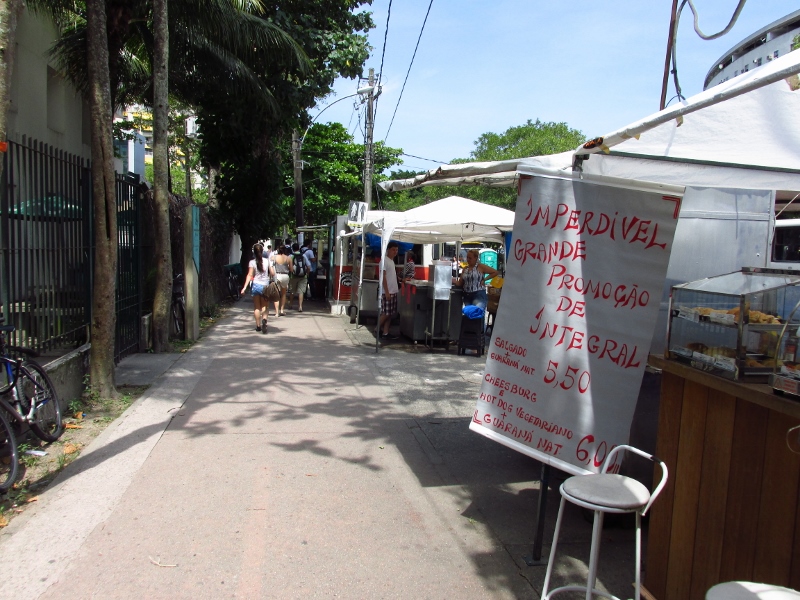
IMG_0797 (800x600)

Step outside PUC’s campus and you will find several options for a quick lunch or even some Acaí (a highly popular “drink” made from the fruit of a particular palm tree.)


Mel in Chile: A lot of time in a few places

December 3, 2013

Last week I went back to Valle Elikura, the location where we engaged in a home stay about a month ago with my study abroad program.

I went back this time because of two main reasons. My research project is an analysis on the experience with community-based tourism in the area. I gave some interviews when I was there with the group but as my research developed and I had a better grasp of the topic in question, I naturally developed questions that were more analytical. Ready with my informed consent forms, I walked down to the bus station as if I was walking to my deathbed, to buy tickets for the overnight nine-hour bus ride to Cañete. My journey would not end there; from Cañete I needed to take another hour-long bus ride to Valle Elikura.

Nevertheless I arrived in Valle Elikura early Sunday morning. Silvia was my host mother when we traveled with my group and I had called her prior to my coming to ask if I could rent the cabin again. She cheerfully agreed and told me she would also provide all three meals. Silvia had left the house early to come meet me at the location where the bus form Cañete dropped me off.

I arrived at the cabin fourteen hours after I left my home in Santiago.

I took the rest of Sunday to rest. Valle de Elicura is an incredibly peaceful place. My room in Santiago faces a very busy street so I was more than happy to trade in the noise of 8 am traffic for the chirping of birds.

I began Monday by starting my work right away. As I greeted familiar faces in Valle de Elicura I felt more and more comfortable every time I spoke with someone I had previously met. This is when I suddenly and pleasantly realized that coming back to visit a place for the second time is an entirely new experience. I enjoyed going back to the river where I ran by on my first visit. After some exploring I found a beautiful meadow. As I lay in the grass, tranquil, away from noise, distractions and other people, I could not help but feel as though I was inside my own conscience. I allowed myself to bathe in this beautiful solitude.

I stayed in Valle de Elicura until Wednesday. I ate all of my meals with Silvia, Lautaro, and Kata (Silvia’s husband and granddaughter). I enjoyed staying with Silvia’s family the first time, but this was even better. It is precisely what I referred to in the above paragraph. I went to visit the people I had interviewed a month ago. The feeling of familiarity, of “Hey! It’s nice to be here again. Nice to see you, how is everything?” is something that feels incredibly warm for me.

Many people have a thirst for constant travel; to hike through as many beautiful mountains as possible, to visit vibrant cities, to jump around countries and see different cultures.

I imagined I would have the same mentality during my study abroad semester in Latin America.

I can assert with confidence that I belong to the other group. I found that I subscribe to the spend- a- lot- of- time- in- a- few- places  philosophy of travel.

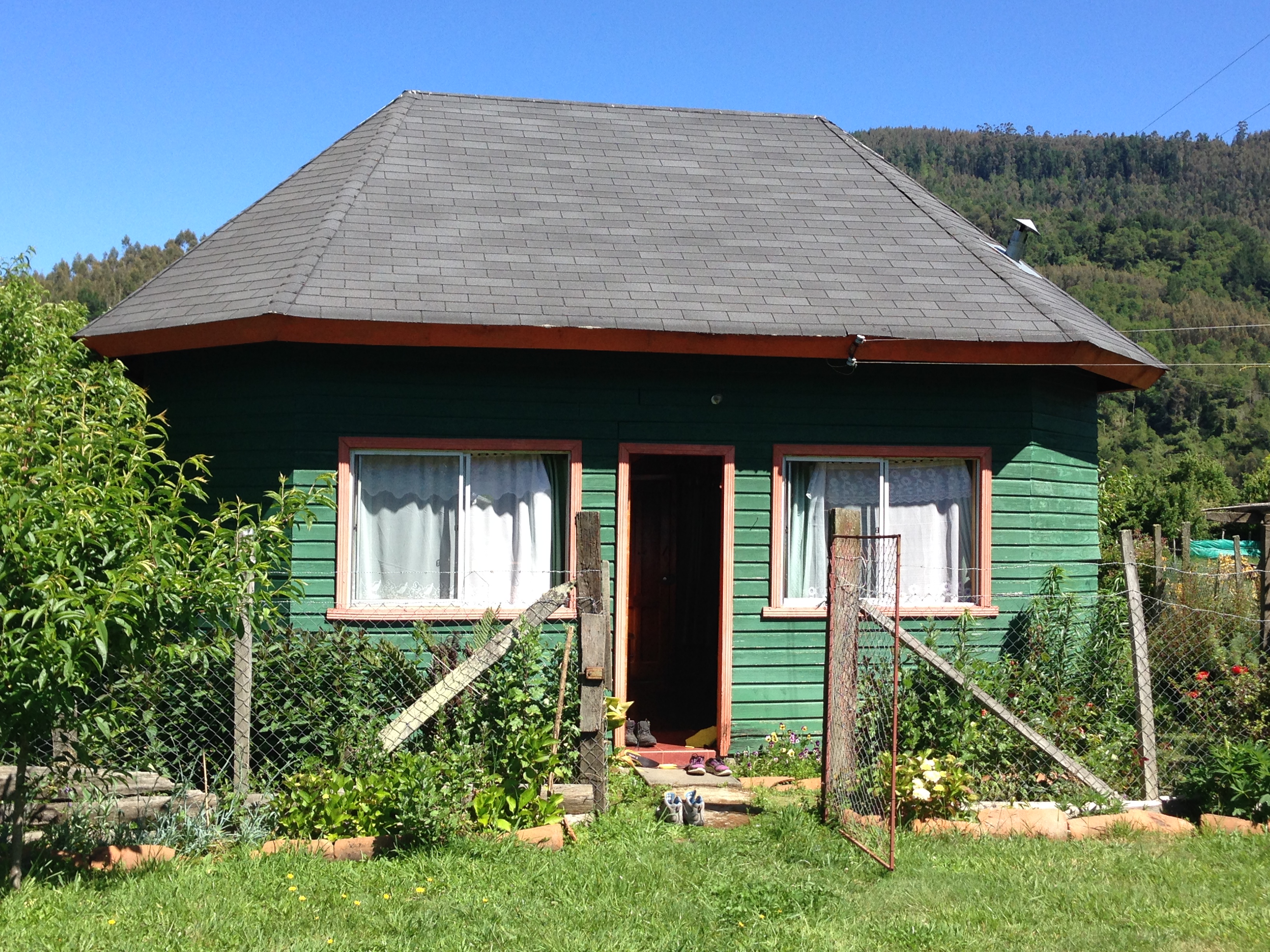
cabin

Silvia’s cabin in Valle de Elicura


Diego in Brazil: It began as a class presentation…

November 13, 2013

Some minutes ago I finished my first in-class presentation on Brazilian Foreign Policy. I could feel all of my Portuguese vocabulary just flying away from my mind minutes before my presentation. I’m the only exchange student in my class and even my group seemed a little nervous not knowing how I was going to do. “What’s the summary of what you’ll present?” asked one of them. I suspect she was somehow testing my Portuguese…

But enough of that. The presentation went incredibly well and I’m happy to feel capable of improvising and analyzing Brazil’s involvement in Latin America during the Cold War in front of a large group. How did it happen? I’m still not entirely sure, but the topic is so interesting that I decided to share with you some history that has traditionally been ignored.

Read any history book on the political landscape of Latin America during the late 60s and early 70s and you will most likely be led to believe that Brazil played an almost-insignificant role in other countries’ politics. Historians and political scientists have typically pointed at the US for its involvement in the region as a hegemonic power interested in sabotaging any left-wing political victory in Latin America. A different language, culture, and history of colonization are all factors that have led us to conclude that Brazil hasn’t really focused its Foreign Policy on Latin America.

While most of the above may be true, it turns out most books won’t be precisely teaching you what really happened between 1965 and 1975. Brazil’s former president Médici – military dictator between 1969 and 1974 – believed that the ideological war in Latin America at the time was an internal conflict, consequence of the poverty and inequality that have historically characterized the continent. Médici concluded early in his time in power that any solution to the region’s ideological war would also have to be internal. During his administration Brazil participated in the overthrow of a democratically-elected leftist president in Bolivia, the weakening of Uruguay’s most important leftist coalition, and the training of military forces that would eventually overthrow Salvador Allende in Chile.

golpe_allende

Attack on the Palacio de la Moneda in Santiago de Chile on September 11th, 1973. Source: http://filosofiacr.wordpress.com/2011/09/12/salvador-allende-vida-y-muerte-la-cia-y-el-golpe-de-estado-del-11973-video/)

In 1971 Médici visited former president Nixon to motivate him to get even more involved in Latin America. Records of the meeting show that Médici left Washington quite unhappy about Nixon’s decision to not drastically increase the economic and military aid given to Bolivia’s and Uruguay’s right-wing regimes. It turns out that between 1970 and 1974 Brazil took the lead in the “fight against communism” in Latin America and constantly tried to get the US to pay more attention to the region. In September 11th of 1973, Salvador Allende suffered a coup d’état in Chile and this meant that, according to the Brazilian Foreign Minister at the time, the Southern Cone’s revolutionary “snowball had been reversed.”

medici

Médici, Nixon, and Kissinger meet in Washington in 1971. Source: http://impressao.wordpress.com/tag/nixon/)

A number of internal and external factors led Brazil to shift its attention away from the region after 1974. Pinochet in Chile and Geisel in Brazil would lead, respectively, the two countries on different paths towards a harsher military rule and more relaxed policies. It wasn’t until the 1990s that Brazil would regain such strong interest in Latin American politics.

Next semester I will start writing my thesis back in Richmond. I have decided to give a more historical touch to my examination of the Brazilian-Peruvian international border in the Amazon region. As it turns out, Brazil’s involvement in Latin America has been much more important than what I once thought. Among all of the academic lessons I have gained while studying abroad in Brazil, this may be the one that will have the greatest impact in years to come.

If you are interested in reading more about Brazil’s involvement in Latin America between 1970 and 1975, you can follow this link (http://dx.doi.org/10.1080/14682745.2011.641953) to the article by Tanya Harmer (2012) that was the basis of my presentation and this blog entry.