The River Runs Free (or should) and Chiang Mai

November 16, 2011

Here in Khon Kaen, Thailand, working as a member of a group and visiting villages every few weeks, the term solidarity has come up a few times. It seems that the more time that passes, the more frequently the term is used. What does solidarity mean in relation to these issues? What does it mean in the villages?

On a journey to discover what solidarity really means, one telling village was Ban Huay Top Nai Noi. Not only does this protest village share passion and drive, but they have a plan. Made up of villagers from two different surrounding villages, this village was formed to protest a dam project upstream. These villagers’ homes were not going to be flooded, but their farms and their livelihoods were. In 1995, the protest village formed in the flood zone of the proposed dam project. Paw Sampone said, “We moved to the flood zone because if they want to build the dam, build the dam. But, if you retain any water, you will be killing people.” The power of their mission is not just for themselves, however —  it is for the land and the people around them.

For communities we visited during unit 4, which are potential or previous dam sites, the river is more than a source of water. The flooding created or exacerbated by dams is not just detrimental to the crops in the farmland or the homes in the area, but completely destroys livelihoods.

For example, in communities in Rasi Salai, the end of the rainy season has led to absolutely no source of income for the people. The wetlands, their original source of food and crops, is flooded. They cannot gather crops that have been sustaining their families for hundreds of years. Because of the dam reservoir, their farmlands are also flooded to the point where they can only get around some parts by boat. Many cannot even walk to their farms to see how much damage has been done. The final portion of these villagers’ income comes from handicrafts made and sold at the local learning center. The center is up to the roof with water because the land the people were given for the project is located on the banks of the reservoir. The supplies to make most of the crafts come from their fields, as well. So without farmland just a few weeks before harvest, plus no crafts and no place to sell them, the dam has led to no financial stability or security for the people of Rasi Salai. Their homes may not be flooded, but they continue to band together because without the other community members, some families could easily go hungry.

This community serves as a mentor for that of Ban Huay Top Nai Noi. They have provided guidance, comfort, and support during the hard times. They inspire the people of Ban Huay Top Nai Noi, and encourage their fight. Even through the violence that occurred, the people of the protest village stayed in their new location. Their presence is a fight, and it is a message. “We do this for the land. Land cannot regenerate, but people are born everyday.” Their strength comes from each other. “Wherever we go, we go together. We share everything, not just knowledge.” These words of the community members is what enables the movement they are part of. They have a cause and support and the strength of their community is what true solidarity looks like. They stand, fall, live and fight together.

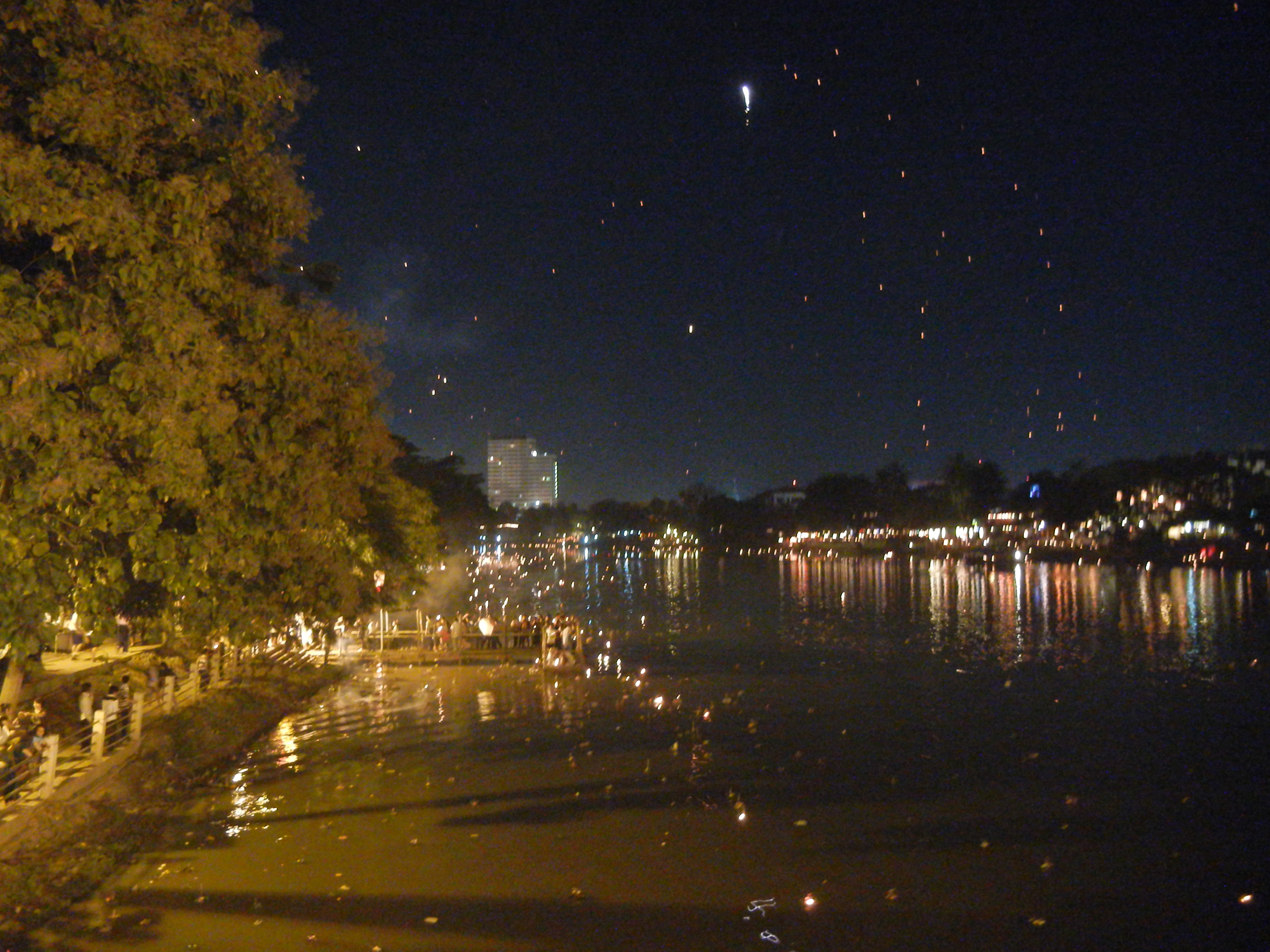
After the water unit was our four-day break, which came and went quickly, and what an amazing adventure it was! Just a quick summary — I went to Chiang Mai and saw the floating lantern festival. It was the most amazing thing, and it is a time to pay tribute to the river, so it was fitting following our water unit. I rode an elephant, played with baby tigers, and went bungee jumping (never thought I would…)  Although I indulged in foreign food like burritos and falafel, it’s good to be back in Isaan where there aren’t tourists and I get to speak Thai.

Onto the mining unit, which should be really interesting and I’ll have more time with internet to blog in a more timely fashion!


Community, Globalization, and Tons of Trash

October 24, 2011

So many villages, so little space to write about them…  so I’ll keep up with the highlights principle.  The highlight of the Land unit was definitely Baw Kaew community.  It is a protest village where the people were kicked off of their land, and two years ago they returned and have built a community.  There were people from all different villages, and through the shared struggle and passion, they have created something unbelievable.  The grandmothers share their stories of being kicked off their land with the children, who will continue to fight based on the devotion.  This unit showed me that an outside force or a powerful figure is not needed for a successful grassroots movement.  Anyone and everyone has agency, and it just takes motivation and passion to create change.  It was a really moving exchange and experience.

My Paw from this unit, other than the two one-nighters, was incredibly educated.  I was sitting watching Meh cook one night when Paw came into the cooking area.  He sat down next to me, pen in hand, and started to lecture.  All in Thai, of course, but the essence of the conversation was, “Julie, do you see this papaya—we grow them in Thailand.  You don’t grow them in America, yet you are able to eat them in America.  That is just one reason why globalization is so amazing.”  The lectures continued and got more and more complex over the course of the three days. There was a lot of guessing based on what was said or drawn (one day he got out his grandson’s coloring book and drew for us—an upgrade to the hand), but it was all an amazing lesson on both communication and globalization.

After the unit ended, there was an optional trip to the landfill near our campus.  Just 17km away, 200 tons of trash is brought in each day.  There is a community of 60 families that live there, started by just one man who went to make a living off of the trash.  Not only does it bring to light the realization of scavengers (those who work 20 hours a day picking through garbage to find plastic bottles to recycle), but it brings to light the realities of consumerism.  I literally climbed a trash mountain.  Not to mention the irony of the laundry detergent package I saw in the mud that read, “Hygiene”.

I was so blown away by the Paw that we exchanged with there.  He no longer works in the landfill, nor does his wife and children, but he lives there because he owns his land and he wants to make the community a better place.  Unlike in America, where people strive to get out of the slums, Paw was trying to improve the village.  He chooses to live in a dump — literally.

The problems with each village we visit are hard to stomach.  With each unit and each exchange, I continue to recognize the realities of a developing country.  It is natural to make comparisons to the United States, and we have many of these issues.  We have medical problems associated with damming and mining (the coming two units).  We have poverty that is solved by cash cropping.  There are so many problems in our world.  This country is so amazing, and my time here is invaluable, but it is hard meeting amazing people and learning about their suffering, unable to fix it.


In The Jungle, The Mighty Jungle

October 17, 2011

Well, this time, it’s “the students sleep tonight”.  Part one of our second unit, Land, takes place in villages that have had recent struggles with their land.  Whether it is a protest village, a community that has recently returned to their land, or exchanging with the governmental agency that protects the forest, we are seeing all sides of land rights in Issan.  The journey started with a six hour van ride to a village just north of Cambodia.

Our van slowed to a stop at a group of houses, but we were told this was not our village.  We all loaded onto the back of a truck and headed into the jungle.  The Suan Ba, or forest, was through deep woods and the land had flooded recently- our vans would not make it.  Little did I understand flooding.  After community members finished nailing wooden boards as two longs rows of seats, we loaded up.  Thus began the most exciting hour long ride of my life.  Somewhere between rollercoaster and safari, we found ourselves on a real life version of a Disney World ride.

The village only got better.  It started with bananas hanging by a pole for us to eat at our leisure, then there was some wading through a river, an exchange, and then a slumber party of the whole group sleeping in the community “room”.  There was a light bulb, but no other electricity.  The exchangee was willing to answer all questions, so after our allotted time, questions were asked about Cambodia, the Vietnam War, and ended by talking about elephants. (We saw one while driving through the city, of all places, on the way home– just a baby walking on a leash led by a man down a busy street.)

We returned for the evening to meet the U.S. Ambassador, have finger food and mingle.  So it’s a nice relaxing evening, and then off to the next village! It has become a trend that at all villages, our host parents like to feed us a lot, and so I am a bit nervous for Yom Kippur tomorrow.  The Ajaans (teachers) know I am fasting, so they will explain it—hopefully it is understood as religious and not as an insult to their food, because village food is so delicious.


Mai Chai Bouey Kem Me: Don’t Use Chemical Fertilizer

September 28, 2011

The food/agriculture unit homestay has come to an end.  These last six days were filled with excitement and unbelievable experiences.  I cannot share everything from this past week, but I’ll go over the highlights.

First stop, Roi Et province.  We stayed in a village that was in transition from non-organic to organic farming, so almost every family had pigs to make their organic fertilizer.  We got a tour of some farms, and they really tried to make it interactive.  So, I got to plant a banana tree!

Before heading to Yasothon province, the location of our last homestay of the unit, we stopped in Masaharaka to observe our future families protesting the use of chemicals in farming.  The speakers brought some to tears as they spoke of the horrors that have come as adverse effects, and the passion of these people to protect their livelihood was an unbelievable thing to watch.  Wearing green, just as the organic market they participate in is the Green Market, the street was flooded with signs and images of pesticides.  This peaceful demonstration showed more than just what chemicals can do—it showed the importance of community.  These individuals came together for a cause, and their community was shown through both the market and the signs floating down the street.

I loved my family at this homestay.  Paw and I were surprisingly able to communicate a lot,  so I got to learn about both his and Meh’s farming practices and lives.  Both have lived in the village their entire lives, and have been farming organically for 12 years now.  We took the tractor out to the farm and came back with a bounty of delicious treats.  A green papaya for Som Tom, a local dish, long beans, peanuts, sugar cane, okra, and my favorite—passion fruit.  I got to learn about the different type of rice that he grows, and then that day we stayed up late and helped prepare for the market.  Weighing peppers, sorting veggies, carrying coconuts, and watching as Meh prepared the banana snacks—coconut and rice wrapped in banana leaf.  We woke early (4:00) to meet our parents at the market, and helped sell their rice and treats. (My time at local farmer’s markets paid off, because I would not allow for bargaining).

Our week came to an end after our last exchange with a local government official who was very passionate about hating TNCs.  This past week was a great first unit trip—personal connections were formed and we got a real insight into the issues.  These next 10 days in Khon Kaen will be rough, because I can’t wait to get back into the villages.

(Oh! I almost forgot… if you put a green mango into a box for a few days, it ripens perfectly!  It’s a very useful skill when mangos are not in season.)


Laying The Bricks for Photography

September 19, 2011

Nic Dunlop, a photographer, came and taught a photography workshop—so I thought it only fitting that I show what I came up with.  Our instructions were to take an establishment shot, a profile shot, a detail shot, an action shot, and then a fifth of any of those.  We had to tell a story, and no children and no monks were allowed.

So I headed off through the streets and decided, despite the heat and blaring sun, to venture down a street I had not been down yet.  I first found myself in a neighborhood, then at a resort, and finally I came upon a bustling street with lots of excitement and potential subjects.  All the pictures were to be of the same subject, so I wanted something new (and boy, did I find it).

I came upon this brick building in construction and thought, “why not?”  There was a young guy working the brick pulley, and seeing as I had never seen this orange contraption before, it fit.  He spoke a little English, and I speak a little (very little) Thai, so we were kind of able to communicate.  He had decided I was going to come back later when he got off  and hang out with him and his friend…I knew I had to come back to get more pictures in the afternoon, so I did as the Thais do, and smiled.

I took a few good shots, and got my establishing shot, but needed more for sure. Only problem was, I wandered to get there—needless to say I got lost coming back.  I was uncertain if I could find it again.  I did though, and it was worth the walk.

My friend from earlier in the day was gone, so I wandered around the construction site.  I then saw this woman on the stairs, asked if I could take her picture, and afterward, she directed me upstairs.  I scaled the edge of the building (for like 2 feet) and spoke with three women, in broken Thai and English.  One may have told me she wants an American boyfriend…but I am pretty sure she had kids… I don’t know.  Language barriers.

It was an amazing experience, and although conversation may not have been perfect, I think I was able to capture my experience through the photos.


A Week That Felt Like Class, Including Saturday and Sunday

September 14, 2011
Our week of background lectures comes to a close today, and in our “alternative education model,” it won’t be returning. To talk about all of them would both bore you and possibly imprison me in Thailand, seeing as each of them were four hours long. I will draw attention to some of the highlights, though.  The “Thai History and Politics” lecture was so intriguing.  This country has such an interesting past and present—it is truly captivating.  The first lecture we had, on Human Rights, was given by the most amazing woman I have met here.  I should set the scene…
When we have exchanges or lectures, we are told to dress in “polite” attire.  This means skirts past the knees and covered shoulders for girls, or our nifty– yes, nifty— school uniforms.  Our lecturer, the Chair of the Association of Southeast Asian Nations Commission on Human Rights, walked in wearing jeans and a jean jacket that faded into lace at the bottom.  And let me tell you, not one of us doubted her for a second. She spoke with such confidence and passion for the subject, and to put it bluntly — she was a total boss.  I learned after the lecture that she was once at a big party with Henry Kissinger and happened to be next to him on the buffet line.  So naturally, she took that as her opportunity to tell him everything she thought he had done wrong.  I could not stop writing as she spoke to us, and her wisdom on Human Rights was profound, to say the least.
The second half of the week was spent on our “mock-unit”, which was on HIV/AIDS.  We had an exchange (a question & answer forum) with TNP+, which is a network for people in Thailand living with HIV/AIDS.  After the question & answer period and an activity that demonstrated the spread of the virus using water cups and food dye, we got to visit a home of a person living with HIV/AIDS.  What an experience.  I must say that in a country where the culture seems to avoid the topic of sex, it is amazing how open both the organization heads and the individuals were with us.  In small groups at the home visits, we were free to ask any questions, and I was overwhelmed with knowledge.  The juxtaposition between Montclair, New Jersey (my hometown) and the community I visited were so drastically different. Here, the “norm” is to be ostracized, whereas at home, neighbors seem to do anything they can to help.  The man I spoke with knows that the disease cannot be transmitted through objects, but still insists on having separate soap, and cups, and plates from his family to ensure his two daughters’ and wife’s protection.  The struggle to fight the silence surrounding sex is obviously a struggle for education in Thailand, and it makes the Condom Caravan at school in Richmond seem like a godsend of information.
In other news, there is a family of geckos living in my room.  I’m not too concerned, because as a friend put it when I was initially freaked out, “They are more afraid of me than I am of eating shellfish.”
And how do you turn a mango yellow? …more on that to come.
Thai village

I Want to Hold Your Hand, and Get Back on the Bus

September 7, 2011

The Beatles had people in complete awe of them, wanting nothing more than to be near them. Now, I would not say I have John Lennon status here in Thailand, but at school in the village, the children certainly wanted to hold my hand.  In fact, all of us had 3-4 Thai kids ranging in age from 6 to 13 hanging off of us at any moment in time.  For our third day in the community, instead of Thai class, we had a “Thai Fun Activity”, consisting of us playing games with kids at school, and then us teaching them an activity.  Thank you, summer camps, because we all quickly agreed to teach them “Baby Shark”, and out second was “The Banana Song”.  If you are unfamiliar with these, I highly recommend learning them, because just as I thought they would never come in handy again—I was mistaken.  The joy that came from these kids was indescribable.  Later, at our homestays, we had kids doing the hand motions, asking us to sing it again.

My homestay could probably be best described by the final night.  Until the last night, it was a lot of observing and eating.  I didn’t really feel a strong connection to my family, and it was not the easiest three days of my life. It did, however, have a very happy ending when the entire village gathered at my neighbor’s house and we had what I would call a block party.  There was music, all the students ate a meal together prepared by many families, and we danced into the night (meaning like 8:00pm, because that is a normal bed time in villages.)

These past few days in Khon Kaen have given us a time to actually explore the city and get a hold of public transportation. Saung Taos, which are “buses” where you sit on benches on the flat of a pick-up truck with a roof, have been an exciting way of exploring.  For instance, last night as we tried to get to this Italian place for dinner, we were supposed to switch buses.  This, of course, we did not know, and ended up past the slums and far from the city.  As the Saung Tao slowed to a stop, the nine of us looked at each other, and got off hesitantly as we were kicked off by the driver.  The fear started to set in for sure, but luckily, there was one store with its light on, and the two women in the pharmacy spoke a little English.  We had them call a cab for us, because we had no clue where we were.  Seeing as cab drivers have numbers, but do not answer their phones, we were stuck.  At that moment, another Saung Tao drove up, and we had the women ask them to drive us to the hotel down the street from the restaurant.  At the price of 200 bhat, it was totally worth it.  So our personal taxi Saung Tao drove us back down the shady roads, and the night concluded with a delicious pizza.  (I absolutely love Thai food, but as a true American, I really missed pizza).  Another adventure, another night in Thailand.


Lean on Me, Leech on Me

August 29, 2011

My departure from Bangkok was timely, as I was ready to experience something outside of the backpacking district of the capital. The drive to the “resort” where we stayed this past week was about 7 hours from Bangkok in Khon Kaen, Provence. We left our computers to be brought to Khon Kaen University, so the week was entirely wireless and open for bonding.  Through many group meetings and activities, we really started to work together as a group, finding our way each moment.  Whether we were transferring people through a web of string or discussing oppression, we leaned on each other through rougher moments and celebrated the positives together.  It seems like we are really forming a strong community, which is a main focus of the program both internally and within the villages we stay in.

On our way to the resort, we stopped about halfway through for a nature walk. By nature walk, of course I mean sludging through mud in gaters (which are cloth coverings for your legs and feet, because apparently there are leeches in the national park).  The scenery was absolutely gorgeous and followed by a delicious plate of kauw pad (fried rice).  As we went to get in the van, though, I noticed I was bleeding on my foot, so the med kit was grabbed so that I could bandage my apparent leech wound. It wasn’t until we were ten minutes on the road that I noticed I was bleeding on my thigh as well, and friends in the back of the van simultaneously found a huge leech on the ground. I suppose I, too, am delicious. All is fine, the leech was killed and cleaned up, and I was bandaged. Needless to say, mai pen rai (it’s all good / no problem—and a popular Thai phrase at that).

We started Thai class this week, and wow, is it a difficult language. Sure, they don’t have verb conjugations, but they have tones for each word. Use the wrong tone, and it’s a different word. So, although I will throw in some random Thai in these posts, it is not really helpful without audible dictation.

rice paddies in Thailand

The final stop before coming to Khon Kaen University, and our apartments, was a homestay in a weaving village. I was with one other girl, and together, we maybe understood 10%. Communication was not easy, and all our Meh (mom) wanted to do was feed us and have us take an abb naam (shower). However, in the course of 24 hours, we had a fresh coconut and grapefruit picked off a tree for us, ate fresh peanuts, and helped farm rice, pulling up the plants in the paddy. I also was attacked by my host mom with baby powder (which has the affect of Icy-Hot here). Before we left, some of us spent a few hours playing with the kids at school. My favorite game was their version of Duck Duck Goose, which involves a shirt instead of patting heads and a very catchy song. We were running around, slipping on the dirt, and finally “communicating” with Thais.

playing duck duck goose

It has been a long week, filled with surprises and adventure. I finally have met my roommate and moved in, and she is so cool. She is an English major, so communication is fairly simple. We were welcomed last night through a traditional Thai welcoming ceremony and we have a short weekend break before heading off to the Railroad community on Sunday.


Take Your Shoes Off and Wai 3 Times

August 22, 2011

So after 28 hours of travel (40 if you include time change) I arrived in Bangkok! The van ride to the hotel was filled with zoning out, but the street where the Red Shirts rioted last summer was pointed out, and it is covered in twinkle lights at night! So pretty!!! Needless to say, I went right to sleep (hopefully I’ll start sleeping through the night soon) and woke up the next morning to start the adventure.

We had a general orientation meeting, which was a nice introduction to the other students and the course. And then we were set free for lunch. Oh my goodness are the streets crazy. We are staying in the backpacking district, so there are food carts EVERYWHERE- just a matter of finding things I can eat. Luckily, there is a girl who was with us who is ethnically Thai, so she served as out translator. Veggie dumplings-YUM!

Later we walked to the Royal Palace and got a tour. I have never seen so many jeweled buildings in my life. Insane architecture mixed with a soft-spoken tour guide led to a disparity of the information I picked up. However, there are elephant gods that bring good luck, lots of respect to Buddha, and snakes with 5 heads that are protecting some of the temples. When we went into the temple to see Buddha, we had to take our shoes off outside and then enter the temple. There was holy water that you apply through a flower on your forehead and when you go in, you don’t point your feet towards Buddha. Wai is when you bring your hands to your heart and bow, and for Buddah you Wai three times all the way down till your forehead almost touches the ground. You do this again before you leave as well.

Instead of taking a cab back, we walked around Bangkok and got lost for the first time! We had the business card of our hotel so it wasn’t bad that we were wandering but there was one moment where we were in a shady fish market and next thing we knew we were behind shops in a scary alley. It all turned out fine though, got back to our block had dinner and then I crashed (to wake up 2 hours later and toss and turn). This morning we have a political lecture so needless to say I am excited. We leave Bangkok tomorrow for a week of orientation and homestay, but I’ll let you know how it goes as soon as I have access.


How do you say hakuna matata in Thai?

August 1, 2011

Well, I’ve never blogged before but what better time to start than two weeks before I leave for my semester abroad. My name is Julie and I am a junior at the University of Richmond studying Leadership and Political Science.  I am from New Jersey so the adjustment from suburbia to rice paddies will surely be interesting.

As I gear up to go to Thailand, “no worries” is the most prevalent thought in my mind.  As far as my language capabilities, they are limited to a restaurant take-out menu and I am pretty sure that English is not as prevalent there.  The dress code is very different from what I am used to (no gym shorts!) And did I mention it’s near the equator? Hello eight month summer. I have a feeling I will be returning with many mosquito bites. What is an adventure without a challenge though right? (and yes, I am freaking out—but just a little..)

The country itself has been politically unstable for the last six years.  It is amazing that I will be there just after an election (they just elected their first female prime minister!), especially as a political science major-as long as more riots don’t break out.  The local communities and rural areas have become more politically active over these past years and technology is finding its way out onto the rice paddies.  As a student of political science, this is truly awesome.  I am about to embark on an adventure where I get to witness grassroots government and its founding.  The program is focused on development and globalization, so I am given the opportunity to participate in NGO workings and grassroots community development.  Having worked in my Congressman’s office this past summer, I have seen government and democracy first hand, in fact I have contributed to it.  I am both excited and a little scared to see the juxtaposition Thailand is sure to pose.

So, how does one prepare to go to such a place?  Well I am meditating more—both to calm the nerves and to experience a taste of Thai culture before I leave (or maybe its just cause my mother keeps telling me to).  I am also attempting to eliminate all expectations that I have.  I recently learned that Denmark is the happiest country in the world, and it is because they do not have expectations.  I know I am a control freak, so this is not the easiest task I have taken on, but I am going to live abroad with a no expectation and YES attitude.  A good friend who just got back from abroad told me to accept every invitation, and I fully intend to take her up on that challenge.

So for now, I am packing, finishing out my internship, and learning as much about my future home as possible.  So hakuna matata in Thai—still no worries.  I plan to live every day, study hard, but explore more.   This is my greatest adventure so far, and I invite you to follow along on my journey as I truly live and let Thailand happen to me.  So all aboard, next stop Thailand.