Rhiannon in India: Observing the many religions of India

November 6, 2013

A lot has been changing here recently. Finals are quickly approaching, the end of our program is almost a month away, and believe it or not, it is getting a little cooler here in Hyderabad. Right now, we are busy reviewing for finals in our classes, making travel plans for our last trips around India, and preparing for the Cultural Show, a performance that the Study in India program puts on at the end of every semester for the entire university. SIP students will perform things they know from home or something that they have learned here, like sitar or traditional dance. According to our advisors, it’s a huge hit among the university community and the auditorium is always packed. My sitar class will be performing two songs in the show, one traditional raga and one popular Bollywood song from the movie Aashiqui II. Together, the songs total 15 minutes of straight playing time, so it’s safe to say my fingers will be totally numb by the end.

Because I am leaving India in only one month, I have been spending more time reflecting on what I have learned in my time here – what has fascinated me, what has confused me, and what I am still interested to learn more about. A few weeks ago, CIEE took us to Varanasi (formerly called Banaras) for a long weekend trip, and although I have been interested in the many religions of India since I arrived in July, being in Varanasi made me even more fascinated by the complexity of the subject. Just as in any other part of the world, religion is a complex part of Indian culture that is impossible to boil down to one blog post, but somehow India strikes me as even more complicated than many other places in its religious culture. It seems impossible for an outsider like me to understand the innumerable traditions, values, festivals, and rituals of each of the religious groups present in India, especially because each part of the country has created its own unique version over the centuries. What’s more, religion or spirituality is much more present in everyday life here than it is in the US, so I am surrounded by constant reminders of its importance and complexity.
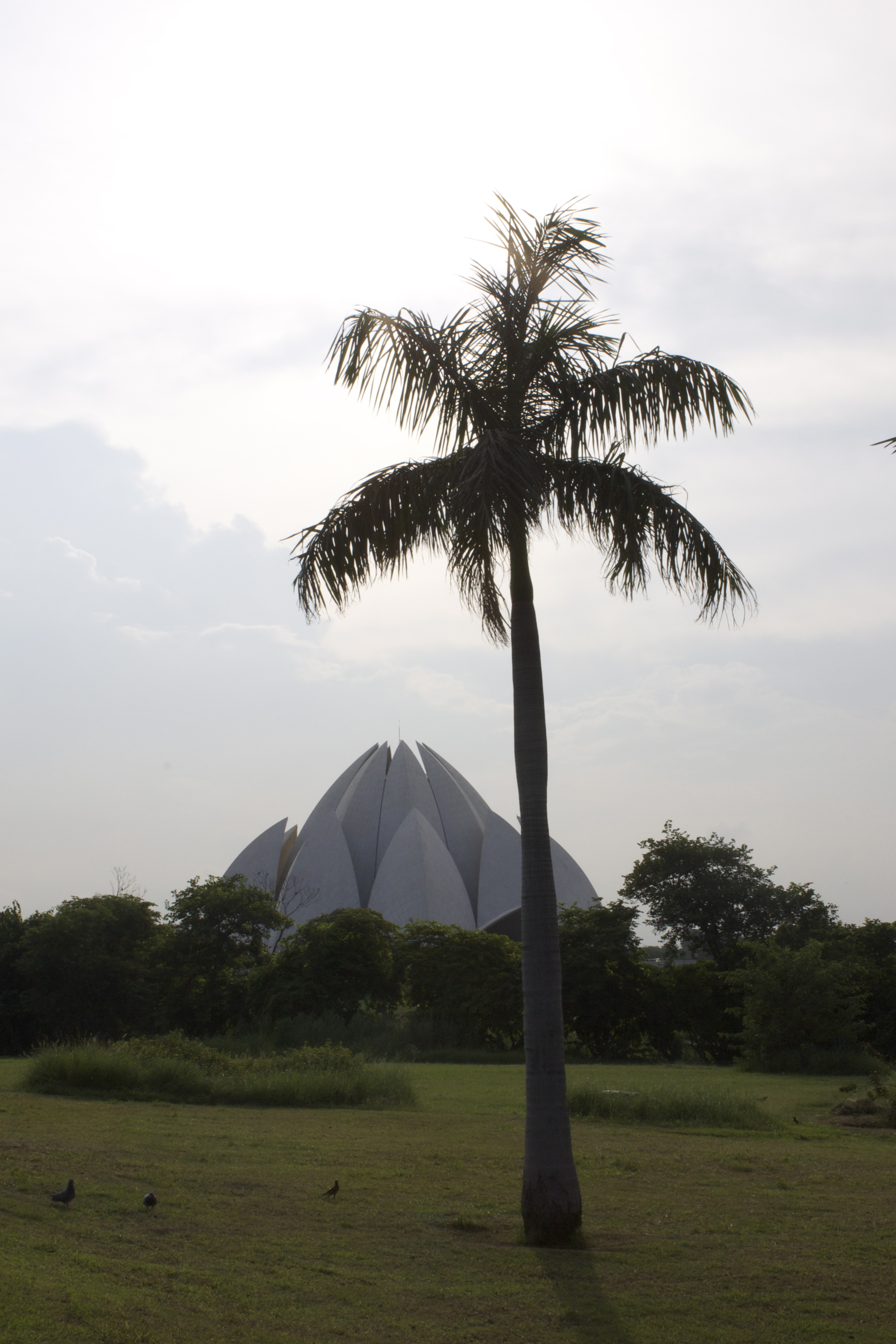
IMG_2941

The Bahai Lotus Temple in Delhi

Of course, religion is different for every person in India, and there is no way I have seen even a small part of all there is to see. I have met Hindus, Muslims, Christians, Jains, Sikhs, Buddhists, and I’m sure many others. Instead of attempting to make sense of it all, I would just like to share the experiences I have had over the past few months that show just how integral religion is to Indian culture.

IMG_3415

A small shrine on the side of the road in Pondicherry

As Hinduism is the dominant religion in India, there are references to Hindu gods everywhere you turn. There are Hindu temples along the roadsides, tucked away between houses in neighborhoods, and among the rocks on the hillsides. There are shrines to one god or another in almost every store and restaurant, puja rooms in almost every Hindu household, and pictures or statuettes of deities in many taxis and autos. As I said before, each region of India has molded their own religious traditions, so people always joke that if we celebrated every religious holiday in India, we would never have to go to school or work. Adding to this is the shear number of gods recognized in Hinduism. There are millions of Hindu deities, but most Hindus will say that this is because there are just many names for each of the main gods.

IMG_4080

Men performing morning puja at Assi Ghat in Varanasi

As I said, our trip to Varanasi last month really solidified my interest in religion in India. Varanasi, nestled on the edge of the Ganges River, is the “Mecca of Hinduism” and full of religious temples, stupas, and shrines to various Hindu gods and the Buddha. It is one of the only places in India that is famous for its sacred rituals concerning all parts of the life cycle. The Ganges River, named after the Hindu goddess Ganga, is the holiest river in India, although all rivers are considered to be auspicious because of their cleansing and purifying qualities. All Hindus aspire to visit Varanasi and bathe in the Ganges at least once in their lifetime to be cleansed of their sins. Unfortunately, the Ganges has now become one of the most polluted rivers in the world. Families unable to afford cremation often put the bodies of the deceased in the river anyway, and you can see trash lining the water’s edge as you walk along the riverbank. However, this doesn’t deter many followers of Hinduism and other religions that worship the Ganges from bathing in the water, or even drinking it to cure diseases.

There are over one hundred “ghats,” or long, steep steps leading down to the water’s edge, along the riverside in Varanasi. These ghats are used for bathing, daily puja, and death rituals. At many of the ghats, there are cremation pyres, where the bodies of the dead are burned and their ashes spread into the water of the Ganges, allowing that person to reach Moksha, or the liberation from the reincarnation cycle of life and death. As we explored the city that weekend, it seemed like every 20 minutes we saw a funeral procession moving through the narrow, crowded alleyways toward the river, with covered bodies laid out on stretchers carried by two men. At first all the talk about death was a bit depressing, and I wondered if this process of pushing through the crowds of people was disrespectful to the deceased. However, I came to realize as I watched this happen many times that the procession through the holy city to the river is a very sacred part of the death ritual.

Because of these rituals, many Hindus and people from other religions move from all over the world to the holy city in order to die and be cremated by the Ganges. As a result, Varanasi has become a microcosm of India, comprised of small neighborhoods for people from each region of the country. Even the way each of these groups practices Hinduism – the gods they worship, the types of temples they build, and the rituals they conduct – are very different, so moving around the city quickly becomes a lesson in the cultural plurality of India.
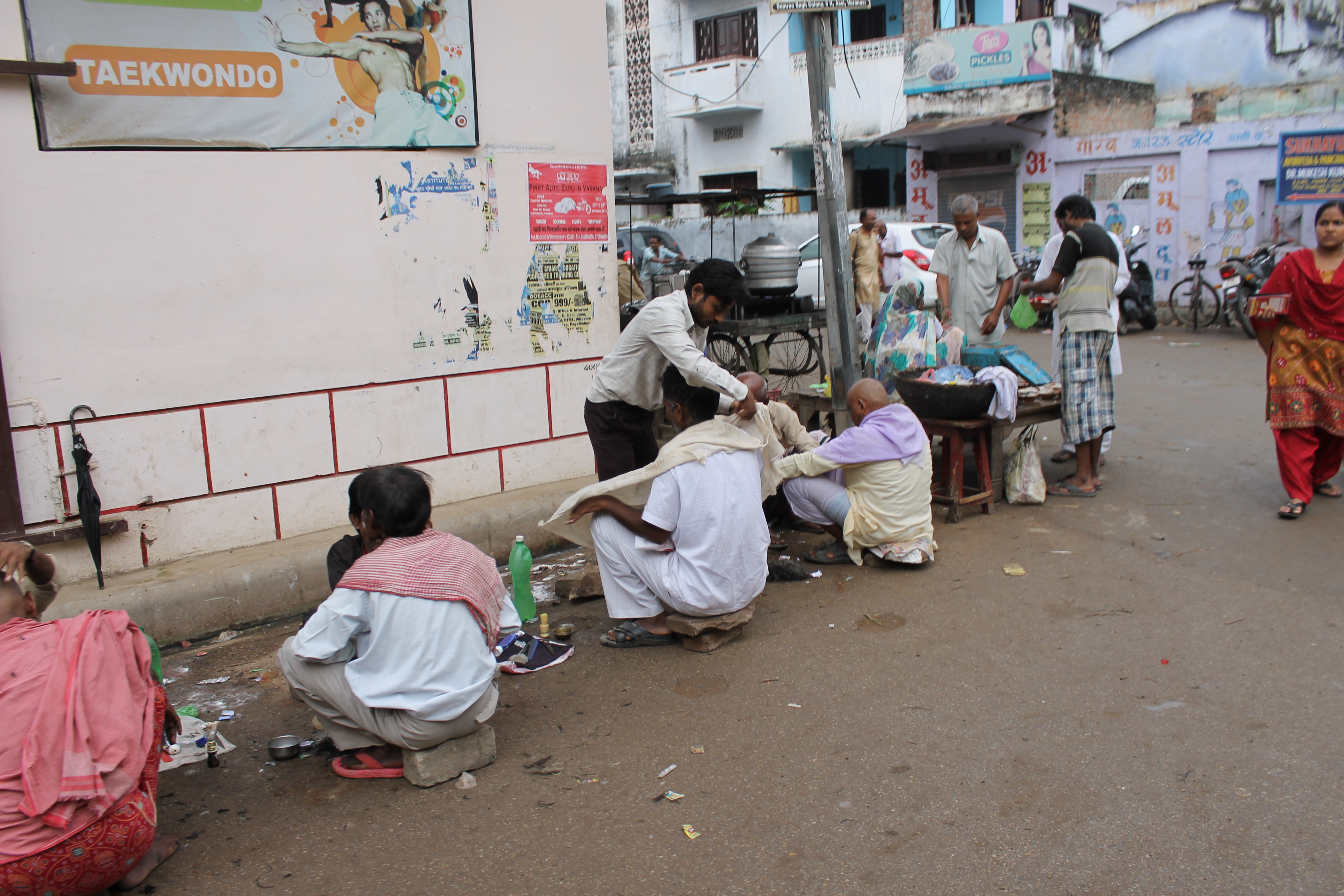
IMG_4081

Men having their heads shaved on the street for Pitru Paksha, a 16-day period when Hindus pay homage to their ancestors

We also went to Sarnath, the sister city of Varanasi where the Buddha gave his first sermon and now home to a Buddhist stupa and a sapling from the Bhodi tree under which the Buddha found enlightenment. A stupa is a solid mound of earth, stone, or brick of any size, usually containing relics from the Buddha himself, that is used as a meditation site for Buddhists. We have seen many stupas while we have been in India, and most of them contain relics (usually ashes) from the Buddha. At first, I thought it was very curious that, although Buddhism originated in India, there are very few Buddhists in the country, and instead it is practiced mainly in Sri Lanka, Nepal, Thailand, and other Asian countries. But I learned from a few friends here that in India, Buddhism is not considered a religion separate from Hinduism. Rather, the Buddha is considered a Hindu sage, and his followers in India consider themselves Buddhist Hindus. It was not until the ideology spread to other countries that it became a religion in itself.
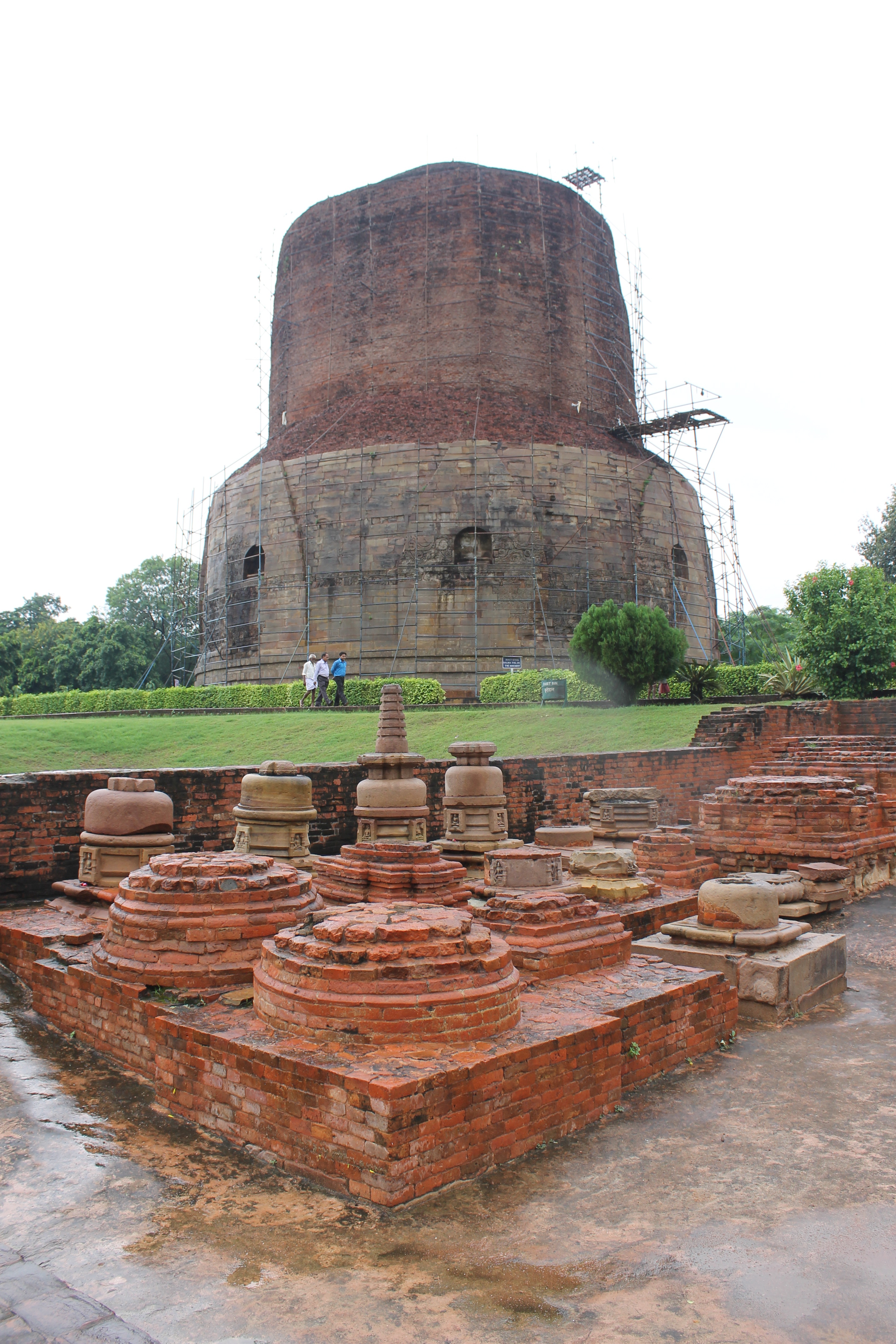
IMG_4180

The Buddhist stupa in Sarnath

Although Hinduism is the main religion in India, Hyderabad is actually one of the largest Muslim centers in the country. As you go towards the Old City in the center of Hyderabad, you will see more mosques, men wearing taquiyas (head coverings), and women wearing hijabs or burkas. Even from our apartment, we can hear music from the Hindu temple and the call to worship in Arabic from the Mosque in our neighborhood. The Old City has a large Muslim population because Hyderabad used to be ruled by the Nizams, an Islamic monarchy, from 1724 until 1948. This mixture of Islamic and Hindu culture makes Hyderabad an especially interesting place to live.

I didn’t intend for this blog post to be a boring lecture on religion, but I hope that it shows just how important religion is to the vast majority of people in India. Because we are surrounded by it every day as we are studying here, it has become something we must learn about – whether we like it or not. I know I am not alone in my frustration over which Hindu god did what, what religious holidays we are celebrating practically every week, or the reasoning behind the rituals that we witness everyday. But becoming a part of these things has been a wonderful opportunity that I could have never had at home.


Mel in Chile: The South Part 1

October 25, 2013

The South: Part 1

I have finally returned to Santiago from the ten-day excursion with my study abroad program. If I was promoting SIT before, I am really promoting them now! The excursions are valuable because they contextualize our lectures, readings, and discussions. The excursions allow us, as students, to move closer to the reality of the theories and discourses we are exposed to in an academic environment.

The title of this blog is “The South: Part 1” because I will divide our trip into three parts. For the first two days we traveled to Ralco, a town in the Biobío region, and stayed in cabins with the other students in our program. The next five days we participated in a homestay in small village called Valle Elikura. During this time we learned about the practice of communal tourism, engaged in discussions with community members, and heard stories of struggles and achievements of the Mapuche group. As we bid our temporary homestay families farewell in Valle Elikura, we spent the last two days around the city of Concepcion. These last days we visited a coalmine, the industrial complex of a forestry company, and had two lectures at Universidad de Concepcion.

Worry not; all of the above events will be described in detail in the upcoming posts.

So this particular post is about the first part of our excursion. We left Santiago at 10 pm on the evening of Sunday, October 13. We drove through the night and arrived to our cabins in an area just outside of Ralco at six am on a very chilly Monday morning. Biobío is the eighth region in Chile bordered by the Pacific Ocean to the west and the Andes in the east.

We all devoured breakfast like hungry wolves that morning and headed out to find our cabins. I am not a car/bus/airplane sleeper so I was tired. I planned to claim my bed and sleep well into the afternoon.

As I was wobbling through the grass, sandwiched in between the two backpacks I was carrying, I looked to the left and felt like I had been zapped awake by an electrical force. I saw the most bizarre and beautiful mountain. The peak looked like it had been split in three pieces by a lighting bolt. I thought, “Alright, this deserves some attention.” I dropped off my things in the room and, without any sleep, decided to look for a trail.

As fate would have it, there weren’t any trails leading up the mountain and the forest was too dense to create my own, so my intended hike turned into a nature walk.

The pictures will speak on behalf of the scenery much better than I will be able to describe it in words so I will not continue with descriptions.

cabins

These are the cabins we stayed in while in Alto Biobío

mountain

This is what our research methods class looked like Tuesday afternoon. The mountain is in the background.

I wanted to talk about what I enjoyed in Ralco. The town has a strong representation of Pewenche people, a group ethnically related to the Mapuche indigenous group in Chile. We were going to visit the Pewenche museum in Ralco. The last time we visited a museum trying to show “indigenous culture” we were in San Pedro de Atacama. It was an incredibly disappointing experience. Until recently the museum (in San Pedro) had an open display of a mummified body of an individual who belonged to the Atacameño group (the indigenous group in San Pedro de Atacama). The Atacameño community denounced this as incredibly disrespectful to their ancestors and an inappropriate display of the Atacameño people in general for many years. The mummified body was not removed until recently. I am positive I spoke of this in my blog post after the trip to San Pedro, but to recap; tourism in San Pedro is almost entirely based on foreign agencies. The indigenous culture is commoditized for consumption of western tourists, and the community itself is outside of any discourses and dialogue on how tourism of their region and culture is carried out. In literal terms, they are also physically outside of the center of the village. The center is now only for restaurants, tourist agencies, and hostels. It maintains a manicured “rustic” image of an “indigenous village” in order to supply tourists with the preconceived notions we have of exotic places. An anthropologist who works at the museum in San Pedro told us she will hear guides tell entertaining stories of Atacameño history to their groups that are incredibly far away from the history as told by the Atacameños themselves.

For this reason, when we were told we were going to a museum that exhibited Pewenche people and their culture, I was a bit weary and irritated.

When we entered the museum, however, I encountered a much different dynamic.

For starters, the museum was relatively small. The two people who worked there told us they were Pewenche. The young man let us know he would guide us through the museum. The museum didn’t have any displays of “ancient artifacts” produced from archeological digging sites. One section had photographs of different Pewenche people from Ralco with a caption of something they wanted to share about the Pewenche culture. Another area displayed Pewenche cuisine, including the instructions of how the food could be prepared. The other wall displayed and explained fruit and vegetables typically used by the Pewenche people in Ralco.

In the middle there were four wax figures of Pewenche males dressed in ceremonial attire, imitating a dance. Our guide told us next month he would dress in that way and participate in this dance.

This museum was a display of a living culture. The Pewenche people in Ralco designed it. They controlled the displays. Most importantly, they control the dialogue of how people outside the culture would consume what the museum exhibits.

We also visited a dam in Ralco. The building of dams is a big struggle the communities and environmental activists have in the Biobio region. I remember in my Environmental studies region we learned about the pros and cons of building dams. I particularly remember we had an exam on “clean” forms of energy so I diligently studied the flashcards of pros and cons I had created for the types of alternative energy we would have on the test. It was…a dejavu moment (i think?) to stand on the dam. I would look to my left and see a huge reservoir and look to my right and only see a tiny river. We also went inside the dam, into the control room to see the technological face of the structure. We also saw the various components of the dam, like the turbines the water turns and the magnetic sheet above it. As far as my understanding goes, the water from the river turns the turbine which causes positive and negative electrons in the magnetic sheet to move, which then generates electricity.

river

This is the river side

reservoir

and this is the reservoir side.

inside a dam

This is a section inside the dam where the crew controls….stuff.

The first part of our trip in Alto Biobío was incredibly valuable. I was incredibly happy with the museum. I also felt comfortable knowing I was not “consuming” images of an ethnic group that were built by people outside said group. It was also interesting to visit the dam and visualize not only the “pros and cons” that I kept thinking about, but also gain an understanding of how the structure functions internally.

Physically speaking, the area is incredibly beautiful

It is my second favorite museum in Chile.

Stay tuned for Part 2!


Mel in Chile: Santiago

September 13, 2013

Week #2. I’ve had the chance to walk around the city a lot this past week. In fact, I walked from my house in Providencia to the University which is close to Estación Central. It takes about an hour and fifteen minutes.

In general, I try and walk anywhere that will be within an hour or so and feel comfortable saying I have seen many areas of the city and walked through similar streets several times. Although, I should disclose that I have only been through the “safe” and usually nice areas of Santiago. In other words, all of my comments about the city refer to the middle/upper-middle class regions and are not a full representation of all of Santiago.

Okay.

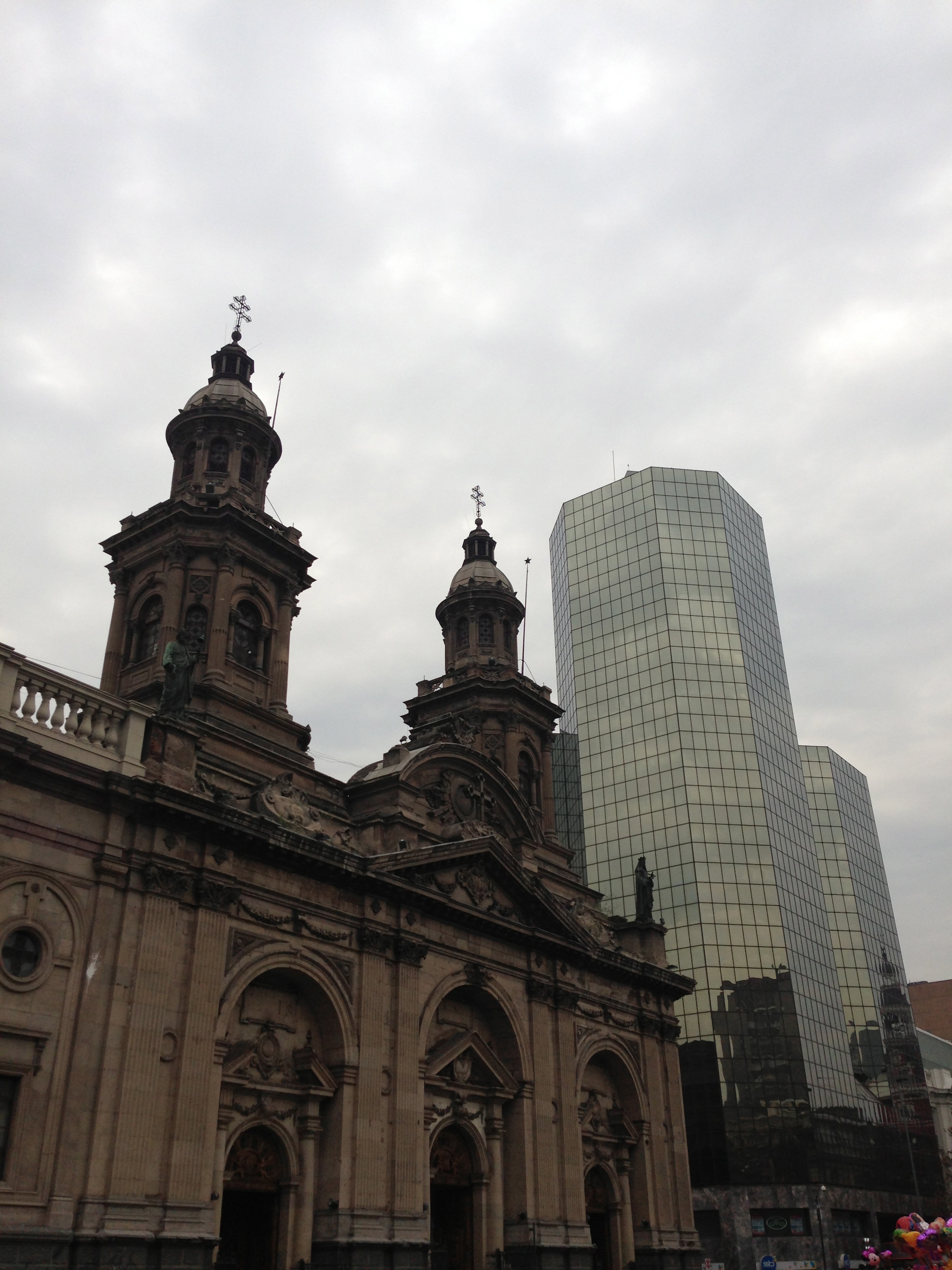
The past week and a half I walked around central Santiago confused. The architecture of the buildings seemed almost awkward. Actually, not the architecture of each individual building, rather the collective appearance of several buildings positioned close to each other. When I look one way on Avenida Providencia I see an old building with a structure screaming 18th century Spain which I imagine this to be the case in many Latin American countries. Then I look the other way and see the modern building of “Fundacion Telefónico” which holds various cultural events like theater plays and galleries. Across the street, on Plaza Italia, and I see the overbearing residential skyscraper marking it’s territory on central Santiago.

IMG_1891

On the left is the Metropolitan Cathedral of Santiago built in 1748. To the right, stands a perfect example of the many skyscrapers piercing the Santiago sky today.

Sometimes I feel I am in Spain, sometimes London and at other times even Tirana! Tirana, for the few of you who might not know (joking, I know most of you don’t know) is the capital of Albania. This is where I was born, grew up for the first ten years of my life, where most of my family lives and where I have spent many of my summers since migrating to the United States.

All last week, as I found myself in different areas of the city, I thought “What is going on here? Santiago must be confused. Is it colonial? Is it modern? Does it have its own identity? Its own niche?”

I am not suggesting cities, or even the tiniest municipality, is, or needs to be, homogeneous. Santiago is big. Of course it is diverse. I do not expect the architecture of every single part of the city to be identical. I also do not want to reduce an incredibly diverse city of almost seven million inhabitants to one single identity. That is not what I tried to do.

With that said, I still contend Santiago is a special place.

I spent the past week and a half trying to understand how the different structures and diverse architecture tell the story of Santiago.

The colonial architecture obviously comes from the colonial period. Easy. At first glance, the skyscrapers filled with offices of foreign enterprises contend that Chile does enjoy a developed economy, sophisticated financial structure and plenty of foreign investment. These are the buildings that proudly show the international community “Hey, we have made it!”. The modernity is celebrated not only by the elite who benefit from an open and deregulated market, but from also a working class who hope swallow their objections in hope that trickle down economics will eventually…well, trickle down to them.

On the contrary, the buildings are also an uncomfortable symbol  of the seventeen years of military dictatorship that aggressively implemented neoliberal economic  reforms. The reforms made possible  the most stable macro-economy in Latin America, but also created severe inequality in earnings, education, and healthcare to name a few. Consequently, for many, the modernity, the high-rises, and the “booming” economy also represent classicism, racism, and enforcement of prejudices and the further entrenchment of the degrading stereotypes that sustain them. The disrespect of human rights for seventeen consecutive years during the dictatorship which carried out a neoliberal economy and replaced citizens with consumers, and the current systematic neglect of key functions of a democratic government and civil society are oftentimes seen as an unjustifiable sacrifice for macroeconomic success.

But, this isn’t meant to be a history lesson.

So friends, I walked around for a week and a half thinking Santiago was confusing me because of how incredibly diverse the architecture is. As I thought this, I came to a street crossing. The light was red for the vehicles, but that isn’t what’s important. In front of the stopped cars was a man on top of those high unicycles, dressed as a clown, and juggling. He was putting a show for the cars during the few minutes they wait at the red light.

That is when I realized, the city isn’t confused.

It is unbelievably eclectic.

There is a fusion of past and present. The struggles and the victories. Protests on one side of town and celebrations on the other. Business men in suits and students marching in the streets. A musician playing his fiddle in the subway train and a woman dressed as if ready for a fashion show, having an extensive conversation about the current health of her nail-beds. September 11th 2013, the fortieth anniversary of the military coup, will undoubtedly result in riots across the streets (No worries, I will be in the north, and more that safe), then a week later, everyone will celebrate the fiestas patrias with friends, family, barbecues, and late night parties.

But, these “extremes” should not come as any surprise. It sort of runs in the country. Geographically speaking, Chile can make even the most experienced National Geographic photographer go “Huh. I have never seen anything like that before.” There are the Andes, an entire coast line in the Pacific, the world’s driest desert, glaciers, enormous lakes, valleys, rivers, grassland, and finally, the eclectic metropolitan city of Santiago.

Right now, I am on a plane flying north for an excursion with my program. The plane is going over the Atacama desert, the driest and highest desert in the world, and in the background I see the snow capped Andes.

Chile defies geographical norms.

IMG_1919

Birds eye view of the mountainous Atacama desert.


Mel in Chile: A Lens

September 3, 2013

It has been exactly a week. The most interesting aspect of “the life of a university student” is that political affiliation is a big part of the identity of public universities. Chile is an incredible place to study political systems as it is the only place in the world where a socialist government was elected democratically and without military intervention. This government was overthrown in a military coup only a few years after it was established. The years of Pinochet’s military dictatorship brought the implementation of strict neoliberal economic reforms and fast privatization of important industries. Many will argue it was precisely this period of free markets and capitalist ventures which brought Chile the macroeconomic “success” it currently enjoys. It is considered one of the most stable economies in Latin America. However this same period of military dictatorship also carries painful memories of vast and blatant human rights abuses the government committed against dissidents. Leaders of socialist parties were assassinated, thousands  of civilians who opposed the neoliberal reforms were tortured as political prisoners, and thousands more would simply disappear; they are called the “desaparecidos”. It is without a doubt that Chile’s “economic miracle” came at heavy price.

The bittersweet taste of “macroeconomic” success is not simply nested in the past. Chile continues to be a country with one of the highest margins of income inequality in South America. Access to health care and higher education (along with other industries) is concentrated in the hands of elites. I imagine many will remember the student led protests in 2011.

I apologize! This was not meant to be a history lesson on Chile’s economic and political evolution. I started the blog with the statement that university life for students in Santiago is very interesting. I have found that the universities in the city have a strong political identity. After only two days in the city, I heard from other Chilean students which universities were rightist and which were leftist. After walking around other campuses in the city, I also began to see the role of politics in the university.

This group of SIT students has come to study politics and economics in Chile at an incredibly special time. September 11th will be the 40th anniversary of the military coup in Chile. My host family, professors, and other students say there are many things that go on around the city. At USACH (my university), as in other universities, there are forums, discussions, panels and other events the university has organized. There are also events that will take place throughout the city. My group will actually be traveling to the North for our first excursion so we will be away from all the activity.

Then on November 17th Chileans will vote for their president.  It will be the first presidential election in which voting is voluntary.

In conclusion, I feel very lucky to be in this program during such a specific time in Chile. I am not simply here taking classes, making friends, and sightseeing. I have the opportunity to “experience” the country through a specific lens. I walk around the metropolitan areas of Santiago and I don’t simply see huge skyscrapers housing foreign companies. I also think about the implications of such economic growth. When I am in the university campus I don’t just see other university students. I think of how their identity as students was formed through the movement, and how they help form the identity of the university.

IMG_1743

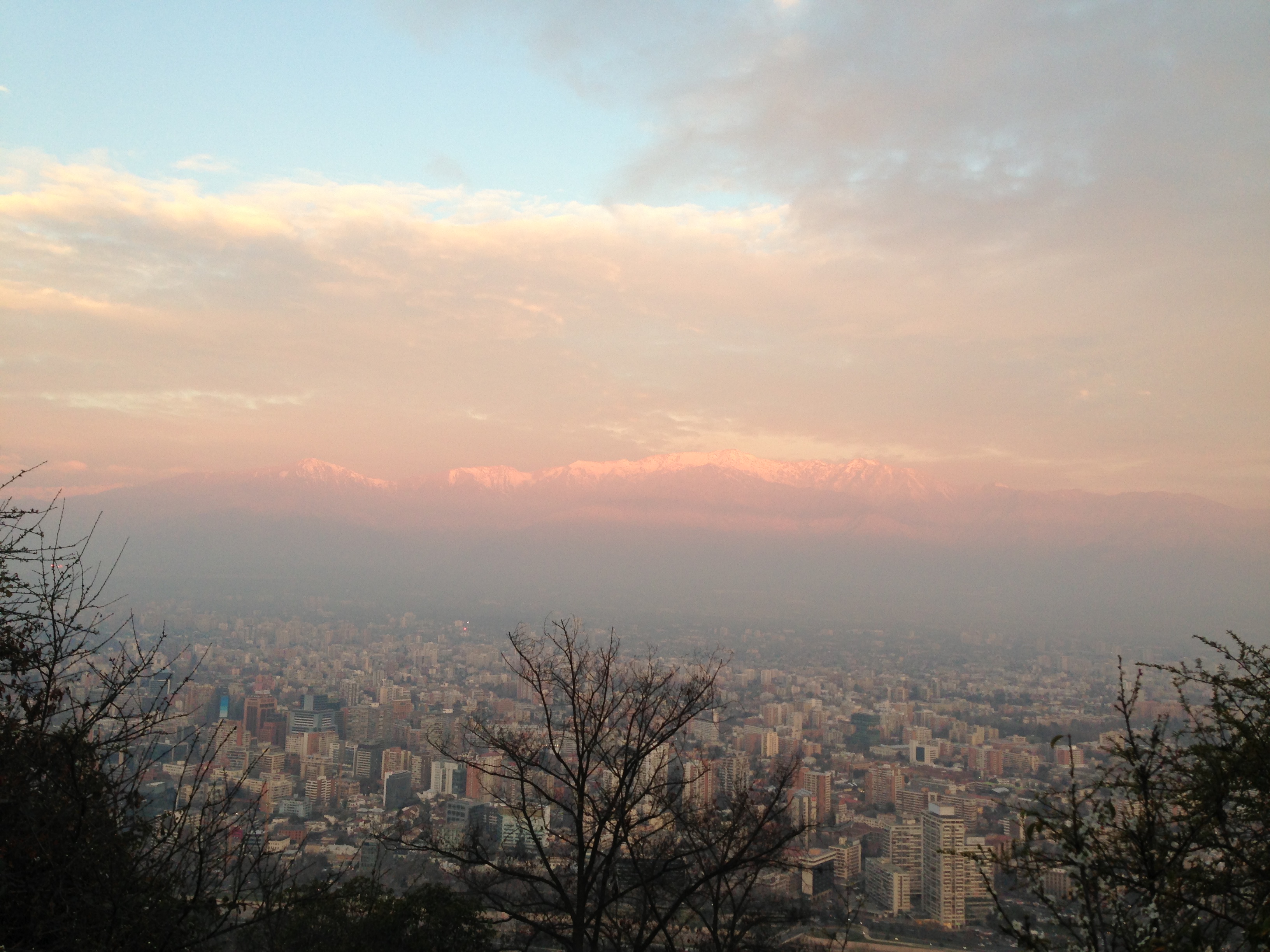
This is a view of Santiago from the San Cristobal hill. Note the Andes in the background!

It has been incredibly helpful to have this lens. Another student studying abroad in Brazil and writing for the Traveloges for UR mentions how easy it is for study abroad students to be “tourists”. Being a “tourist” is not bad. I am already planning a backpacking trip to Patagonia after the program is over with another friend studying in Valparaiso and I will do as much traveling as I can. That is to say, if you have the opportunity to travel you should take advantage of it. However you should also take advantage of the fact that studying abroad gives students an opportunity to create a lens. It gives students the opportunity to travel not to simply visit places and appreciate their presence in space but to also see what isn’t physically there.

I can feel myself becoming poetic as I sit in the cozy kitchen of Pedro and María on this cold night in Santiago, Chile.

Better to stop now before I start writing of the wisdom of the wind and the courage of the sun or something.

Have a great week everyone 🙂


Cambodia: Heat, Tuk Tuks, Temples, and Discovering the Country (posted by Indira in South Korea)

June 11, 2013

This semester I spent in South Korea and it was my very first visit to Asia. This continent has always been something different and somewhat far, but once I was in one of the Asian countries I tried to do my best to see as much as possible of it. Even though I decided to spend quite some time traveling in South Korea and discovering the beauties of this amazing country, I also knew I wanted a big trip to some other Asian country. Luckily two of my friends were of the same opinion so we planned a week long trip to Cambodia, a country I actually never even thought of visiting up until we started discussing the possibility of it.

Denis, Michael, and I were all very excited to board our Korean Air flight (definitely the best airline I flew with so far) to Phnom Penh, the Cambodian capital. We left Seoul on Friday afternoon and embarked on the adventure of lifetime. We landed around 10pm Phnom Penh time and were instantly greeted by the heat and humidity. It was quite a shock, I have to admit! A temperature of almost 100 degrees and humid air made it hard to breathe, but one can get used to it after a while. After going through immigration, getting our arrival visas, and making it through Customs, the biggest culture shock of my life took place (and we haven’t even left the airport, mind you). It was really interesting seeing all the tuk-tuks (the most common means of transportation in Cambodia) waiting for their customers, people trying to sell you all kinds of products for a super low price just to make enough for living, and the general atmosphere. We took a short cab ride to the place where we would stay that night before we headed to Siem Reap the morning after. On our arrival we also tried some Khmer (local Cambodian cuisine) so we had some soup, which pretty much discouraged us from trying anything else local.

On Saturday we traveled from Phnom Penh to Siem Reap by bus. This was not a really good idea. Very cheap, but not a good idea (that is why on the way back we got a private car: A bit more expensive, but much faster and comfortable). We spent over 8 hours in the bus with almost completely broken air conditioner. I tried to sleep through most of the trip in order to avoid the heat. Once we arrived to Siem Reap we were overwhelmed by all the tuk-tuk drivers who wanted to take us to our hotel and be our tour guides for the time we stayed in Siem Reap (there are not that many tourists in Cambodia at this time since it gets too hot and humid and the wet season is starting).

During our 4 day stay in Siem Reap we visited all the major temples including Angkor Wat, Bayon, Ta Prohm, and Angkor Thom. It is amazing to see how an ancient civilization managed to build such impressive temples a 1000 years ago but this beautiful country is facing such poverty nowadays. The temples we visited were by all means fascinating and something that is worth seeing just to understand how small a human being is compared to what he can make.

Ta Prohm temple, Tomb Raider

Ta Prohm temple, used in the film “Tomb Raider”

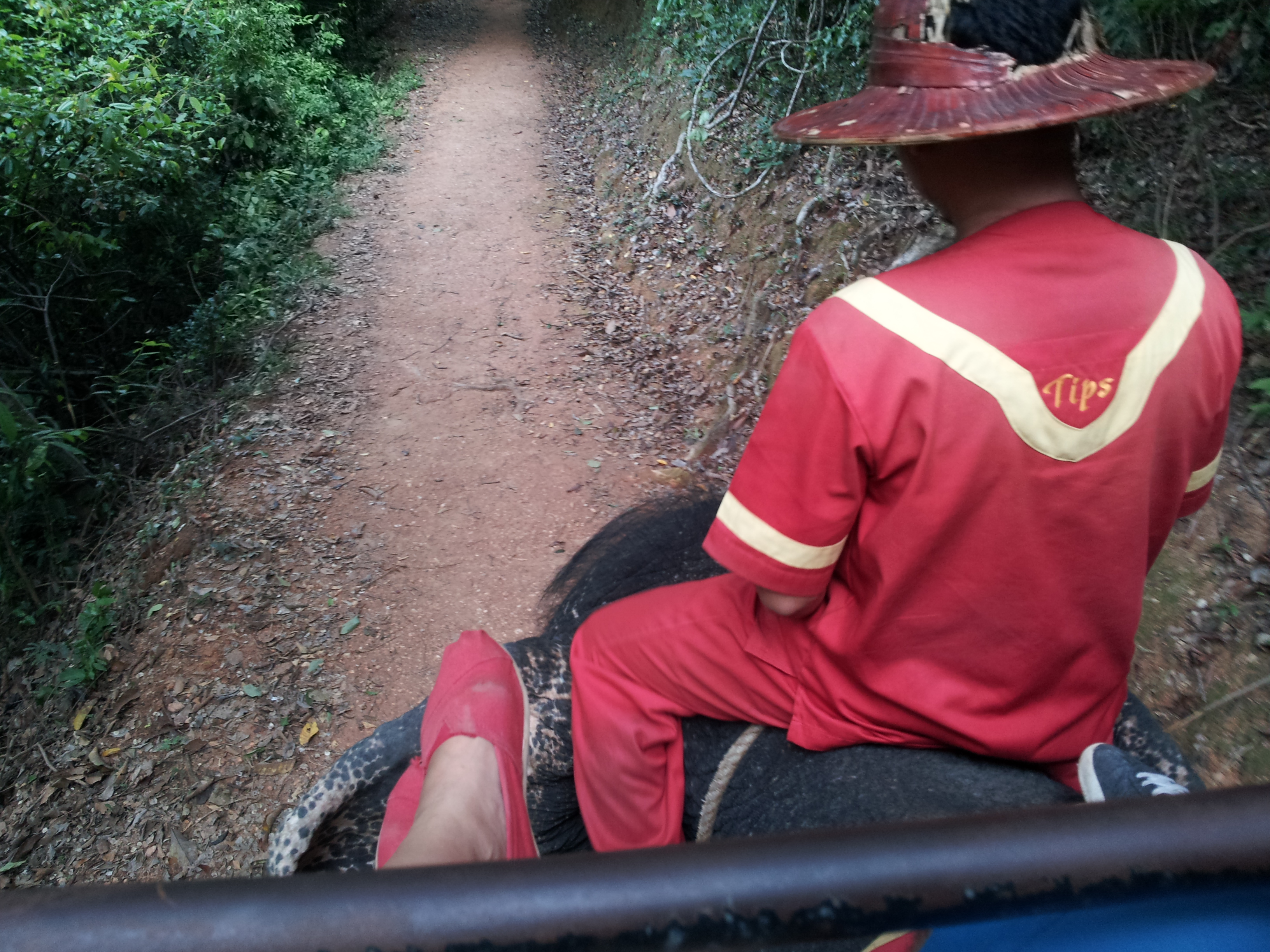
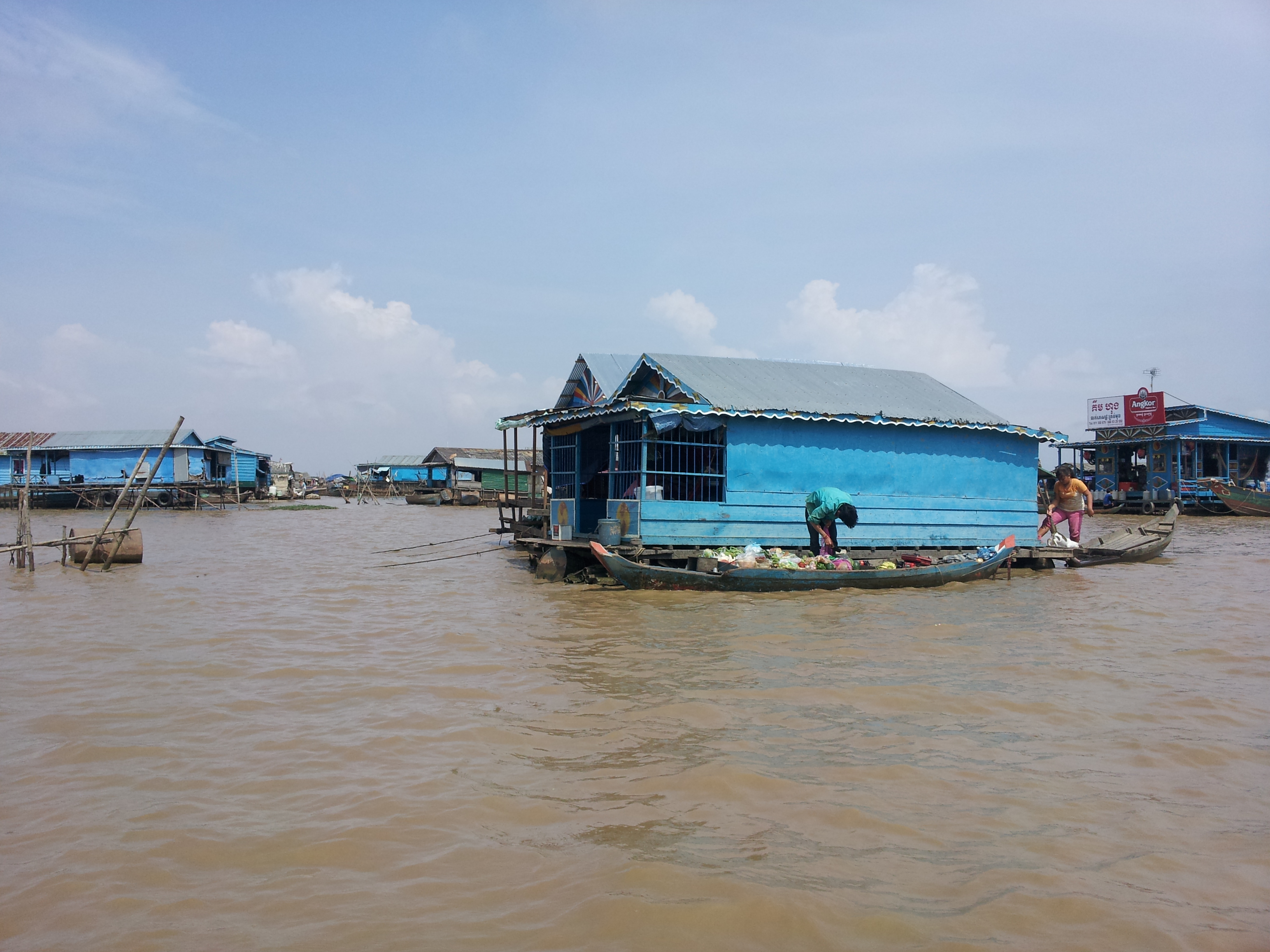
We also went to see the sun rise at Angkor Wat but unfortunately due to bad weather we weren’t able to see it. Another day we tried to see the sunset at Phnom Bakheng, a temple located on the top of the hill. We actually rode an elephant to the top of the hill and it was quite an interesting and fun experience. Unfortunately, there was no spectacular sunset that we were expecting due to the fact it was cloudy. Nevertheless, we had fun since the view of the jungle and Angkor Thom was very nice. Siem Reap is a really great place to visit as you can see the temples, but also get a more up-to-date Cambodia experience since the city is quite modern. Most of the city, however, caters to the tourists so there are lot of shops where you can buy souvenirs and there are plenty of western restaurants. We also went to see the floating village located on the lake just outside the city.

riding the elephant

Riding the elephant

floating village

The floating village

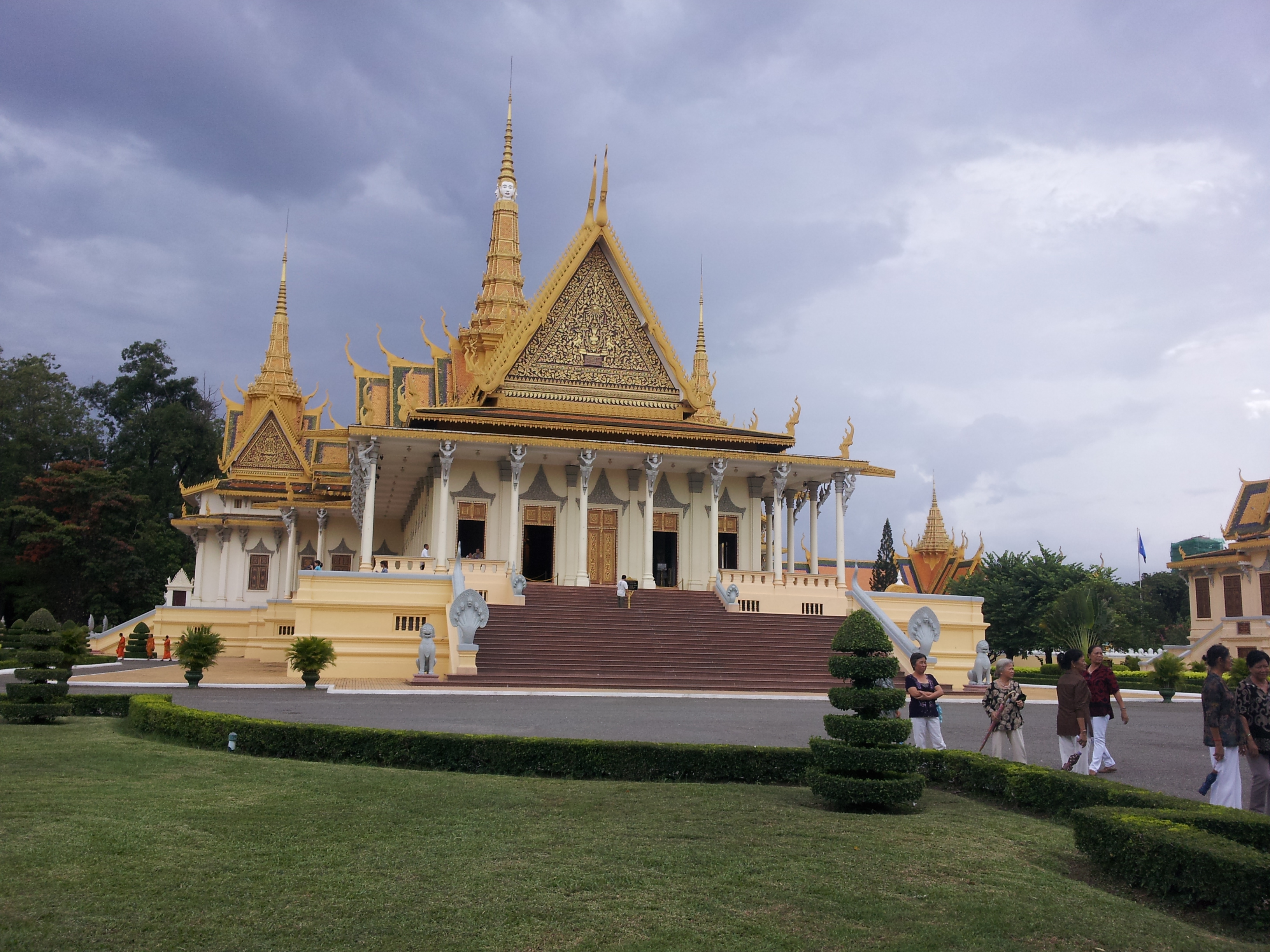
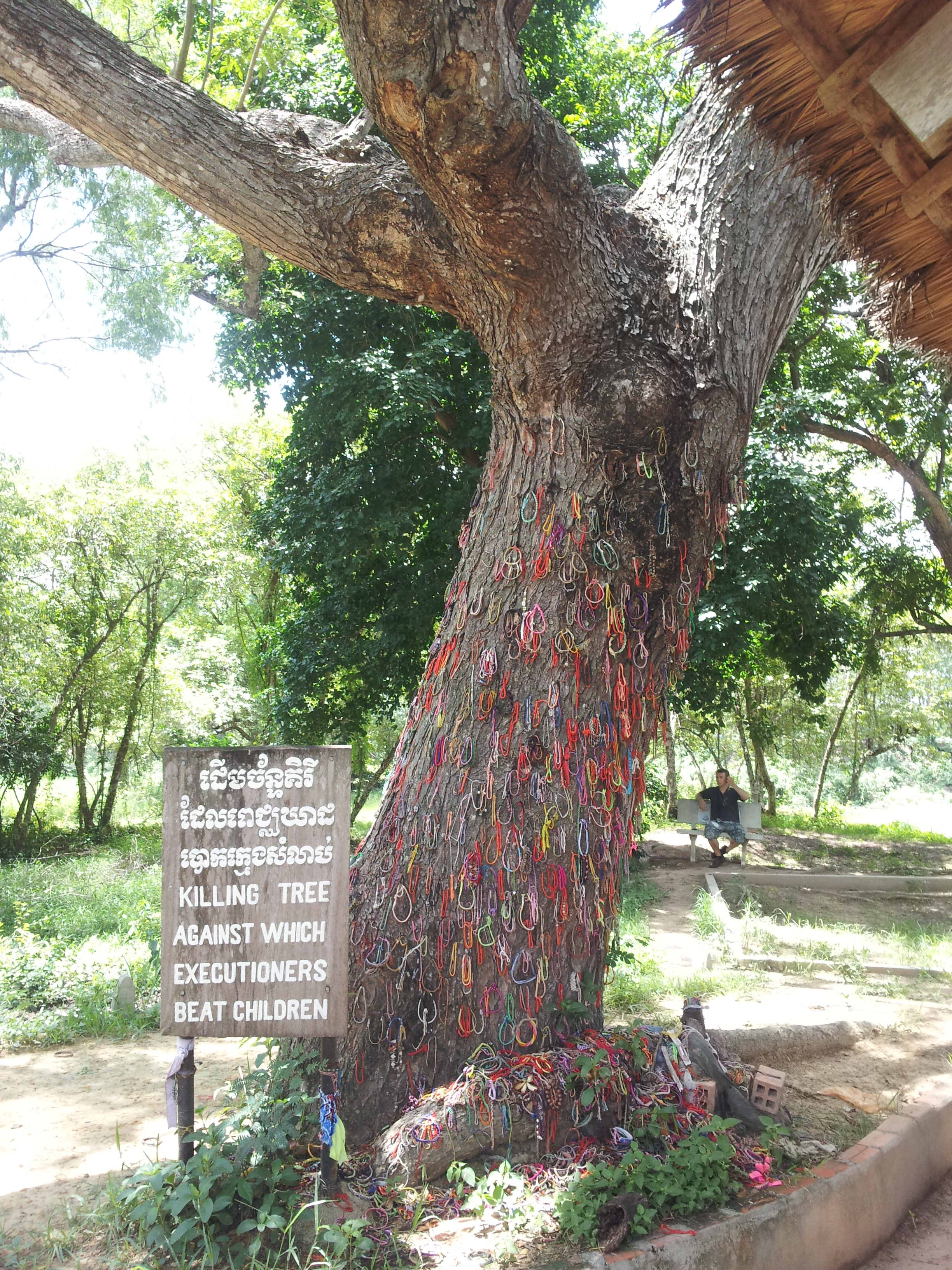
Our last day we spent in Phnom Penh visiting the Royal Palace and the Killing Fields. It is quite a contrast to see the streets of the Phnom Penh and then the riches of the Royal Palace. It is very beautiful and worth a visit!  Visiting the Killing Fields was a very emotional experience since I learned more about the genocide that happened during the Khmer Rouge regime in Cambodia. Seeing the mass graves, the killing tree where babies were killed, and hearing personal stories of the people who survived the atrocities of Pol Pot’s regime was very moving and I learned  a lot. Even though it was very hard being there, I am happy we got to visit the Killing Fields and learn more about the history of this beautiful Asian country.

royal palace

The Royal Palace

killing tree

The Killing Tree

Once you get past the humidity and heat, and get used to the tuk-tuk rides, it is very easy to enjoy Cambodia. No matter whether you visit the temples, the Killing Fields, or just engage in a conversation with the friendly locals (they all speak at least some English!) the beauty and the rich (no matter whether gloomy or fascinating) history of Cambodia shows through. The most impressive part was meeting Cambodians who are so helpful and have this great will to live and to be happy. Cambodia won my heart and it is definitely a country that I would visit again and recommend others to visit. This trip is surely one of the biggest highlights of my semester.


City of dreams! (posted by Pierre en Suisse)

April 26, 2013

Salut tout le monde! If you remember reading my last post, Voyageur du monde, you may remember that I hinted at another upcoming voyage, but I did not reveal my destination. My country count is now officially at four, as I just returned from a trip to Paris! What a weekend that was! Before heading off, I had quite a few expectations of the city, all of which are possibly the most cliché images one could produce of the city. This included wanting to eat crêpes at the Eifel Tower, hearing accordion players at various street corners, and going on long walks through the city’s gardens and famous streets, namely the Champs Elysée. But against all the stereotypes, I was most excited about just being in the presence of such history and culture. Not to mention the fact that I’d be able to visit a European capital city with such importance for politics, finance, and culture.

As always, the first thing that I was super excited about upon arriving in Paris was the fact that I could speak the language of the country. I didn’t have to ask someone at an information window to speak English, but instead, me and my friends who traveled together (other exchange students at UNIL) could all pose our questions in French and continue practicing our language skills. I also have to say that knowing the language definitely enriched the experience for me. The first site we visited was the city catacombs. Buried 45 million years under the Earth, the catacombs are the city’s former stone mines where the materials to build structures like Notre Dame Cathedral were taken from. As a more touristy twist, they have been turned into the burial site of more than six million people. Posted throughout the catacombs were writings, in both French and Latin, with very thought provoking quotes about human nature. Without knowledge of French, I would have missed out on what became my favorite part of the catacombs!

The entrance into the tomb area of the catacombs, underground in Paris

The entrance into the tomb area of the catacombs

Of course, our tour of the city moved above ground after our first stop. We later found ourselves visiting an old train station turned museum, le Musée d’Orsay, where we saw the works of some famous artists I had first learned about in elementary school, such as Monet! My group and I had all decided that it was a necessity to go to a museum in Paris, even though not all of us were crazed for looking at art, just because it was such an important part of the city.

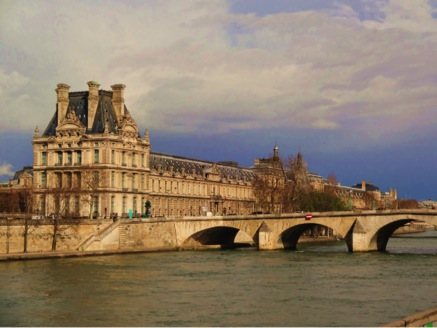
Right in the heart of the city, Paris, with the Louvre and the river Seine in sight

Right in the heart of the city, with the Louvre and the river Seine in sight

We found ourselves right downtown in the city when we left the museum, and by that point we all had food on our mind. After meeting up with a friend from France who had studied abroad at U of R last semester, we went off for our first real adventure into French cuisine. Luckily, our local was able to help us out with choosing some of the more traditional French dishes. I definitely branched out when I chose a duck dish for my dinner, and tasted my friend’s dish. She had ordered something called tartare de boeuf, which is essentially raw, ground meat with various seasonings for flavor. If you thought sushi is a terrifying concept, think again. I was at first really hesitant to try this, since all of my prior food knowledge was telling me something like this needed to be cooked, but I figured if French people can eat it, so could I, so I decided to be open and try it. I rewarded myself afterwards with crêpes, and then we finally made our way to the Eifel Tower.

And of course Paris' most famous site, the Eiffel Tower!

And of course Paris’ most famous site!

That being just our first day in Paris, it would require a much longer post for me to recount everything that we did during this trip. Four days in the city gave us the opportunity to see and do so many things, from just aimless touring to visiting some historical museums as well, notably L’Hôtel des Invalides, a a military hospital that Louis XIV ordered to be built for his forces in 1670. In some of the areas where the walls were newly renovated, it became so easy to place yourself in this time period, and feel like you were a part of it for a moment. It was an amazing feeling, when looking up at all of the stone walls and blue roofs. We also got to see the tomb of Napoleon in Les Invalides, which for a history nerd such as myself was pretty exciting.

Did Paris live up to my expectations? It certainly did, and then some. In the end, I don’t think that I embodied the clichés that I felt like I would before heading off, minus the fact that me and my group all bought berets the very last day and wore them through the airport and all the way back to Lausanne. I do count on the fact that I will be back there one day, but as always, coming back to Lausanne a third time from a trip abroad helped to solidify just how special I regard this city and country, as my first ever home away from home.


Uppsala goes fancy: Norrlands Nation’s Höstgasque and Gasque 101 (posted by Indira in Sweden)

November 23, 2012

As I mentioned in some of my previous posts, Uppsala is a meeting point for many contrary and contrasting things. Last week it was new and old. I was a part of a tradition so specific for Uppsala University students and so deeply embedded in the history of the student organizations here known as the nations, and yet so modern that still it occurs every semester.

The student life at Uppsala Uni is organized around 13 nations each representing a city or a region/county in Sweden. One can work in the nations, go for fika, study in nations’ libraries, meet friends, watch sport matches, go to the pub, attend concerts, participate in open mic and karaoke nights, go to the club there, take part in the gasque, as well as do many other things. But, let’s focus on the gasques (or gasks as they are called in Swedish). A gasque is basically  a formal dinner with an after-party. During the gasque you eat, drink, make toasts, and most importantly – sing. Yes, sing. Quite a lot, actually. Singing is basically the most important part of the gasque: You sing before making toasts, when drinking snaps (a celebratory tradition), when starting the dinner, when the dinner is almost finished, and for any other reason you could possibly propose to sing. And singing during the gasque is rather fun. Most of the songs are in Swedish, but you get a Songbook so you can follow and sing along. It’s also very easy to get the rhythm. Some songs even have their own little choreographies: My favorite song so far is one for which you stand up on your chair and sing and once the song is finished you should not sit in the chair since it means bad luck and you will fail all your exams. All in all, gasques are fun events where you get amazing food and meet new people, as well as familiarize yourself with Uppsala University and the nations’ traditions.

Höstgasque is the most formal of all the gasques during the Fall semester (höst means Fall in Swedish). The dress code is tail coat for the guys and ball gown for the girls. Ever since I heard of this gasque I made the decision to attend one, and I did so last week. A friend of mine plays in Norrlands nation’s orchestra so she attended the gasque and I joined her. All the members of the orchestra had dinner in a special room, but they followed all the gasque traditions.

The dinner table before the gasque started, a Swedish University tradition

The dinner table before the gasque started

There was a lot of singing, toasts, speeches, and chatting. I got to meet the members of the orchestra who were all Swedes. It was great practicing my Swedish and learning more about Sweden. Apart from that I enjoyed the food a lot – I ate moose for the first time ever. That was a whole new experience. We also played a game: All of us had a “top secret mission” that we had to fulfill during that evening. My task was to be obnoxiously loud after every toast and speech, applaud as loud as possible, and compliment the speech or toast. It was so much fun doing that! Other people had to propose toasts on every possible occasion, or start a conversation about music etc. It was a good way to bond with the people sitting near you at the table.

 Some of the members of the orchestra, which, played during the gasque, at the after-party

Some of the members of the orchestra

After dinner, the orchestra played and other gasque guests danced waltz and polonaise – that is how formal Höstgasque is! The formal dance continued during the after-party as well since more classical and jazz music was played. This is the typical after-party for these formal gasques in all nations.  Below is a video of the orchestra that played:

My friend and I decided to go for a full Höstgasque experience and went to the after-parties in two other nations  – Värmlands and Östgöta. The whole atmosphere made me feel like I travelled back in time. It was definitely an experience I am happy I was able to have. Attending the Höstgasque is definitely going to be one of the highlights of my semester abroad in Uppsala.


The Smartest Man in the Room (posted by Jimmy in England)

October 22, 2012

I woke up this morning and couldn’t exactly remember what had happened last night.  I tried to piece together the bits of information that were coming back to me but there was just so much missing.  Good thing that I wrote everything down. Let me take you back to when it all started.  During orientation week, thousands of college societies set up in a big auditorium so that every student has an opportunity to explore their interests.  Various societies include Sports Clubs,  A capella, Harry Potter Society, Philosophy Society, and my personal favorite, the Scientific Society.  I signed up for a few different societies and on Monday I received an email about different lectures that the Scientific Society holds throughout the year.  This week’s seminar was to be given by Ian Fleming.  There are probably many Ian Flemings in the world, but two of them particularly ring a bell in my mind.  The first is the English author that wrote the James Bond novels and the second is the man who appears in all of my organic chemistry textbooks.  Since this email was from the Scientific Society, I presumed that the organic chemist was coming to Oxford.  For those of you that have never heard of Ian Fleming, he is one of the most important organic chemists of the 20th century.  He was the first person to determine the full structure of chlorophyll in 1967, he helped synthesize vitamin B12 during a one year postdoc at Harvard, and he created a mechanism (Silyl-Hydroxy Conversion, also called the Tamao-Fleming reaction) that is used in many organic chemistry research labs today.  He also did all of this at a time when there were not accurate ways of determining chemical products based on computers. Dr. Fleming is included in the panel that nominates Nobel Laureates for Chemistry as well.  Simply put, he’s big time.

I jumped at the idea of going to hear this man speak and so I emailed the Scientific Society and told them that I would definitely be attending. An amazing woman, Aimee, who is from Oklahoma and doing her postdoc with her husband at Oxford, responded and asked if I would like to attend dinner with Dr. Fleming before his speech!  The simplicity at which you can make things happen via email astonishes me.  Within a few hours I went from potentially listening Dr. Fleming speak, to walking to a little dinner with an extreme sense of anticipation as I prepared to meet him.  The dinner was at an Italian restaurant off of Banbury road.  I have yet to mention the fact that it has been a few weeks and I still can’t get used to people driving on the left side of the road.

Banbury Road, the location of my dinner with Ian Fleming

Banbury Road

I expected that I would be one of about 30 or 40 people at dinner and I would probably introduce myself and eat with some graduate students.  When I got there, I couldn’t have been more surprised.  Dr. Fleming was sitting with one graduate student having a conversation.  I ended up joining them, along with another undergraduate and Aimee and her husband.  There were 6 of us in total, including Dr. Fleming, and I can’t even begin to explain how incredible it was.  If you want to talk about brilliance, look no further.

I want to share some of the advice that Dr. Fleming gave us throughout the night.  First off, he knew he was brilliant, but he didn’t act better than anybody.  He is 78, but still quick as a whip.  He told us to understand that we are smart, to be thankful for it, and to get better.  He also absolutely loves what he does.  He simply loves being in a lab, synthesizing organic compounds.  “It’s all about the chemistry” he would say.  At the time that he was doing all of his research, he couldn’t connect the dots, but random things would come to him later in life that ended up helping him in all of his work.  He was asked what makes him see the answers to problems that others have questioned for years and he responded, “My group of colleagues have the ability to think about a problem longer than anybody else.  We didn’t know what we were doing, but something would eventually work.  We would stare at a problem for weeks and something would click.”

During the lecture, I sat in front of two Ph.D students, one was from Canada and another from France.  Before Dr. Fleming started, these students were reciting the periodic table from memory.  They knew every element in order, all they way through.  At the end of the lecture, the French man said, “Wow, I feel like a schmuck compared to him!” His answers to problems are so simple, but they always work.  He says that most answers stare at you, and if you just think a little bit harder, they appear.  I ended the night by simply walking home and going to bed.  There was so much information that my mind was trying to wrap itself around so I made sure that throughout the night I wrote everything down.  My mind had been blown, and it clicked that I was in such a special place with the opportunity to meet one of the most important chemists of the last hundred years.

“All the greatest men are maniacs. They are possessed by a mania which drives them forward towards their goal. The great scientists, the philosophers, the religious leaders – all maniacs. What else but a blind singleness of purpose could have given focus to their genius, would have kept them in the groove of purpose. Mania … is as priceless as genius.” 
-Ian Fleming, Doctor No


A Glimpse of the Beauty (posted by Jimmy in England)

October 12, 2012

“On Thursday at 4:30 walk to the first white house on Longwall street and knock on the window in between the front door and the entrance to the courtyard.”  That was the message that my tutor sent me for the time and location of our first tutorial. In the previous week , visiting students had been warned that the cardinal sin of Oxford was being late for a tutorial. So I naturally decided to show up a little early for my first lesson and like every other day at Oxford, it was raining. When I arrived at the house,  I knocked on the window in between the front door and the courtyard and there was no response. At exactly 4:30, a man came biking up to the house.  He was fully equipped with all the essentials of biking in the rain.  He had a neon raincoat, thick rain pants, a case for his backpack, and even goggles for his eyes.  On that note, let me tell you that this is not that out of the ordinary.  There are two guarantees at Oxford: It rains and everyone uses bikes as the main form of transportation. As he got off his bike he introduced himself as my tutor.  He opened the front door and we went into the living room.  On the outer edge of the room was a couch, a desk that faced the window, and a bookshelf containing many Human Evolutionary Genetics textbooks.  In the middle was a table and at the table there were chairs.  In those chairs we were to sit and talk for an hour about the genetic differences and variation among populations of humans and chimpanzees. The tutorial, a little daunting a first, turned out to be typical of the Oxford lifestyle.  Academic life is not a job that you go to and then leave behind at the end of the day. As seen by my experience in a random house, it is something that is part of your everyday life.  It is essential to who you are.  My first week of tutorials made me realize that.

I will be completely honest with you, academic events have taken up every bit of my time here.  No matter what I am doing, there is always some component of learning involved.  Now that may seem a bit excessive, but I absolutely love it.  Every day this week I would wake up and pick a random lecture that I wanted to go to.  I sat in on biophysical chemistry  lectures and went to seminars on various biological processes.  Is this completely academic? Yes. Do I love it? Absolutely!  I may not be travelling through Europe too much this semester, but I am gaining invaluable experience by working here.

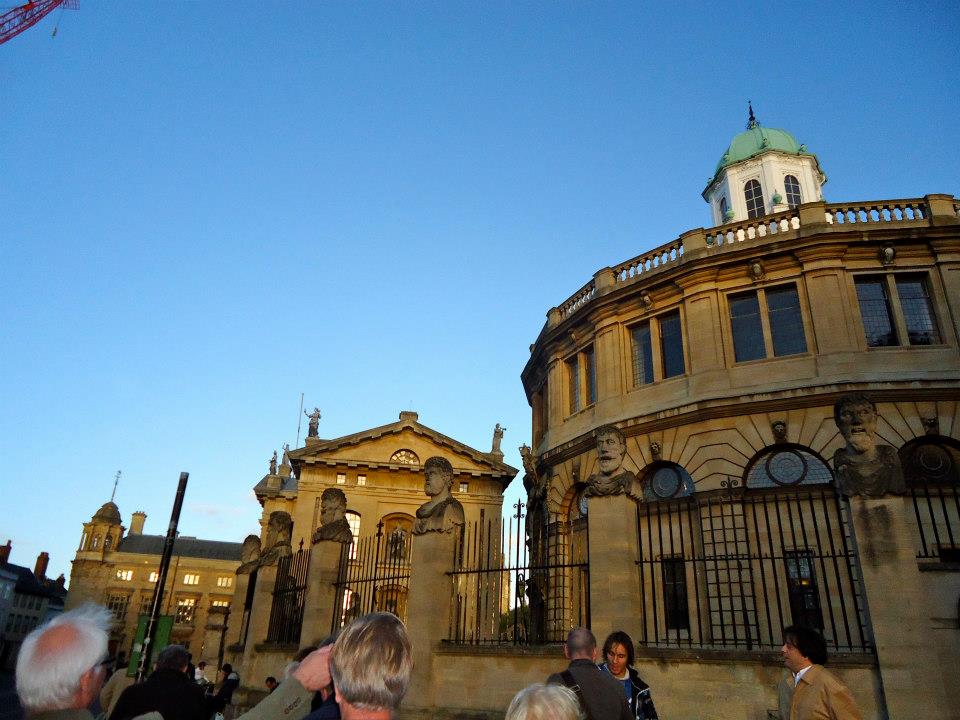
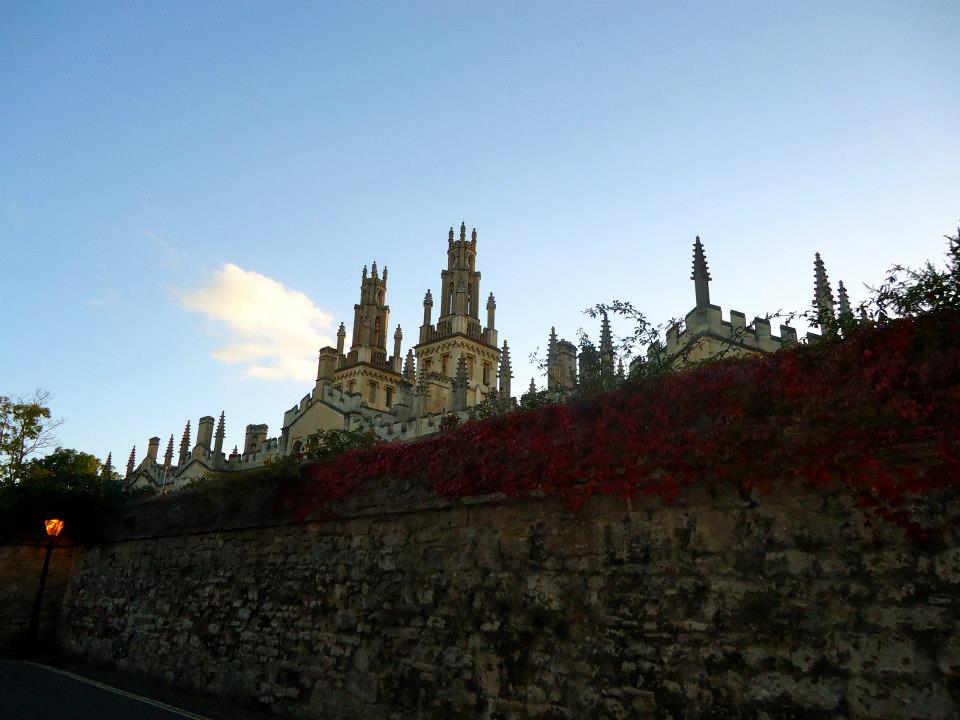
I will admit that I did take a break last night.  I went to the Turf Tavern with some other visiting students and got some very good advice from a woman who was reminiscing on old times with a long friend.  She said, “One of the problems with people in Oxford is that they all look down.  It rains all the time, so they naturally put their heads down.  While you’re here, look up.  You’re in a beautiful city, why not take it in and enjoy it.”  With that in mind, I spent most of today just ‘looking up’ and I found a lot of different sites at Oxford. The first are the Heads at Bodleian library.  I live about 30 seconds away from there and do not know the story behind the heads.  When I find it out, I will let you know.  The other two pictures I have included in this blog are from Christ Church.  Christ Church is not only one of the 38 colleges that are part of the University of Oxford, but it is also the cathedral church of the diocese of Oxford.  It is a very good representation of the beautiful architecture of this city.

Bodleian Heads at the Bodleian library in Oxford

Bodleian Heads, the Bodleian Library, Oxford

Christ College a cathedral at Oxford University

Christ Church, Oxford

Christ College at Oxford

Christ Church, Oxford

“Life is full of beauty. Notice it. Notice the bumble bee, the small child, and the smiling faces. Smell the rain, and feel the wind. Live your life to the fullest potential, and fight for your dreams.”- Ashley Smith


Fall in Uppsala: Seminars, Skansen und Richmond Re-union (posted by Indira in Sweden)

October 5, 2012

I started understanding how busy it can get here at Uppsala University over the past couple of weeks. Papers, reading, assignments, seminars, and exams have all come with the first days of Fall.

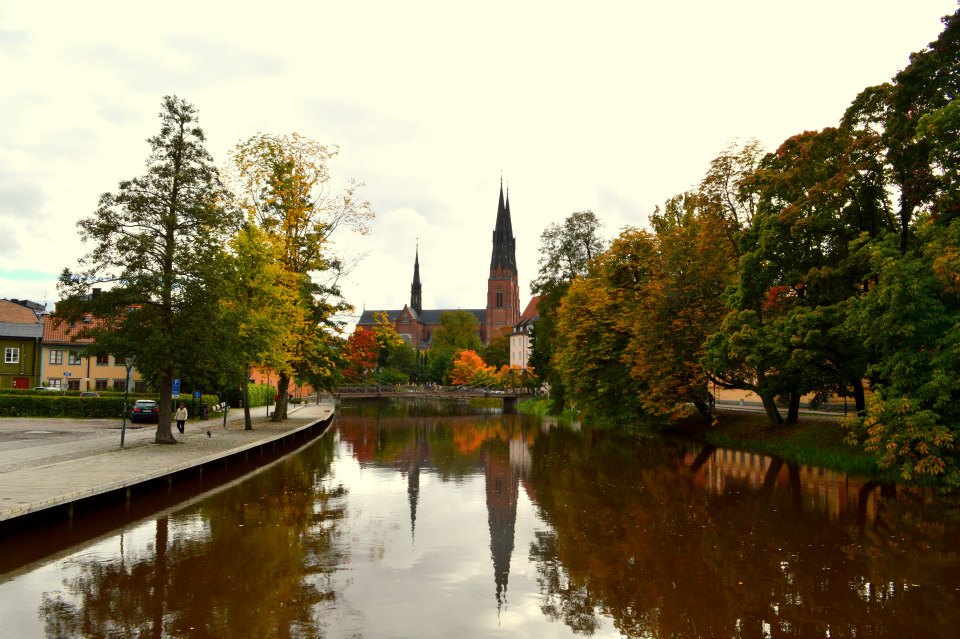
On the bright side – I don’t think Uppsala could look any more beautiful than it does right now. Leaves are changing colors and the whole city looks very majestic in different shades of yellow, orange, and red. I don’t need to do anything more than just look out of my window to enjoy this beauty. When the weather allows and it is not raining (unfortunately , it doesn’t happen all too often here) taking a walk in the forest close to the accommodation area Flogsta (where I live) is very calming and true food for all senses.

Fall in Uppsala, a gorgeous scene of the changing leaves on the trees

Fall in Uppsala

With all the school work, it is not always easy to enjoy Uppsala. Just last week I experienced the Uppsala University education system to its fullest. As I wrote earlier, there are lectures and seminars, and in seminars you are in a group of about 15 students where you discuss specific questions and have tasks to complete. My seminars so far have involved writing papers, preparing a debate and preparing a presentation. This way the students do more work on their own (but professors and lecturers are always available in case one needs help) and get to work on the questions and issues they take interest in. All lecturers encourage group and pair work. I worked on all of my seminar assignments with Izabelle who is a freshman from Stockholm. I really like that I got to work with a Swede since it provided an opportunity to meet someone new, to understand more about Sweden and Swedish culture, possibly learn new Swedish words, and also create a stronger link with someone who can be seen as an insider. I enjoyed working with Izabelle and I feel like we learned a lot from each other. Actually, all of the members of my seminar group are amazing and I got to know them pretty well. Unfortunately, as soon as we became friends (and not just classmates), our course ended (this class was basically an intensive 5 week class where I had classes every day. I wrote about this “one class at the time” system earlier). Not having a class together makes it harder to see people. On Monday I had my exam and it went really well. Uppsala University has a specific building where all the exams are held so it all feels very official. It felt somewhat weird to walk out of that exam and realize that my first Government class is over.

A view of Stockholm from Skansen, a park/zoo that I recently visited in Sweden

A view of Stockholm from Skansen, a zoo/open air museum I recently visited

Classes here are not all about having loads of reading and being stuck in the classroom. My other class, Critical Perspectives on Sustainable Development in Sweden, tries to incorporate the fieldwork in the course as well. A week ago we took a class trip to Skansen, which is a mixture of a zoo and an open air museum in Stockholm. We got to see brown bears, lynx, and many other animals, but we also learned more about sustainability in Sweden throughout its history by visiting small settlements and houses built as examples of how people used to live in different parts of Sweden at different points in history (my group, for instance, had to learn more about Sami). My personal highlight was a visit to a bakery where there was a cook who makes the Knäckebrot the way it was made traditionally. One can watch and then enjoy the delicious Knäckebrot with some salted butter. Yummy!

A brown bear at Skansen, a park/zoo in Sweden

A brown bear at Skansen

Another exciting thing happened recently: I finally managed to meet with Carl-Johan (or CJ as he was known in Richmond), who was an exchange student at UR last year and who was a great support and source of information about Uppsala (in essence, he is the one who made me think about applying to Uppsala Uni in the first place and I am so glad he did since coming here was the best decision ever). We had a nice fika and it was great to talk about Richmond with someone in person (I am the only student from UR here this semester). I really enjoyed meeting him!

Now I’m eager to see what October brings and I am looking forward to my trip to Tallinn at the end of the month! 🙂