Fabiana in China: The Last One

May 1, 2015

As we wrap up the month of April, I sit back and enjoy my last plane ride back to Beijing. I look at the blue sky and clouds, and remember I forgot to throw out the milk in my refrigerator before leaving (two weeks ago). Haha.

With approximately 1,400 photos in my camera (of which 200 are basically selfies), I feel as if it was only yesterday when this trip started. We had seen and learned so much, to the extent that I have to make an effort to remember what I had seen in each city. I could go on and on about everything that has happened, but instead I’ll briefly narrate my top 10 experiences.

(Because it’s too hard to rank them, I just listed them according to the order in which each was done)

Visiting the White Horse Temple (Luoyang, western Henan province, China)

The White Horse Temple is the first Buddhist temple in China. Established in 68 AD under the patronage of Emperor Ming, the temple is considered “the cradle of Chinese Buddhism.” The legend says Emperor Ming had a dream vision about a Buddha who established Buddhism in India. He then sent emissaries to search for Buddhist scriptures. In Afghanistan, they found two Buddhist monks that agreed to come to China to translate the Buddhist scriptures into Chinese. These monks carried their Buddhist books, scriptures and relics on two white horses. In their honor, the Emperor built and named the first Buddhist temple The White Horse Temple.  Creative huh?

Photo 1

Witnessing tens of thousands Buddhist statues carved into mountains (Luoyang)

The last time I remember feeling this amazed was when I saw the Taj Mahal in India two years ago. The view of the Longmen Buddhist Grottoes was simply breathtaking, especially because you never really know when you’ll reach the most famous sculptural site of the place. The construction of the grottoes began in 493 BCE, and in 2000, the area was inscribed on the UNESCO World Heritage List. With around 2345 caves and niches, 2800 inscriptions, 43 pagodas, and over 10,000 Buddhist images at the site, it is one of the most impressive collections of Chinese art from the Northern Wei Dynasty, Tang Dynasty and other periods.

Photo 2

Touring The Terracotta Soldiers Site (Xi’an)

Ever since I saw an exposition at Epcot, Disney of the Terracotta Soldiers, my dream was to go see “the real-deal.” These life-sized statues of warriors older than the Roman Empire are located 1.5 kilometers east of the Mausoleum of the First Emperor, Shi Huang Di. Farmers found pieces of broken terracotta in 1974 when digging a well. This is how the 14,260 square-meter pit of terracotta warriors and horses was found. Today, more than 8,000 soldiers and 100 chariots have been excavated. However, because of the “limited technology” today, most of the excavated warriors have been buried again for better protection. There are only 1,000 terracotta figures in exhibition today.

Photo 3

Riding a Tandem Bike on Xi’an’s Ancient City Wall

There is truly no other way to wander this 14-kilometer city wall other than riding a bike. If you’re up for spicing things up, try renting the tandem bikes. From the top, you’ll be able to see the contrast between the old and new architecture: the old referring to the construction located inside the city wall, and the new referring to the outside. The city walls form one of the largest and most complete, ancient military systems of defense in the world. They were built on the fortifications of the Tang Forbidden City.
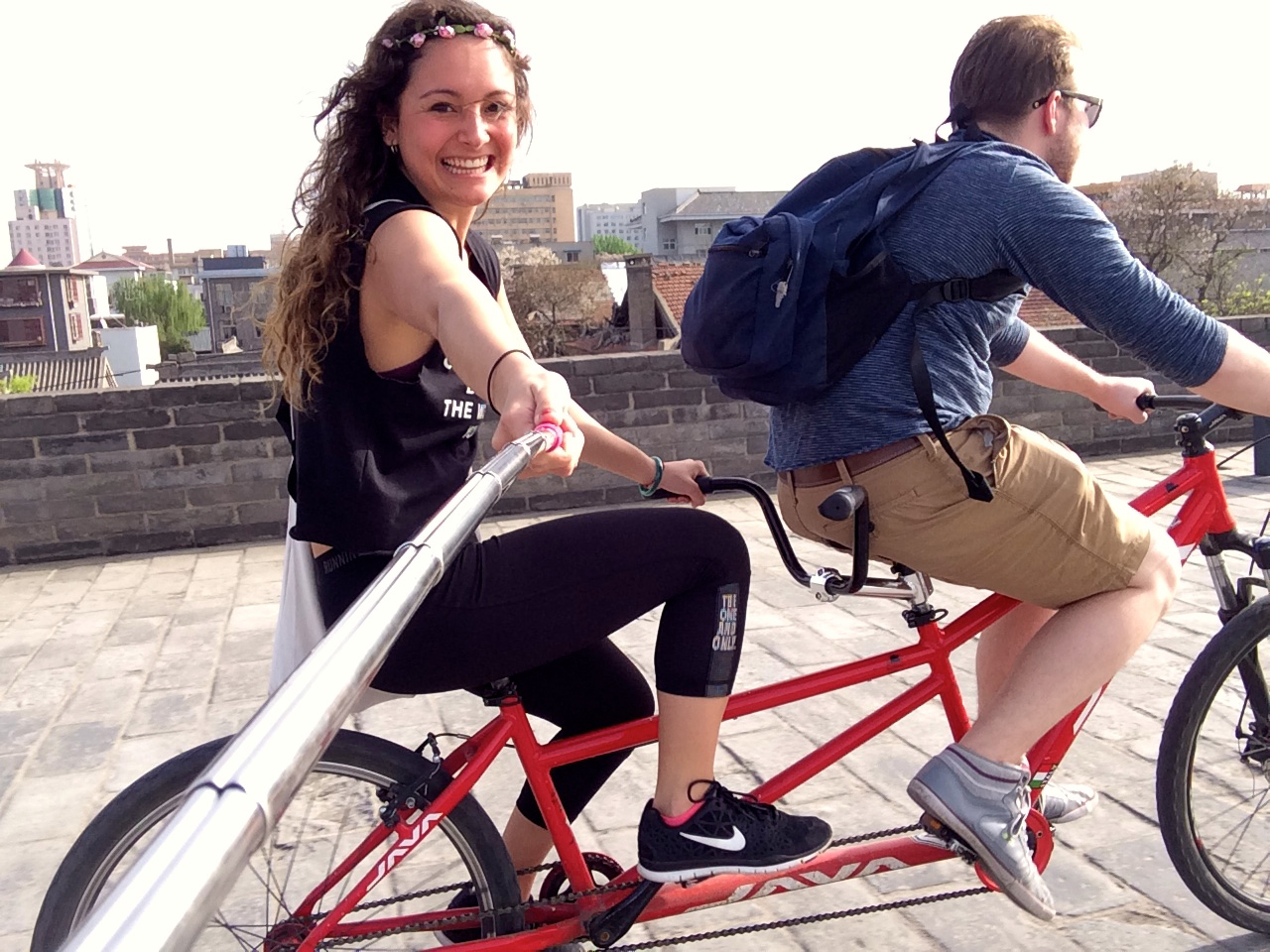
Photo 4

Eating in Xi’an: Arab Street Food

From fried bananas on sticks to spicy meat over bread: when in Xi’an this street is a “must-go” to eat. Half the time you will not know what you’re eating, but the lines of people waiting will depict how good the food being sold there is.
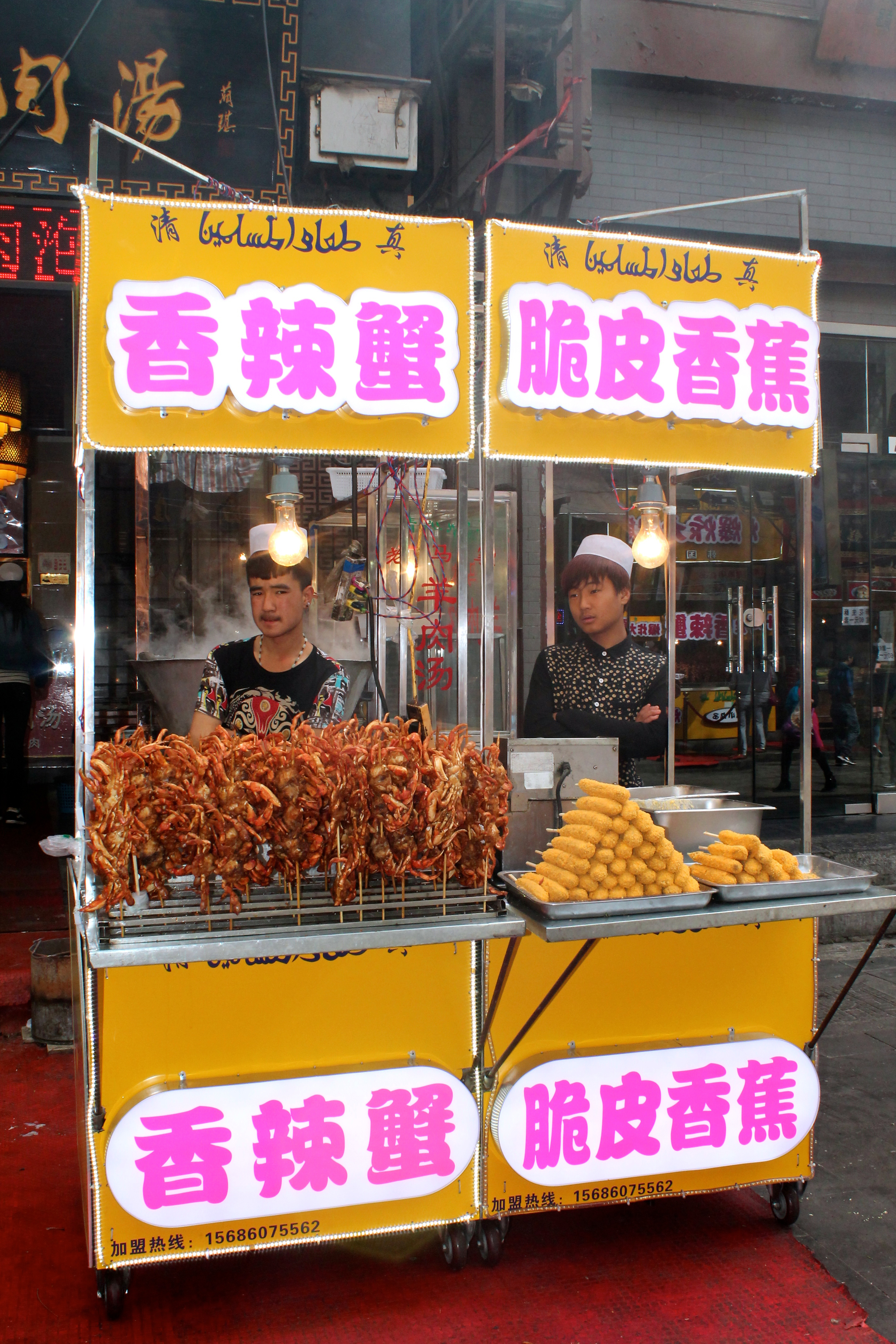
Photo 5

Roaming Around the Potala Palace (Lhasa)

This palace is truly astonishing. When seeing it from the outside, you see a combination of white on the bottom and red on top. These two colors correspond to two palaces built in different time periods, but connected to form one from the inside. Pilgrims walk around the Potala Palace for hours to pay homage, so as soon as you’re near the palace you can get a feel of how important this building is for Buddhists. The 13-story palace stands 117 meters high and has over 1,000 rooms. It covers an area of 130,000 square meters.

The red palace contains jaw-dropping mausoleums of previous Dalai Lamas and the white palace contains the living headquarters of successive Dalai Lamas and their tutors. The Potala Palace is full of precious sculptures, murals, scriptures, and Buddha figures accompanied by the hums of the Buddhist prayers. It has been considered one of the most sacred places for Buddhism for hundreds of years.
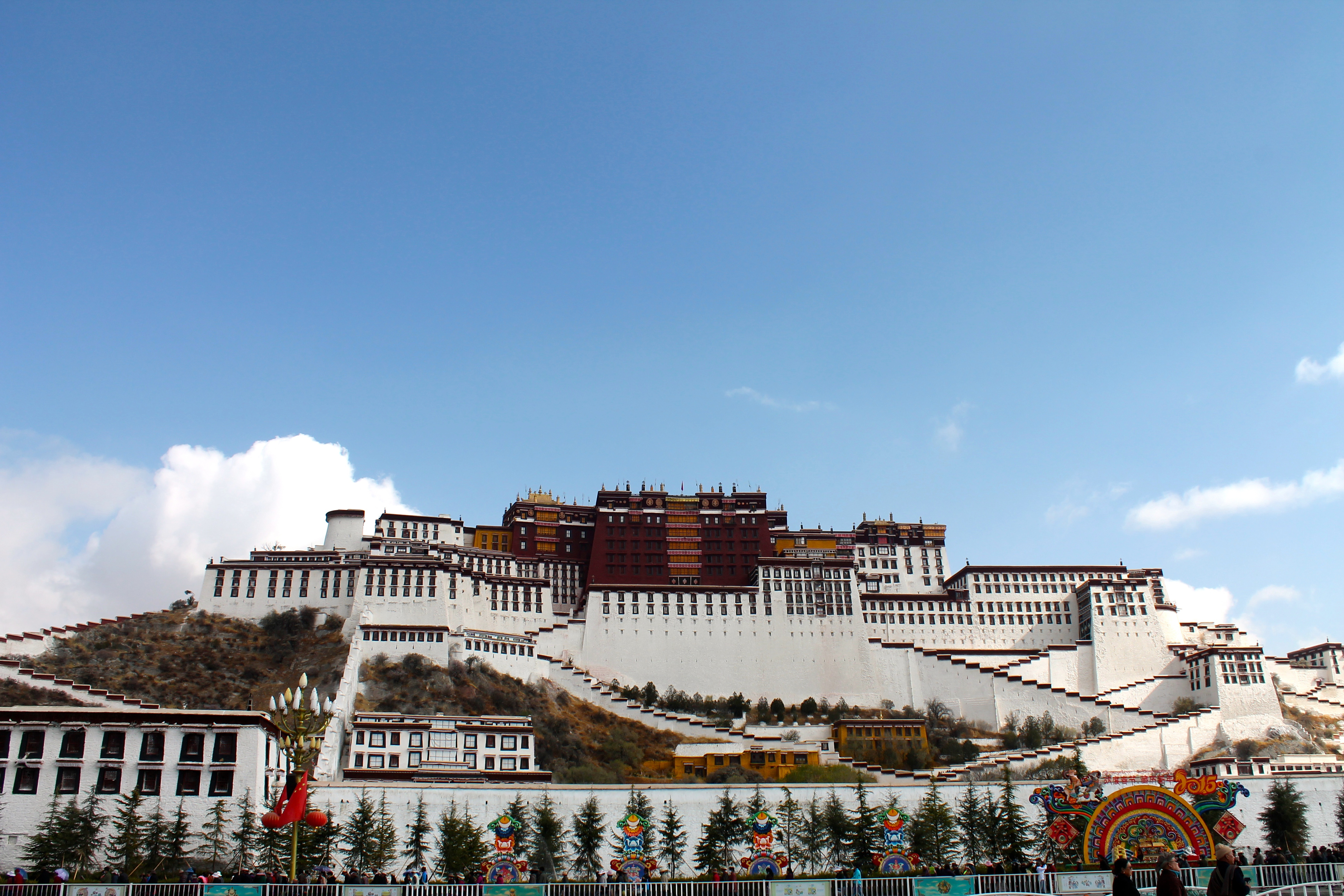
Photo 6

Having Tea by the Barkhor Street (Lhasa)

“入乡随俗,”by far one of my favorite four-character word sayings in Chinese means: “In Rome, do what Romans do.” After walking one of the oldest streets in Lhasha called Barkhor Street, one has to make an effort to find the famous teashops located on hidden alleys. Our tour guide took my friend and I to one of these for a big surprise. These places are not the ordinary teashops you’re imagining, where you sit in an ordinary manner and have a server ask your order. These are the type of places you sit wherever you fit: there are long tables and chairs everywhere. This is a type of place locals sit and chat, do business and meet total strangers. With a whole pot of milk tea priced at $1, this is the place to end your day’s adventure.

Hiking the Leshan Giant Buddha (Leshan)

The Leshan Giant Buddha is the biggest carved stone Buddha in the world (71 meters high). Located at the confluence of three important rivers, the statue was built to bring the water spirit under control. The falling stones during the carving would also help reduce the water force there. It took 90 years to complete the carving.
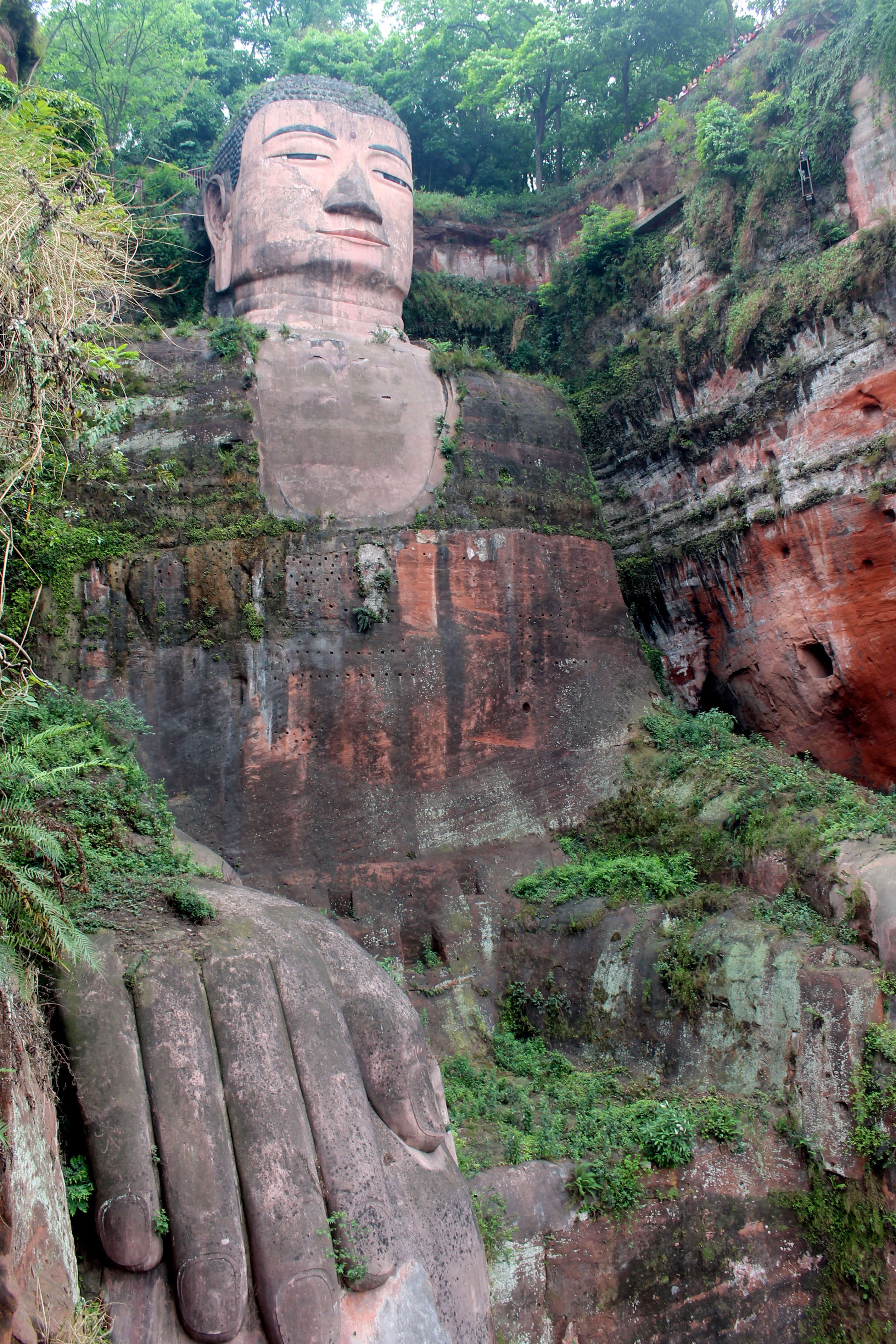
Photo 8

Visiting the Panda Research Base/Giant Panda Breading Center (Chengdu)

The research base, which has elements of a veterinary lab, a park, a panda habitat, and a zoo, is one of the best places to see giant pandas in the world. The research base, covered in trees, flowers and 14 species of bamboo, provides a pleasant escape from city life. Red pandas (closer-looking to a raccoon than a panda) are also sheltered there, giving a twist to the whole experience.

Photo 9 pandas

Walking through Jinli Street (Chengdu)

In ancient times, Jinli was one of the busiest commercial boulevards of the Kingdom of Shu. Today, visitors from all over China and abroad enjoy this renovated street, as there is a lot to see, hear and EAT. WARNING: eating some of the local specialties will literally make you sweat. If you’re not into spicy food, make sure you tell the vendor “bu yao la” 不要啦 = I don’t want spicy. They’ll look at you a little insulted (they love the spice), but will make sure you get the least amount of spice in it (if possible).
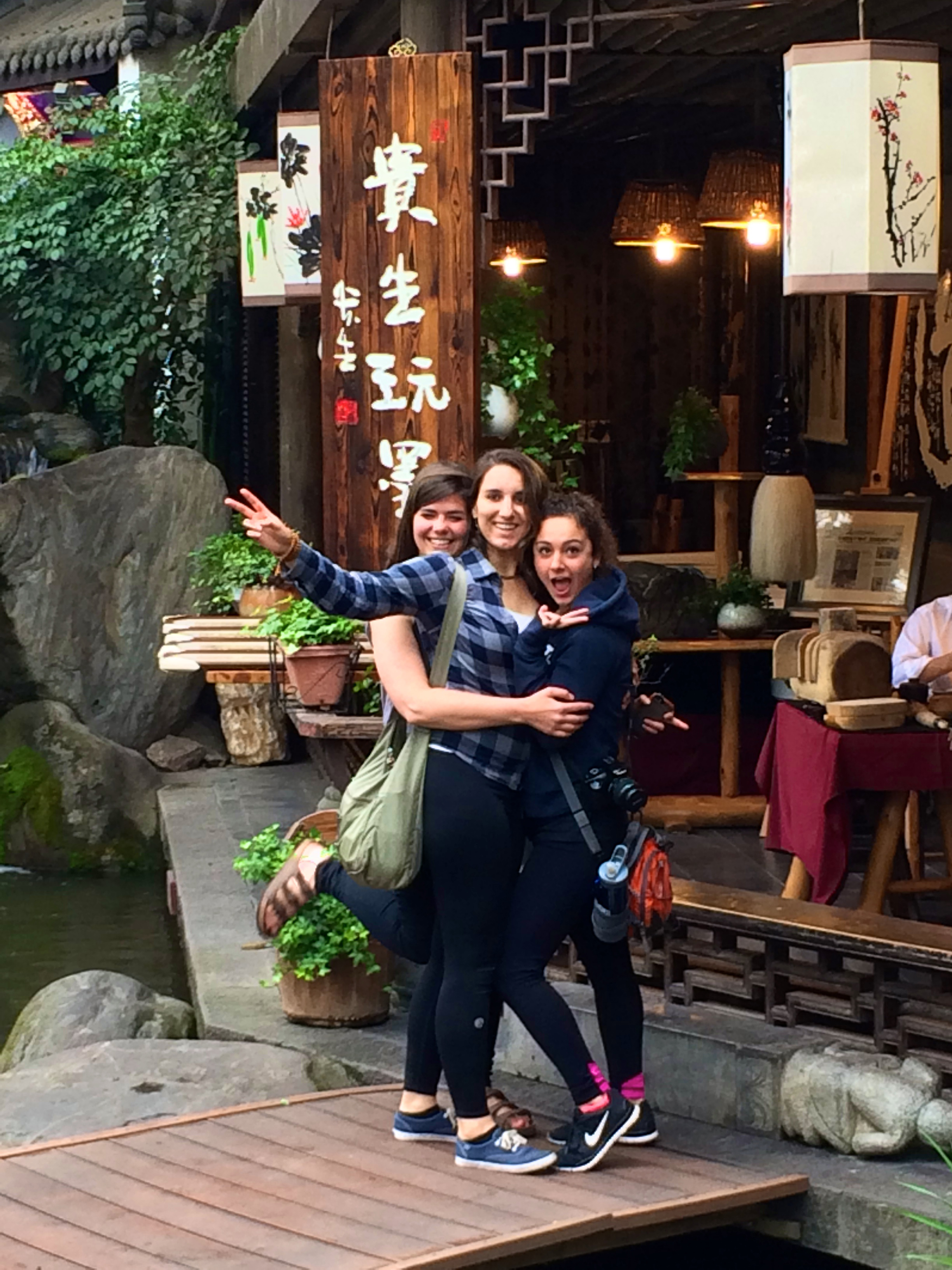
Photo 10

With the semester completed and a month left in Beijing, I wrap my last blog post with a BIG THANK YOU. I couldn’t have done anything without the support of my family, boyfriend, and friends I made along the way. I liked having this blog for my stay in China, who knows if I’ll have another independent one in the future.

There is still so much to see, touch and taste out there. I am young. I am hungry for experience.

Till we meet again.

F.


Becca in Hungary: Small Town Hungary

April 20, 2015

First I just wanted to start with some fun facts about Hungary’s geography:

1) Hungary borders 7 countries and no bodies of water.

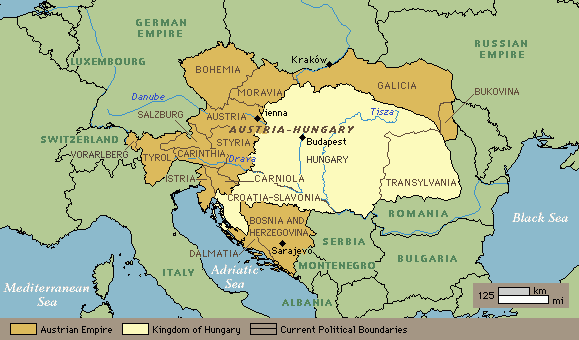
2) Before WWI Hungary was about 2/3 times bigger than it is today including all of Croatia, and Transylvania (now in Romania). At this time Hungary was part of the Austrian-Hungarian Empire, but due to the Treaty of Trianon after WWI Hungary lost most of their land. Today many Hungarians blame their countries recent hardships on the fact that Hungary has been split into all these smaller countries. When you travel Hungary you can find small stickers that say “big Hungary” in support of trying to regain these lost areas.

Map of Big Hungary before the end WWI

Map of Big Hungary before the end WWI

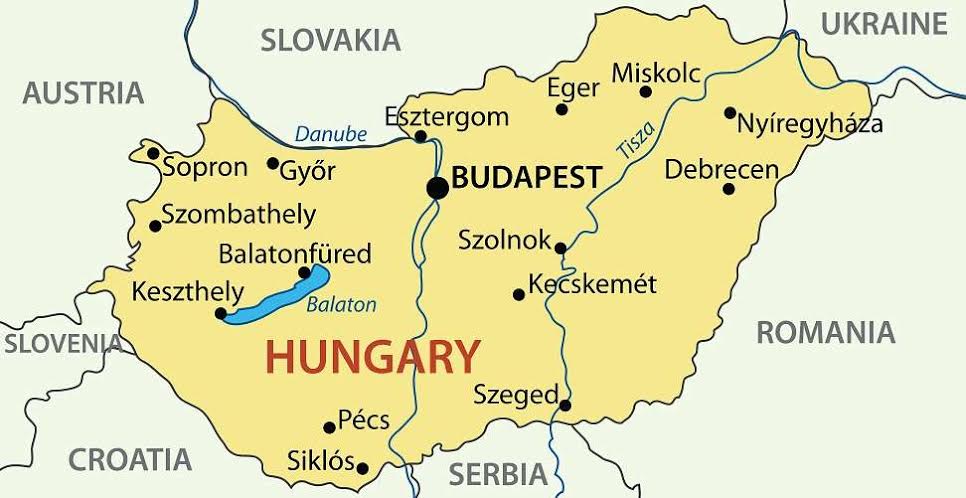
3) Some of Hungary’s most famous regions are the settlements on a long the Danube, Lake Balaton (the largest Lake in Central Europe), the plains below Budapest, and the more mountainous region in the north.

Map of current day Hungary

Map of current day Hungary

So why am I spitting off all these facts about Hungary’s geography? Well, my goal for my time left in Hungary is try to explore as many of these regions as possible. This weekend marks the beginning of this exploration.

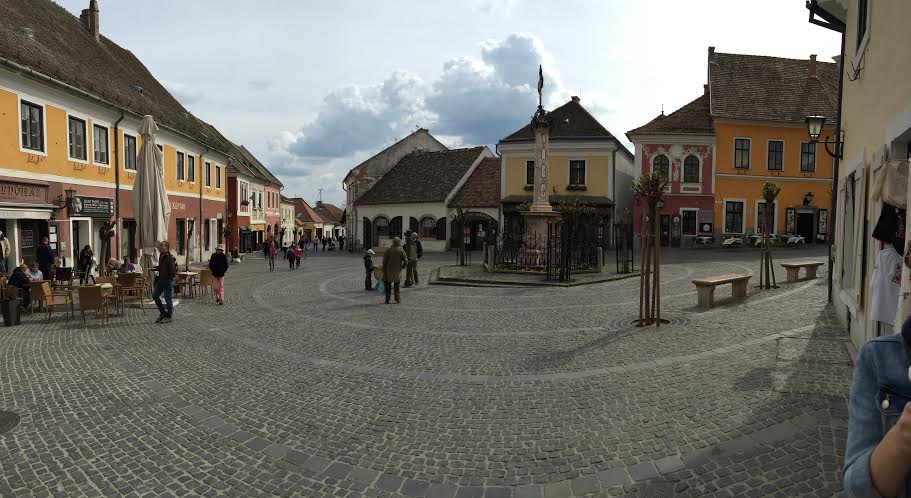
On Saturday I spent time exploring the small town of Szentendre which is a quaint city between Esztergom and Budapest. Szentendre is that small, adorable town that you just can’t help but fall in love with. The town is full of winding cobble stone roads that roll by small stores, ice cream parlors, and restaurants. For me, Szentendre is the perfect place to explore because you can hangout in a park near the river and play frisbee, and then finish off the game with a wonderful meal along the water. All of this and more all in Hungarian prices aka not expensive.

The town of Szentendre

The town of Szentendre

Chilling along the Danube

Chilling along the Danube

On Sunday I took a day trip two hours north of Budapest to Miskolcs where you can find what is said to be one of the best thermal baths in Hungary. This bath is popular because it was built within a cave system, so as you whirl around the relaxing tunnels you are surrounded by beautiful natural rock formations. While I was there I was able to take a mud bath. I assumed that the mud bath would be bathing in some thick substance like you might see in the movies, but oh no in Hungary a mud bath in literally a bath tub of water with some mud and dirt in it. Definitely an interesting experience!

Inside the thermal baths of Miskolcs

Inside the thermal baths of Miskolcs

This upcoming weekend my whole program will be heading to Lake Balaton for some adventures up there! Stay tuned!


Becca In Hungary: Connections!

March 2, 2015

When I was six years old my family made the big trip to Disney World in Florida; the trip that every kid never forgets. The most memorable part for me was the exhibit where you swirl around a magical world on a small boat while the song “It’s a Small World After All” plays. As a six year old the song just didn’t make sense to me because in my view the world was just a huge playground ready to be explored! I thought the 100 foot walk to my best friend’s house in my neighborhood was a large distance, so the idea of this world being seen as “small” was just preposterous to my young mind. To this day I still see the world as a massive complex network of people and places, but these past two weeks have shown me how interconnected this world really is.

The first connection I was able to make was meeting up with my previous University of Richmond roommates, Aileen and Rayna. They are studying abroad in Germany and Denmark respectively, and this past weekend we all met up in Prague. I really had to step back and reflect on this because it truly is amazing how out of 6 billion people in the world and even more opportunities, somehow the three of us were able to all come together and meet in a new country which we had never explored before. How cool is that!?! I loved being able to visit some of my closest friends and create meaningful memories with them.

My UR friends and I exploring Prague

My UR friends and I exploring Prague

While in Prague, the three of us went on a tour of the city. While on the tour my friend Rayna was approached by an individual in the group who ended up being a friend from her grade school! This just blew my mind because again even in a world so big we are still so interconnected.

Some main attractions in Prague

Some main attractions in Prague

unnamed-2 unnamed-3

My favorite part of Prague was visiting the Pinkas Synagogue which holds pictures drawn by children during the Holocaust. Through these pictures visitors could see the children’s fears, hopes, desires, and prayers. The thing that struck me that most about these pictures, though, was the fact that even though these children were enduring unimaginable pain and loss, they always drew the Jewish people with a smile on their faces and frowns on their perpetrators. I was moved by their ability to see such hope and happiness despite the pain they had endured.

After visiting the Jewish district in Prague, I decided that this weekend I wanted to explore Budapest’s Jewish District in order to draw parallels between these two countries. On this tour I began to see all these connections between the countries I have visited and these connections have really opened my mind to how interconnected our world truly is. For instance,  in the 19th century Austria came to “liberate” Hungary and bring Catholicism to their people. The ruler of Austria during this time was the Habsburg family. When I visited Austria, I was able to visit the Habsburg palace. What I found interesting was during the Jewish District tour in Budapest the tour guide was very negative about the Habsburg family and discussed their blatant discrimination against Jews. However, while in Austria, the people spoke highly of the wealth and power of the Habsburg family. It really goes to show you how skewed history can be. This idea reminds me of the quote”“The world is a book and those who do not travel read only one page.” By traveling to different countries I have had the oppertunity to see different countries prospectives on the same historical events. I able to draw my own connections between people and places and begin to feel even more connected to this beautiful and expansive world.


Fabiana in China: Chinese New Year for Beginners

February 19, 2015

Red lanterns, golden dragons and white goats.

YES! Spring is finally here! The arrival of the Chinese New Year (or modernly called as the Spring Festival) can be seen, smelled, and touched everywhere you go. For a foreigner like me however, the countdown to a holiday like this has meant smiles, less traffic and clear skies. What not to love about it!?

While trying to find out more about the holiday, I found a short&sweet video I’d like to share with all of you. The video explains what the most common Chinese New Year traditions are and things History.com “bets you didn’t know” about the holiday. Deep stuff.

http://www.history.com/topics/holidays/chinese-new-year/videos/bet-you-didnt-know-chinese-new-year

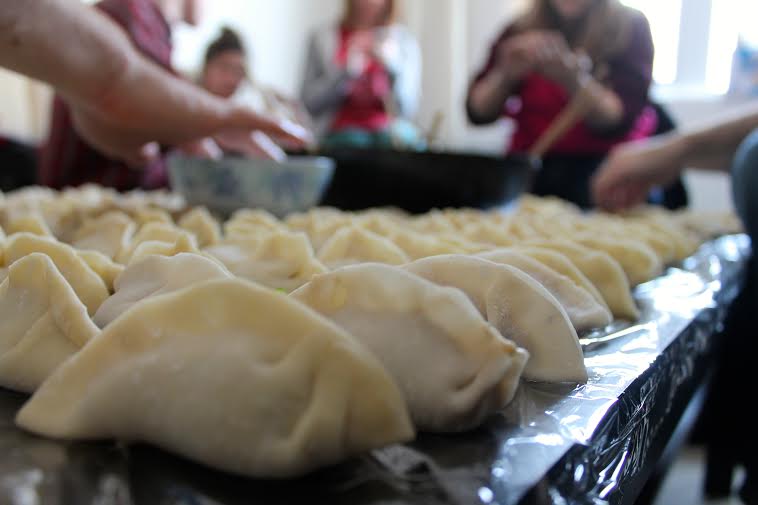
As part of this week’s language activity, our professors organized a dumpling-making(饺子) evening. We gathered in the immersion guys’ apartment and were taught how to wrap (包)pork and onion leaves dumplings (猪肉大葱饺子),and chives and eggs dumplings (韭菜鸡蛋饺子). Although I did most of the taking-pictures part and not much of the actual making of it, we all learned about the different techniques used and traditions held behind the dumpling-making. We definitely enjoyed our time with the whole Immersion-track family.

unnamed

unnamed-1

unnamed-2

unnamed-3

The most interesting thing I learned that day was the reason why northern Chinese people eat the dumplings on New Year’s Eve. According to my professors, the tradition of eating dumplings occurs because the word dumpling or jiaozi (饺子) in Chinese, sounds like a Chinese word meaning “bidding farewell to the old and ushering the new” (credits to travelchinaguide.com for the translation). I can’t think of a better adjective than superstitious when I think about Chinese people and customs, but then again who am I to judge after freaking-out every time someone tries to hand me the salt.

Next week, we’ll be having a break from 5am coffee and endless character-writing for our one-week Spring Break vacation. As a treat to our hard work, today, two friends and I decided we wanted to travel. YOLO right?

With the luck we have, we managed to get train tickets to Harbin, China, or may I say, the “Ice and Amusement World.” So yes, I’ll be freezing to death in one of the most beautiful cities in China, most know for its ice sculpture festival, Siberian tigers, and Russian landmarks. 10 hours in a hard-seat train during the famous “spring travel rush,” OH! am I going to breath in Chinese culture. I can’t wait!


Becca in Hungary: Trying to Find my Way

January 27, 2015

I have been in Budapest for two weeks, and mainly I have worked on finding ways to get around the city. Growing up in Ohio, I was not exposed to public transportation, so trying to figure out the public transit here as been a learning experience. Budapest is equipped with trams, buses, railways, and metros which makes the city easy to navigate.

As I practice navigating the city I have also seen many beautiful sites! I am sure I will say this thousands of times, but Budapest is truly one of the most beautiful cities! Budapest consists of a unique blend of modern and classic architecture. Because Budapest has been under the control of the Roman Empire, the Ottoman Empire,  Austria, and the Soviet Union, all of these countries and cultures have left an interesting mark on the landscape. For instance, during the invasion of the Turks many bath houses have been built throughout the city. Today Budapest is known for their array of baths and spas. Yesterday, I was able to soaked up the warm water in the Szecheny bath, a popular outdoor bath. The baths are an awesome way to wind down after a day of class, and hang out with some friends.


The Szechnyi Baths in the Center Park"

The Szechnyi Baths in the Center Park

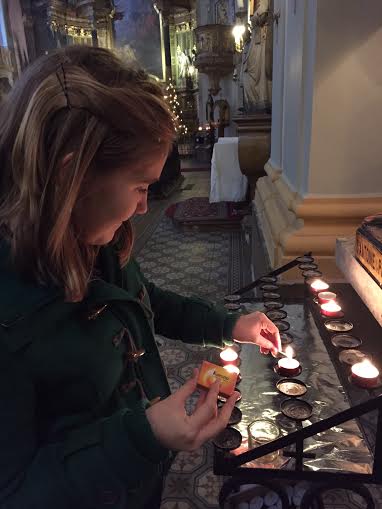
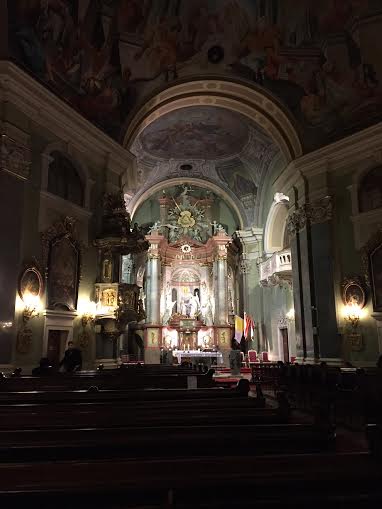
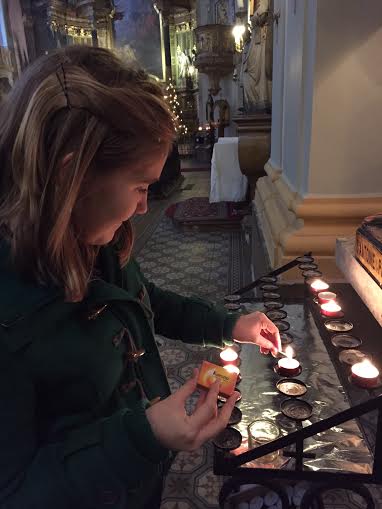
Another thing I have enjoyed in the city is the plethora of churches. Growing up Roman Catholic, I have a tradition of lighting a candle at each church I visit as a prayer to bless my travels as well as my wonderful family and friends that have allowed me to make the travels possible. While in Budapest I have been able to visit three beautiful churches. Each one provided a safe haven for me to reflect on all my blessings. My goal for the trip is to be able to visit all the Catholic Churches in Budapest. So far I have a good start!

Lighting candles at various Churches in Budapest to give thanks for my family and friends.

Lighting candles at various Churches in Budapest to give thanks for my family and friends.

unnamed-1

unnamed-2

unnamed-3

Because it was raining during the weekend I stuck to mostly indoor adventures. The main things I visited were the House of Terror and the Parliament building. The House of Terror is a museum that displays what Hungary was like under communist rule after WWII. After WWII Hungary was placed under Soviet Union control. The Soviet Union were extremely cruel to the Hungarian people and killed anyone that tried to defy their rule. I found this museum to be extremely thought-provoking and emotional. It blows my mind that the violence inflected on the Hungarian people was not only so recent but also so wide-scale. For almost 50 years the Hungarian people lived in fear, and it wasn’t until 1990 that they were able to gain independence. By visiting the Parliamentary building the next day, it made me realize how far Hungary has come and how hard they have fought for their independence. I am excited to continue to learn more about Hungarian history!

Pictures of the Parliament building. Much of the building had to be restored after being attacked during WWII.

Pictures of the Parliament building. Much of the building had to be restored after being attacked during WWII.

This weekend I am looking forward for my program to actually start. As stated previously, I am currently enrolled in an independent language school. The language school has been a great way to learn Hungarian and begin to learn more about Hungarian culture. My actual program begins on February 2nd and this weekend will be the program’s orientation. Be on the look out for updates about the official start of my program!


Becca in Hungary: Feeling Hungry in Hungary!

January 20, 2015

I made it! For the past couple days I have been roaming the streets of Budapest, Hungary. During my time here I have been feeling really… hungry. I am hungry mainly for two things: exploration and FOOD.

Ever since landing in Hungary I have been so HUNGRY to eat food. When I first got here there was just so much to do that somehow I forgot to get dinner (something I NEVER have forgotten in my life!). Luckily, I packed some snacks for the flight, so I tried to craft a meal out of the snacks that night. Even with these snacks, I woke up that night at 2AM absolutely starving! I think my internal clock was telling me it was now dinner time because 2AM here is 6PM back home. Every night I have woken up at 2AM ready for my fourth meal of the day. Today I am hoping I will be able to break this cycle.

On my second day here (oh course I woke up starving) I tried to go to cafe to order breakfast around my neighborhood. Quickly I realized that not everyone knows English here and that if I want to feed myself I would need to learn a little Hungarian. Currently, I am enrolled in a 2 week language immersion course where I am learning basic Hungarian. I definitely wouldn’t say that the language comes naturally to me or to most people in the class. Hungarian (what locals call Maygarul) is universally accepted as one of the hardest languages to learn because it is one of the most unique languages. This is because Hungary has been under control by so many different powers that their language has become a unique blend of these languages. Because the language is so unique no one in the class has a head start in understanding the language which makes me feel a lot more comfortable when I continuously mispronounce even the most basic phrases (for instance goodbye in Hungarian is Viszontlátásra). When I go to restaurants I always try to speak Hungarian to the locals, and it is obvious that they truly appreciate the effort even when my pronunciation is way off.

Also being the food lover that I am, one of my favorite qualities about Hungary is there food is so inexpensive!! Yesterday I was able to buy a large sandwich for about $2!! I also recently went to a more upscale restaurant with a group of new friends and each plate was about $10! Because the food is so cheap it cost about the same to go out to eat each day as it is to cook for yourself. I may have been hungry when I got off that plane, but now knowing how cheap and accessible food is here, that will not be happening again!

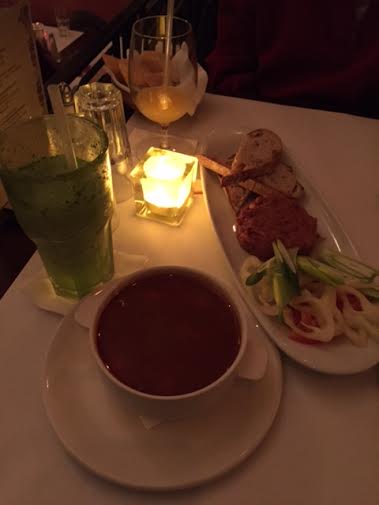
Enjoying a traditional Hungarian meal for less than $20 for two people

Enjoying a traditional Hungarian meal for less than $20 for two people

I am also just so hungry to explore! For the past 4 months I have been making list, charts, and diagrams of all the places I want to go and experience while in Hungary. Now that I am here I feel like I just want to make as many of those ideas possible. So far I haven’t had much time to really dive deep into this list. The main exploring will happen this weekend. On Saturday, I plan to do a walking tour in the Buda Hills and then learn how to make authentic goulash ( a popular Hungarian dish). On Sunday, a smaller group of us will explore the Pest side of the city. You may be wondering what I mean by the Pest side of BudaPEST. The territory of Budapest actually originally use to be two separate cities – Buda and Pest – that are split by the Danube River. It wasn’t until 1873 that the cities merged to form Budapest, the largest city in Hungary. The Pest side is know for their beautiful castles and amazing views of the city.

a picture of the chain bridge that connects the Buda and the Pest sides of Budapest.

a picture of the chain bridge that connects the Buda and the Pest sides of Budapest.

Be sure to tune in soon for updates on these adventures and potentially a video of my apartment and neighborhood.


Jack in Czech Republic: Freedom Then and Now

November 21, 2014

“Hope is definitely not the same thing as optimism. It is not the conviction that something will turn out well, but the certainty that something makes sense, regardless of how it turns out.”

— Vaclav Havel

***

People packed Národní Třída on the morning of November 17th for the Struggle of Freedom and Democracy Day’s celebrations. Beatles music blared as people mingled, listened to speeches, held signs, and chanted many things I couldn’t understand.

One of the first people I spoke with was a local street artist. Despite his broken English, he seemed to enjoy my company. He even offered me some of his breakfast wine, which he was drinking out of a beer bottle.

I asked him several questions about the holiday and his views on the Czech Republic’s current state, and he passionately answered each. As I was getting up to go, he had one more thing to tell me, as if he hadn’t made his message clear.

“Czech Republic is freedom,” he told me. “I am freedom.”

Although the Czech Republic may be, using his words, “freedom,” it is potentially facing another era of political instability, which was on full display on this holiday.

***

This year’s holiday had a greater significance than typical years, since it marked the 25th anniversary of the incident that led to fall of communism in Czechoslovakia. Parts of the city center were blocked off all day where a variety of memorials, musical events, and other festival-like attractions were held. At night, the festivities climaxed with an epic concert in the city’s most famous square – the same square where thousands and thousands of civilians rallied against the communist regime 25 years earlier.

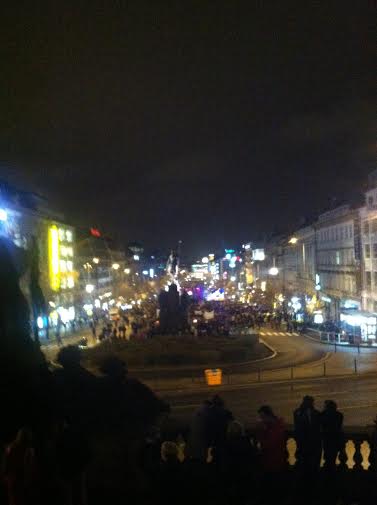
Wenceslas Square, the Times Square of the Czech Republic, was as packed as I have ever seen it for the large concert on Monday night. But…

Wenceslas Square, the Times Square of the Czech Republic, was as packed as I have ever seen it for the large concert on Monday night. But…

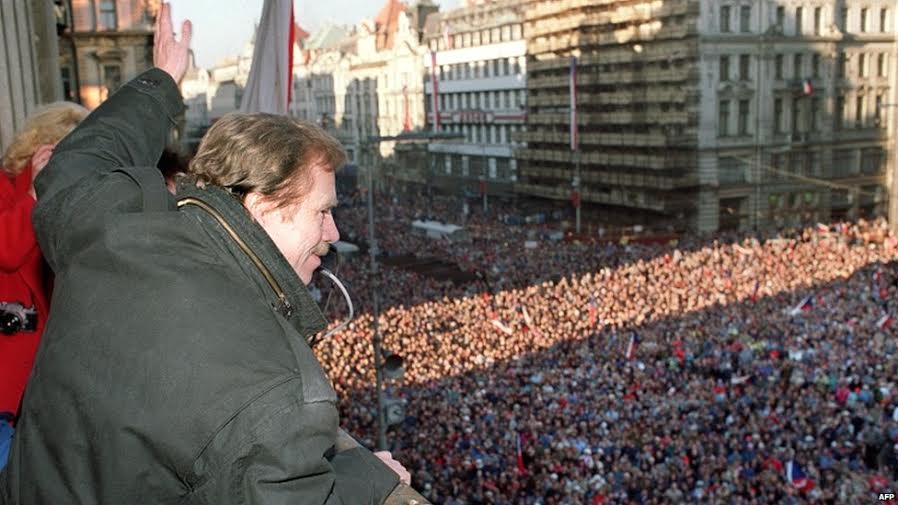
Vaclav Havel, one of the greatest leaders in recent history, speaking to his followers in December 1989.

Vaclav Havel, one of the greatest leaders in recent history, speaking to his followers in December 1989.


November 17th marks the beginning of the Velvet Revolution. On Nov. 17th 1989, thousands of Czech students gathered in the city center to commemorate another assembly, one 50 years earlier protesting Nazi fascism that resulted in more than 1,000 Czechs being sent to concentration camps. The 1989 demonstration started off as a state-sponsored event, but it quickly turned to a riot against the current government. Violence ensued, policemen beat students, and the Velvet Revolution began.

The Velvet Revolution was, for the most part, a peaceful movement that resulted in the overthrow of the communist government. Led by Vaclav Havel, A Czech version of Nelson Mandela who was honored by America and placed in Statuary Hall on Thursday, Czechoslovakia moved into a new era. Less than a year after the Nov. 17th movement, the Czechs held a democratic election. The Czech Republic and Slovakia had a peaceful split in 1993, and moved forward into a much more open time period. And everyone lived happily ever after, right?

Not exactly.

The holiday’s demonstrations, the vandalizing of the Lennon Wall, and, most importantly, Miloš Zeman’s continued idiotic antics intruded on what was supposed to be a gleeful day of remembrance, while demonstrating the Czechs current political instability.

***

Let’s meet President Zeman. Since Zeman won the presidential election last June – I can’t comprehend how he won – he has found different, and sometimes innovative, ways to anger his people. I have yet to meet a young Czech person who has anything nice to say about their president, and for good reason. He’s not just a drunkard; he makes appearances in public drunk. He doesn’t just have a dirty mouth; he used, what Czechs have told me, the dirtiest word in the Czech language to describe the heroic Russian band Pussy Riot. He doesn’t just look the other way from oppressive regimes; he endorses them — he supports Russia and not Ukraine; he supports China and not Taiwan.
Czech people have had enough Zeman, and they made sure outsiders knew that when the world briefly focused on the small Central European nation for its historic holiday. The Czech people believe they have given their president enough warnings. He has, in terms of soccer football, already earned a yellow card. So on this day, thousands of Czechs assembled around the city to give Zeman symbolic red cards, representing their desired ejection, removal, explosion – whatever word you like best – of their president.

At a different event, some protestors took advantage of an opportunity to chuck eggs at Zeman. As you can see in the video below, his guards used umbrellas to shield Zeman as he spoke. I don’t have a word-for-word translation from his speech, but a Czech friend helped translate the speech for me. Zeman’s main gist: I’m not scared of you. You weren’t part of the Revolution. I was part of the Revolution. You cannot scare me.

http://www.ceskatelevize.cz/ct24/nejnovejsi-videa/292682-zeman-nebojim-se-vas-jako-jsem-se-nebal-pred-25-lety/?page=2

You don’t need to even know what he is saying to sense the large disconnect between him and his people. Just listen to his unsympathetic tone and the passionate crowd.

Talk about a charismatic leader!

Zeman’s unjust rule and unfound sympathy managed to overshadow what was supposed to be a day of remembrance of all those who fought for freedom, especially Vaclav Havel.

And yet, Zeman’s actions were not even the wildest part of the day.

***

The Lennon Wall has served as Prague’s greatest symbol of freedom since the 1980s. Throughout his life John Lennon preached the importance of freedom, peace and liberty – a message that struck the Czech youth when, at the time, they lacked all three qualities. So students would graffiti the wall, at the risk of punishment, to illuminate their dreams. Even after communism fell, the Lennon Wall lived on, serving as a reminder of how lucky we, the Western world, are to have peace and freedom, how difficult freedom can be to achieve, and, most importantly, that many people still do not have their natural liberties. The Wall constantly changes, but it is always beautifully decorated with beautiful messages. That is, however, until the night of Nov. 17.

Here’s a picture of the wall before that night:

Lennon Wall Before

Lennon Wall Before

And here’s what it looked like after:

Lennon Wall After

Lennon Wall After

So many questions, fueled with anger, arose: Who did this? Why did they do this? Is the wall gone forever?

The answers, luckily, are much more positive than some people, including myself, feared.

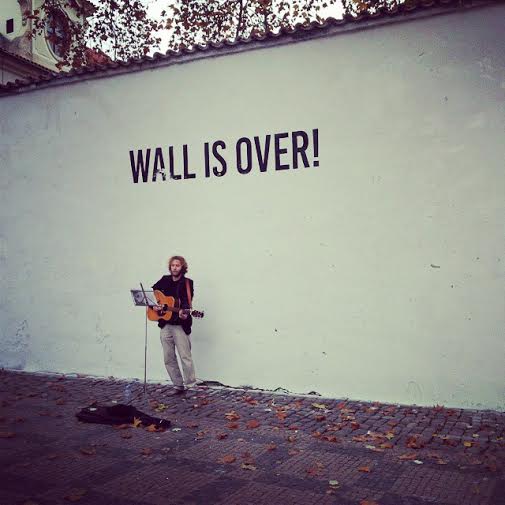
Prague Service, an anonymous group of art students, painted the wall white and added the message “WALL IS OVER!” Their reasoning was, in the best interpretation, fantastically hopeful, or, in the worst interpretation, justifiable; in a statement, they said they wanted “to provide free space for new messages of the current generation.” In essence, it was a symbolic call to action for young people. If you don’t like your government, don’t sit back and complain. Make your voice heard, one way or another.

Two friends and I went to the Wall the following night, and, not surprisingly, many people were already leaving their mark on a wall that was no longer white. Was the Wall what it had been before? Of course not. But it was already well on its way back.

Less than 24 hours after the Wall had been erased, dozens of people helped start the process of establishing a new Lennon Wall.

Less than 24 hours after the Wall had been erased, dozens of people helped start the process of establishing a new Lennon Wall.

My friends and I hung around the wall for a while talking to some of the people there, reading the messages, and, of course, writing our own messages. While I watched people paint the wall from a few yards back, I began speaking with one of the young people there who brought out loads of paint for others to use. He offered me some of his beer, and I hesitantly asked, “Are you sure?”

“Of course,” he replied “It’s Lennon Wall!”

How could you not take a sip after that?

***

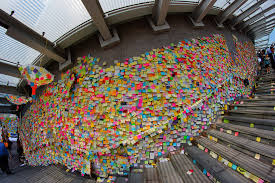
Monday was a day full emotions. Tears of joy and tears of sadness; cheers of ebullience and cheers of disdain. But, most importantly, it was a day of celebratory remembrance. Not long ago, Czechs would be severely punished for speaking out against the regime. And now they can hold mass demonstrations against their elected leader, jeer his speech, and, although probably not allowed, get away with throwing eggs at him! The Czechs may not be happy with the current administration, but at least they can voice their opinion – a right many people around the world still lack. Look at, for example, Hong Kong, where its current foundation of a revolution was somewhat inspired by the Czech Republic.

The Hong Kong Lennon Wall looks much different than Prague’s, but they both carry the same hopeful messages

The Hong Kong Lennon Wall looks much different than Prague’s, but they both carry the same hopeful messages

The Czech Republic is far from perfect (Is any nation near perfect?), but, at least, as the street artist told me, “Czech Republic is freedom.”

… It was nothing compared to the events that took place in the same square 25 years earlier.

… It was nothing compared to the events that took place in the same square 25 years earlier.

***

Selfie of the week: Because I am an egotistical millennial, here is the selfie of the week:

Doug and I bought a one-way ticket to a city in the Czech Republic where the Czechs were hosting Iceland in a Euro 2016 qualifier five hours before kickoff. We didn’t have tickets, a place to stay, or a way to get home. But, as you can see, everything worked out.

Doug and I bought a one-way ticket to a city in the Czech Republic where the Czechs were hosting Iceland in a Euro 2016 qualifier five hours before kickoff. We didn’t have tickets, a place to stay, or a way to get home. But, as you can see, everything worked out.


Garrett in Bonaire – Mi trep na Kursou (My trip to Curaçao)
October 16, 2014

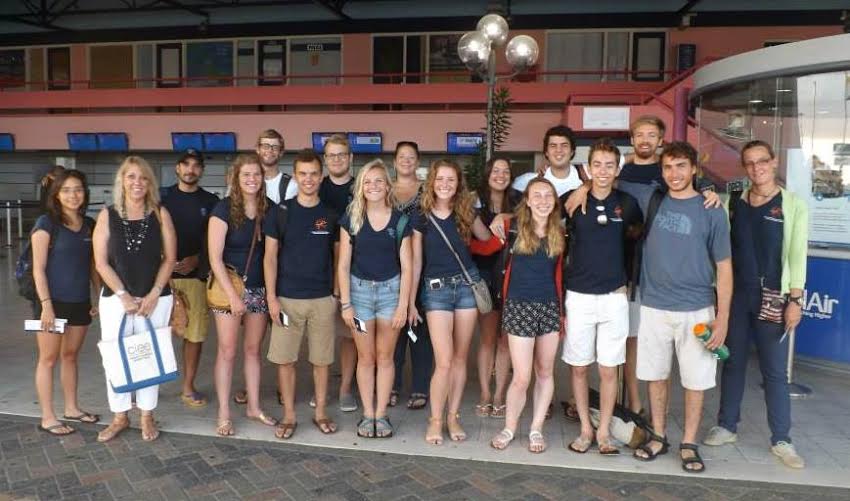
The time was 6:15AM. All 11 students climbed aboard the trucks and were off to Flamingo International Airport. As part of the program, my classmates, professors, and I hopped islands and took an extended two-day field trip to Curaçao.

The group of students and professors at Flamingo International Airport ready to hop over to Curaçao at 6:15AM.

The group of students and professors at Flamingo International Airport ready to hop over to Curaçao at 6:15AM.

For those of you who don’t remember, Curaçao is the “C” in ABC islands and is the largest of the three islands. Curaçao lies only about 30 miles west of Bonaire, making for a short 20-minute flight. Similarly to Bonaire, Curaçao was once a part of the Netherland Antilles. However, in 2010, when Bonaire became a municipality of the Netherlands, Curaçao became its own independent country. So, here I am, taking a casual field trip to another country for class during my study abroad experience in the Caribbean.
My classmates and I enjoying the sun in Curaçao!

My classmates and I enjoying the sun in Curaçao!

The itinerary for this trip was jam-packed.

First up: The Sea Aquarium. The aquarium itself was much like any other aquarium with a plethora of marine life on display in various tanks. However, nothing beats swimming with the same fish on the reef outside my residence hall, so I was slightly unimpressed by the inside. The outdoor facilities were another story. As the aquarium is oceanfront, they have multiple lagoons that have channels leading out into the ocean where they take care of a dozen or so dolphins. Let me just say, the Dolphin Academy is amazing! We got a behind-the-scenes tour from the leader of the dolphin program. He has been working with these dolphins for over 20 years and knows them so well. He took us around to the different lagoons stopping at each to tell us about the dolphins. In one, three male teen dolphins were participating in a snorkel session. Here he told us about the reproductive tendencies of dolphins, which are extremely interesting (if you’re ever bored and want to read up on their habits). In another lagoon, dolphin trainers had just finished putting on a wonderful show and were beginning afternoon training sessions with the dolphins. The next lagoon over was occupied by three female dolphins, two of which had given birth in the past month and the third is due in the near future. We stopped here to watch the two-week old dolphin interact with its mother and hear an explanation of dolphin familial structure and group behaviour. In the last lagoon, a dolphin therapy session was underway. The Dolphin Academy on Curacao is one of the best dolphin therapy facilities in the world. Here the dolphins help children of varying disabilities overcome challenges. While they are not the actual therapists in the scenario, they are used as a reward system for the child. Just look at these guys! No wonder they connect so well with children!

The two-week old baby dolphin swims alongside its mother and offers a shy smile for the camera!

The two-week old baby dolphin swims alongside its mother and offers a shy smile for the camera!

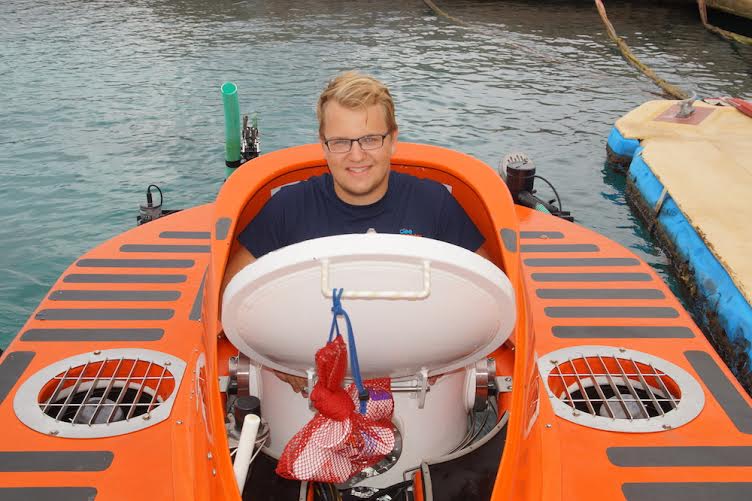
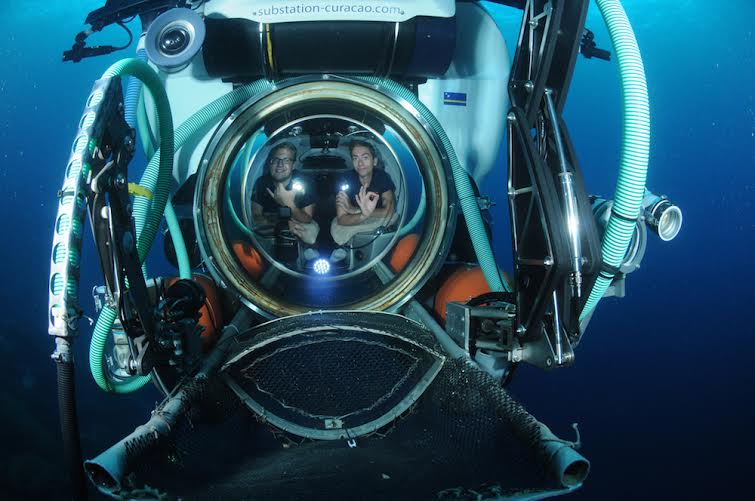
Up next: The Curasub! Just down the pier from the Sea Aquarium was Substation Curaçao. That’s right, a submarine. And not just any submarine; a 5-person scientific mini-submarine. In fact, the day before our arrival, the Smithsonian had taken the sub down to 1,000 feet and brought up countless specimens for analysis in the lab. While we weren’t there to bring up samples or anything, we still got to take a trip down in the sub. It sure was cozy! All complaints aside, the experience was breathtaking. The sights were just beautiful and it is eye-opening to just witness the vast array of life that occurs at that depth. Once the majority of visible light disappears from the water column, corals slowly start to fade out and sponges take their place. As a member of the marine biology lab on campus that focuses on sponge research, this was sponge heaven! Continuing past 200 feet, marine live gets even sparser and more interesting. Our max depth was 530 feet! On our way back up, we stopped by a wreck site of two tugboats, which were teeming with life, including countless lionfish, multiple green moray eels, and all kinds of sponges. The whole adventure was absolutely incredible!

Smiling before I drop down into the Curasub for my first submarine ride

Smiling before I drop down into the Curasub for my first submarine ride

My buddy Graham and I smiling out the glass dome of the sub.

My buddy Graham and I smiling out the glass dome of the sub.

A view from inside the sub looking out at the reef. Note the depth of 510 ft!

A view from inside the sub looking out at the reef. Note the depth of 510 ft!

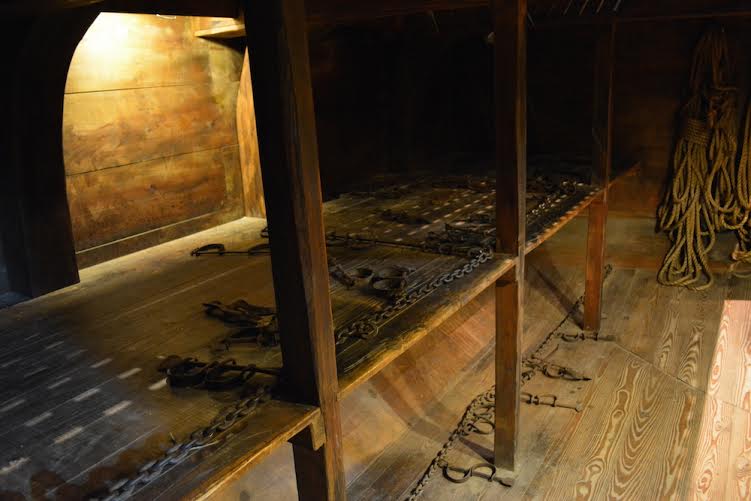
The following day: Kura Hulanda, possibly one of the best museums I have ever been to. Kura Hulanda is a cultural museum, with a focus on slavery and its impact on the world, specifically in the Caribbean. In the US, when we are taught history, the topic of slavery is often glazed over and its horrors are hidden from view; instead we focus on the Civil War and the biggest battles. However, slavery has killed more people than the Holocaust and this museum shed some light on their stories. During our tour of the slavery museum, we saw the devices used to torture slaves that were disobedient, we ducked inside a model of a ship’s hold where the slaves were kept during the trans-Atlantic voyage, and we heard the terrible tales of the conditions they were exposed to throughout the trek. The museum really opened my eyes to the horrors of slavery and offered another cultural lens with which to view the practice as a whole. It was interesting to learn and be exposed to the history of slavery from this other perspective.

A common device used to torture slaves. Disobedient slaves were stripped and placed in this metal chair in the scorching sun, often until they died.

A common device used to torture slaves. Disobedient slaves were stripped and placed in this metal chair in the scorching sun, often until they died.

Replicate model of the hold of a slave ship. Our tour guide estimated that close to 100 slaves would be crammed into this small space. And to think, it felt crowded with just the 7 of us in the tour group

Replicate model of the hold of a slave ship. Our tour guide estimated that close to 100 slaves would be crammed into this small space. And to think, it felt crowded with just the 7 of us in the tour group

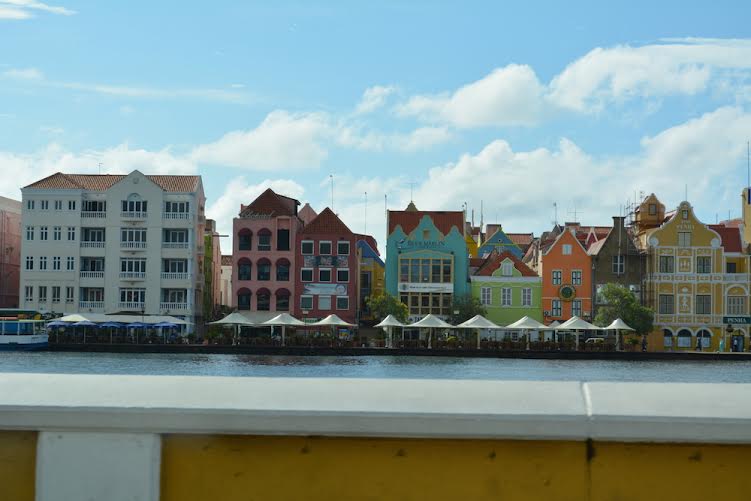
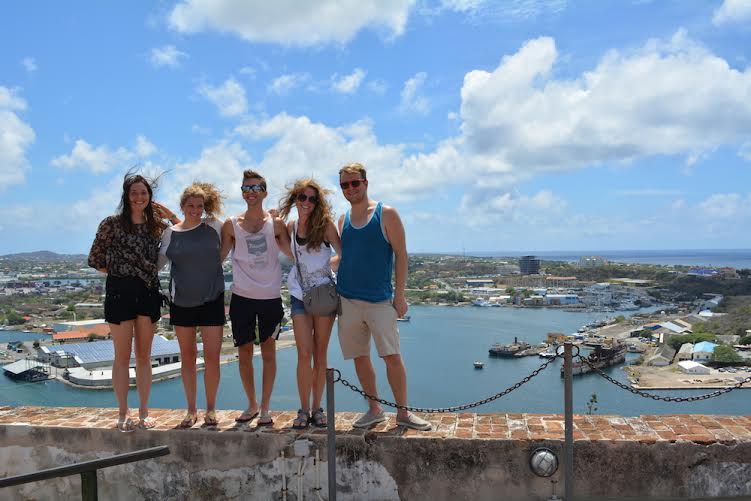
Lastly: Bus tour. With such a limited time on the island, we didn’t really get to see much more than the cove where the Sea Aquarium and our accommodations were located. The bus took us around Punda and Otrobanda, two quarters of the capital city of Willemstad. Literally meaning “other side,” Otrobanda is located directly across Sint Anna Bay from Punda. Together, these quarters are important not only for tourism, but also their history and their proximity to the ocean, which allows for easy trade. In addition, to touring the city, we also were taken to Fort Nassau, which provided a stunning 360 degree view of the city, as well as Fort Beekenburg, which was an old military fort stationed at the back of the bay meant to keep pirates and the British off the island.

A view of Punda across the channel from Otrobanda.

A view of Punda across the channel from Otrobanda.

A few of us pose for a picture with the capital city of Curaçao behind us.

A few of us pose for a picture with the capital city of Curaçao behind us.

Fort Beekenburg standing tall.

Fort Beekenburg standing tall.

All in all, while we were only on the island for less than 36 hours, the country of Curaçao was amazing! I absolutely loved the field trip and appreciate the experience! Guess I can check “Go 530 feet underwater in a submarine” and “Visit Curaçao” off my bucket list too!


Kimberlee in Mongolia: Sainshand – Part 2

June 6, 2014

Another great memory I have from Sainshand is visiting all of the amazing museums, monasteries, and historical sites. Sainshand was filled to the brim with exciting sites! And they were made much more dramatic thanks to the desert weather. The wind was always blowing excessive amounts of sand into our faces. Sometimes, you couldn’t even see the color of the sky or the ground a few feet in front of you.

We went to a couple of monasteries filled with beautiful artifacts and statues. We even visited a rare female monastery, and briefly stayed there for a service. At the end of one tour, a monk had us lay down on the ground to meditate for half an hour.

A view of a monastery museum and prayer flags.

A view of a monastery museum and prayer flags.

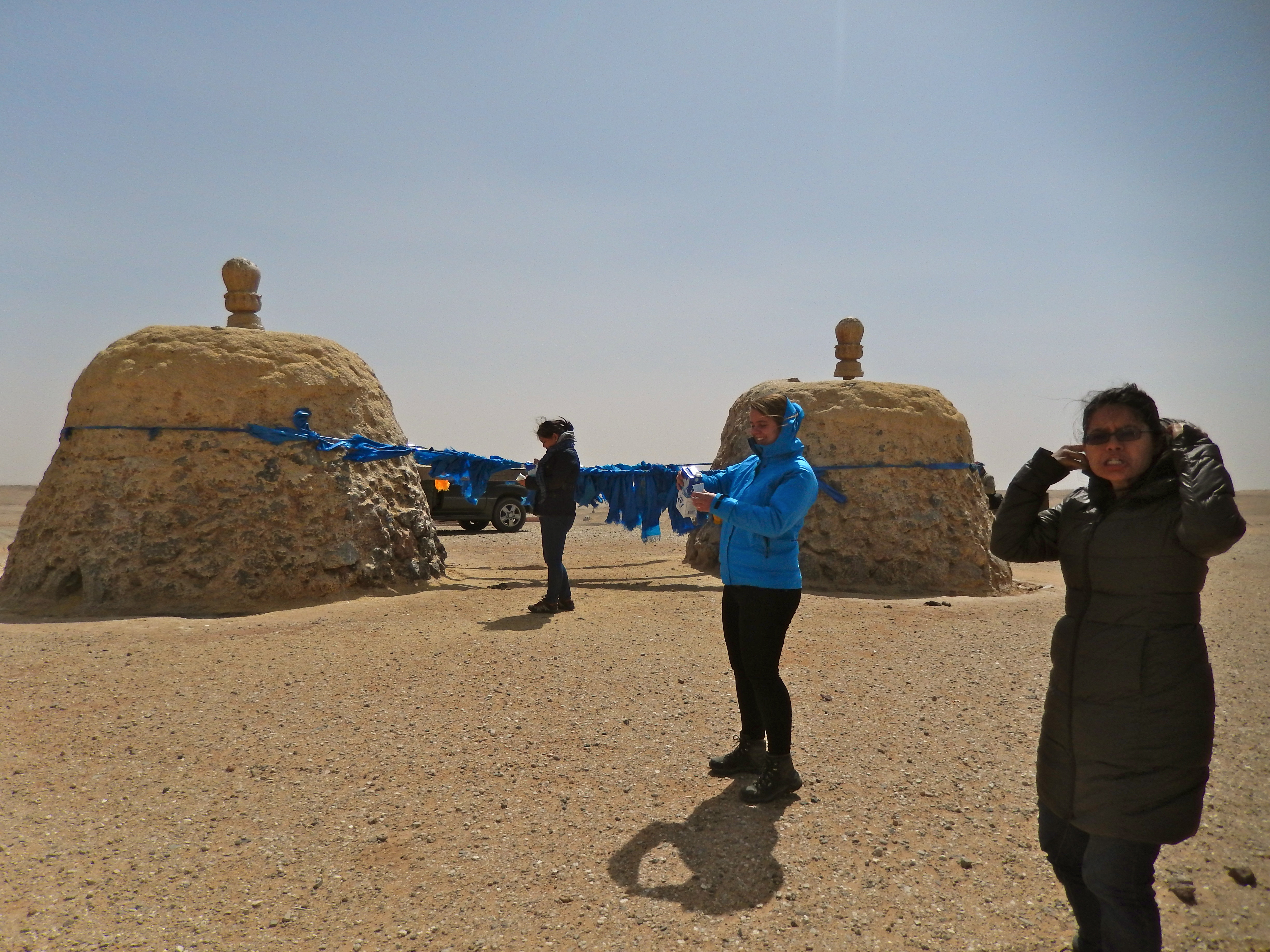
My favorite part was the offerings we gave to them at some of the sites. In total, we had the option of offering to four different sites. But the catch was that you needed to pay for all of it yourself, or else it didn’t count. Therefore, I decided to only offer at one. The four options I had to offer were: water, candy/cookies, milk, and vodka. At 2 sites, we were instructed to wish for something at the same time. To offer we simply tossed or placed the drinks or foods on a specific part of the site. This was often tricky because of the temperamental wind. We had to face a certain direction while offering, and it sometimes meant that a good amount of the offering ended up on us!

I ended up choosing the milk offering site, simply because I thought it was hilarious. The ovoo was in the middle of the desert, and was made of 2 sand breasts. “Ovoo” is a term used by Mongolians to refer to any holy site.

Our monk guide explained that this ovoo was a tribute to celebrate women and encourage fertility. I asked an SIT staff member if there was a deeper meaning and she said “no meaning- just boobs”. I think she was a bit confused as to why I was laughing so hard at that. I also thought it was funny how we were offering milk to 2 giant sand breasts. The men were instructed not to watch while we tried to avoid splashing ourselves with milk and overall enjoyed our time together as women. I would say that I’d prefer to offer milk to a breast ovoo than climb a mountain anyways!

The giant breast ovoo.

The giant breast ovoo.

There were two other memorable events that were unique to the desert environment. First, our monk showed us a dinosaur fossil! It was one of the most interesting things I’d ever seen. I knew that there were many dinosaur fossils in Mongolia, but I didn’t expect to actually see one in person. I even got to hold a piece of its spine! And who would have stopped us? It was just lying out in the open with no fences, guards, or any sort of monitoring device!

It was strange to see a precious dinosaur fossil with no protection. In fact, the monk told us that there used to be a baby dinosaur near it, but it was stolen less than a year beforehand! I can’t imagine a whole community knowing about a dinosaur fossil in the United States and not protecting it or giving it to a museum. It was a difficult concept to wrap my head around.

The other unique experience was the opportunity to visit a camel-herding family in the desert. I got to ride a camel for the first time in my life, and it was amazing. I don’t know what I was expecting, but I definitely wasn’t expecting the camels to be so tall. Or that I would ride them with a carpet saddle. Or that the humps were so soft and bouncy.

They even let us lead each other’s camels, so picture us running as fast as we could to make it fun for the other person. Lucky for me, Kit led my camel, and he ran for the whole time! Thankfully, there were two humps on either side of me that kept me nice and secure. Riding a camel had been on my bucket-list, and I was glad to have finally gotten to ride one.

This is me riding a camel with Kit leading me. To put the size of the camel into perspective, Kit is over 6 feet tall.

This is me riding a camel with Kit leading me. To put the size of the camel into perspective, Kit is over 6 feet tall.


Austen in Ireland: End of the Year – Cork, Liverpool, Belfast, and Finals

June 3, 2014

Right after getting back from Germany, I took the oral exam in my Irish class.  The Irish language was very difficult, but it was a neat experience learning another language.

The next day, I took a train ride to southwest Ireland to Dublin’s smaller sister–the city of Cork (Ireland’s second largest city).  Cork had a very different feel to it than Dublin with a laid-back attitude and with no tourists.  It was set on a nice river and had some beautiful architecture.  I would have argued that there were more pubs in Cork per capita than Dublin, which I thought initially was impossible.

We explored the city of Cork and ended up going to Blarney Castle.  A must while there was  ‘kiss the Blarney Stone.’ Kissing the stone is said to endow the kisser with the gift of the gab (or eloquence and skill at flattery).  The poison garden was another neat attraction at the Blarney Castle, which featured many lethal plants.

The following day, we took a day tour of the Ring of Kerry, a gorgeous attraction in the countryside of Ireland.  There were so many great landscape sceneries and also quaint Irish villages.  Although the weather wasn’t the greatest (fog really hindered our vision), the trip more than made up for it.

Ring of Kerry scenery.

Ring of Kerry scenery.

After getting back from this trip, I had my finals to conquer.  I had three finals in psychology, economics, and Irish.  My first final was a couple days after getting back from the Cork trip.  The whole experience of having to go off campus to an exam hall that fits 3,000 exam takers was intimidating.  I took a shuttle bus that UCD was running to the exam site and it took about ten minutes.

Once I entered the building, there were seat numbers for each exam taker at that time slot.  Once I walked into the exam room, it was overwhelming to say the least.  About 3,000 desks with uncomfortable chairs all lined up in many rows.  A lot different from Richmond, where exams are taken in classrooms.  The exam was fine but there were proctors walking up and down the rows about every ten seconds, which could get distracting.

Since I had over a week in between my first exam and other exams, I had planned a last trip to Liverpool and Belfast with my friends.

The city of Liverpool really surprised me.  It had one of the largest shopping areas I had ever seen and the dock area was very nice.  My friend and I had a jam-packed day.  We went to the Beatles exhibition, since no trip to Liverpool is complete without learning more about the Beatles.  Then, we went to three of Liverpool’s free museums.  We first went to the Merseyside Maritime Museum, where we learned much information about the maritime industry in Liverpool.  We then went to the International Slavery Museum, which explained the history of slavery in Liverpool.

Albert Dock, Liverpool.

Albert Dock, Liverpool.

The third museum we went to was the Museum of Liverpool.  This was a very interesting museum as it really explained the importance of the city, from the city’s large Chinatown to the rivalry between Everton and Liverpool Football Club.  Our next stop of the day was Anfield, the home of Liverpool Football Club, one of the most legendary soccer clubs in the world.  Our tour was fantastic and so was our very passionate tour guide.

Anfield, home of Liverpool Football Club.

Anfield, home of Liverpool Football Club.

We went into the press room where the manager talks to media after the matches, the home dressing room where Liverpool suits up, and the visitor dressing room.  We also were able touch the ‘This is Anfield’ sign which was an iconic part of the stadium.  After this, we went into the stadium and saw the field.  It was amazing being able to see this stadium and also sit right where the manager sits during the games.  It was pouring when we were outside in the stadium, but it didn’t dampen our spirits.  The tour was quite interesting and I was able to really learn a lot more about the history of Liverpool Football Club.  We also went to the museum and saw some of the trophies Liverpool had won.

We got into Belfast early the next morning and learned that there was a bike race going on in the city that weekend (the Giro d’Italia).  We got to our hostel and started our sightseeing in the Queen’s Quarter, which is where Queen’s University, Belfast is located.  This was a very beautiful campus with many historic buildings and nice greens.

Our next stop was the Ulster Museum, a National Museum of Northern Ireland.  It was such a large museum and very expansive.  It covered pretty much everything that had to do with the province of Ulster, where Belfast is located.  We then saw the Botanic Gardens, which had some interesting plants and flowers.  This day was so exhausting and we ended up resting afterward.

The Titanic Belfast exhibition was our main sight of the next day.  The Titanic was built in Belfast and the exhibition was amazing.  The exhibition had many interesting parts, including a ride (to see what it was like to work on building the Titanic) and also a virtual tour of the interior.  It was overall an excellent attraction.  Walking through the port of Belfast, it is apparent that Belfast had and still has a very large industrial part to it.

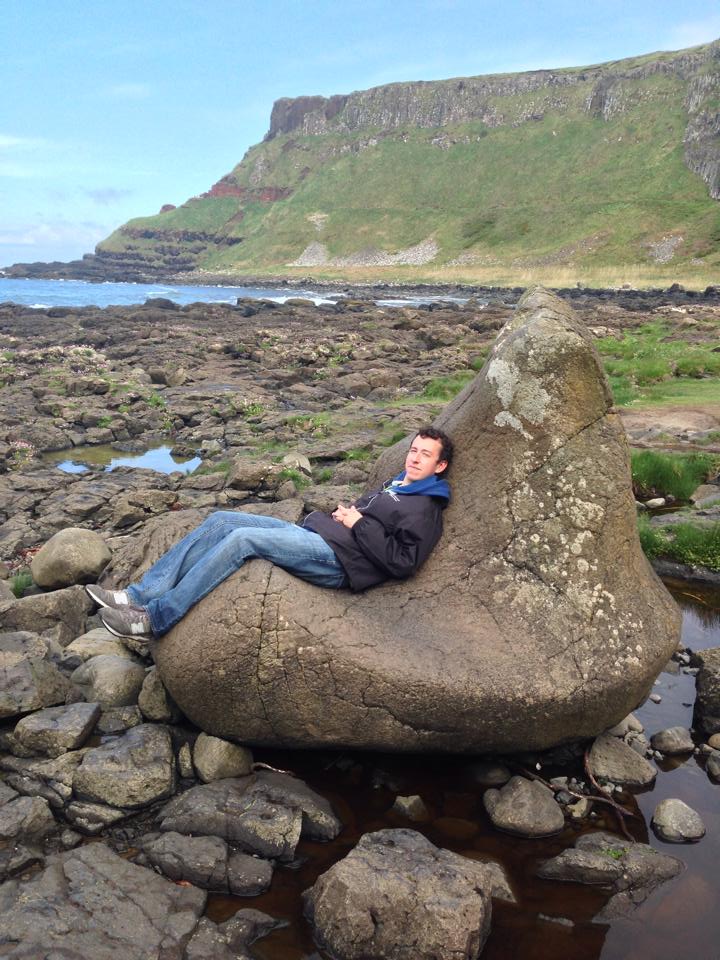
On our final day of the trip, we went on a tour to Carrick-a-Rede Rope Bridge and Giant’s Causeway.  Our first stop was the rope bridge and it was a somewhat frightening experience walking over a very shaky rope bridge, but the views of the sea from the island once you got across were really great. The main attraction was Giant’s Causeway though.  Giant’s Causeway is an area of about 40,000 basalt columns (mostly hexagonal), which are the result of an ancient volcanic eruption.  It is a UNESCO World Heritage Site.  Walking all the way out to the tip on the coast was magnificent but also tough as the rocks were quite slippery.

I found a nice rock at Giant's Causeway, Northern Ireland.

I found a nice rock at Giant’s Causeway, Northern Ireland.

This was really amazing and we walked back up top on the cliffs and were able to really appreciate the Giant’s Causeway Coast from up above.  When we got back to Belfast, we saw the Belfast City Hall, a marvelous building, before eating dinner and then heading back to our hostel since we were both leaving early the next morning.

Once I got back to Dublin, I studied pretty much the whole time before my last two finals.  It was a long day but I got through it and I soon realized that my time in Dublin would be coming to an end as I had to start packing.

I spent my last day sightseeing in Dublin.  I went to get my last fish and chips, to the Trinity Book of Kells exhibition and the Long Room, to the Science Gallery at Trinity College, to the Chester Beatty Library (religious history) and Dublin Castle.  I also just walked around the city, admiring the Irish atmosphere one last time.  I walked around O’Connell Street (I got souvenirs for many people), Grafton Street, and I ended up at pretty much where I started in Dublin, St. Stephens’ Green, a beautiful park right in the center of Dublin, and took some time to think of the great adventures and memories I will have from this semester.

I soon went back to the university and started packing.  Packing started off easy, but got more challenging when I slowly started running out of space. The next day (my last day in Dublin) was very much a relaxing day and I spent it packing and saying bye to friends I had made.  Although I had to get up early the next morning to leave, I figured I should spend one last night with the UCD Softball Club, as I made some of my closest friends in that group.  I ended up not getting to sleep until 4 a.m. that night and waking up at 6 a.m. but it was all worth it.

Saying my last farewells to the people, the campus, and the city of Dublin was challenging, but I know I will be back at some point in the future.  It was my most memorable semester so far and I would say the decision to study abroad (I decided last minute) was one of the best decisions of my college career.  It really opened up my eyes to another culture.  I am currently sitting at my home in the USA relishing the memories and wishing I were in Ireland.  I can’t believe I sometimes wished I were back in the USA when I was in Ireland.  I must have been crazy.