Standing on the Edge of the World

March 26, 2012

I’ve never before experienced a feeling quite like I did standing on the rim of a crater in the Negev desert this past weekend.  I felt all at once the vastness of the desert, my own comparative insignificance, and how incredibly blessed I was to be able to witness such amazing beauty.

We started our trip by leaving campus at 5:00 A.M. on Friday morning.  Driving south, we could see the diversity in Israel’s landscape as the lush green fields gave way to sand and rocks.  After a drive of about six hours, our bus left us at a trailhead on the side of the road, and we set off on our 8 kilometer (about 5 mile) hike.  We were about 75 students, plus 4 guides, two guards, and a medic.  At first, the hike was relatively flat and easy, although it was surprising cold and windy, and huge dark clouds threatened to rain on us.  Then we arrived at the edge of the Ramon crater.  The view was beyond spectacular.

We then had to pick our way down the steep descent, through the crater, then climb out the other side.  We all celebrated when we made it up the last stretch.  But alas, our rejoicing was premature – the bus had not been able to make it down the road to meet us, and we were going to have to walk another two miles!  At this point it was only our will that kept us going.  But finally we made it to the bus just as it started to rain. We then drove to the center of another crater, to the Bedouin camp where we would be spending the night.  We all pitched in and made a huge dinner of Israeli salad (chopped cucumbers, tomatoes, and onions), stir fry and rice, hamburgers and hot dogs, and of course, lots of pita.

Sleeping in the tent was quite an experience. I remember waking up in the middle of the night, and even though I was cozy in my sleeping bag, I felt how bitterly cold it was outside.  Waking up to the sun casting morning shadows across the crater, we set off on our second day of hiking.  This time we climbed up the edge of the crater and walked along the rim, and a couple of times, we had to climb rock scrambles where one slip could send you rolling down the edge of the crater.  At one point, there were even iron handles drilled into the rock; we knew when we saw those that this cliff meant business.  But we all made it through safe and sound, circling the rim of the crater around until we ended up back at our camp just before sunset.

We then set off for Eilat, where we stayed in a lovely hostel that fed us an amazing hot breakfast the next morning, which we were all incredibly grateful for.  On Sunday, we could either choose to stay at the beach or hike in the Eilat mountains to a peak where you can see Jordan, Egypt, and on a clear day, Saudi Arabia.  I chose the hike, even though I was pretty worn out from the past two days, and I was so glad I did!  Looking out over the Red Sea as it lay nestled in the midst of desert mountains was an exhilarating moment, to say the least.

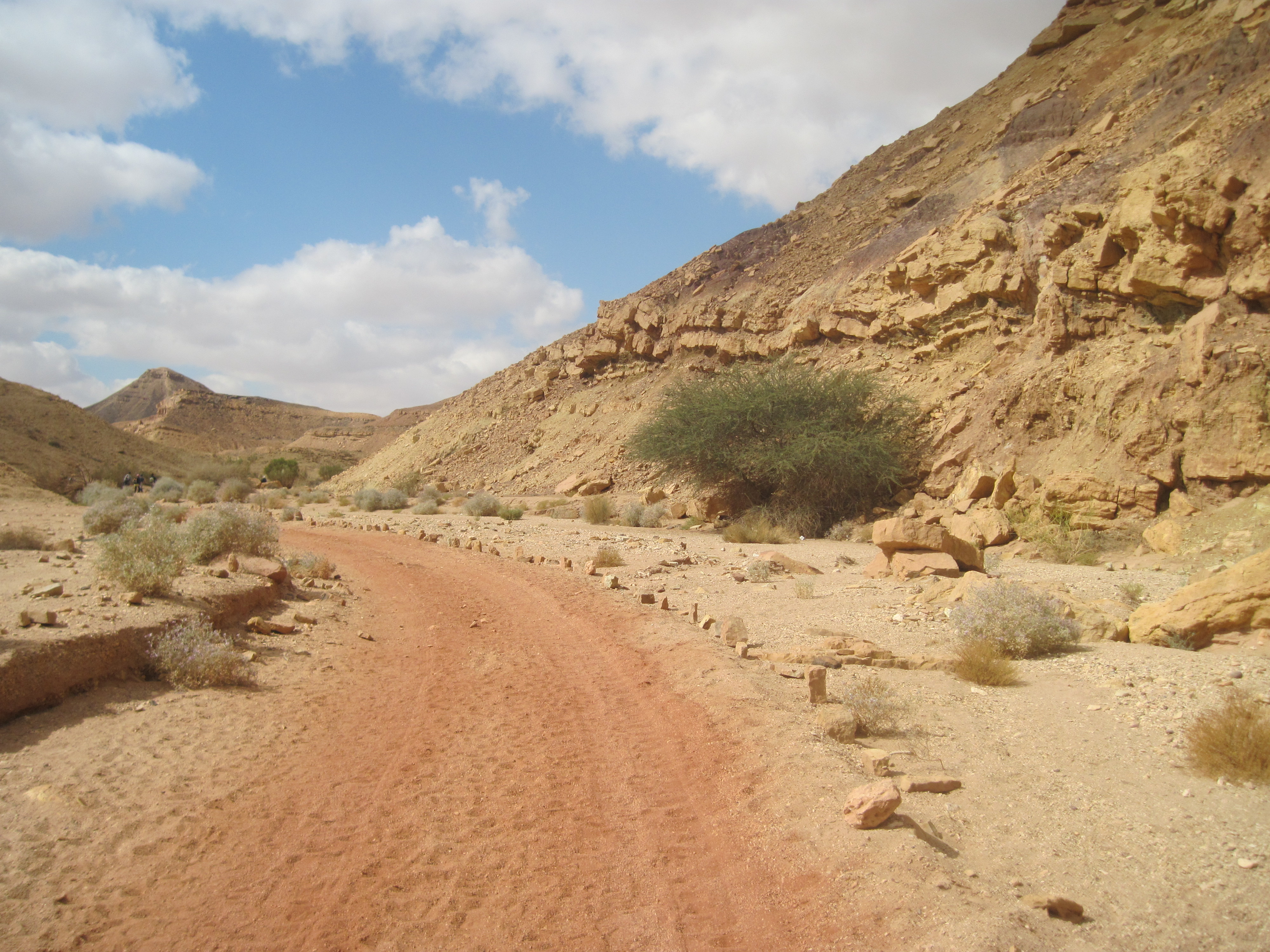
It is really hard to describe in words how I felt throughout this weekend.  It was definitely the farthest I had ever been pushed physically, and the camaraderie the shared experience built within the international students was really great.  Passing each other on the way to class on Monday morning, we all knew not only how sore we were, but that the endless sweeping desert vistas we had seen together would be printed on our minds for the rest of our lives.


Barbados, Week 7: Partying with the Hindus

March 16, 2012

This past Sunday, March 11th, was Phagwa, the Hindu celebration of their New Year and the coming of Spring.  This was not something of which I had any knowledge, however, until my Cultural Studies professor told us about it last week.  The fact that there were Hindus in Barbados had never even occurred to me, and thus my curiosity was piqued.  I knew nothing of Hinduism, except that it had its origins in ancient India/Asia, and wanted to see how they expressed their thankfulness and positivity toward a new year.

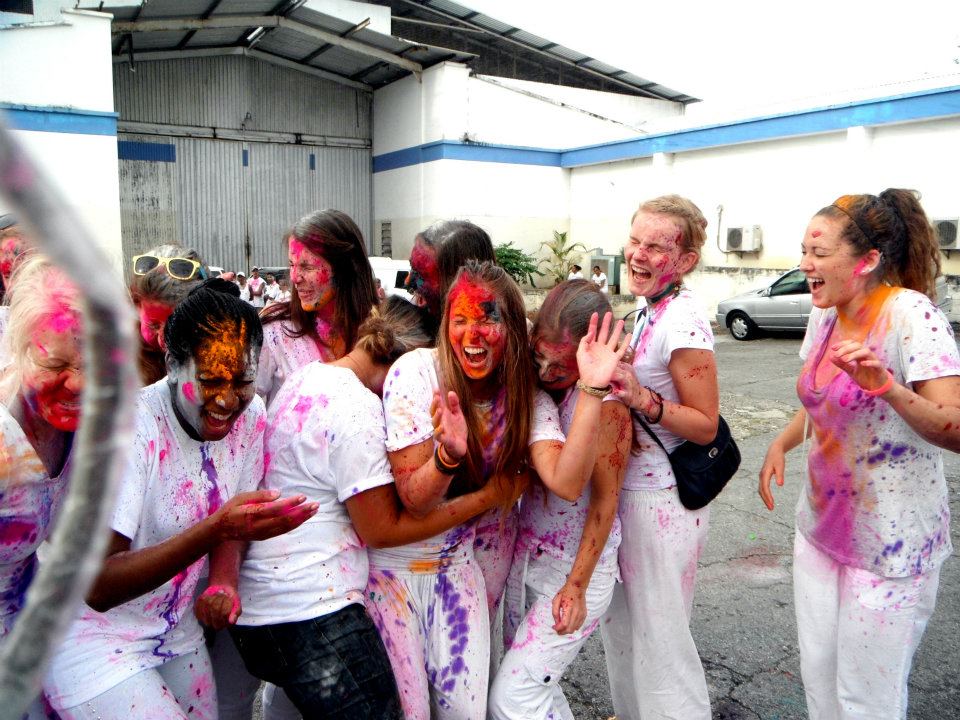
As it turns out, they do so by dousing each other in colored powder and splashing each other with paint for the greater part of three hours!  Would not have been my first guess as to the method of celebration, but it was a lot more fun than any of the students expected.  We were told to wear old clothes, and somehow everyone got the idea in their head that it would be best to wear all white; when 15 white kids wearing all white clothes piled out of the van upon arriving at Phagwa I had to laugh- it looked like we were ready for Halloween.

No sooner had we stepped out of the shuttles than people began patting us on the face with baby powder and welcoming us to the celebration.  Now we looked really, really white.  The festival was held in the parking lot behind the Hindu temple, with a large tent at the back of the lot providing shade for those who wished to sit down or simply had enough of getting paint thrown at their face.  On another side of the lot one could find tables upon tables of traditional Indo-Caribbean food and drink.  Wanting to eat my food without fear of paint contamination, that’s where I went first.  My meal consisted of curried rice and potatoes, spinach, yams, and an unknown spicy dressing.  Most people know to only take small portions of unknown foods, but I decided it was a good idea to take three heaping spoonfuls of the spicy dressing and slather it all over my rice.  Besides all of the fascinating religious and cultural things I learned during Phagwa, I think one of the most important lessons learned was that American “spicy” food and Indian “spicy” food are not on the same level…not even close.

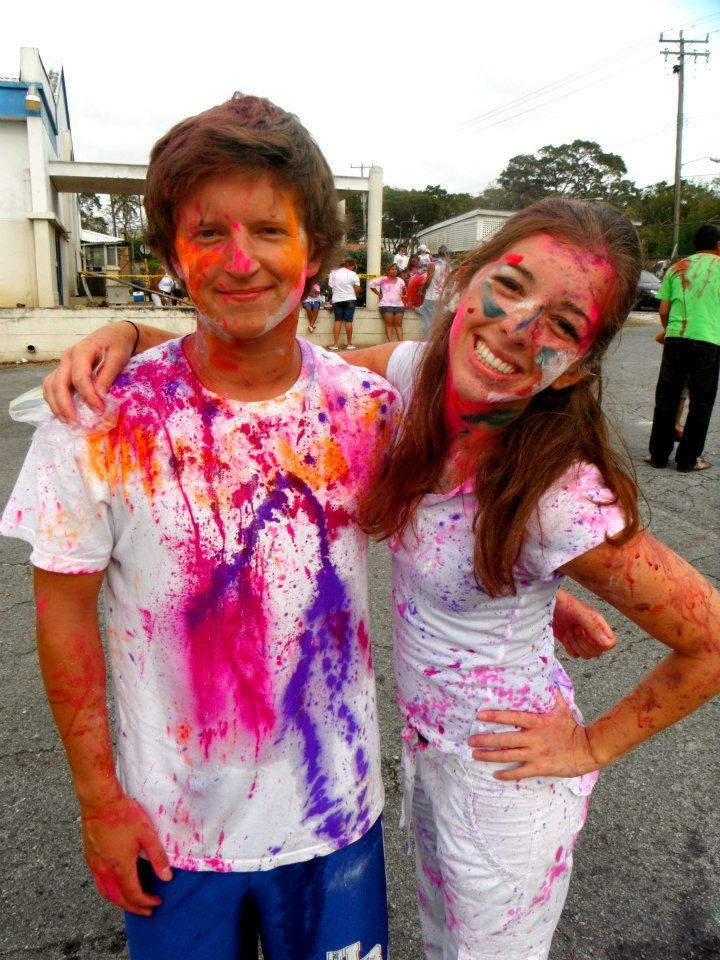
Then things got colorful.  More people began arriving with liter bottles filled with water-based paint and bags of powder.  As musicians played what I assumed to be Hindu music on stage, everyone began running around and dousing each other with as much paint as possible.  I didn’t have any paint, unfortunately, but I bought a few bags of colored powder and went around to friends and strangers alike and attacked them with a barrage of color, albeit gently.  The gesture was returned tenfold as I was covered head to toe in red, blue, orange, pink, and green paint and powder within minutes.  When I finally looked at myself in a car window, I very closely resembled an Oompah Loompah (from Charlie and the Chocolate Factory).

Later in the celebration they brought on a pretty eccentric performer who proceeded to take the stage and make jungle animal noises.  Supposedly he was trying to provide some context for his next displays of skill, as he demonstrated how to break open coconuts as they had done in the jungles of Guyana before the advancement of modern technology.  For his next act he proceeded to place a chicken on his head and play some rhythmic drum lines as the crowd cheered him on and danced.  I, personally, was equally impressed with the chicken’s ability to balance on the man’s head the whole time.  Before we left Phagwa, the temple pundit allowed our group to check out the Hindu temple, which featured detailed drawings and almost-life-sized statues of what I can only imagine were their sacred dieties.  A very cool experience, considering he even let us inside looking like a rainbow had exploded all over us.


Have you bought a costume yet?!?

February 27, 2012

For approximately two weeks leading up to Sunday, February 19th, this is the question I was repeatedly asked.  Sunday the 19th through Tuesday the 21st marked the official dates of the Carnival (or Carnaval — I’m still not sure which is the correct spelling, since I’ve seen them both used interchangeably) before Ash Wednesday.

Here’s what I knew about Carnival before it started:

1. Basically everyone dresses up in some kind of costume, whether it’s just a mask or a full-blown outfit.

2. Carnival is celebrated most in the southern part of The Netherlands, which is where I’m located.

3. Because of this, classes would be cancelled for one week in order to celebrate.

Going into Carnival with this knowledge did not fully prepare me for what I like to call the “Carnival Experience”.  When I first arrived to the Vrijthof, which is the heart of Maastricht– and also where the main festivities were going to be taking place– I was confused.  Although there were people there, and they were in costume, the Vrijthof seemed fairly empty compared to what I was expecting.  It seemed like people were constantly saying that this was such a big deal, yet it wasn’t much more crowded than it would be on a normal weekend.

While we were waiting for the parade to come, there were sporadic hailstorms, and then, in the blink of an eye, the Vrijthof was extremely crowded!  Allow me to put it in perspective for you.  A street that would normally take about one or two minutes to walk down took 10-15 minutes.  This part of the experience is what I’d like to call organized chaos.  Everyone was having a good time and trying to get to their next destination within the Vrijthof, but it could have been perceived as chaotic from someone who was completely unprepared.  My friends and I, however, did what the locals were doing; made a little train by putting our hands on each others’ shoulders and moved through the crowd.

Below is a picture where you can see some people in costume unsheltered during the first hailstorm.

The parade arrived just as the last hailstorm took its leave.  There were bands and of course everyone was wearing a unique costume!  The parade was interactive; the people on the floats saying “hip hip!” and the crowd responding “hooray!” (all in Dutch of course).  My friends and I had a really nice time.

After the parade was over, it was time for food!  One of my friends and I decided to be brave and try Herring, which historically was the traditional food eaten on Ash Wednesday.  Even though it wasn’t Ash Wednesday, we ate it anyway.

This fish was probably the largest piece of fish served to one person that I’d ever seen in my entire life, and it was absolutely amazing! The picture doesn’t do it justice, but it really was a large piece of fish.  After we were fed, it was time to explore and see the costumes.  The Carnival colors for Maastricht (located in the southern province of Limburg) are green, yellow, and red, so that tended to be a common color scheme, especially amongst the older generations.  I was one of the exceptions.  I realized that I may not have the opportunity to experience Carnival again, so I decided to “dress-up” with some of Limburg’s colors.

I bought a cheap purple costume dress, because purple is my favorite color, and accessorized with Limburg’s Carnival colors!  I was surprised to get so many compliments; I felt Dutch 🙂  As the day went on, more and more people kept showing up, including people of all ages (including little children whose parents had dressed them and/or their strollers up in order to celebrate).  As I mentioned earlier, Carnival is a three-day event, and people did not stop wearing costumes and celebrating at any point during those three days.  It was quite impressive that it was still going strong on day three!  I suppose when you plan and wait for months for Carnival, you’re going to enjoy every minute of it.


The Temples of Angkor Wat: Cambodia

February 24, 2012

This weekend, I took my first international trip to one of Thailand’s neighbors, Cambodia.  Specifically, we went to Siem Reap, which is the center for all of the tourism surrounding Cambodia’s famous Angkor Wat.  The journey to get there is not exactly quick; it began with a four-hour minivan ride to the Cambodian border, then about one hour spent actually crossing the border, an hour spent waiting at the bus station, a two-hour minivan ride to Siem Reap, and then a 20-minute tuk tuk ride to our hostel.  All in all, about a ten-hour journey door to door.  We arrived in Siem Reap Saturday afternoon and left early Monday afternoon – it may seem crazy to some of you to travel to Cambodia for such a short time, but a) with the very strict attendance policy at Thammasat it is the only way I can travel, and b) we really felt we did not need any more time in Siem Reap.  So here are the notable highlights:

1) Cambodia is not Thailand.  It may seem obvious, yes, but I have always had a magical view of Southeast Asian countries – friendly, smiling people always willing to help you, greenery everywhere, rice fields lining both sides of the road.  I assumed that the hospitality and kindness that are normal in Thailand would also be present in Cambodia.  But from the second that we stamped out of Thailand and started the visa/entry process into Cambodia we immediately noticed a change in atmosphere.  The guards at the border were not friendly whatsoever, and immediately after officially entering Cambodia we were overwhelmed by men trying to get us to go into their taxi, or in their minivan to Siem Reap.  We have very much become accustomed to Thai courtesy and friendliness; in Thailand I never have to worry about being scammed.  But Cambodia is known for its scams, particularly at the border, so we had to be extremely cautious.  There is even a “fake” border that has been set up.  Literally, a building was built complete with guards, and signs, and visas.  They bribe tuktuk and minivan drivers to bring tourists to the fake border, who then pay a lot of money for what may or may not be a valid visa.

2) Siem Reap is essentially the main city where tourists go in order to see Angkor Wat and the surrounding temples.  The city provides a stark contrast between wealth and poverty – while there are five-star hotels lining both sides of the streets, between those manicured lawns and marble entryways are dirt roads filled with children, running around begging tourists for money.  It was a surprising and uncomfortable reality.  Despite the hotels everywhere, we opted for a much more modest accommodation in a fantastic hostel near the old town, for only $3 USD per night.  Saturday evening we had traditional Khmer red curry for dinner, which was easily the most delicious curry I have had since landing in Southeast Asia.

3) The temples.  The temples of Angkor Wat are located about a 20-30min tuktuk ride from Siem Reap.  The area surrounding the temples has been well preserved, so instead of endless hotels and restaurants, Ankor Wat is surrounded by beautiful forest.  We hired a tuktuk for the whole day (only $15) and left Siem Reap at 5am to see the sunrise over Angkor Wat.  We were joined by many tourists, but the early start was completely worth it – Angkor Wat is incredible and utterly breathtaking.  It is an expansive structure (only pictures can do it justice) that is considered to be the largest religious structure on earth; some place Angkor Wat in the same category as Machu Picchu and other wonders of the world.  It is this fact that I could not get over.  Construction of the temple was started in the year 1112 by the king of the Khmer empire at the time.  It is thought that he created the Hindu temple, which ended up being changed to a Buddhist temple, in dedication to the Hindu god Vishnu.  It took 37 years to complete. The thing is, in my lifetime, I have visited many castles that immediately strike any visitor by their opulence and grandeur.  For example, the Château de Versailles, in France, created by King Louis XIV, is just ridiculously extravagant.  But Angkor Wat was not created for the purpose of living, it was purely in dedication to a Hindu god.  It is purely religious — that’s just hard to fathom, because it is so big!  Though commoners used it for prayer throughout the year, our tour guide explained that the king usually only visited it once per year.

4) Angkor Wat is not the only temple to see. We also visited Ta Prohm, which is the only temple in the area that has not been protected against the jungle.  It is therefore covered with trees and roots that have wound their way around the ruins.  Fun Fact: Ta Prohm was featured in the film “Tomb Raider.”  We then visited Ta Keo, and Bayon, and ended our day by going back to Angkor Wat and having a guided tour of the temple.  I am definitely glad we spent the $3 for a tour guide, because it is not easy to understand the meaning of the temple without some history and explanation. We spent nine hours, from 5:30 am to 2:30pm on our feet visiting temples.  And it was completely worth it.

All in all, Cambodia was incredible – once I realized that Cambodia has only been out of Civil War since 1998, it became very clear as to why there is such a stark contrast between wealth and poverty in Siem Reap.  Cambodia is very much still recovering from the Khmer Rouge regime, and as of now the country relies heavily on tourism, which is why so much money has been poured into hotels and restaurants in Siem Reap, but nowhere else.  I would have loved one more day to travel the six hours to Phnom Penh, the capital of Cambodia, to learn more about the history of the country as well as to see some of the museums there chronicling Cambodia’s recent history.  But otherwise, by the end of our stay we felt we had seen all there was to see in Siem Reap. I have to say, after a nine-hour trip  back to Bangkok which included one very offensive, drunk Irish man, who didn’t stop talking for our four hour-minivan ride, offended every race and religion represented in the van, swore every other word, smoked in the van, threatened to kill most of us, and almost assaulted one of the guys in our minivan – it certainly felt good to be back “home” in Bangkok!


Botswana, Week 3: Protests

February 17, 2012

A couple of weeks ago, there was some tension on campus. The University of Botswana (UB) is working very hard to improve the image, credibility, and stability of the school. However, the actions being taken by the university caused an uprising among students. Although the students that I have spoken with understood the circumstances surrounding the situation, they disagreed upon how to handle it.

Some of the measures UB indicated they would take included:

Close 411:

All of the buildings on campus have a number, unlike at U of R, and most schools in the States, where we name our buildings for other numerous reasons. The bar we have on campus is referred to as “411” and is located only walking distance away.

UB decided that they would consider the closing of 411. The intended date for permanent closure was fall 2012. UB chose to close 411 due to the fact that it caused many problems, such as excess consumption of alcohol, unwanted physical and emotional risks, and constant visitation from outside guests that were not students. Also, unless one orders a soda (known as pop), then he or she will receive a fragile glass bottle with no way of recycling or properly disposing it around campus; trash cans and other forms of waste are still ongoing issues in most developing countries, including Botswana.

However, the UB students are looking at it in a differesent perspective. They know that closing of 411 does not just mean that there will not be a bar on campus – it’s a matter of student rights and freedom. The school has offered to compromise by moving the bar on the edge of campus, instead of closing it entirely, but students’ protests only gained momentum. This is mainly due to the fact that the students saw the real meaning of moving the bar away from middle of campus: Botswana law says that alcohol may be consumed only 500 meters away from any alcohol-serving establishment. Therefore, if the bar is moved to the edge of campus (away from student housing and comfortable seating areas), then that means that any forms of alcohol in open areas of campus, and especially living hostels/dorms, is strictly prohibited.

End Supplementary Exams:

UB’s rules and procedures for students are very different from schools in the United States. For example, if a student fails any subject during the semester, then they are allowed to take what is called a “Supplementary Exam.” This exam is taken once at the end of the year and can erase the previous failing grade received (if passed, of course). The students became very angry upon hearing the news that supplementary exams might be done away with.

Lower Allowance:

Currently, most UB students have their tuition and most other academic needs paid for by the government. Also, a monthly allowance is given in what is considered “to be used for living purposes” only. The allowance comes in cash form and may be used for anything, without any restrictions. UB has been contemplating lowering the allowance because they believe that it is being used for alternative and undesirable purposes that lead to unhealthy choices. Although there is no substantial and realistic evidence for the school to believe this, 411 always happens to be at full capacity immediately after the 23rd of each month – the date that the allowances are distributed.

No More Games:

The Inter Varsity games are like the Olympics, but on a college level, with surrounding country universities participating against each other. UB has decided to not host the Inter Varsity games this semester. This angered students and contributed to the protests that were to come. The school’s reasoning for this was for the safety and security of the students, because the IV Games attract the general population and students from other schools, which can create security concerns.

—————————————————————————————————-

Fortunately for my friends and I, we had left for a trip to Namibia. Windows, signs, buildings, and many other things were broken during the protests. Many students, especially those in charge, were arrested and suspended.

UB closed from January 25th-27th, and upon re-opening, there have been no more protests. As of now, none of the initial propositions by the school have been put in place. Even the IV games seem like a possibility, but a very unlikely possibility. Even though the school has not initiated anything yet, they seem to be moving in the direction of what they originally intended. For example, although they haven’t closed down 411 yet, but we’ve noticed the prices have gone up 15% – slowly pushing students and guests to go elsewhere.


A Weekend Trip….to Tropical Paradise

February 10, 2012

One of the perks of living in this beautiful country is that after a week of stress, no sleep, and lots of late nights, a tropical island is just a few hours away.  My roommate and I decided we had to take full advantage of this, and traveled to the beautiful island of Koh Samet this past weekend.  Koh Samet is located right in the Gulf of Thailand, only a 40min ferry ride offshore, so it is a popular spot for anyone in Bangkok hoping for an island retreat.  The whole process of getting there is very Thai – don’t book anything in advance, just go to a monument in the middle of the city, hand over 200 baht ($6 USD) to a woman sitting at a table, hop into a mini van with a bunch of strangers, and get driven to the coast.

On the island, we stayed at the LungWang Wonderland Resort.  The name makes it sound glamorous, but it was anything but.  Very backpacker-ish, and very simple.  Nevertheless, it had clean rooms and bathrooms, decent food, and most importantly, was right on the beach, with beach chairs and lounge chairs included.  We could have not asked for anything more – just a weekend with our Kindles, catching up on sleep, lying on the beach, and waking up to the sound of the ocean in the morning (yes, that’s how close we were to the water!). And that was all for $10 USD per night.

Our only excursion was to go snorkeling one afternoon right before sunset. I have been snorkeling before in Mexico and the Caribbean, but there the snorkeling was always in crystal clear water;  the fish and coral were at the bottom of the sea, very far away from us, but still very much visible.  Well, that was absolutely not the case here…the coral was so close to the surface of the water that I bumped into it at one point (frightening) and the fish were swarming around us the whole time.  Our excursion ended at a beautiful resort on the island where we laid on lounge chairs, ate fresh fruit, and watched an incredible sunset over the sea.  A perfect weekend getaway.


Shabbat Shalom

February 10, 2012

There is something really intriguing about a country that truly takes a day of rest.  Every Saturday in Israel, shops and businesses close down, buses don’t run their normal routes, and most of the people you see are taking their children to the playground or having a peaceful walk.  After three intensely packed, exciting weeks of classes, tours, making friends, and finding a rhythm to life in a new place, taking this time for reflection and processing has felt more needed than ever before.

Even though it takes more advanced planning to make sure you have all the groceries and things you need before the stores shut down late Friday afternoon, I love the feel of Shabbat.  In my opinion, it limits you to the most meaningful ways of spending your time, whether it is time spent growing closer to God or building meaningful relationships with the people around you.  Last night, I had a quiet dinner with three friends, and it was a wonderful time spent talking through the challenges and joys of our time in Israel thus far.

Last Shabbat, three friends and I hiked from the university to the beach.  We left the university around noon, and made it to the beach just after sunset, after five intense hours of scrambling down the rocky trail running through the national forest that parallels to the city almost all the way to the beach.  At least it was all downhill!  At one point, we came to a fork in the road and were unsure of the way.  Luckily, there was an Israeli family who had stopped for a break right there on the path, and we were able to get some directions from them.  But it wasn’t just a quick exchange like an encounter would have typically been in the US; they engaged in further conversation with us, asking how long we would be in Haifa, and when they found out we were students, asked what we were studying.  I feel like this interaction exemplifies the relaxed, relationship-oriented atmosphere of Shabbat.  Overall, though, Israelis have been incredibly helpful and generous in all the encounters I have had with them so far.

One thing about adjusting to Israeli culture that has been interesting is that there is not one, but many cultures for me to adjust to.  Within the international school, there are students from all over the world, each with their own perspective on life and Israel, and within Israeli culture itself, there are many differences.  The respectful, gentle personalities of my Arab roommates contrast with the more blunt and outgoing personalities of the Jewish Israeli roommates some of my American friends live with.  It is quite a culture study!  At times, it feels like I am studying abroad in multiple countries at once.

I have been learning Hebrew at an alarming rate, although I’m still trying to get confident enough to practice in front of people outside of class.  I have been trying to order at the little sandwich counter on campus in Hebrew whenever I have a break, and the guy who runs it always smiles to himself as I struggle through the words.  I am getting better, though!  Although I have realized more than ever that learning Hebrew is a lifelong process.  But I’m taking this as a challenge, to see how much I can learn in the few short months I am here. We just have one week left of Ulpan (my intensive Hebrew class) — I can’t believe how it has flown by!  This has been the most intense language learning experience of my life, but also a very fulfilling one.  Next week, we start our regular semester classes, and the Ulpan group of 97 people will be joined by about 25 more international students, but we will also lose some students that were here just for the Ulpan.  That will give me even more to get adjusted to, but I am excited about meeting even more new people!

Ruins of the ancient city of Caesarea — some of which weren’t uncovered until 1992.

Hummus in Akko, an old crusader city just north of Haifa.

Me on our epic hike!


Barbados, Week 3: Bridging the cultural divide…or at least trying

February 6, 2012

On our way to one of only a few cinemas on the island this weekend, a couple exchange students and I ran into a friendly, eccentric older man in downtown Bridgetown.  We had just left Chefette, Barbados’s fast food pride and joy, and were on our way to catch a bus that would hopefully get us to the theater in time to watch Mission Impossible:  Ghost Protocol.  He greeted our group with some nonsensical words, his arms open wide like he was welcoming us to Barbados for the first time.  Wary of strangers, especially at night in downtown Bridgetown, we smiled nervously and picked up our pace a bit.  But, of course, the man was not done with the encounter and followed us at our brisk pace.  Having been in New York City enough times in my life where it was not a big deal for unfamiliar characters to approach me on the street, I was at the back of the pack when the man caught up to us.  He took out a big necklace made of simple, wooden cylindrical beads, but I cut him off before he could say anything, “Hey man, I don’t really have any extra cash for that… thanks, though”.  The man reached over and put the necklace around my head, given that my hands were occupied with a soda and my leftover Chefette, and said probably the last thing I expected: “It’s okay mahn, I don’t need ya money, I just need ya love”.  Taken aback, I sheepishly responded, “Alright…well, yeah, we’re all good then”, but the older man was already approaching the other members of my group, adamantly showing off his handicrafts.  The funny thing is, they all got charged for their mementos — I guess he didn’t want their love too badly.

We all had a good laugh about it afterward, especially me, since I got a free necklace, but upon further reflection, it made me realize that I was missing a certain critical aspect of the study abroad experience.  Yes, I was there to see all the touristy sights and explore the country much as any typical visitor to Barbados would, but to study abroad somewhere is to try to immerse oneself in a totally new environment in order to gain new perspectives.  Despite it being an arguably clever sales ploy by the older man in Bridgetown, he struck a metaphorical cord that ran deeper than just getting a free necklace:  I wasn’t there to just feed money and time into the tourism institutions on the island, I was there to love Barbados, to love the experience, and, therefore, the people.

Two weeks have gone by since I first flew into Barbados, and I know nearly everyone in the exchange group program, but only about a dozen Bajan, Jamaican, and Trinidadian students by name.  Frankly, it’s easier to just stick to that which you’re more comfortable — getting to know people from the Caribbean is not as easy as meeting Canadians, regardless of the fact that they’re both English speaking, generally friendly peoples.  Our group of around 30 Americans, Canadians, and Europeans were watching the Super Bowl at T.G.I. Fridays last night, when one of the exchange students brought his two Bajan friends to my side of the table.  As sad as it may seem, I could feel myself tensing up- —What do I talk about with these guys?  Are we going to have anything in common?  As the game went on, the topic of cultural stereotypes was brought up and one of the Bajans, Dre, hesitated to say what he was thinking about the “typical” American.  I urged him to say whatever he was thinking, as, unfortunately, I guessed that it was probably accurate.  Americans, Dre noted as politely as possible, were “stand-offish”.  Canadians, on the other hand, were much more friendly, outgoing, and welcoming.

So there it was:  the realization that most Americans come across as “stand-offish”, and that I, through my retention of standard comfort levels and social apathy, was feeding into that during my first two weeks.  Luckily, I have three and a half months to change that.  It won’t be easy, for example, to just sit down amongst a group of Bajans whom I am not familiar with and have a real, authentic conversation when, frankly, I have very, very little practice at doing such a thing.  But the other option- to just keep existing in my exchange group bubble and never branching out beyond my comfort zone- will assuredly produce a less rewarding study abroad experience than if I have a ton of awkward conversations that lead to real friendships with the Caribbean students.

I’ve kept my free necklace, and every time I look at it I’m going to be reminded that Bajans don’t need my money, they just need my love.

Getting friendly with the Green Monkeys.

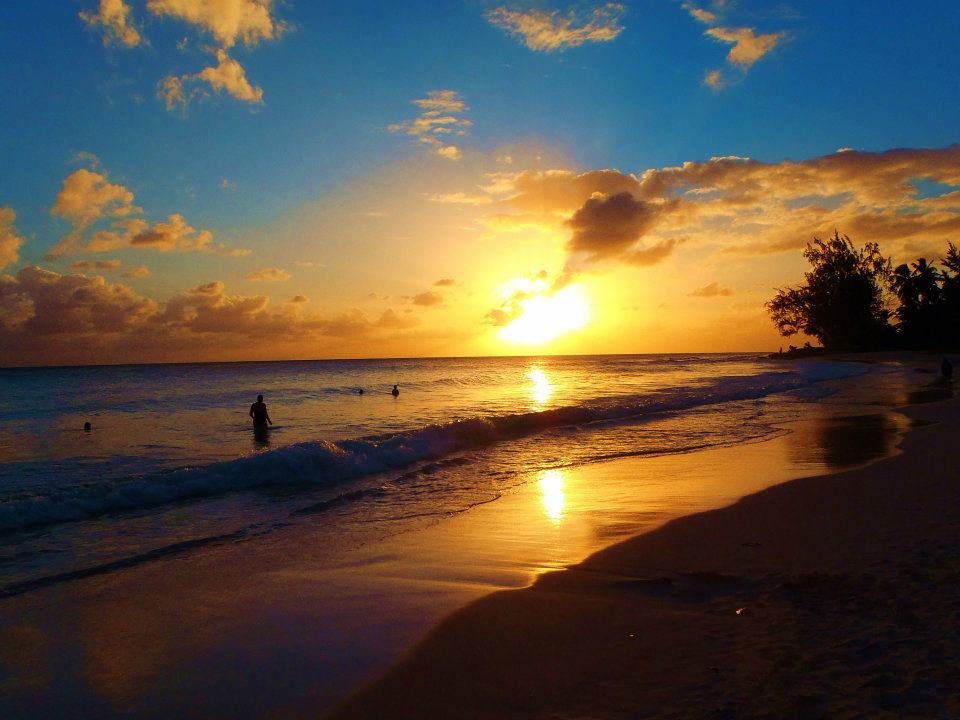
The sun setting on Accra Beach.

 Caribbean superstar, Beenie Man, came to campus for a show.


The Mosaic

February 6, 2012

Shalom all!  I have arrived in ארץ ישראל, the Land of Israel!  Many things are exactly as I expected, but there have also been some surprises.  For starters, I wasn’t prepared for how beautiful Haifa would be!  All the pictures I looked at before I arrived don’t even come close to conveying how amazing it feels to look out over the city, the mountains, and the Mediterranean Sea on my walk to class.  The University is situated on one of the highest points of the city, so you can see everything from here.  Someone even told me on a clear day you can see all the way to Lebanon, but I have yet to hear that from an official source.  We also haven’t had too many clear days yet, as it is the rainy season right now. We have a rain shower or thunderstorm almost every day, and it is usually overcast–  although still beautiful!

The incredibly diverse mosaic of peoples and cultures blending together in this beautiful city are unlike anything I have ever experienced.  The university is a microcosm of this.  My intensive Hebrew class is made up of six Korean students, one Japanese student, a grandfather from Vermont,  four Europeans (mostly PhD or graduate students), and six Americans.  It has been fascinating to learn of the different cultural backgrounds and motivations that have brought us all together in a classroom in Israel.  From the Japanese student of theology wanting to learn Hebrew in order to read Biblical texts in their original language, to the Political Science PhD student from Belgium interested in the political conflicts of the Middle East, our motivations for studying Hebrew are as widespread as the countries we come from.  The fast pace of the class has been overwhelming at times, but today when I took the midterm, I realized how satisfying it was to take an exam that involved reading a story and answering questions entirely in a language that two weeks ago I knew almost nothing about.  I’m really looking forward to having a working knowledge of Hebrew, and at the rate I am going, I am hopeful that it won’t be too long before I can navigate places like the grocery store with ease.  Even simple things like buying laundry detergent have been difficult. I almost bought bleach…oops! That would have been a disaster.  And I have to guess a lot when I am ordering food.  Although, the other day, I ordered coffee in Hebrew — I was quite proud of myself!

Last week the Madrichim (the social activities coordinators for the international students at the University of Haifa) took us on a tour of Haifa.  We explored the Arab Quarter, which included a large shouk, or outdoor market, with piles of fresh fruits and vegetables, fish, bread, spices, dried fruits, nuts, and olives.  We also went to the (reputedly) best falafel shop in Haifa, and a shop with delicious Arab sweets dripping in honey.  On a street running through the Arab colony, we saw the remains of their celebration of the “Holiday of Holidays” during which they celebrate Chanukah, Christmas, and Eid al Adja, the holidays of the three monotheistic faiths, all in one.  We also toured the central shrine of the Baha’i faith, and the German Colony, which was originally established by the Templars.

I am really excited about exploring the many layers of Haifa.  On Tuesday, the Madrichim took us on a hike to Elijah’s cave, believed to be the site of Elijah’s stay on his way to confront and defeat the prophets of Ba’al on Mt. Carmel.  During the hike, we passed a couple of bunkers built by the Israelis several decades ago, intended to be a last defense in case of attack.  So, side-by-side, you have Elijah’s cave standing as a remnant of ancient Israel and the spiritual battles that took place in the land, and the bunkers, evidence of the modern State of Israel’s current reality.

The adjustment to living abroad has been harder than I expected.  It is like the awkwardness of the first week of freshman year, but intensified by the new and foreign cultures and languages surrounding me.  It really helped that I was warmly welcomed by my five Arabic-speaking apartment mates, who have been fixing me delicious food and are eager to practice their English with me.

I am so blessed to have this opportunity to study here, and  I am eagerly looking forward to the friendships I will make and the many amazing experiences I will have over the next four months!


Only in Bangkok

February 3, 2012

I thought I would share some details about what I did this past Saturday, to give you a good idea of an average, ordinary day in Bangkok.

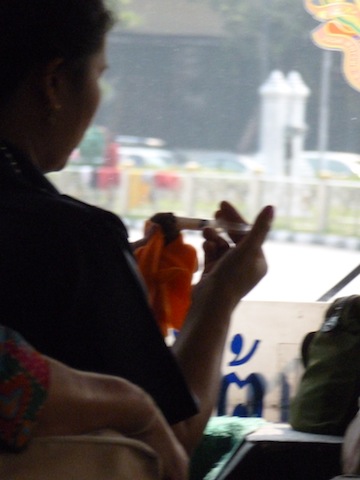
My day began by meeting a friend in the lobby of my apartment building, so that we could catch the bus together to meet a few friends for breakfast.  We said our usual “Sa wat dee kha”  to the lovely guards at the bottom of our building, and headed out on a walk to the bus.  At only 10am, it was already 85 degrees outside; the sun was shining, and all of the street vendors who crowd the Bangkok streets were just beginning to set up their food and clothing stands to begin their long weekend of work.  We climbed up the stairs of the overpass, which provides a safe way to cross the huge, 10-lane highway, passing the usual homeless men lying on the concrete, and the standard installments of individuals singing into a microphone hoping to make some money.  We hopped onto our bus, being careful not to touch the monks, clad in their orange robes, who were also boarding the bus.  We sat down, and the bus “tout” came over to collect our money – only 8 baht (about 25 cents), because the bus was open-air and not air-conditioned.  I quickly noticed what looked like an animal’s cage resting at the front of the bus next to the driver – based on the tail that was visible we assumed it must be a squirrel.  Well, that’s odd.  After the bus tout was finished collecting money, she proceeded to the front of the bus, opened the cage, pulled out what we think was a baby squirrel, wrapped it up in a small baby-squirrel-sized blanket, and proceeded to feed it with a syringe, squeezing something into its mouth for the remainder of the ride.  I tried to get a good picture, but the bus ride was so bumpy that a blurry one will have to do.

We then proceeded to Ethos, our new favorite earthy-crunchy, all-natural, sing-kumbaya, can’t-wear-shoes-inside, sit-on-the-floor type of restaurant. We had the most incredible banana mango gluten-free pancakes. I know it doesn’t sound like much, but they were delicious.

Afterwards, we ventured out to the main road in the now sweltering heat.  We waited for a bus that we knew would take us to the mall right by our apartment complex.  We fully expected to have at least a 30 minute bus ride – it takes minimum of thirty minutes to get anywhere in Bangkok, because there is always traffic.  Well, no one had mentioned to us that this bus takes the most roundabout, absurd path to go from point A to point B.  The ride ended up taking us 2 hours.  Don’t get me wrong, seeing the scenery of a weekend in the city was great, but my gosh, in that heat, with no air-conditioning, it was rough.

After two hours, our mall destination was finally in sight, so we got up and pressed the red button which signals to the driver that we want to get off at the next stop.  He was driving particularly aggressively at this point, especially considering how bad the traffic was.  And then, like slow motion, I saw it: bus jerking left, small helpless car turning right, and then — CRRUUUNCCHHH.  The horrible sound of metal crunching.  Our bus crashed straight into the car next us.  We all looked at each other, decided it would be best to just get off that bus as fast as possible, and into the refuge of the huge and nicely air-conditioned Central Pinklao mall.

Just another morning in Bangkok, Thailand.