Reflection week part 2: Cheese & Delftware

April 30, 2012

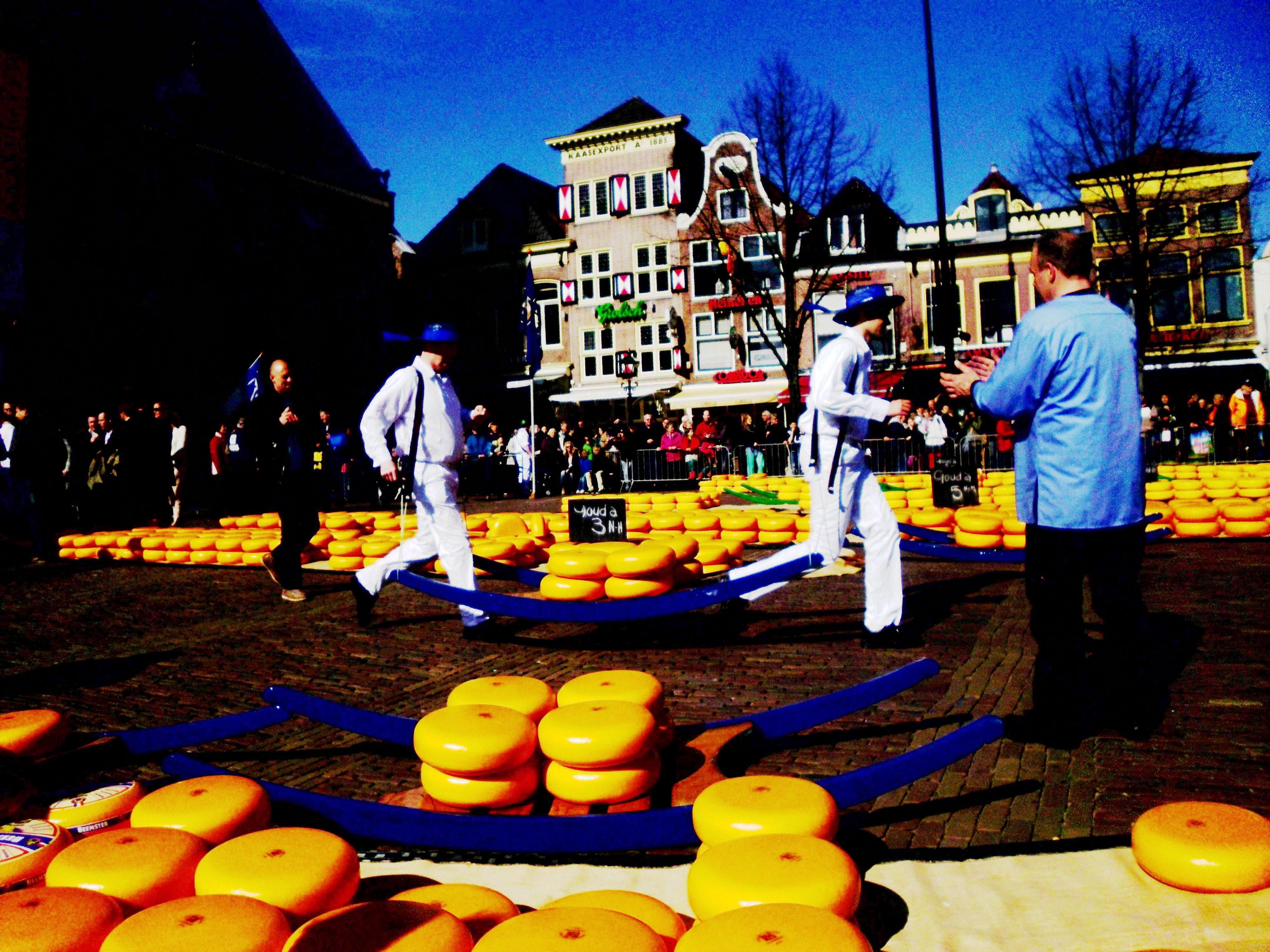
Hello everyone.  So as I told you last week, I spent the first part of my reflection week in Berlin with one of my Sorority sisters.  We had a nice few days and it was really hard to say goodbye and get on separate planes.  I don’t think I realized just how much I missed my friends and family until I had to say goodbye in the airport.  After parting ways I went back home to Maastricht to relax for a few days and mentally prepare for period 5 (the second part of the semester and my new classes).  The day after I got home a friend asked me if I wanted to go to Alkmaar and Delft with her for a day trip.  I said “why not”, so we got up early and headed up north (still in The Netherlands) to Alkmaar.  Alkmaar is known for its traditional cheese markets.  They open in April and we were going on the first day they were open to see the cheese markets in action.  People were dressed in what seemed to be traditional clothes.  Two men ran back and forth across the market carrying cheese on what looked like a sled (see picture below).
It’s funny because before I left to come to The Netherlands, I stumbled across a TV show that was about traveling around The Netherlands (specifically Holland, which is a province in the north).  One of the places they went was Alkmaar.  These TV shows were a little dated, but the cheese market looked the same.  It was kind of cool visiting a place you’d seen on TV since that doesn’t happen very often; at least not for me.

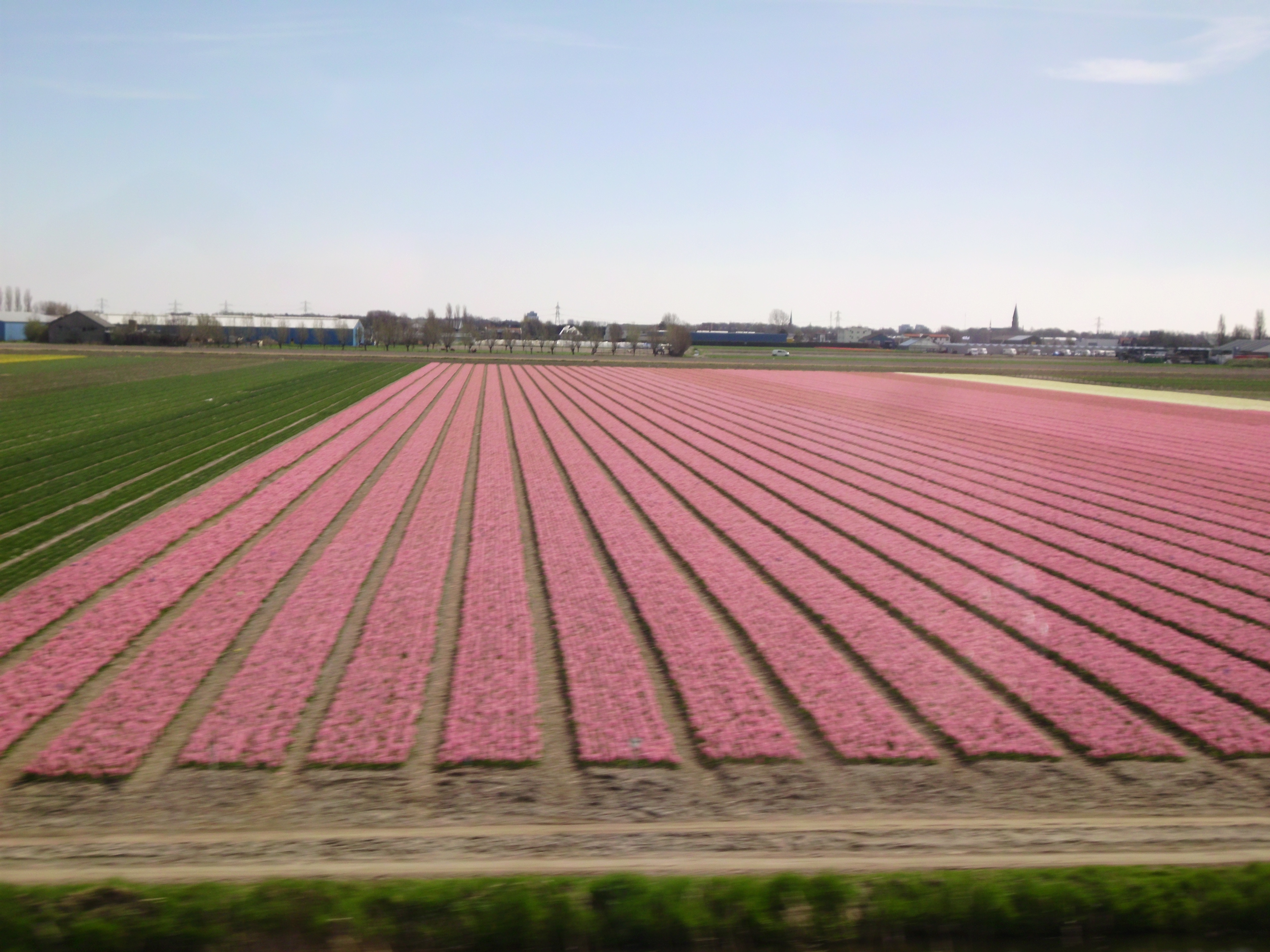
After tasting a variety of some of the best cheese I’ve had in my entire life we got back on the train and headed to Delft.  On the way to Delft my friend and I literally jumped out of our seats and moved to the seats across from us because saw tulips!  So many colors and there fields of them everywhere!  It was so pretty.  Since the weather was just starting to warm up, most plants hadn’t bloomed yet so it was nice seeing all the colors.
After the fields of tulips, we made it to Delft, is known for its blue and white Delftware.  It’s pretty funny because during orientation at UCM, one of the speakers told us how the majority of the things The Netherlands are known for don’t actually come from here.  One of the examples was tulips which are apparently Turkish.  Another example was the Delftware pottery which he said is from China.  I figured since I can’t go to China, I’ll go to Delft.  They have several museums dedicated to showcasing the Delftware and of course just about all of the souvenir shops claim to have “The Best Delftware” or to be “The original Delftware”.  I took a picture of a variety of it so you have an idea of what it looks like and what types of things are made.
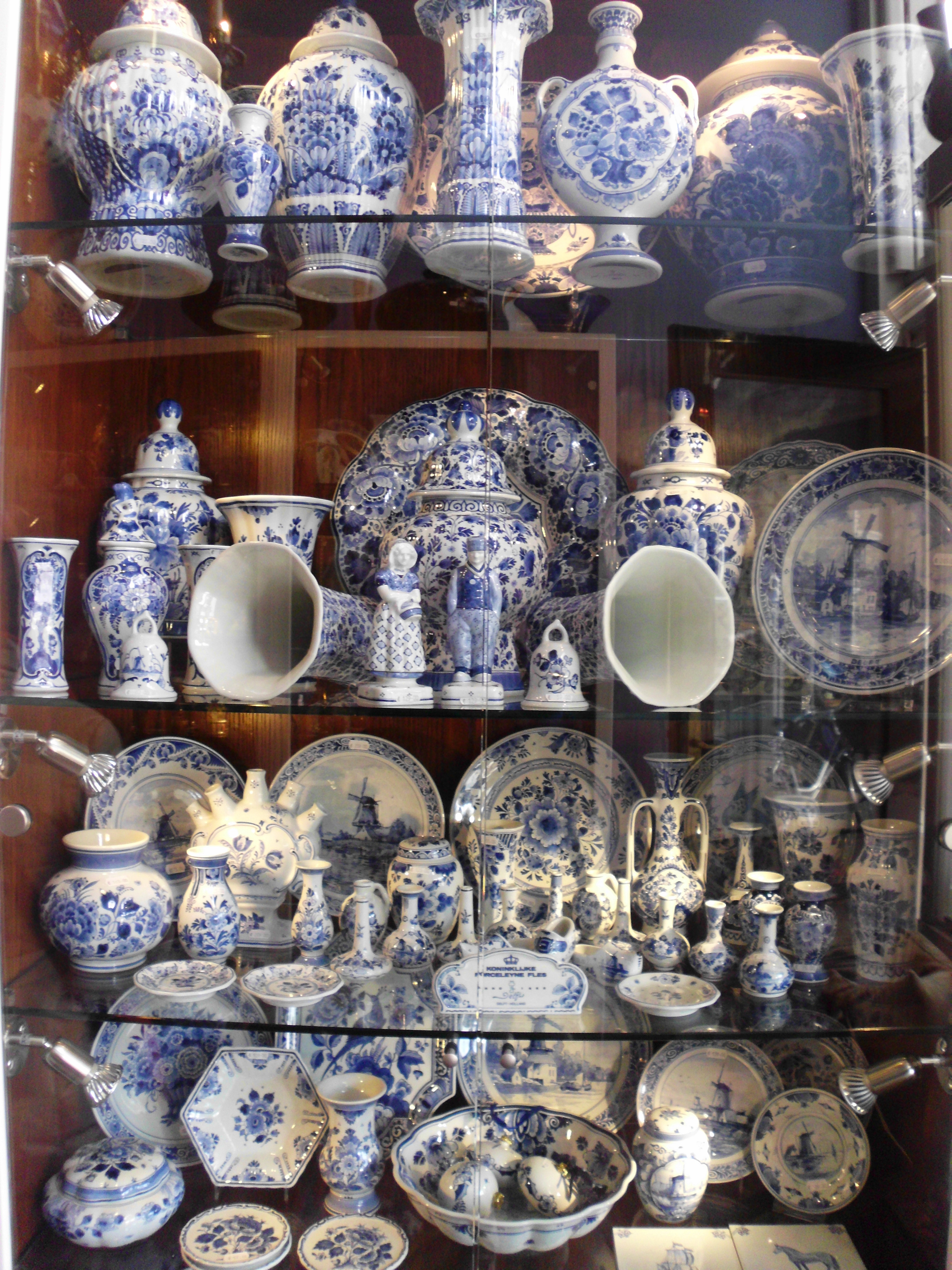
My favorite place was probably Alkmaar for the simple fact that you could taste cheese (for those of you who don’t know me very well, I absolutely love cheese).  After a very long trip, we made it home.  For the next two days I relaxed and started preparing for the next period’s classes.  This period I’m taking Theorizing Terrorism: A Philosophical Approach, Rights of the Child, and Strategy and Negotiation Skills.  So far, and it feels really weird saying this, but I really like my Theorizing Terrorism course; I think it may be my favorite.  Although we have deep discussions and terrorism isn’t a light, fluffy subject to talk about I’m learning a lot from this course.  For example, as an American, my idea of what/who is a terrorist is heavily defined by 9/11, but this course is causing me to think outside of that isolated incident and look at terrorism from different angles in order to shape my personal definition of terrorism.

Ok well I guess I should end on a lighter note than terrorism so with that being said, I recommend a trip to Alkmaar; cheese and music everywhere!


Barbados, Week 12: The American gets a Cooking Lesson

April 23, 2012

Upon being notified that I would be living on Halls this semester, a certain idea crept up in my mind:  I may actually have to learn how to cook for myself.  I had no idea what sort of eating venues UWI would have, and my mother was extremely excited that her generally helpless son would develop some valuable life skills.  However, you can take me out of America but it is not as easy to take the American out of me; no sooner had I arrived in Barbados in late January than I made it priority number one to find where I could buy ready-made food to consume.  Thus my diet consisted of chicken, rice, and salad at the school cafeteria, pizza from the local Esso gas station, and snacks or microwaveable goods from the Campus Mart.  Now this was no particular issue for me, for as I’ve previously mentioned, the cafeteria food is very tasty and Esso pizza is probably the best pizza on the island.  But I couldn’t help but feel a twinge of longing and jealousy as I would walk by one of the girls’ blocks, ham and cheese sub in hand, and smell some of the most delicious aromas to have ever hit my nostrils.

So one night, as I walked back to my block with a sizeable bag of KFC delivery under my arm, the RA on hall stopped me.  “Man how long have you been here?  You need to stop eating this fast food and start making some real Caribbean food.”  I secretly agreed, but decided it would be easier to come up with excuses such as “I would…but I have no time” (a blatant lie).  As it turns out my blockmate Nickoy is something of a master chef, and the RA quickly roped him into teaching me how to make a West Indian dish to “impress your parents when you get back!”.  Nickoy was skeptical I would actually follow through when I told him that I would buy the ingredients if he taught me how to make a simple Caribbean dish.  He was happily surprised when, on Monday, I walked through the door with a bag of chicken from the local supermarket, proclaiming that it was time to make a feast.  We would be making chicken stew, Caribbean style.

As Nickoy and I cut up the chicken breast and legs into manageable sizes, he told me how he had been cooking since he was fourteen years old.  Needless to say I could barely create a sandwich at that age, much less become a self sufficient cook.  As we went along it became apparent that, with cooking, practice does indeed make perfect, as Nickoy effortlessly skinned and diced up three potatoes in the time it took me to completely mangle one into small pieces.  However, it was really cool to see how such a delicious meal was created, and once mastered probably wouldn’t even take too much time to finish.

My blockmate Nickoy hard at work preparing the chicken.

Instead of meticulously describing how we went about making the chicken stew, I will include something of a recipe below in case anyone wants to learn how to do it themselves.  Bon Appetit.

– Chop up chicken breast and legs into thirds or quarters (about 6 pieces), wash in a bowl with water

– pour a handful of vinegar in the bowl, then wash again with water to remove the “rawness”

– cut up into fine segments and add onions (two), garlic (3 cloves), hot pepper (one), and a pinch of ginger to give it “attitude”

– thoroughly mix together by hand before covering, refrigerating, and let sit for three hours

– put olive oil in a sizable pot (enough to cover bottom), and turn oven on high

– chop up three potatoes into fine segments and mix in with the chicken, then add browning sauce (for coloring)

– wait until oil is steaming, then put chicken (with onions, etc) and potatoes into the pot, mix up with spoon

– keep oven on high for a few minutes before turning down to below medium until stew sauce is boiling

– add pepper or other ingredients as necessary by periodically tasting the stew sauce

– after stew sauce is boiling, turn oven on high again for a few minutes and then let sit for a few minutes

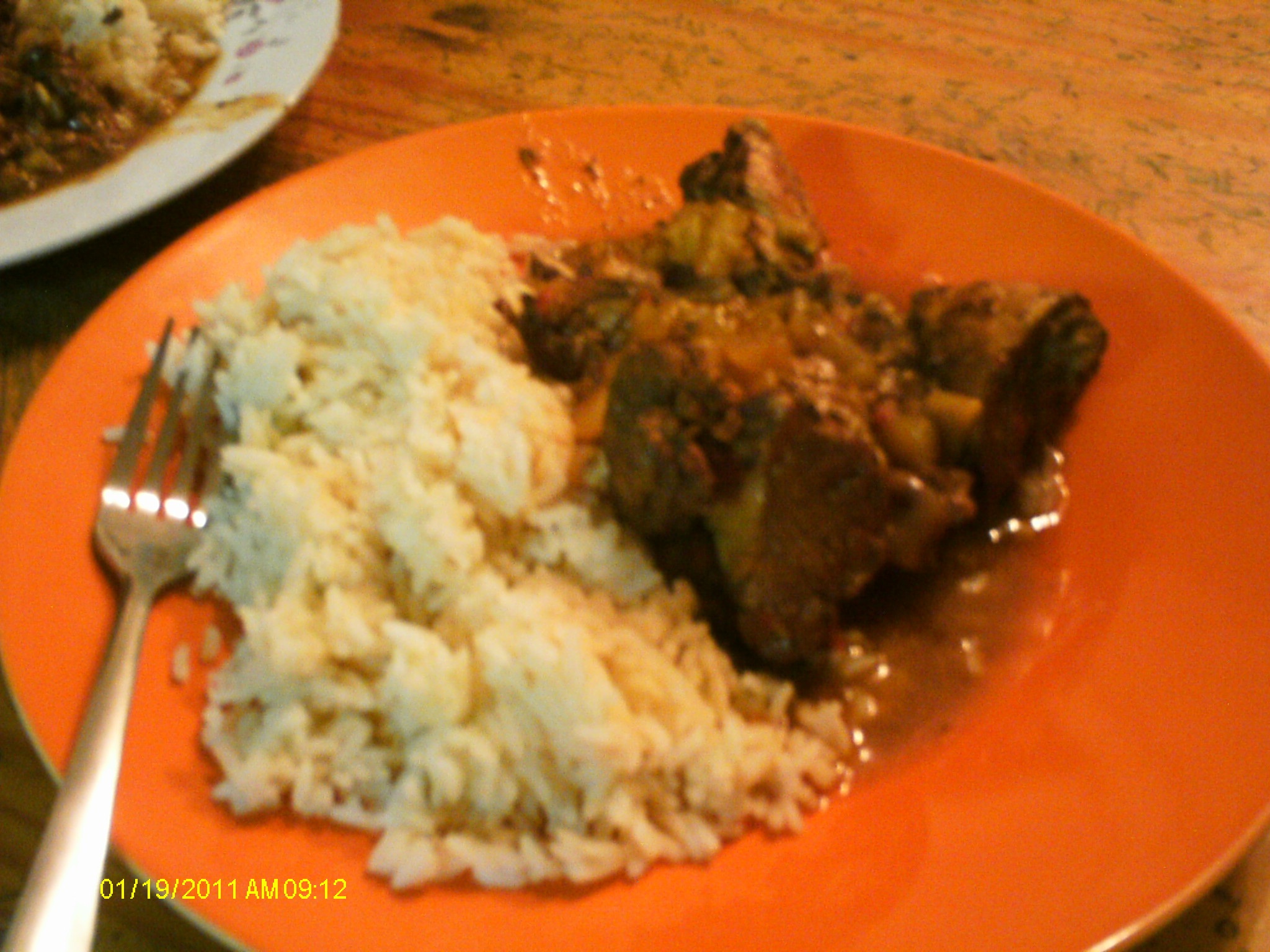
The finished product – delicious.

I wrote this recipe from memory shortly after completing the chicken stew, so chances are I may have left out a few steps here and there, but if you follow the recipe I’m sure you’ll have a delicious chicken stew dinner nonetheless.  Nickoy and I made a pretty big pot of chicken stew and rice, so we decided to share some with our fellow blockmate Richie.  Per usual, my eyes were bigger than my stomach, and I ended up eating myself into a near food coma.  Somehow food tastes better when you’ve helped to make it with your own hands, and so it was with the chicken stew.  And gentleman, FYI, telling girls you’re making dinner/can cook at all makes them swoon pretty hard.  So if you don’t consider it a manly undertaking and refuse to learn, just know that Nickoy and I will probably be entertaining your girl this weekend.

Richie, Nickoy and Jevaughn digging in.


Two Unforgettable Weeks

April 23, 2012

Five cities.  Two sunrises.  The Lowest Point on Earth.  One mud bath. Two Passover Seders.  Two rooftop hostel gardens.  A 5 a.m. mountain climb.  Seven long bus rides and one train ride.  Old friends and new friends.  Dancing across Israel.  Life advice from 71 year old Peggy, a dorm mate in a hostel in Jerusalem.  The best hummus in Israel.  The best hot chocolate in the world.  A literary café in Jerusalem. Spying on a wedding reception in Tel Aviv. Burning leavened bread in Be’er Sheva in preparation for Passover.  A shepherd with his flock next to the Sea of Galilee. Coming home to Haifa.

It is hard to know how to begin to describe my spring break.  Just as my friends and I thought as we were planning the trip, where do you begin a whirlwind tour of a country that has so much to offer?  All I know is I am convinced more than ever that studying in Israel was the right decision.  There are moments here that are hard and confusing, such as when I witnessed a young man hissing at an Israeli soldier in the Old City of Jerusalem. At times like these, I wonder what I have gotten myself into.  Who am I to be a cheerful, curious tourist when the reality of the situation in Israel is very serious for so many people?  But it is this confrontation with a human experience so different from my own that makes studying in Israel so incredible.

Another occasion in the past two weeks that showed me the high intensity of life in Israel was when my friend and I had Shabbat dinner with a lovely, generous Orthodox Jewish family in Jerusalem. They had an eighteen year old daughter named Shlomiya who was preparing to begin her army service in a few weeks.  Army service is mandatory in Israel, women serve for two years and men for three.  Observing Shlomiya and the mature, thoughtful way she spoke and acted throughout the evening, I thought of myself when I was eighteen, and how the most important thing on my mind was my next Spanish test.  Constantly living on edge, young Israelis must mature quickly as they are faced with challenges that never crossed the minds of me and my American friends as we were growing up.

I spent the majority of my break with my friends Emma and Heather, fellow international students who attend Brandeis University in the U.S.  I met Heather during the intensive Hebrew Ulpan at Haifa University at the beginning of the semester, but she is now doing a complete Hebrew immersion program at Ben Gurion University in Be’er Sheva, during which she is not permitted to speak in English.  To be completely honest, after the first day we spent together I did not have a very good attitude toward the situation.  What was I thinking, spending my spring break with someone I can’t even have a normal conversation with?  But within a couple of days, I was amazed by how Hebrew really started clicking for me.  I had always thought I learned almost exclusively from reading and writing, but I was proved wrong as I learned more from a few days of conversations than I had in weeks of classes.

This semester has held some challenges for Heather.  On top of the difficulties of having to speak Hebrew all the time, several weeks ago she had to run to the bomb shelter in her dorm several times as over ninety rockets were fired at Be’er Sheva from the Gaza Strip over the course of a few days.  She said the Israelis in the shelter with her would sit and count the booms as the Iron Dome, Israel’s missile defense system, destroyed many of the rockets in mid-air.

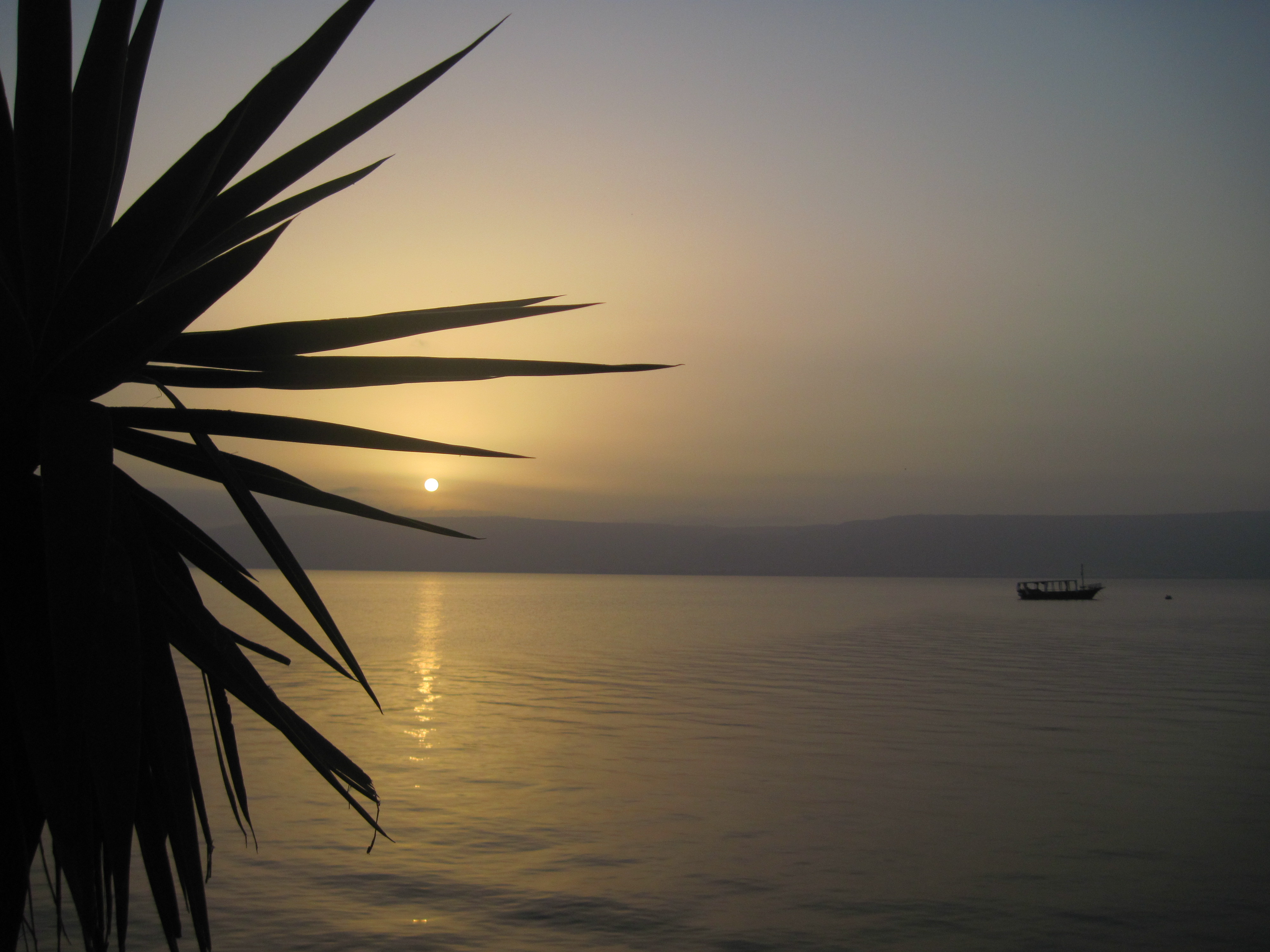
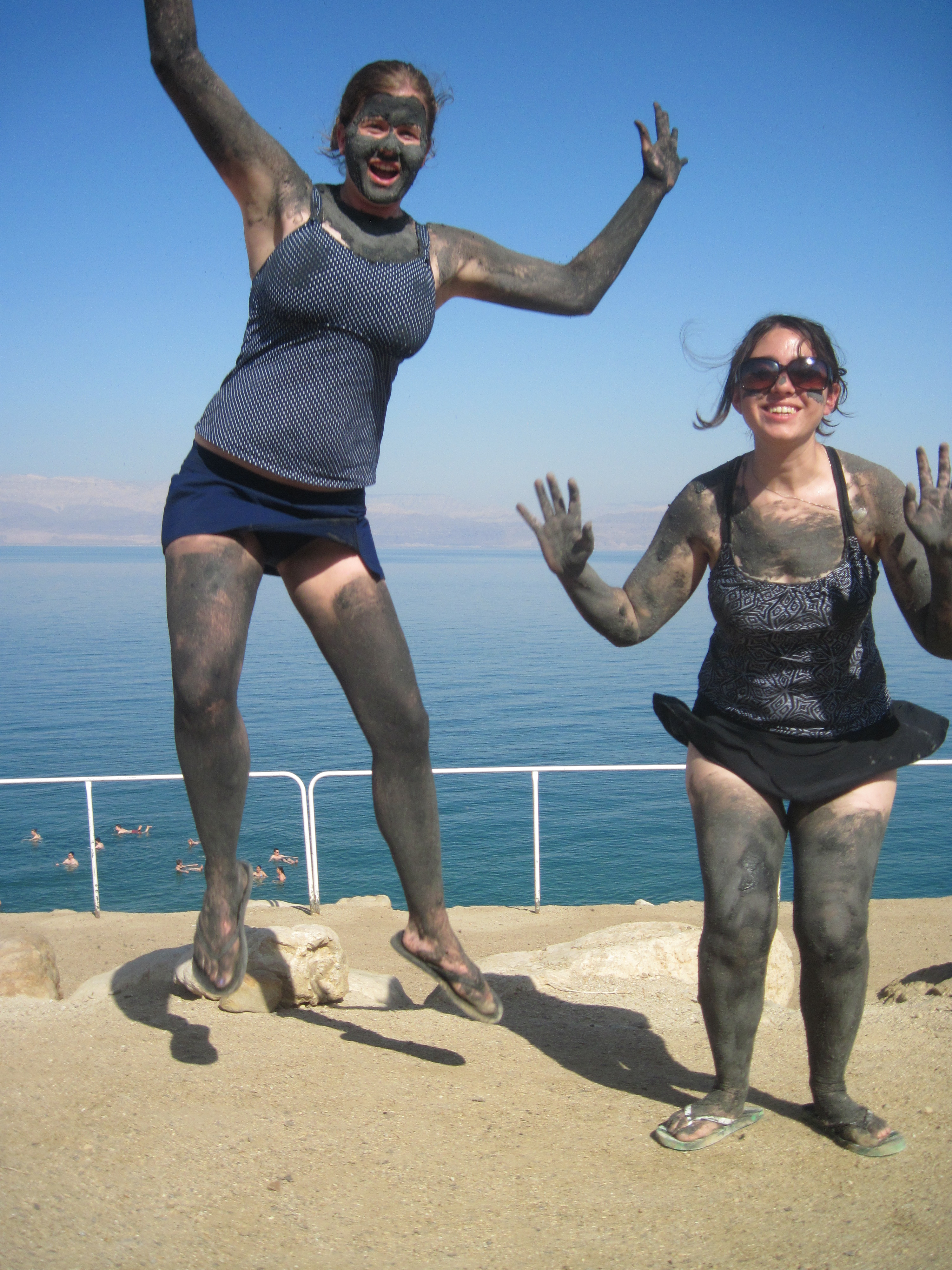
I accomplished a lot of bucket list items over break – climbing to see the sunrise on the desert mountain fortress of Masada where almost one thousand Jewish rebels committed mass suicide rather than be taken by the Roman army, floating effortlessly on the buoyant salty water of the Dead Sea, and seeing the sun rise over the Sea of Galilee and set over the Mediterranean in the same day.  Most importantly, though, I had a lot of time for reflection, and when new thoughts to ponder came my way I was able to soak them in, trying to expand my understanding of what it really means to live in Israel.

Sunrise over Masada

Standing on Masada

Sunrise over Sea of Galilee

Mud bath at Dead Sea


Cooking with Poo and Thai Massage

April 23, 2012

What a FANTASTIC weekend! I checked two things off my Thai bucket list that I have been wanting to do since arriving in Bangkok: a cooking class, and a Thai massage.

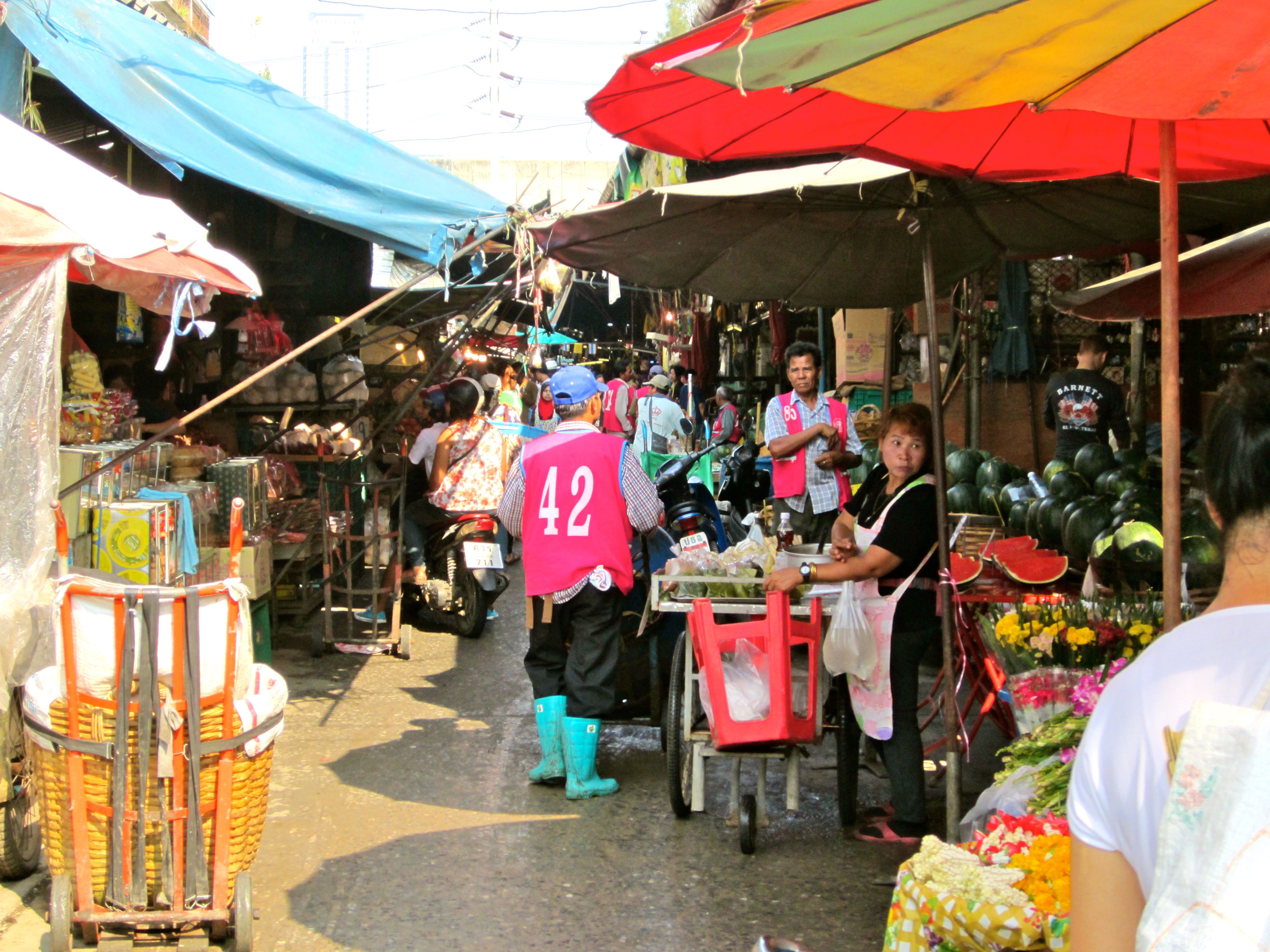
This morning I cooked with Poo and it was fantastic! Poo is an incredible Thai woman living in one of Bangkok’s slums, Khlong Toei.  She was given a microfinance loan through the “Helping Hands” organization, and using that loan she has become incredibly successful operating her cooking school.  The morning started off with a small tour of Klong Toei’s market.  It is an extensive market with everything and anything you could imagine.  We started by going through what Poo called the “Issan” area.  Issan is a Northeastern province in Thailand, and the food there is quite different than the food in Bangkok.  That row of the market has everything and anything strange you could imagine: live frogs, skinned frogs with hearts still beating, an endless assortment of bugs, eels, catfish, cow innards, skinned chickens etc… I did not once breathe in through my nose that entire walk. The rest of the market contained more “normal” items – beef, vegetables, and every possible exotic fruit.  Poo explained that most stall owners start work at 2am, and don’t stop until 6pm, they only way they can scrape by to make a living.  This market is incredibly cheap and has a wide variety of foods.  As a result it is the source of product for many of the street vendors and many of the hotels in Bangkok.  What an experience!

market

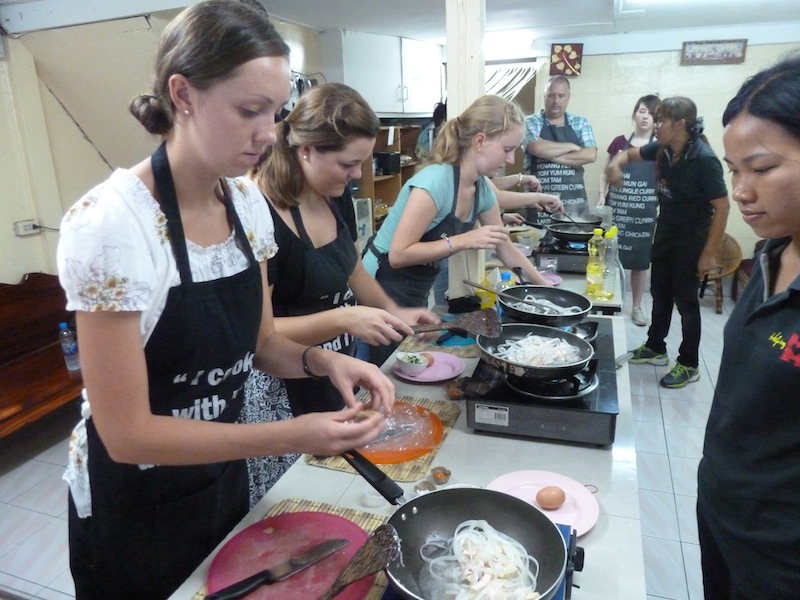
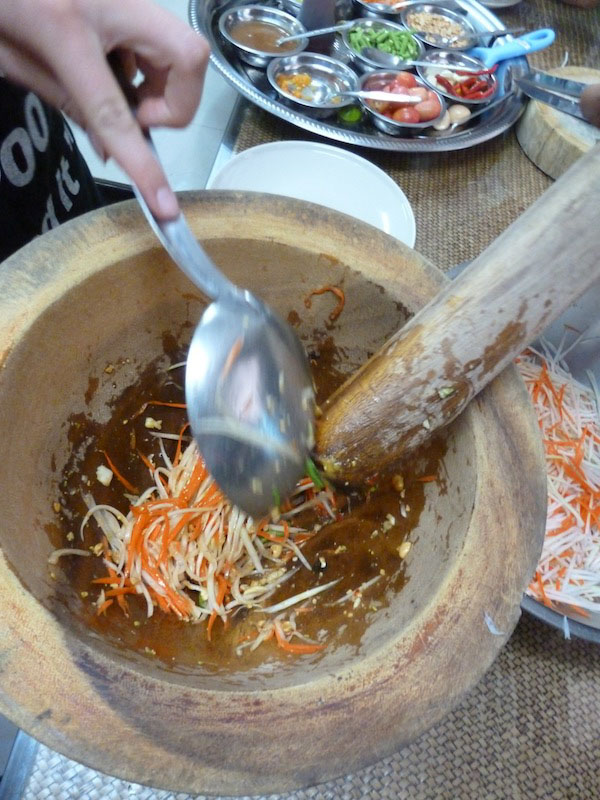
The second portion of the morning was the actual cooking.  The class is not meant to transform you into a Thai chef, but it gives a nice introduction to basic Thai dishes and lets you cook your own portion each time.  We cooked three dishes: Som Tham (papaya salad), Tom Yam (a delicious spicy soup with many different flavors), and Pad Thai.  The food was delicious, and now that we know how easy it is to make these foods it is definitely something I will take back to the US with me.  The only obstacle in the US: trying to find all of the ingredients.  What was most fascinating to me, is realizing what goes into the dishes I have been eating all semester.  For example, one of the strongest flavors in Tom Yam soup, comes from lime leaves.  Before putting the lime leaves into the pot, we broke the leaves apart which emitted the strongest and most delicious smell.  All the taste from this dish comes from breaking a green leaf apart–AMAZING!  Part of the fun of the experience was Poo herself.  She is a hilarious and kind woman, with completely broken English, yet she is sweet, enthusiastic, and eager to share her story, and the story of Klong Toei.  She explained to us that following her great success, she has also seen a change in the people in her community, and deliberately tries to uplift them as well.  For example, some of the ingredients we used to cook were handed to us in small cups made of banana leaves.  Poo said she purchased these from a woman in her community who is very sick and strapped for cash, so she thought she could help her by buying her product.  For each need of her business, Poo employs a member of her community, and tries to evenly distribute where she buys things so that as many people in the community can benefit from her success.  It truly is an incredible project.

The other event of the weekend was getting a Thai Massage: two hours for $12.  Yes, really, it’s that cheap.  But my goodness, that was a massage like nothing I have ever experienced.  First of all, I was in pain the first 45 minutes.  My masseuse literally dug her feet/fingers/hands into ever inch of my leg, almost as if she was trying to separate every muscle fiber.  Because the massage is two hours, the women can thoroughly cover every part of your body.  They also stretch you in every which way which was quite intense, because they completely ignore whether you are flexible or not.  They are also very hands on – you are lying on a mattress, and they sometimes use their whole bodies, for example contorting you around them to stretch you.  Not necessarily relaxing in the same way as a typical massage, but I certainly feel like I had a work out! Our fantastic evening massage ended with some Thai tea, before heading home.  I have to say I feel so content after such a fantastic long weekend.  Yes, some people may complain that Bangkok is crowded, or that the city is too dirty and smells bad, but I love the fact that there is never a dull moment in Bangkok: there is always something new to do, something to learn, and something incredible to experience, and I LOVE it!


Barbados, week 9: Carnival Chaos

March 30, 2012

The most hyped weekend of the year, at least for college students, is now in the books: Carnival, or KadUWIval as it is formally called, came with much fanfare and it certainly proved to be one of the most culturally different experiences of which I had the pleasure of being a part.  You see, back in the United States, there are parades, and there are circuses, and there are parties, but never has one event been so bold as to combine elements of all three.  It was one of those special times where you don’t really know what something truly IS until you’re smack in the middle of it, going “Ohhh… so THIS  is carnival”.

I may have taken some liberty with my previous statement, as, in reality, if one searches for UWI and/or Barbados on YouTube, videos of Carnival are the first thing that appears.  Carnival, for the avid YouTube video consumer, should be the first thing one will have known about Barbados before actually being there.  My experience was a little different, however.  I was walking across the campus lawn, noticing a greater buzz of activity surrounding the area than normal, when a tall Bajan guy approached me, “Hey man, you jumpin’ for Carnival?”  “Jumping? Uhm, no, I don’t think so, man, what exactly is it?”

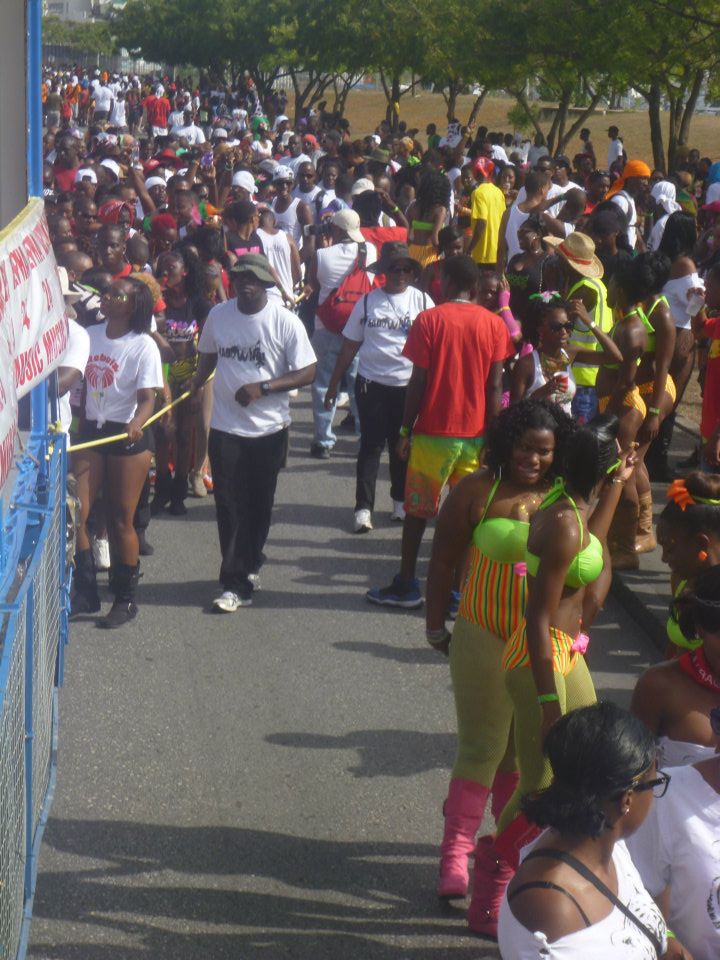
Simmz,  as I would later find out he was called, gave me the rundown on how it would work.  First, you join a ‘band’.  This is the group you will be organized into and ‘jumping’ with at the beginning of Carnival.  Each band has specific outfits the members wear, with different costumes for girls and guys.  The Carnival parade starts down near the cruise ship port in Bridgetown and ends on campus in Cave Hill.  What takes place during ‘jumping’ is this; the bands line up behind a huge truck stacked with speakers and posters, and once the music starts and the truck tires begin to roll, you have nonstop dancing, socializing, and picture-taking until the sun goes down and one finds themselves back at UWI.

I liked what Simmz told me, so I signed up for Carnival with his band, Island Army.  Now, usually, friends confer with friends before choosing his/her band, but since I didn’t really know what was going on and if there was a deadline or not, I dismissed the notion of conferring before choosing.  After all, Simmz had approached me out of nowhere and wanted me to be in his band — who am I to deny such adamant recruitment?  It turned out to be a good choice, anyways, as I talked to my Bajan friends Devito and Quaisy and they, as well, had joined Island Army.  The rest of the exchange group students had either joined the Halls Band or a band called Island Roots.

Fast forward three weeks, and it’s the morning of Carnival.  Girls are running around freaking out about how small their outfit pieces turned out to be, and the guys are still sleeping because all they have to do is wear their band t-shirts.  Carnival, I was beginning to realize, is maybe 5% about the guys and 95% about the girls.  No one is lining up to see me in my t-shirt — they’re there to check out the girls in their hot pink or leopard print outfits.  And as far as the outfits are concerned, less is definitely more.  Feminists may decry the event as objectifying women, but I think it is 100% cultural that they dress like that, and I don’t think you’ll find many Bajans that’d say otherwise.

Now, as far as the dancing that went on…well, that was cultural, too, I guess.  Caribbean women know how to dance — as children they are dancing soon after they can walk.  It’s no timid “I don’t really know how to dance, and I’m scared that people are looking at me” type of dancing one might frequently encounter in the United States, but a more full-bodied expression of rhythm and feeling.  I’m not going to lie, it was a little nerve-wracking for someone not completely sold on his own dancing ability to dance with exotically dressed, beautiful Caribbean women, but I was set on partaking in Carnival to its fullest, so dance I did.  For nearly three hours.  But Carnival was also a time of fraternizing with friends as well, and it was fun to see all the people I’ve met in the past two months out on the same street having fun together.  You begin to feel like maybe you’re not so much of a stranger after all when a friend comes up to you every five minutes and tries to get another girl to dance with you.

The Carnival procession finished up on UWI campus, and there everybody immediately remembered what they somehow forgot for the previous six hours: I’m incredibly hungry.  I had another “American” moment when I thought the contents of a yellow bottle was obviously mustard and so doused my hotdog in it.  It was Bajan hot sauce, and thus I proceeded to eat one of the spiciest hotdogs of my life.  But the day was far from done.  A big draw for a lot of the UWI students was the Carnival after-party, with one of the parking lots being craftily turned into a penned-in version of the last five hours’ various activities.

I liked Carnival for two reasons: One, nothing, or at least nothing I am aware of, exists like this in the United  States’ Northeastern region.  Nothing.  Two, it was a genuinely fun time dancing and socializing out in the beautiful Caribbean sun.

In fact, some past exchange students had flown down just to relive the epic weekend that is Carnival.  God-willing I save up enough money, I hope to be that guy next year.


I get by with a little help from my friends

March 30, 2012

Hello to all of my faithful readers.  It makes me happy when people tell me that they’ve been keeping up with my posts.

In a few days, I will have officially been here for two months, and I’m still enjoying my time here.  One of the main reasons I’ve been enjoying my time here is because of all of the new friends I’ve been making.  I’ve literally made friends from all over the world; Australia, Denmark, Canada, Chile, and of course The Netherlands.  When we’re not in class, we do a variety of things: going to the movie theater, travelling, cooking and having dinner together, sitting outside studying and relaxing, and playing cards.  Those are just a few examples of some of the things we do in our spare time.

Living in a foreign country for a significant amount of time with people from other countries is an eye-opening experience.  I was born and raised in the U.S. (Virginia, to be exact) so the way things are done in Virginia seem to be the most natural way of doing things.  With that being said, learning about how things are done in other countries reminds me that there isn’t one right way to do things.  I’ve compiled a short list of cultural differences that you may or may not be familiar with.

1. Chips can mean chips, or they can mean fries, depending on the context.

2. Biscuits can mean biscuits or cookies, depending on where you are.

3. Outside of the U.S., football and American football are two different things.

4. The Netherlands is, thankfully, not as humid as Virginia.

5. “Convenience” stores are not necessarily convenient (most stores are not open on Sunday).


Standing on the Edge of the World

March 26, 2012

I’ve never before experienced a feeling quite like I did standing on the rim of a crater in the Negev desert this past weekend.  I felt all at once the vastness of the desert, my own comparative insignificance, and how incredibly blessed I was to be able to witness such amazing beauty.

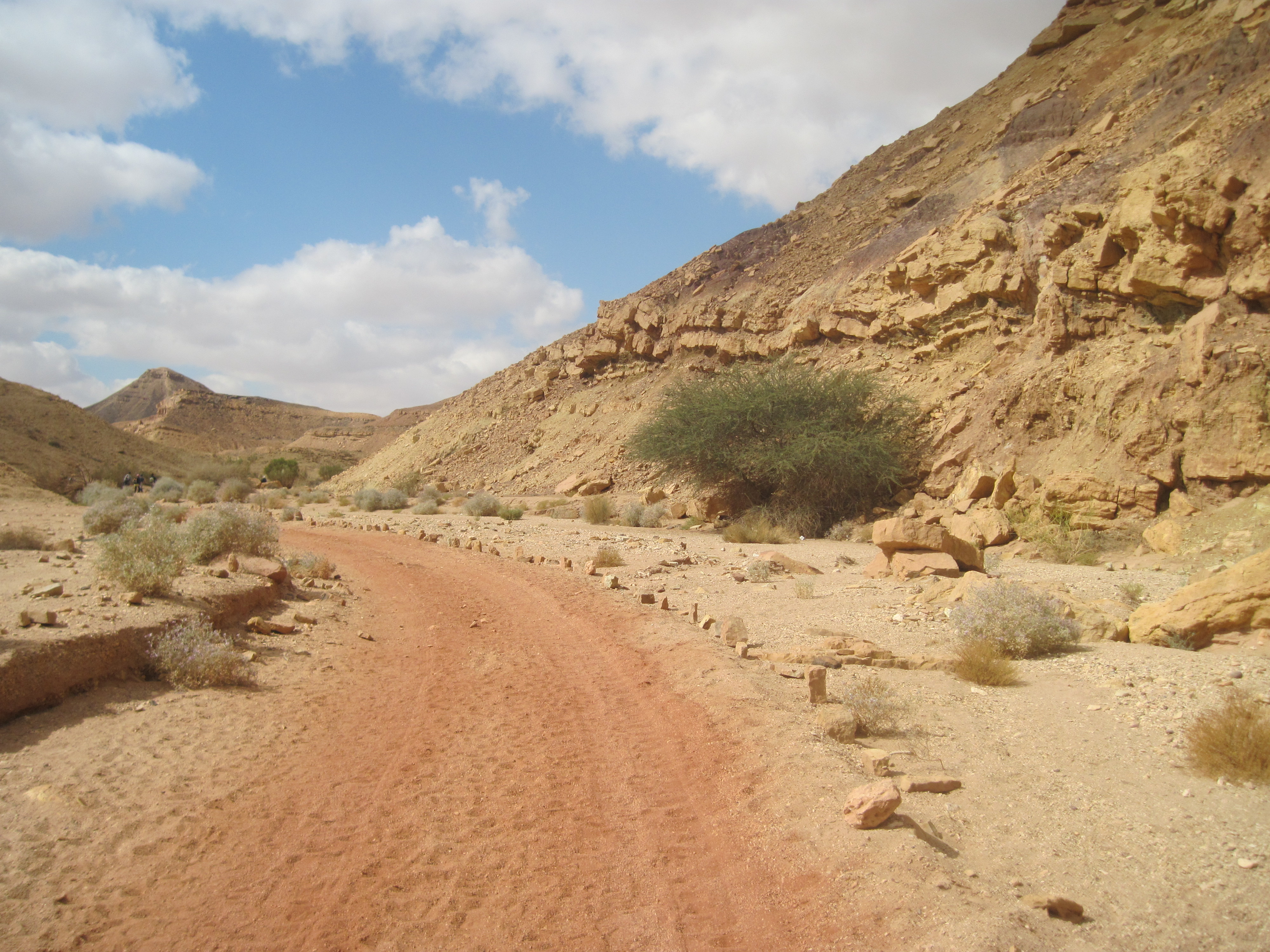
We started our trip by leaving campus at 5:00 A.M. on Friday morning.  Driving south, we could see the diversity in Israel’s landscape as the lush green fields gave way to sand and rocks.  After a drive of about six hours, our bus left us at a trailhead on the side of the road, and we set off on our 8 kilometer (about 5 mile) hike.  We were about 75 students, plus 4 guides, two guards, and a medic.  At first, the hike was relatively flat and easy, although it was surprising cold and windy, and huge dark clouds threatened to rain on us.  Then we arrived at the edge of the Ramon crater.  The view was beyond spectacular.

We then had to pick our way down the steep descent, through the crater, then climb out the other side.  We all celebrated when we made it up the last stretch.  But alas, our rejoicing was premature – the bus had not been able to make it down the road to meet us, and we were going to have to walk another two miles!  At this point it was only our will that kept us going.  But finally we made it to the bus just as it started to rain. We then drove to the center of another crater, to the Bedouin camp where we would be spending the night.  We all pitched in and made a huge dinner of Israeli salad (chopped cucumbers, tomatoes, and onions), stir fry and rice, hamburgers and hot dogs, and of course, lots of pita.

Sleeping in the tent was quite an experience. I remember waking up in the middle of the night, and even though I was cozy in my sleeping bag, I felt how bitterly cold it was outside.  Waking up to the sun casting morning shadows across the crater, we set off on our second day of hiking.  This time we climbed up the edge of the crater and walked along the rim, and a couple of times, we had to climb rock scrambles where one slip could send you rolling down the edge of the crater.  At one point, there were even iron handles drilled into the rock; we knew when we saw those that this cliff meant business.  But we all made it through safe and sound, circling the rim of the crater around until we ended up back at our camp just before sunset.

We then set off for Eilat, where we stayed in a lovely hostel that fed us an amazing hot breakfast the next morning, which we were all incredibly grateful for.  On Sunday, we could either choose to stay at the beach or hike in the Eilat mountains to a peak where you can see Jordan, Egypt, and on a clear day, Saudi Arabia.  I chose the hike, even though I was pretty worn out from the past two days, and I was so glad I did!  Looking out over the Red Sea as it lay nestled in the midst of desert mountains was an exhilarating moment, to say the least.

It is really hard to describe in words how I felt throughout this weekend.  It was definitely the farthest I had ever been pushed physically, and the camaraderie the shared experience built within the international students was really great.  Passing each other on the way to class on Monday morning, we all knew not only how sore we were, but that the endless sweeping desert vistas we had seen together would be printed on our minds for the rest of our lives.


Barbados, Week 7: Partying with the Hindus

March 16, 2012

This past Sunday, March 11th, was Phagwa, the Hindu celebration of their New Year and the coming of Spring.  This was not something of which I had any knowledge, however, until my Cultural Studies professor told us about it last week.  The fact that there were Hindus in Barbados had never even occurred to me, and thus my curiosity was piqued.  I knew nothing of Hinduism, except that it had its origins in ancient India/Asia, and wanted to see how they expressed their thankfulness and positivity toward a new year.

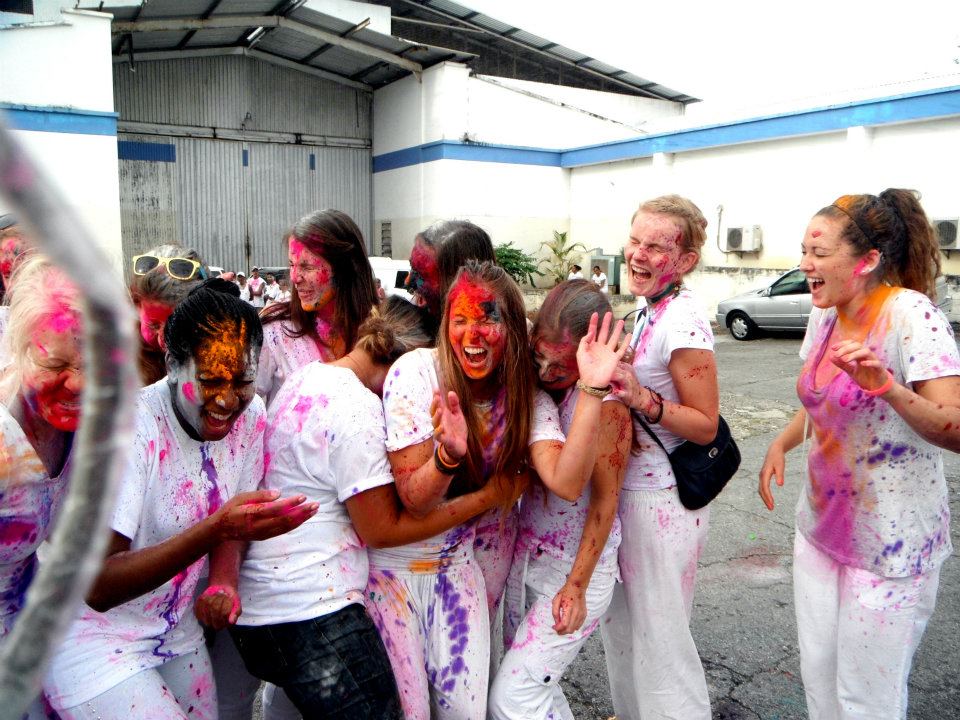
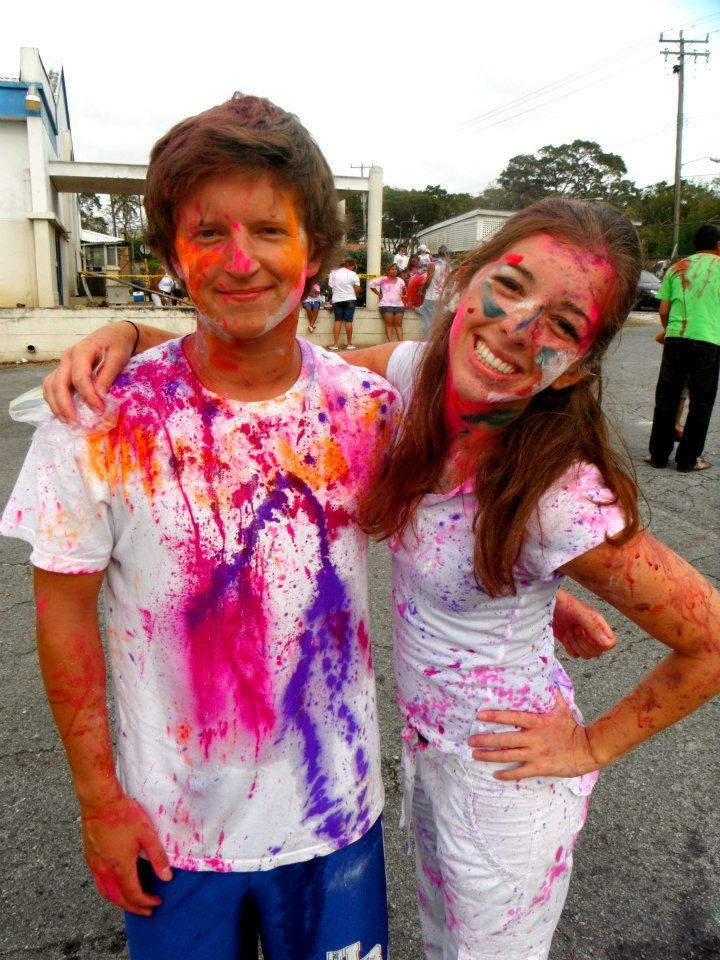
As it turns out, they do so by dousing each other in colored powder and splashing each other with paint for the greater part of three hours!  Would not have been my first guess as to the method of celebration, but it was a lot more fun than any of the students expected.  We were told to wear old clothes, and somehow everyone got the idea in their head that it would be best to wear all white; when 15 white kids wearing all white clothes piled out of the van upon arriving at Phagwa I had to laugh- it looked like we were ready for Halloween.

No sooner had we stepped out of the shuttles than people began patting us on the face with baby powder and welcoming us to the celebration.  Now we looked really, really white.  The festival was held in the parking lot behind the Hindu temple, with a large tent at the back of the lot providing shade for those who wished to sit down or simply had enough of getting paint thrown at their face.  On another side of the lot one could find tables upon tables of traditional Indo-Caribbean food and drink.  Wanting to eat my food without fear of paint contamination, that’s where I went first.  My meal consisted of curried rice and potatoes, spinach, yams, and an unknown spicy dressing.  Most people know to only take small portions of unknown foods, but I decided it was a good idea to take three heaping spoonfuls of the spicy dressing and slather it all over my rice.  Besides all of the fascinating religious and cultural things I learned during Phagwa, I think one of the most important lessons learned was that American “spicy” food and Indian “spicy” food are not on the same level…not even close.

Then things got colorful.  More people began arriving with liter bottles filled with water-based paint and bags of powder.  As musicians played what I assumed to be Hindu music on stage, everyone began running around and dousing each other with as much paint as possible.  I didn’t have any paint, unfortunately, but I bought a few bags of colored powder and went around to friends and strangers alike and attacked them with a barrage of color, albeit gently.  The gesture was returned tenfold as I was covered head to toe in red, blue, orange, pink, and green paint and powder within minutes.  When I finally looked at myself in a car window, I very closely resembled an Oompah Loompah (from Charlie and the Chocolate Factory).

Later in the celebration they brought on a pretty eccentric performer who proceeded to take the stage and make jungle animal noises.  Supposedly he was trying to provide some context for his next displays of skill, as he demonstrated how to break open coconuts as they had done in the jungles of Guyana before the advancement of modern technology.  For his next act he proceeded to place a chicken on his head and play some rhythmic drum lines as the crowd cheered him on and danced.  I, personally, was equally impressed with the chicken’s ability to balance on the man’s head the whole time.  Before we left Phagwa, the temple pundit allowed our group to check out the Hindu temple, which featured detailed drawings and almost-life-sized statues of what I can only imagine were their sacred dieties.  A very cool experience, considering he even let us inside looking like a rainbow had exploded all over us.


Have you bought a costume yet?!?

February 27, 2012

For approximately two weeks leading up to Sunday, February 19th, this is the question I was repeatedly asked.  Sunday the 19th through Tuesday the 21st marked the official dates of the Carnival (or Carnaval — I’m still not sure which is the correct spelling, since I’ve seen them both used interchangeably) before Ash Wednesday.

Here’s what I knew about Carnival before it started:

1. Basically everyone dresses up in some kind of costume, whether it’s just a mask or a full-blown outfit.

2. Carnival is celebrated most in the southern part of The Netherlands, which is where I’m located.

3. Because of this, classes would be cancelled for one week in order to celebrate.

Going into Carnival with this knowledge did not fully prepare me for what I like to call the “Carnival Experience”.  When I first arrived to the Vrijthof, which is the heart of Maastricht– and also where the main festivities were going to be taking place– I was confused.  Although there were people there, and they were in costume, the Vrijthof seemed fairly empty compared to what I was expecting.  It seemed like people were constantly saying that this was such a big deal, yet it wasn’t much more crowded than it would be on a normal weekend.

While we were waiting for the parade to come, there were sporadic hailstorms, and then, in the blink of an eye, the Vrijthof was extremely crowded!  Allow me to put it in perspective for you.  A street that would normally take about one or two minutes to walk down took 10-15 minutes.  This part of the experience is what I’d like to call organized chaos.  Everyone was having a good time and trying to get to their next destination within the Vrijthof, but it could have been perceived as chaotic from someone who was completely unprepared.  My friends and I, however, did what the locals were doing; made a little train by putting our hands on each others’ shoulders and moved through the crowd.

Below is a picture where you can see some people in costume unsheltered during the first hailstorm.

The parade arrived just as the last hailstorm took its leave.  There were bands and of course everyone was wearing a unique costume!  The parade was interactive; the people on the floats saying “hip hip!” and the crowd responding “hooray!” (all in Dutch of course).  My friends and I had a really nice time.

After the parade was over, it was time for food!  One of my friends and I decided to be brave and try Herring, which historically was the traditional food eaten on Ash Wednesday.  Even though it wasn’t Ash Wednesday, we ate it anyway.

This fish was probably the largest piece of fish served to one person that I’d ever seen in my entire life, and it was absolutely amazing! The picture doesn’t do it justice, but it really was a large piece of fish.  After we were fed, it was time to explore and see the costumes.  The Carnival colors for Maastricht (located in the southern province of Limburg) are green, yellow, and red, so that tended to be a common color scheme, especially amongst the older generations.  I was one of the exceptions.  I realized that I may not have the opportunity to experience Carnival again, so I decided to “dress-up” with some of Limburg’s colors.

I bought a cheap purple costume dress, because purple is my favorite color, and accessorized with Limburg’s Carnival colors!  I was surprised to get so many compliments; I felt Dutch 🙂  As the day went on, more and more people kept showing up, including people of all ages (including little children whose parents had dressed them and/or their strollers up in order to celebrate).  As I mentioned earlier, Carnival is a three-day event, and people did not stop wearing costumes and celebrating at any point during those three days.  It was quite impressive that it was still going strong on day three!  I suppose when you plan and wait for months for Carnival, you’re going to enjoy every minute of it.


The Temples of Angkor Wat: Cambodia

February 24, 2012

This weekend, I took my first international trip to one of Thailand’s neighbors, Cambodia.  Specifically, we went to Siem Reap, which is the center for all of the tourism surrounding Cambodia’s famous Angkor Wat.  The journey to get there is not exactly quick; it began with a four-hour minivan ride to the Cambodian border, then about one hour spent actually crossing the border, an hour spent waiting at the bus station, a two-hour minivan ride to Siem Reap, and then a 20-minute tuk tuk ride to our hostel.  All in all, about a ten-hour journey door to door.  We arrived in Siem Reap Saturday afternoon and left early Monday afternoon – it may seem crazy to some of you to travel to Cambodia for such a short time, but a) with the very strict attendance policy at Thammasat it is the only way I can travel, and b) we really felt we did not need any more time in Siem Reap.  So here are the notable highlights:

1) Cambodia is not Thailand.  It may seem obvious, yes, but I have always had a magical view of Southeast Asian countries – friendly, smiling people always willing to help you, greenery everywhere, rice fields lining both sides of the road.  I assumed that the hospitality and kindness that are normal in Thailand would also be present in Cambodia.  But from the second that we stamped out of Thailand and started the visa/entry process into Cambodia we immediately noticed a change in atmosphere.  The guards at the border were not friendly whatsoever, and immediately after officially entering Cambodia we were overwhelmed by men trying to get us to go into their taxi, or in their minivan to Siem Reap.  We have very much become accustomed to Thai courtesy and friendliness; in Thailand I never have to worry about being scammed.  But Cambodia is known for its scams, particularly at the border, so we had to be extremely cautious.  There is even a “fake” border that has been set up.  Literally, a building was built complete with guards, and signs, and visas.  They bribe tuktuk and minivan drivers to bring tourists to the fake border, who then pay a lot of money for what may or may not be a valid visa.

2) Siem Reap is essentially the main city where tourists go in order to see Angkor Wat and the surrounding temples.  The city provides a stark contrast between wealth and poverty – while there are five-star hotels lining both sides of the streets, between those manicured lawns and marble entryways are dirt roads filled with children, running around begging tourists for money.  It was a surprising and uncomfortable reality.  Despite the hotels everywhere, we opted for a much more modest accommodation in a fantastic hostel near the old town, for only $3 USD per night.  Saturday evening we had traditional Khmer red curry for dinner, which was easily the most delicious curry I have had since landing in Southeast Asia.

3) The temples.  The temples of Angkor Wat are located about a 20-30min tuktuk ride from Siem Reap.  The area surrounding the temples has been well preserved, so instead of endless hotels and restaurants, Ankor Wat is surrounded by beautiful forest.  We hired a tuktuk for the whole day (only $15) and left Siem Reap at 5am to see the sunrise over Angkor Wat.  We were joined by many tourists, but the early start was completely worth it – Angkor Wat is incredible and utterly breathtaking.  It is an expansive structure (only pictures can do it justice) that is considered to be the largest religious structure on earth; some place Angkor Wat in the same category as Machu Picchu and other wonders of the world.  It is this fact that I could not get over.  Construction of the temple was started in the year 1112 by the king of the Khmer empire at the time.  It is thought that he created the Hindu temple, which ended up being changed to a Buddhist temple, in dedication to the Hindu god Vishnu.  It took 37 years to complete. The thing is, in my lifetime, I have visited many castles that immediately strike any visitor by their opulence and grandeur.  For example, the Château de Versailles, in France, created by King Louis XIV, is just ridiculously extravagant.  But Angkor Wat was not created for the purpose of living, it was purely in dedication to a Hindu god.  It is purely religious — that’s just hard to fathom, because it is so big!  Though commoners used it for prayer throughout the year, our tour guide explained that the king usually only visited it once per year.

4) Angkor Wat is not the only temple to see. We also visited Ta Prohm, which is the only temple in the area that has not been protected against the jungle.  It is therefore covered with trees and roots that have wound their way around the ruins.  Fun Fact: Ta Prohm was featured in the film “Tomb Raider.”  We then visited Ta Keo, and Bayon, and ended our day by going back to Angkor Wat and having a guided tour of the temple.  I am definitely glad we spent the $3 for a tour guide, because it is not easy to understand the meaning of the temple without some history and explanation. We spent nine hours, from 5:30 am to 2:30pm on our feet visiting temples.  And it was completely worth it.

All in all, Cambodia was incredible – once I realized that Cambodia has only been out of Civil War since 1998, it became very clear as to why there is such a stark contrast between wealth and poverty in Siem Reap.  Cambodia is very much still recovering from the Khmer Rouge regime, and as of now the country relies heavily on tourism, which is why so much money has been poured into hotels and restaurants in Siem Reap, but nowhere else.  I would have loved one more day to travel the six hours to Phnom Penh, the capital of Cambodia, to learn more about the history of the country as well as to see some of the museums there chronicling Cambodia’s recent history.  But otherwise, by the end of our stay we felt we had seen all there was to see in Siem Reap. I have to say, after a nine-hour trip  back to Bangkok which included one very offensive, drunk Irish man, who didn’t stop talking for our four hour-minivan ride, offended every race and religion represented in the van, swore every other word, smoked in the van, threatened to kill most of us, and almost assaulted one of the guys in our minivan – it certainly felt good to be back “home” in Bangkok!