Soccer at San Siro: Forza Inter!

January 3, 2012

Maicon brings it across midfield on the right side, makes a quick move around his defender, lays it off to Zanetti, who crosses into the box for Milito, and GOALLLLLLLLLLLLLLLLLLLLLLLLLLLLLLLLLLLLLLLLLLLLLLLLLLLLLLLLLLLL!

Never before have Americans been so entranced by soccer as 3 of my buddies and I scream at the top of our lungs celebrating in Inter Milan goal surrounded by 80,000 passionate Italians. An experience unlike any sporting event I have ever been too, Italian soccer (calcio) is truly incredible.

With fans that reach crazed levels of fanaticism screaming aggressive chants, numerous catcalls, and loud whistles (the Italian form of booing), when you find yourself comfortable in the atmosphere it can become many things, but most of all, it is fun.

While in Milan I had to use my small amount of European soccer knowledge to select a team to which I would pledge my allegiance. With two powerhouse teams both playing in the San Siro Stadium home to 80,000 seats and a large amount of history I had to make my decision between supporting AC Milan or Inter Milan. From the moment I stepped off the plane in Italy I was already being grilled about which team I would support my locals, cab drivers, and fellow students, with the city of Milan being split almost down the middle with fans of each side. After attending one AC game and one Inter game it was clear that I was driven to support Inter… so I embraced it. With one of my best friends already being a huge supporter of Inter (which he claimed was his biggest reason for studying in Milan) we went to a number of matches and truly embraced the Italian sporting culture. Over the course of the season thus far I have attended 5 Inter games… all of which they have won.

Now if I tried to claim I was a good luck charm you all might doubt me. And I will grant that one American in a knock off jersey and a European soccer scarf may not ultimately be the deciding factor for Italian soccer.  However as any avid “Serie A” fan can tell you Inter is having an uncharacteristically disappointing season and has only won 8 of their 15 games up to date. Which means that the probability of me attending 5 winning games out of 8 is quite low (I told you I was taking statistics), so there must be some kind of magic going on.

After 5 games at San Siro I felt like quite the loyal fan. I knew where to buy my ticket, I knew where to sit in the stadium, I knew the players’ strengths and weaknesses, I even knew where to buy the best street vendor food outside of the stadium. Attending Inter Milan soccer games became a way for me to truly blend into the Italian culture and feel like a bigger part of the country I was living in. So for your next European adventure whether you are a sports fan or not, see a unique side of European culture, feel connected to the people of that culture, and have an amazing time doing it. Go see a soccer game.


A Last Minute Trip.

January 3, 2012

Seven days before all final work was due Megan, Tomas, and I hightailed it to Scotland. It was to be our final excursion of the semester. After what seemed like less than an hour flight, we arrived in Edinburgh. Being late at night, we just headed to our hotel for the night. Much to our surprise, our room was spectacularly modern- a welcome change from Derry. Our building was also right on the water so we had a great view. From what we saw, Scotland looked relatively similar to Ireland, but was much, much colder.

The next morning, we got all bundled up and headed to the train station. Our destination? St. Andrews. Not only would Megan be able to fulfill her parents’ wish of walking on the famous greens of the St. Andrews golf course, but I could see my good friend and fellow Spider, Kate. She has been studying at University of St. Andrews. Needless to say, we were all very excited about the day ahead of us.

The train to St. Andrews passed over some beautiful rivers and scenery. When you are in Europe, it is difficult not to miss something. Everything is intriguing and interesting- the nature, the buildings, the people. I could not get enough of simply looking around. Purely observing my surroundings would have been good enough for me.

Meeting up with my UR friend Kate was uplifting. It was just enough of home to help me to the end of the semester. I had been homesick lately, but seeing her washed those feelings away. After visiting the St. Andrew’s Links Golf Course, Kate showed us around a bit. We visited the ruins of a cathedral and a castle. It is amazing that such sights could not really be seen in America. Here’s a picture of Kate and me:

Back in Edinburgh at night, we happened upon a German food festival near the train station. Spontaneous events such as this have been the highlight of my trip abroad. The next day in the city we followed this trend by wondering aimlessly through the intertwining alleyways and streets of Edinburgh. The easiest way to gain the feel of a city is to just walk around and explore. Our main plan for the day was however to visit Edinburgh Castle.

Finally I fulfilled one of my main goals of going abroad- visiting a castle. Perched atop a hill in the city, the views were remarkable. We were even able to see across the water to St. Andrews where we had been the day before. In the distance, the mountains were covered with snow. We explored the dungeons, the oldest building in Scotland, chambers of Scottish royalty, as well as saw the Crown Jewels. Here’s a picture of the castle:

Our last day in Edinburgh ended with a ghost tour in the crypts underneath the city. On that frightening note, I returned to Derry where all of my final work waited for me. Famous for procrastination, I headed straight to the computer lab to get my work done. After a long week of nonstop work, I had finished and turned in the work for all three of my modules.

For graphic design, I just needed to edit projects created previously in the semester. Finishing up the work for this module took no time at all. Animation and 3D however were the most time consuming. I needed to finish up my dinosaur character for 3D as well as make my robot character walk for Animation. Both proved to be difficult tasks, but here is what I came up with:

Now all that lay ahead of me was my last week here in Derry and my long, long journey home…

Fun Fact #15: The oldest pub in Derry is called the River Inn. It has recently been converted into a much more modern bar.

Fun Fact #16: Irish people call potatoes spuds.


Full Circle: Mai Pen Rai

December 21, 2011

With Bi Si (welcoming and goodbye ceremony strings in which locals bless you) strings on my left hand and an ocean to my right, how do I even begin reflecting on this experience? I am sitting on the beach in Koh Tao, staring out at the beautiful water forgetting that I am in Thailand still. It is the brief interactions with locals and long conversations with vendors in Thai that remind me of my experience. Or the exported food items on the menu that make me wonder how far they had to travel. It is the memories of my host families and the villages that come flooding back when I see bedding or mats. These are just a few of the moments that make this experience real. Otherwise it feels like a dream. A dream that I can’t forget in the morning, a dream whose lessons I must keep with me.

I am traveling with four of my friends from the program and we often find ourselves talking about goals for going home or how to explain our program in relatable terms. The list of 55 buzz words work well when talking to another group member, but to anyone else, space just means space. It does not make you laugh, cringe, or cry. I am struggling with how to explain my tears when someone says that word, or explain my frustrations and successes with “challenging appropriately”.  However, this experience would not be meaningful if I could not take it back with me, if I could not implement the lessons I have learned.

So what will I do? For starters, write down my lessons, quotes from NGOs, villagers, and government officials, and post them around my room. Keep a constant reminder of my growth and new knowledge. And for that knowledge, bring it back to UR. Not just the content, but my new outlook of what education means. We turned it into a joke here, the basis of our education model, “Took kawn ben ajaan.” Every person is a teacher. This program put it in the structure, we learned from each other as facilitators, villagers about their lives and development, journalists about politics, and everyone we encountered. I hope to share that lesson. One can learn a lot from the experts, but experience is unmatched. Lets just hope this plays out well in VA and NJ.

So, as for my first question prior to leaving… how do you say “no worries” in Thai? It’s mai pen rai. Meaning no problem, don’t worry about it. And just like I thought, it’s more than a saying here—it’s a lifestyle. It is a lifestyle I have now understood and adapted to. So adjustment back home will surely be difficult, but mai pen rai, its all a learning experience.


The Spirit of Collaboration: Grassroots Movements

December 9, 2011

On an alternative education program, it is not final exams that we have, but rather, final projects.  After working with communities all semester long, learning about their struggles, successes, and current projects, we as students finally get to be a part of it.  When I initially came I was confused what out projects were.  I did not understand the process; and that process is collaboration.  My final project is unlike anything I have ever worked on because I am not only working with a group of five other students, but with an entire community.  And these people not only want, but need, it to be perfect, because it changes their livelihoods.  (Also, everything has to be translated into Thai.)

For my project, I am working with the Rasi Salai community as they begin the very early stages of starting a Green Market, or an organic market.

We created surveys and the conducted them both in the city with consumers and on potential producers’ farms.  After collecting our data, we returned to Khon Kaen to analyze it, create an educational pamphlet on organic food, and prepare for our annual Human Rights Festival.  What a crazy two weeks it has been!  So now, as it nears an end, I finally have clarity on what it means to collaborate with a community, and I have a better idea of what grassroots movements really are.  I came into this program thinking there needed to be outside involvement, but after having worked with a community that has been organizing for 17 years, I understand that motivation and passion are what drives movements, not power or money.  A dam was built in the community, and rather than giving up, they fight (“sou sou!”)  In this case, that means working within their situation, and making it better.  So currently, that means an organic market.  I know it is early stages, but I am really looking forward to years from now when I return to Thailand and go to the Wetlands Peoples’ Green Market.

As for now, well it’s time to wind down.  (No, that doesn’t mean free time).  We will have the Human Rights Festival, which is a gathering of many communities and NGOs presenting their issues and networking together.  Then off to the retreat to reform the program structure and reflect on my experience.  It is hard to believe that its all coming to an end, but nice to know I have a community at Richmond to come home to.


The Work of a Giant.

December 6, 2011

As the final weeks of term loom ahead, I would like to reminisce about being new to this whole living in Europe thing. Back in the day (sure seems like a heck of a lot longer than just 3 months), I felt the electric excitement of exploring Derry and its surrounding areas. Early on in the semester, a group of American students and I decided to hop on a train one Saturday morning and take it to the coast. Two hours and a long stream of breathtaking landscapes later, we arrived at the Giant’s Causeway on Northern Ireland’s Antrim Coast.

When researching the must-see sights of Ireland, the Giant’s Causeway always tops the list. Ever since I saw a picture of this geological phenomenon, I knew I needed to see it. My American companions all had the same thought. Just as we stepped off the bus, rain began to fall. It didn’t matter to us, though — we were determined. An advisor here at Magee actually told me that going to the coast in less-than-perfect weather was kind of a good idea. She said that seeing the waves violently crash against the coast made the cliffs and sights dramatic to behold. Anticipation was building as we made it all the way down the winding coastal path, passing signs warning of falling rocks. We rounded a final rock wall, and then we saw it. There is no way to describe it. Pictures don’t even do it justice. It’s one of those sights that you have to experience in person. Here are some pictures to give you an idea:

The Giant’s Causeway is basically a path of huge circular rocks projecting into the sea. Millions of years ago, the lava of an erupted volcano cooled in a certain way to form the almost perfectly circular rocks. It is really amazing because they look completely manmade. Even more interesting than the science behind the causeway is the Irish myth (and its namesake) about the place. The story is that an Irish giant named Finn MacCool wanted to battle with a Scottish giant known as Benandonner. Finn built a great stone bridge to link Ireland with Scotland so that Benandonner could cross. As Benandonner began approaching Ireland, his sheer figure terrified MacCool into hiding. The myth goes that MacCool was disguised as a baby and was placed in a giant crib. Upon seeing the ‘baby’, Benandonner did not want to imagine how massive MacCool would be if that was the size of his child. Quickly he turned around and ripped up the pathway as he ran back to Scotland.

As we were exploring the Causway, the rain finally let up and we were able to see the sights really well. We then took another bus to the nearby town of Bushmills. The attraction here? Ireland’s famous Bushmills Whiskey brewery, of course! We took a tour of the plant and learned about how “the water of life” is made. This is the literal translation of the Irish word for whiskey! They sure do love it here. A picture of the factory even appears on some Irish £20 notes. At the end of the tour we were offered a sampling of the whiskey. I’d have to say it was a wee bit strong for my tastes… Here is a picture of me next to a bunch of Bushmills barrels:

The next stop on our journey of the coast was the resort town of Portrush. Seeing it during the month of September obviously wouldn’t reveal all that the place has to offer, but it was beautiful in any case. The city is a place where many families in Ireland and the UK come to vacation. Here I finally had my authentic Irish Fish and Chips that I had been dying for! Here’s a picture:

Reflecting on it now, that trip really opened my eyes to the wonders that exist outside the borders of the United States. It made me hungry to see more and more of what else is out there! This is probably the reason why Megan and I planned a last minute trip over to Scotland. With only 2 weeks until all my final artwork is due, it’s proper crazy if you ask me! Well, at least I’m making progress. Here’s a wee picture of my latest work-in-progress creation… he will end up being a dinosaur of sorts:

Fun Fact #13: The Titanic was built in Northern Ireland’s capital of Belfast.

Fun Fact #14: The HBO series Game of Thrones is shot here. I met someone who was actually an extra in next season’s filming that took place earlier this semester. Also, Rihanna’s video for “We Found Love” was shot near Belfast. Apparently she was filming in a farmer’s field, but the shoot got a little too risqué, so the farmer kicked her off his land.


Time for Harvest, and Final Projects

December 5, 2011

Harvest time means that all the green fields from the beginning of my journey have turned golden yellow.  It is a physical representation of truly how much time has passed.  Pretty cool, though, because just as the rice has changed through process, so have I, through our group process.

This last unit before final projects was based on mining, and it brought together everything we have learned so far.  Water gets poisoned, land rights are violated, and of course, the farmland is destroyed.  What was most interesting about this unit was its complexity.  I, as an American consumer, contribute to this issue.  At our reading discussion, we had to take everything that had mined products in it and put it at our feet.  Jewlery, electronics from our backpacks, notebooks, pens — everything was sitting at our feet.  It was a scary realization.  Then we went off to the communities, and they, too, use products that have been mined.  It’s really a “not in my backyard” argument, but it needs to happen in our current economy, so whose backyard do we put it in?  More importantly, how do we ensure that those people have a say? That seems to be one of the biggest problems here in Northeast Thailand.  The villagers simply are not heard when the proposed projects will change their livelihood forever.

Despite all the work that was due, two friends and I decided to take our personal days and return back to the organic village.  What an adventure it was.  I could not stay with my host family, so I stayed with my friends and Paw Wan.  Paw is the local rice varieties expert, so it was cool harvesting rice in his farm.  It wasn’t just Jasmine 105 or Gaw Kaw 6; we were harvesting black rice, and then for dinner, we had the most delicious red sticky rice.  (Which doesn’t mean the rice is sticky — it is a different kind of rice that is eaten in this region.)

The trip back was where the adventure happened.  A driver brought us to the city nearby, then we got on an open air bus to take us to the bus station, and then there was only standing room on the four-hour bus ride.  Plus, the air conditioning was broken.  I found myself sitting on the floor (because it was cooler) scrunched between my friends, and just hoping that time would pass quickly.

We got home safe and sound as always, appreciating the adventure and impressed with our language skills.  It is now time for final projects, so off to the village to assess the feasibility of a Green Market.  But more on that soon…


Hallowe’en Night

November 16, 2011

Ever since I got to Derry, I have been told again and again about Halloween night. “It’s a shame you’re missing St. Patrick’s Day,” people would say, “but at least you get Halloween!” People around here flock to the city centre for this holiday. The town puts on a parade and a firework show over the Foyle River. The bars and pubs are packed with costumed celebrators.

My Halloween celebrations actually started quite early. Tomas, my Irish friend, and his father picked up me and my two American friends at the Student Village (on-campus housing) around 4 pm. It felt a little strange walking down the street this early already dressed as Dorothy from head to toe. I’m not going to lie… I got a few strange looks. We headed over to Tomas’ house to eat dinner with his family. His mother made lasagna and served it with chips. All the food here comes with chips… even Chinese. (And when I say chips, I am of course talking about french fries.)

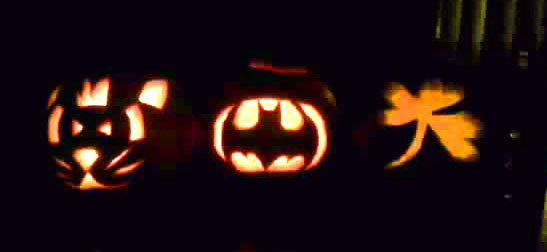
Followed by dinner was dessert. This dessert was extra special, because it was the first pumpkin pie Tomas had ever baked. See, a week previously, Megan, Tomas, and I got together to carve pumpkins and bake pies. Megan and I found it terribly strange that carving pumpkins and eating pumpkin pie are not really part of the Halloween tradition here. Very few Irish people I have met have ever carved a pumpkin, and many didn’t even know that it could be made into a dessert. Tomas was slightly embarrassed to be carrying around our five pumpkins in the supermarket, as he was getting some strange looks. We explained to him that carrying around a bunch of pumpkins in America only inspired more Halloween spirit in onlookers. Not only is it interesting to learn about the culture here, but it feels great to introduce others to some of our fun traditions. Here is a picture of the lovely jack-o-lanterns we made that night (mine, Megan’s, and Tomas’):

Later on Hallowe’en night (how many people in Europe spell the word), we headed into town to take part in all of the festivities. We caught a couple minutes of the Halloween parade before heading over to the banks of the Foyle River to get a good spot for the fireworks. They shot the fireworks high above the river, choreographed to a soundtrack. It was definitely a sight to see. Not only were the fireworks amazing, but the number of people who came out dressed in their Halloween best was astounding. I quite enjoyed watching as all the costumes walked by. After the events in town were over, we headed to a Halloween party held in the Students Union. The night truly was a blast. Here’s a picture of Megan, me, and Lauren in our costumes:

Fun Fact #9: Traffic lights here go from red, to yellow, to green as well as from green, to yellow, to red.

Fun Fact #10: Electrical plugs have on and off switches here. This can get quite annoying for us Americans, because we always seem to plug something in, but forget to hit the on switch… so my phone will just end up sitting there, not charging.


The River Runs Free (or should) and Chiang Mai

November 16, 2011

Here in Khon Kaen, Thailand, working as a member of a group and visiting villages every few weeks, the term solidarity has come up a few times. It seems that the more time that passes, the more frequently the term is used. What does solidarity mean in relation to these issues? What does it mean in the villages?

On a journey to discover what solidarity really means, one telling village was Ban Huay Top Nai Noi. Not only does this protest village share passion and drive, but they have a plan. Made up of villagers from two different surrounding villages, this village was formed to protest a dam project upstream. These villagers’ homes were not going to be flooded, but their farms and their livelihoods were. In 1995, the protest village formed in the flood zone of the proposed dam project. Paw Sampone said, “We moved to the flood zone because if they want to build the dam, build the dam. But, if you retain any water, you will be killing people.” The power of their mission is not just for themselves, however —  it is for the land and the people around them.

For communities we visited during unit 4, which are potential or previous dam sites, the river is more than a source of water. The flooding created or exacerbated by dams is not just detrimental to the crops in the farmland or the homes in the area, but completely destroys livelihoods.

For example, in communities in Rasi Salai, the end of the rainy season has led to absolutely no source of income for the people. The wetlands, their original source of food and crops, is flooded. They cannot gather crops that have been sustaining their families for hundreds of years. Because of the dam reservoir, their farmlands are also flooded to the point where they can only get around some parts by boat. Many cannot even walk to their farms to see how much damage has been done. The final portion of these villagers’ income comes from handicrafts made and sold at the local learning center. The center is up to the roof with water because the land the people were given for the project is located on the banks of the reservoir. The supplies to make most of the crafts come from their fields, as well. So without farmland just a few weeks before harvest, plus no crafts and no place to sell them, the dam has led to no financial stability or security for the people of Rasi Salai. Their homes may not be flooded, but they continue to band together because without the other community members, some families could easily go hungry.

This community serves as a mentor for that of Ban Huay Top Nai Noi. They have provided guidance, comfort, and support during the hard times. They inspire the people of Ban Huay Top Nai Noi, and encourage their fight. Even through the violence that occurred, the people of the protest village stayed in their new location. Their presence is a fight, and it is a message. “We do this for the land. Land cannot regenerate, but people are born everyday.” Their strength comes from each other. “Wherever we go, we go together. We share everything, not just knowledge.” These words of the community members is what enables the movement they are part of. They have a cause and support and the strength of their community is what true solidarity looks like. They stand, fall, live and fight together.

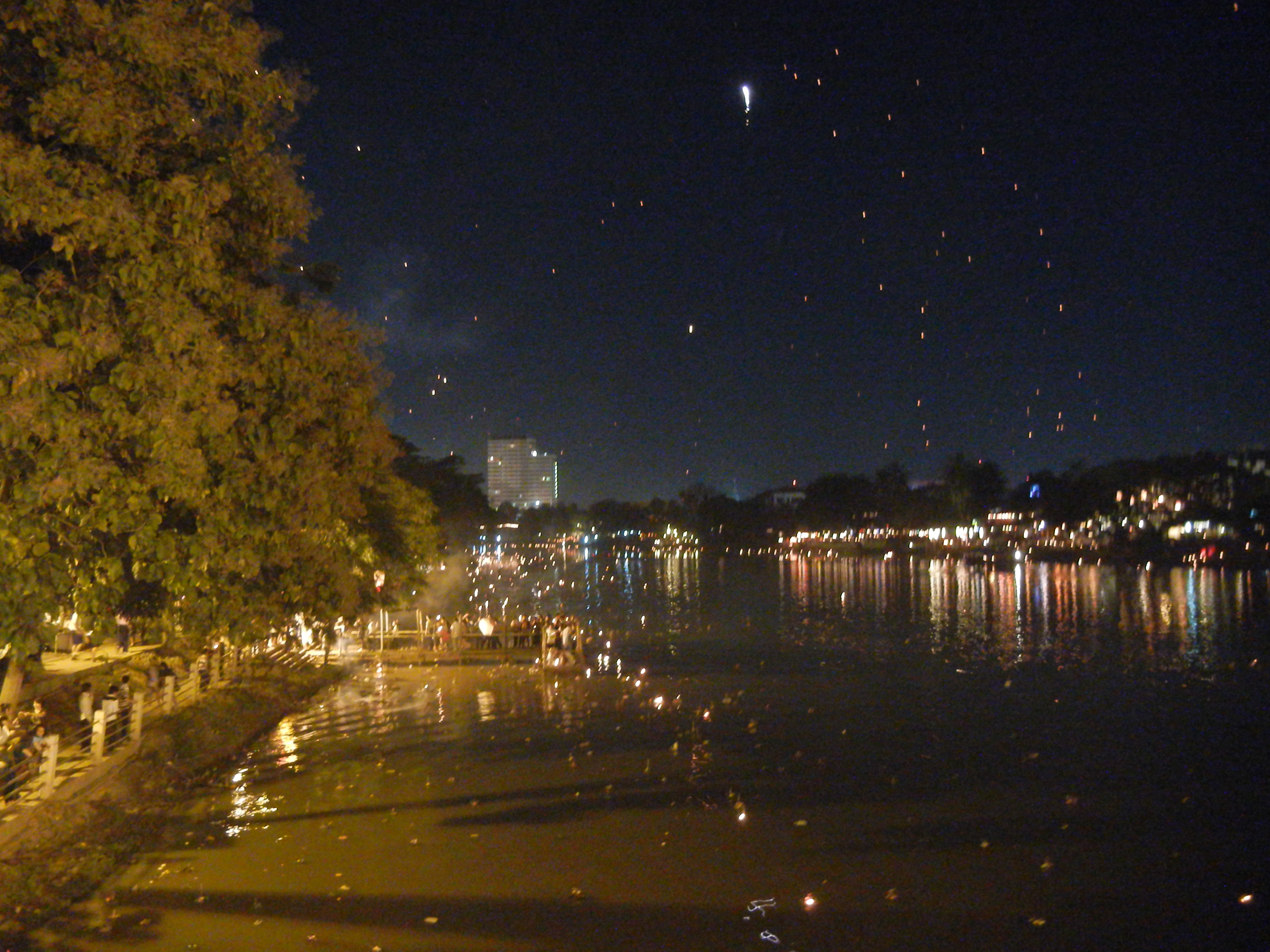
After the water unit was our four-day break, which came and went quickly, and what an amazing adventure it was! Just a quick summary — I went to Chiang Mai and saw the floating lantern festival. It was the most amazing thing, and it is a time to pay tribute to the river, so it was fitting following our water unit. I rode an elephant, played with baby tigers, and went bungee jumping (never thought I would…)  Although I indulged in foreign food like burritos and falafel, it’s good to be back in Isaan where there aren’t tourists and I get to speak Thai.

Onto the mining unit, which should be really interesting and I’ll have more time with internet to blog in a more timely fashion!


Silly Souvenirs

November 7, 2011

We all do it. Every tourist, every abroad student — we buy things as souvenirs we would never buy in our own country.

Consider a postcard… In America, you see a postcard of the Statue of Liberty or the Liberty Bell, and you think, “Ha, why would I pay a dollar for a picture I could take myself? Obviously, no one mails postcards… what is this, the stone age?” Postcards, despite being clearly made obsolete by various technological channels of communication, are still made because they are cheap and because they are the ultimate tourist trap.

I feel pretty confident in saying this because I, too, am a giddy, interested, stupid tourist whenever I see postcards abroad. I currently have a postcard from just about every city I have traveled to this semester. Postcards of Big Ben in London, the Duomo in Florence, the majestic Danube River, and the state building in Budapest, to name a few. I don’t know what it is, but when we see a postcard from a new place, it suddenly takes on a whole new meaning — from a floppy piece of cardboard in our hand to a portal that reminds us of an experience that we treasure and enjoy. It triggers the memory in the back of our brain and makes us feel like we are there, remembering the experience, just as excited as ever.

In addition to postcards, we will willingly overpay for anything that makes us feel like we are part of the home culture. Recently, I bought an Italian soccer jersey in Milan, as well as 2 Italian soccer scarves, because to me, they were inherently Italian. Uniqueness is a big thing for souvenir buyers, as we find that anything we could not readily purchase in our home country is something we must buy immediately (Haven’t any of us heard of the internet?).  Everything from watches in Switzerland, to fish and chips in London… anything we see that we identify as being unique to where we are visiting, we go crazy for. (You should have seen how much stuff I bought at the Guinness Factory in Dublin. My bank account trembles just thinking about it).

The real reason that we tourists spend money, however, is that everyone wants to feel as though they connected with the culture that they experienced. It comes in different degrees, based on the length of your journey, obviously, but in some way, a true tourist or world traveler wants to do something that identifies them with the country at least once while they are there. Whether that is eat at an authentic cultural restaurant, buy authentic cultural attire, or attend an authentic cultural event, we search for an experience we have never had before in a place we have never been. After all, we do always covet things we have never had.

The next fun souvenir topic, and probably the most important, is mastering the souvenir gift. This can be tricky, and I have already had some trouble with this myself. The truth is, we generally have a lot of souvenirs to buy,  in order to avoid the classic reaction of “Why did she get one, but I didn’t?” This also means that we can’t buy something too expensive for everyone, or we won’t be able to pay for dinner at the authentic cultural restaurant we already made reservations for a month and a half in advance. (We tend to get very prematurely excited about our trips.)

So how do you find something that is unique to the place you’re visiting, unique to the person you are giving it to, not too expensive, and is something they might actually want? … It’s almost impossible, and I feel like that last criteria gets overlooked most of the time. While hopefully the trend of t-shirts and other things saying “My (fill in generic family member title here) came all the way to (fill in place you are traveling here) and all I got was this lousy (fill in name of useless item here)” is dead and gone, there are still plenty of worthless souvenirs to go around.

While for a normal gift, our biggest concern in getting something is “Do I think they will like it?,” that seems to be the farthest concern from the mind of a souvenir gift buyer. Realistically, how many of us have gotten souvenir gifts and never looked at them again? Probably 90 percent of us. But it isn’t even the souvenir buyer’s fault– it is the system’s fault. We are obligated to buy gifts, and the stuff we have to choose from is stuff no one would ever want! It is inevitable that these gifts will be presented to less-than-thrilled family members. But it is the thought that counts, right? So remember, as you go to purchase that Swedish snow globe, or if you are receiving a“I heart Madrid” keychain — giving a bad souvenir gift is still always 100 percent better than giving no gift at all.

So as we all waste our money on these items of uselessness, let us remember that:

1. We are stimulating the economy of the country that is so graciously hosting us, and
2. To embrace this practice, as it is simply part of being a tourist. Enjoy your junk! I know I will.


Oh Yeah, That School Thing.

November 1, 2011

Going abroad is quite an experience. It is, however, grounded by that one thing that actually got you here in the first place — school. Living in a foreign country and traveling may be the most exciting aspect to studying abroad, but there is still work to be done. Up until this point in my blog, I have really neglected to talk about anything school-related, so here I go.

I am about a month and a half into my stay here, and the schoolwork is coming in at full force. While preparing to go abroad, I heard many times that the teaching style in Europe is very different, and that final grades are often determined by a single exam or paper. This is true in many cases, but my field of study dictates something much different. I am taking three design modules (what we call classes) that are largely computer based. At Richmond, they are transferring in as Studio Art credits. In these type of classes, work is constantly due. Whether it be sketches, print-outs, or final pieces, the module coordinators (or professors) keep you working. In this case, final grades are earned from turning in all revised coursework at the end of the semester. I like this method of teaching because, after a critique, I am able to apply changes to the final product that is turned in.

One fault I have with the university system here is that classes only meet once a week for about 4 hours. The idea is to give students ample time for independent work, but I would much rather learn from a professor and gain experience in the classroom. This is part of studying abroad, though — learning different ways of doing something.

Although the classes are set up differently, I am finding them extremely interesting and beneficial. I am learning computer programs that I probably wouldn’t have used back at Richmond. In my Animation course, we are learning to animate scenes using Adobe Flash. When we get further along with the course, I will post an animated video on my blog. I am also taking a Graphic Design module in which we use InDesign, Photoshop, and Illustrator quite a bit. This week we critiqued a poster design brief (what we call a project). Here is a picture of my class’s posters:

My most challenging class is 3D modeling. We are learning a program called 3D Studio Max. Designers use it for character and product design. Imagine a scene in a video game — it was probably created in this program, or a program like it. It is engaging material, but definitely a little more difficult to understand. I still have over a month until my final projects are due, so I think I will get a handle on it!

I have been spending a lot of time in the Learning Resource Center (basically a library — reminds me of exam week last year!) to get work done. My advice would be to get most of your work done during the week so you are free to explore during the weekends! I made sure to get everything done this week because Halloween is Monday, and they do Halloween big here — I’m talking thousands of people, costumes, parades, and fireworks. My next post will definitely be about this event!

Fun Fact #7: While living here in Derry, I have learned that people are not expected to tip. You don’t tip taxi drivers, you don’t tip waitresses, and you don’t tip at the bar. I have to say that I am a fan of this cultural difference!

Fun Fact #8: Shelled peanuts are called monkey nuts. People generally don’t eat peanut butter although it is sold in stores (doesn’t taste the same as good ol’ Jiff). Jell-O is called jelly. Jelly is called jam. And most people haven’t heard of a PB&J.