Garrett in Bonaire – Sopi Yuana i Ekperens Nobo (Iguana Soup and New Experiences)

September 23, 2014

After a busy first week of learning to identify 82 fish, mumbling through our first Papiamentu lesson, and completing the Open Water diver certification, we were ready for the weekend. Kicking off our first weekend we had Dia di Boneiru, Bonaire’s national Flag Day, a holiday filled with high-spirited displays of patriotism – something I would liken to Fourth of July in the States. During the day, we walked a few blocks and strolled around the local booths selling handmade jewelry, artwork, and various other knick-knacks.

My buddies and I milling around downtown Kralendijk during the festivities of Dia di Boneiru

My buddies and I milling around downtown Kralendijk during the festivities of Dia di Boneiru

When we went back a few hours later, the scene had changed dramatically as the sheer number of people milling around the plaza in downtown Kralendijk had increased 100-fold. Local musicians were jamming out on stage, everyone was on their feet dancing the night away, and the smell of booze and street food filled the air. After realizing that we couldn’t read much of anything on the menus, which were entirely in Papiamentu, my friends and I approached a vendor and attempted to decipher the menu. With some help from other locals who spoke some English, we quickly realized that “Everything on the menu is $10” was not something that could be ordered and were goaded into ordering sopi yuana and karko stoba. We were handed a small cup of iguana soup and a plate of conch stew served over rice, plantains, and pumpkin pancakes. It was positively delicious! Now I can check “Eat iguana” off my bucket list!
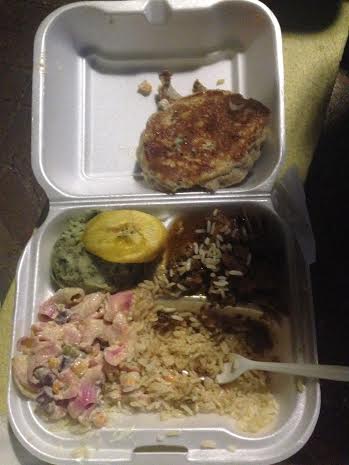
My friend Jack's dish of karko stoba, or conch stew, served with rice, pasta salad, mashed potatoes, plantains, and a pumpkin pancake. Yum!

My friend Jack’s dish of karko stoba, or conch stew, served with rice, pasta salad, mashed potatoes, plantains, and a pumpkin pancake. Yum!

The following day we set out to cross another item off my bucket list – cliff jumping! While on a tour of the island last week, one of our professors mentioned a dive site a few miles north of the residence hall where one can jump into the water off a cliff and return via a ladder. So that afternoon, six of us took out our bikes and began the 4-mile trek to Oil Slick. In what seemed like no time, we were there. We all took turns jumping off the cliff, which admittedly was only about 15 feet above sea level. Nevertheless, it was quite thrilling to jump into the crashing waves of the ocean below!
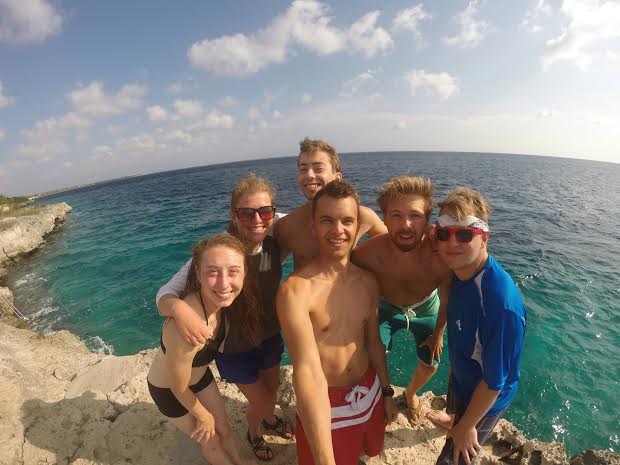
Selfie atop the cliff at Oil Slick!

Selfie atop the cliff at Oil Slick!

And the habitat! We were only a few miles up shore from our normal dock; however, the habitat differed greatly. It was a blast to get the chance to get out of the house and explore a new section of the reef!

A photogenic banded butterflyfish (Chaetodon striatus) poses with a soft coral and a brain coral!

A photogenic banded butterflyfish (Chaetodon striatus) poses with a soft coral and a brain coral!

Speaking of exploring the reef, the diving has been nonstop intense since my first four certification dives. Since then we have been working on becoming trained as Advanced and Rescue Divers. For a new diver, jumping straight into this is intimidating to say the least. Most nerve-racking of all – the night dive (only my sixth dive ever). We waded into the water just as the sun disappeared below the horizon. With our dive lights illuminated, we descended into the darkness. Everything aside from the beams emitting from our torches was covered in stale blackness. However, what our lights did unveil was an entirely different biotic reef community. Parrotfish were sleeping on the sandy bottom, eels fluttered across the corals, and two gigantic tarpin hovered nearby hunting for food. Oh, and moon jellies descended from the heavens. Imagine the Finding Nemo jellyfish scene, but at night. One “Cool! Look at that!” jelly turned into a crowded middle school dance with everyone bumping into the jellies. We were quick to find out that these jellies are nonlethal and quite harmless, aside from the minor panic attacks they cause. Needless to say, it was another successful and amazing dive!
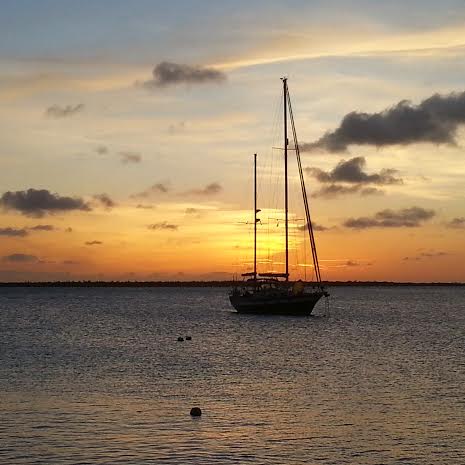
Beautiful sunset before the night dive!

Beautiful sunset before the night dive!

As for the above water portion of Bonaire, we haven’t really gotten much time to do a lot of exploring. With our only transportation being bikes and the weather being as hot as it is here, it can be tough getting to places outside of the capital city of Kralendijk. However, we have weekly field trips to various parts of the island with our Cultural and Environmental History of Bonaire class. This week we took a tour of the Cargill Salt Works production plant. Salt production on the island goes back hundreds of years. Initially dubbed “the useless islands” by the Spanish for their lack of gold, Bonaire and the rest of the ABC islands were soon taken over by the Dutch and transformed into a hub for slave trade. At this time, Bonaire was discovered to have natural salt, which was necessary for keeping and curing meats. Without going into too much detail, the process is actually quite intriguing. The process here uses the energy from the sun and wind to drive salt production. Water is taken in from the sea and collected in pools. As it sits there, the water evaporates, thereby increasing the salinity. Eventually, (over-simplifying the whole process) salt is left. The process itself is actually quite beautiful!

The piles of sea salt at Cargill Salt Works

The piles of sea salt at Cargill Salt Works

Two saliñas on the Cargill property. The rosy-pink color indicates a higher salinity, which means the salt is almost ready to be harvested.

Two saliñas on the Cargill property. The rosy-pink color indicates a higher salinity, which means the salt is almost ready to be harvested.

Eating iguana, jumping off cliffs, swimming with jellyfish, and visiting a salt production plant. Here’s to having new experiences! And having many more!


Diana in Germany Week Three: Rumor Has It

September 22, 2014

Hi everyone! I feel my focus so far has mainly been on surface details – the nuts and bolts of my experience and of Freiburg, Germany. This week I want to delve a little deeper and analyze some observations I have made. **Disclaimer** The following are my interpretation of experiences and discussions with Germans and Americans that I know. This does not reflect every possible opinion, experience, or perspective.


Analysis of Observations
Almost instantaneously upon arrival, I noticed that Germans tend to be more reserved in public spaces as compared to Americans. In grocery store lines at home I’m used to striking up conversation with others – maybe about the weather, or how I like their outfit, anything to pass the time more pleasantly. So far people in stores and on trams in Germany do not joke or chit-chat with strangers. This difference is most notable between when I ride the tram with and without my IES group. Without the group, the trains are mostly silent. When a whole group of IES students get on the tram speaking in English, all eyes are on us because of how loud we are. I think both systems have their perks and that a respectful volume on public transportation has been enjoyable.

I understand such formality in Germany to be much more fundamental to the culture, especially as compared to the US. In German class our first day, we learned the difference between addressing someone formally and informally. In the US we also tend to address older strangers as Mr. and Mrs. (Herr and Frau auf Deutsch), while referring to younger strangers and familiar people by their first name. However, grammar and language changes due to formality in German. Verb conjugations in German rely on whether you want to be formal or informal, which to my knowledge does not exist in English.

The issue of formality may also seep into how quickly people become friends between the two countries. Before I came to Germany I read that personal relationships take more time to build here than in the US. One of the IES staff members put it differently: Americans tend to make “friendships” faster, but these are often superficial. Maybe what Americans recognize as friendship is acquaintanceship through another lens? Is this why we differentiate between our “best friends” and people who are only our “friends”? Either way, the people I spend time with here are very friendly and helpful and I strive to be friendly and helpful back — even if we aren’t technically friends. And that’s the way it should be!

P.S. People do not walk around in lederhosen and dirndls (traditional dresses) here. Unless you go to Munich right now or you are in a supremely traditional rural area. Sorry if this disappoints anyone.

Social Updates
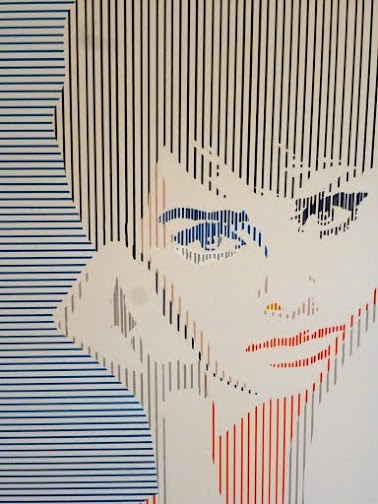
There is so much to do during study abroad that it starts getting to be too much to remember to blog about it! Last week I left out an amazing exploration of Freiburg’s art galleries with Tobi, my flatmate and Simon, a houseguest from Toulousse. We visited an art gallery in addition to several smaller private collections with art for sale. The gallery is called Stadische Museen Freiburg im Briesgau, and it was full of contemporary/modern art. I found my new favorite piece of art (as shown below). Unfortunately I did not write down the name or artist, but that only means I will have to go back! We visited two smaller galleries as well, and I have never been to such a small gallery with prices listed next to the artwork. There were a multitude of mediums and techniques utilized in the artwork. Some of my favorites included paintings on aluminum using lacquer, 3-D boxed city collages, and amazing line portraits.

​My new favorite painting. Though the subject is quite gruesome (a huge massacre of animals?), the mark-making is powerful and expressive in a way that I admire

​My new favorite painting. Though the subject is quite gruesome (a huge massacre of animals?), the mark-making is powerful and expressive in a way that I admire

​A painting of Martinstor using lacquer on aluminum. This medium blows my mind and I need to try it sometime!

​A painting of Martinstor using lacquer on aluminum. This medium blows my mind and I need to try it sometime!

​The simplicity of a few lines can still capture the complexity of a portrait. Amazing.

​The simplicity of a few lines can still capture the complexity of a portrait. Amazing.

I also forgot to mention the Apple Pie Contest. Simon created several wonderful dishes and desserts while here. Somehow we ended up challenging each other to a duel where apparently I would have the home field advantage… because all Americans know how to make apple pie, right? Instead of going fully traditional, which would have taken way more baking experience and time, I decided to create an apple crumble Gordon Ramsey style. In addition to apples and caramel and cinnamon crumbles, this dessert has cranberries and lemon zest for extra pizzaz. The Gordon Ramsey apple crumble Youtube video and Simon’s help on making caramel sauce all contributed to me winning in taste. Simon won for presentation with a huge piece of caramel and obviously won for technique. Still – I won in a category against someone who has been cooking and baking his whole life!

​The apple crumble seriously crumbled on the plate - but it was still delicious!

​The apple crumble seriously crumbled on the plate – but it was still delicious!

​Me with my creation. Simon, my competitor, is still cooking in the background.

​Me with my creation. Simon, my competitor, is still cooking in the background.

This week, I also participated in a few social events. My friend Sarah and I went swimming at an indoor public pool. To our dismay there was no hot tub and everyone was swimming laps. I guess the pool is as serious as the gym here in terms of a workout! The planned trip to Titisee on Saturday fell through because I had a cold and ended up sleeping in bed all day. My friend Anne finally got me out of bed with the promise of all you can eat sushi. We ended up each eating 15 pieces of sushi (3 rolls more or less), 2 miso soups, a side dish, and 3 scoops of ice cream. I am definitely going back on a weekday at lunch when the same deal is available for a full 10 euro less. The green tea ice cream was the highlight of my entire day.

Sunday I knew I needed to get out of the house, sick or not. With that goal in mind, I went on the 10km hike through Ravennaschlucht in the Black Forest as planned. Originally there was a group of 8 students, some from Ukraine and Japan in addition to Anne, another IES girl named Katherine, and I from the US. There were gorgeous waterfalls all along the trail and here or there I saw water wheels. The train stop was only one away from Titisee, so we originally planned on hiking then eating lunch in Titisee. Unfortunately, it started raining! This was not the best for my health, but it still was worth it. Katherine, Anne, and I celebrated successfully making it back to Freiburg with a nice, warm falafel pita.

​Goats greet us as we make our way to the start of the Ravennaschlucht trail.

​Goats greet us as we make our way to the start of the Ravennaschlucht trail.

​Me with our guide Mimi on a bridge in the Black Forest.

​Me with our guide Mimi on a bridge in the Black Forest.

One of the many beautiful waterfalls along the Ravennaschlucht trail.

One of the many beautiful waterfalls along the Ravennaschlucht trail.


Next week
-Goals in Freiburg and beyond!
-Common topics of conversation during my trip so far
-The end of German class
-Brussels trip


Oliver in Spain: This place is starting to feel like home

September 22, 2014

I’m finishing up my third full week in Valencia, and this place is starting to feel like home. I have become very comfortable with my family, and Mark and I frequently play FIFA and other games together. He’s definitely starting to look up to me, and is practicing his English with me too! Coming back to the house after a long day out feels very relaxing too.

I feel lucky to have an awesome friend group of about 15 people on my program with me. Friendships strengthen very quickly when everyone is put into a new culture with a new language. It’s nice to know that everyone is going through the same transition and that we have come to rely on each other a lot.

Valencia vs. Espanyol

Valencia vs. Espanyol

Last weekend I had the opportunity to go to a Valencia football (soccer) game. I went with a few other friends and the atmosphere was like nothing in the United States. These people live and die by their football team. The stadium, La Mestalla, crams almost 60,000 screaming and jumping fans together for 90 minutes of pure enthusiasm. I have to be honest, I’m getting very attached to this team and will be picking up a jersey very soon. ¡Amunt Valencia!

Celebrating a goal! Final score: 3-1 Valencia

Celebrating a goal! Final score: 3-1 Valencia

This was also my first weekend of travel outside of Valencia. Along with 8 of my friends, I went to the island of Ibiza off the East coast of Spain to celebrate my 21st birthday! Needless to say, we had a blast. We rented an apartment through Air B&B which we used as a base and as a place for family meals.

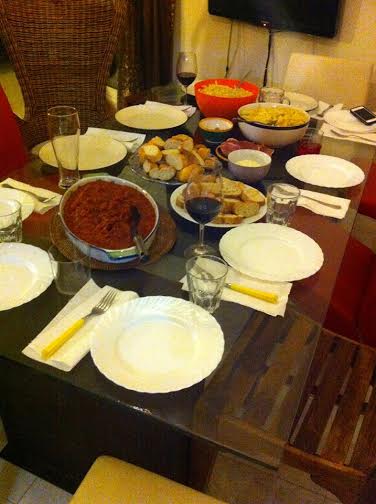
Spaghetti with a Chorizo and tomato sauce

Spaghetti with a Chorizo and tomato sauce

Ibiza has a great nightlife, but it also has amazing beaches and cliffs. It was not at all what I was expecting going into it but we all had a great, and tiring, time.

Incredibly clear, blue water

Incredibly clear, blue water

Next weekend I’ll be crossing off another box on my bucket list by going to Oktoberfest from Thursday through Saturday. I’ll have another update next Sunday to let you all know how that goes!


Diana in Copenhagen: Eating in Denmark

September 18, 2014

Greetings Travelogue-ers! Sorry it’s been so long since my last update. Classes are finally fully underway and it feels like I’m finally starting to get the hang of everything. I’ve also spent a lot of time planning trips around Europe, which has been really exciting (and expensive…) for me so far!

I was thinking of what to write about this time, and settled on the thing that has surprised me most about Copenhagen so far. Coincidentally, the topic is also one of my favorite things on the planet…food.

I have come to learn that Denmark is not a place you should visit for the food. It doesn’t boast world-renowned pasta like the Italy or delicious tapas like Spain. While Denmark is home to Noma, the restaurant frequently voted the best in the world, I have found that the average visitor or resident here is deprived of food that you would describe as traditionally Danish. I am sure this is due in part to how expensive the city is, as only very wealthy families go out to eat and those restaurants might be where most Scandinavian cuisine is hiding. Alas, this has meant that I have been cooking for myself quite frequently and getting takeout sometimes as well.

After already completing two years at Richmond, I have to say I was surprised I yet to feel the quintessential pressure to survive on Easy Mac and Ramen Noodles that so many associate with their college years. Perhaps it’s because I’ve always lived a convenient distance from D-Hall that I’ve always found myself eating fairly diverse and well-balanced meals in my time as a university student. Or maybe it’s because of my fondness for Lou’s salads, it’s hard to say. One thing that is clear though is that that trend has not followed me across the pond to Denmark nor have I had much chance to try much Danish food.

Instead of the streets of Copenhagen being lined with Danish food trucks or eateries serving up traditional dishes, they’re saturated with pizza places. They also have tons of shops selling to-go food like Thai, shawarma (an Armenian equivalent of a gyro), and burgers. I’ve also found myself cooking a lot in my time here, which so far has left little to the imagination. My small kitchenette hasn’t seen much variety thus far as I’ve found myself eating an astounding amount of pasta and grilled cheese. Pizza, pasta, grilled cheese, burgers…

I came to Denmark and am finally eating like a college student.

A photo of my kitchenette and one of my grilled cheese masterpieces

A photo of my kitchenette and one of my grilled cheese masterpieces

This being said, I have tried to actively seek out Danish meals to help broaden my understanding of the culture here. My first experience was when my CBS buddy invited me to his apartment to cook some authentic Danish food. We started out by walking downstairs from his apartment to the grocery store, and I mean “downstairs” very literally. The closest supermarket was just steps from the door of his apartment. That’s another thing about Copenhagen—there are grocery stores everywhere. While each is much smaller than the ones we have in the States, they are much more abundant here in Denmark. I can’t say which I prefer yet to be honest, but it is remarkably convenient to have four stores within seven minutes walking from my dorm.

We picked up some potatoes, flour, beets, and butter at the grocery store and then set on making stegt flæsk med persillesovs, which directly translates as “roast pork with parsley sauce.”

Even though my buddy Kristoffer and his apartment-mates wouldn’t let me help, I sat back and took mental notes on how they were preparing the food should I ever want to be adventurous and give it a go myself. They started by boiling the potatoes, which I am fully confident in my ability to do, and making the parsley sauce (basically a gravy). The sauce itself probably made me gain ten pounds as it was comprised exclusively of some parsley and lots of butter, flour, and milk. Parts of each were added in increments while constantly stirring the mixture at a light boil. The parsley was added at the end, which not only added flavor but also made the sauce speckled green in a pretty way.

The meat out of the oven and ready to be flipped

The meat out of the oven and ready to be flipped

Then came the meat to prepare, and I learned I was foolish to think the gravy was to be the thing to make my pants tighter. The meat was described to me as more thickly cut bacon (imagine my excitement), and they cooked it in the oven on moderate heat and flipped it to brown both sides. They made sure to cook some pieces more thoroughly than others since people have different preferences on how well-done they like the slices. I think I preferred the crispier pieces but I’m not opposed to giving the others a second audition.

We sat down to eat, drowned the meat and potatoes in gravy and served it with a side of beets, a food that I’ve always surprised myself by loving. It was a great meal and I thank those guys not only for welcoming me into their apartment but also for sharing some of their culture with me. Frederik, one of Kristoffer’s apartment-mates, also gave me some insight on my aforementioned observation of the lack of traditional Danish food.

The final product! One of the most traditional Danish dishes called stegt flæsk med persillesovs.

The final product! One of the most traditional Danish dishes called stegt flæsk med persillesovs.

It was clear the meal before us was hearty and, while delicious, full of fat. He explained that dishes like these were what Danes typically ate back when Denmark was an agricultural country and the farmers needed a hefty supply of fuel to work in the fields all day. Since the country has evolved away from this physically strenuous agriculture, the people could no longer consume the same food and lead a healthy lifestyle. I found this description fascinating because of how a simple shift in the occupational norm could affect food, something integral to a nation’s culture, with such magnitude. Hopefully I will be successful in tracking down some more Danish dishes, but until then I might venture to cook some more elaborate things myself.

I make no promises.


Jack in Czech Republic: Netherlands vs. Czech Republic

September 18, 2014

As I mentioned in my last post, I am a passionate sports fan. I knew I would see at least one soccer game football match while in Europe, but I did not expect to see the greatest sporting event I have witnessed in person on my second night.

A quick description of who was playing and why: qualifying for Euro 2016, which is like a World Cup for European countries, began last week. Teams were placed into six-team groups and will play a home-and-home round-robin schedule that determines who makes it into the tournament. The Netherlands, who lost in the World Cup Final, played at the Czech Republic in both countries’ first match of qualifying. Both countries played close to their best teams, since a good start in qualifying is crucial.

Following an orientation session, four other adventurous soccer football (I’ll get it eventually) fans and I navigated our way to Stadion Letná, despite not having tickets or knowing what to expect. Worst case, we thought, we would see the stadium and find a nearby pub to watch the game.

We ended up getting off the tram a stop early, because we saw some festival-looking event that seemed worth checking out. We made a great decision. This event turned out to be a large public tailgate for the match. Let me tell you, the Czechs know how to tailgate. There was a huge screen playing highlights of former Czech matches, lots of games, and, of course, excellent pivo (beer).

These tents surrounded the games and the viewing area

These tents surrounded the games and the viewing area

As kickoff neared, we walked a couple blocks to the stadium, so we could get a greater idea of what the atmosphere would be like. Let’s just say the rundown Stadion Letná would not pass any NFL team’s requirements to serve as a home. But it’s the fans that make a stadium great, and the passion both the Czechs and Dutch had around the stadium was unparalleled to anything I have seen. The closest comparison I can think of is SEC football fans, and that’s still a stretch.

We made some Dutch friends outside the stadium

We made some Dutch friends outside the stadium

One other thing that struck us was the amount of people selling tickets. We never intended on attending this match, but after we did some asking around to gauge prices, collectively, we said let’s do it. And so we did.

Buying tickets can be hard when both sides speak the same language, so buying them with some people who spoke little English was a struggle. But it all worked out. After each of us found a ticket, we regrouped and expressed our shock in what was transpiring. Our tickets were not together so we made a meeting plan and went through the gates minutes before kickoff.

All the hype of the atmosphere that surrounds a European football match is actually not hype at all. It is an accurate description of all the madness –Constant cheering, never-ending singing, clapping for good plays, yelling at the referees– that goes on for 90 minutes. And when the home team scores, all hell breaks lose – especially when the goal is this good (Only watch the first minute).

This singing seen in this video went on constantly. Because I didn’t know what they were saying, I contributed by clapping.


The Czechs clung to a 1-0 lead at the half, but a Dutch goal felt imminent. Four of us regrouped at half, still full of shock, and managed to find some seats near each other for the second half. Sam, who bought the cheapest ticket, couldn’t watch with us because his seat was actually so good that he couldn’t leave his section. Go figure.

Sam’s seat wasn’t terrible.

Sam’s seat wasn’t terrible.

Not surprisingly, the Dutch equalized early into the second half, and looked to be on its way to a come-from-behind win. But the Czechs defense fought off attack after attack, and even created a few chances. If the Czechs continued to hold tight, it looked like they could cling onto the tie, which would have been considered a success.

And then this happened. If you’re too lazy to click on the link, here’s what transpired: In stoppage time, a Czech player fired in a cross, which a Dutch defender tried to head to safety. Instead, he headed it right off the post, and it redirected to the wide-open Pilar who easily tucked the ball in the back of the net. GOOOOOOOOL! The stadium absolutely erupted. Screaming, cheering, high-fiving, hugging, kissing – it all happened. And it happened all the way through the final whistle, which came just moments after Pilar’s game-winning goal. And it carried outside the stadium as well. I truly have never seen anything like it, and I am sure I never will again. And this was my second night.

A video that shows the moments after the winning goal.

Thanks for reading!

Selfie of the week: Because I am an egotistical millennial, here is the selfie of the week:

Two of my three female roommates and I in our new kitchen. That’s right, I am the only male in my flat. More on that to come.

Two of my three female roommates and I in our new kitchen. That’s right, I am the only male in my flat. More on that to come.


Diana in Germany Week One: Travel Nightmares, but Living the Dream

September 11, 2014

Arrival
So you know how people ask if you want the good or bad news first? We’re starting with the only thing that could be described as “bad” because it came first. Traveling was extremely stressful and full of sleep deprivation. I went a full 25 hours without sleeping and I have never done anything close to that in my life.

The goodbyes were somewhat easy (I didn’t cry! I totally thought I would). Thankfully I traveled with Heather, a girl from my living-learning community “Earth Lodge” from sophomore year. Heather and I both ordered white wine with our dinners on the plane, which marked the first legal drink of our trip. After this, things went downhill for me. I thought I would get 5 hours of sleep or so on the 8 hour flight, however several people kept their lights on or were watching movies the entire time. Regret filled me as I realized I had left my eye mask at home and there was no way I’d be sleeping before I made it all the way to Freiburg.

The train from Frankfurt to Freiburg was the worst part of the journey. Heather and I got in on the completely wrong end of the train and were 9 cars down from where we should have been. A bunch of Germans laughed at us for even trying. Heather helped keep things in perspective for me and we eventually made it to the right seats. Soon we got off, caught a taxi, and visited the IES Freiburg Center to get instructions. 24 hours after I woke up for my flight to Germany, I was finally in my dorm room. I quickly set it up and took a nice long nap before IES took us out for dinner.


Housing
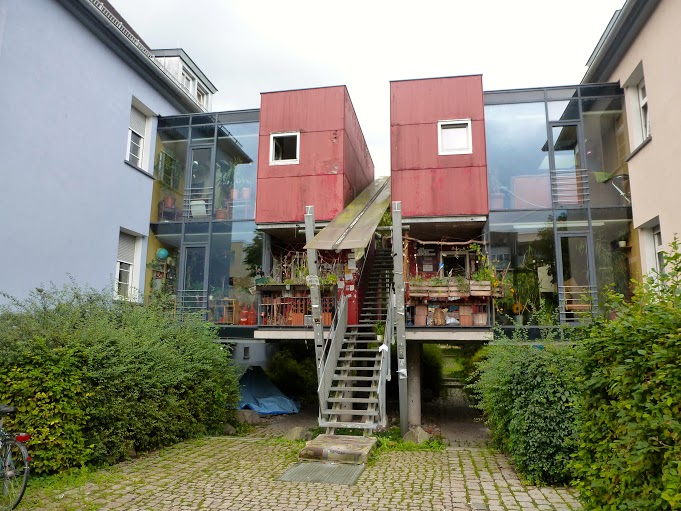
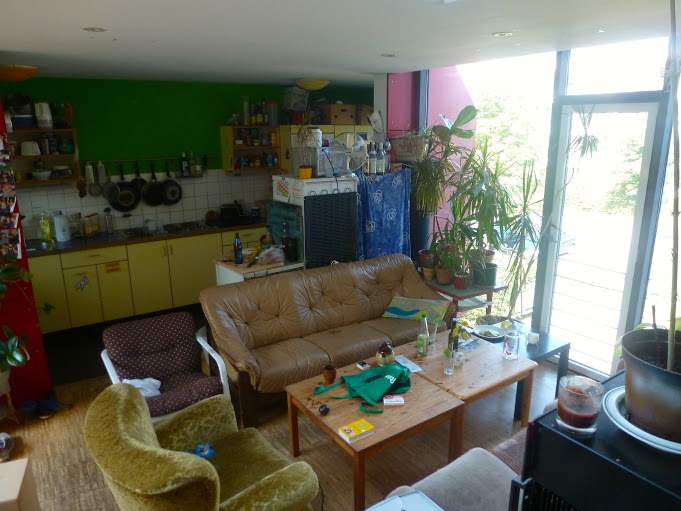
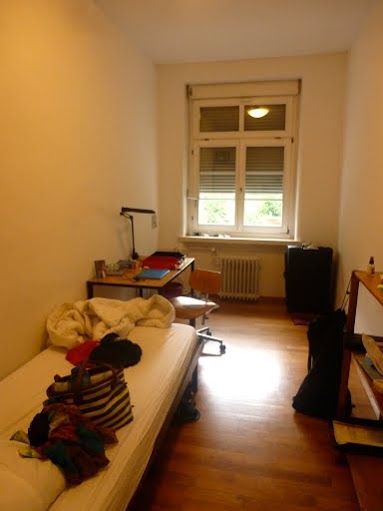
My dorm is, in my opinion, the best possible dorm in terms of its “cool factor” and its “awesome flatmate factor.” Plants everywhere, huge shared kitchen, large lounge couches, party space with awesome speakers, very hippie vibe. My dorm room is plain, but who cares when the shared space is so spectacular?! Here are some pictures to really help you visualize this:

The outside of my hippie dorm

The outside of my hippie dorm

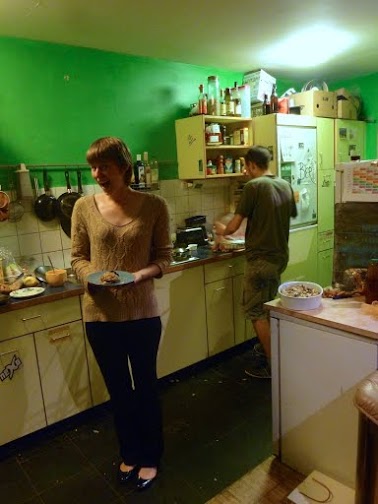
Kitchen and living room

Our kitchen and living room

My plain dorm room

My plain dorm room

In terms of my flatmates, they immediately started inviting me out to things. Most of them are German, but they all speak English. They are Conny, Tobi, Sarah, Felix, Theresa, and Lovisa (who actually just left for a month for Algeria and lent me her bike in the meantime!!!). We also have a French guy named Simon who is here for 2 weeks. There is a lot of turnover in the household, especially in October when the “real” semester starts at Uni Freiburg. Apparently, other people in the IES program are not in contact with their flatmates much at all. I do not know a single other one who has a social life with their flatmates, so I consider myself EXTREMELY lucky to have them in my life as friends.

We’ve hiked up mountains, picked fruit, biked, swam in the Flückigersee lake, played games, shared dinner/wine, gone clubbing, and had a trilingual jam session together. In addition one of our neighbors, Judith comes over here a lot. She was the first person to do “cheers” with me, but here in Germany you say “Prost!” She also was the first to “invite” me to join her for ice cream, which here means she invited to pay for me! Thank you, Judith!

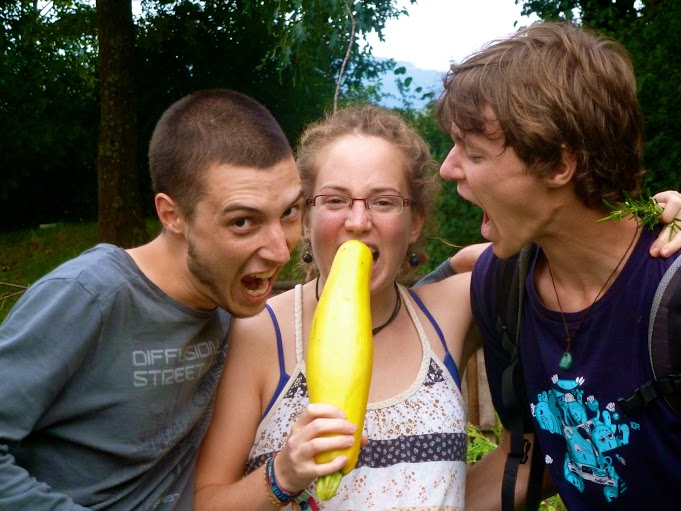
Flatmates Simon, Youdid, and Felix with zucchini

Flatmates Simon, Judith, and Felix with zucchini


Swimming at Lake Flückingersee

Swimming at Lake Flückingersee

Orientation
IES had small orientation sessions on Monday and Tuesday to give us basic information about the surrounding area, such as where the best places to eat are, where to seek medical attention, where to buy things, and how to stay safe while doing it. Freiburg is relatively safe, but according to one of the IES employees, there has been a rise in thefts recently. We also were asked to attend a presentation on Thursday in order to learn more about getting involved in clubs or volunteering. There is also a Tandem Partner program that allows a German speaker and English speaker to informally practice conversing in the opposite language. I’m considering horseback riding, a cappella, dance, badminton, and am 100% sure that I will be volunteering at some point.

IES so far has mainly functioned as a “home base” in case we need them. I believe that some of my environmental classes later in the semester will be there though. Speaking of which….


Academics
German class started on Wednesday. My teacher is Andrea Snuggs (yes, her last name is awesome). She is very sweet, always open to questions, and creates an extremely interactive environment in the classroom. It is crazy, but I can already ask a lot of basic questions or ask how to say things in German without using any English in the process! German class and listening to my flatmates is obviously working. Monday marks our fourth day of class and we are already having a quiz on verb conjugations!

Basic German verbs and their conjugations

Basic German verbs and their conjugations


Next week
I will cover more about academics, such as the city of Freiburg and its surrounding, food and drink, stereotypes, and updates about travel and fun I am having. Tschüss!


Diana in Copenhagen: Beer Culture

September 2, 2014

To many American students studying abroad there is one cultural difference that is most apparent: the drinking age. Acknowledging that this could be an inappropriate topic or one that someone reading a cultural blog has little interest in hearing about, I’ll tread lightly and keep this as post as sociological as possible. We all know the drinking age in the United States is 21 and over, and that that makes us somewhat of a global minority, since most other countries have drinking ages that are 18 or even younger. This has been interesting to observe from my new perspective at a university where the entire student body is of legal drinking age and how that affects the way students view the use of alcohol.

The Danes love their beer, and I have a few reasons for how I came to this conclusion. I mentioned in an earlier post that I’m attending Copenhagen Business School this semester and they have corporate partners just like any other university. In company with Danske Bank and Deloitte, one of CBS’ seven major partners is none other than the Carlsberg Group, the makers of the most popular beer in Denmark. I’ll get back to them later.

Last week, exchange students were invited to purchase a social program consisting of activities to help us bond and get to know each other. At the meet and mingle night (glorified speed dating) they set up a bar in the classroom building. The social booklet also informed us that we could bring out own beverages to Danish folk dancing night. We had a student organization, the equivalent of Student Activities at Richmond, give a presentation at orientation about the social culture here. As you might have guessed by the progression of this post, the girls’ presentation was oddly centered around where you can drink at CBS, what it means to them culturally, and how at the welcome party we will find their very own university president handing out Carlsberg’s. The welcome party is a whole other story in that they clear out the CBS academic building Solbjerg Plads on Thursdays and transform the place into the largest bar in the city of Copenhagen. Mind you, this is a building many students will return to hours later to partake in their Friday classes.

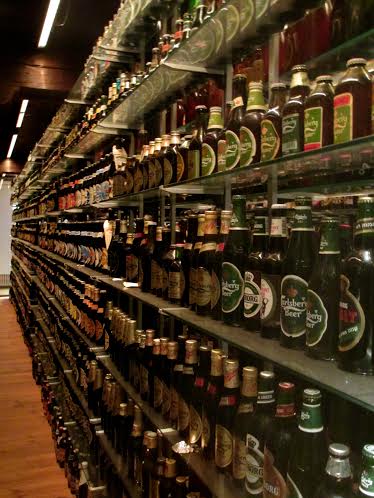
The largest collection of unopened beer bottles in the world

The largest collection of unopened beer bottles in the world

I worry that by writing this post I will seem like another uncultured 20 year-old American student fixated on alcohol consumption, but I truly have found this topic intriguing. It’s a common thought in the US that our issues surrounding drinking (i.e. binge drinking, drinking and driving) come as a direct result of our higher legal age. We laude places in Europe for being way “classier” in their drinking because to young people, it is simply part of their national culture. Since young people drink with their families and have casual drinks with dinner they become immune to the perils we have in the States. Does this sound familiar? I certainly said it, and it’s true to an extent. While I wouldn’t fantasize it as much as I had from afar, it’s true that alcohol here, namely beer, is extremely engrained in Danish culture.

The aforementioned examples should illustrate how important beer is to Danes, but another place I saw this was on a trip I took to the Carlsberg Factory. We took a guided tour around the factory that was used for Carlsberg production up until 2008 and heard the surprisingly dramatic tale of the Jacobsen family that started the empire. They experienced their share of family issues (I would recommend reading the story if you have time), but the men did remarkably well for themselves and created a site full of beautiful, expensive, artistic, and elaborate buildings that exemplify how they perceived their importance as brewers.

One of the gates within the Carlsberg Factory depicting members of the Jacobsen family

One of the gates within the Carlsberg Factory depicting members of the Jacobsen family

Carlsberg is now the fourth largest brewery in the world, outdone only by Heineken, SABMiller, and Anheuser-Busch. Brewing has recently moved from this location and their plans for what to do with the factory demonstrates how beer is such a cultural staple. They are going to make a Carlsberg city.

This factory was used for brewing Carlsberg beer up until 2008

This factory was used for brewing Carlsberg beer up until 2008

Our tour guide promised that if we were to return to the Carlsberg factory in 16 years we would find it filled with apartments, houses, universities, preschools, grocery stores, and anything else you would imagine being in a small city. This news rendered me speechless, but it shows the cultural influence this corporate behemoth has in Denmark. Time will tell if this endeavor will be successful, but the belief in the cause is enough to show that beer here has an importance that far surpasses that which we have in America. Denmark is literally building a city on the foundation of its favorite starchy drink, and that’s certainly a cultural difference from America in my eyes.


Diana in Copenhagen: My First Week

August 29, 2014

Hello from Copenhagen!


After I had less than 48 hours to get ready and pack, I somehow made my way to Logan airport in time for my big European sendoff. I waddled around the airport equipped with a backpack “carry on” that was about the size I am, a tote bag “purse” heavier than most children I’ve seen, and a suitcase that tested the airline luggage worker’s strictness on weight limits. I was ready to begin my journey.

Me at the gate at Logan

Me at the gate at Logan Airport

To be fair, the said journey had a rocky start when I found that I was the lucky one placed at a middle seat with a broken screen on the seven-hour flight to Germany and, of course, the air conditioning on the flight was broken. Alas, things started to look up once a flight attendant restarted my screen and the AC finally started working.


The flight from Germany was short though, and before I knew it I was touching down in my new home. The Copenhagen weather welcomed me with rain, which I’ve learned is not surprising. Rare is a day here where there’s not a single shower—something I have yet gotten used to. On a brighter note, I walked into the lobby area of the airport to a smiling Dane waiting there to greet me.


This semester I’ll be attending Copenhagen Business School (CBS) and they have a program that matches its exchange students with a Danish student to show us the ropes. I greeted my buddy Kristoffer with a hug and spent the entire metro ride to my dorm asking him all of my questions about Denmark. Topics of conversation ranged from what Danish food is (apparently lots of heavy foods), Danish clothing (all black everything), and Danish people (extremely happy but not often outwardly friendly).


Time went quickly and soon we were walking into my dorm Kathrine Kollegiet in a municipality called Frederiksberg. The dorm room is for exchange students only and my hall has students ranging from Connecticut to China, so I’m even expecting dorm living to be a multicultural experience. My single here is huge too! I’ve got a kitchenette, two big windows that open to a playground area, and my own bathroom. The kitchenette with two burners, a small sink, and a microwave is…quaint. It’s served me well to make pasta, grilled cheese, and eggs so far but we’ll see how far I can survive on those meals. I’m hoping to write a food entry later once I get more creative!

My single in Kathrine Kollegiet

My single in Kathrine Kollegiet

The bathroom really surprised me though, because in Denmark they don’t differentiate the shower from the rest of the bathroom. The “shower” is really just a curtained off corner of the room. Just a curtain—yep. Getting used to this has been interesting, but I guess the system has its perks? I never need to worry about tripping on the little lip on the ground when getting in and out of the shower and I can put my foot on the toilet to shave my legs with ease. The whole room gets soaked though; I can only defend the system so much. Outside of this odd cultural design difference, I’ve truly enjoyed playing house so far and I know it will grow my independence tenfold.

The shower area

The shower area

I arrived in Denmark a week earlier than most to take something called a “Danish Crash Course” consisting of classes to help familiarize us with the Danish language. While I’m still quite the novice (this is a nice way of telling you I can say hello, thank you, and goodbye), this course was an easy way to get to know people. Now comes the real orientation week where we have the opportunity to meet even more students and hear about life at CBS. I’ve loved my time in Denmark so far and can’t wait to have more adventures.


Thanks for reading!


Garrett in Bonaire – Bon dia!

August 29, 2014

Bon dia!

(That is “Good day!” in Papiamentu, the official language of Bonaire.)

My name is Garrett, and I am a rising junior at the University of Richmond as a Mathematics and Biology double major, with an as-yet-undeclared minor in Integrated Science. However, this upcoming semester I will be studying abroad in Bonaire as a part of the CIEE program in Tropical Marine Ecology and Conservation.
First thing’s first. I know most of you are asking “Bon-where?” Well, it is in fact a small Caribbean island off the coast of Venezuela. It is a special municipality of the Kingdom of the Netherlands and was formerly part of the Lesser Antilles. It is located in the southern Caribbean as a part of the ABC islands, along with its neighbors Aruba and Curaçao.

Fifty miles off the coast of Venezuela, Bonaire is situated in the southern Caribbean along with the rest of the ABC islands From Google: http://www.harbourvillage.com/art11/bonaire/image001.jpg

Fifty miles off the coast of Venezuela, Bonaire is situated in the southern Caribbean along with the rest of the ABC islands
From Google: http://www.harbourvillage.com/art11/bonaire/image001.jpg

The island itself is approximately 114 square miles and is home to about 17,500 people. To give a size reference, it is less than half of the size of New York City (that’s including all five Boroughs) and has a population size that falls somewhere between the undergraduate student populations of UVA and Virginia Tech.

A map of Bonaire shows that it is only about 24 miles long and 3-5 miles wide. From Google: http://www.lovebonaire.com/images/BonaireMap-MED.gif

A map of Bonaire shows that it is only about 24 miles long and 3-5 miles wide.
From Google: http://www.lovebonaire.com/images/BonaireMap-MED.gif

Additionally, you may be wondering about CIEE. Well, my specific program is not run through a foreign university like many people would think of a stereotypical study abroad experience. Instead, my study abroad experience is run through the Council on International Educational Exchange or CIEE. Through their program, I will be staying at a research station, with 12 other students, in Kralendijk, Bonaire, where we will be taking classes in marine biology and conducting our own marine research. And that is precisely why I chose this program. Not only can I take upper level biology classes that transfer credit back to UR, but I will also be getting a once in a lifetime experience living on a Caribbean island steps away from the ocean, where I will be scuba diving for my classes and gaining firsthand experience in a potential career field. In a week’s time, I will be out in the water with the coral reef as my classroom.

I can’t believe it. I leave in 4 days!

It may be because just four days ago I was moving my sister into her dorm room for her first semester at Arcadia, but right now, I’m experiencing the same emotional rollercoaster that came just before I moved off to college two years ago. Nervous because I don’t exactly know what is to come. Detached because I know all of my friends at UR are having a great first week of school. Excited because I know it’s going to be an amazing experience. Worried because I still have yet to pack. Stressed because, apparently, memorizing 100 fish ID’s in a week is something I also need to fit into my schedule. Eager because everyone tells me Bonaire has some of the most beautiful diving in the world. Whatever my emotions are now, I tell myself that I have to stay open-minded and be ready for new experiences.

Change is on the horizon, but it’s going to be the best sunrise I’ve seen in awhile!

Stay tuned for my adventures!


Kimberlee in Mongolia: ISP Period

June 11, 2014

We are now at the point of our program where all of us students pick our own topic of interest and research it for a month. Our Independent Study Project (ISP) allows us to go anywhere to study anything for four weeks, and gives us a great deal of independence and control over what we want to learn about Mongolia. At the end of the four weeks, we have a 25-50 page paper and oral presentation due. The other students are researching a variety of topics, including: accessibility for people with disabilities, how climate change affects herders, street cleaning, emergency medicine in the countryside, and the use of the traditional Mongolian characters in modern society.

I first decided to study distance education in Mongolia, but soon decided that the topic was a bit too outdated. The further I researched distance education in Mongolia, the more I realized that most of the projects were conducted from the 1990’s to around 2007. I could continue to research and interview people on these past projects, but I decided to change my topic to technology in the Mongolian education sector. As you might guess, this topic is huge. I’m covering both the formal and informal education sectors, and it ranges from teacher training to e-learning to changes in classroom culture. It’s large, but I find it so interesting and don’t want to cut anything out.

My main research methods have been attending a conference, conducting 26 individual interviews, and observing classrooms. It was pure luck that the day our ISP research began was also the beginning of a 2-day international conference on technology in education in Mongolia. It was great to be able to experience it, and thankfully, most of the slideshows were in English. At the end of the conference, we were given a CD filled with each presenter’s individual Powerpoint or research papers. I don’t think it can get more helpful than that!

One of the best parts of my ISP time is getting to know Ulaanbaatar city on my own terms. I get to make my own schedule and plan what I want to do during my days, and I love having the opportunity to explore during my free time. The longer I live here, the more I realize how much I love it. This is the first time I’ve gone to a new city and explored it thoroughly on my own, and I love knowing the area so well. The city is relatively small (1.5 million people), but big enough to discover new areas! It’s strange to come from a smaller town in Maine and to realize how much I have fallen in love with this city. I never thought I would like to live in a city so much. This is something new that I discovered about myself abroad! I know that I’m going to miss UB when I have to leave.

A cafe where I go so frequently they know me by name! I also walk on this street almost daily.

A cafe where I go so frequently they know me by name! I also walk on this street almost daily.

Another perk of the ISP is getting to interact with locals more. I interviewed around 1-3 people a day, and so I had to engage with Mongolians on a daily basis. I also used university students as my translators, so I had the opportunity to hang out with them between or after interviews. I learned so much from them, and it’s fun to hang out more as friends outside of interviews. I think that if ISP taught me anything, it’s how to begin to really live in UB. The rest of the SIT program was wonderful, but this time period definitely gives me more freedom, independence, and a look into what life here would be like if I didn’t go to university classes.

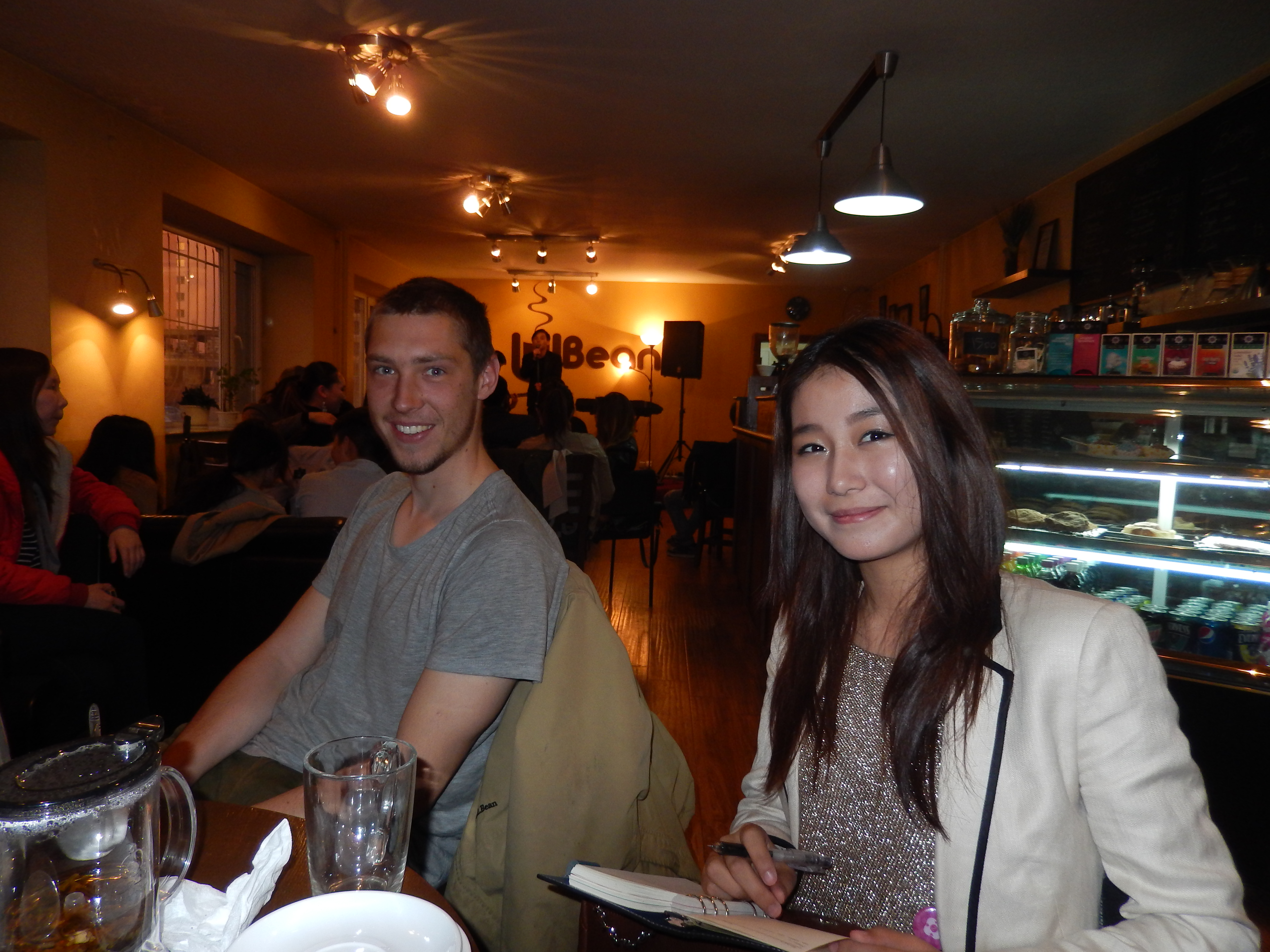
My friends Kit & Anni at an open mic night we went to as a group.

My friends Kit & Anni at an open mic night we went to as a group.