A Weekend Trip….to Tropical Paradise

February 10, 2012

One of the perks of living in this beautiful country is that after a week of stress, no sleep, and lots of late nights, a tropical island is just a few hours away.  My roommate and I decided we had to take full advantage of this, and traveled to the beautiful island of Koh Samet this past weekend.  Koh Samet is located right in the Gulf of Thailand, only a 40min ferry ride offshore, so it is a popular spot for anyone in Bangkok hoping for an island retreat.  The whole process of getting there is very Thai – don’t book anything in advance, just go to a monument in the middle of the city, hand over 200 baht ($6 USD) to a woman sitting at a table, hop into a mini van with a bunch of strangers, and get driven to the coast.

On the island, we stayed at the LungWang Wonderland Resort.  The name makes it sound glamorous, but it was anything but.  Very backpacker-ish, and very simple.  Nevertheless, it had clean rooms and bathrooms, decent food, and most importantly, was right on the beach, with beach chairs and lounge chairs included.  We could have not asked for anything more – just a weekend with our Kindles, catching up on sleep, lying on the beach, and waking up to the sound of the ocean in the morning (yes, that’s how close we were to the water!). And that was all for $10 USD per night.

Our only excursion was to go snorkeling one afternoon right before sunset. I have been snorkeling before in Mexico and the Caribbean, but there the snorkeling was always in crystal clear water;  the fish and coral were at the bottom of the sea, very far away from us, but still very much visible.  Well, that was absolutely not the case here…the coral was so close to the surface of the water that I bumped into it at one point (frightening) and the fish were swarming around us the whole time.  Our excursion ended at a beautiful resort on the island where we laid on lounge chairs, ate fresh fruit, and watched an incredible sunset over the sea.  A perfect weekend getaway.


Shabbat Shalom

February 10, 2012

There is something really intriguing about a country that truly takes a day of rest.  Every Saturday in Israel, shops and businesses close down, buses don’t run their normal routes, and most of the people you see are taking their children to the playground or having a peaceful walk.  After three intensely packed, exciting weeks of classes, tours, making friends, and finding a rhythm to life in a new place, taking this time for reflection and processing has felt more needed than ever before.

Even though it takes more advanced planning to make sure you have all the groceries and things you need before the stores shut down late Friday afternoon, I love the feel of Shabbat.  In my opinion, it limits you to the most meaningful ways of spending your time, whether it is time spent growing closer to God or building meaningful relationships with the people around you.  Last night, I had a quiet dinner with three friends, and it was a wonderful time spent talking through the challenges and joys of our time in Israel thus far.

Last Shabbat, three friends and I hiked from the university to the beach.  We left the university around noon, and made it to the beach just after sunset, after five intense hours of scrambling down the rocky trail running through the national forest that parallels to the city almost all the way to the beach.  At least it was all downhill!  At one point, we came to a fork in the road and were unsure of the way.  Luckily, there was an Israeli family who had stopped for a break right there on the path, and we were able to get some directions from them.  But it wasn’t just a quick exchange like an encounter would have typically been in the US; they engaged in further conversation with us, asking how long we would be in Haifa, and when they found out we were students, asked what we were studying.  I feel like this interaction exemplifies the relaxed, relationship-oriented atmosphere of Shabbat.  Overall, though, Israelis have been incredibly helpful and generous in all the encounters I have had with them so far.

One thing about adjusting to Israeli culture that has been interesting is that there is not one, but many cultures for me to adjust to.  Within the international school, there are students from all over the world, each with their own perspective on life and Israel, and within Israeli culture itself, there are many differences.  The respectful, gentle personalities of my Arab roommates contrast with the more blunt and outgoing personalities of the Jewish Israeli roommates some of my American friends live with.  It is quite a culture study!  At times, it feels like I am studying abroad in multiple countries at once.

I have been learning Hebrew at an alarming rate, although I’m still trying to get confident enough to practice in front of people outside of class.  I have been trying to order at the little sandwich counter on campus in Hebrew whenever I have a break, and the guy who runs it always smiles to himself as I struggle through the words.  I am getting better, though!  Although I have realized more than ever that learning Hebrew is a lifelong process.  But I’m taking this as a challenge, to see how much I can learn in the few short months I am here. We just have one week left of Ulpan (my intensive Hebrew class) — I can’t believe how it has flown by!  This has been the most intense language learning experience of my life, but also a very fulfilling one.  Next week, we start our regular semester classes, and the Ulpan group of 97 people will be joined by about 25 more international students, but we will also lose some students that were here just for the Ulpan.  That will give me even more to get adjusted to, but I am excited about meeting even more new people!

Ruins of the ancient city of Caesarea — some of which weren’t uncovered until 1992.

Hummus in Akko, an old crusader city just north of Haifa.

Me on our epic hike!


The Mosaic

February 6, 2012

Shalom all!  I have arrived in ארץ ישראל, the Land of Israel!  Many things are exactly as I expected, but there have also been some surprises.  For starters, I wasn’t prepared for how beautiful Haifa would be!  All the pictures I looked at before I arrived don’t even come close to conveying how amazing it feels to look out over the city, the mountains, and the Mediterranean Sea on my walk to class.  The University is situated on one of the highest points of the city, so you can see everything from here.  Someone even told me on a clear day you can see all the way to Lebanon, but I have yet to hear that from an official source.  We also haven’t had too many clear days yet, as it is the rainy season right now. We have a rain shower or thunderstorm almost every day, and it is usually overcast–  although still beautiful!

The incredibly diverse mosaic of peoples and cultures blending together in this beautiful city are unlike anything I have ever experienced.  The university is a microcosm of this.  My intensive Hebrew class is made up of six Korean students, one Japanese student, a grandfather from Vermont,  four Europeans (mostly PhD or graduate students), and six Americans.  It has been fascinating to learn of the different cultural backgrounds and motivations that have brought us all together in a classroom in Israel.  From the Japanese student of theology wanting to learn Hebrew in order to read Biblical texts in their original language, to the Political Science PhD student from Belgium interested in the political conflicts of the Middle East, our motivations for studying Hebrew are as widespread as the countries we come from.  The fast pace of the class has been overwhelming at times, but today when I took the midterm, I realized how satisfying it was to take an exam that involved reading a story and answering questions entirely in a language that two weeks ago I knew almost nothing about.  I’m really looking forward to having a working knowledge of Hebrew, and at the rate I am going, I am hopeful that it won’t be too long before I can navigate places like the grocery store with ease.  Even simple things like buying laundry detergent have been difficult. I almost bought bleach…oops! That would have been a disaster.  And I have to guess a lot when I am ordering food.  Although, the other day, I ordered coffee in Hebrew — I was quite proud of myself!

Last week the Madrichim (the social activities coordinators for the international students at the University of Haifa) took us on a tour of Haifa.  We explored the Arab Quarter, which included a large shouk, or outdoor market, with piles of fresh fruits and vegetables, fish, bread, spices, dried fruits, nuts, and olives.  We also went to the (reputedly) best falafel shop in Haifa, and a shop with delicious Arab sweets dripping in honey.  On a street running through the Arab colony, we saw the remains of their celebration of the “Holiday of Holidays” during which they celebrate Chanukah, Christmas, and Eid al Adja, the holidays of the three monotheistic faiths, all in one.  We also toured the central shrine of the Baha’i faith, and the German Colony, which was originally established by the Templars.

I am really excited about exploring the many layers of Haifa.  On Tuesday, the Madrichim took us on a hike to Elijah’s cave, believed to be the site of Elijah’s stay on his way to confront and defeat the prophets of Ba’al on Mt. Carmel.  During the hike, we passed a couple of bunkers built by the Israelis several decades ago, intended to be a last defense in case of attack.  So, side-by-side, you have Elijah’s cave standing as a remnant of ancient Israel and the spiritual battles that took place in the land, and the bunkers, evidence of the modern State of Israel’s current reality.

The adjustment to living abroad has been harder than I expected.  It is like the awkwardness of the first week of freshman year, but intensified by the new and foreign cultures and languages surrounding me.  It really helped that I was warmly welcomed by my five Arabic-speaking apartment mates, who have been fixing me delicious food and are eager to practice their English with me.

I am so blessed to have this opportunity to study here, and  I am eagerly looking forward to the friendships I will make and the many amazing experiences I will have over the next four months!


Botswana, Week 2: The Botswana Way!

February 6, 2012

We’ve kicked off our second week with an intense reality check… except this reality check has a Botswana twist to it! Our week consisted of an immersion to Botswana culture and way of life.

https://fbcdn-sphotos-a.akamaihd.net/hphotos-ak-ash4/395155_10150482057608015_514083014_8971467_1298084400_n.jpg

We met some really nice local Batswana in a tiny village, named Mmokolodi, just about 2 hours away from University of Botswana. The chief greeted us with open arms, the older ladies of the village sang for us, and the younger males taught us how to dance African style!

https://fbcdn-sphotos-a.akamaihd.net/hphotos-ak-snc7/398016_10150482058378015_514083014_8971481_918416941_n.jpg

As soon as sun hid away under the beautiful Botswana trees and mountains, we began the festivities. We kicked it all off with sounds of dance and rhythm! The males were told to go with the young boys and older males, while the females were sectioned away to watch the males dance right before they began their own group dances.

https://fbcdn-sphotos-a.akamaihd.net/hphotos-ak-snc7/397821_10151184865300451_673750450_22932065_2047271341_n.jpg

Botswana traditional dancing is much different than what I am accustomed to in the States and back in Europe. Instead of using machine-made instruments, such as a guitar, microphone, or keyboard, the locals use handmade –with very dependable and strong materials from animals — instruments to make sounds and with their hands and feet, accompanied by vocal rhythms! It was very interesting to see, and partake in, the traditional Botswana dances, especially in groups. It had a lot of soul and sense of individualism and community within it. We weren’t dancing to an iPod or a repeated sound; everything felt personal and special in the dances and music. It was as if I was a part of something special with my group and the Batswana people and it really bonded us by forcing us out of our shells!

I played a traditional Botswana game with the local Chief (on the left of the above photo). It involves going in circles around a sketched piece of wood with rocks and trying to overlap the opponent to take away his rocks. It’s very simple and clearly traditional. I’ve learned quickly that even items and objects as simple as a piece of wood, rocks, a board, and a friend to play with can pass time by the hours as quickly as any video game back home!

https://fbcdn-sphotos-a.akamaihd.net/hphotos-ak-snc7/381531_10150482058518015_514083014_8971483_260130149_n.jpg

During our stay, we had a chance to hike a mountain nearby and take a scenic walk around the villages. We even ran into a sectioned-off piece of land in the mountains that we were told held a 2,000 year old cave drawing.

https://fbcdn-sphotos-a.akamaihd.net/hphotos-ak-ash4/403840_10150482060563015_1430147558_n.jpg

https://fbcdn-sphotos-a.akamaihd.net/hphotos-ak-snc7/407069_10150482061888015_514083014_8971525_1526760536_n.jpg

Our last stop consisted of us driving about 30 minutes away to view the oldest living tree in the Southern African region. This tree is named The Livingstone, in honor of the African explorer and missionary David Livingstone, and it was originally dated to be over 200 years old, but is expected to have been growing much longer than documented. It is said that Livingstone’s heart was buried under this Mvula tree by a local tribe – appreciating his love of nature.

https://fbcdn-sphotos-a.akamaihd.net/hphotos-ak-ash4/378975_10150482063188015_514083014_8971545_429038321_n.jpg

When the entire weekend was finished, it was finally bedtime. We didn’t expect anything but the stars above us and our sleeping bags below us at the Botswana village. To our surprise, we ended up in a very well-constructed traditional hut. Not only was it well built, but it also had doors, windows, and even seats with thin, cool blankets inside. Also, the pyramid-shaped roof with specially designed wooden vents created breezes throughout the night to allow us to escape the African heat!

https://fbcdn-sphotos-a.akamaihd.net/hphotos-ak-snc7/401078_10150482058698015_514083014_8971486_54403790_n.jpg


Only in Bangkok

February 3, 2012

I thought I would share some details about what I did this past Saturday, to give you a good idea of an average, ordinary day in Bangkok.

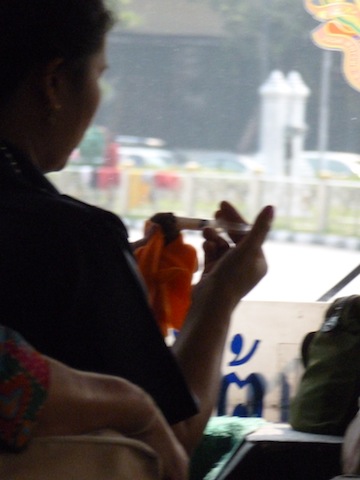
My day began by meeting a friend in the lobby of my apartment building, so that we could catch the bus together to meet a few friends for breakfast.  We said our usual “Sa wat dee kha”  to the lovely guards at the bottom of our building, and headed out on a walk to the bus.  At only 10am, it was already 85 degrees outside; the sun was shining, and all of the street vendors who crowd the Bangkok streets were just beginning to set up their food and clothing stands to begin their long weekend of work.  We climbed up the stairs of the overpass, which provides a safe way to cross the huge, 10-lane highway, passing the usual homeless men lying on the concrete, and the standard installments of individuals singing into a microphone hoping to make some money.  We hopped onto our bus, being careful not to touch the monks, clad in their orange robes, who were also boarding the bus.  We sat down, and the bus “tout” came over to collect our money – only 8 baht (about 25 cents), because the bus was open-air and not air-conditioned.  I quickly noticed what looked like an animal’s cage resting at the front of the bus next to the driver – based on the tail that was visible we assumed it must be a squirrel.  Well, that’s odd.  After the bus tout was finished collecting money, she proceeded to the front of the bus, opened the cage, pulled out what we think was a baby squirrel, wrapped it up in a small baby-squirrel-sized blanket, and proceeded to feed it with a syringe, squeezing something into its mouth for the remainder of the ride.  I tried to get a good picture, but the bus ride was so bumpy that a blurry one will have to do.

We then proceeded to Ethos, our new favorite earthy-crunchy, all-natural, sing-kumbaya, can’t-wear-shoes-inside, sit-on-the-floor type of restaurant. We had the most incredible banana mango gluten-free pancakes. I know it doesn’t sound like much, but they were delicious.

Afterwards, we ventured out to the main road in the now sweltering heat.  We waited for a bus that we knew would take us to the mall right by our apartment complex.  We fully expected to have at least a 30 minute bus ride – it takes minimum of thirty minutes to get anywhere in Bangkok, because there is always traffic.  Well, no one had mentioned to us that this bus takes the most roundabout, absurd path to go from point A to point B.  The ride ended up taking us 2 hours.  Don’t get me wrong, seeing the scenery of a weekend in the city was great, but my gosh, in that heat, with no air-conditioning, it was rough.

After two hours, our mall destination was finally in sight, so we got up and pressed the red button which signals to the driver that we want to get off at the next stop.  He was driving particularly aggressively at this point, especially considering how bad the traffic was.  And then, like slow motion, I saw it: bus jerking left, small helpless car turning right, and then — CRRUUUNCCHHH.  The horrible sound of metal crunching.  Our bus crashed straight into the car next us.  We all looked at each other, decided it would be best to just get off that bus as fast as possible, and into the refuge of the huge and nicely air-conditioned Central Pinklao mall.

Just another morning in Bangkok, Thailand.


Botswana, Week 1: Intro, Facts and Excursions!

February 3, 2012

Hello, everyone. My name is Igor Martic, and I am junior (class of 2013) studying International Economics at the University of Richmond (UR). Currently, I am acting as a Foreign Correspondent for UR while representing the student exchange program at University of Botswana (UB), Africa. Welcome to my blog! Feel free to contact me at any time via e-mail: Igor.Martic@Richmond.edu. Enjoy, and I encourage my readers to leave comments. Thanks! Now, for an introduction to UB…

Here is a video I recorded while flying into the Gaborone, Botswana airport:

Next, I’ll answer some basic questions you might have about University of Botswana.

How many people attend University of Botswana (UB)?

Botswana, a country with a population of a little over two million, has a very limited amount of space in its one University, UB. There are approximately 15,484 (1,445 postgraduate) students and 2,658 faculty and staff.

What does University of Botswana (UB) have to offer?

UB provides many options and locations for its students. With four campus locations nationwide, this University has grown to become internationally renowned for its academics. UB offers seven areas of study: Business, Education, Social Sciences, Science, Engineering, Humanities, and Medicine.

When are the important dates for University of Botswana?

UB was established in 1982 as a public university in Gaborone, Botswana. Semester 2 (referred to as spring semester in the States) begins around January 9 of the new year and ends May 6. Exam week ends May 10, final grades are due May 24, and grades are finalized May 26.

The UB course catalog:

http://www.ub.bw/documents/UB_UnderGrad_Academic_Cal_2010_2011.pdf

Where is University of Botswana?

UB has 4 locations: 2 in Gaborone, 1 in Francistown, and 1 in Maun. The main campus, and the one I attend primarily, is located in Gaborone, Botswana, Africa.

Why was University of Botswana established?

UB was established for the purpose of educating the citizens of Botswana. With an economy that depends on primarily one resource as its main source of income (diamonds), Botswana understands that a limited resource also brings limited opportunities. UB exists to create a better social, private, and professional life for everyone across the Botswana lands. An educated and innovative society will bring intelligent and creative new ways of life and business to a nation that relies heavily on a depleting natural commodity.

How do I get more information about University of Botswana?

UB is an amazing academic institution. Please stay tuned to my blog for more personal information about this anything-but-ordinary study abroad experience. Also, please contact your advisor, international education office, or http://www.ub.bw for statistics, facts, and ways of applying to study here with the great citizens of Botswana and the “internationals” like me!

Finally, I’ll discuss some of the excursions I’ve had so far and will enjoy over the coming weeks.

After being in Botswana for a little under a week, I’ve had a quick, but simultaneously slow, transition into the culture, environment, and atmosphere of this new life.

To become more acquainted with our new home for this semester, the local students and the school have set up excursions for us to attend. This includes visiting the local village, a hike into the Gorge, local village dancing and an overnight stay, learning African pottery techniques, a game drive, and viewing one of the oldest living African trees and rock paintings in the world.

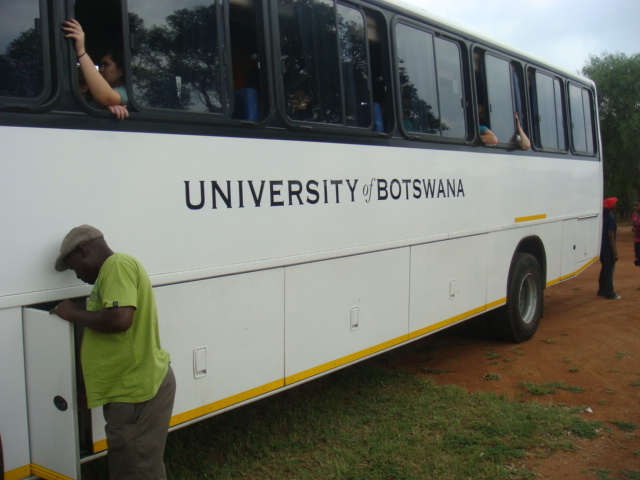
For our first excursion, we packed into a UB bus and headed out to the Kanye Village in Botswana, Africa. The trip lasted a brief 2 hours, but was well worth it! When we arrived, we were told that all males had to change into long pants and a collared shirt, and the females were required to cover their legs and shoulders. This was to respect the local customs of the tribe.

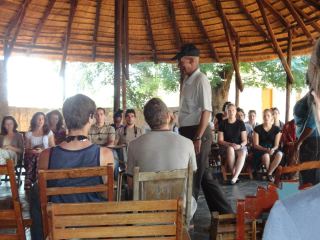
They had us seated in their local “courthouse.” A local directed the males to sit in the front of the females in traditional, hand-made chairs. He was very well-spoken and groomed, educated, and made everyone feel like he was their grandfather with a cheek-to-cheek smile and open arms. Surprisingly, he spoke my language, Serbo-Croatian, with almost perfect grammar and a slight African accent.

Group discussion

Side wall of village


Traveling is done… let orientation begin!

February 3, 2012

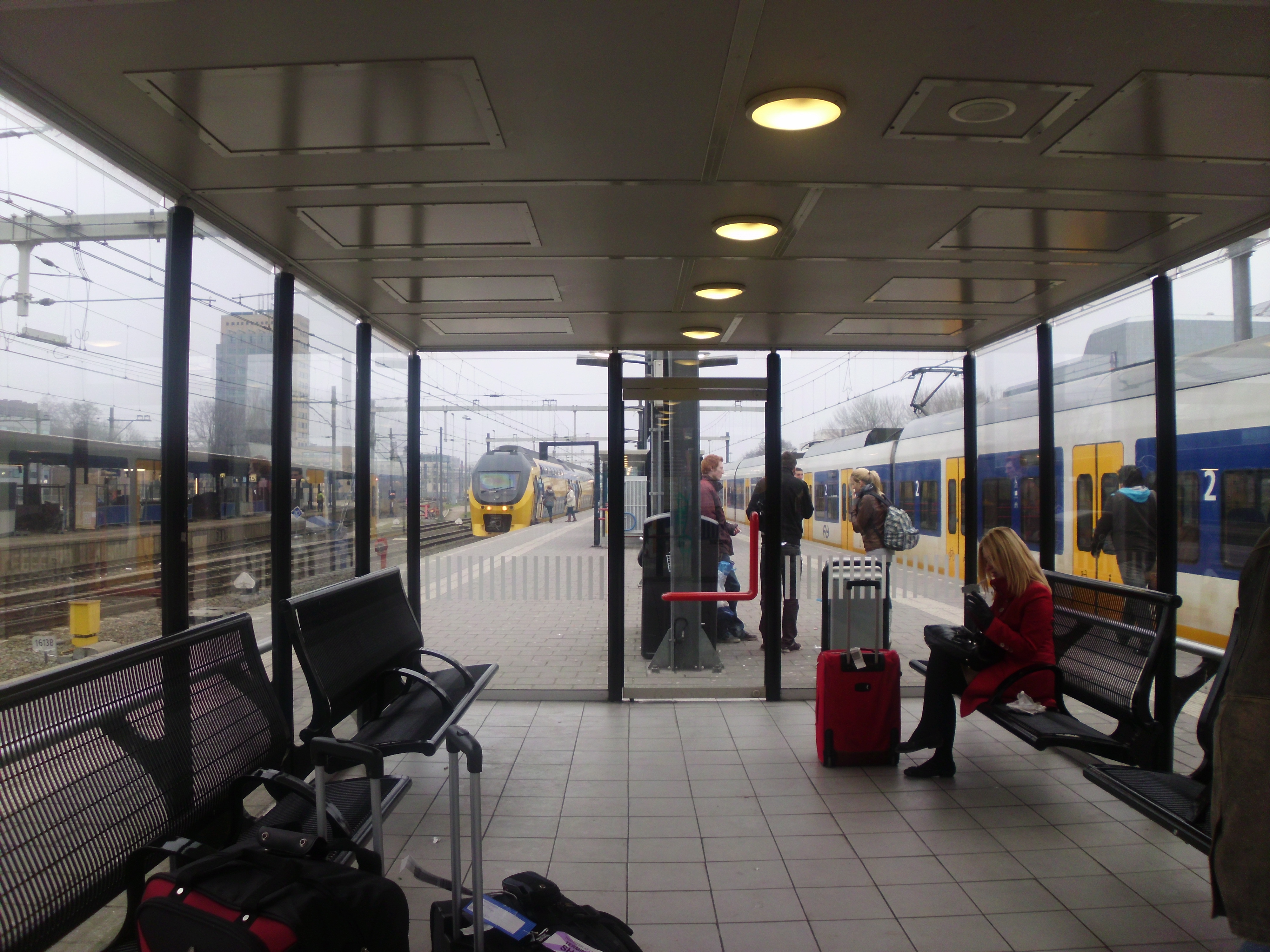
As you can assume from the title of my blog, I have made it to the Netherlands!  After a long, but comfortable flight to London, a short flight to Amsterdam, and a 2 1/2 hour train ride to Maastricht, I have arrived!  I must say that although I enjoy traveling to new places, I wish I could save several hours by teleporting myself to wherever I would like to go.  Despite the long journey, I had a nice time in the London airport.

My trip was also nice because one of the student organizations at UCM picked me up from the train station and took me to what would become my home for the next 4 months.  A funny story about the train ride:  I was buying my ticket in the Amsterdam airport and the man helping me circled where I needed to transfer and made sure I understood what I needed to do (since it was in Dutch) before I walked away.  When the transaction was done I walked away, saw a young guy looking at me so I smiled out of courtesy than kept walking.  I made it about two steps before I heard someone say “Whitney?”  I was really confused as to who would be calling my name in the Amsterdam airport, but naturally I turned around to see if I knew the person.  “I couldn’t help but overhear your conversation.  Are you by any chance the Whitney who is going to UCM?”  Then I realized that he was the person who was supposed to get picked up from the Maastricht train station with me, since our train was arriving at the same time.  Once we exchanged brief introductions, we proceeded to the platform and our 2 1/2 hour ride began.

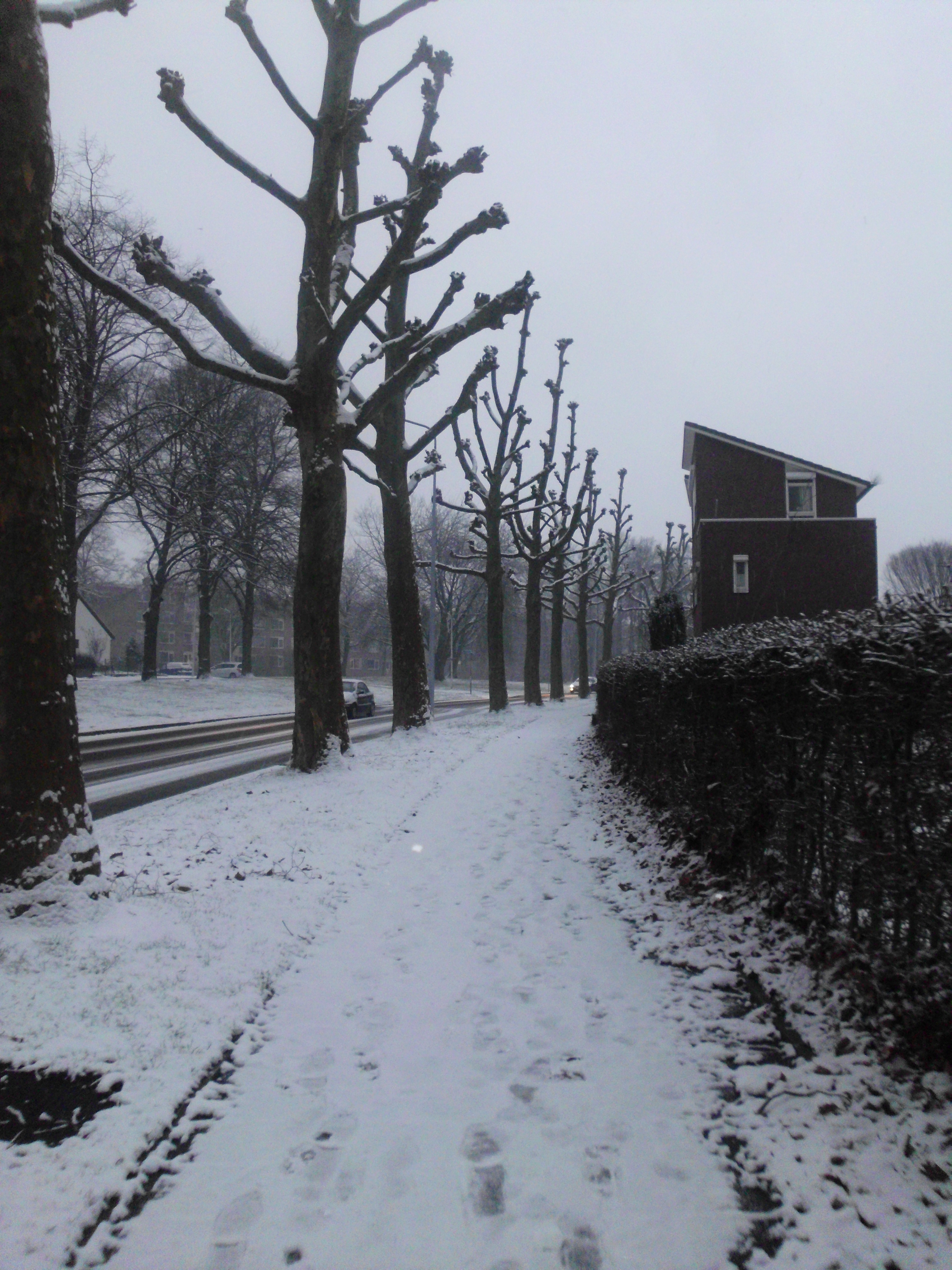
Re-focusing on the title of this entry, now: Traveling is done, so let orientation begin.  Today was my first day of orientation.  When I woke up this morning and looked out the window, snow was covering the ground, and it was still coming down.  Snow is a kind of rare occurrence in Virginia, so I was excited.  My second reaction was the realization that I needed to prepare to walk approximately 20 minutes in snow, since I don’t have a bike yet.  I also had a feeling that it was going to be extremely cold, so I put on layers and headed out.  Although the snow kept falling during my walk and continued throughout the day and most of the evening, it actually wasn’t as cold as I thought it was going to be.  I have to admit that I kind of enjoyed walking in the snow; it was peaceful.

Once I made it to UCM, I welcomed the breakfast and immediately started mingling with the other exchange, transfer, and freshmen students.  I met people from literally all over the world: Singapore, Australia, the U.S., Germany, Peru, and, of course, the Netherlands, just to name a few.  Everyone was friendly, so it was easy to talk to people.  During orientation, we received our class schedules, learned about UCM’s online programs (student email address and online file storage), and began PBL (Problem Based Learning) training.  I was worried what my schedule was going to look like, because I was told that it was possible to have class anytime between 8:30am and 6pm, Monday through Friday.  Luckily, I don’t have class on Monday, and I only have one 8:30am class.

You may be curious about PBL.  In a nutshell, it’s when a tutor (equivalent to a professor) observes the class while an appointed student (the discussion leader) leads a discussion about a specific text.  At the end of this discussion, the students collectively create learning goals to serve as a guide while they read for the next class.  These tutorials take place twice a week, whereas the lecture for the course only takes place once a week.  I’m excited to see how this works, especially since it’s very different from what I’m used to at UR.  I have orientation for two more days, and then classes will begin this Tuesday. In particular, I’m looking forward to the “Introduction to Dutch Culture” lecture.

One more thing that I found interesting about my first day of orientation: the food.  For lunch, a Dutch student took a few of us to a nearby deli place, which thankfully had an English menu.  As you can probably assume, sandwiches are not something that are unique to the Netherlands.  Also, for dinner, the student organization that picked me up from the train station organized a dinner that was only 5 euros.  Frankly, I didn’t really care what they were providing, since it was inexpensive and it meant I did not have to cook that night.  It was Chinese take-out.  It was absolutely delicious and well worth the money, but once again, Chinese food isn’t a unique part of Dutch culture.  With that said,  tomorrow I will venture to the grocery store.  Wish me luck!


Barbados, Week 2: Where the Wild Things Are

January 30, 2012

It’s the start of a new week, and I finally feel like I’ve got my head on straight.  Survival mode has seamlessly transitioned into “vacation” mode, as the first week of classes at the University of the West Indies consists of only one class meeting, in which the professor may or may not show up, merely handing out the syllabus and discussing it if he or she does indeed come.  The days have blended together, as my biggest daily decision is whether to head down the hill to Batt’s Rock Beach with the morning crew, the afternoon crew, or both.  There’s been days when I’ve rolled out of bed and thought to myself, “there has to be something I have to do… I can’t have this open of a schedule”, but, in reality, the only absolute necessities of the day are picking out some delicious food to eat at the cafeteria and tracking down the lecture halls for my 6:00 or 7:00 pm classes.  After the hectic hustle and bustle of the first few days — sorting out school payments, navigating the transportation systems, and getting my class schedule straightened out — things are definitely feeling more natural.

As soon as I had become comfortable with life on UWI campus, though, the urge to keep exploring was buzzing around my head.  This was probably one of the last weekends of the semester of abundant free time before my nose would be stuck in the books, I realized, and thus it was prime for checking out some of the more remote destinations on this island of 166 square miles.  Although Barbados is not necessarily known for its abundant wildlife, there were rumors that a place called the Barbados Wildlife Reserve, in the northern parish of St. Peter, had a number of different species within their confines.  Oh, and not all of them were in cages!  Our group crammed ourselves onto the local bus headed north toward Speightstown, passing the ritzy tourist-trap Holetown on the way.

The Wildlife Reserve is located in the middle of picturesque rolling sugarcane fields, but once inside the “zoo,” visitors follow winding stone pathways that are nicely shaded by hundreds of tall trees.  Immediately, the cameras were out, and before we walked more than a dozen yards into the park, many of us were excitedly snapping countless pictures of the large tortoises meandering through.  Little did we know that Bajan deers (formally known as red brocket deer), peacocks, pythons (caged, of course), parrots, and the famous green monkeys awaited our eager eyes.  A Bajan zoo-keeper distributed peanuts to those who wanted to feed the monkeys, and it was a challenge to keep a straight face as the mischievous-looking monkeys hopped up next to you, uncurled your hands with their miniature fingers, and proceeded to eat all the food in your hands in mere seconds.  Reactions ranged from one girl shaking in nervous energy to another proclaiming she could “die happy” after having had such a close encounter with the green monkeys.

The next nature adventure our group undertook was one that I, myself, had searched out and organized.  Before I arrived in Barbados, I knew two things:  One, I wanted to see as much of the island as possible; and two, I wanted to do so on a budget where I could still eat during the last month of school.  The Barbados National Trust hikes are the love-child of such ideals, as they are free hikes guided by the Barbados National Hikes every Sunday at either 6:00 am, 3:30 pm, or 5:30 pm.  This Sunday’s hike took place in Foul Bay, a complete geographic unknown to me before that afternoon, and I discovered it was all the way on the other side of the island.  I called a taxi, gave him all the logistics for the 3:30 pm hike, and estimated that about 10-15 students would be going on the hike.  Sunday afternoon, nearly 30 students came out to our meeting spot to take the taxi!

Foul Bay turned out to be quite an amazing scene.  We drove down a steep hill, parked among a thick enclave of trees, and marched out onto the beach, lined with palm trees and sandwiched between huge stone cliffs.  Our tour guide was a wizened, older Bajan man named George, who not only gave us some historical background about the area we covered, but also launched into some serious philosophical musings about the future of renewable energy, the dangers of money, and World War III.  At one point in the 6- mile, three hour hike, he took me aside and told me that “you, young man, are going to be the leader of your group.  There is a lot of you, and we need to make sure everyone makes it back”.  I took away a strange satisfaction that George would make me second in command without any previous knowledge of my abilities, but I agreed to keep an eye of our pack of 29 and make sure no one fell behind.  Our hike took us through the beachside forest, up a stone staircase to the top of the sea cliffs, and winding through the grass fields that skirted the coast.  On the way back, we took a number of back roads that would through villages of both large and small, colorful Bajan abodes, often waving to the onlooking locals as we passed.

We tramped back into the beach parking lot well after sundown, and it’s safe to say we were all tired and hungry to the bone.  As we were clambering aboard the taxis that would return us to campus, George stopped me and said “I made a good choice in choosing you as your group leader.  You did a good job, and I look forward to seeing you on more of the hikes!”  Again, I wasn’t aware of anything I did to deserve such high praise from our tour guide, but I guess someone with so much life experience was able to see in myself something that I’ve never truly noticed.  Whatever it was, I will try to cultivate it further in my time here at the University of the West Indies, knowing that it’d make George proud.

The stunning view of the east coast from Farley National Park.

A green monkey catching a ride on a tortoise at the Barbados Wildlife Reserve.

Foul Bay beach is sandwiched between rocky cliffs.

George appointed me group leader of the exchange students.


Elephants, Waterfalls, and Bamboo Rafts

January 27, 2012

I just got back from an incredible weekend in Chiang Mai, Thailand, which is a ten hour bus ride north of Bangkok.  Chiang Mai is close to the Burmese border in Northern Thailand.  I was there with my roommate, Addie, as well as two other exchange students.  Thanks to the fantastic recommendations of another Spider (thank you, Dora!), we packed a lot into a three-day weekend.

We took the night bus to and from Chiang Mai, meaning we had three full days there — Saturday through Monday.  Because we had such a short time, we wanted to make sure we made the most of our stay.  Through the hostel that we were recommended, Libra Guesthouse, we were able to book a 2-day, 1-night “trek,” which ended up being incredible.  Our trek started off Saturday morning with a stop at Mork-Fa Waterfall, in Doi Suthep Pui National Park. The water was freezing, but the sight was incredible, and in the end, very refreshing.  After the waterfall, we stopped for some delicious lunch (vegetable fried rice with fresh pineapple). and then we headed to yet another national park, which was home to hot springs.  When I say hot, I mean hot — upwards of 110 degrees Fahrenheit, or 40 degrees Celsius.  It was at this point that we begun our “walk through the jungle,” as it was advertised on Libra’s website.  Well, let me tell you, this was not just a casual stroll. This was, in fact, a 5-hour hike through the jungle.  The walk provided us with incredible views of the mountains, and in the end, it was fantastic, but certainly not what we were anticipating.

On our hike, we came across a few “hill tribes.”  Hill tribes are essentially groups of people — most of the time not recognized as Thai citizens — who, over the past few centuries, have migrated from China and Tibet, settling in the border between Northern Thailand, Laos, and Burma (Myanmar).  It was wonderful to be able to see a different part of Thailand, and to learn a little bit about the hill tribes, especially because most of our guides on the trek are members of those hill tribes.  So after five hours of trekking, crossing many unstable bridges made of bamboo, and finishing every last drop of our precious bottled water, we finally made it to our campsite for the night.  We bundled up quickly, because unlike Bangkok, where the temperature never drops below 85 degrees F (30 Celsius), it was freezing.  We had a delicious freshly made dinner by our guides (fresh fruit with homemade chicken and potato curry), and spent the evening sitting around the campfire, hearing hilarious and inappropriate stories from our guides, as well as learning an elephant song that none of us could quite understand. I must also mention that we were joined by eight crazy Russians on this trek. They did not speak a word of English, but somehow thought that speaking Russian very loudly to us would help us understand what they were saying.  After they had a few drinks that evening, it certainly made for an interesting campfire.

After a freezing cold night with only a thin, damp mat separating us from the bamboo floor, we woke up on Day 2 of the trek, and before we knew it, there were elephants in the river! We could not believe our eyes – our guides were on top of them, washing them, and the elephants casually strolled out of the river towards us, at which point we were able to feed them and touch them.  We were then mounted on the elephants – at first sitting on a contraption they had tied to the elephant, but wanting the real jungle experience, I opted to slide down and ride on the elephant’s back.  We spent about an hour just wading through the jungle and the river on the elephants.  A truly incredible experience.  Instead of hiking back down the mountain to get back to our starting point, we opted for a more relaxing variety of transport, taking a bamboo raft that our guides made for a two hour trip down the river.  Definitely a fun way to end the two day trek!

For the last day of our trip, once we were back at the hostel in Chiang Mai, we were able to see the many sights of the beautiful city.  These included the Sunday night market, the Night Bazaar, and many Buddhist temples, including the most famous temple in Chiang Mai, Doi Suthep.  Doi Suthep is situated in the mountains above the city — about a 30 minute drive away.  It has incredible views of the city, and like many of the other temples we have visited, the beauty of the temple was breathtaking.

All in all, it was a fantastic weekend! And I have to say, for anyone who is wondering… the weekend was unbelievably cheap.  For the entire weekend, door-to-door, bus, taxi, food, water, trekking, hostel, everything; the weekend came to a grand total of $140 USD.  Not bad, right? Still on a high from this weekend, Addie and I are certainly excited to plan our next adventure…we have our sights set on Cambodia next!


Barbados: In the Land of Fish and Cricket

January 23, 2012

As I bounced around in the back of a jam-packed ZR (pronounced Zed-R), which is more or less an industrial mini-bus, with loud Bajan music blasting through the air, the stark contrasts of Bajan versus American life were definitely in the forefront of my mind.  Minutes earlier, 20 exchange students managed to cram into the mini-bus on our way to Bridgetown, the capital of Barbados, with an older Bajan women and her son, unfazed by the apparent invasion of everyone’s personal space.  When you’re forced to nearly sit on a relative stranger’s lap, becoming comfortable around the other exchange students has been comparatively easy.  All things considered, however, the ZRs are a great way to travel, as they’ll take you anywhere on their respective routes for a mere US $1.00.  I joked to the only other American male exchange student, Glen, that I should start one of these ZRs in America, but he shook his head, responding, “they would never let this many people in a vehicle this size in the states… too much of a safety hazard”.

Transportation, though, was just one of the many great unknowns I faced as I stepped out of the taxi and onto campus at the University of West Indies.  It became clear to me that my first few days in Barbados would consist of a less severe state of survival mode.  After I moved into my on-campus single room, my goals for the afternoon broke down to 1) find an ATM to get money 2) find food 3) find my way back to campus.  Part of the studying abroad experience, I suppose, is not always figuring out things the easy way, as I ended up walking for two hours in the rain in my search for a local restaurant; I ended up getting bread, chips, and Sprite from a local mini-mart, which sufficed for my first night’s dinner on the island.  Being the American that I am, I assumed there would be at least five different types of restaurants on every corner, especially near a University campus.  Evidently, Bajans are much more self-sufficient and opt for the cooking at home option rather than spend their hard-earned money out on the town.

My fortune changed the next morning, however, as I discovered at our foreign exchange orientation that the typical exchange student here at UWI was Canadian, female, and very friendly.  Facebook was able to quickly unify everybody in our coordination of daily plans, and after a day of touring campus and doing the mandatory meet-and-greet, we decided to head down to the famous Friday night Oistins Fish Fry for our first cultural experience.  The fish fry is exactly what it sounds like: a ton of small food vendors and restaurants all lined up in between the beach and the road with local bands or DJs providing some background music.  It was packed full of tourists fresh off the cruise ship, so we all settled down with some food and drinks and continued to figure out who’s who, where they live, and other basics.  I hadn’t met so many new people at one time since freshmen year at Richmond, so it took all my brain power to keep names and faces together.

The first truly cultural event I went to, as the beach does not count (in my opinion), was the Caribbean Cricket Championship at the Kensington Oval in Bridgetown.  If you want to get a good perspective on how important cricket is to Bajans, just know that the entire UWI campus is literally centered around the “Oval”, which is baseball’s equivalent of a diamond.  A US$10 ticket got us great seats for not only the 3rd place match between Barbados and the Windward Islands, but the championship match between Trinidad and Jamaica.  The group who went consisted of 19 girls from Canada, the United States, and Finland — oh, and me.  Being in a fraternity back at Richmond, and thus hanging out with a lot of guys most of the time, this was definitely a different scene.  While I grappled with figuring out the rules of cricket as the game progressed, the girls were busy discussing future baby names and how they wanted their dream weddings to go.  I cracked up laughing as the conversation turned to which cricket player they thought was the cutest.  Unfortunately, Barbados had a terrible day and only scored 101 runs after 10 batters — a very poor showing, I eventually discerned — and they lost to the Windward Islands in the 3rd place game.  I actually really enjoyed watching the game and the reactions of the crowd, who were a lot of fun — there was a ragtag band of percussionists who played from time to time, and we ended up doing the wave numerous times.  After nearly five hours of cricket, however, I was pretty saturated and ready to head back to campus, where I fell asleep streaming the Giants vs. 49ers playoff game on my computer.  I guess after a weekend of pure exploration and discovering new people and places, an NFL playoff game was too familiar an entertainment to keep me awake.

The rowdy Bajan crowd cheers on the national cricket team.

Swinging from the rope swing at the Boatyard Beach Club.

Batt’s Rock Bay Beach — just a five minute walk from campus.