기초: Living in a Dorm, Classes, and Korea 101 (Posted by Indira in South Korea)

March 18, 2013

It’s been three weeks since I’ve come to Seoul and I have to admit that I’m getting used to it all. I figured out the shortest route to Sinchon (the area of the city where I live), I can communicate with shopkeepers by using the very limited Korean skills I have, and through hand motions, and I know what places I love going to eat at. Those are just some small things that make me feel more at home in Korea. I find it truly fascinating how quickly I can adapt to a new environment and embrace it as a place that I call home: going back to Yonsei University campus or to I-House is always referred to as going “back home.”

I really do feel comfortable in my dorm, going to classes, walking around Sinchon, using the subway, and simply living in Seoul. It feels that all the culture shock is wearing off as I have started accepting and appreciating all the differences around me. I am no longer shocked by a certain behavior, Korean über-politness, or crazy drivers. I am really starting to love this place!

Sunset over Sinchon, an area in Seoul

Sunset over Sinchon

But, what makes me it love it? It’s simple – the people, the place, the atmosphere, and the dynamics.

I live in a dorm called International House where most of the exchange and/or international students live. My roommate is American; she is from San Francisco and I really enjoy sharing a room with her (she is the first roommate I have had in last 1.5 years). There are a whole lot of other people on our corridor and we share a bathroom and a really nice lounge area. All the girls I’ve met here are amazing and we all come from very diverse backgrounds (some of the nationalities represented on my floor are: American, Malaysian, Dutch, Indonesian, Chinese, Swedish, Vietnamese, Bosnian (I am the only Bosnian at Yonsei)). It is really nice that we have the lounge area (there are couches, a TV, and a small kitchen) as we get to hang out there and meet new people. Everybody is really respectful of each other’s needs and people are so nice. International House is connected to SK Global House (another dorm where exchange and/or international students live) so it’s easy to just walk through the building and go visit your friends who live in the other dorm. It is interesting that the floors in both dorms are gender specific and guys are not allowed on girls’ floors and vice versa. There are a lot of rather strict rules regarding the interaction between genders (there are even women’s and men’s laundry rooms!), but in case you want to hang out with your friends there are study rooms and lounges usually located on the first floor or in the basement.

A lot of my friends are shocked by the strict gender rules and almost always ask me whether the classes are gender specific too, but they are not. Classes are really relaxed and nice. Professors are very easy to approach and they are super helpful. As I am taking Study Abroad courses all of the students in my courses are exchange students so the classes are very diverse and it is easy to get, for example, the German, Australian, Canadian or Indian perspective on a certain issue or topic. Classes are organized in a way that there is a short class (50 min) and a long class (2×50 min). Usually the long class is used for a very interactive lecture, while the short class is used for workshops and seminars. I really like this set up. In most of my classes I don’t have a real in-class midterm or a final, but I do have to write quite some papers, memos, and reports. The professors try to make the classes very interesting by incorporating group work. Last week, for example, in my U.S.-Korea Relations class we were divided in 8 groups where each group represents a certain country with a specific power. Then we had to form alliances with other countries and fight a war. This workshop helped us understand the importance of strategic thinking and what lies behind the alliances and friendships between the countries. Apart from that, it was such a fun activity and time flew by!

As we are having really nice weather and a plenty of sunshine, I spent some time walking around the campus and discovering new areas I like. Yonsei campus is really beautiful, especially the park located in the middle (kind of like the lake in the middle of the UR campus) and the huge outdoor stadium built in the Greek style (in essence it is like a much bigger Greek Theater with more concrete and less green areas). The campus is super big and so beautiful!

The outdoor stadium at Yonsei University
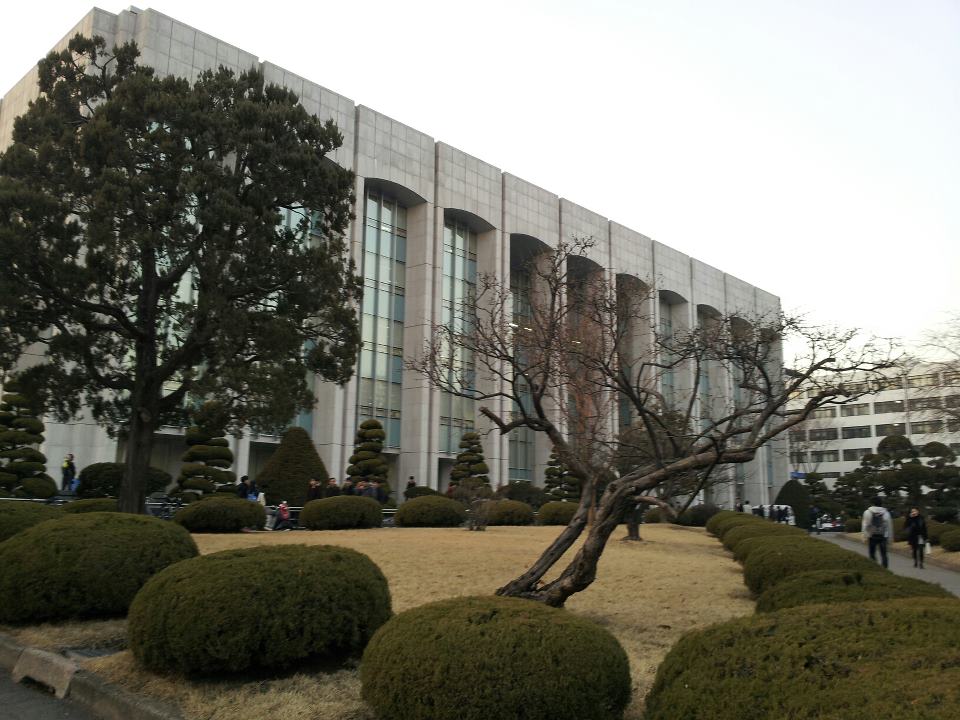
The outdoor stadium

Beautiful Central Library at Yonsei University

Beautiful Central Library

It really feels like this place is growing on me and I like that feeling. 🙂


Suivre: to follow (Posted by Pierre en Suisse)

March 8, 2013

As I am writing this, my third week of the semester here at the University of Lausanne is coming to a close. What this means is that the first real week of classes has just finished. At UNIL, there is a two week grace period to try out all the classes you’d like. Unlike at UR where you need to register the semester before and classes often fill up, at UNIL, you can go to any course or seminar you want for the first two weeks without signing up for it to decide if you will take it or not. It provides the opportunity for the professor to really go over what the course will be like, present the syllabus, and also present the grading method. There are several different ways that a student can be evaluated here, depending on the format of the course even. There are two different types of courses that students can take at UNIL, or at least in the faculty (school) of political science: courses, or seminars. Courses are generally lecture style with a large number of students, where the professor presents the information, people can ask questions, and there is minimal interaction in many cases. At the end of the course, students take some form of an exam. Like at Richmond, this can be a formal written exam, a written paper that is due on a certain date, or alternatively, an oral exam with the professor. Sometimes, there is no exam but students are just regularly evaluated throughout the semester. In courses, the entire final grade can be based on the exam result. This is something that is very intimidating for me, as I get nervous when a final exam at Richmond is worth thirty percent of my grade, never mind eighty percent or more! Alternatively, students can take seminar courses. Seminars are very similar to the classes at Richmond, where there’s a lot of discussion, group work, presentations, however the only difference is that there’s no final grade at the end. Students get evaluated essentially pass/fail, with an attestation if the student passes, or an “échec” if not.

Going back to the title of this blog post: suivre, meaning “to follow.” In French, one says “je vais suivre ce cours” which technically means I am going to follow this course, rather than how in English we would say “I am taking this course.” For my program, I decided to suivre (take) two courses and two seminars in the Political Science faculty, and two courses in the French as a Foreign Language faculty. Yes, this sounds like a lot since four or five courses is the normal load at Richmond, but typically students can take as many as seven courses here! My classes are all instructed in French. The only difference is that in the political science faculty, the classes are catered to native French speakers. This is definitely where I find the verb choice to be quite ironic. Rather than me saying to myself, “oh yeah I’m taking this course,” I really will start thinking, “oh I’m following this course! Wait, but am I really following what the professor is saying?” I don’t, however, regret for a second taking the courses in French. Because the French I have been learning at Richmond for the past two and a half years is very scholastic French, I can generally follow the professors quite well. They use the same very formal register of the language when instructing that my professors at Richmond use. However, they do speak a bit faster. Luckily as well, many of the terms that are used in a French sociology text for example are very similar to words in English, so I can pretty easily figure things out when doing assignments or just in general listening in class.

So what am I actually taking now that my two week trial period is done? A mix of sociology courses, one political science course, and two French as a foreign language classes. To highlight some of them, my political science class is called Swiss Politics, since I figured it would be a good idea to learn about the country I am studying in while I am here. I also am in a course called Sociology of Work, which I think is going to be absolutely fascinating to learn about all of the trends in history and what it really means to work. I am also really excited about my French Structuration and Production class, one of the French as a foreign language courses, because the professor really teaches it with the goal of helping us develop a more familiar, casual register of the language for our every day interactions. We are constantly telling stories in class of mistakes we may have made with the language in different situations, pointing out what we learned from those mistakes, listening to music in French to see just how different the casual language is compared to the scholarly French, and many other activities to develop a different level of understanding of French. I will say for sure it is going well, and it is definitely helping me to become much more comfortable in the different situations I face, which is after all the goal of the course! Well that’s all for now! As I have learned to say here, à la prochaine! (Until next time!)


정신이 충만한: Big City Life, Spicy Food, Classes, and Uppsala Reunion (posted by Indira in South Korea)

March 8, 2013

It’s my second week in Seoul and I’m starting to get used to life in the big city. It is crazy how everything here seems to go so fast and everyone is in rush. The city is so lively and something is always going on whether its 4:00 a.m. or 4:00 p.m. It can be truly overwhelming. I find it funny that now I live in a city that has almost three times more inhabitants than my entire country. It’s really insane!

After days of fighting against the spicy food I’m starting to give in: I’m experimenting and testing how I react to certain spicy foods (many say they don’t find it spicy, but I have major issues eating it). It’s usually funny for the people I’m with – I can’t resist coughing and making faces when I eat something spicy. It’s going to be a long way before I’m able to eat kimchi (spicy fermented cabbage) like everyone else. But I’m getting there!

Last week I managed to go with a group of exchange students to the immigration office and apply for an alien card. Basically, anyone staying longer than 90 days in Korea must apply for one. We were stuck at the immigration office for about three hours. There is so much waiting and a gazillion administrative things to do. We were lucky to have Leo, an American-Korean student, to take us there and help us out. I really appreciate it when I have a Korean speaker around! It was also great that the person working at the counter figured out we were all exchange students from Yonsei so we didn’t have to go through the process individually, but as a group, which cut down our waiting time. It took us almost that entire day to sort the immigration things out, but we are finally done! All that’s left to do is to wait for the cards to be mailed to us. I really don’t think I’d be able to go through the whole process again!

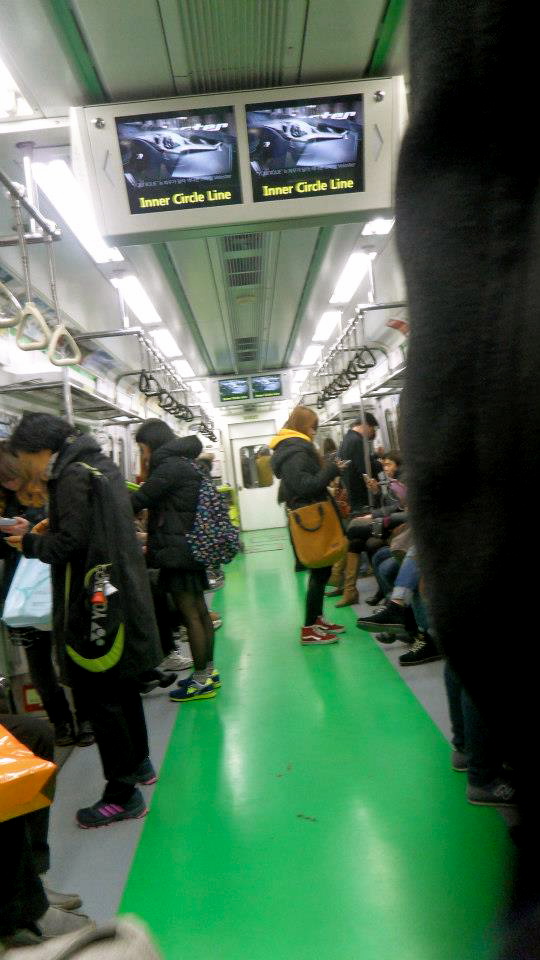
Subway in Seoul (on our way to the immigration office) to apply for our alien card

Subway in Seoul (on our way to the immigration office)

Before school started this week, the Yonsei International Committee organized many welcome events such as parties and dinner. There was even a party for all exchange students at the universities in Seoul so we could get to know more people.

There were also a lot of events held related to the Mentors Club. The Mentors Club is the equivalent of UR’s Ambassador Club: exchange students are paired up with a Korean student who will help them adapt to the new environment and show them the best of the Korean life, culture, language, and traditions. Mentors and mentees are then grouped in cells (groups of about 25 people) that do things together, go out for dinner, or attend some cultural events. Last Friday some of my cell members and I met for dinner to learn more about Korean cuisine and traditions. We had some dish with chicken and vegetables (relatively spicy I’d say, but nobody else really agreed with me) and then we had this huge pancake with sea food (I loved it! It was so delicious and not spicy at all so I was able to eat loads of it) and makkoli (very refreshing beverage made out of rice). It was really fun (apart from the fact I wasn’t able to eat much of the food we were served)! And my mentor is really amazing. His name is Junhyung and he’s a senior at Yonsei with a great passion for djing. He’s also the leader of the cell so he’s in charge of organizing events. I loved how during that cell evening we were all able to get to know each other better and to learn more about Korea.

Seafood pancake and makkoli, a Korean food that I really like!

Seafood pancake and makkoli

Inevitably all the tours, new climate and environment, and very cold weather took their toll on me and I got sick (I know I was in Sweden last semester in temperatures of -8F and I didn’t get sick, but Korea is something different). It was frustrating being in bed the past few days; I just got here and I wanted to go out, explore Korea, and meet new people, but instead I was chained to the bed by my fever and cough. At least I did get better in time for school!

This week is the first week of classes. Initially I was registered for four classes: US-Korea Relations, International Conflicts and Cooperation, Free Trade Agreements, and German Romanticism (this one has a funny story behind it). I thought of taking Beginner Korean, but I just wasn’t able to fit it in my schedule. That is why I will participate in FLE (free language exchange) where I will be paired with a person who will teach me Korean and I will teach them one of the languages I speak. I am really looking forward to the program to start!

All of my classes seem really good and I like them, particularly Free Trade Agreements as the professor seems to be so passionate and knowledgeable about the topic (she used to work in this field in the US, Korea, and China) and as I don’t really know much about anything related to economics, this will be a new experience for me. All the classes I am taking are in the “Study Abroad” department and basically all students in the classes are exchange and/or international students.

German would have been the only class I would be taking outside the “Study Abroad” department if it wasn’t for a big misunderstanding I had about this class. On Tuesday I was supposed to have my first German class and I went to the assigned classroom. The professor comes in and starts lecturing. IN KOREAN! I was so shocked. That was supposed to be a 300-level language class that at UR would be taught entirely in German, but Yonsei is apparently much different than UR when it comes to foreign languages. I was really sad as I was looking forward to my first German class in over a year. I had to improvise and get an override for the Modern Korean History class (also in the “Study Abroad” department). Now I am all set for the school!

Classes are structurally similar to UR classes as the final grade is based on attendance and participation, essays, projects, a midterm, and a final (unlike in Sweden where the final exam is 100% of the final grade). As this was the first week of classes we didn’t do much, just general introduction and course related explanations. Next week real lectures start.

The absolute highlight of this week was an Uppsala reunion I had with three Korean students I met while we were on exchange at Uppsala University – Taesung (he picked me up at the airport), Suji (she helped me get a Korean phone), and Eun Chong (back in Sweden we were in the same project group for one of our classes so we used to spend a lot of time together). In the spirit of the country (or the region) that bonded us, we went to the Scandinavian Design House near the Gangnam area (yes, like the “Gangnam Style” song). The was a Fika – Swedish Coffee Break café where we could get Swedish coffee, tea (or some other beverage) and typical Swedish cookies, cakes, and pastries (you can read more about the tradition of fika in the blog I was writing about my time in Uppsala last semester). We had kanelbulle and semla! They were so good – I really felt like I was partially back in Sweden. The most amazing part was seeing the three people who helped me make my decision about the spring semester study abroad destination and who helped me settle in once I got to Seoul. It was such a great afternoon and I had so much fun with Taesung, Suji, and Eun Chong. This was also kind of a farewell party as Taesung is leaving this weekend for Germany where he will be doing an internship until Fall.

My Korean friends who I met in Sweden - Teasung and Suji (Eun Chong left before we took the picture) - in front of the Fika place, where we enjoyed a typical Swedish tea time

My Korean friends who I met in Sweden – Teasung and Suji (Eun Chong
left before we took the picture) – in front of the Fika place

I guess now I have a bit more time to enjoy before the schoolwork kicks in, so I’m looking forward to the weekend! 🙂


Reintroduction (Jimmy in England)

February 27, 2013

Allow me to reintroduce myself. My name is Jimmy Maiarana and I am a junior at the University of Richmond. I am spending this year studying abroad in the biomedical sciences division of the University of Oxford. I wrote my last post on December 15 and took a long desired trip home to Buffalo, New York for winter break. I was originally supposed to continue blogging on January 10 in anticipation for my next two terms at Oxford, but today is February 26 and this is my first blog. I apologize to my viewers and to the University of Richmond International Education Department for this long absence. Allow me to use this time to fill in some gaps.

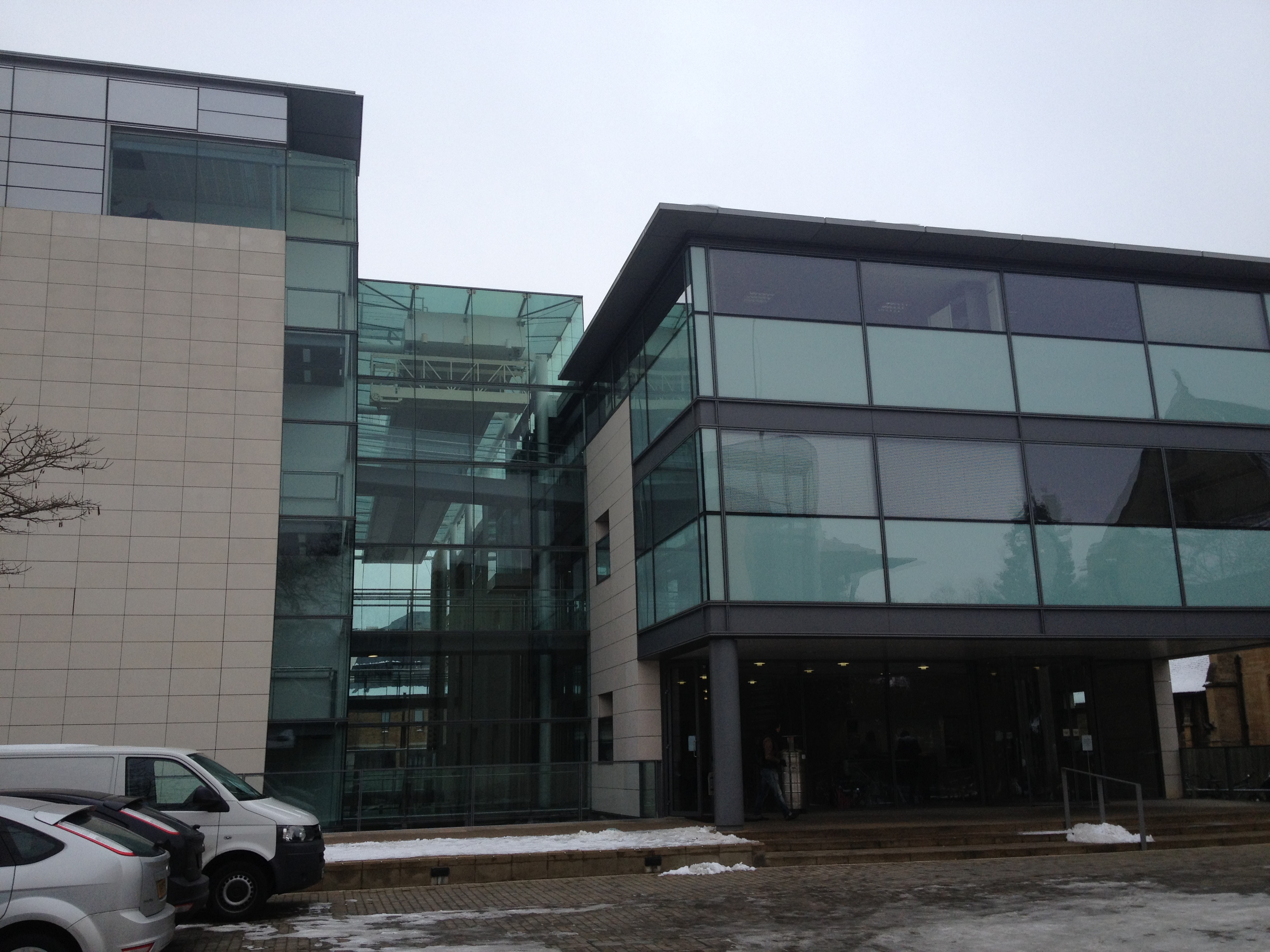
Before I left for winter break in early December, I had an interview with Dr. Jim Thomson in the Steve Davies group at the Chemistry Research Laboratory of Oxford. Steve Davies is the Waynflete Professor of Chemistry at Oxford and he is a genius. He founded two organic chemistry research companies, Oxford Asymmetry and Oxford Diversity, back in the early 90s and sold them for £316 million in 2000. He is also the founder and editor-in-chief of Tetrahedron: Asymmetry, an international journal that presents research on asymmetry in chemistry. Upon my return from winter break, I had a second interview. This time, it was with Dr. Davies. I sat down in his office at 9:15 a.m. on my first Monday back to England. His presence is felt anywhere he goes, and as I walked in he motioned for me to sit down and then asked, “What do you know?” I proceeded to explain my chemistry experience that I had received from Dr. Downey and Dr. Myers at the University of Richmond. After talking for what felt like hours, but in reality was probably less than 45 seconds, Dr. Davies stopped me and asked, “Do you know that you are in the best chemistry research laboratory in the world?” I could feel the mood in the room lighten a little, so I laughed and responded, “Yes.” He said, “No, I am serious. You are in the best research lab in the world. It’s time to get to work.” I left his office with a big grin on my face knowing that most of my next three months would be spent in his building.

The Chemistry Research Laboratory of Oxford where I am doing my chemistry research

The Chemistry Research Laboratory of Oxford

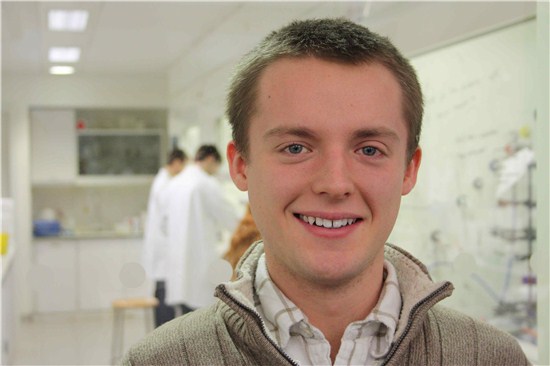
A picture of me posted on the "Academic Visitor" section of the Davies Group website, because I am researching for only a semester

A picture of me posted on the “Academic Visitor” section of the Davies Group website

Most of the students that work in this lab are Ph.D candidates and post grads. They arrive at the lab by 8 a.m. and leave after 6pm. Many of them come in on weekends as well. I have never seen such commitment in any field of work. These men and women love what they do and it shows in their results. There is also a high level of attention to detail. A minor mistake could lower yields and cost lots of money. I can now see why students that are placed in this environment succeed after college. They are challenged every day and they must raise their standards to such a high degree of excellence that they are bound to succeed. I have been working in this lab for seven weeks and most of my time has been spent there. On weekends I have been catching up on my actual tutorial work (I am still taking the normal major and minor tutorials). Needless to say, this term has been very busy but I wouldn’t have it any other way. Over the course of the next few posts I will explain some of the other activities that I have enjoyed and let you in on new insights in the lab. Again, I would like to apologize for my absence, but I am back now! Have a great day, and I will write again soon.

“To believe your own thought, to believe that what is true for you in your private heart is true for all men- that is genius. Speak your latent conviction, and it shall be the universal sense; for the inmost in due time becomes the outmost.” — Ralph Waldo Emerson, Self Reliance


Education and Experience (Posted by Blair in Ecuador)

February 25, 2013

We have now successfully made it through the first week of classes! For the SIT program, we have a Spanish Exam at the beginning of the semester, in which our language level is determined. In this SIT Ecuador program, the Spanish instruction is done through a program called Experiment in International Learning (EIL). EIL has a staff of Ecuadorian professors who have Spanish instruction education and experience. EIL also helped SIT with the homestay placements, so the Spanish classes sometimes incorporate specific interactions with the homestay families.

 The yellow bus gang is ready for our first day of school in Ecuador!

The yellow bus gang is ready for our first day of school!

On Monday, we were placed in our different classes; ours is the biggest class. We are seven girls sitting around our square table with Profe Vladimir at the white board at the front. School is in some extra classrooms of a state pre-school/childcare facility, so there is a picture of the pope and some holy crosses scattered throughout the room. The general class layout is a two hour segment of grammar, followed by an hour and a half of cultural learning, then a final hour of vocabulary and slang. We have breaks between each section and chow down some snacks brought by the EIL program, usually typical Ecuadorian food.

For instance, on Monday, we went over the subjunctive and conditional tenses, ate an Ecuadorian bread-wrapped-in-a-leaf snack called quimbolitos, read about the Incan history of the Valley of Los Chillos, then learned about the history of Ecuadorian slang and its connection to Kichwa, the language of the Incans.

On Wednesday, after learning about connecting words in the morning, we watched an Ecuadorian movie named “Qué tan lejos” about the journey of an Ecuadorian girl to get to Cuenca and break up a wedding. Throughout the whole movie, we were asked to write down Ecuadorian slang and our profe paused it every once in a while to make sure we were clear on what was happening. He also paused at points to talk about the Ecuadorian landscapes we were seeing and the different cultural aspects, such as the music, and political connections with the roadblock. We finished the day off with a game: each person chooses a Hispanic character, writes it on a piece of paper, and tapes it to their neighbor’s head. Everyone then has to ask questions to determine who they are. The best part was that our profe, the only guy in the room, was the only female character: Dora la Exploradora.

Class photo after the game, still with our character nametags which we used for the game in class

Class photo after the game, still with our character nametags

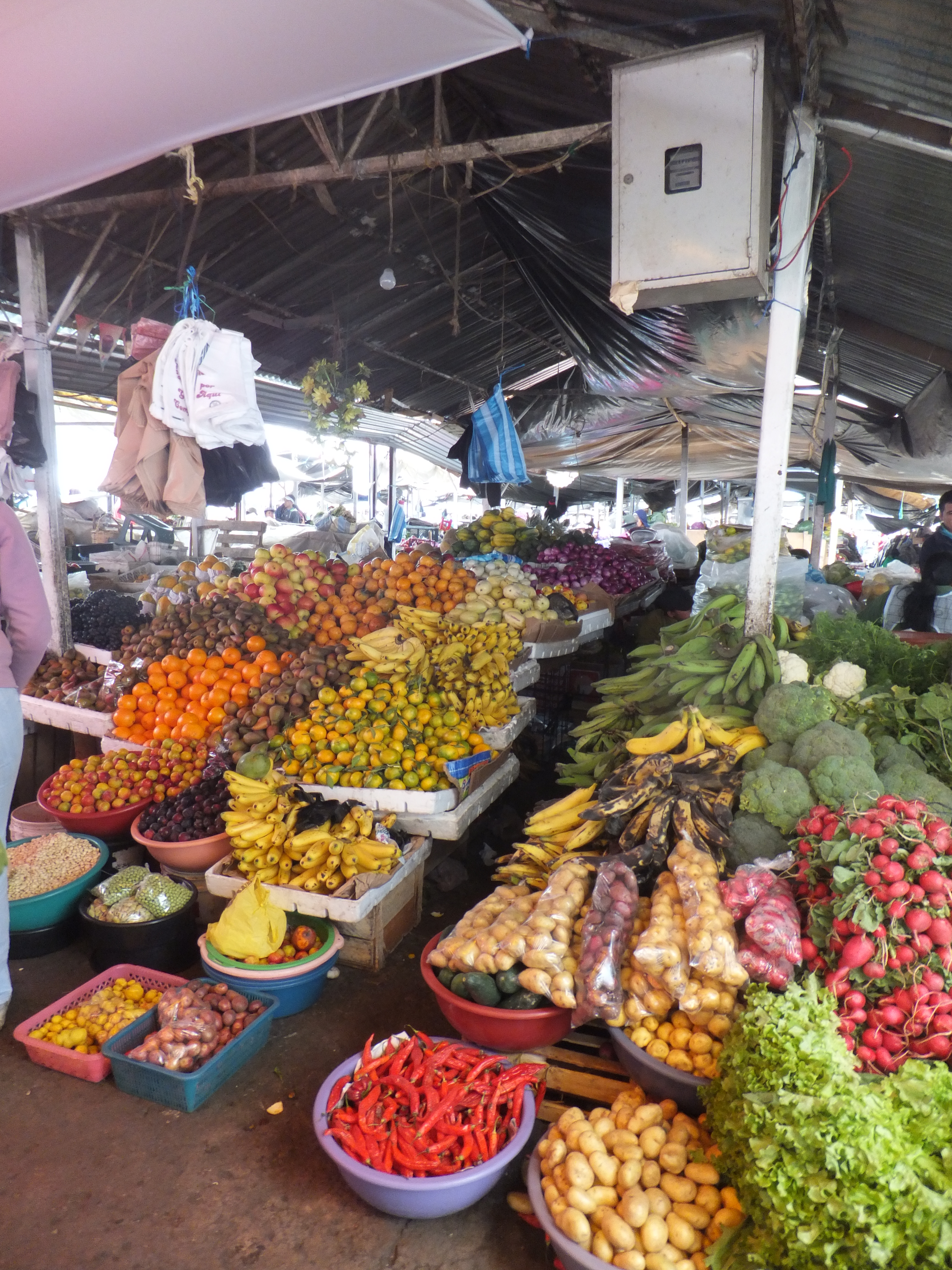
We also have special days that provide a different type of learning. On Thursday, we had a mini learning excursion into a nearby town, Sangolquí. We went to the church in the center plaza, where our professor told us about how the Spaniards used the Catholic church, from the architecture of the actual building to the masses and ceremonies held inside, to assert their control over indigenous Ecuadorians. Afterward, we went to the town park and library, where we read a bit about the history of the town and checked out the library. Sangolquí is a small town, much like Ashland, Virginia. However, its library is one floor of a tiny building with about 5 small bookshelves, 3 computers, and a stack of newspapers. Our profe was explaining that reading is not a popular activity among any age group, which is reflected in this library. We then went to the town market, where we spoke with some of the vendors about their sales, which have gone down significantly with the installment of a Wal-mart brand supermarket, MegaMaxi.

Profe Vladimir and class heading into Sangolquí Church as part of a class "field trip"

Profe Vladimir and class heading into Sangolquí Church

A tiny selection of the wide array of fruits, veggies, and other produce items at the main Feria of Sangolquí, a local market

A tiny selection of the wide array of fruits, veggies, and other produce items at the main Feria of Sangolquí

We also have had a couple academic seminars during this week. We have a 20 Questions activity that we have to complete throughout the semester. It is an opportunity for cross-cultural learning, with questions from “How much importance do people place on appearances?” to “What does it mean to be a part of a family?” and “How can you ascertain the importance of God in people’s lives?” There are four parts to the assignment: the first part is observations of how people naturally behave, followed by explanations of why this might be the case. The hard part is that we then have to talk with two or more people about what they think of our observations and explanations, but without simply asking them the question. The final section is reflections, in which we discuss how willing people were to actually converse on the subject and how the culture ties into the question and answers.

At first, I really felt this was a silly assignment, it seemed we could learn more simply observing and that the conversations would be uncomfortable. However, I have realized that the assignment leads to an essential learning and very informative conversations. People are generally very willing to talk about the question, they are often interested to know what I think and sometimes see an aspect of their own culture for the first time.

This program ensures that we are always learning. From waking up and insisting that I do not need to eat three pieces of bread with ham and egg along with my fruit and smoothie for breakfast, to navigating my way back home in the evening and attempting to discuss the day around the dinner table, Spanish class is the least learning of it all! More than just taking in information, we’re forced to analyze and use it every single day. I have to remember that my profe said that we do not throw things in Ecuador because it’s seen as rude, as well as the warning we received during a 20 Questions Seminar about lending things because you might not see them again.

The only source of knowledge is experience. -Albert Einstein 


Living, Learning, Loving (Posted by Blair in Ecuador)

February 22, 2013

The homestays are a very important aspect of the SIT program. I think the experience of living in a different culture almost requires this aspect. The families help us a lot with our Spanish language skills, as well as cultural behavior learning, information about Ecuadorian society, and, obviously, the quintessential family love and caring. I can go to my mamá when I have a headache, when I’m frustrated with my classes, even when I feel really confused about being here in Ecuador.

More than just living with a family, we often have homework assignments that incorporate them. Sometimes it’s something as simple as talking with them about an Ecuadorian movie we’re watching or a news item we talked about in class. Later in the semester, we have to write a Personal-National History Essay about a historical event in Ecuador that also affected some family member of ours and how his/her personal account compared to the history books. These little assignments help us learn about the history and culture, as well as to form a closer relationship with our family members.

Living in a homestay certainly has its difficulties as well. It sounds so silly, but after “moving out of the house” into university housing, I felt that I was in control of my life: how I spend my time, what and when I eat, when I sleep, when I get to simply have some alone time. This homestay is quite an adjustment. Now, I depend on my host mamá for my food, for clean clothes, and for help in absolutely every part of life.

Mamá prepares and serves us all the food, sets and clears the table, washes the dishes, stores the food, and the kitchen is spotless again before I know it. Still not sure how she does that… I still don’t know how to boil some water for tea on the gas stove because she’s in the kitchen asking what I would like before I can even find the kettle!

I have washed my own clothes for myself at home since I was about 14, when thought I was too grown-up to have my mom do my laundry (I don’t remember her objecting too much). I have no idea how to wash clothes here… and the machine is even in English! Apparently you have to hook up some hoses though, lesson learned. But my mamá simply insists upon doing it.

I went to the pharmacy with my mamá the other day when we were running some errands and I remembered I ran out of band-aids. When I went to buy them, not only did I have to ask my mamá how to say band-aid, she had to explain to me that No, you don’t buy an entire box of band-aids, who would possibly need that many? About 10 minutes of explanation later, we left the pharmacy with 5 individual band-aids.

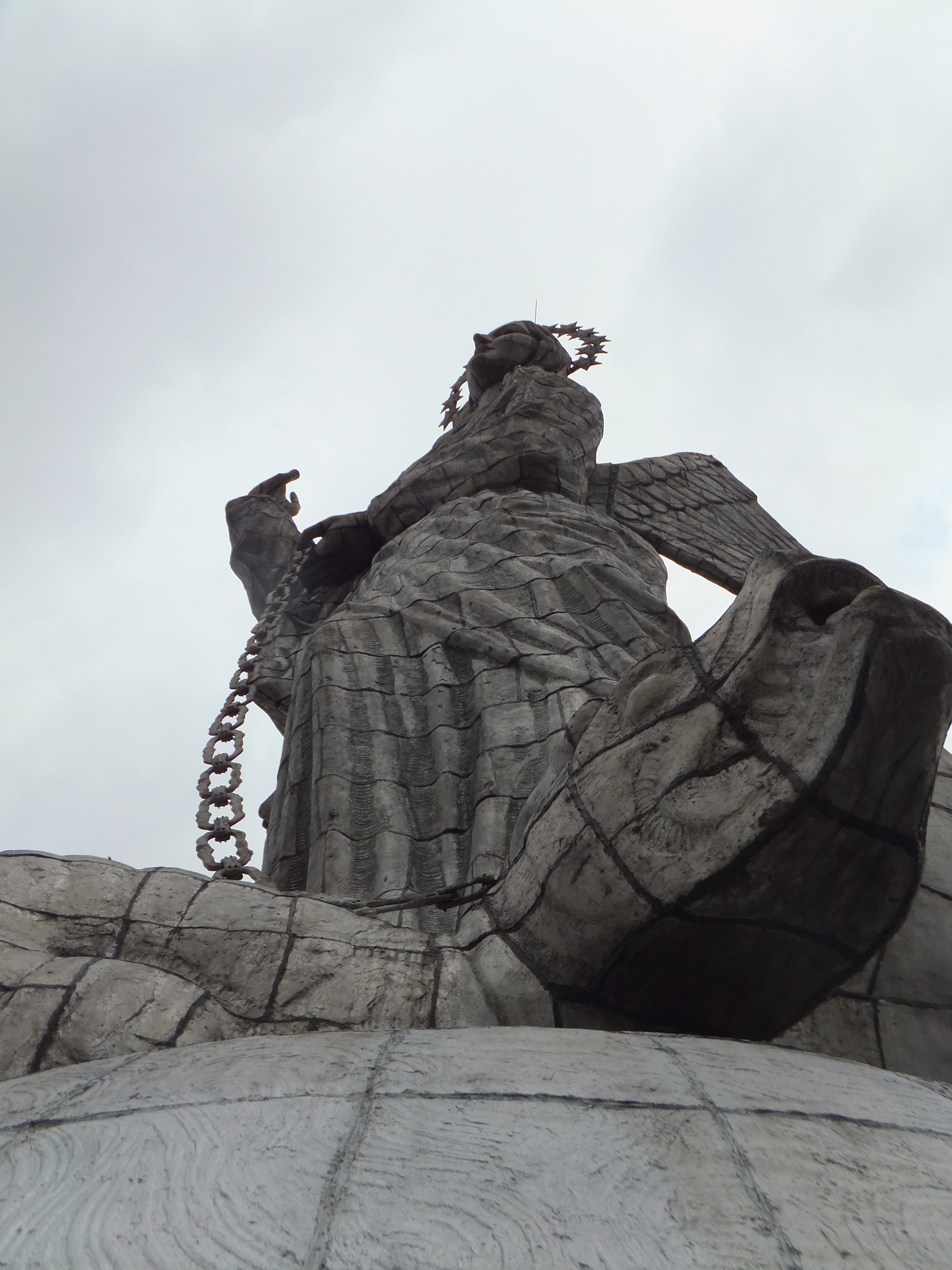
Apart from Band-aid runs, we get to go out with our families and they show us around their city. We went on Saturday afternoon to the Virgen de El Panecillo, a hill in the center of Quito where a priest built a large Virgin Mary back in 1976. From that point, you can see all around the city of Quito, much like the panoramic view I got to see from the Volcanic mountain hike on my first day here [see Centers of the World (Posted by Blair in Ecuador)].

The Virgen de El Panecillo from directly beneath, after climbing many flights of stairs for a better view of the city, Quito

The Virgen de El Panecillo from directly beneath, after climbing many flights of stairs for a better view of the city

My host dad pointing out the historical churches of Quito's Old Town, after climbing to get a better view of the city

My dad pointing out the historical churches of Quito’s Old Town

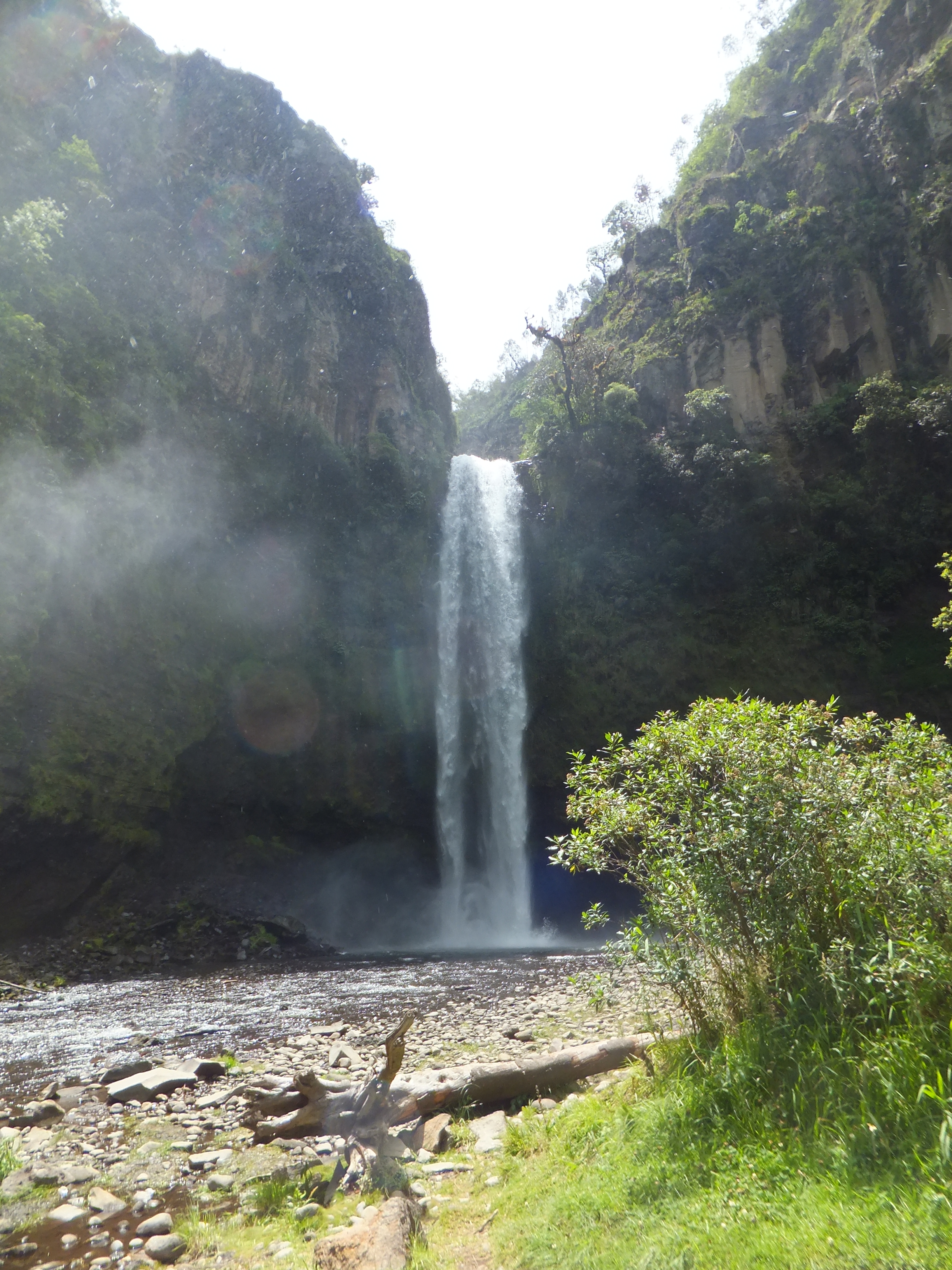
We also got to go to Molinuco Falls on Sunday, which is a HUGE waterfall at the end of a lovely hike. The walk there includes smaller waterfalls, some pools where you can swim, even a ‘Meditation Pond!’ For an idea of the size and force of this waterfall, you should know that I could feel the mist from where I was standing in the photo below!

The GIANT Cascada Molinuco (waterfall); it was so powerful I could feel the mist from where I was standing!

The GIANT Cascada Molinuco

The option to live in a different culture, in a society different from mine, to share with the people of that society, and to live for some time in a different country is a rare opportunity. Not everyone can spend a year of their life hopping between countries due to their committments. I believe many people also prefer to stay in their safe and comfortable space. However, the information and the lessons that I will have learned by the end of the program, whether learned in the classroom, in the daily activities of my family, or during the excursions we take, will make this an unforgetable semester.

Go to the people. Live with them. Learn from them. Love them.” Lao Tzu

P.S. My family prefers that I do not write about them personally in this blog. We will also be living with a family in a different section of Quito beginning in March and I hope to be able to talk a bit about them.


Bernin it up! (posted by Pierre en Suisse)

February 22, 2013

Bonjour à toutes et tous! This is to say, hello to all ! This is typically how emails that I receive from the University begin. For those of you who are not familiar with the French language, toutes and tous both mean “all,” so essentially I just said hello to all! However, in French there are also the different genders. As such, it is necessary in various circumstances to use both the masculine and feminine forms when sending mass emails or writing to many people! It doesn’t happen all the time, but it does often with official emails. Hope you enjoyed your free French lesson of the day!

What a whirlwind the past two weeks have been. To sum it up really fast before reading on, I have experienced fondue and the festival known as Carnaval. Within the course of a quick four days, I feel as if I got a lot of Swiss culture really fast, but it was all amazing! I will start with the food.

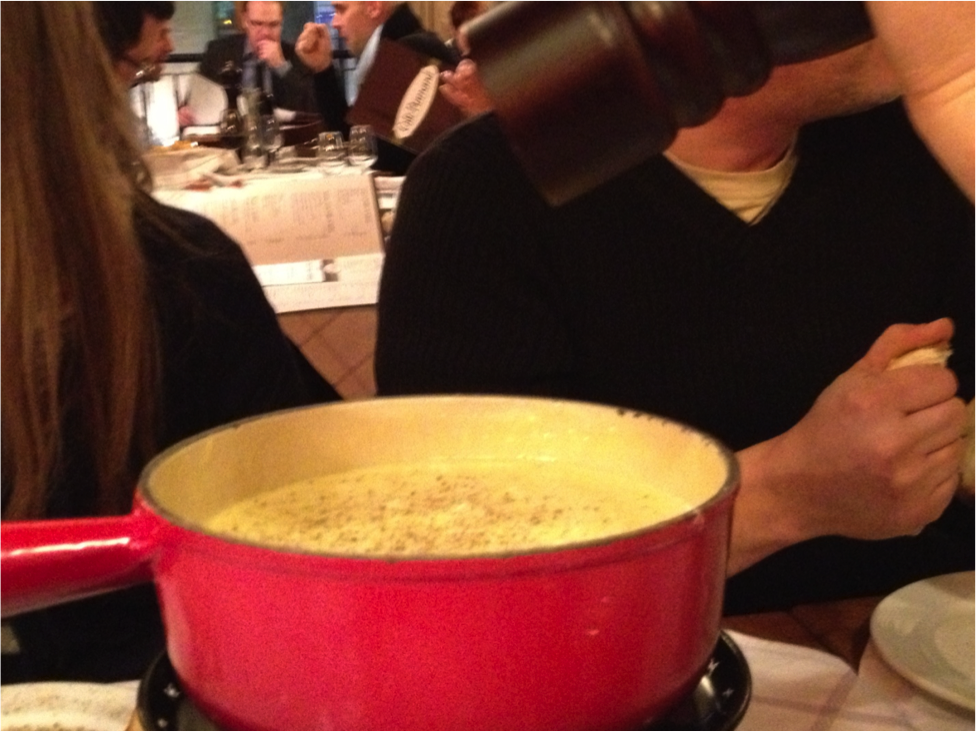
Last week, I went out to fondue with my cours de vacances class, which you may remember reading about in my last entry. Fondue is a very traditional Swiss meal. It is not the typical chocolate fondue that we like to think of using fruit, although one can find it. Rather the Swiss eat bread, a mixture of cheese, and then finish the meal off with wine or tea. The cheeses most typically used are gruyere and emmenthal, melted together in a pot. At the restaurant, we were presented with a plate of bread, and it is your job to take a piece, break it up, put it onto the “fork” and cover it in cheese.

Cheese for the fondue! Bread is dipped into this pot

Cheese for the fondue!

The utensil used was something that I’m used to roasting marshmallows on. It is also critical to make sure you don’t delicately or lightly cover it just to taste the cheese. It was completely obvious to all Swiss people around me that it was my first time eating fondue. I was instructed by a friend who comes from the German part of Switzerland to completely sink the piece of bread into the cheese, then pull it out and let the excess cheese fall off. One also must pay close attention that the bread doesn’t fall off of the “fork” because then the person who lost it needs to either sing or do some other embarrassing task that the table decides. Luckily, this didn’t happen to me. When the cheese is all gone, there is usually some burned cheese left on the bottom of the fondue bowl. According to the fondue experts, this is the best part, and cannot be left! I tried it and must say I loved it. While this entire meal is going on, you need to drink either white wine or tea with the fondue. Otherwise, your stomach is going to be left to digest a block of cheese. While it was very filling and unlike anything else I’ve ever eaten, I did absolutely love it and I am excited for the next time I’ll get to try it!

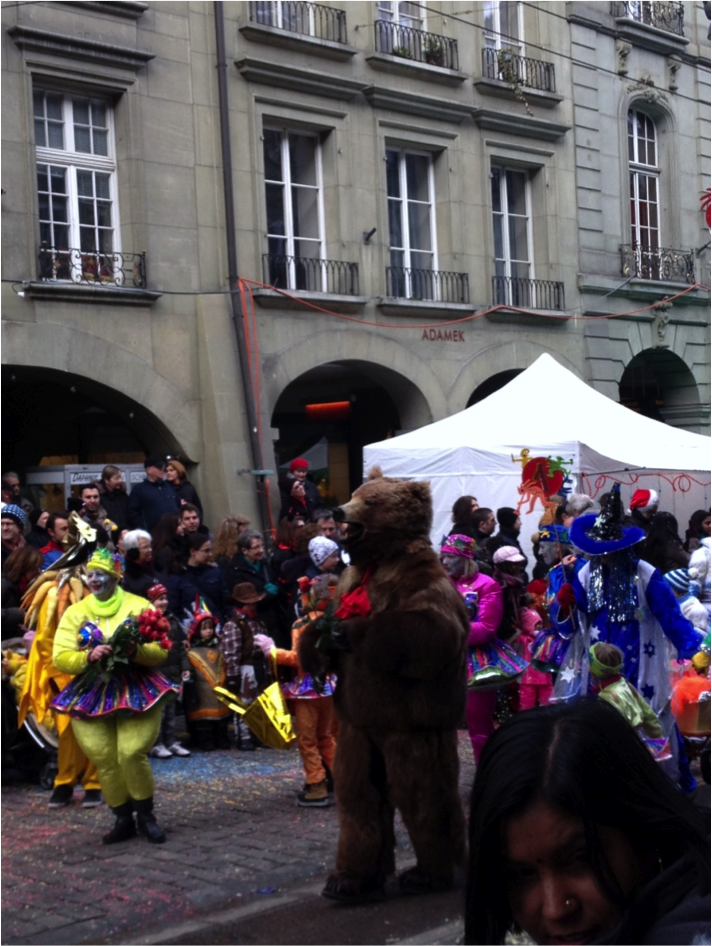
The food experience certainly doesn’t stop there. This weekend I also got to go to a Swiss festival known as Carnaval! It is very similar to the idea of Mardi Gras, though it happens throughout the country on various dates, beginning anywhere from the weekend before Ash Wednesday to the end of May in some cases. On Saturday morning, a friend and I hopped on a train and headed into Bern for Carnaval in the Swiss capitol city. After a breathtaking train ride through the mountains, we arrived in the city, without a single idea of where to go! Our friend who had planned it wasn’t able to go at the last minute, so we had to improvise in order to figure out where to go. The one thing we did know about Carnaval is that people would be dressed in very colorful costumes. Luckily, we saw some people dressed up for the party and followed them from the train station into the city, until we found where we were supposed to be. Along the way, we saw some of the famous sites such as the Swiss Parliament building, and the most elaborate clock tower I have ever seen (so far). Included in this tour was trying probably way too much food that we found at various street vendors lining the main street of the festival. We ate things such as tarte flambée, crêpes, and of course, German sausage. With our stomachs filled, we lined the street with the rest of the carnaval-goers! In Bern, it is tradition to commence carnaval celebrations with a freeing of the bear that had been captured and held in prison for its winter sleep, and so the parade begins with the bear leading the way.

The carnival parade starts when the bear comes marching through the street!

Parade starts when the bear comes marching through the street!

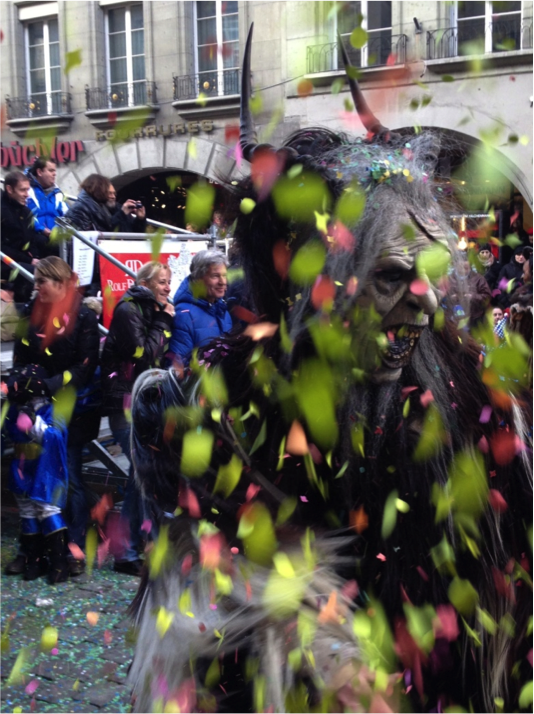
After the mascot passes through the street, there are marching bands dressed unlike anything you will ever see in your life, playing all kinds of music, and throwing candy to the crowds. There is also a lot of confetti throwing. If you ever go to a Carnaval in Switzerland, don’t be surprised when a kid maybe as young as six year old looks up at you, takes a handful of confetti from a bag, and throws it right up at you with a huge triumphant smile. People usually have confetti of their own to throw right back at whoever throws it at them, but my friend and I didn’t know about this before everything began, so we generally just laughed with surprise when we would get covered in all sorts of colors. I absolutely loved Bern! The city was truly quite beautiful and the festival was amazingly fun!

So many colors at the carnival parade!

So many colors!

There were many creatures like this who also joined in throwing confetti throughout the parade

There were many creatures like this who also joined in throwing confetti

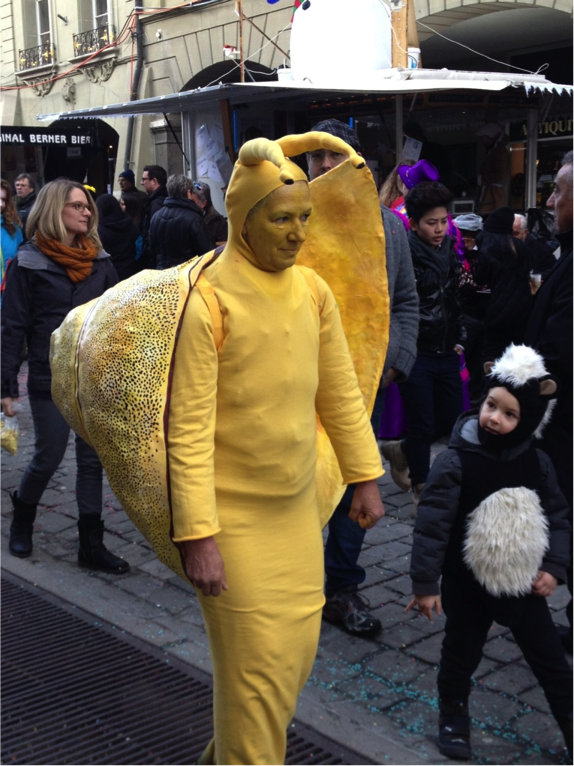
Probably my favorite site at Carnaval was this lady, who was dressed like a snail and walking at the same speed as a snail (despite kids throwing confetti at her the whole time).  A good idea of the carnival atmosphere

Probably my favorite site at Carnaval was this lady, who was dressed like a snail and walking at the same speed as a snail (despite kids throwing confetti at her the whole time)

This week has been the first week of classes. Stay tuned for my next post to hear about just how very different of an experience trying to get settled into classes here at a large university has been, and also to get a glimpse of some photos of the Alps, as this weekend I’m headed skiing! Thanks for reading, and à bien tôt!


Courses, Travels, and Cheese (posted by Pierre en Suisse)

February 13, 2013

Salut! I am now entering my third week here in Switzerland, and I can comfortably say that I’m getting settled into life here. Over the past two weeks, I have been participating in the University of Lausanne’s cours de vacances (vacation course). The course is designed for people of all ages and all levels of French who wish to improve their French language skills. There are three different levels, and I am in the class which is essentially been a preparatory course for taking classes in French at a Francophone university for students whose maternal language is not French. The class has students from all over the world; I have met people from the German part of Switzerland, Russia, Australia, Mexico, and other places, of a variety of ages as well. I am on the younger end of the spectrum, as the course is open to people of all ages who wish to improve their French. With such a diversity of people, it is pretty amazing to hear all the languages that can be spoken at once. One morning in particular, I remember reading an article in English while having a conversation in French at the same time, and hearing people speaking German around me; while all this was happening, one Russian girl even began speaking to another in Russian at one point to figure out how to say something in French. Yes, it can be a tad confusing at times but overall I think it is amazing.

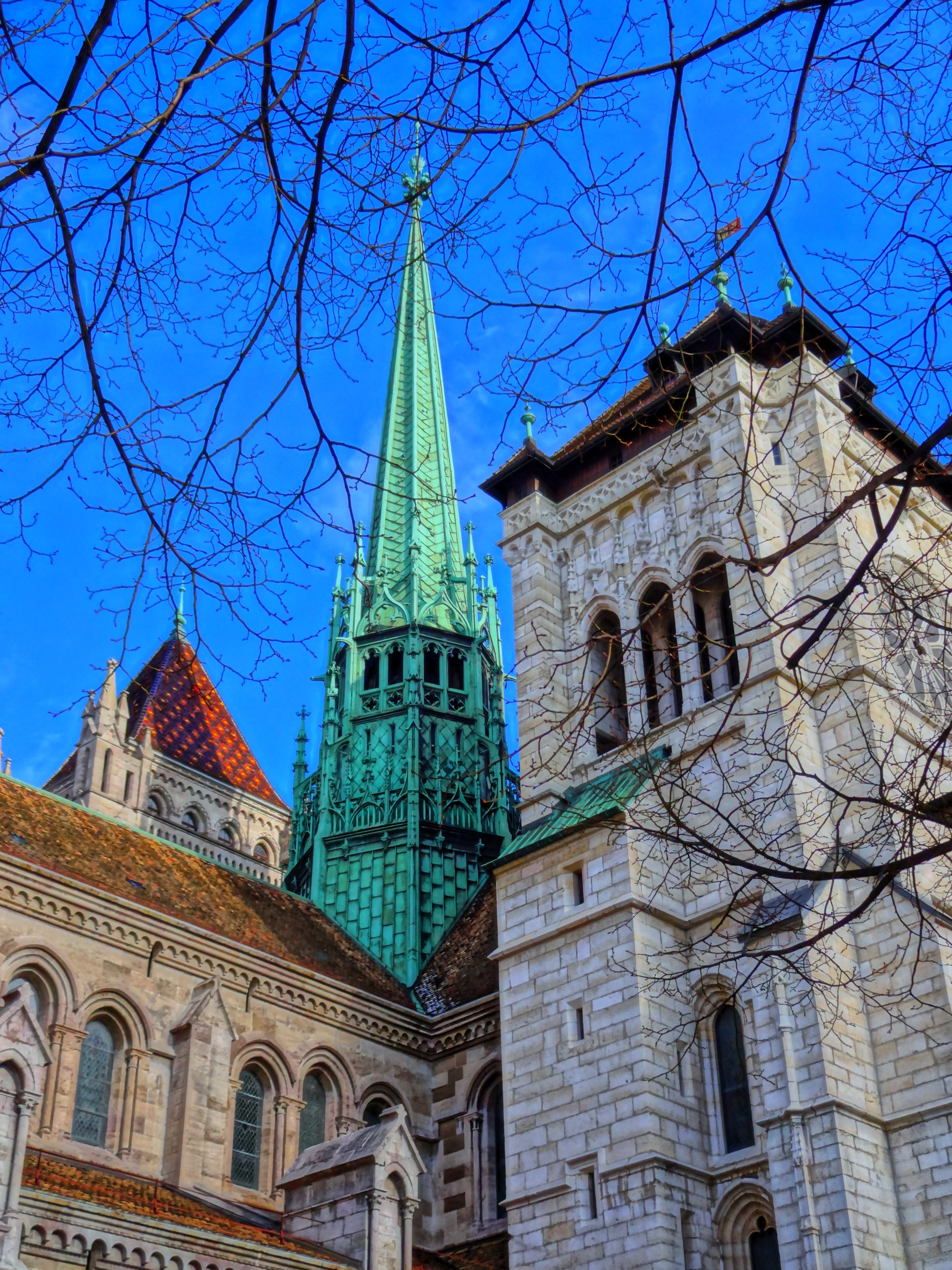
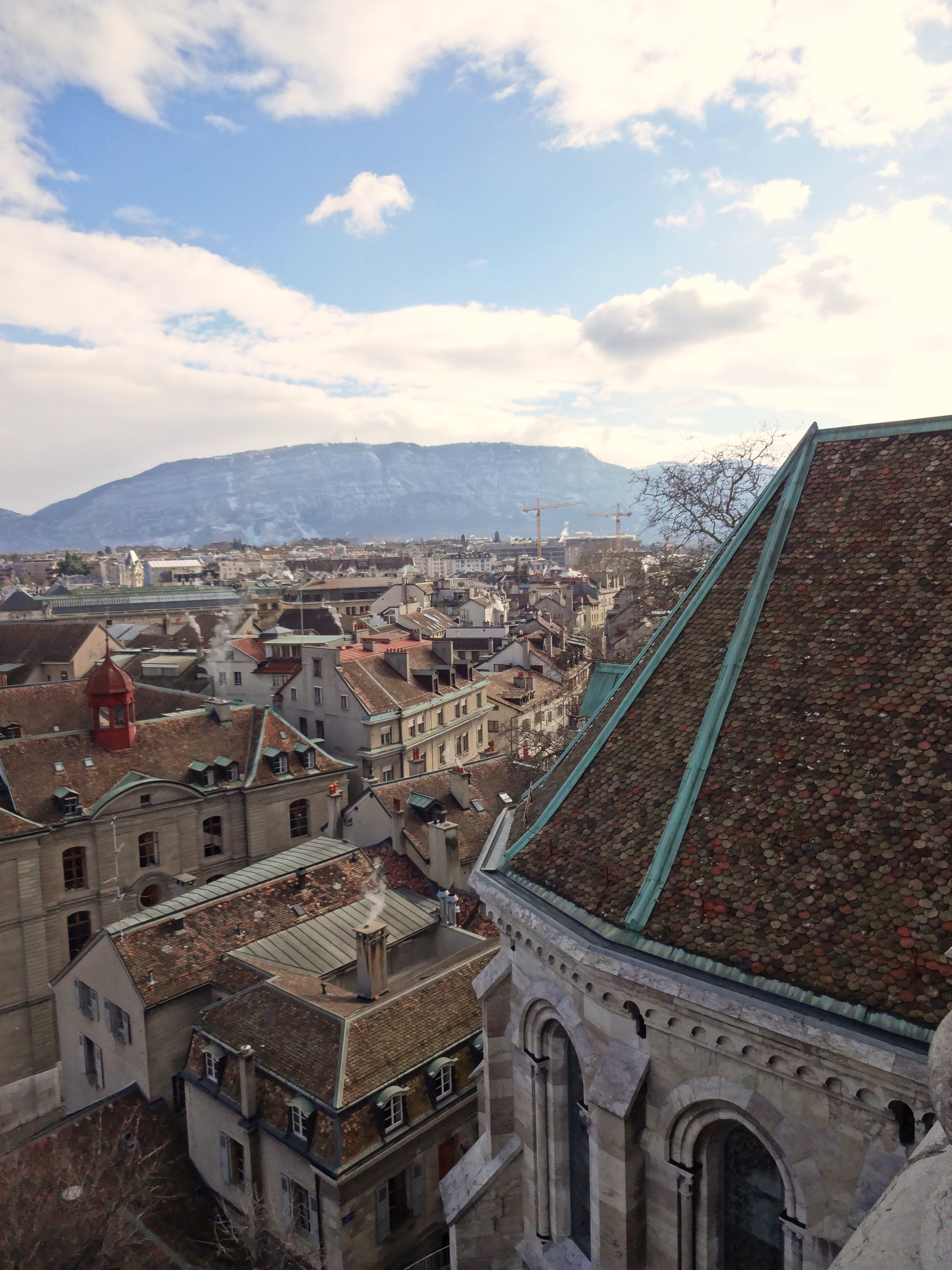
One day after class last week I hopped on a train to go to Geneva. The university has a program that pairs exchange students with Swiss students to introduce us to Switzerland and help us get adjusted as well. My partner lives in Geneva right now. Luckily, the Swiss rail system is incredible, and after a quick half hour train ride without a single stop from Lausanne and some really pretty views of the snow-covered Swiss countryside, I was back in Geneva! This time I got to see more than just the inside of the airport; I got almost a full tour around the city!  I learned quite a bit about the city that I didn’t realize before, such as the fact that the famous philosopher Jean Jacques Rousseau was born there, and not in Paris as many people believe. I got to see his statue, and also the entire city from the top of a church roof!

Statue of Jean Jacques Rousseau in Geneva!, because this is his birthplace

Statue of Jean Jacques Rousseau in Geneva

Went to the top of this church in Geneva and got a view of the entire city!  It's truly beautiful

Went to the top of this church in Geneva and got a view of the entire city

This is a rare occurrence in Switzerland at this time of year, because of how much it likes to rain and be cloudy in these parts during the winter. The city seems like quite a great place to live! There are a ton of parks, places to go swimming, and beautiful views.

View of Geneva from the top of the church! Made possible because of gorgeous weather

View of Geneva from the top of the church

The city’s public transportation network, just like that of the other places in Switzerland I have seen, was also quite interesting. There were buses and trams, which were a new site to me. I am extremely interested in urban studies, and as such it was really cool for me to see how advanced the city was in its transportation network. I’ve found that its the same in Lausanne. The metro lines are always running on time, and are so very clean and up to date. The buses even generally run on time, except for a few very rare times that they have been one or two minutes off in the morning rush to work and in my case, school. The Swiss stereotype of being on time definitely holds true!

I am also happy to report that the chocolate has been incredible, as I was expecting. I will admit I never go a single day without it. While prices of basically everything are really expensive here, the grocery stores always have bargain products which are still an incredible quality, and cost far less than the rest of the selection. I won’t lie though, going to the small patisseries and fromageries is my favorite shopping experience. My flatmate and I walked into a patisserie one morning for croissants for breakfast, and we essentially began drooling over everything we saw. The assortment of breakfast foods and breads just looked so good! The two ladies who I am assuming owned the store saw the looks on our faces and had to ask us if everything was okay, we were just so excited! We explained how we were here on exchange and this was our first time in Switzerland with a selection like what was there. We got pain au chocolate aka croissant-like bread filled with chocolate, and then a croissant au jambon which is a croissant filled with ham and cheese. Another time, I visited a small cheese shop, called a fromagerie to buy local cheese. I had asked a Swiss person for some advice on what to buy since there are just so many cheeses, and I wanted to try something really local to the area. Armed with some recommendations, I went in and was still overwhelmed, but I explained to the shop owner in French that I was American and I was here for studies and was investigating cheese. He helped me out quite a bit with the different types of cheeses and sold me two very traditional cheeses, called emmental and gruyere, just to start me off. He also explained to me that it would be a good idea to start off with lighter cheeses before moving on to the stronger stuff, so I really appreciated his advice! I made a second trip back there after I finished my first cheeses and they remembered my face and helped me buy other types after I told them what I liked! Can’t beat service like that!

Needless to say, life so far in Switzerland has been great! I am enjoying my time here immensely, and am really looking forward to next week when I will be starting real classes here at UNIL. I have some ideas of what I will take, but nothing set in stone just yet. More on that next time though!


Last night in the US! (posted by Pierre en Suisse)

January 25, 2013

Hello! Or as they will say in Switzerland, bonjour! My name is Peter CampoBasso, and I will be writing this blog over the next twelve weeks about my journeys, trials, and tribulations in Switzerland. Why so dramatic about the trials and tribulations? I have never been abroad before! This will be my first time ever leaving the safety and comfort of the United States, unless you count my family’s one trip to Niagara Falls, where we were on the Canadian side for less than twelve hours. We didn’t even need passports back then! Thus, tomorrow will mark the first time in my mind that I have ever left United States territory!

Why did I choose to study in Switzerland? I was looking for a program in Europe where I could have a truly authentic European experience, but also where I could speak French. I chose this program in Lausanne over another in Paris because this would be an exchange program, meaning I would be studying at a European university with European students, rather than an American-run program with other American students. I thought this would help me to better practice the language, which is ultimately the real reason I am studying abroad. No better way to learn French than to be in a Francophone country! I am a Leadership Studies major with a concentration in Urban Studies, and a French minor along with an Education and Society minor. The classes I had to choose from at this University that I could take in French all seemed to fit most in line with my interests. Plus, I am enrolled in a three-week long French immersion program to prepare my language skills for the university classes. This was one of the biggest draws to the University of Lausanne, because no other universities that I was looking at offered a comparable program.

If I attempted to say that I wasn’t nervous about going, I’d be lying. Yes, I am looking forward to speaking French every day to the point where my brain hurts, yes I can’t wait to have a beautiful view of both the Alps and of Lake Geneva (or Lac Leman as I understand the locals call it) every day for the next five months, and yes I can’t wait to eat absurd amounts of Swiss chocolate. And not to be stereotypical, but I am so excited to live at Euro-sophistication status while I am away. But again, this being my first time leaving the US, this is bound to be a memorable experience.

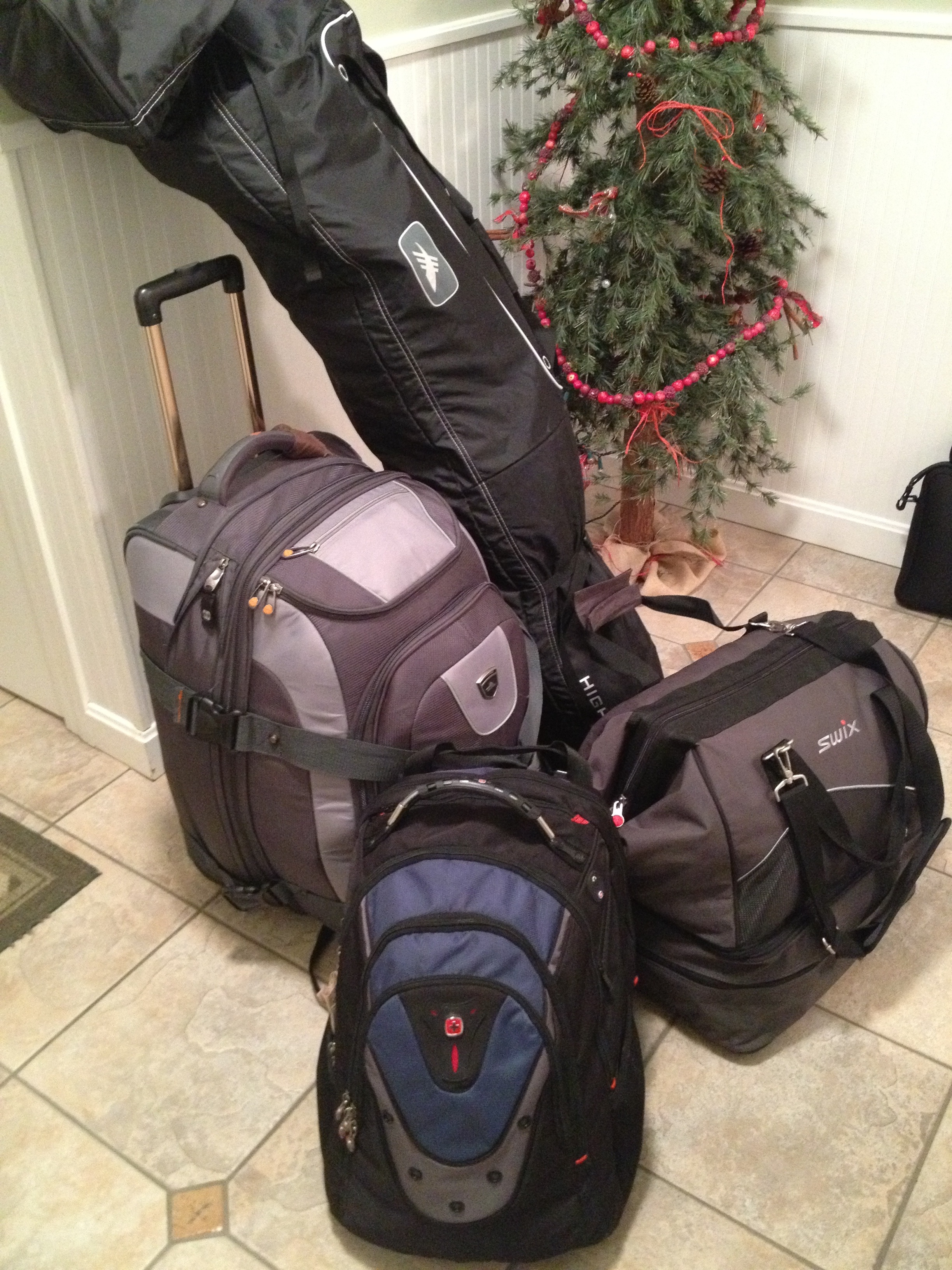
The first day that I land will be one that I will never forget. I will land in Geneva after a nonstop flight from New York City, and have to navigate the Swiss rail network on my own to get to Lausanne, which is about an hour train ride. I hope I don’t get lost! I have this recurring nightmare that I will ask someone for directions, misunderstand them, and end up on a train to the Principality of Lichtenstein or something. Assuming I get to Lausanne in one piece, I will have to find my way to my hotel where I will spend the first two nights, and spend the rest of the day trying to entertain myself. Maybe I’ll do something productive like get things I need, such as bedding? Definitely not. I’m going to explore, the second that I drop all of my bags off in my room. If there’s one thing I learned from packing tonight, it’s that suitcases can fit far more than any suitcase company wants you to know. Every single empty air space in mine is packed with something. I was pretty impressed when I finished!

My packed bags.  I give the international students who can travel with less so much credit!   It was so difficult to pack for the semester!

My packed bags. I give the international students who can travel with less so much credit!

My biggest fear is honestly language. I feel pretty confident with my French language skills, but what if the Swiss have an accent I cannot understand? What if I can’t find the words to express something I want to say? Will I just have to speak English? I started taking French my first year at U of R, and two and a half years later, I find myself on the eve of leaving for the real test of what I’ve learned. One of my major goals is to speak as little English as possible so that I can improve my French immensely. I am confident this will happen.

In any case, I am as ready as ever to get on that plane! After seeing the Inauguration on Monday and having a stereotypical American dinner of burgers and fries, I can safely say that the past few days have been especially America-filled.

Last "American" dinner with my family, the evening before leaving for Switzerland

Last “American” dinner with my family!


I’m ready for my journey. In my excitement to go abroad, I have been checking the weather in Lausanne every day for the past three months. I expect it to be around freezing with some snow on the ground. I am going armed with my new pair of boots I got in expectation of more snow than we could ever imagine in Richmond. It sure is a good thing that I grew up in New England and love winter! Be on the lookout in the next week for my post about my arrival! I will report on how well (or miserably) my first day goes, and have some pictures of the scenery! À bientôt!


Uppsala: A Journey of Discovery (posted by Indira in Sweden)

January 4, 2013

The time truly flies by. It’s already 2013. 2013… it feels really weird to write that number. Since it’s the New Year we all makes wishes and hopes as compared to the previous year(s). I was thinking really hard, but my 2012 was good on so many levels that I honestly didn’t want it to end. My semester abroad in Uppsala definitely plays a huge role in that.

Today when I checked my Facebook there was an entry saying: “Graduated from Uppsala University” and then it hit me – wow, that was really it. The best semester yet is over, but I learned so much about Sweden, as well as other countries, traveling, people, my major, and most importantly about myself. The last 5 months in Uppsala have truly been a journey of discovery. I started learning a new language, learned how to cook (I’m really proud of this one), figured out how to live on my own, mastered the art of constant cycling, made friends from all over the world, survived Swedish winter (which involved -7F temperatures and a major snowstorm), travelled a lot, attended a Nobel Lecture, took some amazing classes, gained the experience of living in Sweden, and so much more. It’s really hard to remember everything I went through over the past semester. Sometimes it feels like August was just yesterday, but then again when I think of everything that has happened since, August seems so far away.

The Swedish summer truly is amazing: You learn to appreciate every second of the sunshine, enjoy countless barbecues in parks and on the rooftops, and buy a bike. Uppsala looks absolutely breathtaking in summer – there is green everywhere, city parks and squares look stunning, and people are so happy.

A scene of summer in Uppsala

Summer in Uppsala

Fall is no less impressive: Uppsala puts on new clothes and amazes everyone with its colors. The whole city looks like it came from a fairytale scene. Golden and red leaves, somewhat pleasant cold, and warm sunshine, as well as rain create a perfect atmosphere to spend hours in cafes drinking some hot beverage, eating cake or a cookie, talking to friends, watching people, or simply studying. Fall In Uppsala has it charms for sure!

A beautiful scene of fall in Uppsala

Fall in Uppsala

Before you can notice, the rain is replaced by a snow layer and golden leaves are nowhere to be seen. That is a sign that another glorious season has arrived in Uppsala – Winter makes a grand entrance and it doesn’t cease to impress. It is not hard to enjoy Swedish Winter even with the cold and snow: Glögg, Julmust, fikas, sledding down the Flogsta or Uppsala caste hill, cycling in the snow adventures, and snowball fights can definitely make anyone enjoy Uppsala even during its most cruel months.

A scene of winter in Uppsala

Winter in Uppsala

Seeing Uppsala change through the seasons is like seeing yourself grow fonder and fonder of this place, but also seeing yourself grow as a person. There is something magical about it. I feel Uppsala is home. But that is not the only reason why someone would want to study abroad in Sweden; the list of things one can love about Uppsala is very long:

  • Uppsala University is an old and prestigious university
  • Diverse classes
  • Great professors: knowledgeable and chill (you can go for fika with them)
  • Mixed student body: a lot of internationals from all over the world and Swedes from every part of Sweden
  • You are very much in charge of your in class experience: some classes are not mandatory and you choose your seminar groups
  • One class at a time system: you take only one class and you focus on it for about a month, take the final exam and then move on to the next course
  • Campus makes up most of the city and the buildings are in different parts: great way to explore the city
  • Each building is unique in its own way and has a story to tell
  • Attend Nobel lectures: Need I say more?
  • Chance to make friends from all over the world
  • New culture, language, traditions
  • Everyone speaks English: In the beginning when I needed help with something I would always first ask if the person spoke English but then I would just go over and ask for help right away. Basically everyone is bilingual in this country
  • Flogsta: you get to live in the most amazing and fun accommodation area ever! Ever thought of a 500 person Halloween party in two corridors? Well, that is how wonderful Flogsta is. The party was even featured in the local newspaper!
  • Your corridor: you corridor-mates become your family and your corridor your new home. Corridor dinners and parties are definitely one of the best part of dorm life in Uppsala.
  • Cycling: you get to cycle everywhere, anytime. And you’re gonna love it. Seriously.
  • Ekonomikum: Most amazing place to study, chill, or simply get some snacks
  • Blåsenhus: probably my favorite building. One part of the building looks like a spaceship hovering over the entrance hall. Great place to study or get fika
  • Carolina Rediviva: the most beautiful library ever. Even if you don’t have to study, you simply go there to hang out since it’s so cozy
  • FIKA! Forget Starbucks or whatever you consider to be “the best coffee ever” because I’m sure nothing beats Swedish fika. Just imagine great coffee/tea with amazing pastries, cookies and cakes, cozy kaferummet atmosphere, and the warmth of the people around you while it is snowing outside. And you get to do this for hours every day. One of those “I don’t think life can get any better” moments!
  • Kanelbullar: Oh, sweet love o’ mine! Cinnamon buns/rolls that simply taste great. Oh, and there is a day dedicated solely to this delicious treat: Kanelbulledag.
  • Marabou: best chocolate ever! Don’t even try to argue it. I mean it.
  • Music: Do you love house? Electronic music? Well, then Sweden is a heaven for you. Everyone makes music (I don’t think it’s even possible to keep count of how many people who make music I’ve met) and Sweden’s home to Avicii, SHM, Adrian Lux, Alesso, Lykke Li and many others.
  • Student nations: It’s really hard to explain, but once you get here you’ll get it. BEST thing ever! Every university should have them.
  • Great night life!
  • Stockholms nation’s lunch: make sure you get there at 12 sharp otherwise you’ll spend some time waiting for the deliciousness prepared by the Stokcholms nation’s Kökmästare
  • Värmlands nation’s bread: I don’t think I ever had better bread. Definitely worth going for the lunch at Värmlands. Make sure you start queuing at noon.
  • Gasques: there is a gasque for everything (newbies gasque, Halloween gasque, Fall gasque, Christmas gasque, Lucia gasque, and even Doomsday gasque)
  • Uppsala: it’s a student city so literally everyone is organized in a way that serves the students.

I think those reasons are more than enough to make anyone want to study abroad in Uppsala. I couldn’t have asked for a better semester. Coming to Uppsala was one of the best decisions I ever made. I fell in love with the city, country, and the people – I plan to go back one day. Maybe even sooner than I think. I actually remember my first month in Sweden when I met so many international people who live/work in Uppsala and they kept telling me that one day I will be back to Uppsala (or at least Sweden) for whatever reason, and could quite possibly make this place my home. I sure hope they are right, but right now I should focus on Seoul.

In less than two months I will start a new adventure on the other side of the world; with new people, a new system, new language, new culture. It is frightening, but also exciting. Knowing that the new adventure awaits around the corner makes me miss Uppsala a little bit less. New year – new adventure. And I’m more than ready to embrace it in the fashion of the words of one of my German friends: “Vollgas!”. 🙂