Camellia Travels the World: Special Month in Chile

October 21, 2019

We come to Chile at a special time. September is an important month in Chilean history.

On September 11, 1973, the world’s infamous dictator Pinochet led a coup d’état to overthrow the Socialist Chilean government. On that horrific day, the city of Santiago was overwhelmed by air raids and ground attacks over the presidential palace. Under the terror, President Allende vowed to remain in the presidential palace as a confrontation against the threats. He calmly delivered his final speech to the nation via radio: “My words do not have bitterness but disappointment. May there be a moral punishment for those who have betrayed their oath…the only thing left for me is to say to workers: I am not going to resign! Placed in a historic transition, I will pay for loyalty to the people with my life.” 

Flag to commemorate President Allende. The quote is from his last speech: “The history is ours, and people make history.”

The violence did not cease after the death of Allende. Under the dictatorship, numerous citizens were abused and tortured. According to the Commission of Truth and Reconciliation, the number of direct victims of human rights violations accounts for around 30,000 people; they were taken as political prisoners in concentration camps. Approximately 4,500 people were executed, and around 200,000 people were forced to exile.

In order to commemorate these victims of political violence, people gather for peaceful marches and ceremonies on September 11 every year. After learning and discussing the dark history, we went to one memorial site – Estadio Nacional – at night for the commemoration ceremony.

The Candlelight Ceremony outside of Estadio Nacional.

Walking into the tunnel around the stadium, I was overwhelmed by the heavy ambiance inside. The ceiling of the tunnel was not too low, yet I felt it was barely above my head; the lights were brightly incandescent, yet the tunnel was still so dim; the paint on the wall had fallen out, and it was full of marks from history. On the walls, there was a photograph exhibition that reveals the  terror that people had gone through.
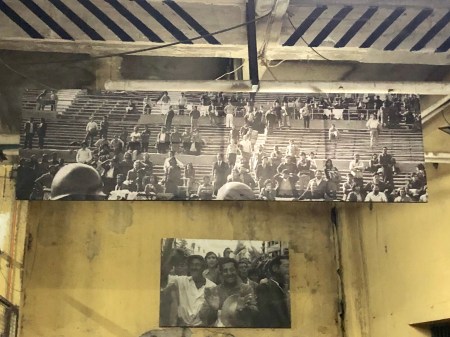
Thousands of people were captured, detained, and tortured at this specific site.

Inside the modern stadium, there was a remaining section with wooden benches surrounded by modern plastic seats. Many people put flowers and notes on the fence to pay their tribute. A group of us went inside the fence and sat on the benches for a while, trying to absorb the atmosphere and comprehend the fear and despair in the dark.
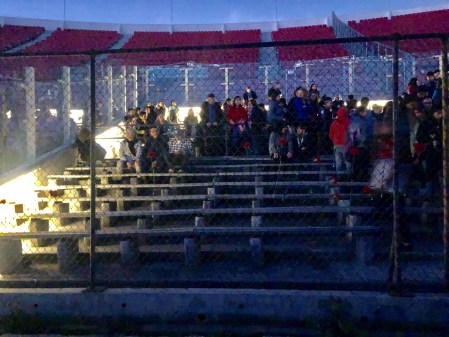
The fenced section inside the Estadio Nacional dedicated to memorializing the horror of 1973.

On a lighter note, September 18 is the National Day of Chile. On September 18, 1810, the Independence movement began in opposition to the rule of its colonizer, Spain. The Independence movement lasted more than a decade, but at last in 1826, the last Spanish troops surrendered, and the Chilean Republic was established. Thus, the Chileans have a week of celebration for their independence.

We went on a cultural “site visit” – going to a fonda. It is a carnival fair for a whole week, where people can buy food and beverages, dance Cueca (a traditional dance), play games, and watch rodeo. There were several fondas taken place in Santiago, so I went to the one at Parque Padre Hurtado, closest to my homestay.
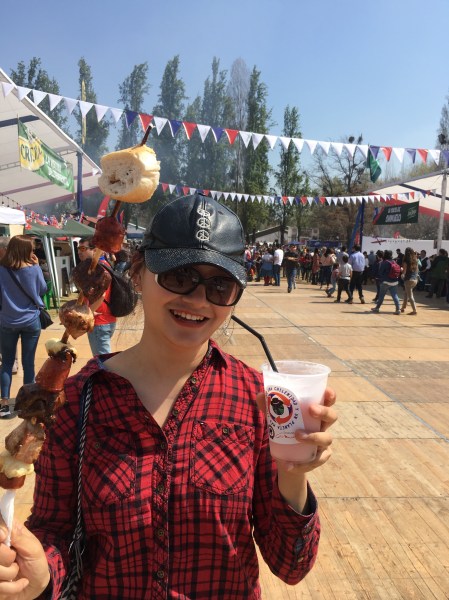
My giant smile and double chin with Terremoto (a drink made of pipeno wine, grenadine, and pineapple ice cream) and Anticucho (a meat skewer).

Anyway, it was a lot of up-and-down feelings in one week. On the one hand, we memorialized and honored the dead from the horror of coup d’etat; on the other hand, we celebrated the thrilling independence of Chile. It was a full cultural experience.


Madelyn In TCI: Classroom Outreach

October 10, 2019

This Wednesday it rained, hard. I woke up at 6:30 when the rain began, and it sounded like the entire sky was falling down on us. The wind blew the water sideways and I moved my things away from the windows to keep them dry. We don’t have classes on Wednesdays and Saturdays; they’re dedicated to waterfront and community outreach. After breakfast, we learned that all of the dives for the day were cancelled, on account of the constant thunder. Instead, I signed up for as many outreach events as possible. It was still pouring when we got in the truck, ‘Big Red’, and drove to the Christian elementary school. There were five of us, plus our staff member. We ran from the truck into a small building that looked more like a house, and the woman who ran the school opened up the door for us as we ducked inside, already dripping from the rain. Inside, we found the teacher and only one, small, lonesome student. Apparently, nobody else showed up on account of the rain so the teacher cancelled class, but this one girl ‘snuck in’. The teacher didn’t have a number to call for the girl and didn’t know who she was staying with now. The idea that this 5-year-old girl was being shuffled around in homes on the island struck me as very odd and concerning, but I didn’t feel it my place to pry. 

Big Red and Little Red

After the failed attempt for the Christian elementary school, I went to the public elementary school. My goal there was to educate the 1st grade students about a different country. However, there was only one, very dedicated girl in the 1st grade classroom. Since I don’t do well with large groups of children, I was rather relieved. She was very sweet and respectful, and she was extremely interested in the presentation of Australia and Madagascar animals that we showed her during our presentations. I was honestly most impressed when she reviewed the information that my fellow scholar showed her about Madagascarian animals and described to me how a particular lemur uses its long finger to tap on the tree and listen for the buzz of insects. It was the first very obvious proof of my making a difference in the education of a young child, and I took it to heart. For the first time, I was somewhat disappointed when the hour was up and it was time to go.

The kindergarten class that I was to go to next was also cancelled, due to nobody showing up, so we went back to the research center. There, I learned that soccer practice for the afternoon was also cancelled, which was another outreach event I was scheduled to help with. As a result, the majority of my day was very relaxed, and I had time to get caught up on my work. Fortunately for me, my livelihood doesn’t depend on these activities.

I thought it was extremely strange that school should be cancelled just for a bit of rain; what should the island do if there were to be snow?! When I expressed my confusion to the staff at School for Field Studies, they told me that the rain tends to flood most of the streets in town. The arid land isn’t used to torrential downpours and doesn’t have the capacity to absorb the water, so it just flows in rivers along the streets. Since most of the students walk to school, this creates a serious problem for their attendance. It was fascinating to learn more about the circumstances that impact areas to disproportional degrees. It also made me consider that climate change increases the intensity of weather around the world. Already, South Caicos was in a deep drought from March to September, before these massive storms began during hurricane season. On a small scale, how might the escalation of these weather patterns affect simply the education of children on South Caicos? And how might it affect the general livelihoods of the residents of this island, living in such closeness and vulnerability to the patterns of the natural world?


Camellia Travels the World: Stepping out My Comfort Zone

October 9, 2019

Hola, Amigos!

I have been in Chile for a while, and I am finally starting to adapt into this new environment. To be honest, even though I have already experienced studying in another country (the United States) for six years, it is still uneasy for me to be in Chile.

Panorama of Santiago area from Cerro de San Cristobal. (Look closely to find Gran Torre Santiago, the tallest building in South America)

First and foremost, there is a huge language barrier. In Chile, almost 90% of the population speaks only Spanish; and unfortunately, my six years of French is unhelpful in this situation. Even for my classmates who have learned Spanish, the Chilean Spanish is still difficult to comprehend, because Chileans speak very fast and use a lot of slang. Therefore, it is my daily struggle to navigate and order food in Spanish.

Furthermore, the language barrier extends into classroom. Even though we have an interpreter for every site visit, and she does a wonderful job, there is still always a giant wall between me and the speakers. We practice consecutive interpretation, which is an interpretation done by repeating in chunks; so I always have a delay in reacting to what has been discussed (when the Spanish speakers laugh at jokes or frown for displeasure, I just look confused). Also, it is difficult for me to concentrate when stories are broken into pieces; thus, even though I am listening to all the interpretation carefully, I feel that I am still only getting half, if not even less, of what the speaker is conveying. Nevertheless, this is a practice that I have to work on for the rest of the trip and in the future.

Another challenge is cultural custom. One of the most common etiquette in Chile is that people greet by hugging and kissing on the right cheek. I learned this in the orientation, yet I forgot about it in the blink of an eye. Thus, when I first met my little host brother, he opened his arms when I was reaching out my right hand. He looked so confused, and then he turned to his mother, using his puzzled eyes to ask her what to do. Finally, in order to not embarrass me, he gave me a handshake and then hugged me. Nevertheless, I was still abashed by my mistake. Ever since that moment, I engraved this local greeting gesture in my brain.

A family photo with my two host siblings, my host mom, and my two roommates.

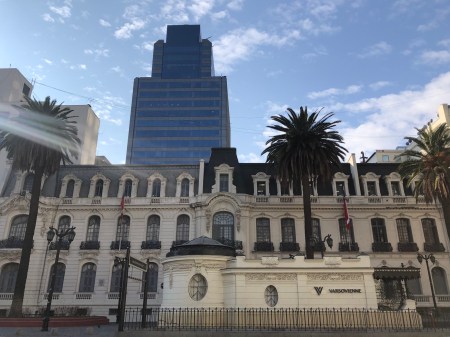
Apart from those challenges, I am enjoying a variety of things that Santiago offers. In the metropolitan region, there are several cerros (hills); my friends and I hiked Cerro de San Cristobal to see the panorama of the city. At the Central Market, there are many restaurants (touristy yet still worth a visit); my friend and I had fresh seafood for a Saturday brunch. At Plaza de Armas, there is a big square with neoclassical-style buildings around; we sipped pisco sour (a typical Chilean drink) as we imagine being in Spain.

At the center of the Central Market. There are numerous men in red sweaters waiting for tourists to come. They can greet them in many languages; one waiter greeted us in Japanese and Mandarin. It was also interesting to me that a group of restaurants use the same menu.

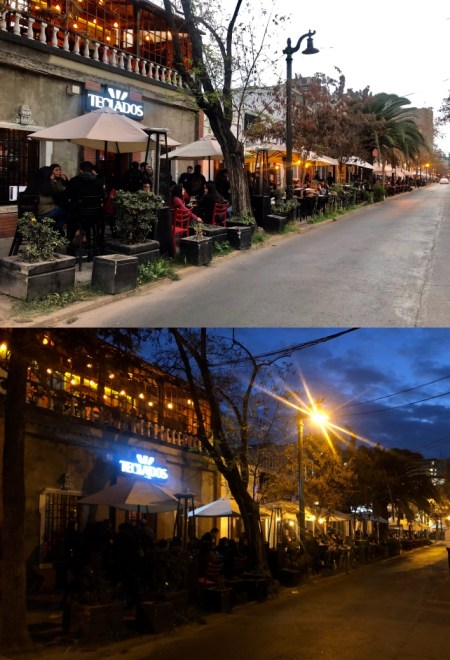
The city of Santiago presents itself with multiple facades. Spain subdued and colonized Chile from 1540 to 1818 (Chile declared its independence on September 18, 1810, yet it only won its formal independence when it defeated the last large Spanish force on Chilean soil on April 5, 1818). On account of its colonial history, there is strong reminiscence of European footprints across the city. On the other hand, there are also segments reflecting the modernistic industrial period; the apartment buildings demonstrate the emphasis on simplicity, economy, and functionality. Moreover, the post-modernistic skyscrapers are also scattered in the city. Overall, the architecture in Santiago is quite diverse (sometimes I find elements of Asia as well), so it is very enjoyable to stroll down streets and experience different ambiances.


Madelyn In TCI: Class in the Field

October 4, 2019

This morning was a relaxed one; after a simple breakfast we had a morning debriefing for the day, and then I was free for the rest of the morning while another group went out to do the field exercise. I laid in the hammock garden and did some of the readings for our classes; it’s mostly scientific papers on fishery management, which I actually enjoy. Tropical storm Jerry is coming towards us and rain is forecasted for the next week and a half, so I enjoyed the bit of sunshine while it lasted. Lunch was delicious and healthy, as always. I was on kitchen crew today, so we cleaned up the food after lunch and washed all the dishes together. After lunch, my group and I grabbed our snorkel stuff and piled into the two trucks with our professor and teaching assistants. I sat in the bed of the truck because I love the breeze and the views, despite the mosquitoes and dust. On the way to East Bay Beach we passed the salt flats and saw numerous flamingos, which never seems to get old! As soon as the truck stopped by the beach, the mosquitoes began to swarm. It’s been raining more here, which means there is standing water on the island and hordes of mosquitoes. At least we can have freshwater showers now though (we collect and filter our freshwater from the rainwater). There’s always a silver lining 🙂

At the beach we split into groups of three with our underwater slates, a 100m transect line, and a ½ meter square made out of PVC pipe. One student in each group swam directly out from the coast laying down the transect line and sat out in the water alone until joined by the other members of his or her group. Meanwhile, the other two snorkeled along the transect line and dropped the PVC quadrat at 5 random distances, and on their underwater slates recorded the percentage of different seagrass coverage within the quadrant. Once they reached the third group member, they swam back all together and recorded all of the invertebrates they saw.

Seagrass meadows are homes for the juveniles of lots of different aquatic species; there are plenty of places for them to hide from predators until they grow up a bit. They also help keep the sediment in place and take excess nutrients out of the water, making the water more clear.

It was so much fun to do class exercises while snorkeling, and also very exciting to have a research purpose while snorkeling. It also provided a new perspective on the ecosystem; I was rather surprised at the count of live conch we found! We also found a lobster hiding in an old conch shell, several Giant Caribbean Sea Anemone, and a beautiful sand dollar.

A sand dollar in the bay

Seagrass meadows

When it was my turn to take the transect out and wait alone in the water, it was beautifully unsettling. The seagrass waved gently in unison in the surge and an occasional fish rushed by. Coming towards me from the distance I recognized a distinct, elongated shadow. Barracuda don’t actually attack humans, but they show a disturbing lack of fear around us and they simply look very mean, a perception that doesn’t improve when they allow their sharp teeth to show. They also have a very radical display when they’re hunting or aggressive: they flash black. This particular barracuda was pitch black, easily half a foot in diameter, and longer than my leg. It came up so close to me that I nervously kept my fins between us, unsure of how it might act. When my group members arrived and we swam back together, this barracuda followed us so close I was afraid I might touch it. Our data may have been a little bit skewed on the return because we were so distracted and somewhat terrified.

Laying out quadrats for seagrass coverage

When we finished our underwater surveys, my braid was entirely intertwined with a bushel of sargassum, which is a type of seaweed that has a particular affinity to my hair. It took me approximately 30 minutes under the saltwater shower to get it entirely out. The purpose of our field exercise was to collect and later analyze data on the effects of high quantities of sargassum on seagrass coverage. Sargassum is currently the highest algal bloom in all of the world of all time, and it’s causing a lot of problems all over the Caribbean, mainly with the tourism industry. Tourists don’t want to go to beaches that are clogged with rotting sargassum; it really ruins the aesthetic appeal. Researchers are still attempting to determine what is causing this massive algal bloom, but the most probable cause is from excess nutrients in the ocean due to deforestation of the Brazilian rain forest. One of our projects this semester is to help our professor determine the extent of damage that this excess alga causes on the ecosystem. It’s truly amazing to be a part of the worldwide effort to understand reverse climate change before it’s too late.


Madelyn In TCI: Diving with a Dolphin

September 23, 2019

We’ve finished Week 2 on the island, and I can’t believe it; so much happens every day! This Saturday was so unbelievably incredible. In the morning I went for a run along the salt flats of the island. The salt industry used to be huge on the island, but died off around the 60’s. Now the Salinas are a historical protected area that provide habitat for the island’s flamingos. It’s still very exciting to see their bright pink bodies apparently floating on a few feet above the water (their legs are too narrow to see from a distance). It was the full moon, which was still in the sky on the horizon as the sun rose.

Moonset over the beach.

After a quick breakfast I went on a morning dive, and the most incredible thing happened. I wore leggings and a rash guard instead of a wet-suit, which made me significantly more comfortable for the dive. The water is 85 degrees Fahrenheit, which is extremely comfortable even without a wet-suit. We dove below to the boat and there was so much coral and all sorts of fish swimming around it: Yellow Jacks, Parrotfish, Trumpet fish, Blue Tangs, and so many others that I haven’t yet learned the names to. The surf was very high, so a lot of the more flexible coral and algae swayed rhythmically as we swam along. About 20 minutes into the dive, I turned around and saw a huge shadow coming towards me. As it came closer, I wondered if it was a shark, but it wasn’t quite the right shape. After a few more seconds I realized: it was a dolphin!! It was much bigger than any of us, but I didn’t feel afraid. It swam right up to me, close enough that I could have reached out and touched it quite easily. Looking into my eyes, it swam right past me, and then circled around our group of divers, weaving between us and getting incredibly close to everybody. It also swam over top of us and I got the feeling that it was enjoying the tickling sensation of our bubbles as we exhaled under water. I was smiling so much that my mask kept flooding with water during the entire interaction, but I didn’t mind! Fortunately, somebody in my group had a camera on them and was able to film a good portion of it.

The whole interaction lasted about 2 minutes, but it felt like an eternity. It was truly the most amazing experience I’ve had. There are very few, random dolphins around Turks and Caicos, and I wasn’t expecting to see one this semester. Our dive master told us that he had been here for 25 years and had never had a dolphin interaction to that extent. I felt so blessed to be here and to have such an incredible opportunity. When we came back to land and I called my mom to tell her about it, I saw two eagle rays in the water just off the edge of the shore. It wasn’t even noon yet!

In the afternoon, we had our weekly outreach time, which is when children from the community come to our campus for games, swimming or snorkel lessons, and an all-around good time! The kids were so excited they were waiting outside over an hour before we opened the gates. This week I went out with a small group of children to the local beach with gloves and bags to pick up trash, as it was Environment Awareness Day. It wasn’t exactly fun, but I thoroughly enjoyed myself. There was a very simple but profound satisfaction with every piece of trash we picked up, and especially looking at the collective result at the end of the hour.

Picking up trash on the beach.

All cleaned up!

 We are working on a project to decorate and set up large trash bins at this beach because litter is a regular problem here. To be completely honest, I would really enjoy doing this more in my free time here. There’s so much plastic waste and I know that I can’t clean it all up. Even so, I stayed hopeful by imagining that every bottle I picked up was one less fish that would get sick or killed from pollution. Every bit counts!


Madelyn In TCI: A Morning Dive

September 16, 2019

Hey y’all! So far I’ve been on the research base for nearly a whole week. Our actual classes begin on Monday; this week has been dedicated to tours of the island, the water front, and swim/snorkel/dive tests. Our schedule is usually packed with activities from 7am to 8pm, Monday through Saturday. Saturdays are particularly fun though! This Saturday I woke up at 5:30 am (it was still dark!!!) and enjoyed some quiet time to read until breakfast at 7am. I usually sit on a bench by the conch wall, which drops down to the ocean about 30 feet below, and the sound of the waves on the rocks is very soothing. After breakfast a group of us headed out onto the boat to scuba dive for the first time of the semester. We went out to a dive site where a plane had crashed and formed an artificial reef for many different and colorful fish to congregate around. From the boat, we sunk to the sea floor, which was about 60 ft. down. There were little patches of coral with all sorts of organisms. I saw a giant Caribbean Sea Anemone and the invasive Lionfish almost immediately. I’m currently having some issues with my underwater camera but will be including pictures in future blogs, so stay posted!

On the boat to explore the ocean.

We followed our dive leader to The Wall, where the seafloor drops from 60 ft. to about 300 ft. We felt like Nemo, going to the edge of the coral reef to stare out into the great expanse of open blue water. Along this edge a Great Barracuda saw me and began swimming directly towards me, probably curious. Their scales flash black if they’re truly being aggressive and this one remained silver, but it was still a little unnerving and I was relieved when it turned away. As the group meandered our way back to the boat, I saw a Green Sea Turtle swimming through the coral off to the side. I’m always fascinated by how unbothered and relaxed sea turtles look while they swim. A bit further on in the dive, a huge black fish took an interest in our group. It was about two feet tall and long and kept swimming around all of us and getting very close. Our dive leader and interns didn’t know what kind of fish it was, but it was very cool to get checked out by a fish. The experience just emphasized the idea that we were visitors in another creature’s home.

One of my favorite parts of diving and snorkeling is experiencing such a different world without harming it. We will be doing a lot of this for my classes this semester and I’m very excited to learn more about the marine environment and the creatures that inhabit it! I’m also excited to become more comfortable and skilled underwater with all of the practice. It’s going to be a very fun semester!

Watching another beautiful sunset over the ocean.

A Caribbean sunset.


Camellia Travels the World: Human Rights vs. human rights

September 13, 2019

It has been a week since the program started, and we have been contemplating the concept of “Human Rights” vs. “human rights”. In short, Human Rights is a regime of governance working to advance it from the top-down level, while human rights is an array of struggles against oppression from the bottom-up. This is the guiding rubric of our whole journey; we do not only compare countries and their human rights issues, but also learn different forces that promote and defend human rights.

For that purpose, we are constantly dipping our toes into both waters, and I have to say, I am caught in a maze by the diverse range of organizations and their fascinating works fighting for human rights from all levels:

These are our “classrooms.” On the left is the renowned LGBT Community Center in Manhattan, and on the right is a multi-purposed building called Mayday Space in Brooklyn. Even though both buildings are associated with human rights, there is a distinctive disparity of influence and resources.

Visits for Human Rights. We paid a visit to the U.S. Mission to the UN, speaking with a senior adviser of Human Rights and Social Affairs and learning the U.S. efforts on promoting Human Rights around the world. We went to the office of elected officials, studying their contribution for the people of their districts; we talked with Human Rights Watch and Amnesty International, learning their specific work in defending Human Rights as International NGOs. Apart from these organizations who directly lobby for Human Rights, there is one organization that astounded me. Witness is an organization that teaches and uses the power of video and technology to promote and defend Human Rights. It does not directly lobby for human rights, but they help others to produce more effective videos and avoid potential harm. The group has offices around the world and its work consists of three layers: on the ground with activists, working as guidance for movements, and connecting with big tech platforms. Besides their unique approach for advocating human rights, their ethics impressed me as well. As we were talking about blurring faces in videos in order to protect victims and activists, our speaker also brought up the issue of privacy of perpetrators: should Human Rights apply to all humans, even if one is a violator or abuser of these Rights? This is a very complicated question to ponder. (To learn more about Witness: https://www.witness.org/).

The Twitter Post of U.S. Mission to the UN about our visit.

Visits for human rights. We met with many grassroots activists and organizations fighting for different rights, criminal justice, labor rights, economic justice for Jews, and housing justice. To explore more about grassroots organizations and their work, we were invited to a celebration dinner for housing justice at Mayday Space. We met many organization leaders who fought for new rent laws in New York. For many years, the tenants of NYC had been suffering from landlords’ violation of rights for just housing: shortly-posted evictions, constant rent increases, high deposits, inadequate repair services, and so on. They had been suffering for twelve years, and finally, they won the battle. After months of demonstration outside of the capitol and sixty-two people mass arrests, they have changed the rent laws. One elder lady also told us an anecdote of her victory: “A few of us went to the landlord’s house on a Sunday morning. We knocked on his door, and after a few minutes, he opened the door without checking who is outside. Then, we handed him an eviction notice. He was so mad, and he called the police. We ran to the yard and stuck the eviction notice everywhere onto the fence before the cops got here.” The event truly showed the solidarity of communities; the group is very diverse: different age groups, different races, different languages, etc. Yet, they united to fight for their own rights as well as all the tenants of New York. (To learn more about new rent laws in New York: https://www.nytimes.com/2019/06/21/nyregion/rent-laws-new-york.html). I am truly inspired by their courage and action to challenge the system and gain their rights.

Even though it has only been one week of learning and unlearning, I am overwhelmed by the depth we have gotten into, and I am grateful for all the opportunities to talk with different organizations and workers dedicated to human rights. This is truly an experience one can never get in a classroom. Alright, one week done, fifteen more to go!

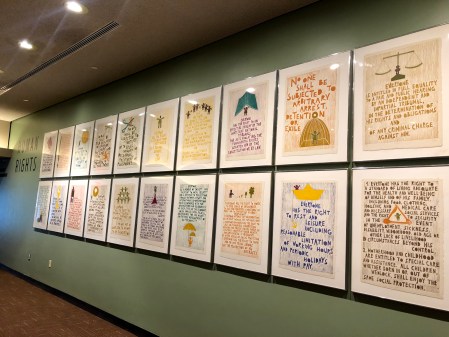
Parts of the Universal Declaration of Human Rights at the United Nations.


Madelyn In TCI: Starting the Next Adventure

September 12, 2019

Hey folks, I’m Madelyn, a junior and studying Biology with an Environmental Studies minor. I’m currently on a plane from Milan to Toronto. I’m actually studying abroad in Turks and Caicos Islands (TCI), but I have two 7-hour layovers in Toronto and then Montreal before heading to TCI. That’s just what happens when you buy the cheapest plane ticket, I guess! Anyways, I spent all of my summer in Greece WWOOFing (definitely look this up if you’ve never heard of it; it’s a great way to experience new countries). Then I took a terribly long ferry ride and spent five days in Bari, Italy, with my Italian host family from high school. It was really fantastic to be able to see them and my friends there again! And the food… my host mother is the best cook any of her friends know, which in Puglia, that’s saying a lot. I learned how to cook focaccia, panzerotti, fresh seafood, and so many different types of pasta. At least in southern Italy, the pasta stereotype is not much exaggerated! I also tried squid raw, which is something very unique to Puglia. It was surprisingly good with just some lemon, olive oil, and pepper!

Fresh squid from the local fish market.

So, after a lovely few days in Puglia, I took a flight to Milan. I can’t begin to explain the amount of struggle it took to make all of my suitcases fit the weight restrictions for this flight. You see, I had to pack everything for 6 months into one big suitcase, one carry-on, and one back pack. This includes my scuba and snorkeling equipment, because I’ll need it for my fall program. This flight to Milan was through Ryanair, which is usually very strict about their baggage allowances policies. By the time I was done organizing all of my stuff, I was dripping sweat and my back pack was quite possibly heavier than my suitcases. But guess who didn’t have to pay extra baggage fees!

In Milan I stayed with an old friend for a few days. Ironically, we were both neighbors in a rural Pennsylvania town, meeting up several years later in Milan. Not only did we explore the city of Milan together; we also took a train up to Lake Como, which is absolutely beautiful. If you ever get the chance to go there, definitely take the ‘funicolare’ up the mountain to the town of Brunate. It’s a quaint little town with many places to walk and enjoy nature. There is also a lot of folklore there about gnomes and fairies and it seems quite natural to imagine little mischievous creatures hiding behind the ancient trees of the mountain.

The tram station going up the mountain from Como to Brunate.


Walking through the forest by Brunate.


The Duomo at midnight.

So that is the story of how I ended up on a flight from Milan to Toronto as an American studying in Turks and Caicos. My study abroad program is a bit abnormal. It’s actually a marine biology research program, where I’ll be studying the marine environment and learning about how the population and tourism impact the ecosystem, as well as helping to develop policies to minimize the harmful effects. Most of my courses will be science-oriented, and emphasize really getting into the area of study, hence why I need my scuba equipment. My classes should spend a lot of time outside, whether it be hiking around to explore the various ecosystems on different islands, or snorkeling in the coral reefs to see in person the species that we learn about in the classroom. This sort of thing is exactly my jam, so I’m really excited to see how it goes! I’ll keep you all updated on whatever weird stuff I see or do!


Camellia Travels the World: An Extraordinary Journey Begins

August 28, 2019

Hello, everyone! I am Camellia, and I am a junior at the University of Richmond, majoring in International Studies: World Politics and Diplomacy. I am from Chengdu, China, and fun fact, it is also the hometown of Giant Panda. At the age of fifteen, I boarded the plane from China to the United States to pursue education. During these six years, I have not only learned critical thinking and empirical reasoning, but also Frisbee playing and Netflix binge-watching. In other words, I think I have taken my root on the other side of the world; and, I decided that it is time for a new challenge.

Therefore, I applied for the International Honors Program with SIT. This has been my dream program since freshman year; it is unique because IHP gives me an opportunity to contemplate with one theme on a global scale. Gladly, I will also be with thirty other fellow enthusiasts and a director throughout the program. We are from different universities, we represent different cultures, we have different hobbies, yet we are all coming together for our shared passion for human rights. Over the next four months, we will closely examine the causes of struggles for human rights, the relationship between human rights and activism, and the comparison of “Human Rights” and “human rights”[1]; Moreover, we will travel to four drastically different locations: New York City, USA; Santiago, Chile; Kathmandu, Nepal; and Amman, Jordan. At each location, we will take classes with local faculty and stay with host families to learn and experience the authentic culture.

This journey is deemed to be extraordinary even from the prequels of my traveling. Long story short, I had to go to Boston for my Chilean visa, therefore I came back to the US a few days before my program. Everything went smoothly until I found out my flight from Newark to Boston was cancelled. It was already 8:30 pm, and all the other United Airlines flights were completely full. At that moment, my heart was filled with despair and my eyes were full of tears. All I had in mind was that I have to get to Boston in time. Thus, I cancelled my plane ticket and made up my mind to rent a car and drive, even though I had been tirelessly travelling for the last 20 hours. When I went to the carousel, I noticed another lady waiting for her baggage. I collected my courage and asked her if she was interested in carpooling with me. Amazingly, she agreed, and we even found two other girls wanting to share the ride. In the end, we embarked for our road-trip to Boston. We talked non-stop for almost four hours and learned a lot about each other: Elisa is from Italy, and she comes to the US to visit her high school host family in Boston; Sneha has just gotten her Master’s degree, and she is going to Boston for a job interview; Erin is on her way back to Boston for an important meeting the next day and her husband’s birthday… Now that I reflect on it, I would never have met these incredible people if I only sat quietly on the thirty-nine-minute flight; maybe the cancellation was not so disastrous after all. 

On our way to Boston. Elisa could not believe how much traffic there was at 11 pm in NYC.

There is an old Chinese proverb: “A good gain takes long pain.” I have finally got my visa after everything, and I am ready to start my journey, hopefully without any cancellations or delays. I will be sharing fun stories, travel tips, personal thoughts, and anything you ask throughout my trip. So stay tuned and wish me luck!

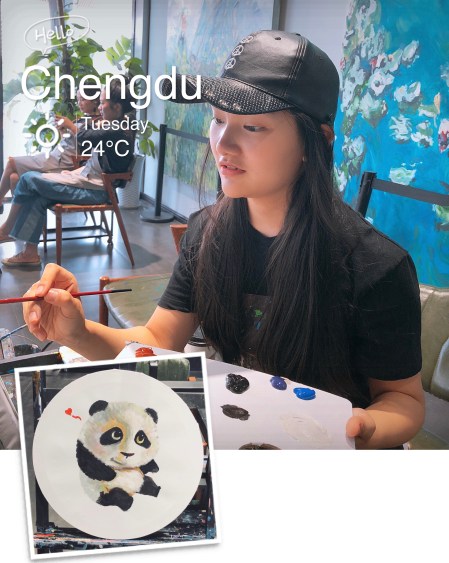
Me trying to paint my “selfie”.


[1] Stephen Hopgood delineates the two spheres of human rights in his book, The Endtimes of Human Rights, where “Human Rights” represents “top-down” influences while “human rights” relates to “bottom-up” movements.


KrissinKorea: 안녕Cherry Blossoms

April 20, 2019

It is with heavy hearts that Koreans and visiting foreigners alike wish the blooming Cherry Blossoms farewell. Cherry Blossom season lasts about 10 days in South Korea and it’s a pretty big deal. Stores like Art Box and Starbucks start selling merchandise and drinks inspired by Cherry Blossoms at least 2 weeks prior to their blooming. People from all over the world plan their visits to Korea and Japan in anticipation of witnessing this beautiful time of the Spring season. I was lucky enough to be able to walk just down the road to the main part of my campus to see some whenever I wanted to. Unfortunately the blooming period is over and all the petals are being blown away by the wind, which in itself is very beautiful to see. What was once a pinkish-white is now bright green—signaling that summer is on its way. Even though the time has passed, let me tell you guys about one of the most magical Cherry Blossom festivals I went to.

The 2019 Seokchonhosu Lake Cherry Blossom Festival in Jamsil was held from April 5th to April 12th. There was no entrance fee and anyone was welcome to enjoy the Cherry Blossom lined paths around the two, large, connected lakes. The two lakes are split by Lotte World, which is one of South Korea’s amusement parks. At the festival, visitors can bask in the awesomeness of the many cultural and musical performances taking place. Face painting, caricature booths, and experience exhibitions are also available for those who wish to participate. One of my favorite parts of the festival must have been the huge balls of cotton candy my roommate and I bought. They were way too much to finish, but we rose to the challenge.

When my roommate and I first arrived at the festival, one of the most impressive things we noticed was the amount of people in the area. Even though everything was so nice to look at, walking around without bumping into someone every two seconds was a real challenge. We tried our best to move with the flow of pedestrian traffic but many times people would stop abruptly in the middle of the path to take pictures or look around, which would cause a domino effect of people tripping over one another. Not fun. However, as the afternoon went by, more and more people grew tired of the crowd and started leaving, which was great news for the lot of us that stayed. This was the first time that my roommate and I were truly able to enjoy the Cherry Blossoms and got to take pictures of them.

Each Cherry Blossom tree is beautiful, but when you put them all together in clusters, they form huge bouquets that rise way above your head and extend for miles. The effect is amazing. Everything was great, but there was one moment that I remember the most and, as I am writing this, I still remember the feeling it gave me.

The air froze around us briefly before it came peacefully rushing past us as people kept walking by. The breeze hit first, making our hair and skirts billow along with it, but then came the gentle, snow-like falling of the petals. I stood in awe of the event before me and I managed to catch some of the petals in my outstretched hands. This only lasted about 15 seconds before it was over and the magic was gone.

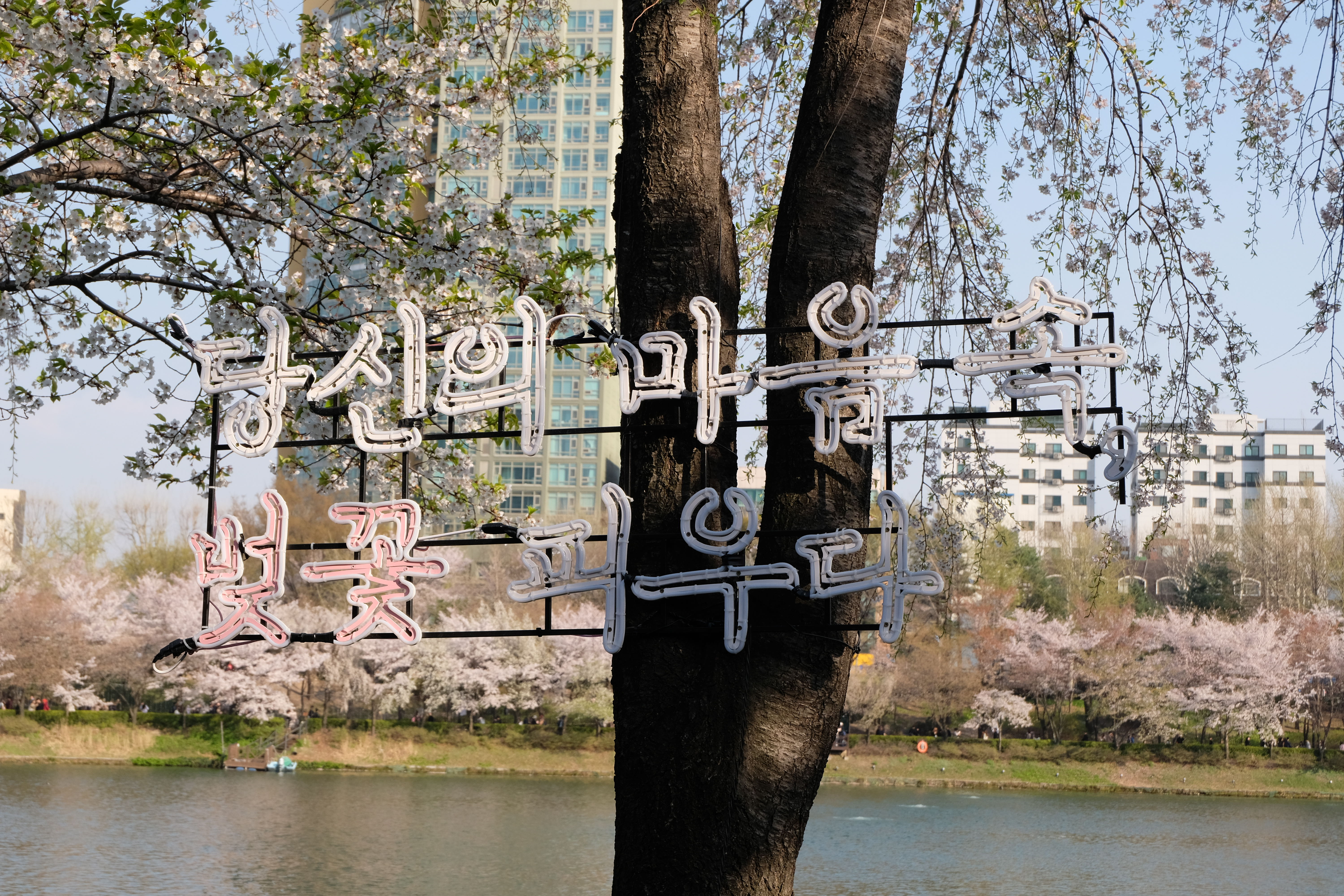
Cherry blossom festival sign

In your heart, there is a Cherry Blossom blooming

I don’t know the next time that I will be able to witness Cherry Blossom season again in Korea, but I hope that it is not too far away. I have truly fallen in love with the many things this country has to offer and getting to experience the coming and going of the Cherry Blossoms was one of the highlights of my experience so far. I look forward to seeing them again soon.