Barbados, Week 7: Partying with the Hindus

March 16, 2012

This past Sunday, March 11th, was Phagwa, the Hindu celebration of their New Year and the coming of Spring.  This was not something of which I had any knowledge, however, until my Cultural Studies professor told us about it last week.  The fact that there were Hindus in Barbados had never even occurred to me, and thus my curiosity was piqued.  I knew nothing of Hinduism, except that it had its origins in ancient India/Asia, and wanted to see how they expressed their thankfulness and positivity toward a new year.

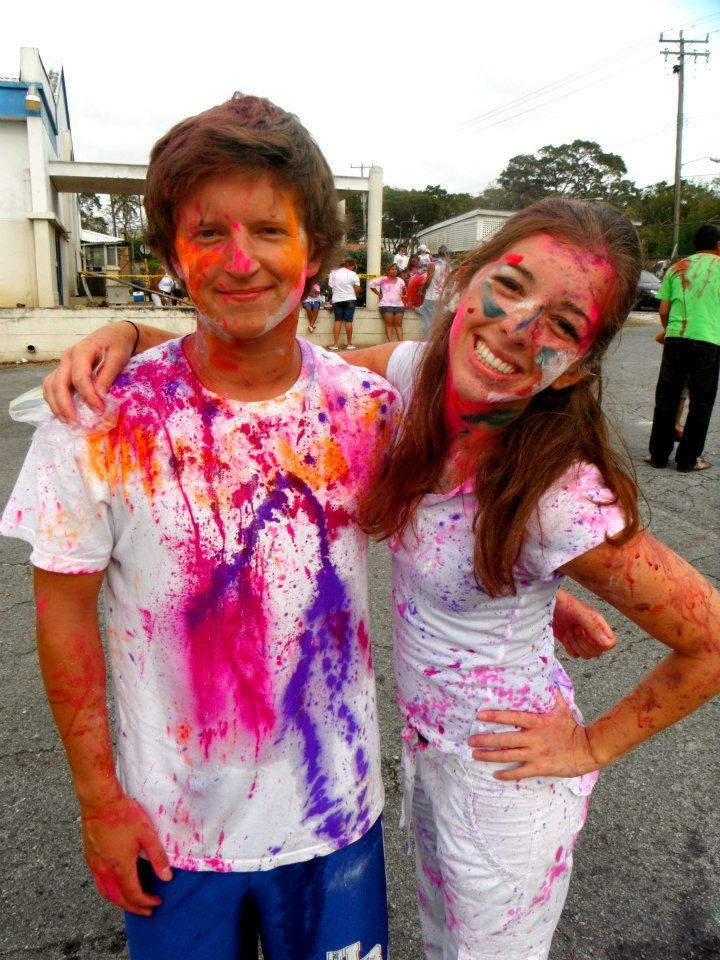
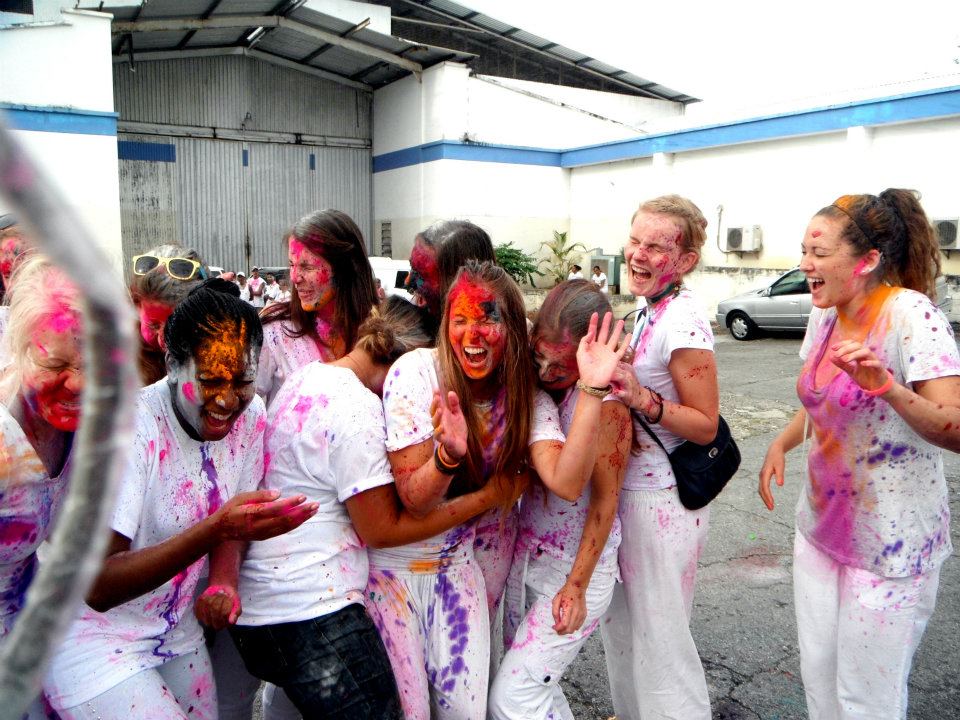
As it turns out, they do so by dousing each other in colored powder and splashing each other with paint for the greater part of three hours!  Would not have been my first guess as to the method of celebration, but it was a lot more fun than any of the students expected.  We were told to wear old clothes, and somehow everyone got the idea in their head that it would be best to wear all white; when 15 white kids wearing all white clothes piled out of the van upon arriving at Phagwa I had to laugh- it looked like we were ready for Halloween.

No sooner had we stepped out of the shuttles than people began patting us on the face with baby powder and welcoming us to the celebration.  Now we looked really, really white.  The festival was held in the parking lot behind the Hindu temple, with a large tent at the back of the lot providing shade for those who wished to sit down or simply had enough of getting paint thrown at their face.  On another side of the lot one could find tables upon tables of traditional Indo-Caribbean food and drink.  Wanting to eat my food without fear of paint contamination, that’s where I went first.  My meal consisted of curried rice and potatoes, spinach, yams, and an unknown spicy dressing.  Most people know to only take small portions of unknown foods, but I decided it was a good idea to take three heaping spoonfuls of the spicy dressing and slather it all over my rice.  Besides all of the fascinating religious and cultural things I learned during Phagwa, I think one of the most important lessons learned was that American “spicy” food and Indian “spicy” food are not on the same level…not even close.

Then things got colorful.  More people began arriving with liter bottles filled with water-based paint and bags of powder.  As musicians played what I assumed to be Hindu music on stage, everyone began running around and dousing each other with as much paint as possible.  I didn’t have any paint, unfortunately, but I bought a few bags of colored powder and went around to friends and strangers alike and attacked them with a barrage of color, albeit gently.  The gesture was returned tenfold as I was covered head to toe in red, blue, orange, pink, and green paint and powder within minutes.  When I finally looked at myself in a car window, I very closely resembled an Oompah Loompah (from Charlie and the Chocolate Factory).

Later in the celebration they brought on a pretty eccentric performer who proceeded to take the stage and make jungle animal noises.  Supposedly he was trying to provide some context for his next displays of skill, as he demonstrated how to break open coconuts as they had done in the jungles of Guyana before the advancement of modern technology.  For his next act he proceeded to place a chicken on his head and play some rhythmic drum lines as the crowd cheered him on and danced.  I, personally, was equally impressed with the chicken’s ability to balance on the man’s head the whole time.  Before we left Phagwa, the temple pundit allowed our group to check out the Hindu temple, which featured detailed drawings and almost-life-sized statues of what I can only imagine were their sacred dieties.  A very cool experience, considering he even let us inside looking like a rainbow had exploded all over us.


Living, Learning, and Volunteering in Maastricht

March 16, 2012

When I was in high school, I was heavily involved with community service.  My school did not have a community service requirement that had to be fulfilled in order to graduate; I simply did it for the satisfaction of knowing that I was helping other people.  I knew I wanted to make this a part of my college experience, so I was excited when I received an email from the University of Richmond’s Bonner Scholars Program, suggesting that I should apply.

The Bonner Scholar Program consists of hundreds of students at 27 different universities across the United States who are anxious to help and serve their community.  When the program was founded, it was noticed that students generally had to choose between working part-time to help pay their tuition or doing community service.  Since the Bonner Scholar Program provides a stipend for completing a certain amount of volunteer hours, students no longer had to choose; they could have their cake and eat it too.  Since it did seem like the best of both worlds, I decided to apply and was accepted!

Since I did not want to put my service on hold for a semester, I decided see if there were any non-profit organizations in Maastricht that would like to have an extra volunteer.  I found that it was very difficult to find non-profit organizations in Maastricht.  Maastricht is not a very large place (a fair amount of people bike or walk around Maastricht on a daily basis, since it is small enough to easily navigate by foot).  Also, I discovered from a Bonner who previously went to Maastricht to study abroad that doing voluntary service work is not as common in The Netherlands as it is in the U.S.

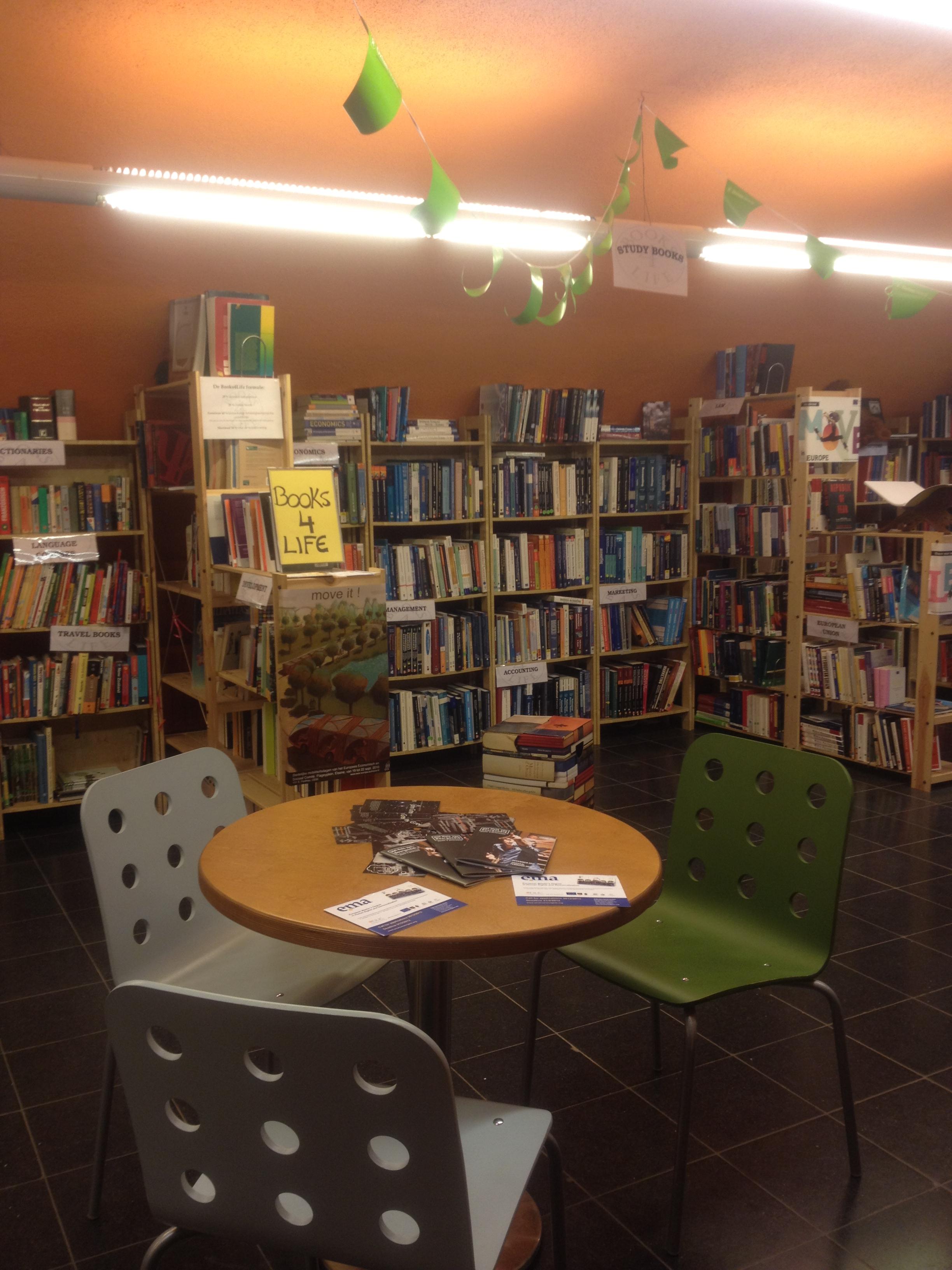
With that being said, I was more determined than ever to find a place to serve.  With the help of the director of the Bonner Scholar Program, I was finally able to get in contact with a place in Maastricht — Books4Life.  Books4Life is a non-profit organization in Maastricht (and Amsterdam) that sells books and gives the proceeds to charity.  The majority of the proceeds go to Amnesty International, and a smaller portion goes to a local charity that is chosen by the B4L staff.  Everyone has been very welcoming to me here and I enjoy being here.  I get to meet and interact with people from all over the world who are here as exchange students.  I even had the privilege of seeing an award-winning book from a special collection in the local library!  If you’re looking for a laid-back place to meet up with friends or buy a variety of books, then B4L is the place for you.  I’ve thoroughly enjoyed my time here so far and recommend B4L for any future Bonners who may come to Maastricht.


Six cities in two days

March 12, 2012

This weekend I had the privilege to visit six cities in The Netherlands in a span of two days.  It was definitely two of the busiest days of my life, but it was worth it.  We left at 8am on Saturday and headed off to Utrecht.  In Utrecht, we took a quick tour of the city, which is the religious centre of The Netherlands, and also contains the largest university in the country (Utrecht University).  After that, we climbed all 465 steps of the Dom Tower.  The Dom Tower is the tallest church tower in The Netherlands (a little over 368 feet).

The next stop was The Hague.  The Hague has famous buildings such as the International Court of Justice and the International Criminal Court.  The House of Parliament and the Queen’s working Palace is also in the Hague, but unfortunately she wasn’t there during our visit.  There are also several embassies here (I saw the United States’ embassy) and the Peace Palace.

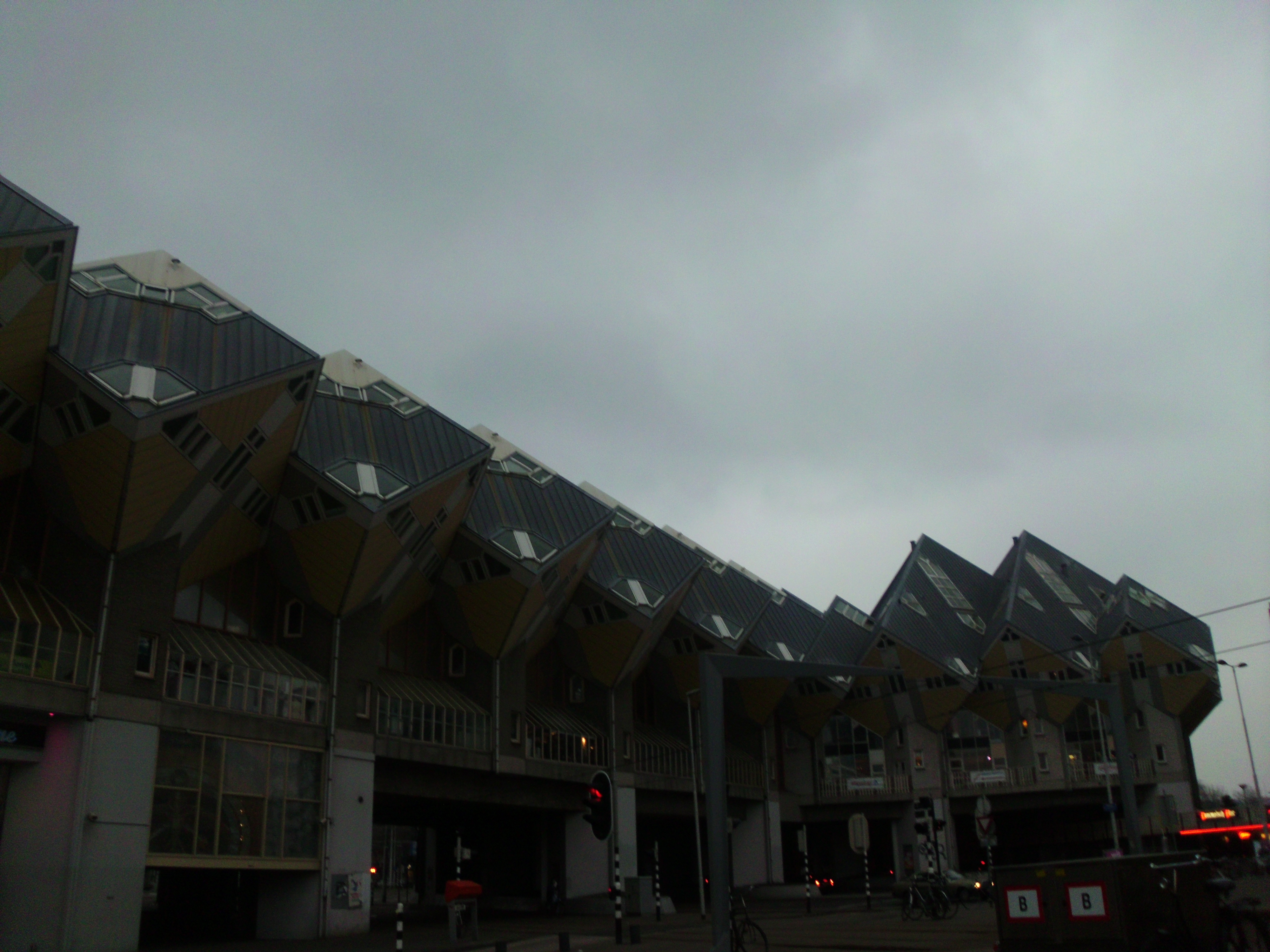
Next up was Rotterdam.  We stayed at a really cool hostel — my first hostel experience!  As we drove under the hostel, they pointed it out to us and we realized that it was made up of cubes!  Even after staying there for a night, I still can’t understand how a building made of cubes is possible.

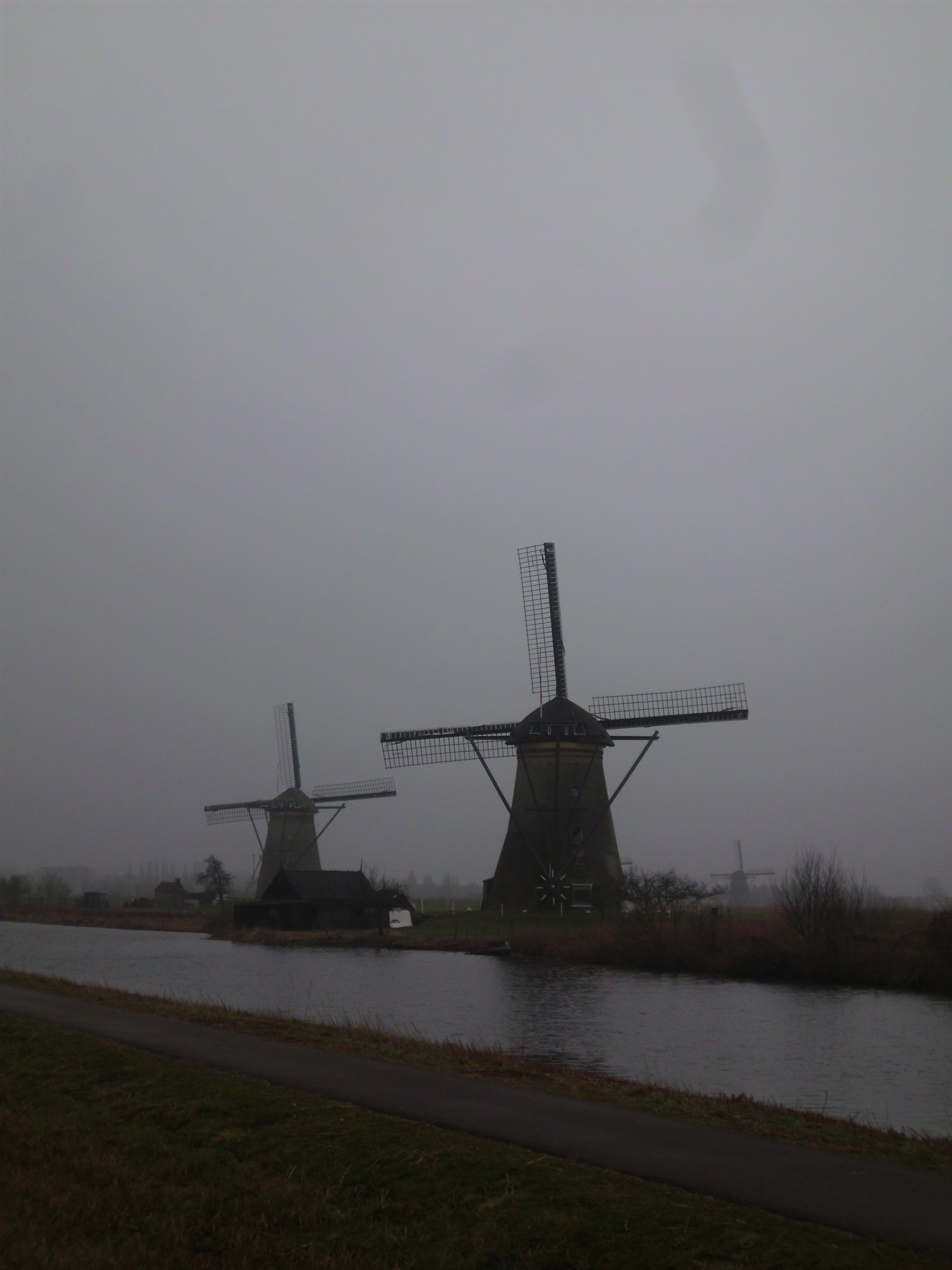
The next morning, we all woke up and made our way to Kinderdijk, which is famous for its windmills!

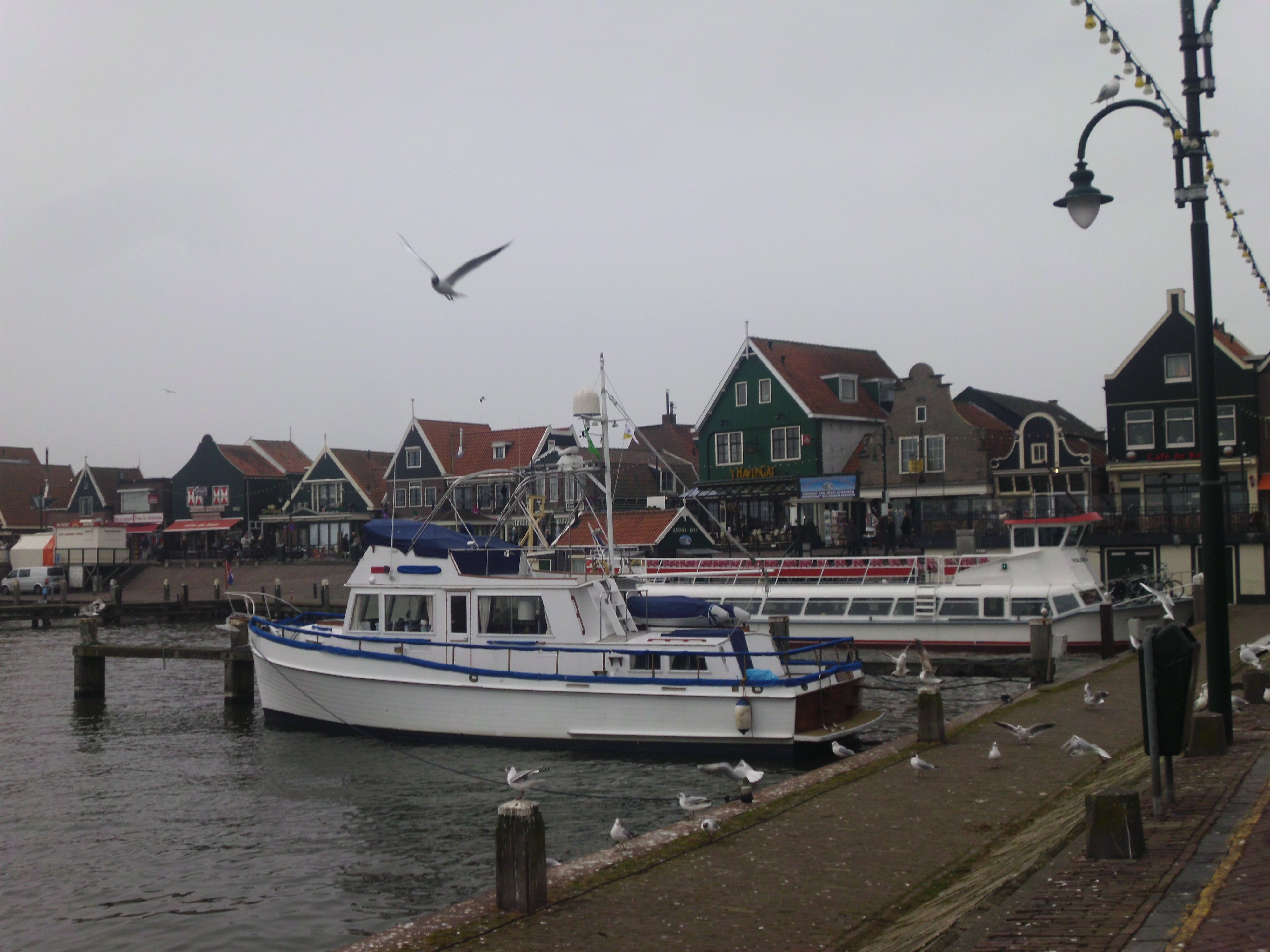
Next stop: Volendam.  Voldendam was a very tourist-oriented place.  While we were here, we took a picture in stereotypical Dutch clothing (clogs included).  The traditional cheese markets are also located in Volendam, but unfortunately, they take place on Wednesdays, so we weren’t able to see them in action.

Saving the best for last,  you probably guessed by now that the last stop was Amsterdam!  After a tour of the city, we had pannenkoeken (a Dutch pancake comparable to a crepe)–  I had a pineapple pannenkoeken with sugar and syrup on top; it was absolutely delicious!

After a long, fun-filled weekend, it’s back to Maastricht and time to hit the books!  Can’t wait to update y’all about the next part of my adventures living and learning in The Netherlands!


The Classroom Culture

March 12, 2012

After two and a half months of studying abroad in Thailand, it seems fitting to actually blog about the studying part of this experience.  The much-discussed stereotype about studying abroad is that the classes will be easy and there will be no work.  Well, clearly those students did not study at Thammasat in the BBA program. There is definitely work, and classes are not at all something you can blow off…it will eventually catch up with you.  So here are four of the most notable differences between University of Richmond courses and Thammsat BBA courses (Disclaimer: the academic faculties at Thammasat are very different from one another, so this blog post only applies to the BBA program).

1.  Unlike Richmond, there is not much day-to-day homework at Thammasat, but classes are very much oriented around case studies and group projects. While I don’t have to worry about day to day homework in each class, there is always a group project meeting that I have to attend – and this has been the case since the first day of school, not just something that has crept up at the end of the semester.  While sometimes the group projects are overwhelming, doing case-based learning is extremely helpful for applying what we are learning in class and understanding “real-world” examples.

2. Attendance is extremely serious.  The rule is that if you miss more than 30% of a class, then you are not eligible to take the midterm or the final.  Because all of my classes are three hours long, I am allowed to miss three classes throughout the whole semester – which seems like a lot, but when I’d love to be traveling around Southeast Asia most weekends, those missed classes can add up quite quickly.  During the first fifteen minutes of each class, a few BBA administrators sit in the hallways, each assigned to watch over one clipboard as students sign in for their respective courses. Students are required to sign in wearing a full uniform — otherwise, they are considered absent.

3.  Regarding class format, most professors use the typical PowerPoint lecture model.  I learned very quickly that Thais love PowerPoint.  In the US, it is sometimes encouraged for students to ditch PowerPoint and find a more creative way to prepare a presentation, but here it is mandatory to use PowerPoint for presentations.  I have to say, though, the presentations that Thai students create are incredible, and much more creative than anything I have ever done with PowerPoint.

4. Classroom culture.  This has been one of the biggest paradoxes of my time in Thailand.  I have remarked in previous posts about how Thai people are so respectful, and how they value hierarchy and respect their elders and teachers.  Yet the actions of the students in classes do not seem to fully reflect these values.  Students talk throughout the class, they constantly text on their phones (above their desks, in plain sight!) Some even take calls and just stick their heads under the desks while on the phone. Most students are constantly checking their email or Facebook on their iPads or laptops.  Some will leave classes in small groups and come back with Starbucks or other drinks in hand.  And throughout class, there are students continuously walking in and out of the room to print something, get a snack, or take a phone call.  I have had only one professor actually address this behavior in class, on one occasion.  I would never be comfortable acting so informally in a class at Richmond, and professors at UR strongly discourage this behavior.  Certainly an interesting nuance of classroom culture compared to Thai culture in general.

Note: I don’t have any pictures relating to this blog, but enjoy some of the pictures from around the city these past few weeks.


Jerusalem: Steeped in Faith

March 12, 2012

On the 26th of February, I went on the  International School’s tour of Jerusalem.  It was the longest touring day of my entire life.  Leaving campus at 6:30 A.M, we had a beautiful two hour drive through farmland, small cities, and the Judean Hills to Jerusalem.  Approaching Jerusalem, it was hard to believe I was actually going to see the city that has existed for centuries in the imaginations of Jews, Christians, and Muslims as a city of great holiness and significance to their faith.  Jerusalem is the object of songs, poetry, paintings, and religious longing for so many throughout the world, and I now had an opportunity to experience it for myself.

Somehow, though, the reality is quite different from the idealized images and feelings many have come to associate with Jerusalem.  The tension is almost tangible, and as we visited King David’s tomb, the site of Jesus’ Last Supper (a former church that has now been turned into a mosque), the Western Wall, and the Church of the Holy Sepulchre, I realized the extent to which the people and faiths of Jerusalem live intertwined with each other, yet are distanced by the conflict and perpetual state of unsettled feelings between the varied groups within the city.  Jerusalem is a mixture of so many different people, with such widely varied backgrounds.  Israeli soldiers carrying guns walk through the streets across from Catholic nuns in their habits, and groups of American tourists with their huge cameras and enthusiastic tour guides make their way through the vibrant, lively Arab market.  I was struck by how you can often tell what group someone is affiliated with by their clothes or head coverings – Orthodox Jewish married women wear a different head covering than the hijab of Muslim women, and Hassidic Jews in their tall black hats stand out from the other Jewish men wearing kippahs, or smaller head coverings.  The clothes they wear identify the differences they have with each other, making the religious and cultural divisions within the city physically apparent.

In both my Biblical Theology and Literature of the Shoah (Hebrew word referring to the Holocaust) classes, we have discussed the idea of memory, and how it influences and shapes people and nations.  Reflecting back on my time in Jerusalem, I realize that national memory is one of the factors that make Jerusalem so important.  Jews pray at the Western Wall because it is a tangible piece of their national memory. The Wall is all that remains after the destruction of the Second Temple, but it stands as a symbol of what they have survived as a people.  Jerusalem is full of symbols, from the Dome of the Rock standing on the site of Mohammed’s Night Journey as recounted in Muslim tradition, to the Mount of Olives, turned white by the graves of Jews awaiting the Messiah’s arrival.  Made up of physical locations that past events or promises for the future have made crucially important to so many, it is no wonder Jerusalem is one of the most fought over places on earth, historically and today.

Sometime before this semester ends, I want to visit Jerusalem again, but this time to take it slower, letting the experience sink in more deeply.  I need a fuller picture in order to begin to understand the city.  There was a lot I didn’t see, and a lot I need to see again before I can begin to process the full significance of what Jerusalem stands for.


A Different Side of Bangkok

March 2, 2012

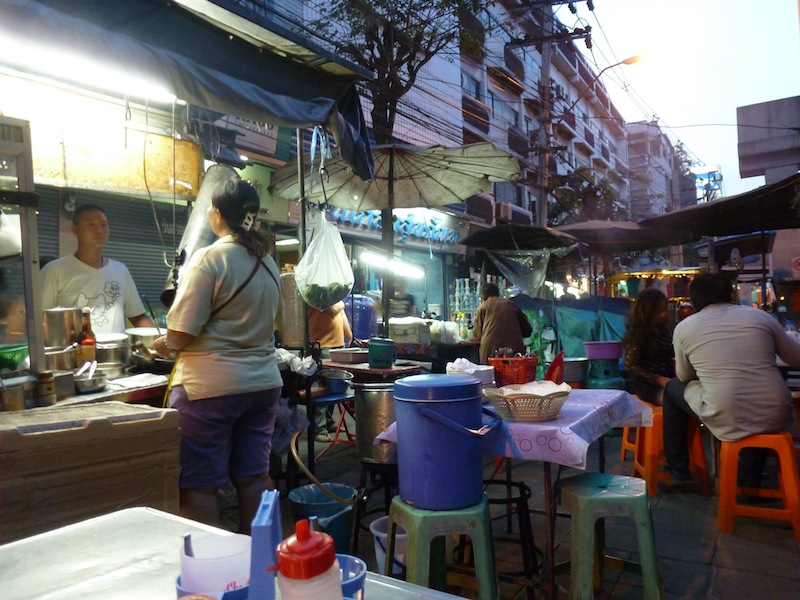
For the first time in weeks, I did not travel this past weekend.  Granted, it was because I had a huge group presentation and midterms to study for, but still, it was quite an event.  Sadly, studying took up most of the weekend, and there was a lot of studying required, because, truth be told, I have not been great at keeping up with school work here. With it being 96 degrees every day, so many places to visit, and so many delicious types of food to discover, it sort of feels like I am on summer vacation.  It’s just so difficult to concentrate with so many fun things to do.  So to have midterms now is like having exams in the middle of summer vacation… which is not easy.

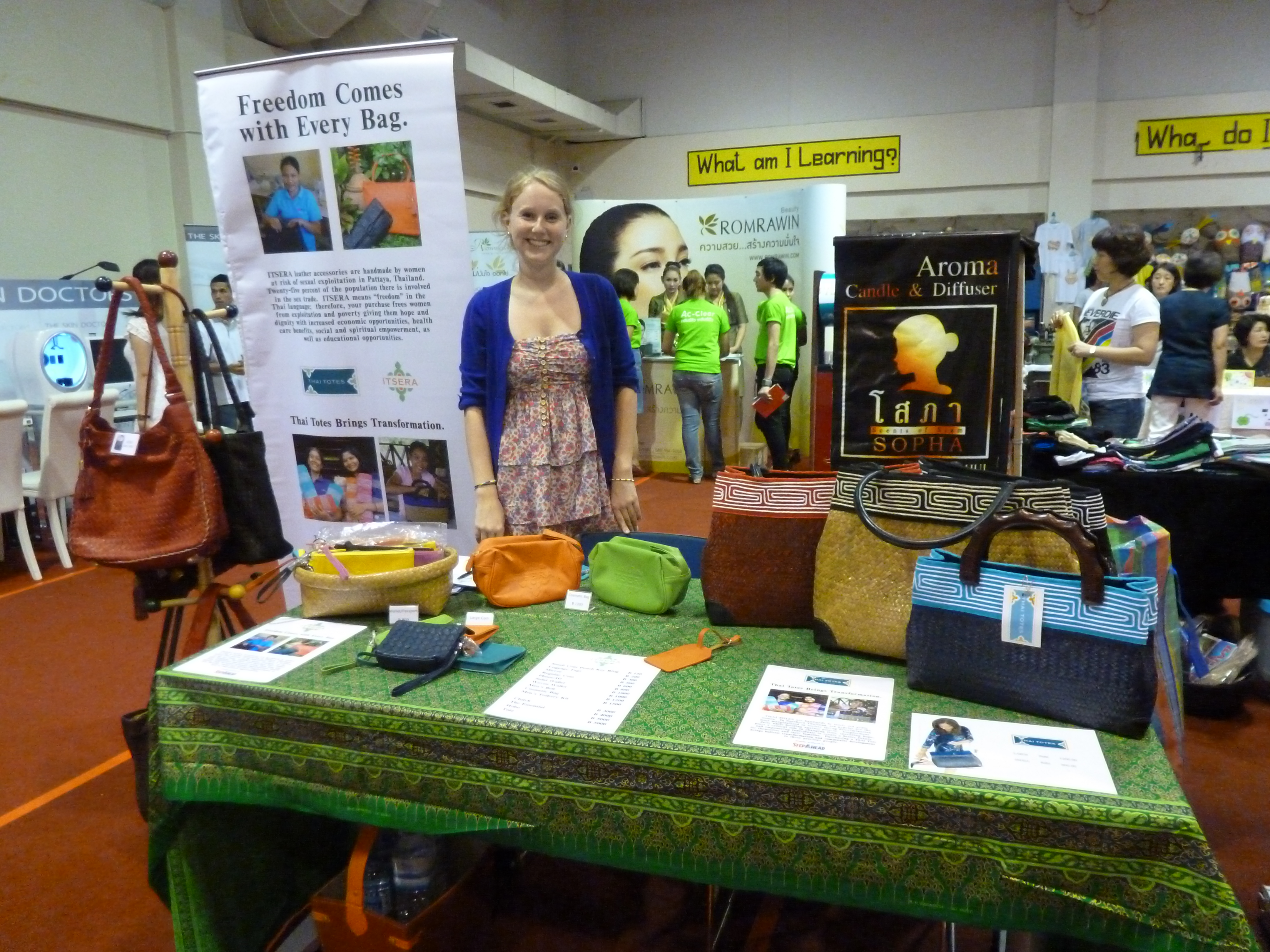
Nonetheless, I spent Saturday at an event for my internship. I am interning part-time with Step Ahead, a fantastic NGO headquartered here in Bangkok.  Step Ahead was founded by John and Kim Quinley, whose daughter, Carter Quinley, graduated from Richmond this past May.  Step Ahead is a community development organization that works all over Thailand with various populations.  One of their projects is a “Purse Project” that works with women in Pattaya, Thailand.  One in four people living in Pattaya are involved in the sex industry, so this purse project aims at prevention: to prevent poor women from being sexually exploited by giving them an alternative way to make a stable living by making these leather purses.  The products are beautiful — the link to the website is stepahead.myshopify.com.

As part of this internship, my roommate and I went to the International School of Bangkok for a Food Fair event to sell these Itsera bags; the event revolved around a huge room filled with large stands representing the nationalities of  students at ISB, each serving their own traditional food.  So, for example, at the “Israel” stand they were serving falafel, and at the “American” stand, there were delicious brownies, cookies, and apple pie.  Next to this large room was a smaller room where we were selling our bags along with other vendors.

All in all, this was quite a different side of Thailand.  Addie and I live in a very local Thai neighborhood, so we don’t see foreigners on our side of the river often.  ISB, however, is located in a planned community (there is literally a sign at the entrance gates that say “Planned Community”).  It’s like magic; as soon as you pass the guards and drive through the gates you are literally in what looks like an American suburb. There are clusters of gorgeous houses that all surround their own pools; there is a country club, a shopping center, and – get this – golf carts.  The residents get around the enclosed neighborhood (which includes the international school) in golf carts.  Literally, the outside of the school is lined with golf carts belonging to residents. I attended an international school when I lived in Holland when I was younger so this was a bit nostalgic, remembering a similar event we held at my school, overflowing with nationalities from around the world.  But, my goodness, this was also reminiscent of the Stepford Wives.  Nonetheless, I am extremely grateful to be able to experience so many different sides of life in this wonderful city.


Have you bought a costume yet?!?

February 27, 2012

For approximately two weeks leading up to Sunday, February 19th, this is the question I was repeatedly asked.  Sunday the 19th through Tuesday the 21st marked the official dates of the Carnival (or Carnaval — I’m still not sure which is the correct spelling, since I’ve seen them both used interchangeably) before Ash Wednesday.

Here’s what I knew about Carnival before it started:

1. Basically everyone dresses up in some kind of costume, whether it’s just a mask or a full-blown outfit.

2. Carnival is celebrated most in the southern part of The Netherlands, which is where I’m located.

3. Because of this, classes would be cancelled for one week in order to celebrate.

Going into Carnival with this knowledge did not fully prepare me for what I like to call the “Carnival Experience”.  When I first arrived to the Vrijthof, which is the heart of Maastricht– and also where the main festivities were going to be taking place– I was confused.  Although there were people there, and they were in costume, the Vrijthof seemed fairly empty compared to what I was expecting.  It seemed like people were constantly saying that this was such a big deal, yet it wasn’t much more crowded than it would be on a normal weekend.

While we were waiting for the parade to come, there were sporadic hailstorms, and then, in the blink of an eye, the Vrijthof was extremely crowded!  Allow me to put it in perspective for you.  A street that would normally take about one or two minutes to walk down took 10-15 minutes.  This part of the experience is what I’d like to call organized chaos.  Everyone was having a good time and trying to get to their next destination within the Vrijthof, but it could have been perceived as chaotic from someone who was completely unprepared.  My friends and I, however, did what the locals were doing; made a little train by putting our hands on each others’ shoulders and moved through the crowd.

Below is a picture where you can see some people in costume unsheltered during the first hailstorm.

The parade arrived just as the last hailstorm took its leave.  There were bands and of course everyone was wearing a unique costume!  The parade was interactive; the people on the floats saying “hip hip!” and the crowd responding “hooray!” (all in Dutch of course).  My friends and I had a really nice time.

After the parade was over, it was time for food!  One of my friends and I decided to be brave and try Herring, which historically was the traditional food eaten on Ash Wednesday.  Even though it wasn’t Ash Wednesday, we ate it anyway.

This fish was probably the largest piece of fish served to one person that I’d ever seen in my entire life, and it was absolutely amazing! The picture doesn’t do it justice, but it really was a large piece of fish.  After we were fed, it was time to explore and see the costumes.  The Carnival colors for Maastricht (located in the southern province of Limburg) are green, yellow, and red, so that tended to be a common color scheme, especially amongst the older generations.  I was one of the exceptions.  I realized that I may not have the opportunity to experience Carnival again, so I decided to “dress-up” with some of Limburg’s colors.

I bought a cheap purple costume dress, because purple is my favorite color, and accessorized with Limburg’s Carnival colors!  I was surprised to get so many compliments; I felt Dutch 🙂  As the day went on, more and more people kept showing up, including people of all ages (including little children whose parents had dressed them and/or their strollers up in order to celebrate).  As I mentioned earlier, Carnival is a three-day event, and people did not stop wearing costumes and celebrating at any point during those three days.  It was quite impressive that it was still going strong on day three!  I suppose when you plan and wait for months for Carnival, you’re going to enjoy every minute of it.


The Temples of Angkor Wat: Cambodia

February 24, 2012

This weekend, I took my first international trip to one of Thailand’s neighbors, Cambodia.  Specifically, we went to Siem Reap, which is the center for all of the tourism surrounding Cambodia’s famous Angkor Wat.  The journey to get there is not exactly quick; it began with a four-hour minivan ride to the Cambodian border, then about one hour spent actually crossing the border, an hour spent waiting at the bus station, a two-hour minivan ride to Siem Reap, and then a 20-minute tuk tuk ride to our hostel.  All in all, about a ten-hour journey door to door.  We arrived in Siem Reap Saturday afternoon and left early Monday afternoon – it may seem crazy to some of you to travel to Cambodia for such a short time, but a) with the very strict attendance policy at Thammasat it is the only way I can travel, and b) we really felt we did not need any more time in Siem Reap.  So here are the notable highlights:

1) Cambodia is not Thailand.  It may seem obvious, yes, but I have always had a magical view of Southeast Asian countries – friendly, smiling people always willing to help you, greenery everywhere, rice fields lining both sides of the road.  I assumed that the hospitality and kindness that are normal in Thailand would also be present in Cambodia.  But from the second that we stamped out of Thailand and started the visa/entry process into Cambodia we immediately noticed a change in atmosphere.  The guards at the border were not friendly whatsoever, and immediately after officially entering Cambodia we were overwhelmed by men trying to get us to go into their taxi, or in their minivan to Siem Reap.  We have very much become accustomed to Thai courtesy and friendliness; in Thailand I never have to worry about being scammed.  But Cambodia is known for its scams, particularly at the border, so we had to be extremely cautious.  There is even a “fake” border that has been set up.  Literally, a building was built complete with guards, and signs, and visas.  They bribe tuktuk and minivan drivers to bring tourists to the fake border, who then pay a lot of money for what may or may not be a valid visa.

2) Siem Reap is essentially the main city where tourists go in order to see Angkor Wat and the surrounding temples.  The city provides a stark contrast between wealth and poverty – while there are five-star hotels lining both sides of the streets, between those manicured lawns and marble entryways are dirt roads filled with children, running around begging tourists for money.  It was a surprising and uncomfortable reality.  Despite the hotels everywhere, we opted for a much more modest accommodation in a fantastic hostel near the old town, for only $3 USD per night.  Saturday evening we had traditional Khmer red curry for dinner, which was easily the most delicious curry I have had since landing in Southeast Asia.

3) The temples.  The temples of Angkor Wat are located about a 20-30min tuktuk ride from Siem Reap.  The area surrounding the temples has been well preserved, so instead of endless hotels and restaurants, Ankor Wat is surrounded by beautiful forest.  We hired a tuktuk for the whole day (only $15) and left Siem Reap at 5am to see the sunrise over Angkor Wat.  We were joined by many tourists, but the early start was completely worth it – Angkor Wat is incredible and utterly breathtaking.  It is an expansive structure (only pictures can do it justice) that is considered to be the largest religious structure on earth; some place Angkor Wat in the same category as Machu Picchu and other wonders of the world.  It is this fact that I could not get over.  Construction of the temple was started in the year 1112 by the king of the Khmer empire at the time.  It is thought that he created the Hindu temple, which ended up being changed to a Buddhist temple, in dedication to the Hindu god Vishnu.  It took 37 years to complete. The thing is, in my lifetime, I have visited many castles that immediately strike any visitor by their opulence and grandeur.  For example, the Château de Versailles, in France, created by King Louis XIV, is just ridiculously extravagant.  But Angkor Wat was not created for the purpose of living, it was purely in dedication to a Hindu god.  It is purely religious — that’s just hard to fathom, because it is so big!  Though commoners used it for prayer throughout the year, our tour guide explained that the king usually only visited it once per year.

4) Angkor Wat is not the only temple to see. We also visited Ta Prohm, which is the only temple in the area that has not been protected against the jungle.  It is therefore covered with trees and roots that have wound their way around the ruins.  Fun Fact: Ta Prohm was featured in the film “Tomb Raider.”  We then visited Ta Keo, and Bayon, and ended our day by going back to Angkor Wat and having a guided tour of the temple.  I am definitely glad we spent the $3 for a tour guide, because it is not easy to understand the meaning of the temple without some history and explanation. We spent nine hours, from 5:30 am to 2:30pm on our feet visiting temples.  And it was completely worth it.

All in all, Cambodia was incredible – once I realized that Cambodia has only been out of Civil War since 1998, it became very clear as to why there is such a stark contrast between wealth and poverty in Siem Reap.  Cambodia is very much still recovering from the Khmer Rouge regime, and as of now the country relies heavily on tourism, which is why so much money has been poured into hotels and restaurants in Siem Reap, but nowhere else.  I would have loved one more day to travel the six hours to Phnom Penh, the capital of Cambodia, to learn more about the history of the country as well as to see some of the museums there chronicling Cambodia’s recent history.  But otherwise, by the end of our stay we felt we had seen all there was to see in Siem Reap. I have to say, after a nine-hour trip  back to Bangkok which included one very offensive, drunk Irish man, who didn’t stop talking for our four hour-minivan ride, offended every race and religion represented in the van, swore every other word, smoked in the van, threatened to kill most of us, and almost assaulted one of the guys in our minivan – it certainly felt good to be back “home” in Bangkok!


Botswana, Week 4: The City!

February 24, 2012

I’ve been in Gaborone, Botswana since mid-January, but I’ve only had a chance to explore the city and surrounding area for about 3 weeks. This is mainly due to the fact that we either have to take a taxi, combi, or walk to local areas. However, the weather here is almost always the same (hot and sunny) which means walking is sometimes out of the question.

Most of our shopping centres are located at the local Main Mall, convenient River Walk Mall, and the highly commercialized Game Mall. Game Mall and River Walk Mall have the most options, but are still very similar to any other, smaller mall in Gaborone.  They basically have everything you would find in a local mall back in the States, except with an African touch to it. The Botswana ways and culture are different than American customs. Even customer service, buying items, and viewing items is different. Also, 90% of the items bought in department stores in Botswana come from South Africa.

The Main Mall

River Walk Mall

Game City Mall

In terms of restaurants, we have several here. Nando’s serves delicious wraps, pitas, and salads, etc. It’s equivalent to a sit-down Panera Bread with available wi-fi and they even bring the food to you. Tip: If you ask for french fries, the employees and locals will stare at you for what seems like an eternity. They call it “chips” and they’re just as good as they are in the states!

Nando’s is well known for their international sauces. Be careful when ordering because what we consider “mild” back home is actually very spicy and hot here. Nando’s is also known for hilarious billboards and signs across Africa such as the one below.


Believe it or not, they have KFC here. And yes, it’s delicious. However, the menu is completely different, but the secret recipe is the same and still a “secret,” so they say, even on the African continent. It’s very interesting to see the same KFC logo of Colonel Sanders smiling when walking by local vendors and local businesses as I would see back in Richmond, VA.

Chicken Licken is the equivalent to KFC, but the African version. It’s good food for the great price one would pay for a piece of chicken and chips. Interesting event: KFC sued Chicken Licken and took them to court. KFC claimed that the slogan “Finger Licken Good” resembled Chicken Licken’s company name and confused customers. Needless to say, KFC lost their claim in court.


Belonging

February 24, 2012

In Hebrew, there is no “to be” verb in the present tense.  I studying Hebrew.  Kind of awkward, right?  My brain always wants to stick another word in there, forcing the sentence to comply with my English-centered demands.  I’ve realized I am expecting more than just the language of Israel to fit my idea of what is ‘right’.  I want the washing machines to wash my clothes like they do in the US, I want my salad dressing to taste like it does in the US, I want to just walk in and out of a shop on the street without being hassled by the overbearing shop owner, I want people to wait politely in line at the bus stop instead of always shoving their way to the front. But there is something really amazing about realizing the rest of the world doesn’t do everything exactly like you do.  And when you can get over trying to find the American equivalent for everything, you allow yourself to truly become a part of your host culture.

Last weekend, two friends and I traveled to Sefad, a small, heavily religious city a couple hours by bus from Haifa.  Winter probably isn’t the best time to travel to Sefad — it was cold and rainy most of the time, and it even snowed!  The owner of the hostel we stayed in was really excited about the snow, so it was hard to be annoyed at it for spoiling our plans.  Israel really treasures its water, so I have really tried to have a good attitude about the copious amount of rain we have gotten the past couple of weeks.  Despite the weather, we managed to have a nice, cozy time, except for two hours on Saturday when our power was out due to the rain. Sefad is beautiful, and I was amazed by the height and beauty of the mountains surrounding the city.

When I arrived back in Haifa late Sunday afternoon, just as the sun was setting, I realized how much I have come to love this city.  I feel like I have really become a part of Haifa’s diverse, beautiful community.  I don’t miss UR like I thought I would.  There is so much to discover and accomplish here, both in my language learning ambitions and in growing as a person.  The surreal feeling I have had since arriving here has started to fade, and in its place has grown a sense of belonging and permanence.   For a country whose right to exist is constantly questioned by the international community, and one that seems to stand perpetually on the verge of international conflict, life in Haifa is surprisingly rhythmic and normal.  Falling into that rhythm has been one of the greatest things I have ever experienced.