Jess en France: Oh, Italy.

October 6, 2017


It’s Thursday evening, and I’m on a plane to Italy. The flight is only an hour and fifteen minutes (which, by plane, won’t get you much farther from somewhere like San Diego than spitting-distance north of LA), so I’m not accustomed to how close in proximity major European cities generally are to each other. Geographically speaking, Virginia is equivalent in total land mass to Iceland, and the US as a whole is quite a lot larger than Europe but is inhabited by twice as many people. So there certainly are “empty,” “fly-over” states because everything is packed in pretty tight. But, luckily, this also means that making it to your friend’s house a few countries over for the weekend is completely do-able.

IMG_3771.JPG

I’m visiting one of my good friends, Elena, in Milan and exploring the city—which is my first European city I will have been to outside France.  I was roommates with Elena when she did her exchange at UR and had the pleasure of introducing her to some American cultural dynamics. We had talked about me coming to Milan about a year ago, so it’s a bit surreal that the time has finally come around that I’m visiting her, and I get to learn a bit more about the city she grew up in. After I landed in Milan and walked out into the receiving area, I heard a familiar voice yell “Jess!” and was immediately enveloped in a long-overdue hug.

We first ventured to the Duomo Cathedral, which is one of the largest churches in Europe. I didn’t get a chance to snap any pictures of the interior, but it was nearly incomprehensible in size and just as impressively detailed. There are over three thousand statues situated on the façade surrounding the entirety of the church. If you take a look at some of the statues that are closer to the ground, you can tell that they’re not in the least bit basic but carved with great attention to detail. It’s hard to imagine that a church of this magnitude could be both conceived and constructed so long ago— the construction of the building began in 1386 and took over six decades to complete. It’s a testament not only to how incredible humans are in their capacity to create but also to how powerful human spirituality is in its similar capacity to invoke such realizations of grandeur. There’s nothing like churches or religious monuments that are as architecturally awe-inspiring.   

IMG_3780.JPG

IMG_3792.JPG

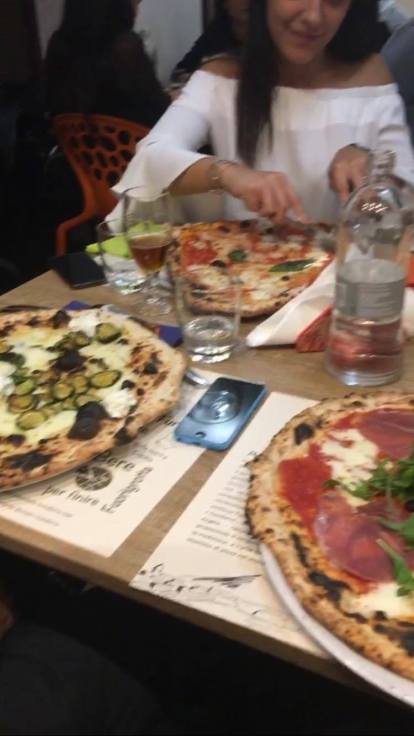
This post wouldn’t be complete if I didn’t talk about the food. Oh, the food. I met up with a group of six other Italian friends, who had studied abroad at UR the year before with Elena, and tried real pizza for the first time. Unlike American pizza, the crust is thin and the toppings are generally fresh ingredients not piled but sprinkled on. And no need to dab the oil with a napkin; you’re going to want to taste the olive oil drizzled on top. It was an entire operation trying to finish that thing—first you have to cut each individual slice and try your best to grasp and fold the pizza properly lest it falls apart. Although the most difficult pizza I’ve ever eaten, it was in no equal measure one of the best.
22281382_1497184227064144_1815662334_o.jpg

Sorry for the blurry-ness– I’m typically not one to take pictures of food because inevitably I get too excited and dive right in: so this was all I could manage!

Fortunately this is only the first of several trips I’ve planned to go to Italy not only to visit Elena but also to further explore the peninsula as a whole. But fino alla prossima volta (until next time), Milan has a pizza my heart. Sorry—had to do it. 

Here are some more photos!

IMG_3786.JPG

Just another beautiful walk down Milan’s picturesque streets

just narrowly missed Milan fashion week, but you can still easily find bold fashion statements–like this (euro) 45,000 jacket thing

IMG_3789.JPG

I just narrowly missed Milan fashion week, but you can still easily find bold fashion statements–like this (euro) 45,000 jacket thing

IMG_3790.JPG

And yet another captivating castle


Jess en France: Life in French Academia

September 15, 2017

In light of France’s loss in the Franco-Prussian war in 1871, Sciences Po was established in order to promote a new generation of French politicians. It’s now one of the most well-known schools in France. It’s not a university in the traditional sense, however. There isn’t a contiguous campus or a cafeteria. It’s also a school that specializes in the political sciences, so there aren’t many classes that expand outside the discipline. But the most significant difference between Sciences Po and other traditional universities, in France or elsewhere, is that Sciences Po isn’t a university but a Grande École. In other words, within the French educational system, which is rather hierarchical, the pinnacle of French education is not a university but a Grand École, which is a step higher. For the sake of accuracy I’m synthesizing some external sources in my definition of Grandes Écoles, which essentially are highly prestigious and selective institutions outside of the public university system. Because they’re intensely competitive and difficult to get into, Grande École graduates tend to dominate the top echelons of the political and business sectors in France. Sciences Po in particular has produced France’s last five successive presidents. Needless to say the classes are difficult, the expectations are high, and the students here are quite impressive.

unnamed

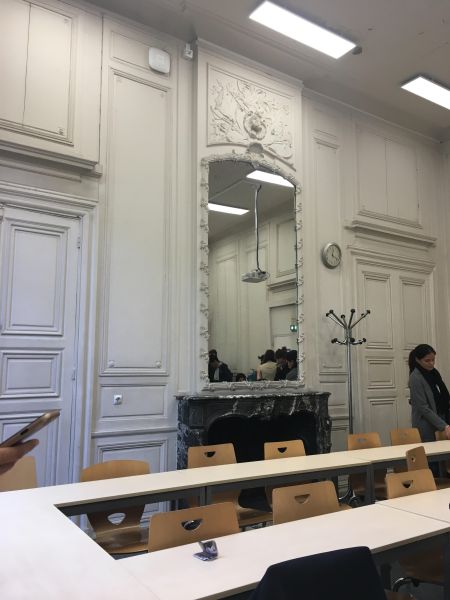
Hard to pay attention in class when you’re learning in such a historical environment

I’m taking five courses, all of which so far have been some of the most interesting I’ve taken in college so far. My most demanding course is “The Sacred and the Profane: Critical Perspectives on Power, Ecstasy, and Violence” which is taught by a professor who used to work with UNESCO as an Enseignment (or educator). We’re currently diving into the works of sociologist Emile Durkheim, which is new territory for me academically, so it’s been relatively difficult for me so far to substantially contribute to class discussions. The class discussions as well are demanding in the sense that many students here are more familiar with classical texts and can provide compelling philosophical evidence even for the question or answers they propose in class. It’s been tough, but I’ve been enjoying the challenge—it’s certainly what Sciences Po is known for.

unnamed-1

Hard to believe this is classroom!

One of the other exciting parts about studying abroad is assimilating into a new social culture, and the best way to do this is to join a club. I’ve joined the “Refugee Help” association as well as “Stop and Go,” Sciences Po’s very own hitchhiking club. I wanted to get involved with the humanitarian side of politics and thought an association that is dedicated to doing exactly that would be a good choice to both meet French students and also dedicate my extra time to serving a cause the needs all the help it can get. On a less serious note, the hitchhiking club is a lighthearted group of French people struck by wanderlust and who share in excursions all across Europe. I’m going on a hitchhiking trip next weekend across France, so we’ll see how that goes. They’re two entirely different clubs but, experientially, will make my time studying abroad here all the more interesting.

À plus tard,

Jess


Jess en France: Ch-Ch-Ch-Ch-Changes!

September 4, 2017

Now that orientation is over, and I’ve been settled with my host family for over a week, I want to talk about studying abroad and the inevitable adjustment process. Before coming to France I only spoke as much French as I had managed to cram over the summer. Although many people in Europe speak English as their second, third, or even fourth language (and I met some Europeans who know a fifth one), the French are notoriously picky about language competency. Granted, this is a stereotype, but the French are rightfully proud of being a historically significant contributor to the world in art, gastronomy, and language and have the cultural organizations to ensure that the ‘French’ way is respected. So I made sure that upon arriving in Paris I would, at the least, have a basic grasp on, well, the basics.

Inevitably, adjusting to a new language is difficult, and I’ve messed up quite a few times. One of my most embarrassing moments, admittedly, occurred when I tried to talk about the former President of Vichy France, Philippe Petain, and mispronounced his last name. I won’t be too explicit, but I, essentially, had renamed the man “President *expletive*,” about which it took everything in my host mom not to burst out laughing.

Although it was easy enough to laugh off my mistake, it took a while longer to navigate and grow accustom to other cultural shifts. The French don’t generally make small talk with strangers. This also means that smiling at strangers or saying “hi” to them in passing is bizarre. As someone who loves to smile I’ve garnered some unwanted attention being a bit too ‘smiley’ on the streets of Paris. But on the other hand, when French people engage in conversation with you they do it not out of a sense of obligation to be nice but because they genuinely want to. So there isn’t much doubt when a French person offers to help you that they sincerely would like to help. If I walk into a store or go to a restaurant there isn’t always someone readily and eagerly waiting to assist me, but there is certainly help if I ask. There’s a more pronounced sense of independence or ‘laissez-faire-ness’ here that is difficult to articulate, but it starkly contrasts with the bustle of American overt-friendliness.

This is one of my favorite aspects of the French culture, however—most don’t feel an obligation to make small talk and, consequently, respect each other’s solitude. The metro is almost always silent. Interestingly though, most aren’t looking down at their phones, like many would in the States (because there is a sense of awkwardness for Americans when we don’t have something with which to occupy ourselves). Most are reading a book or staring off into space. In cafes, people generally sit on the terrace and eat by themselves while people-watching. This isn’t to say that French culture is aloof or intensely introverted, but silence and solitude is acceptable, and there isn’t a cultural necessitation that people have to be doing something lest they look awkward. Human interaction is still important, there’s no doubt about that, but it’s conducted with a different purpose in different settings than what I’m used to in the United States. As someone who enjoys her solitude eating alone at restaurants or going solo to a movie, often to the curiosity of American onlookers in the States, I feel right at home slipping into this aspect of French culture.

I start my first day of school tomorrow, and I’m excited for the new people, events, and expectations looming on the horizon. During orientation we were given instruction on how to acclimate to the French methodology of writing, which is notoriously strict and systematic. So aside from acclimating to a new school and student body, I have to acclimate to a new system of education as well. Next week I will be sure to talk a bit more about the ‘French’ way of all things academia and the five classes I plan on taking for the rest of the semester.

À la prochaine,

Jess

P.S. I’ve done a bit of exploring around Paris, so here are some photos. More to come!

IMG_3412.JPGIMG_3442.JPG

IMG_3544IMG_3435


Jess en France: A Beginning

August 27, 2017

It’s quite hard to imagine a city that is as easy to fall in love with as Paris. Every street corner has a musician, every boulevard is peppered with bakeries, and the very ground you walk on is historical. The river Seine weaves itself throughout the city and, today, I find myself dangling my feet at its elevated edge. Along this part of the canal-way there are wide ledges where Parisians and tourists alike come for leisure. I have my journal with me, as I often do, and feel compelled to reflect on these past few days. I sit under the shade of a willow tree and, in the warmth of a setting sun, I begin to catalog my time in France so far.

1.4 La Seine

The first day I arrived in Paris I stayed in Saint-Germain-en-Laye, where I met with a friend who currently studies at Sciences Po. SGL is not only in the outskirts of Paris where the views are panoramic but it also is in one of Paris’ most beautiful and historical parts. We walked through a large garden next to an even larger castle that used to house the royal family before Versailles was built. Every facet of the chateau had been restored to its original state—the gargoyles, the Gothic-inspired ornamentation of the facade, the exactly trimmed square hedges in the garden and the perfectly spread beige gravel. This attention to detail is not uncommon in the rest of Paris. I came to discover in the next few days that the entire city is just as architecturally ornate. It was Day 1 and I was already awestruck.

1.2 Notre Dame


Orientation began the next day, and it felt like freshman year all over again—in a good way! Although I got lost going in the wrong direction on the metro, I made it to school and, fortunately, was given a tour and a map to help orient myself to the area. In my orientation group, China, South Korea, Sweden, Brazil, the US, and Singapore were all represented, which made for a melting pot of cultural diversity and ever-more interesting conversation topics. We were then funneled into a massive auditorium, which I later learned is a lecture hall. Coming from a school with an average class size of sixteen people, a classroom of that size is a bit alien to me. The director of the university, Frederic Mion, was in attendance and gave a speech about the many paths we might find ourselves traversing this next year or semester of our lives and the richness they bring to our sense of identity as citizens and academics of the world. And just as my orientation facilitated for me at University of Richmond, I felt like I had found a new home at Sciences Po.


1.1 Student ID Card


It’s the weekend now, and I’ve moved into my housing arrangement for the semester. I’m living with a lovely host family in Montmartre, and they are thankfully patient with my limited French. I chose to live with a host family because I wanted an immersion experience. It also helps curb the homesickness to be in a home with a mom who cooks wonderful French food. They live right next to the Basilique du Sacre-Coeur or the Sacred Heart Church as us Anglophones know it. The church is constructed of limestone, which is said to have an effervescent glow after it rains. Needless to say, this area is beautiful, the church down the road is ethereal, and I’m pretty ecstatic about spending the next four months with a wonderful family.


1.3 Host Family


I still have a few days of orientation left, so my next update will include some more tidbits about acclimating to French life as I’m introduced to all its Parisian nooks and crannies.

à bientôt,

Jessica


Jess en France: Nerves (the Good Kind?)

August 25, 2017

It’s a few days before I fly to Paris, and my hyper-active mind has presented me with a mixed-bag of emotions. I find myself reminiscing the days before I made my move across the country, from southern California, to start my college career at University of Richmond. But as I now face the new prospect of moving across the world, to one of the most gushed about destinations on our planet, the sentiment of these last few days feel similar, yet altogether different than that before I came to Richmond. If you’re like me, you like to plan and over-plan, going over minutiae in your head until planning becomes superfluous (and even unhelpful). But if there’s anything I learned from my move just a few years ago it’s that there’s a finite extent to which planning is actually going to help—especially when you’re travelling and taking root in an entirely new place. This isn’t to say you should “wing it”—travelling can be logistically challenging. However, one of the greatest parts about travelling is letting yourself be surprised by what you find and allowing it to paint your experience, rather than you painstakingly painting it for yourself. And this is where my anxieties fortunately drop-off, at the point where I let myself “be” and let what will come, come.

Hi, I’m Jess. I’m a UR student majoring in International Studies: World Politics and Diplomacy, and I’m spending my first of two semesters abroad studying at Sciences Po in Paris, France. I chose to study abroad in France for two main reasons—to work on my French language skills and to study at Sciences Po, which offers one of the best International Politics programs in higher education. I will be staying with a host family in Montmartre, which is a large hill in the eighteenth arrondissement (i.e. the outer district of the city) as well as a historically renowned part of Paris that artists have flocked to throughout the years, particularly in the nineteenth century. As someone who loves to write, I can’t wait to scope out a “writers spot” and bask in the wonderment this corner of the city has to offer. So I would definitely be remiss not to mention that Paris is a melting-pot of cultural, artistic, as well as musical, and gastronomical prominence! There is quite a lot to look forward to.

I’ve been truly blessed with such a wonderful opportunity to study here, and there are many people to thank—professors and friends who have supported me, but also the Office of International Education and Chris Klein, my study abroad adviser. Without them, I wouldn’t have been afforded such a life-altering adventure. I cannot wait to share my experiences with you and any tips or words of wisdom I may be able to impart as I venture off into Europe.  I will be posting weekly, so stay tuned!

À la prochaine (Until next time),

Jess