Back in the USA

May 30, 2012

I am back in the U.S. and it feels surreal to think that I just spent five months living in Bangkok.  After my traveling this year, it scares me a bit how easily I move between locations and stages of life–since August 28th when I left my hometown for my first travel experience my schedule has been: Boston, Amsterdam, Kenya, Tanzania, Kenya, Amsterdam, Germany, Amsterdam, Boston, Thailand, Cambodia, Thailand, Burma, Thailand, India, Thailand, London, Brussels, London, Boston, and soon onto DC.  I haven’t had the “ah ha, I was in Thailand” moment, which I think will come once I start going through all of my pictures.

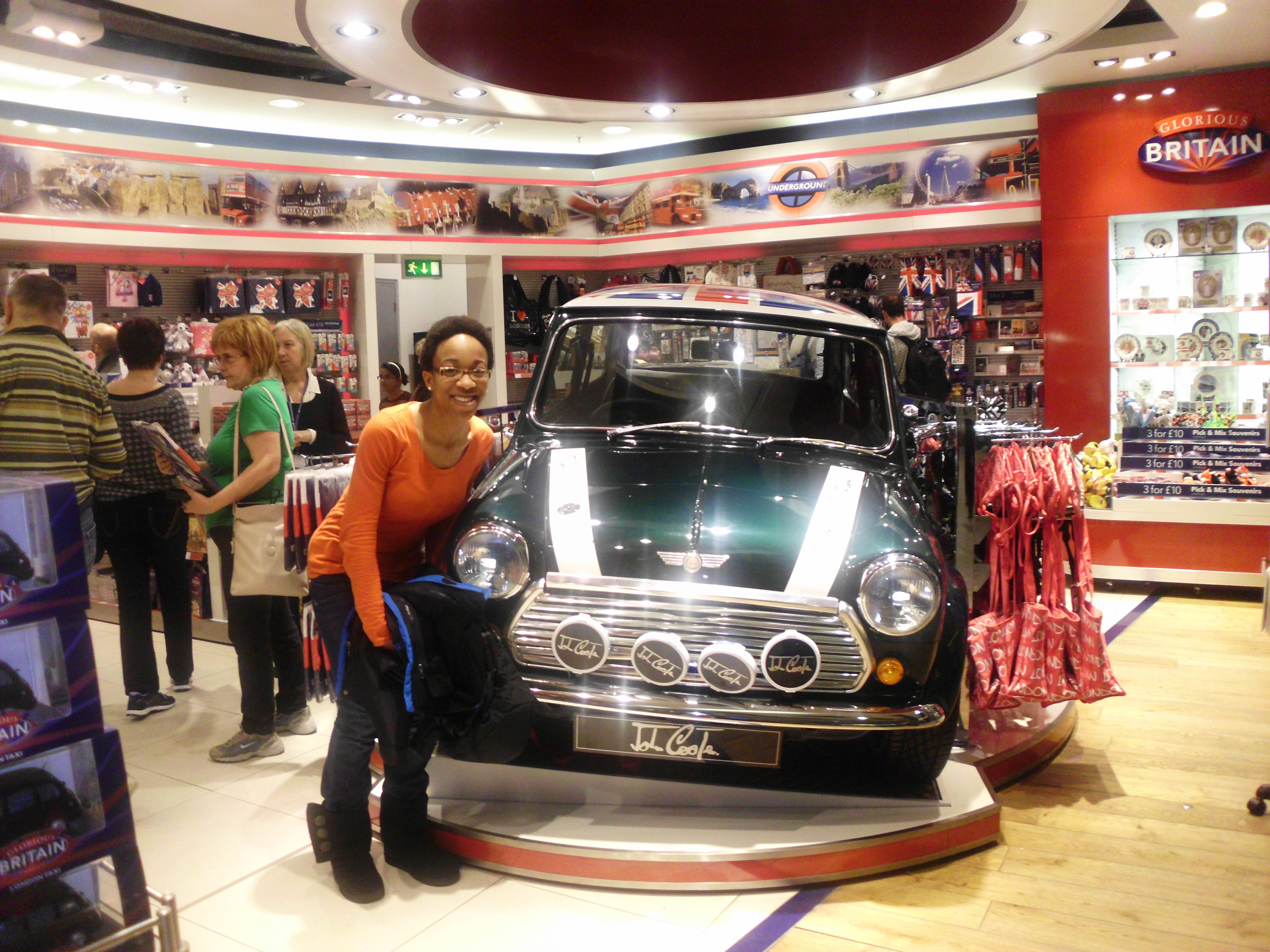
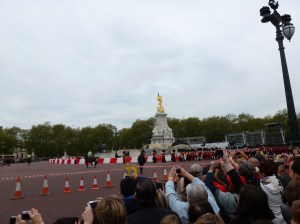
After leaving Bangkok I spent a week and a half traveling in London and Belgium visiting my family.  I had my “oh my gosh  I’m not in Bangkok anymore” moment, when I got caught at Buckingham Palace in the freezing cold, in the midst of a ceremony practice for the Queen’s Diamond Jubilee.  Red coats, black fuzzy hats and all, I was surely not in Bangkok anymore.
Throughout this time, however, and since catching up with friends at home, I am constantly asked “so how has this year, or this semester changed you?”  I can’t put it into grand and poetic terms, so I will keep it simple:

1.  I got home, and was embarrassed and appalled at how many clothes I had in my closet. So I cleaned out the whole thing and since then have given two bags of clothes to Goodwill.

2.  Before this year, I had every intention of moving to London after graduation to pursue some sort of career there.  Now I think more likely that I would move to Bangkok or somewhere in Africa.

3.  I want to learn: read books, travel, talk to people as much as I can to learn as many different things as possible.

4.  I will never ever complain that 85 degree weather in Massachusetts is “hot.”

5.  “May pen ray” is my new favorite motto.  It’s the Thai version of “hakuna matata,” meaning no worries, take it easy, everything is okay, no sweat.  It is Thailand’s slogan, and truly governs the Thai lifestyle.  And despite being extremely organized, and a very Type A personality, this is something I have really embodied this year. Just go with the flow.  It doesn’t matter. No worries. Take it easy. Adapt to the situation. Love every minute of it.  Don’t think too too much about “what if.”  Just relax, and enjoy it.

I just hope once I am back in the grind at Richmond, or even working on my internship this summer, that I can continue to keep “may pen ray” in mind. It really is a great way of living!


Midterms and Hiking

May 25, 2012

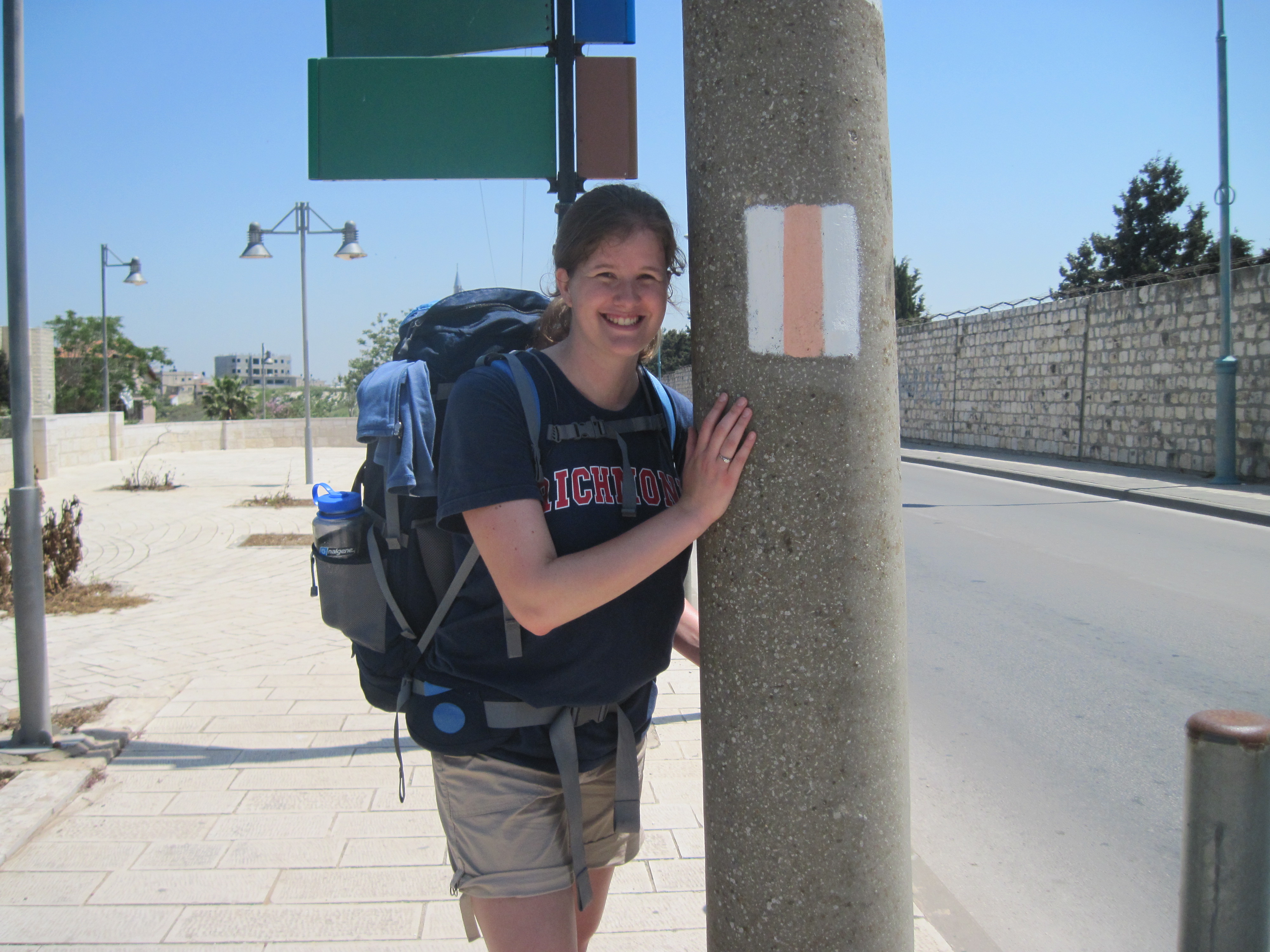
Are the two things that have been occupying most of my time lately.  But really, mostly hiking.  A few weeks ago my friend Bekkah from Ohio and I hiked the Jesus Trail, a 65 kilometer trail that runs from Nazareth to Capernaum.  Because of Israel’s Memorial Day and Independence Day we had a few extra days off, so we were able to take five days to complete the trail.  Most of the trail runs through small, predominantly Arab villages, farmland and parks.  We took the first two days pretty slowly, taking many long breaks beside fields or on hillsides, pondering life and soaking in the sunshine.

On Friday, however, it was a different story.  We got an early start, which was good, after spending the night in a guest shed at Yarok Oz organic goat farm.  Our first obstacle was a series of farm fields that for some reason were infested with flies.  Now I know why the Biblical plague of flies was, well, a plague.  We finally made it through that area and ended up on the outskirts of Kibbutz Lavi, where we visited their Holocaust Memorial and refilled our water bottles.

We were glad we did, because after that we ended up taking the wrong trail through the kibbutz, and by the time we realized and corrected our mistake we were four hours behind schedule and had spent so much time wandering through fields that we were dangerously low on water.  Also, a blister the size of Texas was forming on my toe.  We ended up cutting out a loop of the trail and heading straight for Moshav Arbel, where we spent the night.  The next day we climbed down Mt. Arbel and stopped for a break at a gas station.  I think we were still feeling the effects of being dehydrated the day before, because once we sat down we didn’t want to move again.  So we took a cab straight to Tiberias, where we stayed in a hostel for the night and then rented bikes and rode from Tiberias to Capernaum on Sunday.  So we ended up finishing most of the trail, just not on foot.

The whole trip was amazing, and quite possibly my favorite time here so far.

I was able to see an incredible variety of landscapes, and because we needed to ask for directions so much, we interacted with a lot of different people along the way.  There was something really meaningful about spending five days without internet, and without trying to communicate with anyone who wasn’t right there with us.  Too much of my life is spent in the virtual world of the internet and my phone, and getting away from all of that to focus on absorbing the experience of the moment was liberating and incredibly rewarding.

The following weekend the International School took us on a hiking trip in the north. the first day we hiked near Sefad, and the second day in and around the Hula Valley.  We saw Banias Falls, which was beautiful.  We slept under the stars at a campsite, which was exhilarating (but incredibly cold), and I woke up to little birds hopping around on my sleeping bag.  I’ve discovered how addicting hiking is, and I think this realization will result in a permanent lifestyle change once I return to the States.  Bekkah and I are even thinking about hiking the Appalachian Trail the summer after graduation, I’ll keep you posted on how that goes!

I have actually spent some of the time in the past four weeks doing schoolwork, studying for midterms and writing a couple of papers.  My roommate told me that I was talking in my sleep the other night, and some of what I said was in Hebrew.  So I guess that means I was dreaming at least partly in Hebrew.  This makes me quite excited; I love the idea that the language has sunk into my thoughts enough for this to happen.


Two Unforgettable Weeks

April 23, 2012

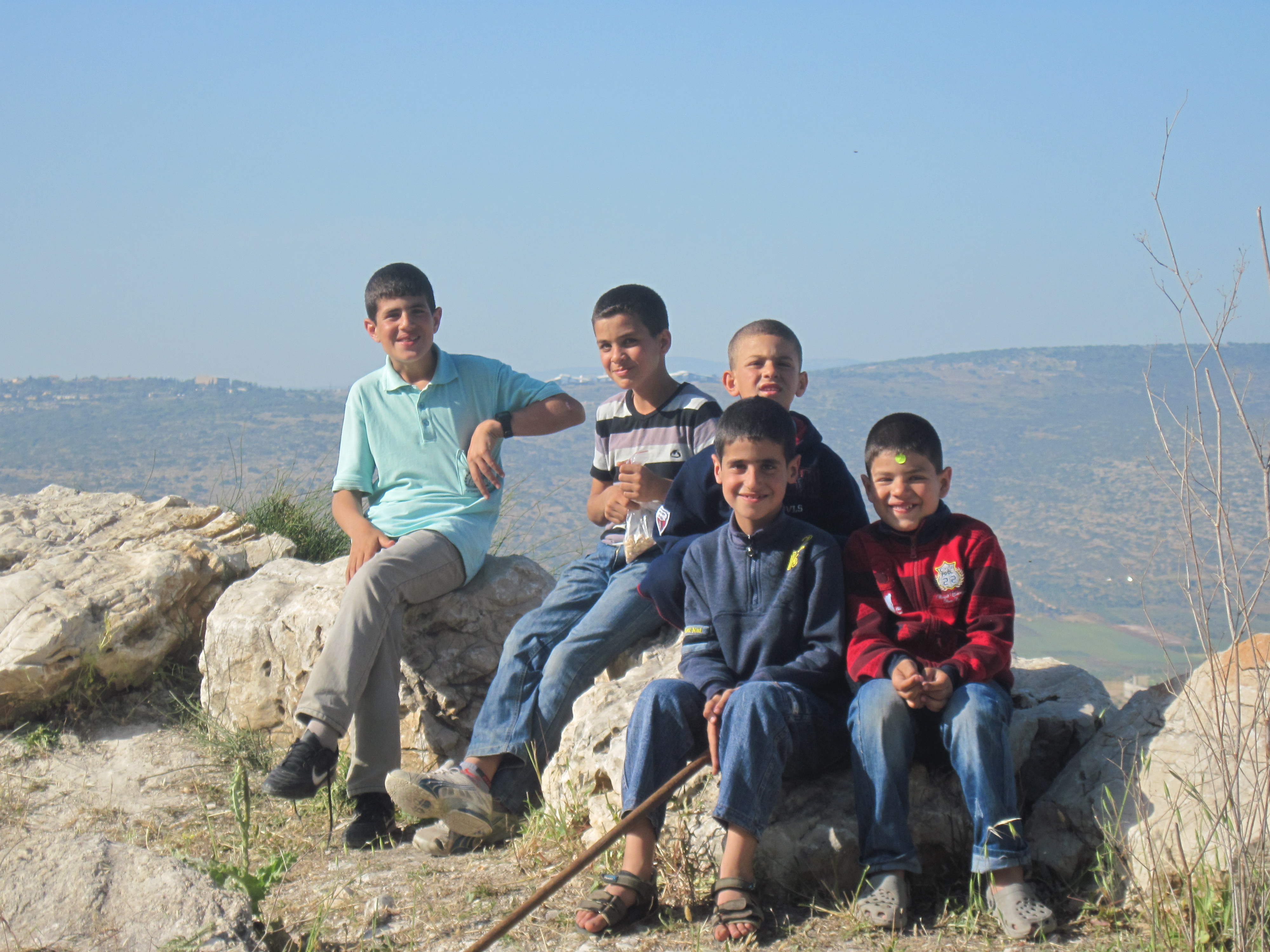
Five cities.  Two sunrises.  The Lowest Point on Earth.  One mud bath. Two Passover Seders.  Two rooftop hostel gardens.  A 5 a.m. mountain climb.  Seven long bus rides and one train ride.  Old friends and new friends.  Dancing across Israel.  Life advice from 71 year old Peggy, a dorm mate in a hostel in Jerusalem.  The best hummus in Israel.  The best hot chocolate in the world.  A literary café in Jerusalem. Spying on a wedding reception in Tel Aviv. Burning leavened bread in Be’er Sheva in preparation for Passover.  A shepherd with his flock next to the Sea of Galilee. Coming home to Haifa.

It is hard to know how to begin to describe my spring break.  Just as my friends and I thought as we were planning the trip, where do you begin a whirlwind tour of a country that has so much to offer?  All I know is I am convinced more than ever that studying in Israel was the right decision.  There are moments here that are hard and confusing, such as when I witnessed a young man hissing at an Israeli soldier in the Old City of Jerusalem. At times like these, I wonder what I have gotten myself into.  Who am I to be a cheerful, curious tourist when the reality of the situation in Israel is very serious for so many people?  But it is this confrontation with a human experience so different from my own that makes studying in Israel so incredible.

Another occasion in the past two weeks that showed me the high intensity of life in Israel was when my friend and I had Shabbat dinner with a lovely, generous Orthodox Jewish family in Jerusalem. They had an eighteen year old daughter named Shlomiya who was preparing to begin her army service in a few weeks.  Army service is mandatory in Israel, women serve for two years and men for three.  Observing Shlomiya and the mature, thoughtful way she spoke and acted throughout the evening, I thought of myself when I was eighteen, and how the most important thing on my mind was my next Spanish test.  Constantly living on edge, young Israelis must mature quickly as they are faced with challenges that never crossed the minds of me and my American friends as we were growing up.

I spent the majority of my break with my friends Emma and Heather, fellow international students who attend Brandeis University in the U.S.  I met Heather during the intensive Hebrew Ulpan at Haifa University at the beginning of the semester, but she is now doing a complete Hebrew immersion program at Ben Gurion University in Be’er Sheva, during which she is not permitted to speak in English.  To be completely honest, after the first day we spent together I did not have a very good attitude toward the situation.  What was I thinking, spending my spring break with someone I can’t even have a normal conversation with?  But within a couple of days, I was amazed by how Hebrew really started clicking for me.  I had always thought I learned almost exclusively from reading and writing, but I was proved wrong as I learned more from a few days of conversations than I had in weeks of classes.

This semester has held some challenges for Heather.  On top of the difficulties of having to speak Hebrew all the time, several weeks ago she had to run to the bomb shelter in her dorm several times as over ninety rockets were fired at Be’er Sheva from the Gaza Strip over the course of a few days.  She said the Israelis in the shelter with her would sit and count the booms as the Iron Dome, Israel’s missile defense system, destroyed many of the rockets in mid-air.

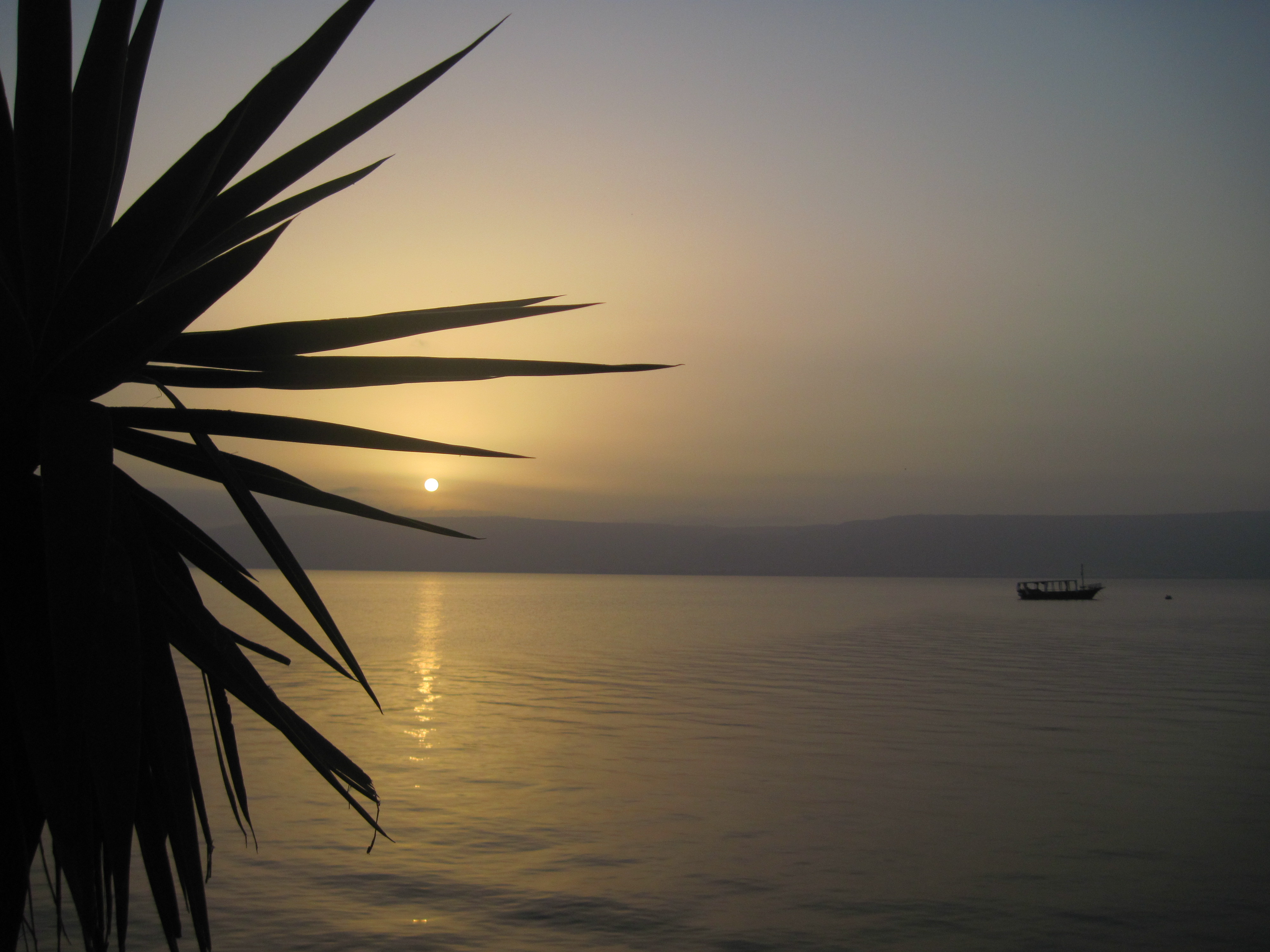
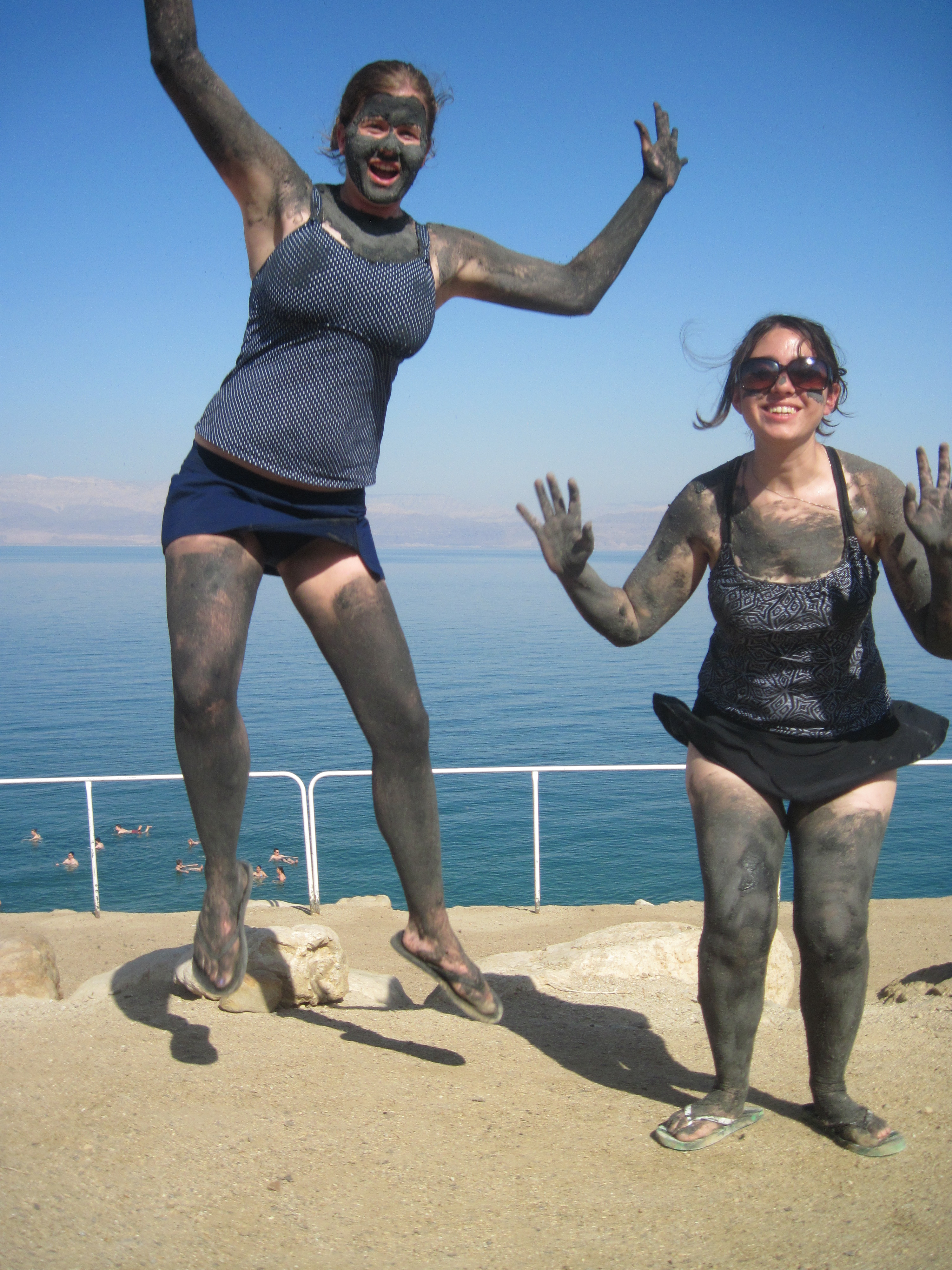
I accomplished a lot of bucket list items over break – climbing to see the sunrise on the desert mountain fortress of Masada where almost one thousand Jewish rebels committed mass suicide rather than be taken by the Roman army, floating effortlessly on the buoyant salty water of the Dead Sea, and seeing the sun rise over the Sea of Galilee and set over the Mediterranean in the same day.  Most importantly, though, I had a lot of time for reflection, and when new thoughts to ponder came my way I was able to soak them in, trying to expand my understanding of what it really means to live in Israel.

Sunrise over Masada

Standing on Masada

Sunrise over Sea of Galilee

Mud bath at Dead Sea


Tel Aviv Without a Plan

March 30, 2012

So far this semester, I have only been to Tel Aviv once, only for a weekend.  Many of the international students have gone several times to experience Tel Aviv’s vibrant night life, but that aspect of the city doesn’t have that much appeal to me.  So I hadn’t been aching to go, but when my friend Eva asked if I wanted to join her, I didn’t refuse.

A little background on Eva:  She was born in Hong Kong, lived part of her life in Texas, returned to Hong Kong, and now goes to college in the States.  Last semester, she did a Semester at Sea program, where she lived on a ship that traveled literally all the way around the world.  So, needless to say, she is a seasoned traveler. We chose a hostel with no problem, and planned our bus and train times for the trip. When we arrived in Tel Aviv on Thursday, we spent the day hanging out and touring Old Yafo with a couple other international students who were there for the day.  When we woke up Friday morning, I expected to carefully plan our day so that we would be able to visit all the museums and such that would be closed on Saturday.  So I started making suggestions of possible plans.

Me: “So, what do you think of checking out this Bible Museum, or going to the Art Museum to find the street festival the lady at the tourist counter mentioned yesterday?”

Eva: “Meh.  We’ll see what happens.”

Taken aback, I tried a couple more times to suggest plans, but each time, she refused to discuss them with me.  I was rather frustrated.  So we set out walking, really in no particular direction at all.  I wasn’t sure how to handle it at first, and the controlling side of me was rebelling at the thought of aimlessly wandering the city with no plan or goal in mind.  Finally I made up my mind to try my best to forget about a plan, and just go with the flow.  I guess really that was my only option anyway, as Eva had pretty much taken control of the situation.

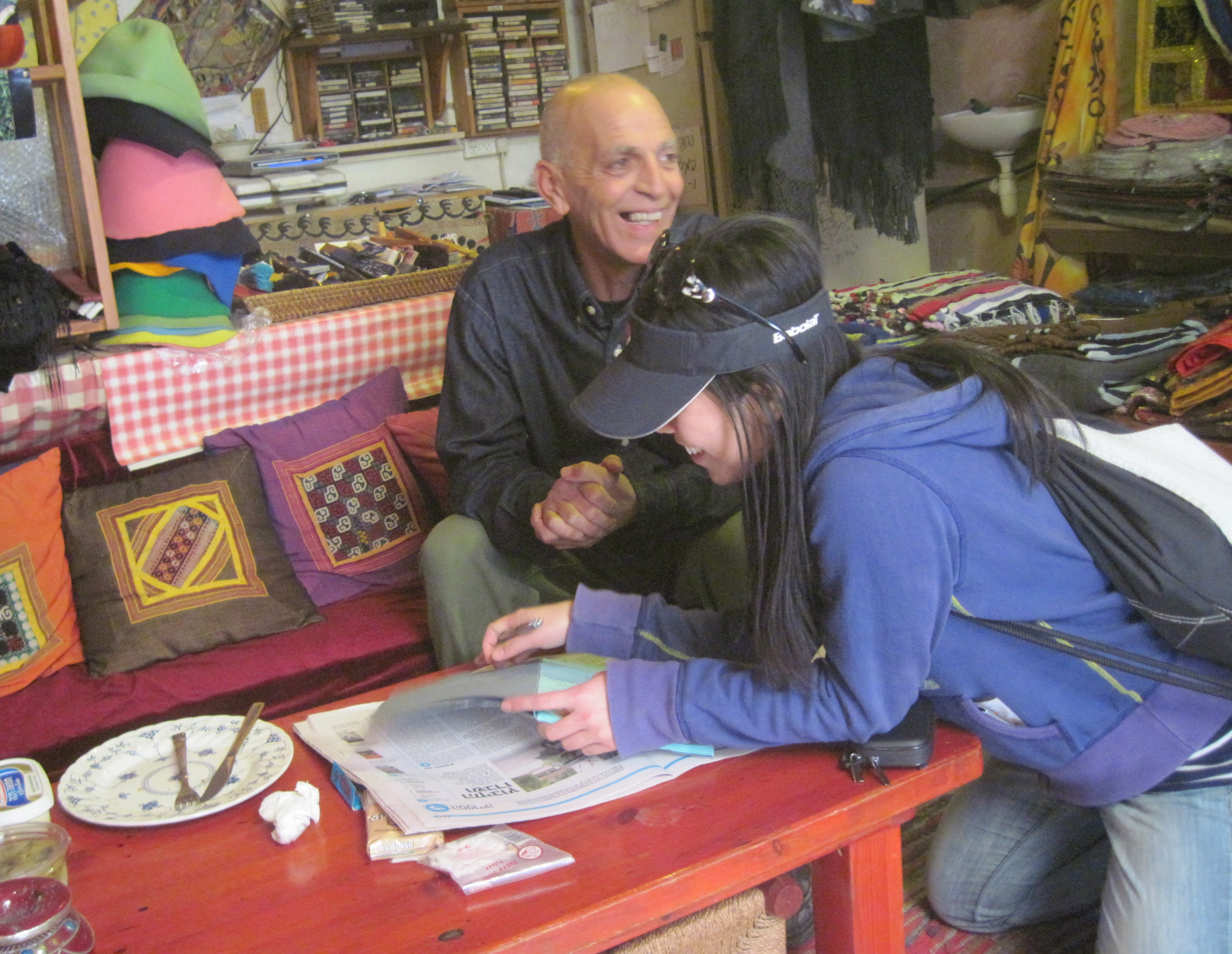
So we continued wandering, and entirely by accident, we bumped into this really neat crafts market, with some really amazing handcrafted items made by the vendors.  There was a lady who made baskets with rolled up, painted newspaper, there were painters, jewelry makers, you name it.  It was really fun, and we ended up spending a couple hours just wandering around.  Eva also was determined to practice her basic phrases of Hebrew with every shop owner that would give her the time of day, and hilarity ensued.

After the market and a stop for some freshly made carrot juice, we continued our wandering and ended up at the beach, where we ended up hanging out and playing a strange form of tableless beach ping pong that is really popular on the Tel Aviv beach.  Then we explored a little more and met a couple friends for dinner that we had run into the day before.

That is how our weekend progressed, and once I was able to leave my comfort zone of carefully planning every step of the day, it turned out to be one of the most relaxed, enjoyable weekends of touring I have ever had.  The weather was beautiful, and the Tel Avivians were extremely helpful when we were standing on a street corner trying to figure out our map; on multiple occasions  people even stopped to ask us if we needed help.  I think if we had minutely planned the day, I would have been focused on our next destination in my mind, and I would not have noticed all the life going on around me.


Have you bought a costume yet?!?

February 27, 2012

For approximately two weeks leading up to Sunday, February 19th, this is the question I was repeatedly asked.  Sunday the 19th through Tuesday the 21st marked the official dates of the Carnival (or Carnaval — I’m still not sure which is the correct spelling, since I’ve seen them both used interchangeably) before Ash Wednesday.

Here’s what I knew about Carnival before it started:

1. Basically everyone dresses up in some kind of costume, whether it’s just a mask or a full-blown outfit.

2. Carnival is celebrated most in the southern part of The Netherlands, which is where I’m located.

3. Because of this, classes would be cancelled for one week in order to celebrate.

Going into Carnival with this knowledge did not fully prepare me for what I like to call the “Carnival Experience”.  When I first arrived to the Vrijthof, which is the heart of Maastricht– and also where the main festivities were going to be taking place– I was confused.  Although there were people there, and they were in costume, the Vrijthof seemed fairly empty compared to what I was expecting.  It seemed like people were constantly saying that this was such a big deal, yet it wasn’t much more crowded than it would be on a normal weekend.

While we were waiting for the parade to come, there were sporadic hailstorms, and then, in the blink of an eye, the Vrijthof was extremely crowded!  Allow me to put it in perspective for you.  A street that would normally take about one or two minutes to walk down took 10-15 minutes.  This part of the experience is what I’d like to call organized chaos.  Everyone was having a good time and trying to get to their next destination within the Vrijthof, but it could have been perceived as chaotic from someone who was completely unprepared.  My friends and I, however, did what the locals were doing; made a little train by putting our hands on each others’ shoulders and moved through the crowd.

Below is a picture where you can see some people in costume unsheltered during the first hailstorm.

The parade arrived just as the last hailstorm took its leave.  There were bands and of course everyone was wearing a unique costume!  The parade was interactive; the people on the floats saying “hip hip!” and the crowd responding “hooray!” (all in Dutch of course).  My friends and I had a really nice time.

After the parade was over, it was time for food!  One of my friends and I decided to be brave and try Herring, which historically was the traditional food eaten on Ash Wednesday.  Even though it wasn’t Ash Wednesday, we ate it anyway.

This fish was probably the largest piece of fish served to one person that I’d ever seen in my entire life, and it was absolutely amazing! The picture doesn’t do it justice, but it really was a large piece of fish.  After we were fed, it was time to explore and see the costumes.  The Carnival colors for Maastricht (located in the southern province of Limburg) are green, yellow, and red, so that tended to be a common color scheme, especially amongst the older generations.  I was one of the exceptions.  I realized that I may not have the opportunity to experience Carnival again, so I decided to “dress-up” with some of Limburg’s colors.

I bought a cheap purple costume dress, because purple is my favorite color, and accessorized with Limburg’s Carnival colors!  I was surprised to get so many compliments; I felt Dutch 🙂  As the day went on, more and more people kept showing up, including people of all ages (including little children whose parents had dressed them and/or their strollers up in order to celebrate).  As I mentioned earlier, Carnival is a three-day event, and people did not stop wearing costumes and celebrating at any point during those three days.  It was quite impressive that it was still going strong on day three!  I suppose when you plan and wait for months for Carnival, you’re going to enjoy every minute of it.


Belonging

February 24, 2012

In Hebrew, there is no “to be” verb in the present tense.  I studying Hebrew.  Kind of awkward, right?  My brain always wants to stick another word in there, forcing the sentence to comply with my English-centered demands.  I’ve realized I am expecting more than just the language of Israel to fit my idea of what is ‘right’.  I want the washing machines to wash my clothes like they do in the US, I want my salad dressing to taste like it does in the US, I want to just walk in and out of a shop on the street without being hassled by the overbearing shop owner, I want people to wait politely in line at the bus stop instead of always shoving their way to the front. But there is something really amazing about realizing the rest of the world doesn’t do everything exactly like you do.  And when you can get over trying to find the American equivalent for everything, you allow yourself to truly become a part of your host culture.

Last weekend, two friends and I traveled to Sefad, a small, heavily religious city a couple hours by bus from Haifa.  Winter probably isn’t the best time to travel to Sefad — it was cold and rainy most of the time, and it even snowed!  The owner of the hostel we stayed in was really excited about the snow, so it was hard to be annoyed at it for spoiling our plans.  Israel really treasures its water, so I have really tried to have a good attitude about the copious amount of rain we have gotten the past couple of weeks.  Despite the weather, we managed to have a nice, cozy time, except for two hours on Saturday when our power was out due to the rain. Sefad is beautiful, and I was amazed by the height and beauty of the mountains surrounding the city.

When I arrived back in Haifa late Sunday afternoon, just as the sun was setting, I realized how much I have come to love this city.  I feel like I have really become a part of Haifa’s diverse, beautiful community.  I don’t miss UR like I thought I would.  There is so much to discover and accomplish here, both in my language learning ambitions and in growing as a person.  The surreal feeling I have had since arriving here has started to fade, and in its place has grown a sense of belonging and permanence.   For a country whose right to exist is constantly questioned by the international community, and one that seems to stand perpetually on the verge of international conflict, life in Haifa is surprisingly rhythmic and normal.  Falling into that rhythm has been one of the greatest things I have ever experienced.


The Mosaic

February 6, 2012

Shalom all!  I have arrived in ארץ ישראל, the Land of Israel!  Many things are exactly as I expected, but there have also been some surprises.  For starters, I wasn’t prepared for how beautiful Haifa would be!  All the pictures I looked at before I arrived don’t even come close to conveying how amazing it feels to look out over the city, the mountains, and the Mediterranean Sea on my walk to class.  The University is situated on one of the highest points of the city, so you can see everything from here.  Someone even told me on a clear day you can see all the way to Lebanon, but I have yet to hear that from an official source.  We also haven’t had too many clear days yet, as it is the rainy season right now. We have a rain shower or thunderstorm almost every day, and it is usually overcast–  although still beautiful!

The incredibly diverse mosaic of peoples and cultures blending together in this beautiful city are unlike anything I have ever experienced.  The university is a microcosm of this.  My intensive Hebrew class is made up of six Korean students, one Japanese student, a grandfather from Vermont,  four Europeans (mostly PhD or graduate students), and six Americans.  It has been fascinating to learn of the different cultural backgrounds and motivations that have brought us all together in a classroom in Israel.  From the Japanese student of theology wanting to learn Hebrew in order to read Biblical texts in their original language, to the Political Science PhD student from Belgium interested in the political conflicts of the Middle East, our motivations for studying Hebrew are as widespread as the countries we come from.  The fast pace of the class has been overwhelming at times, but today when I took the midterm, I realized how satisfying it was to take an exam that involved reading a story and answering questions entirely in a language that two weeks ago I knew almost nothing about.  I’m really looking forward to having a working knowledge of Hebrew, and at the rate I am going, I am hopeful that it won’t be too long before I can navigate places like the grocery store with ease.  Even simple things like buying laundry detergent have been difficult. I almost bought bleach…oops! That would have been a disaster.  And I have to guess a lot when I am ordering food.  Although, the other day, I ordered coffee in Hebrew — I was quite proud of myself!

Last week the Madrichim (the social activities coordinators for the international students at the University of Haifa) took us on a tour of Haifa.  We explored the Arab Quarter, which included a large shouk, or outdoor market, with piles of fresh fruits and vegetables, fish, bread, spices, dried fruits, nuts, and olives.  We also went to the (reputedly) best falafel shop in Haifa, and a shop with delicious Arab sweets dripping in honey.  On a street running through the Arab colony, we saw the remains of their celebration of the “Holiday of Holidays” during which they celebrate Chanukah, Christmas, and Eid al Adja, the holidays of the three monotheistic faiths, all in one.  We also toured the central shrine of the Baha’i faith, and the German Colony, which was originally established by the Templars.

I am really excited about exploring the many layers of Haifa.  On Tuesday, the Madrichim took us on a hike to Elijah’s cave, believed to be the site of Elijah’s stay on his way to confront and defeat the prophets of Ba’al on Mt. Carmel.  During the hike, we passed a couple of bunkers built by the Israelis several decades ago, intended to be a last defense in case of attack.  So, side-by-side, you have Elijah’s cave standing as a remnant of ancient Israel and the spiritual battles that took place in the land, and the bunkers, evidence of the modern State of Israel’s current reality.

The adjustment to living abroad has been harder than I expected.  It is like the awkwardness of the first week of freshman year, but intensified by the new and foreign cultures and languages surrounding me.  It really helped that I was warmly welcomed by my five Arabic-speaking apartment mates, who have been fixing me delicious food and are eager to practice their English with me.

I am so blessed to have this opportunity to study here, and  I am eagerly looking forward to the friendships I will make and the many amazing experiences I will have over the next four months!


Botswana, Week 1: Intro, Facts and Excursions!

February 3, 2012

Hello, everyone. My name is Igor Martic, and I am junior (class of 2013) studying International Economics at the University of Richmond (UR). Currently, I am acting as a Foreign Correspondent for UR while representing the student exchange program at University of Botswana (UB), Africa. Welcome to my blog! Feel free to contact me at any time via e-mail: Igor.Martic@Richmond.edu. Enjoy, and I encourage my readers to leave comments. Thanks! Now, for an introduction to UB…

Here is a video I recorded while flying into the Gaborone, Botswana airport:

Next, I’ll answer some basic questions you might have about University of Botswana.

How many people attend University of Botswana (UB)?

Botswana, a country with a population of a little over two million, has a very limited amount of space in its one University, UB. There are approximately 15,484 (1,445 postgraduate) students and 2,658 faculty and staff.

What does University of Botswana (UB) have to offer?

UB provides many options and locations for its students. With four campus locations nationwide, this University has grown to become internationally renowned for its academics. UB offers seven areas of study: Business, Education, Social Sciences, Science, Engineering, Humanities, and Medicine.

When are the important dates for University of Botswana?

UB was established in 1982 as a public university in Gaborone, Botswana. Semester 2 (referred to as spring semester in the States) begins around January 9 of the new year and ends May 6. Exam week ends May 10, final grades are due May 24, and grades are finalized May 26.

The UB course catalog:

http://www.ub.bw/documents/UB_UnderGrad_Academic_Cal_2010_2011.pdf

Where is University of Botswana?

UB has 4 locations: 2 in Gaborone, 1 in Francistown, and 1 in Maun. The main campus, and the one I attend primarily, is located in Gaborone, Botswana, Africa.

Why was University of Botswana established?

UB was established for the purpose of educating the citizens of Botswana. With an economy that depends on primarily one resource as its main source of income (diamonds), Botswana understands that a limited resource also brings limited opportunities. UB exists to create a better social, private, and professional life for everyone across the Botswana lands. An educated and innovative society will bring intelligent and creative new ways of life and business to a nation that relies heavily on a depleting natural commodity.

How do I get more information about University of Botswana?

UB is an amazing academic institution. Please stay tuned to my blog for more personal information about this anything-but-ordinary study abroad experience. Also, please contact your advisor, international education office, or http://www.ub.bw for statistics, facts, and ways of applying to study here with the great citizens of Botswana and the “internationals” like me!

Finally, I’ll discuss some of the excursions I’ve had so far and will enjoy over the coming weeks.

After being in Botswana for a little under a week, I’ve had a quick, but simultaneously slow, transition into the culture, environment, and atmosphere of this new life.

To become more acquainted with our new home for this semester, the local students and the school have set up excursions for us to attend. This includes visiting the local village, a hike into the Gorge, local village dancing and an overnight stay, learning African pottery techniques, a game drive, and viewing one of the oldest living African trees and rock paintings in the world.

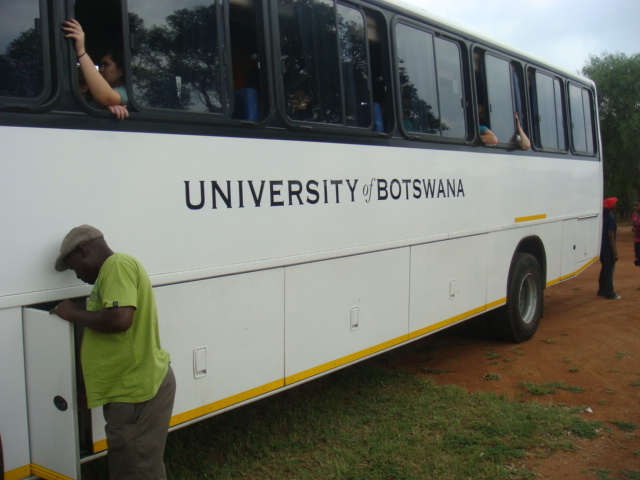
For our first excursion, we packed into a UB bus and headed out to the Kanye Village in Botswana, Africa. The trip lasted a brief 2 hours, but was well worth it! When we arrived, we were told that all males had to change into long pants and a collared shirt, and the females were required to cover their legs and shoulders. This was to respect the local customs of the tribe.

They had us seated in their local “courthouse.” A local directed the males to sit in the front of the females in traditional, hand-made chairs. He was very well-spoken and groomed, educated, and made everyone feel like he was their grandfather with a cheek-to-cheek smile and open arms. Surprisingly, he spoke my language, Serbo-Croatian, with almost perfect grammar and a slight African accent.

Group discussion

Side wall of village


Traveling is done… let orientation begin!

February 3, 2012

As you can assume from the title of my blog, I have made it to the Netherlands!  After a long, but comfortable flight to London, a short flight to Amsterdam, and a 2 1/2 hour train ride to Maastricht, I have arrived!  I must say that although I enjoy traveling to new places, I wish I could save several hours by teleporting myself to wherever I would like to go.  Despite the long journey, I had a nice time in the London airport.

My trip was also nice because one of the student organizations at UCM picked me up from the train station and took me to what would become my home for the next 4 months.  A funny story about the train ride:  I was buying my ticket in the Amsterdam airport and the man helping me circled where I needed to transfer and made sure I understood what I needed to do (since it was in Dutch) before I walked away.  When the transaction was done I walked away, saw a young guy looking at me so I smiled out of courtesy than kept walking.  I made it about two steps before I heard someone say “Whitney?”  I was really confused as to who would be calling my name in the Amsterdam airport, but naturally I turned around to see if I knew the person.  “I couldn’t help but overhear your conversation.  Are you by any chance the Whitney who is going to UCM?”  Then I realized that he was the person who was supposed to get picked up from the Maastricht train station with me, since our train was arriving at the same time.  Once we exchanged brief introductions, we proceeded to the platform and our 2 1/2 hour ride began.

Re-focusing on the title of this entry, now: Traveling is done, so let orientation begin.  Today was my first day of orientation.  When I woke up this morning and looked out the window, snow was covering the ground, and it was still coming down.  Snow is a kind of rare occurrence in Virginia, so I was excited.  My second reaction was the realization that I needed to prepare to walk approximately 20 minutes in snow, since I don’t have a bike yet.  I also had a feeling that it was going to be extremely cold, so I put on layers and headed out.  Although the snow kept falling during my walk and continued throughout the day and most of the evening, it actually wasn’t as cold as I thought it was going to be.  I have to admit that I kind of enjoyed walking in the snow; it was peaceful.

Once I made it to UCM, I welcomed the breakfast and immediately started mingling with the other exchange, transfer, and freshmen students.  I met people from literally all over the world: Singapore, Australia, the U.S., Germany, Peru, and, of course, the Netherlands, just to name a few.  Everyone was friendly, so it was easy to talk to people.  During orientation, we received our class schedules, learned about UCM’s online programs (student email address and online file storage), and began PBL (Problem Based Learning) training.  I was worried what my schedule was going to look like, because I was told that it was possible to have class anytime between 8:30am and 6pm, Monday through Friday.  Luckily, I don’t have class on Monday, and I only have one 8:30am class.

You may be curious about PBL.  In a nutshell, it’s when a tutor (equivalent to a professor) observes the class while an appointed student (the discussion leader) leads a discussion about a specific text.  At the end of this discussion, the students collectively create learning goals to serve as a guide while they read for the next class.  These tutorials take place twice a week, whereas the lecture for the course only takes place once a week.  I’m excited to see how this works, especially since it’s very different from what I’m used to at UR.  I have orientation for two more days, and then classes will begin this Tuesday. In particular, I’m looking forward to the “Introduction to Dutch Culture” lecture.

One more thing that I found interesting about my first day of orientation: the food.  For lunch, a Dutch student took a few of us to a nearby deli place, which thankfully had an English menu.  As you can probably assume, sandwiches are not something that are unique to the Netherlands.  Also, for dinner, the student organization that picked me up from the train station organized a dinner that was only 5 euros.  Frankly, I didn’t really care what they were providing, since it was inexpensive and it meant I did not have to cook that night.  It was Chinese take-out.  It was absolutely delicious and well worth the money, but once again, Chinese food isn’t a unique part of Dutch culture.  With that said,  tomorrow I will venture to the grocery store.  Wish me luck!


Elephants, Waterfalls, and Bamboo Rafts

January 27, 2012

I just got back from an incredible weekend in Chiang Mai, Thailand, which is a ten hour bus ride north of Bangkok.  Chiang Mai is close to the Burmese border in Northern Thailand.  I was there with my roommate, Addie, as well as two other exchange students.  Thanks to the fantastic recommendations of another Spider (thank you, Dora!), we packed a lot into a three-day weekend.

We took the night bus to and from Chiang Mai, meaning we had three full days there — Saturday through Monday.  Because we had such a short time, we wanted to make sure we made the most of our stay.  Through the hostel that we were recommended, Libra Guesthouse, we were able to book a 2-day, 1-night “trek,” which ended up being incredible.  Our trek started off Saturday morning with a stop at Mork-Fa Waterfall, in Doi Suthep Pui National Park. The water was freezing, but the sight was incredible, and in the end, very refreshing.  After the waterfall, we stopped for some delicious lunch (vegetable fried rice with fresh pineapple). and then we headed to yet another national park, which was home to hot springs.  When I say hot, I mean hot — upwards of 110 degrees Fahrenheit, or 40 degrees Celsius.  It was at this point that we begun our “walk through the jungle,” as it was advertised on Libra’s website.  Well, let me tell you, this was not just a casual stroll. This was, in fact, a 5-hour hike through the jungle.  The walk provided us with incredible views of the mountains, and in the end, it was fantastic, but certainly not what we were anticipating.

On our hike, we came across a few “hill tribes.”  Hill tribes are essentially groups of people — most of the time not recognized as Thai citizens — who, over the past few centuries, have migrated from China and Tibet, settling in the border between Northern Thailand, Laos, and Burma (Myanmar).  It was wonderful to be able to see a different part of Thailand, and to learn a little bit about the hill tribes, especially because most of our guides on the trek are members of those hill tribes.  So after five hours of trekking, crossing many unstable bridges made of bamboo, and finishing every last drop of our precious bottled water, we finally made it to our campsite for the night.  We bundled up quickly, because unlike Bangkok, where the temperature never drops below 85 degrees F (30 Celsius), it was freezing.  We had a delicious freshly made dinner by our guides (fresh fruit with homemade chicken and potato curry), and spent the evening sitting around the campfire, hearing hilarious and inappropriate stories from our guides, as well as learning an elephant song that none of us could quite understand. I must also mention that we were joined by eight crazy Russians on this trek. They did not speak a word of English, but somehow thought that speaking Russian very loudly to us would help us understand what they were saying.  After they had a few drinks that evening, it certainly made for an interesting campfire.

After a freezing cold night with only a thin, damp mat separating us from the bamboo floor, we woke up on Day 2 of the trek, and before we knew it, there were elephants in the river! We could not believe our eyes – our guides were on top of them, washing them, and the elephants casually strolled out of the river towards us, at which point we were able to feed them and touch them.  We were then mounted on the elephants – at first sitting on a contraption they had tied to the elephant, but wanting the real jungle experience, I opted to slide down and ride on the elephant’s back.  We spent about an hour just wading through the jungle and the river on the elephants.  A truly incredible experience.  Instead of hiking back down the mountain to get back to our starting point, we opted for a more relaxing variety of transport, taking a bamboo raft that our guides made for a two hour trip down the river.  Definitely a fun way to end the two day trek!

For the last day of our trip, once we were back at the hostel in Chiang Mai, we were able to see the many sights of the beautiful city.  These included the Sunday night market, the Night Bazaar, and many Buddhist temples, including the most famous temple in Chiang Mai, Doi Suthep.  Doi Suthep is situated in the mountains above the city — about a 30 minute drive away.  It has incredible views of the city, and like many of the other temples we have visited, the beauty of the temple was breathtaking.

All in all, it was a fantastic weekend! And I have to say, for anyone who is wondering… the weekend was unbelievably cheap.  For the entire weekend, door-to-door, bus, taxi, food, water, trekking, hostel, everything; the weekend came to a grand total of $140 USD.  Not bad, right? Still on a high from this weekend, Addie and I are certainly excited to plan our next adventure…we have our sights set on Cambodia next!