Diego in Brazil: A new routine

August 26, 2013

Moving to a new place certainly has its advantages. Although feared by many (I suppose), one of my favorite aspects of settling in a new city/town is finding a new routine. Based on how everything developed this past week, I will dare to say that some sort of order is entering my life here in Rio de Janeiro. Don’t get me wrong, I pretty much depend on avoiding settling for a repetitive routine, knowing that I should not unpack my suitcase because in a matter of weeks I will be changing places, and even accepting that people I meet will stay around only for some time before I go back home or they continue their journeys. Yet these are precisely the thoughts and needs that make finding a routine so great sometimes.

From Monday to Thursday I spend about 8 hours each day at my host university, the Pontifícia Universidade Católica do Rio de Janeiro (PUC). I have two or three two-hour classes each day, and I normally stay to have lunch and dinner at the University’s cafeteria. On Monday and Wednesday I start with States, Politics, and Development in Latin America, continue with “Poverty and Social Inequality, and end the day with Geography of the Contemporary World. In between my classes I manage to escape to the University’s gym for a one-hour yoga class. On Tuesday and Thursday I go to only two classes: Brazilian Foreign Policy and Portuguese.

Exchange students at PUC have the option to choose certain courses that are taught in English. I originally considered taking some of these classes, but in the end decided to go for only courses in Portuguese. Being a native Spanish-speaker certainly gives me some advantage to learn Portuguese, but it is not by any means a guarantee that I will magically be able to communicate effectively. While I had never taken a Portuguese class before coming to PUC, I spent about a month and a half working in the northwestern region of Brazil this past summer. Sadly I did not find myself in the urgent need to speak Portuguese since many of those that I worked with spoke Spanish. However, my time in the Brazilian Amazon did help me to get used to Portuguese sounds, main endings, pronunciation, and so on. This, plus a lot of motivation and desire to learn Portuguese as soon as possible, pushed me to avoid English courses and go straight for those in Portuguese. I am afraid I will have to wait for my first tests to see how that turns out.

DiegoBrazil3(1)

PUC has a very warm atmosphere

It is an exciting time to be studying in Brazil. Next to Brazil’s socioeconomic changes in the last decade and the country’s growing economic and political influence around the world, social sciences at Brazilian universities have developed and expanded significantly. My impression so far is that my professors at PUC are much more concerned with theoretical and structural approaches to a social question than my professors at Richmond. I would say two different reasons explain what I have seen. On the one hand, the recent expansion of social studies in Brazil has led to very active debates on theories, appropriate methodologies, and other type of “larger” questions. On the other hand, Latin American social thinkers have traditionally chosen structural over particular explanations for social and political topics. To give you an example, while last semester at UR my international relations class started with readings on contemporary political structures, my Brazilian Foreign Policy course at PUC has been reading about Brazil’s foreign policy since the late 19th Century, several theoretical approaches to foreign policy, and discussions on how the study of foreign policy has developed in Brazil during the past twenty years.

Both inside and outside the classroom, the atmosphere at PUC is incredibly dynamic and welcoming for new students. As I walk towards the cafeteria, I come across hundreds of students eating, drinking coffee, and chatting in the University’s two main buildings. A friend at PUC recently invited me to a women’s rights group that meets every Tuesday to watch films, discuss, and organize for several events. Needless to say, I am incredibly excited to join them this coming Tuesday. While student-run groups may not be as common at PUC as in some US colleges, joining activities such as yoga has definitely given me a space to meet Brazilian students at PUC in a more relaxed environment.

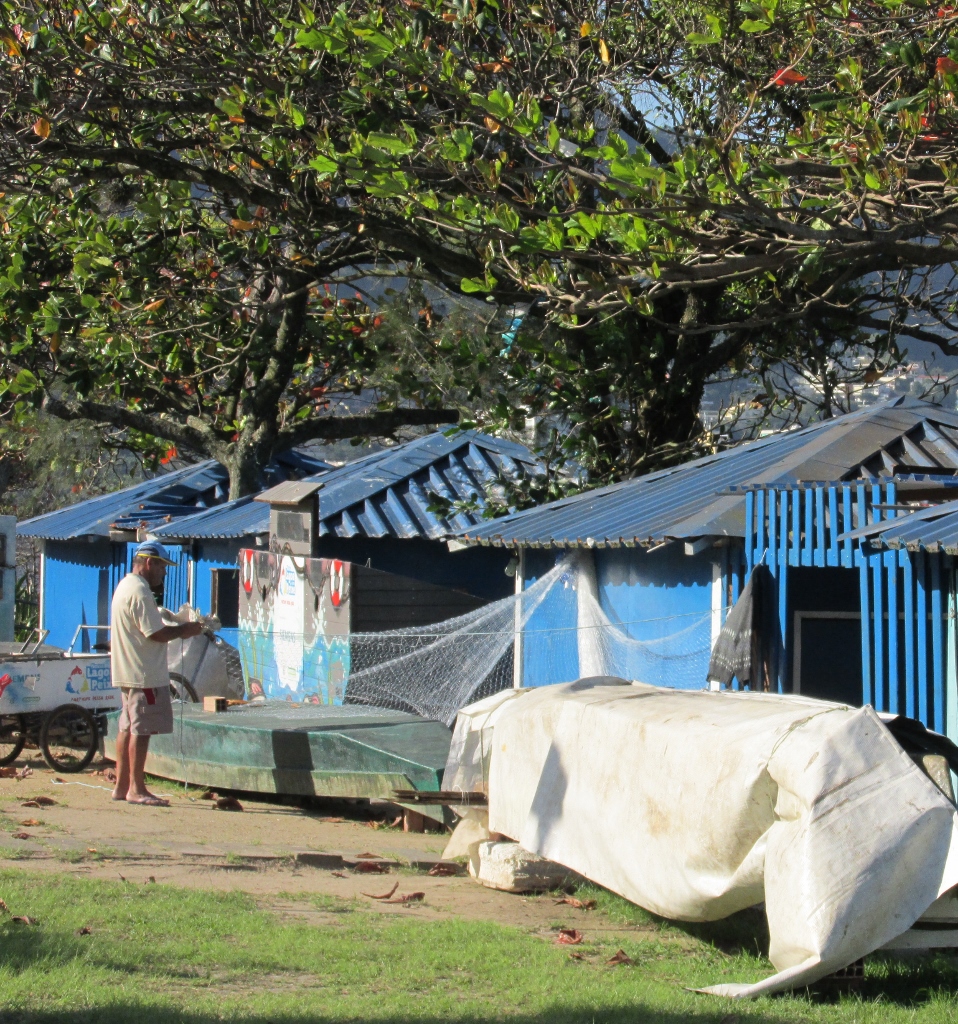
Whenever possible I bike home at the end of each busy day. On Thursday I chose to bike around the Lagoa Rodrigo de Freitas, a lagoon in Rio’s Southern Zone, and had the great pleasure to talk for some minutes with some local fishermen who have established a small community next to the Lagoa. Biking home from PUC around the Lagoa takes only about 25 minutes, and now that I met these local fishermen I will be definitely trying to avoid taking the bus more often.
DiegoBrazil3(2)

A fishermen community next to the Lagoa, a lagoon in Rio de Janeiro’s Southern Zone

As I said, there are some great things about finding a new routine!


Profiter (posted by Pierre en Suisse)

May 16, 2013

Hello, once again, from Switzerland. A few weeks have passed since my last journey outside of the country, which means that recently my time has been spent en profitant de la Suisse. The title of this blog, Profiter (pronounced like prof-eet-ay), is the French verb to mean to benefit from, or to take advantage of. In adding de la Suisse, I mean to say that I have spent the past few weeks in Switzerland  taking part in more of what my European home has to offer. From bake sales to road races and group hikes, the past few weeks have been pretty action packed, but I am not complaining one bit.

Two weeks following the Monument 10k in Richmond–a race I have always wanted to partake in–I ran in the Lausanne 20km, which I ran instead as my first road race. It is called the 20km because the main race is that distance, however I only ran 10km because I was running it with my University team, the Social Erasmus Committee. If you are like me and thought at first that Social Erasmus meant organizing social events, well, this is only partially correct. I serve on this committee here in Lausanne, which is responsible for organizing community service and volunteering events for exchange students. Together, we decided to run as a fundraiser, and it turned out to be a great event. While this was my first time ever competing as a runner, I grew up a swimmer, so I am very familiar with racing. What I wasn’t familiar with were French motivational expressions, since I had never heard any before. That changed during the race when I heard spectators who lined the streets shouting out to everyone, “Allez! Voici! Allez!” It was a shock at first to hear my name called out several times, but then I remembered people could read it from my number on my shirt! I must say, I quite enjoyed hearing the cheers in a foreign language.

The weekend following the race, the committee put together a bake sale, or vente de patisseries as it is called in French. We sold different desserts and delicacies from all around the world, and collected money for a children’s association here in Lausanne. I must say, we had quite the spread before us. We had fresh, homemade tiramisu, a “tarte aux pommes,” which is basically an apple pie of sorts, but different from our American version, and my contribution of chocolate chip cookies, just to name a few. Since I am quite accustomed to at least saying hello to people as they pass by when I am working a stand, a few of the other volunteers and I began to say bonjour to people in the streets. We were quickly stopped by our Swiss friend who was working with us. She explained that she felt like it wasn’t a good idea because she thought it would be bothersome to people and make them feel uncomfortable rather than more willing to stop and look at what we had. This wasn’t really something that people did in Switzerland, she told us. Instead, we ended up gathering everyone’s attention with, I kid you not, a mix of amateur musical performances orchestrated by our iPods and own voices with words on the screen, which was met with many laughs, and smiles, and even the participation of some kids who passed us. At first I was puzzled by the idea that we couldn’t say hi to people, but instead could dance in the streets. But, because we were all having so much fun and bringing people to our stand, I didn’t question it.

The view from our stand at the bake sale

The view from our stand at the bake sale

While still staying in Switzerland, it was about time to take a quick journey out of Lausanne. The following weekend the exchange association had organized a hiking trip to a location north of Lausanne. We headed up to a place called Creux du Van, a rocky circular formation that was cut into what appeared to be some form of a mountain that became a complete plateau on top. We would stand just along the edge and be able to look down into what was an abyss of trees and straight, vertical rock from the top, in addition to seeing the valley and surrounding villages and very small cities in the distance. It was absolutely gorgeous. Although we weren’t very high up by the standards of other Swiss mountains, there was still some snow at the top in the middle of May. It was an incredible sight for me to see snow this late in the year. I did learn that this winter has been particularly snowy and cold across Europe (much like I read happened in the United States), so this too was abnormal. However, being the winter enthusiast that I am, I was not saddened by the sight.

View from Creux du Van

View from Creux du Van

While exams are now beginning to approach, my time in Switzerland is still not complete. I have about two more months here, as my exam schedule extends pretty late in the semester. I guess this means only one thing: I will have more time to continue exploring this wonderful country I have come to love so much. I will be sure to profite bien from every opportunity that comes my way, as a reward for getting school work and studying done. Until next time…


City of dreams! (posted by Pierre en Suisse)

April 26, 2013

Salut tout le monde! If you remember reading my last post, Voyageur du monde, you may remember that I hinted at another upcoming voyage, but I did not reveal my destination. My country count is now officially at four, as I just returned from a trip to Paris! What a weekend that was! Before heading off, I had quite a few expectations of the city, all of which are possibly the most cliché images one could produce of the city. This included wanting to eat crêpes at the Eifel Tower, hearing accordion players at various street corners, and going on long walks through the city’s gardens and famous streets, namely the Champs Elysée. But against all the stereotypes, I was most excited about just being in the presence of such history and culture. Not to mention the fact that I’d be able to visit a European capital city with such importance for politics, finance, and culture.

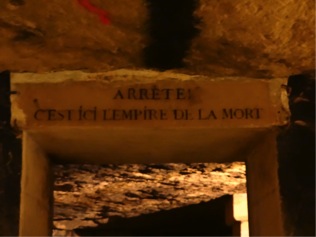
As always, the first thing that I was super excited about upon arriving in Paris was the fact that I could speak the language of the country. I didn’t have to ask someone at an information window to speak English, but instead, me and my friends who traveled together (other exchange students at UNIL) could all pose our questions in French and continue practicing our language skills. I also have to say that knowing the language definitely enriched the experience for me. The first site we visited was the city catacombs. Buried 45 million years under the Earth, the catacombs are the city’s former stone mines where the materials to build structures like Notre Dame Cathedral were taken from. As a more touristy twist, they have been turned into the burial site of more than six million people. Posted throughout the catacombs were writings, in both French and Latin, with very thought provoking quotes about human nature. Without knowledge of French, I would have missed out on what became my favorite part of the catacombs!

The entrance into the tomb area of the catacombs, underground in Paris

The entrance into the tomb area of the catacombs

Of course, our tour of the city moved above ground after our first stop. We later found ourselves visiting an old train station turned museum, le Musée d’Orsay, where we saw the works of some famous artists I had first learned about in elementary school, such as Monet! My group and I had all decided that it was a necessity to go to a museum in Paris, even though not all of us were crazed for looking at art, just because it was such an important part of the city.

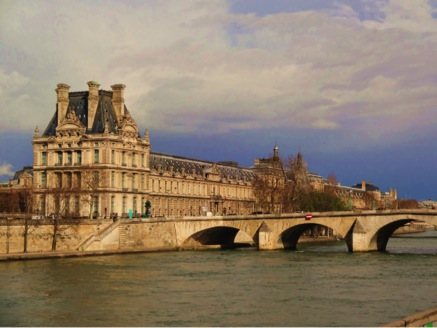
Right in the heart of the city, Paris, with the Louvre and the river Seine in sight

Right in the heart of the city, with the Louvre and the river Seine in sight

We found ourselves right downtown in the city when we left the museum, and by that point we all had food on our mind. After meeting up with a friend from France who had studied abroad at U of R last semester, we went off for our first real adventure into French cuisine. Luckily, our local was able to help us out with choosing some of the more traditional French dishes. I definitely branched out when I chose a duck dish for my dinner, and tasted my friend’s dish. She had ordered something called tartare de boeuf, which is essentially raw, ground meat with various seasonings for flavor. If you thought sushi is a terrifying concept, think again. I was at first really hesitant to try this, since all of my prior food knowledge was telling me something like this needed to be cooked, but I figured if French people can eat it, so could I, so I decided to be open and try it. I rewarded myself afterwards with crêpes, and then we finally made our way to the Eifel Tower.

And of course Paris' most famous site, the Eiffel Tower!

And of course Paris’ most famous site!

That being just our first day in Paris, it would require a much longer post for me to recount everything that we did during this trip. Four days in the city gave us the opportunity to see and do so many things, from just aimless touring to visiting some historical museums as well, notably L’Hôtel des Invalides, a a military hospital that Louis XIV ordered to be built for his forces in 1670. In some of the areas where the walls were newly renovated, it became so easy to place yourself in this time period, and feel like you were a part of it for a moment. It was an amazing feeling, when looking up at all of the stone walls and blue roofs. We also got to see the tomb of Napoleon in Les Invalides, which for a history nerd such as myself was pretty exciting.

Did Paris live up to my expectations? It certainly did, and then some. In the end, I don’t think that I embodied the clichés that I felt like I would before heading off, minus the fact that me and my group all bought berets the very last day and wore them through the airport and all the way back to Lausanne. I do count on the fact that I will be back there one day, but as always, coming back to Lausanne a third time from a trip abroad helped to solidify just how special I regard this city and country, as my first ever home away from home.


Voyageur du Monde? (posted by Pierre en Suisse)

April 19, 2013

Zero: the number of foreign countries that I had ever visited before coming to Switzerland. Three: The number of countries I have visited (or lived in) so far by the time that I am writing this. Four: The number I will have reached by the end of this week when I head to another famous European destination! Compared to the “Pierre” I was before leaving the US, I am definitely on my way to becoming a voyageur mondial (global traveler)! This is far from being an actual title I can claim, I still have some other continents to get to, however it certainly feels this way, being so new to this whole traveling thing. After coming back from Italy during my Spring Break, I spent one day back in Switzerland before hopping on a plane to Barcelona!

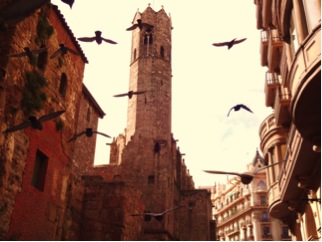
I had quite a different experience in Barcelona compared to Italy, just from the standpoint of language. In Italy, I did not know a single word of Italian, which made me feel bad every time I needed to ask someone for English, and even worse when I was on a train and had no idea how to say “excuse me” or “I’m sorry!” However, after having a single year of Spanish combined with my French, I did pretty well in Spain. As Barcelona is in the Catalonian region of Spain, the people speak both Catalan and Spanish. Luckily, I was able to meet up with a friend I met at Richmond who comes from Barcelona and did a semester of exchange at U of R. She helped me out with some key phrases that I would need to know as well, and explained to me the language. She said that Catalan sounds like Italian, and has a lot of influence from the French language, such as some of the letters and even words, since the region is so close to the French border. Luckily, she also spent a great deal of time with me, showing me some of the streets and main areas that tourists would not normally go down on their own. In the sunlight, it was so easy for me to fall in love with such a beautiful place very quickly, when looking up around me and seeing the narrow streets lined by buildings with terraces and plants coming down from them, walking into a main square and seeing a group of people start performing a dance show, and then being introduced to the main tapas dishes of the region.

Managed to capture this image of the birds while in the oldest parts of the Barcelona. Completely fits my image of the stereotypical European image

Managed to capture this image of the birds while in the oldest part of the city. Completely fits my image of the stereotypical European image

My guide also explained to me one of the most notable features of the architecture in Barcelona. The modernist style is unlike anything I had ever seen before. Just like my friend told me, it is something you just have to see, and not anything that is easily explained, but with the help of my friends at Wikipedia I will attempt. The movement began towards the end of the 19th century, and combines very rich, ornate decoration and detail, while preferring curves over straight lines. One of the most famous sights in Barcelona, the Basilica I Temple Expiatori de la Sagrada Familia, designed by one of the most renowned modernist architechts, Antoni Gaudi, was designed and meant to feel like a forest on the inside, for example. Still unfinished, it was one of the most impressive sights I have ever seen!

Feel like you’re looking up into the tops of a manmade-forest? Well, this would be the inside of Gaudi’s famous Basilica, La Sagrada Familia!

Feel like you’re looking up into the tops of a manmade-forest? Well, this would be the inside of Gaudi’s famous Basilica!

Among other things that we did in Barcelona, aside from just seeing amazing architecture, I also got to tour the Olympic park where the city hosted the summer Olympics in 1992, in addition to finally seeing the beautiful Mediterranean Sea for the first time! While I know I am still so far away from being able to call myself a world traveler, it certainly is beginning to feel like it, having been exposed to two fairly different countries within the same week. Despite all the excitement of the travels, I still get beyond excited when I return to Switzerland, and feel back at ease with the language and get back to the certain degree of familiarity I have with what is still this foreign land. But in any case, the travels shall continue, so stay tuned for what is to come!

One of my famous images of the city, the fountains in this park were absolutely gorgeous!

One of my famous images of the city, the fountains in this park were absolutely gorgeous!


행복: Akaraka and Cheering Competition (posted by Indira in South Korea)

April 15, 2013

I always thought that U.S. universities put a high emphasis on school spirit with their mascots, cheerleaders, teams, etc. but I’ve never seen anything even close to the spirit Yonsei has. It is UNBELIEVABLE!

Everyone wears their fancy Yonsei jackets through the whole city with much pride and they display their love for the school they go to (students of other universities in Seoul do the same). The most impressive display of school spirit and pride, however, has to be the Akaraka and Cheering Competition. I have never seen students so involved and so happy to be part of a certain university.

In some of my earlier posts I wrote about how Yonsei and Korea University are two main rivals and they have all these amazing cheering songs where they talk about which school is better and how they are going to beat the other school. As part of our international student orientation we had an hour long cheering orientation during which we learned (or tried to learn) all the cheers and dances. It is really hard as the vast majority of the songs are in Korean so it’s very hard to follow. Dance, on the other hand, is much easier to follow as you just do what everyone else is doing.

Recently there was an event hosted in Yonsei University’s outdoor amphitheater – a cheering competition. Unfortunately, most of the exchange students had their Korean language course at this time or hadn’t heard about it at all, so it was only five of us who joined hundreds of Yonsei and Korea University students for an evening of cheering, singing, dancing, and fun. We got to the amphitheater pretty late and there were so many people: half of the amphitheater was all blue, and the other half started turning red. In less than a half an hour after we got there the amphitheater was completely full! It was very easy to spot the Yonsei students wearing blue and Korea University students wearing red. There would be one Korea song and the red half of the amphitheater would sing and dance and then the Yonsei students would get a chance to do the same. It was also fun when the Korea and Yonsei prince dressed in fun traditional looking costumes in the colors of their University talked about all the good things about their University thereby showing how bad the rival University is. All of this is of course just fun and helps students bond; both within the respective universities, but also between the two universities. I had so much fun participating in this event as it is a warm-up for the real cheering competition that will happen in May – Akaraka. I am so looking forward to that! 🙂

 Full amphitheater for the Cheering Competition between Yonsei and a rival university

Full amphitheater for the Cheering Competition

 Yonsei students dancing to one of the cheering songs at a cheering competition

Yonsei students dancing to one of the cheering songs

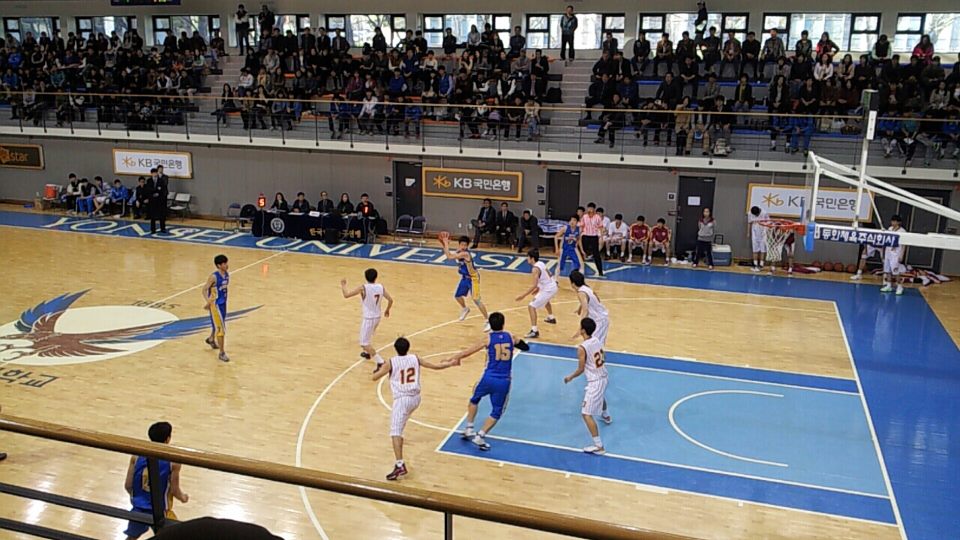
Even though the school spirit is on such a high level, the University sports are not that good on this level. Two of my friends and I went to a home basketball game between Yonsei and another Korean university and I was rather surprised to see how few supporters there were and the program was not on the level I would have expected. There were no cheerleaders at all! It was interesting to have this event and cheering competition and to compare them in my mind. We, however, enjoyed a good basketball game!

Yonsei basketball game which I attended with a friend

Yonsei basketball game

Now, I’ll leave Yonsei for a while to go and visit an island located about 1.5 hours from Seoul and I am really looking forward to exploring Korea!


Homesick? (posted by Pierre en Suisse)

March 22, 2013

It is unreal to me that I have been here already for eight weeks. I continuously keep track of the length of time that I’ve spent here, because whenever I meet someone, especially if they are Swiss, one of the first things they’ll ask is how long I’ve been here. With each passing week, as that number has grown larger, the question started to come up as to whether or not I was homesick at all. My answer? Nope, not really.

Switzerland certainly is a different place than the United States, in very simple ways. What I would normally use at home for a sandwich, for example, was called “sacrilege” by a Swiss friend, since the Swiss standard of bread is much higher than my own. It’s also starting to strike me just how old certain things can be here. While walking through the city, I could pass a site built in the medieval ages, any number of castles, or even a site with Ancient Roman Ruins! When I think about the fact that the first British settlers in the United States arrived in the 1600s, it is really quite impressive to think what an “old” building means to a European compared with me, as an American!

The variety of languages here never ceases to amaze me. Switzerland itself recognizes four national languages: French, German, Italian, and Romansh. But it doesn’t end there. Swiss German, I have been told, can be spoken differently depending on what region you are in, sometimes even by mountain valley. Swiss Germans write in High German, or standard German, but all speak differently. It is as if they could almost form 26 languages of their own, I have been told. But then it gets even more interesting to see the fact that in the Swiss Parliament, laws are written in French, German, and Italian. When I was doing a project for my Swiss Politics class, I had to learn about a law that was assigned to my group. I discovered that one word in the French version of the law, just in the title of it, was the subject of debate, at least among the francophone members of the Parliament. I wondered to myself if this happens in all of the languages, and if it does, just how amazing that truly is that the country can still function as smoothly as it does with all this diversity of language and thought. With diversity of language always comes diversity of culture, so it is an amazing feature of this country to notice the differences between all the different types of people that are here. I definitely came to question whether the political system in the US could handle something like two or even three national languages being used in the Congress, but given the drastically different size of the country the situation is entirely different.

Language is definitely one of the things that fascinates me the most about being here in Switzerland. I share a flat with a girl from Australia, another American, and then a girl from France and a Swiss guy too. As there are some differences between the French spoken in Switzerland and the French spoken in France, as someone learning the language I absolutely love listening to my flatmates point out their differences, just as I would when talking to someone in the states about the word “wicked” or “y’all”. One big difference in Switzerland is the way that they say numbers. The Swiss have a different way of saying 70, 80, and 90 than the French do, using a much shorter word for each. All of us exchange students really appreciate it because it can be a lot easier for us to say! But again, listening to the exchanges between some of the Swiss and the French about the nuances of their respective languages is always a great opporutunity for me to pull out my phone and continue adding to the massive list of words and phrases I have learned since I got here. If I don’t do that I usually forget, so with each day this list keeps expanding!

So going back to my question of whether or not I’ve missed home: I would have to say it’s hard to miss something that I’m so used to when I’m constantly exposed to new things, interesting people, and can practice my language skills. I’ve not been here long enough to find the mountains that lie just across the lake to be any bit normal, so whenever the sky is clear, they always remind me of how lucky I am to be in such a beautiful place, in a way that is completely different than what I have in Richmond. Am I starting to get adjusted to the life here? I don’t think it’s really possible, when each day comes with new challenges and new adventures and opportunities to learn. I think that is probably the most consistent aspect about life here. No matter what, I am always learning, and no matter what, I love every minute of it.


Suivre: to follow (Posted by Pierre en Suisse)

March 8, 2013

As I am writing this, my third week of the semester here at the University of Lausanne is coming to a close. What this means is that the first real week of classes has just finished. At UNIL, there is a two week grace period to try out all the classes you’d like. Unlike at UR where you need to register the semester before and classes often fill up, at UNIL, you can go to any course or seminar you want for the first two weeks without signing up for it to decide if you will take it or not. It provides the opportunity for the professor to really go over what the course will be like, present the syllabus, and also present the grading method. There are several different ways that a student can be evaluated here, depending on the format of the course even. There are two different types of courses that students can take at UNIL, or at least in the faculty (school) of political science: courses, or seminars. Courses are generally lecture style with a large number of students, where the professor presents the information, people can ask questions, and there is minimal interaction in many cases. At the end of the course, students take some form of an exam. Like at Richmond, this can be a formal written exam, a written paper that is due on a certain date, or alternatively, an oral exam with the professor. Sometimes, there is no exam but students are just regularly evaluated throughout the semester. In courses, the entire final grade can be based on the exam result. This is something that is very intimidating for me, as I get nervous when a final exam at Richmond is worth thirty percent of my grade, never mind eighty percent or more! Alternatively, students can take seminar courses. Seminars are very similar to the classes at Richmond, where there’s a lot of discussion, group work, presentations, however the only difference is that there’s no final grade at the end. Students get evaluated essentially pass/fail, with an attestation if the student passes, or an “échec” if not.

Going back to the title of this blog post: suivre, meaning “to follow.” In French, one says “je vais suivre ce cours” which technically means I am going to follow this course, rather than how in English we would say “I am taking this course.” For my program, I decided to suivre (take) two courses and two seminars in the Political Science faculty, and two courses in the French as a Foreign Language faculty. Yes, this sounds like a lot since four or five courses is the normal load at Richmond, but typically students can take as many as seven courses here! My classes are all instructed in French. The only difference is that in the political science faculty, the classes are catered to native French speakers. This is definitely where I find the verb choice to be quite ironic. Rather than me saying to myself, “oh yeah I’m taking this course,” I really will start thinking, “oh I’m following this course! Wait, but am I really following what the professor is saying?” I don’t, however, regret for a second taking the courses in French. Because the French I have been learning at Richmond for the past two and a half years is very scholastic French, I can generally follow the professors quite well. They use the same very formal register of the language when instructing that my professors at Richmond use. However, they do speak a bit faster. Luckily as well, many of the terms that are used in a French sociology text for example are very similar to words in English, so I can pretty easily figure things out when doing assignments or just in general listening in class.

So what am I actually taking now that my two week trial period is done? A mix of sociology courses, one political science course, and two French as a foreign language classes. To highlight some of them, my political science class is called Swiss Politics, since I figured it would be a good idea to learn about the country I am studying in while I am here. I also am in a course called Sociology of Work, which I think is going to be absolutely fascinating to learn about all of the trends in history and what it really means to work. I am also really excited about my French Structuration and Production class, one of the French as a foreign language courses, because the professor really teaches it with the goal of helping us develop a more familiar, casual register of the language for our every day interactions. We are constantly telling stories in class of mistakes we may have made with the language in different situations, pointing out what we learned from those mistakes, listening to music in French to see just how different the casual language is compared to the scholarly French, and many other activities to develop a different level of understanding of French. I will say for sure it is going well, and it is definitely helping me to become much more comfortable in the different situations I face, which is after all the goal of the course! Well that’s all for now! As I have learned to say here, à la prochaine! (Until next time!)


Uncomfortable, and savoring it! (posted by Blair in Ecuador)

March 6, 2013

I often feel uncomfortable.

I stick out like a sore thumb, walking down the street in my sneakers and backpack, while Ecuadorians pass in heels with their pocketbooks clutched tightly to their sides and wiping my blonde hair out of my face after a bus soars past. The stares, car honks, hisses, catcalls, and whistles ensure that my attempt of ‘avoid eye contact and if you can’t see them, they’re certainly not staring at you’ does not work. They make me feel a bit uncomfortable.

I typically walk home from school with my gringo neighbor, Nick, and one or more gringa girls who live nearby as well; we generally get a few honks and plenty of stares, but it is easy enough to ignore them and continue our group conversation. However, one day last week, I walked home alone to stop off at the grocery store. I had nothing to distract me from the expressions of attention being paid to me. I was making sure to stare straight ahead at my path on the sidewalk (which is actually essential to walking the sidewalks of Quito, there are bumps, cracks, small and large holes, chunks of missing sidewalk, trash and dog poop cluttering the sidewalks), but I could still feel the stares coming from all sides. Walking along a main road, I heard a chorus of honks, but knew better than to turn my head for any one of them. When I got to my bus stop, three middle-aged men hissed and clicked as I walked by. And sure enough, when I got off the bus and was heading into my neighborhood, a kind gentleman leaned out the bus window as it pulled away and whistled his approval of my backpack (certainly nothing else, right?). That day, there was no conversation to drown out the noises, there was no group to retreat into. I felt very uncomfortable.

Last weekend, I was in a group of new Ecudorian friends I met through my cousin. I missed a part of the conversation and I wasn’t sure whether to laugh along with the group as they very easily might be laughing at me – something I did, something I said, or just because someone cracked a gringa joke (more or less your classic blonde jokes).

Although I have an absolutely wonderful homestay family with an incredible house, delicious food, and a luxorious room, to retreat to my home would involve a couple hours on a plane. Living only about 45 minutes from University of Richmond is something I have always taken for granted. Any time I just need to get away from UR, I hop in my car and head home, where I get a big hug from my doofus dog, an even bigger one from my mom, a wonderful night’s sleep in my own bed, and some steaming blueberry pancakes in the morning. The flight home from Quito, Ecuador would be a bit more than 45 minutes.

It’s these moments that (well, first I laugh to myself, then…) I remind myself that I may never get this opportunity again. How many more times will I get to say that I feel uncomfortable and have very little control over changing it? Sure, I can go abroad and say, “wow, when will I have the chance to travel throughout all of South America, see Igazú Falls and Patagonia, lay out on the beaches and go to the Rain Forest, and come home with pictures of beautiful places” but, personally, I want my abroad experience to include truly experiencing a bit of the culture. I want to be able to tell the stories of the people in my pictures, to talk of my conversations with my sister when we went hiking that time, and to be able to share what I’ve learned about the struggles that the Ecuadorians of the Oriente are facing.

More than that, there are many people who do not have the opportunity to study abroad, to experience a different culture, and to feel completely and utterly uncomfortable in that culture. I am so incredibly fortunate to have this opportunity, to feel this feeling.

On the other hand, there are international students at UofR who are certainly going through this entire process in my culture. These students certainly have moments when they feel students’ stares all around them, they don’t know whether to laugh, and they feel that they don’t have anywhere to call home. Let’s look out for these students, help them to understand our converstaions and our culture, see if we can’t help them to feel more comfortable, maybe even to feel at home.

Now what about the “and savoring it!” part then? When I do realize they’re laughing at me, I first remind myself what our director told us: “The Ecuadorian government lets in hundreds of thousands of US tourists each year for two reasons: first, they provide income for many Ecuadorians and second, they are a source of entertainment for the rest of us.” With this in mind, I proceed to tell one of two jokes I have now mastered in Spanish, depending on the audience. That way, we can all laugh together (though they’re certainly still laughing at my horrible accent).

Finally, at the end of the day, no matter how frustrated I was that afternoon with the ridiculous catcall or at dinner when I couldn’t follow the conversation, I always remember that I will never feel quite this same type of uncomfortable again for a long time. And it’s the rain that helps us see and feel the sun, right?

Some of the group went to Crepes & Waffles for Hannah's birthday, where we felt right at home in our gringa group; all white foreigners! ...and the chocolate crepes didn't hurt.

Some of the group went to Crepes & Waffles for Hannah’s birthday, where we felt right at home in our gringa group! …and the chocolate crepes didn’t hurt.

“I will love the light for it shows me the way, yet I will endure the darkness

because it shows me the stars.” -Og Mandino


Education and Experience (Posted by Blair in Ecuador)

February 25, 2013

We have now successfully made it through the first week of classes! For the SIT program, we have a Spanish Exam at the beginning of the semester, in which our language level is determined. In this SIT Ecuador program, the Spanish instruction is done through a program called Experiment in International Learning (EIL). EIL has a staff of Ecuadorian professors who have Spanish instruction education and experience. EIL also helped SIT with the homestay placements, so the Spanish classes sometimes incorporate specific interactions with the homestay families.

 The yellow bus gang is ready for our first day of school in Ecuador!

The yellow bus gang is ready for our first day of school!

On Monday, we were placed in our different classes; ours is the biggest class. We are seven girls sitting around our square table with Profe Vladimir at the white board at the front. School is in some extra classrooms of a state pre-school/childcare facility, so there is a picture of the pope and some holy crosses scattered throughout the room. The general class layout is a two hour segment of grammar, followed by an hour and a half of cultural learning, then a final hour of vocabulary and slang. We have breaks between each section and chow down some snacks brought by the EIL program, usually typical Ecuadorian food.

For instance, on Monday, we went over the subjunctive and conditional tenses, ate an Ecuadorian bread-wrapped-in-a-leaf snack called quimbolitos, read about the Incan history of the Valley of Los Chillos, then learned about the history of Ecuadorian slang and its connection to Kichwa, the language of the Incans.

On Wednesday, after learning about connecting words in the morning, we watched an Ecuadorian movie named “Qué tan lejos” about the journey of an Ecuadorian girl to get to Cuenca and break up a wedding. Throughout the whole movie, we were asked to write down Ecuadorian slang and our profe paused it every once in a while to make sure we were clear on what was happening. He also paused at points to talk about the Ecuadorian landscapes we were seeing and the different cultural aspects, such as the music, and political connections with the roadblock. We finished the day off with a game: each person chooses a Hispanic character, writes it on a piece of paper, and tapes it to their neighbor’s head. Everyone then has to ask questions to determine who they are. The best part was that our profe, the only guy in the room, was the only female character: Dora la Exploradora.

Class photo after the game, still with our character nametags which we used for the game in class

Class photo after the game, still with our character nametags

We also have special days that provide a different type of learning. On Thursday, we had a mini learning excursion into a nearby town, Sangolquí. We went to the church in the center plaza, where our professor told us about how the Spaniards used the Catholic church, from the architecture of the actual building to the masses and ceremonies held inside, to assert their control over indigenous Ecuadorians. Afterward, we went to the town park and library, where we read a bit about the history of the town and checked out the library. Sangolquí is a small town, much like Ashland, Virginia. However, its library is one floor of a tiny building with about 5 small bookshelves, 3 computers, and a stack of newspapers. Our profe was explaining that reading is not a popular activity among any age group, which is reflected in this library. We then went to the town market, where we spoke with some of the vendors about their sales, which have gone down significantly with the installment of a Wal-mart brand supermarket, MegaMaxi.

Profe Vladimir and class heading into Sangolquí Church as part of a class "field trip"

Profe Vladimir and class heading into Sangolquí Church

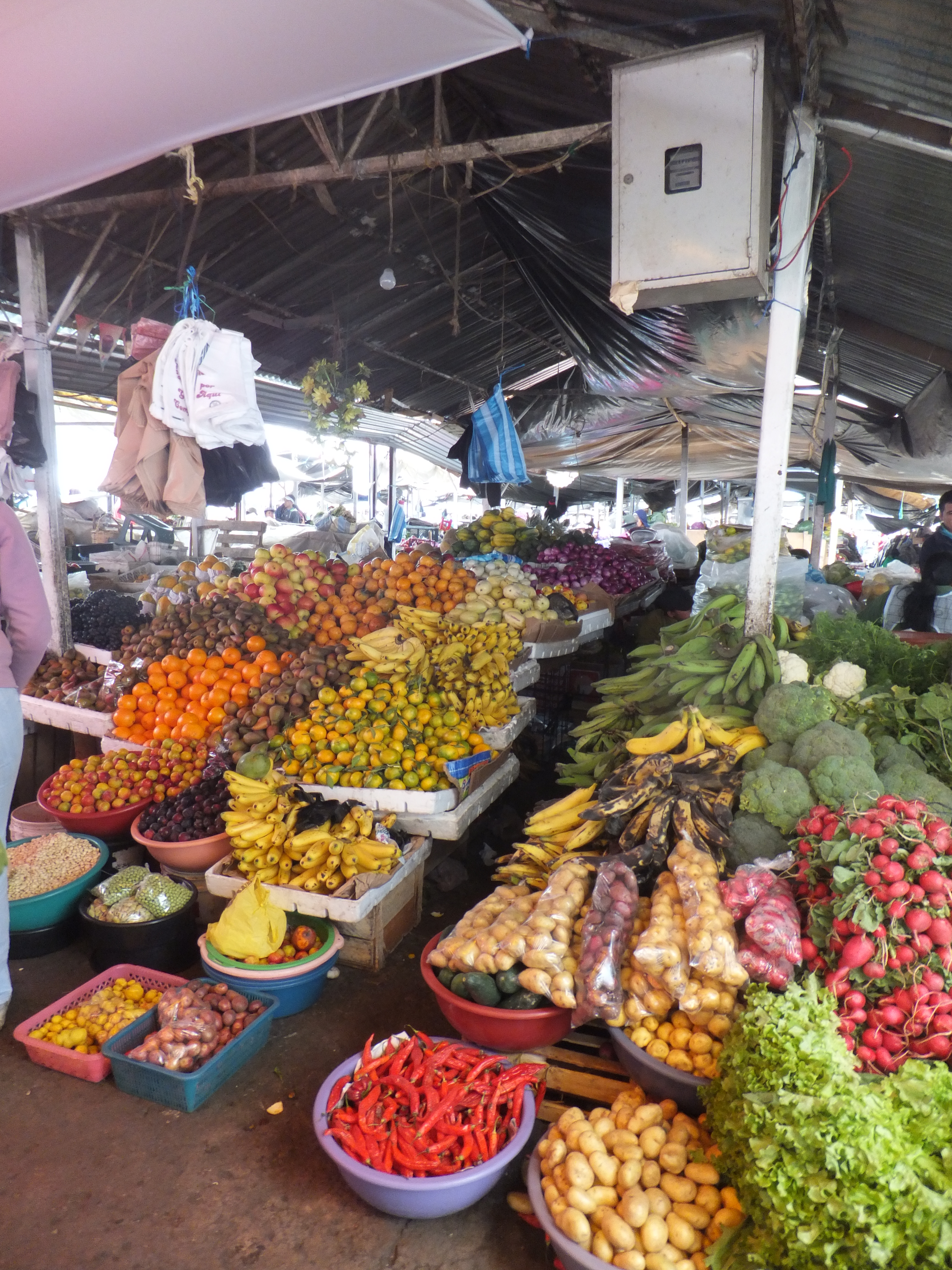
A tiny selection of the wide array of fruits, veggies, and other produce items at the main Feria of Sangolquí, a local market

A tiny selection of the wide array of fruits, veggies, and other produce items at the main Feria of Sangolquí

We also have had a couple academic seminars during this week. We have a 20 Questions activity that we have to complete throughout the semester. It is an opportunity for cross-cultural learning, with questions from “How much importance do people place on appearances?” to “What does it mean to be a part of a family?” and “How can you ascertain the importance of God in people’s lives?” There are four parts to the assignment: the first part is observations of how people naturally behave, followed by explanations of why this might be the case. The hard part is that we then have to talk with two or more people about what they think of our observations and explanations, but without simply asking them the question. The final section is reflections, in which we discuss how willing people were to actually converse on the subject and how the culture ties into the question and answers.

At first, I really felt this was a silly assignment, it seemed we could learn more simply observing and that the conversations would be uncomfortable. However, I have realized that the assignment leads to an essential learning and very informative conversations. People are generally very willing to talk about the question, they are often interested to know what I think and sometimes see an aspect of their own culture for the first time.

This program ensures that we are always learning. From waking up and insisting that I do not need to eat three pieces of bread with ham and egg along with my fruit and smoothie for breakfast, to navigating my way back home in the evening and attempting to discuss the day around the dinner table, Spanish class is the least learning of it all! More than just taking in information, we’re forced to analyze and use it every single day. I have to remember that my profe said that we do not throw things in Ecuador because it’s seen as rude, as well as the warning we received during a 20 Questions Seminar about lending things because you might not see them again.

The only source of knowledge is experience. -Albert Einstein 


Living, Learning, Loving (Posted by Blair in Ecuador)

February 22, 2013

The homestays are a very important aspect of the SIT program. I think the experience of living in a different culture almost requires this aspect. The families help us a lot with our Spanish language skills, as well as cultural behavior learning, information about Ecuadorian society, and, obviously, the quintessential family love and caring. I can go to my mamá when I have a headache, when I’m frustrated with my classes, even when I feel really confused about being here in Ecuador.

More than just living with a family, we often have homework assignments that incorporate them. Sometimes it’s something as simple as talking with them about an Ecuadorian movie we’re watching or a news item we talked about in class. Later in the semester, we have to write a Personal-National History Essay about a historical event in Ecuador that also affected some family member of ours and how his/her personal account compared to the history books. These little assignments help us learn about the history and culture, as well as to form a closer relationship with our family members.

Living in a homestay certainly has its difficulties as well. It sounds so silly, but after “moving out of the house” into university housing, I felt that I was in control of my life: how I spend my time, what and when I eat, when I sleep, when I get to simply have some alone time. This homestay is quite an adjustment. Now, I depend on my host mamá for my food, for clean clothes, and for help in absolutely every part of life.

Mamá prepares and serves us all the food, sets and clears the table, washes the dishes, stores the food, and the kitchen is spotless again before I know it. Still not sure how she does that… I still don’t know how to boil some water for tea on the gas stove because she’s in the kitchen asking what I would like before I can even find the kettle!

I have washed my own clothes for myself at home since I was about 14, when thought I was too grown-up to have my mom do my laundry (I don’t remember her objecting too much). I have no idea how to wash clothes here… and the machine is even in English! Apparently you have to hook up some hoses though, lesson learned. But my mamá simply insists upon doing it.

I went to the pharmacy with my mamá the other day when we were running some errands and I remembered I ran out of band-aids. When I went to buy them, not only did I have to ask my mamá how to say band-aid, she had to explain to me that No, you don’t buy an entire box of band-aids, who would possibly need that many? About 10 minutes of explanation later, we left the pharmacy with 5 individual band-aids.

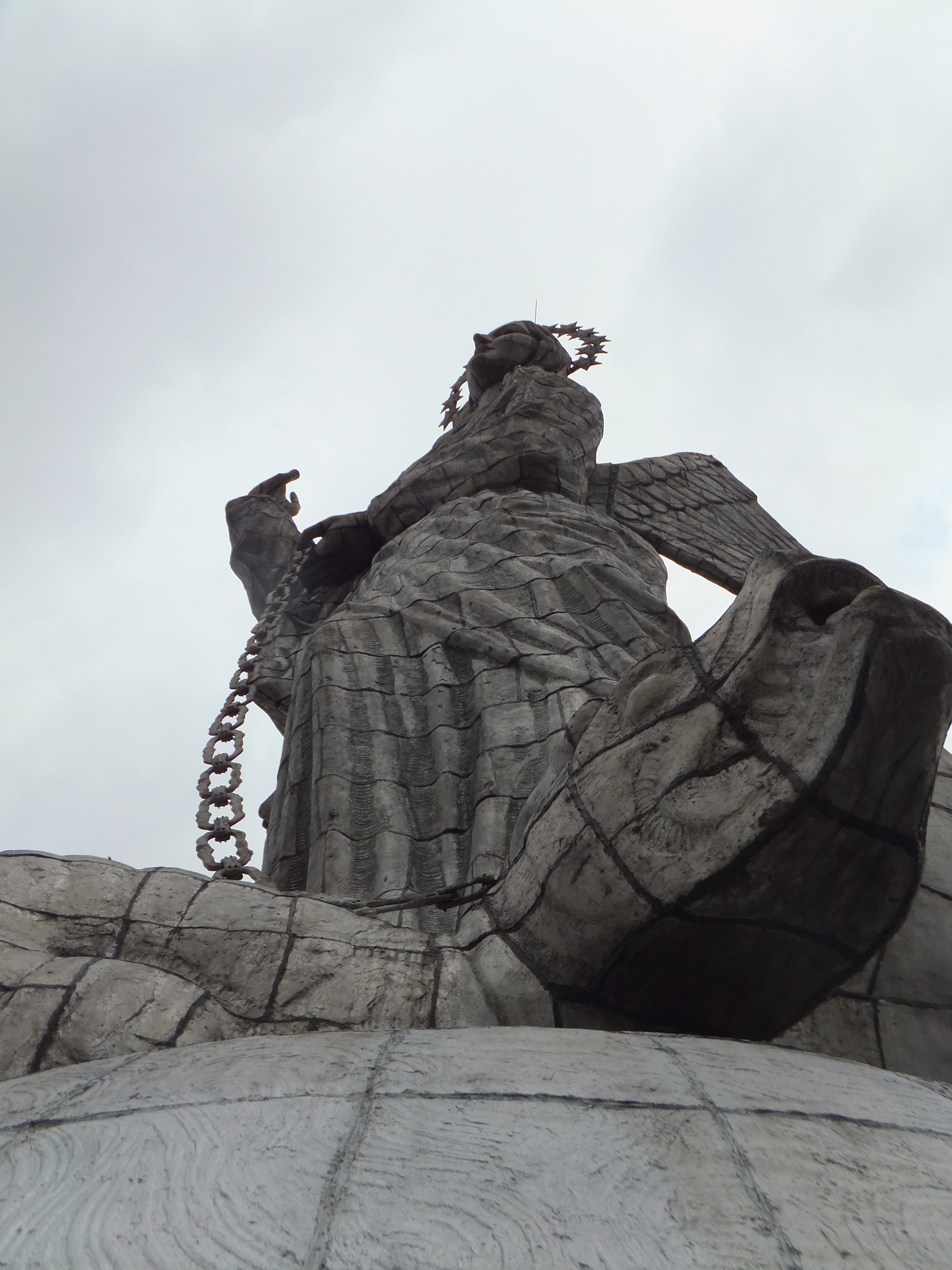
Apart from Band-aid runs, we get to go out with our families and they show us around their city. We went on Saturday afternoon to the Virgen de El Panecillo, a hill in the center of Quito where a priest built a large Virgin Mary back in 1976. From that point, you can see all around the city of Quito, much like the panoramic view I got to see from the Volcanic mountain hike on my first day here [see Centers of the World (Posted by Blair in Ecuador)].

The Virgen de El Panecillo from directly beneath, after climbing many flights of stairs for a better view of the city, Quito

The Virgen de El Panecillo from directly beneath, after climbing many flights of stairs for a better view of the city

My host dad pointing out the historical churches of Quito's Old Town, after climbing to get a better view of the city

My dad pointing out the historical churches of Quito’s Old Town

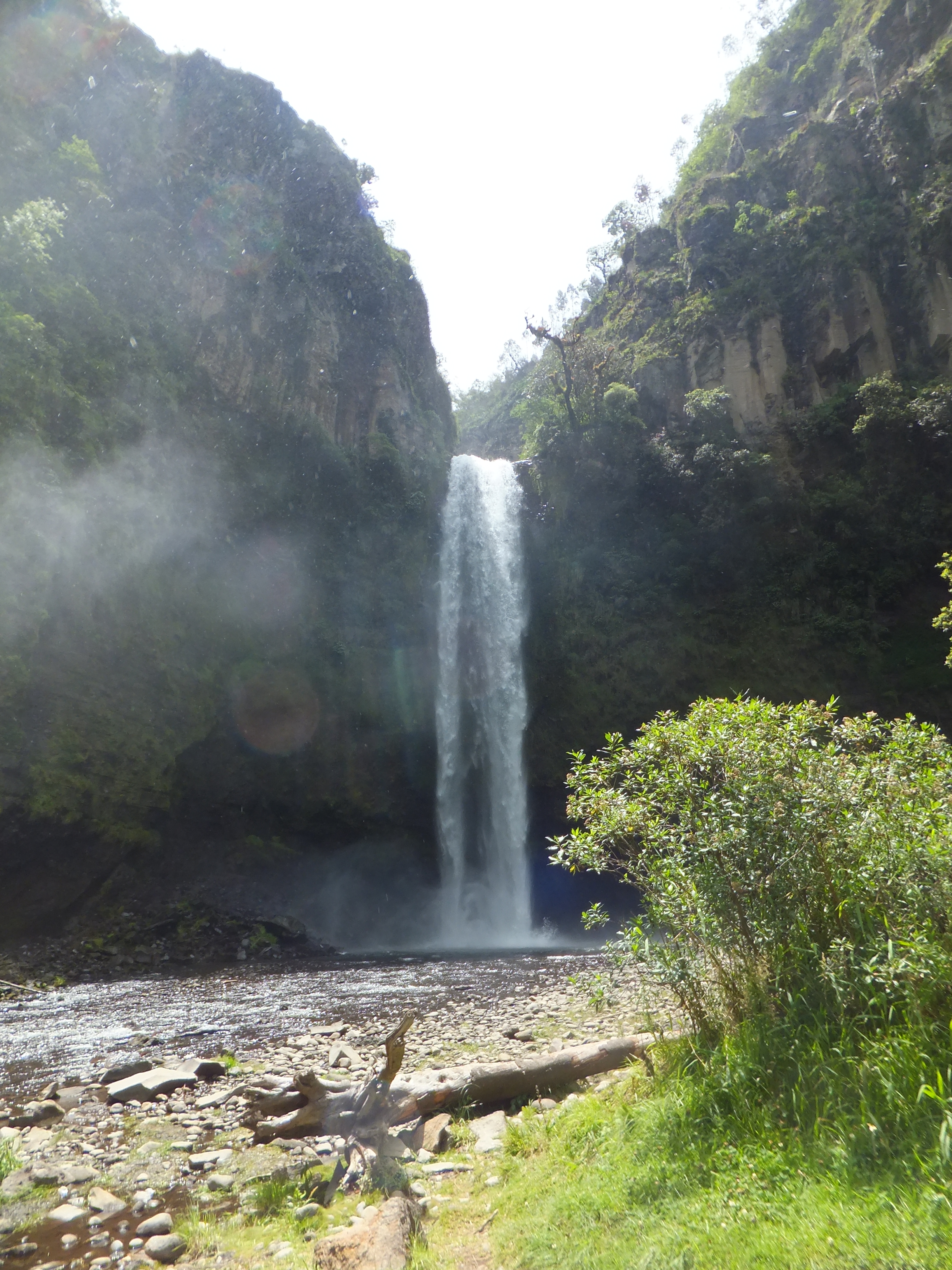
We also got to go to Molinuco Falls on Sunday, which is a HUGE waterfall at the end of a lovely hike. The walk there includes smaller waterfalls, some pools where you can swim, even a ‘Meditation Pond!’ For an idea of the size and force of this waterfall, you should know that I could feel the mist from where I was standing in the photo below!

The GIANT Cascada Molinuco (waterfall); it was so powerful I could feel the mist from where I was standing!

The GIANT Cascada Molinuco

The option to live in a different culture, in a society different from mine, to share with the people of that society, and to live for some time in a different country is a rare opportunity. Not everyone can spend a year of their life hopping between countries due to their committments. I believe many people also prefer to stay in their safe and comfortable space. However, the information and the lessons that I will have learned by the end of the program, whether learned in the classroom, in the daily activities of my family, or during the excursions we take, will make this an unforgetable semester.

Go to the people. Live with them. Learn from them. Love them.” Lao Tzu

P.S. My family prefers that I do not write about them personally in this blog. We will also be living with a family in a different section of Quito beginning in March and I hope to be able to talk a bit about them.