Uppsala goes fancy: Norrlands Nation’s Höstgasque and Gasque 101 (posted by Indira in Sweden)

November 23, 2012

As I mentioned in some of my previous posts, Uppsala is a meeting point for many contrary and contrasting things. Last week it was new and old. I was a part of a tradition so specific for Uppsala University students and so deeply embedded in the history of the student organizations here known as the nations, and yet so modern that still it occurs every semester.

The student life at Uppsala Uni is organized around 13 nations each representing a city or a region/county in Sweden. One can work in the nations, go for fika, study in nations’ libraries, meet friends, watch sport matches, go to the pub, attend concerts, participate in open mic and karaoke nights, go to the club there, take part in the gasque, as well as do many other things. But, let’s focus on the gasques (or gasks as they are called in Swedish). A gasque is basically  a formal dinner with an after-party. During the gasque you eat, drink, make toasts, and most importantly – sing. Yes, sing. Quite a lot, actually. Singing is basically the most important part of the gasque: You sing before making toasts, when drinking snaps (a celebratory tradition), when starting the dinner, when the dinner is almost finished, and for any other reason you could possibly propose to sing. And singing during the gasque is rather fun. Most of the songs are in Swedish, but you get a Songbook so you can follow and sing along. It’s also very easy to get the rhythm. Some songs even have their own little choreographies: My favorite song so far is one for which you stand up on your chair and sing and once the song is finished you should not sit in the chair since it means bad luck and you will fail all your exams. All in all, gasques are fun events where you get amazing food and meet new people, as well as familiarize yourself with Uppsala University and the nations’ traditions.

Höstgasque is the most formal of all the gasques during the Fall semester (höst means Fall in Swedish). The dress code is tail coat for the guys and ball gown for the girls. Ever since I heard of this gasque I made the decision to attend one, and I did so last week. A friend of mine plays in Norrlands nation’s orchestra so she attended the gasque and I joined her. All the members of the orchestra had dinner in a special room, but they followed all the gasque traditions.

The dinner table before the gasque started, a Swedish University tradition

The dinner table before the gasque started

There was a lot of singing, toasts, speeches, and chatting. I got to meet the members of the orchestra who were all Swedes. It was great practicing my Swedish and learning more about Sweden. Apart from that I enjoyed the food a lot – I ate moose for the first time ever. That was a whole new experience. We also played a game: All of us had a “top secret mission” that we had to fulfill during that evening. My task was to be obnoxiously loud after every toast and speech, applaud as loud as possible, and compliment the speech or toast. It was so much fun doing that! Other people had to propose toasts on every possible occasion, or start a conversation about music etc. It was a good way to bond with the people sitting near you at the table.

 Some of the members of the orchestra, which, played during the gasque, at the after-party

Some of the members of the orchestra

After dinner, the orchestra played and other gasque guests danced waltz and polonaise – that is how formal Höstgasque is! The formal dance continued during the after-party as well since more classical and jazz music was played. This is the typical after-party for these formal gasques in all nations.  Below is a video of the orchestra that played:

My friend and I decided to go for a full Höstgasque experience and went to the after-parties in two other nations  – Värmlands and Östgöta. The whole atmosphere made me feel like I travelled back in time. It was definitely an experience I am happy I was able to have. Attending the Höstgasque is definitely going to be one of the highlights of my semester abroad in Uppsala.


Battling a Stomach Virus and a Trip to the Hospital (posted by Jimmy in England)

November 16, 2012

Mom and Dad take a breath, I wasn’t hospitalized.  I do think that the choice of title is witty though.  So what happened then? Let me take you back to last Friday.  Why?  Well Friday was obviously the best day of the year! It was November 9th and that meant that college basketball season was officially starting.  It had been 284 days since the final buzzer went off in the first round of the Atlantic-10 Playoffs.  We had lost 80-72 to La Salle in Philadelphia and this buzzer signified the end of our season.  So 284 days later I was the happiest person on Earth.  That day I went to a talk in Oxford with two friends and since I was in a great mood I offered to host dinner in my apartment the next night. Had I not been in some euphoric state of happiness due to the upcoming Spider game, I do not know if I would have offered.  Anyways, that is besides the point.  The next night a bunch of people came over and we enjoyed Mexican style chalupas with many toppings ranging from avocados, to beans, tomatoes, sour cream, and even shrimp.  The nurse that I saw on Wednesday believes that is where I caught the very infectious norovirus.  It is easily transmittable and there are many ways that it can spread, especially through contact with undercooked food or contaminated objects.  It wasn’t until Sunday night that I started to feel the ramifications of this little virus.  I was starting a presentation on England’s NHS, the government provided health care system and had a horrible pain in my stomach. Oh the irony in being sick for the first time in over a year when you have to write a paper on the health system. I knew it couldn’t be appendicitis because I had my appendix removed when I was a kid, but I wanted to rest just in case it was anything serious.  I went to bed and woke up the next morning with a horrible headache and a fever.  I slept all day and tried to stay hydrated, but nothing seemed to work to combat my symptoms.  The next day I felt very weak and went to the college nurse who told me I had a stomach virus.  What have I learned from all of this?

I learned that nothing treats illness better than being at home and having your Mom cook soup and help you if you need anything.  When you live by yourself being sick is horrible.  You learn to appreciate the people who help you out when you can’t help yourself.  I also learned Paracetamol is the British version of our Tylenol; both are made from the same compound.  I learned that being sick slows you down, but that is sometimes a good thing.  You realize what is important when you move a little bit slower and can only use so much energy.  I can now say that the virus is gone and I am back to my healthy self.  Well almost healthy. You have to subtract the fact that I pulled an all nighter to write a paper for my tutorial because I didn’t do any work when I was sick.  I look forward to using this weekend to catch up on some more sleep and cheer on the Spiders as we play at Minnesota! By the way, just to clear up the reference to the hospital, I walked across town yesterday to listen to a lecture at John Radcliffe Hospital.  Sir John Bell was disussing how new research is allowing doctors to redefine diseases.  There have been recent breakthroughs that will allow doctors to easily define cancers based on their abundances in blood plasma.  It looks fascinating!

Other than being sick, I had a great week.  Last Saturday I visited the Botanic Gardens of Oxford.  It is the oldest botanic garden in Britain and was founded in 1621 to grow plants for medicinal research.  I probably cannot do justice to the history of these gardens because I was taken by the natural beauty when it was being explained.

 Fall in Oxford at the Botanic Gardens, the setting of the original "Alice in Wonderland"

Fall in Oxford at the Botanic Gardens

A winding stream in the Botanic Gardens, next to Christ Church

A winding stream in the Botanic Gardens

The gardens are right next to Christ Church, which I explained in an earlier blog.  A fun fact that I learned: The story Alice’s Adventures in Wonderland come from these gardens.  The author of this story, Reverend Charles Lutwidge Dodgson, who wrote under the pseudonym Lewis Carroll, worked at Christ Church.

Queue Waiting for Entrance to Christ Church, at Oxford, the place where Lewis Carroll wrote Alice's Adventures in Wonderland.

Queue Waiting for Entrance to Christ Church, the place where Lewis Carroll wrote Alice’s Adventures in Wonderland.

The Vice-Chancellor of Oxford University at the time was Henry Liddell.  He had a daughter named Alice and Reverend Dodgson used to tell her stories.  She loved them and asked if he could write them down and the rest is history.  People keep telling me (and I really am starting to believe it) that this place is magical. I look forward to experiencing some new things this weekend and I will report back in a few days!

“I wonder if I’ve been changed in the night. Let me think. Was I the same when I got up this morning? I almost think I can remember feeling a little different. But if I’m not the same, the next question is ‘Who in the world am I?’ Ah, that’s the great puzzle!” -Lewis Carroll


November in Uppsala: New Course, Uppsala Light Festival, and Endless Fikas (posted by Indira in Sweden)

November 12, 2012

As it is getting colder and colder (it gets as cold as 17 degrees Farenheit), I find myself drinking more tea and spending more time at fika enjoying the warm atmosphere of the Swedish kafferummet (cafes). The fika and coffee drinking traditions are a big deal in Sweden. I have a feeling that Swedes can manage without some things, but if you take away their fika time – well, that would not be tolerated. In between our lectures we get 15 minute fika breaks, and professors bring in fika (coffee/tea and cookies) to class so you can have fika during their seminar. If you want to meet with someone, you meet for fika. Everyone fika (yes, you can use the word ‘fika’ as both a noun and a verb)! The peak hour is at 3pm. It becomes really hard to find a kafferummet that is not full. Luckily, there are cafes all over Uppsala and all the student nations serve fika as well.

One could spend an eternity at fika – especially when you find that one cafe you really like – but we also have classes to attend. Last week my new course started: (En)Gendering International Development. So far we have had 3 lectures and a seminar, and the class seems really good. The professor is amazing! I also know most of the people who are in class with me since we already took one class together back in September. The class is organized in more or less the same way as my other courses. There are lectures which consist of a professor lecturing (I have a feeling that the lectures for this course are a bit more interactive than for the other course I took earlier, which I like), and there are seminars. In seminars we mainly discuss the course literature and prepare presentations. I will have to present on anti-colonial movements in India next week. And this is the first time there are Americans in my class. I kind of got used to being surrounded by mainly Swedes and other European students. Uppsala University is highly international and it is really easy to find yourself to be the only representative of your country in your class or group of friends. I actually quite like this since it gives me the opportunity to meet so many new people. Basically, everyday I meet someone new. I guess that is what makes study abroad so exciting and worthwhile – the experiences one gains are hard to gain in any other way.

And Uppsala is full of surprises. Taking a simple walk before the sunset can show the best of this place. If you’re blessed and it is not raining, the Fall in Sweden can be magical. There are so many places one can go wandering or hiking. The nature here is just breathtaking. Luckily (kind of), it is pretty cold now and it doesn’t rain, so we get clear skies and can enjoy the most amazing sunsets (here, the sun sets very early. By 4pm it is already super dark outside).

Sunset in Uppsala, near Flogsta, my housing area in Sweden

Sunset in Uppsala, near Flogsta, my housing area

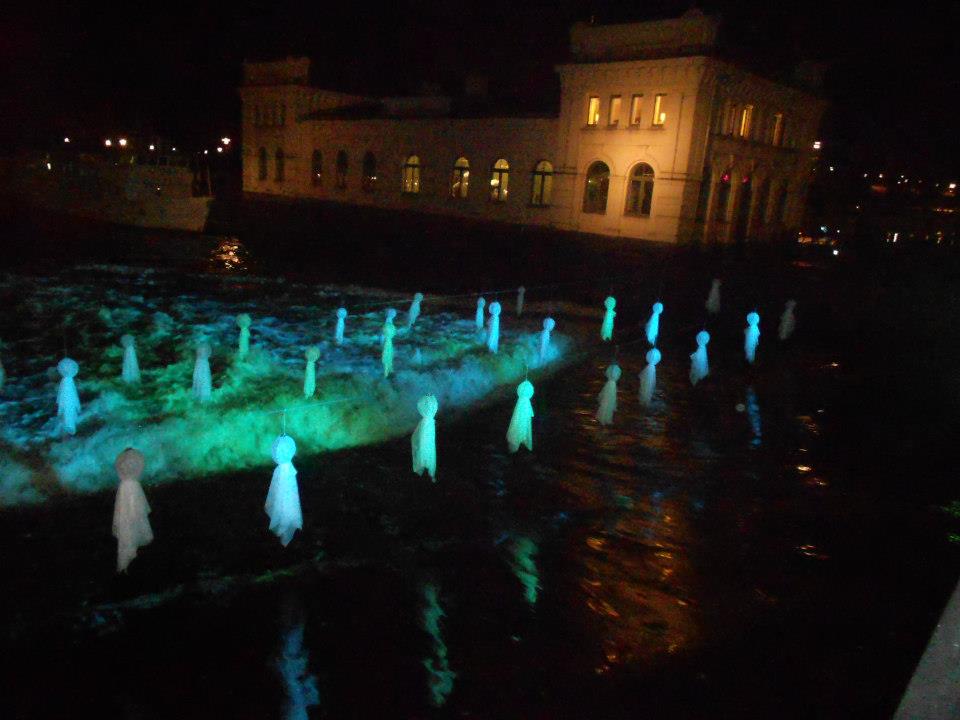
The City of Uppsala has its own beauty display whether it rains or not. Namely, in the month of November there is the Uppsala Light Festival (Allt ljus på Uppsala) and some buildings (this year it is 15 buildings and even two University buildings are part of the Festival: Museum Gustavianum and the Munken block on Trädgårdsgatan) are selected to be part of the Festival so they are lit. It all looks really beautiful, especially the light installations on the river in the City Center. It is somewhat magical to take a walk through the city and follow the ‘light trail’ and enjoy the Festival.

 Light Installations in Stora Torget, the City Center for the Uppsala Light Festival

Light Installations in Stora Torget, the City Center

Light Installations at the Fyrisån River, part of the Uppsala Light Festival

Light Installations at the Fyrisån River


Even if it does get really cold, Uppsala has its way of keeping people warm. November in Uppsala can’t possibly be boring or eventless!


Halloween in Uppsala: Scary Costumes, Flogsta Scream, and Deadly Cold (posted by Indira in Sweden)

November 2, 2012

Whoever thought that Halloween is not that big of a deal in Europe, was absolutely wrong! Everywhere in Uppsala one can feel Halloween (if you open you eyes wide enough,though). Of course, there are no carved pumpkins everywhere, pumpkin spice is not added into everything, there are no children trick or treating, and finding a costume is a relatively hard quest. Ok, where is the Halloween spirit then, you might ask? Well, in every student nation, accommodation area, and in almost every conversation Uppsala University students are discussing costumes, parties, and Halloween themed fikas.

Last week my corridor decided to host a Halloween party (we sort of opened the Halloween season in Uppsala). We decorated our corridor, came up with some spooky snacks, put on our costumes and started welcoming our guests. It was a really fun night and everyone came dressed up and in the spirit of Halloween. Parties like this (about 30 people in total) are really good because you get to know people better and have nice conversations with them. I met a whole lot of Swedes, as well as other international students at our Corridor Halloween Party. Of course, it was an amazing opportunity to bond with my corridor-mates. I already know that I will miss every single one of them. It is hard to think about leaving this place in December – sometimes it feels like I just got here, but when I think back and go all the way to the end of July, I realize how much time I’ve spent in this place I now call home. It was funny that when we came back from our Tallinn trip, the moment I stepped out of our ship, I felt that I actually came back home; oh well, Sweden’s growing on me. That’s why I push thoughts of leaving Sweden out of my mind.

Some of my corridor-mates and I at our Halloween party, which we hosted

Some of my corridor-mates and I at our Halloween party

Back to the happy topic – there are more Halloween parties coming up this week and next week! 🙂 My nation, Värmlands Nation, hosted the Halloween themed pub night on 10/31 in honor of this amazing time of the year. Wermlandskäller’n- my Nation’s pub that dates back to the medieval times, was all decorated with spider webs and served food and snacks that celebrated Halloween. In moments like those nothing could make me feel like I wasn’t in the States (well, the Swedish language and a high number of blonde people kind of sets me back into reality, but still…).

Wermlandskäller'n - The pub at Värmlands Nation that hosted Halloween themed pub night which we attended

Wermlandskäller’n – The pub at Värmlands Nation that hosted Halloween themed pub night

Speaking of spooky and scary things, I have never mentioned this amazing tradition that exists in Flogsta (student accomodation area where I live). Every night at 10pm students go out onto the balconies, open their windows, or go up on the rooftops and scream as loud as they can. Usually this Flogsta scream turns into a competition between the buildings (in Flogsta there are multiple buildings, but students usually live in buildings 1-10): I, for example, live in building 8 and we usually have scream offs against the people living in buildings 7 and 9. It is really fun! And a great way to release stress. There is actually controversy over how this rather interesting tradition started. Some say it was simply a stress reliever, which started during exam times and then became a daily occurrence. The story goes that there was a student who had an important exam and he was studying quite a lot, which made him very stressed out so he opened his window and screamed at the top of his lungs. Others say it started in remembrance of a student who committed suicide in the 1970s. Either way, the tradition is there and it is respected.  Below is a video I took of the Flogsta scream one night in August.

A cruel winter seems to be another Swedish tradition. It is getting colder and colder every day. The worst thing is that the bike and pedestrian paths get really slippery (especially in the morning and after the sunset) because of the icy surface and walking and cycling become really hard. I have witnessed people fall in front of the supermarket, and I’ve heard stories of my friends who fell off their bikes. Luckily, during the real winter (it’s already cold enough, I don’t even want to know what a ‘real Swedish winter’ is like) the city makes it possible to walk/cycle, and there are busses, so getting to classes and to the city won’t be a problem.

Now, I’m off to figure out my Halloween costumes and enjoy the joys of the Halloween season (meaning Swedish chocolate and other godis (sweets and candies in Swedish)). 😀


Challenges as Opportunities

October 26, 2012

When I applied to be a foreign correspondent for this semester I did so to offer a different perspective on the whole study abroad experience.  I felt that my main purpose would be to inform potential study abroad applicants at the University of Richmond about the benefits of spending a semester (or year) away from campus.  My first 5 posts have mainly highlighted the wonderful intricacies that exist in an Oxford lifestyle.  I believe, however, that I would be doing an injustice to all those applying for a study abroad position if I did not discuss some of the challenges that also are present when a student goes overseas.  Many tasks in life have challenges, but we have the benefit of using them as opportunities to better ourselves. As George Patton once said, “Accept challenges so that you may feel the exhilaration of victory.”

When the visiting students were sitting in one of our orientation meetings we were told that by the 5th week of the term Oxford students begin feeling “it.”  Whatever “it” meant, we didn’t know for sure, but we could imagine.  At the time, we thought that it probably meant the typical stress and anxiety that college students feel during the middle of the semester when they are piled with work.  We usually fail to realize how blessed we are to actually be in that position in the first place, but we can talk about that another time.  What we failed to realize at the time was that if normal Oxford students felt this way at week 5, then we would probably feel it sooner since not only were we new to the workload, but we were also new to the country.  So what is “it”?  Well “it” is the combination of many different factors that begin to wear you down as a student and this reflects in your personal life.

The biggest factor obviously is academic work.  By the third week, you’ve already written three to five 2000 word research papers, which may not seem like a lot, but it can get to you.  That may be why I have yet to travel out of the area; I apologize to any readers if my lack of traveling has hindered your understanding of studying abroad.  Most students travel throughout their time, but this specific situation is atypical.  Being here for a year, I have less of an incentive to see the world in the cold weather when the beautiful European springtime awaits.

Outside of all the work, the Oxford system celebrates independent learning.  There is no mandatory class and individual study is encouraged.  I was thinking about it earlier today and realized that I met many of my best friends at UR through our experiences in a classroom (Shout out to Alyson, Lindsay, Meredith, and John).  How do you deal with the lack of social interaction at the academic level?  You handle it like everything else in life and make it an opportunity.  Because most of the visiting students are in their 3rd year of university, many of us celebrate our 21st birthday abroad.  There is a lack of significance in turning 21 in England when compared with the ‘right of passage’ as seen in the US.  But on Wednesday we went out to a local Indian restaurant to celebrate one of the students birthdays and it was a great time.  It’s the little things in life that matter.

Another big challenge is the lack of social interaction with the community.  At UR, there are endless opportunities to volunteer in the community and help better the city that we live in.  Most students at Oxford do not have the time to volunteer since their workload is so great.  Maybe it is being away from home, or the inability to volunteer weekly in Richmond, but I was going through a little bit of withdrawal this week.  Again, how do you change that?  You make something happen.  I decided to email the director of KEEN, a non-profit organization that provides social, sporting and recreational activities for children and young adults with special needs in the Oxford area.  They allowed me to volunteer last Friday and so in the afternoon I was able to draw, sing, and play Duck-Duck-Goose with a bunch of kids. It was big time!

Drawing with children during my KEEN non-profit volunteer experience

Drawing with children during my KEEN volunteer experience

99.9% of my experience here as been incredible.  But it would be foolish to say that challenges do not occur.  I am sure that there have been many more challenges this past month, but like everything else in life, we must make them opportunities. While writing this I realized how blessed I am to not only study at Oxford, but to also study at UR.  All of my challenges at Oxford are mere common activities at UR.  So for those who are considering study abroad, I encourage it, even though we are all already lucky to be studying at an amazing place like Richmond.

St. Catz (St. Catherines), one of the constituent colleges at Oxford

St. Catz, one of the constituent colleges at Oxford: my abroad university 


The University of Richmond, my home university

The University of Richmond: my home university

The longer I live, the more I realize the impact of attitude on life.  Attitude, to me, is more important than facts.  It is more important than the past, the education, the money, than circumstances, than failure, than successes, than what other people think or say or do.  It is more important than appearance, giftedness, or skill.  It will make or break a company…. A church…. A home.  The remarkable thing is we have a choice everyday regarding the attitude we will embrace for that day.  We cannot change our past… we cannot change the fact that people will act in a certain way.  We cannot change the inevitable.  The only thing we can do is play on the one string we have, and that is our attitude.  I am convinced that life is 10% what happens to me and 90% of how I react to it.  And so it is with you… we are in charge of our Attitudes.

-Charles R. Swindoll


Social Events Overload in Uppsala: International Gasque, Birthday, Kanelbulledag and a Stolen Bike (posted by Indira in Sweden)

October 19, 2012

Last week was so overloaded with social events. Every single day there was something going on and so many times I would just come to my room to drop off my bag and in 5 minutes I would be on the move again. I am not complaining though – I enjoy this rhythm that allows me to experience as much of Sweden as possible (especially taking into consideration that half of the time I’m supposed to study abroad in Uppsala has already passed).

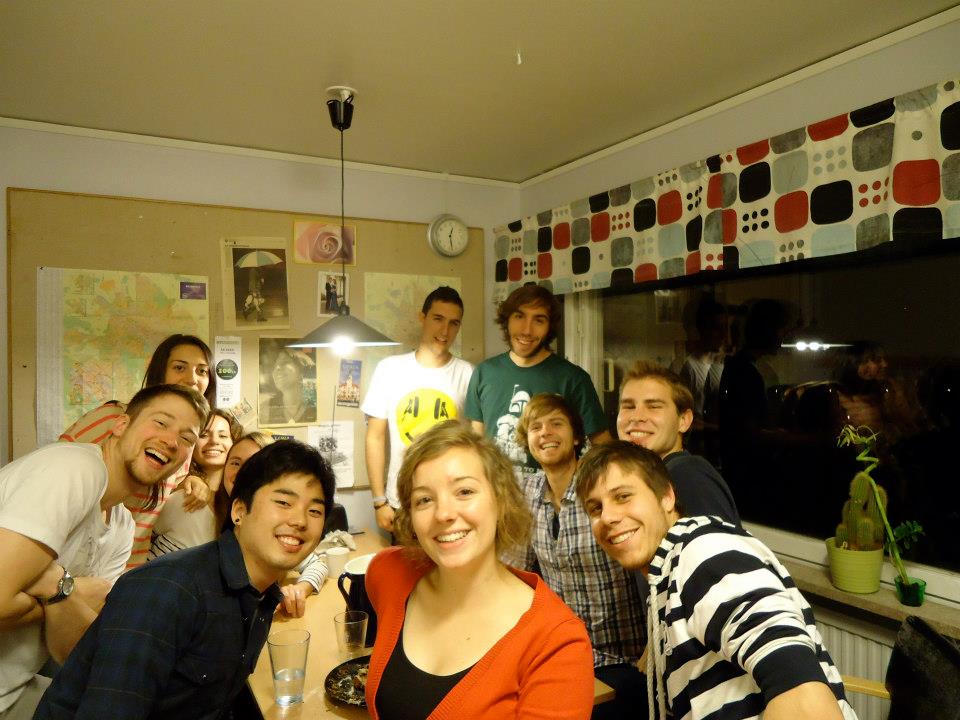
One of my friends, Marine, had her birthday a few days ago so we organized a birthday dinner for her (it was a pot luck style dinner where everyone brought something). I made a traditional Bosnian dish called “sataraš” and I was happy to see that people liked it. We had a really great time talking over the dinner, and then we had our own private concert: two guys played guitars and sang for about an hour before the clock struck 12. It was a really nice bonding experience!

My friend's Birthday Dinner, celebrated with a potluck

My friend’s Birthday Dinner

On Thursday last week it was the official Kanelbulledag (cinnamon bun day – Swedes really love their Kanelbulle and I know why: they are super delicious and go really well with fika!). It is a tradition that on the Kanelbulledag Swedes make homemade Kanelbulle, so my Swedish corridor-mates organized the event. We all got together and enjoyed some quality time together while making some delicious cinnamon buns. 🙂

Kanelbulle, a swedish cinnamon bun

Kanelbulle

On Friday we had the long awaited International Gasque. As I wrote earlier, gasque is a formal 3 or 5 course dinner where all the students dress up and have a nice meal, drink snaps and sing songs, as well as enjoy the entertainment. The International Gasque was very long, lasting 6 hours (6pm-midnight). There was some stand up comedy, a choir performance and skits to make it all incredibly enjoyable. After all the delicious food was eaten, all songs sung, and the entertainment program finished, there was an after party with Karaoke and a live band. I really enjoyed karaoke since so many people came on stage and everyone was having fun, not really caring about how well (or bad) they could sing. The live band was also very good. They were singing mainly popular mainstream songs that brought everyone to dance. All in all, it was a great night! I was really happy to be part of it all!

International Gasque: a picture of the seating arrangement for the dinner

International Gasque: Seating arrangement for the dinner

The twist came later on. The night, unfortunately, ended not so well for me. On our way back home when I wanted to get my bike, it was not there. I couln’t believe that someone had stolen my bike! We were all warned that this might happen, but I was always optimistic about it. It took 2.5 months for my bike to get stolen. At first I was really sad because I went through so many adventures on that bike (including me falling off it multiple times, and over-inflating the tire so it exploded). By now I have accepted what happened and got a new bike (I was really lucky that a friend of mine had 2 bikes, so he let me borrow one for the rest of the time I’m in Sweden). Life goes on!

The week ended with me trying to cook (and actually succeeding)! I cooked Bosnian for 7 of my friends. I made three traditional dishes and they all turned out amazing! I am happy I got a chance to learn how to cook. Those are the skills one will always need and find useful. 🙂

Of course, apart from many events in Uppsala, our classes went on. My only class for this month, Critical Perspective on Sustainable Development in Sweden, started integrating more study group work in the course. We divided into a few groups and now we will work within those groups on the case studies of interest. My study group (which is, by the way, very international. We are 5 people: Swede, Japanese, Korean, German and I) is working on urbanization and we will be looking at two districts in Stockholm in oder to see how sustainable they are. In the end we plan to come up with a list of recommendations for other districts in Stockholm, as well as other cities that are looking into urban resilience.

It was truly a good week with a lot of things going on and very little free time, but it all made my week much better! I guess that is the point of study abroad – do as much as possible and enjoy whatever country you’re in. 🙂


Academics at Oxford (posted by Jimmy in England)

October 9, 2012

Today Times Higher Education came out with their yearly rankings of the 400 best universities in the world.  The top seven universities were:

7. University of Cambridge

6. Princeton University

5. Massachusetts Institute of Technology

4. Harvard University

Tied in 2nd– University of Oxford and Stanford University

1. California Institute of Technology

The rankings use a system based on specific performance indicators including teaching, research, knowledge transfer and international outlook.  With that news buzzing around campus and the lurking start of my term coming up in a few days, I wanted to dedicate this entire post to the academic side of Oxford.  In the months prior to my arrival, I knew that Oxford was an incredible institution, but I didn’t know what set it apart from the rest of the world.  After being here for a week, I can begin to understand why people think so highly of it.

To start, by the time you apply for admission to Oxford you are already expected to know what degree you want to receive.  This is very different from the liberal arts system of the U.S. where we can spend a few years taking different courses to see what interests us.  Included in the admissions process to the university, prospective students take specific examinations in the subjects that they want to pursue.  If they do well enough on the exam, they are offered an interview with a college professor.  During the interview, they are not asked the typical U.S. college interview questions like, ‘Why do you want to attend our university?’ or ‘what are some of your strengths and weaknesses?’ Rather, they are asked questions to see if they really grasp the academics that they have studied prior to the application process.  I spoke with an engineering student that is starting his first year at Oxford.  He was telling me some of the questions that he was asked, one being incredibly interesting. The interviewer showed him a picture of a man running with prosthetic legs and asked him to describe how we would build a replica.  I have been in university for two years and would not have a clue how to answer that.  This institution is world renowned because they demand that you know what you want to study.  They don’t allow you to take any time thinking about potential majors, they want you ready to come in and work.

A second reason that Oxford is world renowned is because of its academic system.  The school year is broken up into three terms.  Each term a student takes one major tutorial and one minor tutorial. Major tutorials meet 8 times over the course of an 8 week term and minor tutorials meet 4 times.  It may seem like only meeting 12 times in a trimester is easy…. Ask any student here and they would laugh.   A tutorial is nothing like the American lecture style learning.   Tutorials, in the simplest analogy, are a 60 minute one-on-one cage match with a tiger…. A massive tiger that is easily capable of destroying you, like the ones in The Gladiator.  In a tutorial, you meet a professor in an assigned location.  It could be an office, a lecture hall, a public café, or anywhere that you decide.  The meeting lasts for one hour and is based entirely on the work that you have done in advance.  All of the work for one tutorial, which usually includes reading mounds and mounds of books and papers and preparing one essay, must be turned in 48 hours before the meeting.  The tutor then reads your work and prepares questions/ commentary for you.  When you arrive, you have to defend your points for one hour against a Ph. D. My first tutorial is next week and I have to read 15 scientific papers and 8 chapters from 3 different text books.  Then I have to write a 2000 word essay answering a specific question outlined in the document that my tutor sent me.  At the visiting student introduction ceremonies yesterday, the Dean of the college said that the minimum amount of time that is usually spent on academic work per week is 40 hours.

Oxford does not have regular tests or mandatory lectures.  They hold end of the year collections exams which rank students and they also hold beginning of term exams which force students to retain the knowledge from the previous years.  Every subject at Oxford offers optional lectures that correspond with it.  None of the lectures are mandatory and anyone can go to them.  This means that even if someone is a linguistics or history major, they can sit in on a biophysical chemistry lecture.  This system is different from any educational system that I have ever experienced.  In America, it seems like there is a lot of structure and if you follow the right path you can succeed.  Here, you are fully independent.  You cannot hide in the back of a classroom or cram the night before a big test.  They demand that you start your work early and continue throughout the week.  At many universities across the U.S. libraries are open 24/7.  At Oxford, there are many library buildings, but all of them close before 10pm on the weekdays and some are closed on Sundays.  The most famous of the libraries is Bodleian Library.  Aside from holding many historical texts and being a frequent place of work for J.R.R. Tolkein and C.S. Lewis, the library’s architecture is a favorite location for filmmakers. It can be seen in the opening scene of The Golden Compass and the first two Harry Potter films, in which the Divinity School acts as the Hogwarts hospital wing and Duke Humfrey’s Library as the Hogwarts library.  

While on the topic of Harry Potter, yes, it does feel like I go to school at Hogwarts.  Aside from Harry Potter actually being filmed at various locations in Oxford, there are many strikingly similar features.  The main one is in Oxford’s formal dinners.  Every evening the colleges have optional formal dinners that go from 7-8:15pm.  Most students attend these dinners every night.  Students arrive at 7 and sit down at a table.  At 7:15, the dining staff stops admitting students and all of the people in the hall stand up.  The professors and deans walk through a door dressed in their college robes (black, like in Harry Potter).  All of the students are quiet and must stand until the faculty has sat down at the head table, which is located at the front of the Hall and is elevated higher than the other tables.  Some colleges do not have a dress code for students but others require students to wear formal dress along with a black robe.

This place may not have any ‘Defense Against the Dark Arts’ courses and I am not likely to play quidditch, but there are reasons why Oxford consistently produces people who go out and make the world a ‘magical’ place.  See what I did there?  Until next time, keep drilling life.  How good are you going to be?

Here’s to the Crazy Ones.
The misfits.
The rebels.
The troublemakers.
The round pegs in the square holes. The ones who see things differently.
They’re not fond of rules.
And they have no respect for the status quo.
You can quote them, disagree with them,
disbelieve them, glorify or vilify them.
About the only thing that you can’t do, is ignore them.
Because they change things.
They push the human race forward.
While some may see them as the crazy ones, we see genius.
Because the ones who are crazy enough to think that they can change the world,
are the ones who do.

-1997 Apple Commercial


Fall in Uppsala: Seminars, Skansen und Richmond Re-union (posted by Indira in Sweden)

October 5, 2012

I started understanding how busy it can get here at Uppsala University over the past couple of weeks. Papers, reading, assignments, seminars, and exams have all come with the first days of Fall.

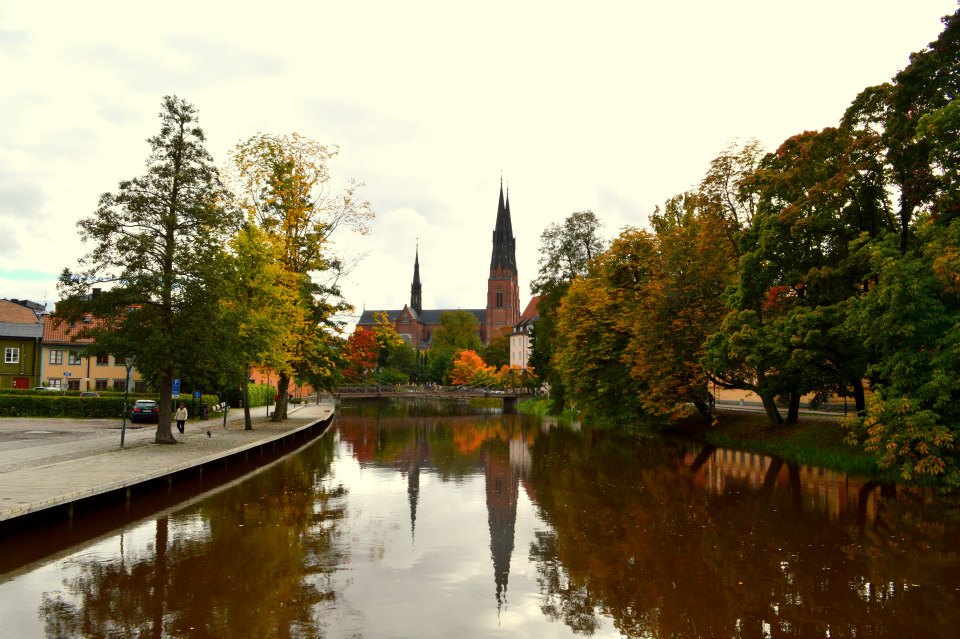
On the bright side – I don’t think Uppsala could look any more beautiful than it does right now. Leaves are changing colors and the whole city looks very majestic in different shades of yellow, orange, and red. I don’t need to do anything more than just look out of my window to enjoy this beauty. When the weather allows and it is not raining (unfortunately , it doesn’t happen all too often here) taking a walk in the forest close to the accommodation area Flogsta (where I live) is very calming and true food for all senses.

Fall in Uppsala, a gorgeous scene of the changing leaves on the trees

Fall in Uppsala

With all the school work, it is not always easy to enjoy Uppsala. Just last week I experienced the Uppsala University education system to its fullest. As I wrote earlier, there are lectures and seminars, and in seminars you are in a group of about 15 students where you discuss specific questions and have tasks to complete. My seminars so far have involved writing papers, preparing a debate and preparing a presentation. This way the students do more work on their own (but professors and lecturers are always available in case one needs help) and get to work on the questions and issues they take interest in. All lecturers encourage group and pair work. I worked on all of my seminar assignments with Izabelle who is a freshman from Stockholm. I really like that I got to work with a Swede since it provided an opportunity to meet someone new, to understand more about Sweden and Swedish culture, possibly learn new Swedish words, and also create a stronger link with someone who can be seen as an insider. I enjoyed working with Izabelle and I feel like we learned a lot from each other. Actually, all of the members of my seminar group are amazing and I got to know them pretty well. Unfortunately, as soon as we became friends (and not just classmates), our course ended (this class was basically an intensive 5 week class where I had classes every day. I wrote about this “one class at the time” system earlier). Not having a class together makes it harder to see people. On Monday I had my exam and it went really well. Uppsala University has a specific building where all the exams are held so it all feels very official. It felt somewhat weird to walk out of that exam and realize that my first Government class is over.

A view of Stockholm from Skansen, a park/zoo that I recently visited in Sweden

A view of Stockholm from Skansen, a zoo/open air museum I recently visited

Classes here are not all about having loads of reading and being stuck in the classroom. My other class, Critical Perspectives on Sustainable Development in Sweden, tries to incorporate the fieldwork in the course as well. A week ago we took a class trip to Skansen, which is a mixture of a zoo and an open air museum in Stockholm. We got to see brown bears, lynx, and many other animals, but we also learned more about sustainability in Sweden throughout its history by visiting small settlements and houses built as examples of how people used to live in different parts of Sweden at different points in history (my group, for instance, had to learn more about Sami). My personal highlight was a visit to a bakery where there was a cook who makes the Knäckebrot the way it was made traditionally. One can watch and then enjoy the delicious Knäckebrot with some salted butter. Yummy!

A brown bear at Skansen, a park/zoo in Sweden

A brown bear at Skansen

Another exciting thing happened recently: I finally managed to meet with Carl-Johan (or CJ as he was known in Richmond), who was an exchange student at UR last year and who was a great support and source of information about Uppsala (in essence, he is the one who made me think about applying to Uppsala Uni in the first place and I am so glad he did since coming here was the best decision ever). We had a nice fika and it was great to talk about Richmond with someone in person (I am the only student from UR here this semester). I really enjoyed meeting him!

Now I’m eager to see what October brings and I am looking forward to my trip to Tallinn at the end of the month! 🙂


Majestätisk Värmlands Reccegasque (posted by Indira in Sweden)

September 24, 2012

Last week was amazing! I don’t think I have ever had more fun and bonding time with my corridor-mates, as well as people from my nation.

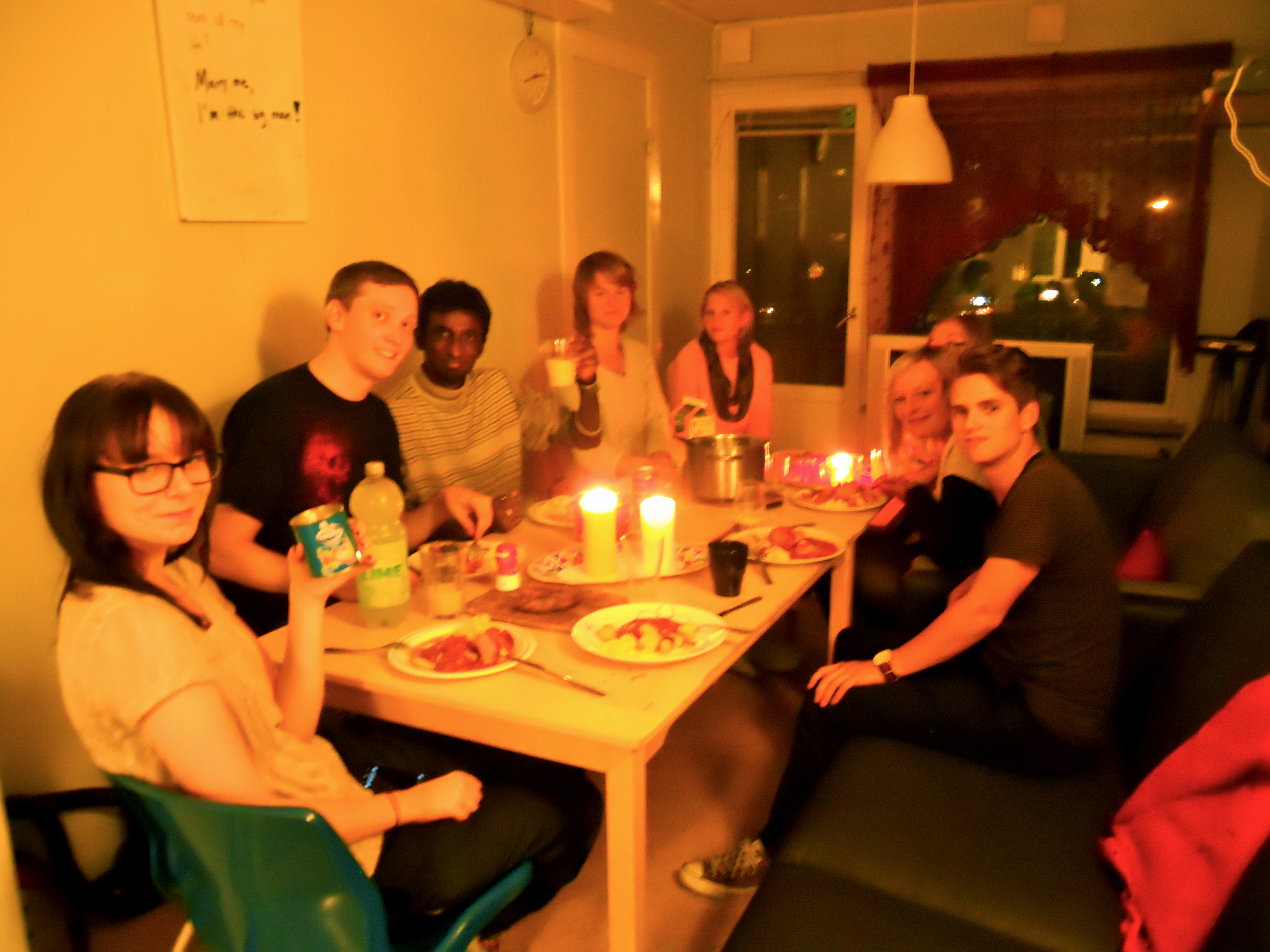
I live on a corridor with 11 other people and we share a kitchen together. There are 4 other international students, and the rest are Swedish. Last week we decided to have a corridor dinner so that we could get to know each other and to discuss some corridor rules. This was truly an amazing idea! We all got together, cooked, and then had a nice meal. The best thing about the corridor dinner is that you get to know people in a way you can’t in class or at fika. Everyone is so much more relaxed and there is a sort of  positive vibe around them. It was fascinating to see how none of us study the same thing or have classes together (we even have few Master students), but we all get along really well. Student life in a residence here is very different than at UR, since the residence halls are not specific to any grade, group, major, or area of interest.  It would seem like all of the residents would be more disconnected as a result, however that is not the case. Sharing a kitchen and a corridor makes us more likely to hang out and to spend time together. I really enjoy this part of being an Uppsala student. And all of my corridor-mates are really great, which makes it all so much better!

 Dinner with the 11 other students living on my hall

Dinner with my corridor-mates

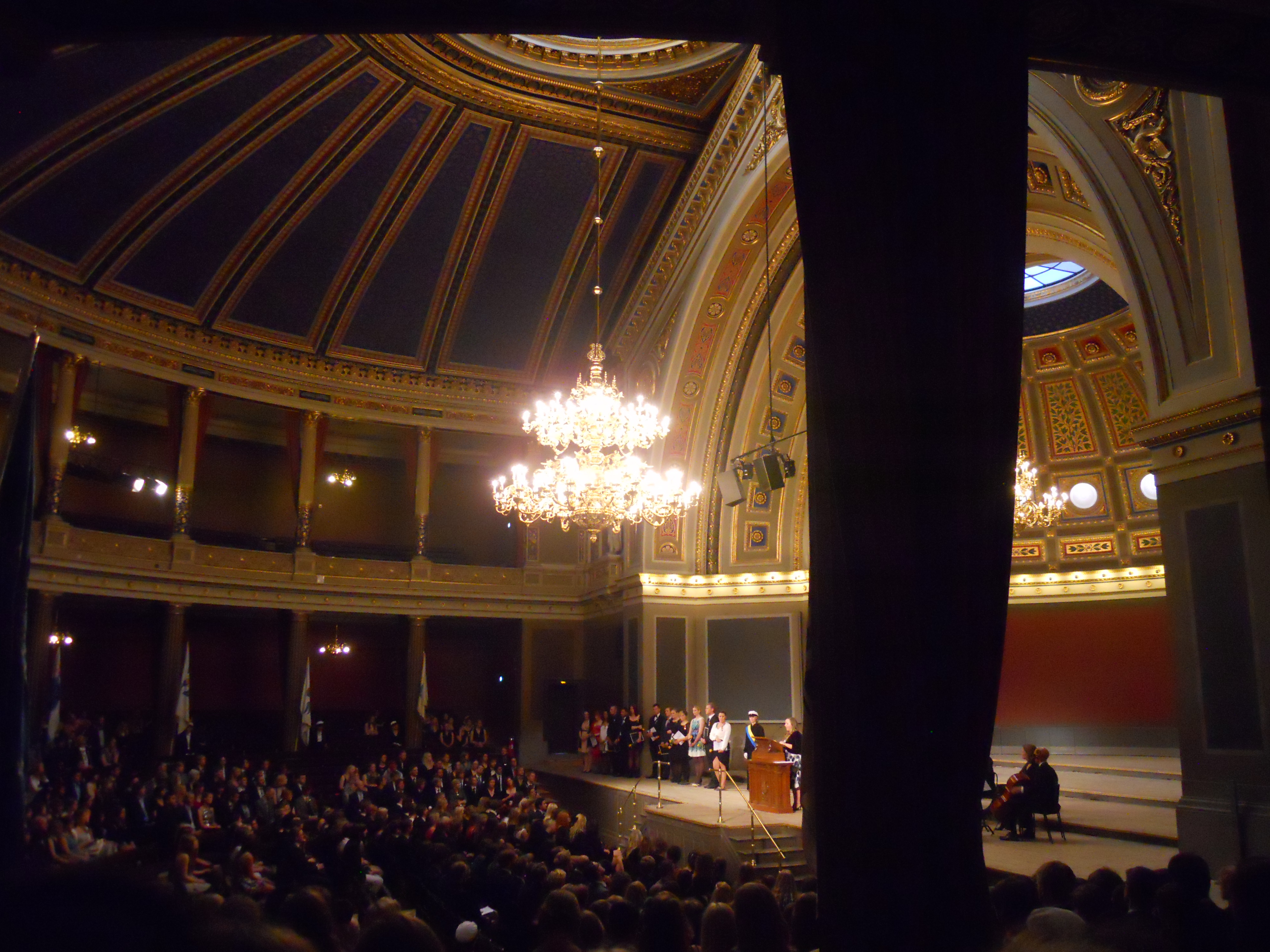
The big part of my week was the Reccegasque I was so excited about. On Friday, we all got ready, dressed in cocktail dresses and suits and all gathered at our respective nations (each of the 13 nations had a Reccegasque at the same time). Uppsala never looked so fancy! We were very lucky to have clear skies and no rain (it rained in the morning). First we gathered at Värmlands Nation (my nation) and then we walked over to the University Main Building. There was a senior member of the nation who carried the nation’s flag and we followed him in a line. This entire ritual made me feel like a part of something bigger. The sense of community is on a really high level here. When we got to the University Main Building (which is conveniently 2 minutes away from our Nation’s house) other nations’ members were also gathering on a patio in front of the building. After about 10 minutes of waiting and chatting  with people standing around me, new nation members, lead by the flag bearer, started entering the building. We were seated in the Great Hall where we had the reception for international students. The program was amazing. We had representatives from the University and Student Union speak, and there was also an entertainment program. It all looked very majestic, especially with the classical music playing while the flag bearers entered the Hall. The weird thing was that most of the speeches were held in Swedish and I, along with all other international students, didn’t understand much. Luckily we had some Swedes around willing to help us. It was funny that there was an a capella group singing, and they performed “Levels” by Avicii. Does it get any more Swedish than this? 😀

Speeches and entertainment in the Great Hall of the University Main Building with all the nations

Speeches and entertainment, in the Great Hall of the University Main Building, as part of my first Reccegasque

After the program in the University Main Building we headed back to our Nations. There we had a looooooong dinner (5.30-10.30pm). The food was amazing (we had typical Swedish food like salmon and potatoes). Of course we sang a lot and heard a lot of speeches. There were also a few short performances by the Värmlands’ drama club and choir. The funniest thing for me was when we had to make a hat out of napkins, put them on our heads, sing a song, and then wave with the napkin after the song. For the last song of the night we had to get up on our chairs and sing. If, after the song, you sit down on your chair you will fail your exams. So we all stood a bit until the dinner was officially over. After the dinner we had an after-party in Värmlands’ own club “State of Mind” that was open to every student (not only the students who attended the Reccegasque). I really enjoyed the Gasque and I can’t wait for the next one (which is in October!). This is a great way to learn more about traditions, have a very formal dinner, and meet new people (the nation arranges the seating so you are almost never sitting next to your friends. I was lucky and had amazing table neighbors).

Waving the "hats" that we made out of napkins at the Gasque, our nations dinner

Waving our “napkin hats” at the Gasque

Uppsala is a place where you can experience so much and I am more and more sure of this every week. 🙂


Lively Uppsala: Orientation Week, Nollning, Värmlands and Aurora Borealis (posted by Indira in Sweden)

September 7, 2012

Just as I was walking to my class yesterday I noticed that the streets of Uppsala have never looked so lively. Beautiful sunny day (a rarity here nowadays), a lot of people (mainly students) on the streets, and all the different languages spoken in every corner – summarize the 5 minute walk I took from the Cathedral to the Department of Government. I was used to a calm and peaceful Uppsala and familiar faces everywhere. Well, I guess this makes it official – summer break is over and school just started!

Orientation Week was so much fun! The International Office, Student Nations and the Student Union put so much effort into making the past week as amusing as possible. Club nights, games in the park, barbecues and a crash course in “the Swedish” helped us all learn more about Sweden, but also bond with other exchange and international students. The official welcome reception held in the University Main Building was possibly the most breathtaking part of the Orientation. In the most amazing hall I’ve been to, the University’s vice chancellor, the City of Uppsala Mayor and other representatives welcomed 740 exchange and 400 international master students. One was truly able to see how majestic Sweden is!

Unfortunately, there is always something that can (slightly) ruin things, and in Sweden it’s usually the weather. Constant rain and relatively cold weather (55F) did their part and many of the exchange students got sick (including myself); but that is also a reason for more socializing. Forget about being in bed all sick, in Sweden we do ‘sick fika’ (usually coffee or tea with a cinnamon bun). I can’t help but notice that Sweden is a country where so much energy is focused on creating a cozy and warm atmosphere. I guess that is the best way to fight off the winter and darkness. 🙂

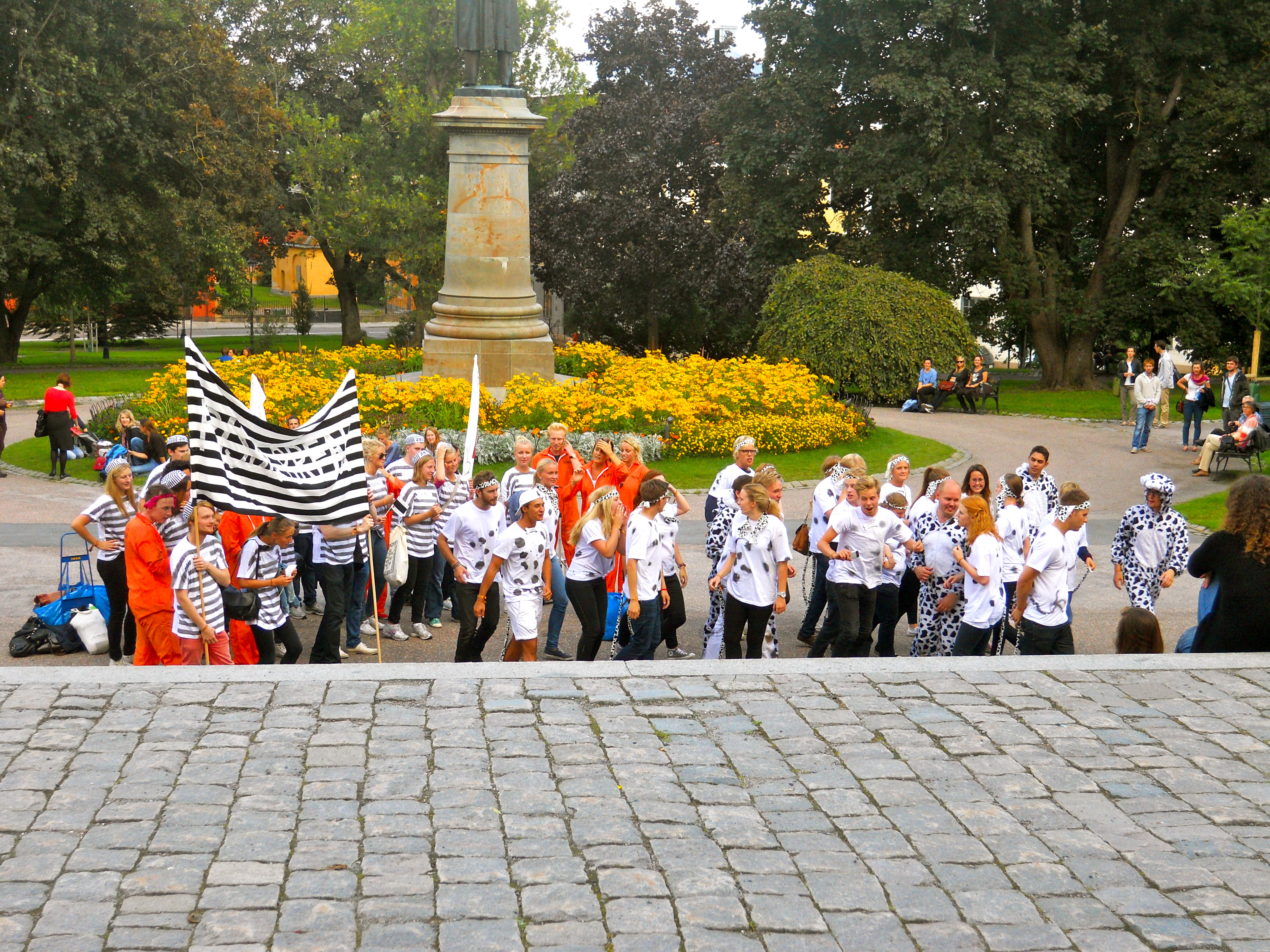
Last week was not only Orientation Week for the international students, Swedish freshmen also had a lot of fun. As far as I understood it, there is some sort of a ritual called ‘nollning’ (roughly translated it means zeroing) where each department at the University has a theme and all the people who participate in nollning wear costumes, sing and make music around the town. It is actually quite stunning to see how good their dance moves and chanting are. The funniest thing, of course, was their costumes. I had a chance to see the Middle Ages, Dalmatians, Super Mario, Prison Break and Lightning groups.

Nollning, essentially Freshman orientation

Nollning

I also completed another important ritual or task of becoming an Uppsala University student: I finally joined a student nation. My choice was Värmlands Nation because they have an amazing restaurant, cozy library, great Friday club and all the members I met are amazing and so helpful. This week we will have Reccereception (reception for all the new members) and next week we will have formal dinner – Reccegasque. I am looking forward to both of those!

Official School Welcome Reception as part of orientation

Official Welcome Reception

And that is not the end of the past week’s adventures in Uppsala – the most amazing thing happened last night! We were very lucky to see the Northern Lights here in Uppsala. Clear skies and time spent outdoors around midnight were more than helpful in seeing this beautiful phenomenon. After about 30 minutes we could no longer see the light. Hopefully we will have more clear skies at night soon (September is a perfect month for spotting Aurora Borealis).

Aurora Borealis (the Northern Lights)

Aurora Borealis

I am excited to see what new adventures await in Uppsala!