Fast Trains to Fun Travels (posted by Pierre en Suisse)

April 10, 2013

Last week was my University’s spring break, or Easter Vacation as it is called here. It could mean only one thing: time to hop on a train and travel somewhere outside of Switzerland for the first time! Where did I pick you may be wondering? Italy! One of Switzerland’s border countries as well as language regions, Italy is also from where my family originates. I am quite proud to say that I am one hundred percent Italian when at home in the states. However, as an American abroad in Europe, I have realized there is a very different conception of nationality here than in the US; whereas it is not that common to be completely of one heritage in the US, here in Europe, to say to someone I am a hundred percent Italian usually means absolutely nothing. It was an interesting realization when I first explained that to someone!

To go to Italy, I hopped on a train the afternoon my classes had ended, and after traveling four hours through mountains, tunnels, and past various lakes, I found myself at my final destination, in Bologna.  I am lucky to have a friend who is studying in Bologna whom I stayed with during my visit. No, Bolonga is not typically the first city that comes to mind when envisioning Italy, but I think it was quite an ideal destination. It is in the heart of the Emilia-Romagna region, and is home to some of the most famous Italian foods, such as the Bolognese sauce, the typical meat sauce that goes over some of the most stereotypically Italian pastas such as tortellini and lasagna, also specialties of the region. Tasting true Italian food was one of my main goals of the trip, and I definitely got my fill of it!

My first meal there was at a very traditional family-style restaurant that served the meal in different courses. Starting with anti pasti, the servers brought out massive plates that you take a bit of food from before passing it on to the rest of those at your table, until you have a full plate. This course can include things like prosciutto, salads, and other types of vegetables. Next up is the pasta course, called primi, followed by secondi, or the main dish of the meal, usually some kind of meat, and then finishing off with desert and then coffee. Due to the fact that we were already stuffed by the time we finished our primis, we decided not to get secondis, choosing desert instead. I won’t lie, even in Switzerland, the land of chocolate, I have never had more on my plate at one time than during this course, between the chocolate mousse, chocolate salami, chocolate sauce to go over one of the pastry, in addition to the other deserts. Don’t worry, Gelato came another time, I made sure I didn’t miss it when in Italy. After the experience I truly understood why my friend had warned me not to eat that day, knowing we would be having such a large meal at the restaurant.

My dessert plate at my first Italian restaurant!

My dessert plate

The next day, I found myself in Florence! My friend and I walked around the city and saw some of the major sights, such as the Basilica di Santa Maria del Fiore, but unfortunately due to the long line and my lack of foresight, we did not have a reservation to go to the Museum where the famous statue of David is located, in addition to the Palazzo Vecchio, or the old town hall of Florence. There, I found among many other things, a map room which happened to be one of my favorite parts. Despite my excitement of being in Italy, I couldn’t help but locate Switzerland and Lausanne on the map of the francophone world.

One of my favorite parts of Bologna: the food markets. Loved the ambiance and just looking at the selection! This is just one of the many fresh produce stands located in the market.

One of my favorite parts of Bologna: the food markets. Loved the ambiance and just looking at the selection! This is just one of the fresh produce stands.

Upon returning to Bologna, I got a full on view of what I envisioned to be Italy one morning when it was sunny. Walking through the city’s colored porticos with the sun burning off any morning dew and fog and shining through the arches, there was nothing else like it. Until that is I climbed up on top of one of Bolonga’s famous two towers and got a full view of the city’s red roof tops and green rolling hills in the distance. The combination of the true Italian food and these images definitely met my expectations of what Italy should be, and I will say I am ready for round two to come at some point down the line. That visit will be to Rome, almost certainly, and then later on I hope to get to Venice. But alas, I am back in the wonderful land of the Swiss, and life could not possibly be better.

A view of Bologna and some of the surrounding hills

Bologna and some of the surrounding hills


Yup, this is all real!! (posted by Pierre en Suisse)

March 29, 2013

Monday in my Swiss Politics seminar, I gave a presentation with a group for the first time since I have been here in Switzerland. Our presentation was only fifteen minutes, and was on the topic of a law that we had been studying for the past couple of weeks, and honestly it was one of the most interesting experiences I’ve ever had. I wouldn’t call this just any presentation, however I would instead refer to it as the presentation of realizations: realizations not solely focused on the topic of our work, but realizations really for me that this is not some fantasy land here, but it is real life. Real studying, real learning, real people seeking their degrees, real people working. Real people are living here doing normal every day things in Switzerland, just like what happens at home in the US.

Sometimes life here can honestly feel like I’m in a dream world that doesn’t really exist. Among some of my other exchange student friends, we often joke that Switzerland is just too perfect of a place. In fact, when I had first arrived here, I saw the water in a river by the university and it was so blue that I actually questioned whether it was highly polluted. The reality is that it is a great deal cleaner than what I’m used to seeing. The scenery is as picturesque as one could ever imagine. On a clear day, when walking pretty much anywhere in the city, just one look to the south and the view of the lake and magnificent snow-covered mountains just takes your breath away. The buildings in the city are real too. As an American, I’m used to really only seeing this style of architecture be replicated in places like an amusement park, or maybe more authentically in a major city. However, the medieval European style is everywhere here, as it is something we just try to copy in the US. Even the money here, being different and far more colorful than what I’m used to can sometimes feel fake, and just as if it’s out of a game like monopoly (this is not to say that I’m spending as if I’m in a game- Switzerland is too expensive to do so, and I’m not trying to run out of money to buy food). And what’s more is that again, people aren’t speaking the language that I am used to hearing. However, it is a language that I truly love and still feel in disbelief that I’m actually able to use it as a means of communication, not just something to study and enjoy hearing in a song or reading in a book, for example. So as foolish as it can really sound, the life here can honestly feel like I’m still asleep and just living in a European fantasy.

However, I think today when I presented in front of an audience of Francophones, it really hit me that no, this is real. I don’t know why it was speaking in front of a class that made me finally realize this. I’ve given countless presentations in my time as a student, however they’ve always been in English, or maybe French to an audience of other Anglophones learning French just like me. So when I was speaking today and opened with, “Sorry if my French hurts your ears” and was luckily greeted with some laughter and some compliments afterwards, it hit me that this time it was real. These people grow up thinking in this language, not in English. It is French that is the little voice in their head that shapes their thoughts and perceptions, not English like mine. It is French that shapes their personalities, and the way that they express themselves, not English like me. Just the thought of how something that we take so for granted each day, our simple means of expressing ourselves orally or written for so many different purposes, has such a profound impact on who we are.  Again, language is something that truly fascinates me. The fact that I’m not yet at a level of French where I feel like it is true French, not just a set of words formulated into a structure very much like that of my own language, that I speak on a day to day basis, really struck me today when I was speaking in front of this class and realized that this was finally me using what I’ve learned to speak and present information to people whose minds speak to them differently. I hope this makes sense; it really has to do with thinking of how you speak to yourself in your head that amazes me, and to think that there are countless ways to do that is an idea that really came to light today.

SO I guess maybe after finally realizing that this is all real might mean that I’m officially habituated or adapted to the life here in Switzerland? I’d say no. Again, every day brings new experiences, but in a way that makes me excited to get up every day and go out exploring. It’s constantly learning time here, with the world around me as my classroom, library, or any other place you could think of as a place of learning. It is incredible, and again, I am so truly lucky to be here.


서울의 노래: Classes, Museum, and Karaoke (posted by Indira in South Korea)

March 29, 2013

It has already been over a month since I got to Seoul and I really feel as if I’ve been here for much longer. It is funny how you can feel well-connected with a place and yet discover new things and faces of that place every single day. Seoul is definitely one of those places: being a huge city, you can always discover new corners, little shops, and amazing restaurants where you least expect to find them.

Past week was a little preview of how the next weeks are going to get: not enough time for all the exploring, traveling, and schoolwork I want/need to do. Last week I had my first assignments to hand in and I was pretty busy with school. It is now that I feel the big change from the system in Sweden – instead of focusing on one class at a time, I am all over the place, balancing 4 courses. This is actually good, as it will me help me get on track by the time I am back in Richmond. Speaking of Richmond, the fact that I will be returning to Richmond for my senior year is starting to hit me. The housing selection and coming course registration definitely make me feel nervous. On the one hand, I am excited to go back to Richmond and see all the people I haven’t seen in almost a year, but I also don’t want this year abroad to end, and most of all  – the thought of me being a senior in August is rather scary.

Being abroad is one of the best things an undergraduate student can do and I would recommend it to everyone. It is unbelievable how much you learn about yourself and the world. The most amazing thing is the first-hand experience: sightseeing, learning the language, understanding the culture, meeting the people. I also love how all of my courses foster the first-hand experience. Even though I take a wide range of courses we always focus on Korea as our main example thereby gaining in-class knowledge, but as soon as you walk out of the lecture halls you can easily realize you are in the world you just read or heard about and you can go and explore it all. For my US-Korea relations class, for instance, the professors gave us 2 hours of lectures off so we could go the National Museum of Korean Contemporary History located near the City Hall. A few of my classmates and I went to the museum and actually had so much fun exploring the contemporary history of our temporary home. One of the most fascinating things in the museum was the 38th parallel that divides US and USSR zone. There were also a lot of other things to see and learn about Korea and how it has changed and progressed. There was even a huge section devoted to the technology development (including a super big screen where you could watch K-Pop videos, including “Gangnam Style”).

 The 38th parallel, an imaginary line dividing the US and USSR zone (South and North Korea)

The 38th parallel dividing the US and USSR zone (South and North Korea)

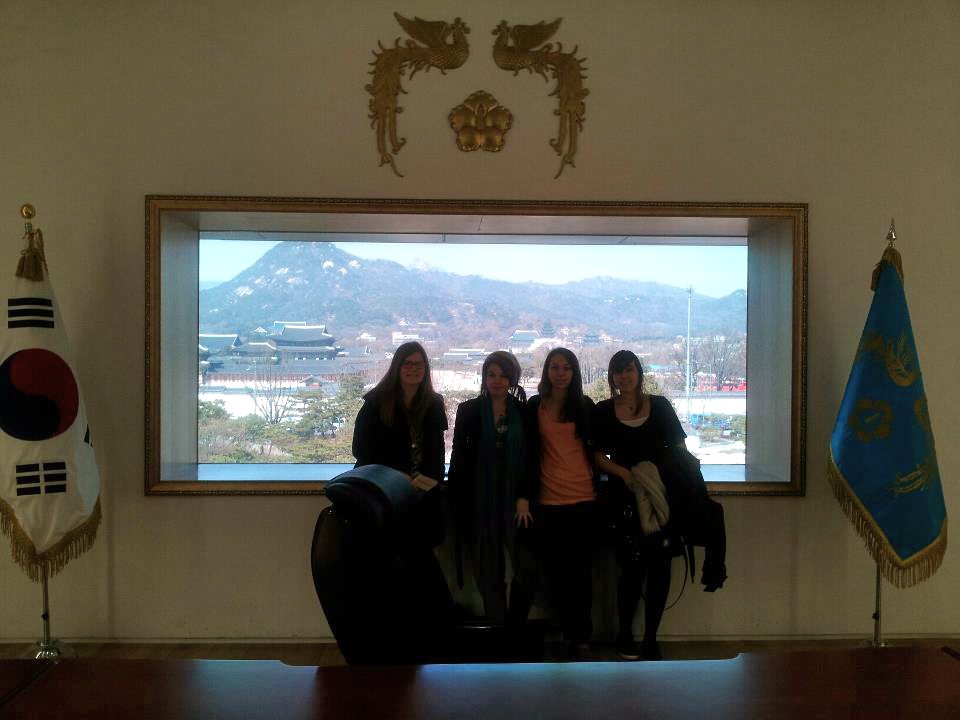
I also really liked the part of the museum that represented the President’s office. We spent quite some time there taking pictures and looking around.

President's office in the National Museum of Korean Contemporary History

President’s office in the museum

And last week I went to the karaoke room with a group of my friends. Basically you rent a room for as much time as you want (usually 1 or 2 hours gives you enough times you sing your heart out), pick your song(s) and sing no matter how good or horrible you sound. It is actually quite entertaining and a great way to meet new people and bond with them!

Karaoke with some of my exchange student friends in Seoul

Karaoke with my friends

It is great when you find little things like karaoke rooms and a trip to museum to make your day. Seoul definitely is soulful, all you have to do is keep your eyes open! 🙂


Homesick? (posted by Pierre en Suisse)

March 22, 2013

It is unreal to me that I have been here already for eight weeks. I continuously keep track of the length of time that I’ve spent here, because whenever I meet someone, especially if they are Swiss, one of the first things they’ll ask is how long I’ve been here. With each passing week, as that number has grown larger, the question started to come up as to whether or not I was homesick at all. My answer? Nope, not really.

Switzerland certainly is a different place than the United States, in very simple ways. What I would normally use at home for a sandwich, for example, was called “sacrilege” by a Swiss friend, since the Swiss standard of bread is much higher than my own. It’s also starting to strike me just how old certain things can be here. While walking through the city, I could pass a site built in the medieval ages, any number of castles, or even a site with Ancient Roman Ruins! When I think about the fact that the first British settlers in the United States arrived in the 1600s, it is really quite impressive to think what an “old” building means to a European compared with me, as an American!

The variety of languages here never ceases to amaze me. Switzerland itself recognizes four national languages: French, German, Italian, and Romansh. But it doesn’t end there. Swiss German, I have been told, can be spoken differently depending on what region you are in, sometimes even by mountain valley. Swiss Germans write in High German, or standard German, but all speak differently. It is as if they could almost form 26 languages of their own, I have been told. But then it gets even more interesting to see the fact that in the Swiss Parliament, laws are written in French, German, and Italian. When I was doing a project for my Swiss Politics class, I had to learn about a law that was assigned to my group. I discovered that one word in the French version of the law, just in the title of it, was the subject of debate, at least among the francophone members of the Parliament. I wondered to myself if this happens in all of the languages, and if it does, just how amazing that truly is that the country can still function as smoothly as it does with all this diversity of language and thought. With diversity of language always comes diversity of culture, so it is an amazing feature of this country to notice the differences between all the different types of people that are here. I definitely came to question whether the political system in the US could handle something like two or even three national languages being used in the Congress, but given the drastically different size of the country the situation is entirely different.

Language is definitely one of the things that fascinates me the most about being here in Switzerland. I share a flat with a girl from Australia, another American, and then a girl from France and a Swiss guy too. As there are some differences between the French spoken in Switzerland and the French spoken in France, as someone learning the language I absolutely love listening to my flatmates point out their differences, just as I would when talking to someone in the states about the word “wicked” or “y’all”. One big difference in Switzerland is the way that they say numbers. The Swiss have a different way of saying 70, 80, and 90 than the French do, using a much shorter word for each. All of us exchange students really appreciate it because it can be a lot easier for us to say! But again, listening to the exchanges between some of the Swiss and the French about the nuances of their respective languages is always a great opporutunity for me to pull out my phone and continue adding to the massive list of words and phrases I have learned since I got here. If I don’t do that I usually forget, so with each day this list keeps expanding!

So going back to my question of whether or not I’ve missed home: I would have to say it’s hard to miss something that I’m so used to when I’m constantly exposed to new things, interesting people, and can practice my language skills. I’ve not been here long enough to find the mountains that lie just across the lake to be any bit normal, so whenever the sky is clear, they always remind me of how lucky I am to be in such a beautiful place, in a way that is completely different than what I have in Richmond. Am I starting to get adjusted to the life here? I don’t think it’s really possible, when each day comes with new challenges and new adventures and opportunities to learn. I think that is probably the most consistent aspect about life here. No matter what, I am always learning, and no matter what, I love every minute of it.


Highs and Lows (posted by Jimmy in England)

March 20, 2013

It is funny how in the course of two weeks you can go from incredible highs to devastating lows.  On my last weekend before spring break, I took a three day trip into London with a few friends.  I have been to London before, but only for day trips.  Oxford is an hour and a half drive west of London, so buses conveniently run through the night.  This time, I wanted to fully experience one of the most influential cities in the world.  We stayed at the Club Quarters Hotel in the financial district, located within a five minute radius of the Thames, St. Paul’s Cathedral, and the Tower of London.  When we settled in, I Googled “shows in London” looking to find a theatre performance for the evening, since London theatre is rivaled only by Broadway.  However, the first thing that came up was “One Direction Concert-Tonight, 7:30p.m.”  One Direction is the British version of the Backstreet Boys, and they are one of the biggest boy bands in the world right now.  They have a few hit singles and their fan base tends to be 11-16 year old girls.  Don’t judge me when I say that we impulsively bought tickets 20 rows from the stage for the concert that night!  My friends and I quickly grabbed some food and took the tube to O2 arena, one of the major concert venues in Southeast London.  I will be honest; these guys draw an unbelievable crowd.  It was the first concert of their new tour and it was packed.  I will gladly swallow my pride and say that this was one of the best experiences of my time at Oxford.

One Direction Concert, at the O2 stadium in London

One Direction Concert

The next morning we set out to do all of the ‘touristy’ stuff.  We attended Mass at St. Paul’s Cathedral, visited Trafalgar Square, the Tower of London, Buckingham Palace, Westminster Abbey, Big Ben, the National Gallery and the London Eye.  Needless to say, it was a LONG day.  The architecture and beauty of the city is absolutely incredible.  London is such a historic place and these landmarks speak to its amazing past.  The following day, we took a 20 minute bus ride north of London to Warner Brothers Studios where we went on a four hour tour of the making of Harry Potter.  I was a little skeptical when the ticket said that it would take 4 hours, but after having been through it, I completely understand why they say that.  We made it through in 3 hours and 45 minutes, and I felt like we were going very quickly.  The studios are amazing.  They have props from every movie, the original sets, costumes, and everything that you could imagine.  They even serve you Butterbeer! ( For what it is worth, I thought it was disgusting). After the tour, we headed back to Oxford and I spent my last week in the lab.

London Eye, a ferris wheel built in celebration of the millennium, from Buckingham Palace

London Eye from Buckingham Palace

One of the sets for Harry Potter, at Warner Brothers Studios

One of the sets for Harry Potter

On Saturday, March 9th, I flew into Richmond to be with the basketball team for Senior Night against Duquesne and the Atlantic 10 Tournament in Brooklyn.  We left for Brooklyn on Tuesday and had our first game on Thursday at noon against Charlotte.  As much as the previous weeks had been my best time at Oxford, this game was by far the most devastating sporting experience of my life.  If you have not seen the highlights on ESPN or Richmondspiders.com, I suggest that you do.  Let me paint the picture: we were up 63-60 with 5.9 seconds to go.  It was Charlotte’s ball, and they were inbounding it underneath their basket and had to bring it up the court and shoot a three before time expired to try and tie the game.  When teams are in this situation, they have two options- they can either play defense and let the team shoot a 3, or they can foul and send them to the free-throw line where the odds of tying the game are very slim.  In order to tie the game, they would have to make the first free-throw, miss the second, get the offensive rebound, and score all in 5.9 seconds.  All smart coaches foul in this situation because they are almost always guaranteed a win.  In fact, I have never seen a situation where the team fouled and then lost.  I have seen countless situations where the team does not foul, and the opposing team hits a three, sends it to overtime, and wins.  Coach Mooney, one of the best coaches in the country, decided that we should foul.  We fouled them with 4.9 seconds left in the game and sent one of their players to the free-throw line to shoot a one-and-one.  The player made the first shot, and after the ball had gone in the basket, there was a tie-up between one of our players and one of the Charlotte players.  At the end of the tie-up, our player extended his arm and as a result their player fell to the ground.  A technical foul was immediately given, and the officials met at half-court for two minutes to go over the call.  After the meeting, they decided to issue the technical, which resulted in two more shots (and the other one-and-on free throw) to Charlotte.  At the end of the free throws, Charlotte was up 64-63 and had the ball as the result of the technical.  Crazier things have happened in sports, so we still had a chance to win.  We were down by one and planned on fouling, so that they would have to go to the free-throw line, and make two free-throws.  We still would have had a chance to win. They inbounded the ball to half court, and we fouled.  However, the player that we fouled did what every player in these situations does.  He threw up the ball after we fouled him in an effort to gain three shots (since he was behind the three-point line because he was standing at half-court).  In these situations, the refs never award the player three shots; they always call the one-and-one.  However, the ref awarded Charlotte three shots, and as a result our coaches were a little angry.  We received two more technicals for arguing the call, knowing that our fate was locked in when they were given three shots.  At the end of it all, they were given 3 shots for the original foul, and 2 for each technical, giving them 7 more free throws.  In a five second span, they shot 11 free throws and turned a 3 point loss into a 5 point win, ending our hopes at the Atlantic 10 Title and turning us away from the NCAA Tournament.  It was absolutely heartbreaking.

I am five days removed from the game, and it still burns. I am currently on spring break and have travelled home to Buffalo, New York.  I will visit Richmond soon for the UR Business Pitch Competition.  We have entered Chance To Play into the competition and hopefully we can receive positive feedback.  On April 17th, I head back to England for my final 8 week term.

Finish each day and be done with it. You have done what you could.  Some blunders and absurdities no doubt crept in; forget them as soon as you can. Tomorrow is a new day.  You shall begin it serenely and with too high a spirit to be encumbered with your old nonsense.-Ralph Waldo Emerson


기초: Living in a Dorm, Classes, and Korea 101 (Posted by Indira in South Korea)

March 18, 2013

It’s been three weeks since I’ve come to Seoul and I have to admit that I’m getting used to it all. I figured out the shortest route to Sinchon (the area of the city where I live), I can communicate with shopkeepers by using the very limited Korean skills I have, and through hand motions, and I know what places I love going to eat at. Those are just some small things that make me feel more at home in Korea. I find it truly fascinating how quickly I can adapt to a new environment and embrace it as a place that I call home: going back to Yonsei University campus or to I-House is always referred to as going “back home.”

I really do feel comfortable in my dorm, going to classes, walking around Sinchon, using the subway, and simply living in Seoul. It feels that all the culture shock is wearing off as I have started accepting and appreciating all the differences around me. I am no longer shocked by a certain behavior, Korean über-politness, or crazy drivers. I am really starting to love this place!

Sunset over Sinchon, an area in Seoul

Sunset over Sinchon

But, what makes me it love it? It’s simple – the people, the place, the atmosphere, and the dynamics.

I live in a dorm called International House where most of the exchange and/or international students live. My roommate is American; she is from San Francisco and I really enjoy sharing a room with her (she is the first roommate I have had in last 1.5 years). There are a whole lot of other people on our corridor and we share a bathroom and a really nice lounge area. All the girls I’ve met here are amazing and we all come from very diverse backgrounds (some of the nationalities represented on my floor are: American, Malaysian, Dutch, Indonesian, Chinese, Swedish, Vietnamese, Bosnian (I am the only Bosnian at Yonsei)). It is really nice that we have the lounge area (there are couches, a TV, and a small kitchen) as we get to hang out there and meet new people. Everybody is really respectful of each other’s needs and people are so nice. International House is connected to SK Global House (another dorm where exchange and/or international students live) so it’s easy to just walk through the building and go visit your friends who live in the other dorm. It is interesting that the floors in both dorms are gender specific and guys are not allowed on girls’ floors and vice versa. There are a lot of rather strict rules regarding the interaction between genders (there are even women’s and men’s laundry rooms!), but in case you want to hang out with your friends there are study rooms and lounges usually located on the first floor or in the basement.

A lot of my friends are shocked by the strict gender rules and almost always ask me whether the classes are gender specific too, but they are not. Classes are really relaxed and nice. Professors are very easy to approach and they are super helpful. As I am taking Study Abroad courses all of the students in my courses are exchange students so the classes are very diverse and it is easy to get, for example, the German, Australian, Canadian or Indian perspective on a certain issue or topic. Classes are organized in a way that there is a short class (50 min) and a long class (2×50 min). Usually the long class is used for a very interactive lecture, while the short class is used for workshops and seminars. I really like this set up. In most of my classes I don’t have a real in-class midterm or a final, but I do have to write quite some papers, memos, and reports. The professors try to make the classes very interesting by incorporating group work. Last week, for example, in my U.S.-Korea Relations class we were divided in 8 groups where each group represents a certain country with a specific power. Then we had to form alliances with other countries and fight a war. This workshop helped us understand the importance of strategic thinking and what lies behind the alliances and friendships between the countries. Apart from that, it was such a fun activity and time flew by!

As we are having really nice weather and a plenty of sunshine, I spent some time walking around the campus and discovering new areas I like. Yonsei campus is really beautiful, especially the park located in the middle (kind of like the lake in the middle of the UR campus) and the huge outdoor stadium built in the Greek style (in essence it is like a much bigger Greek Theater with more concrete and less green areas). The campus is super big and so beautiful!

The outdoor stadium at Yonsei University

The outdoor stadium

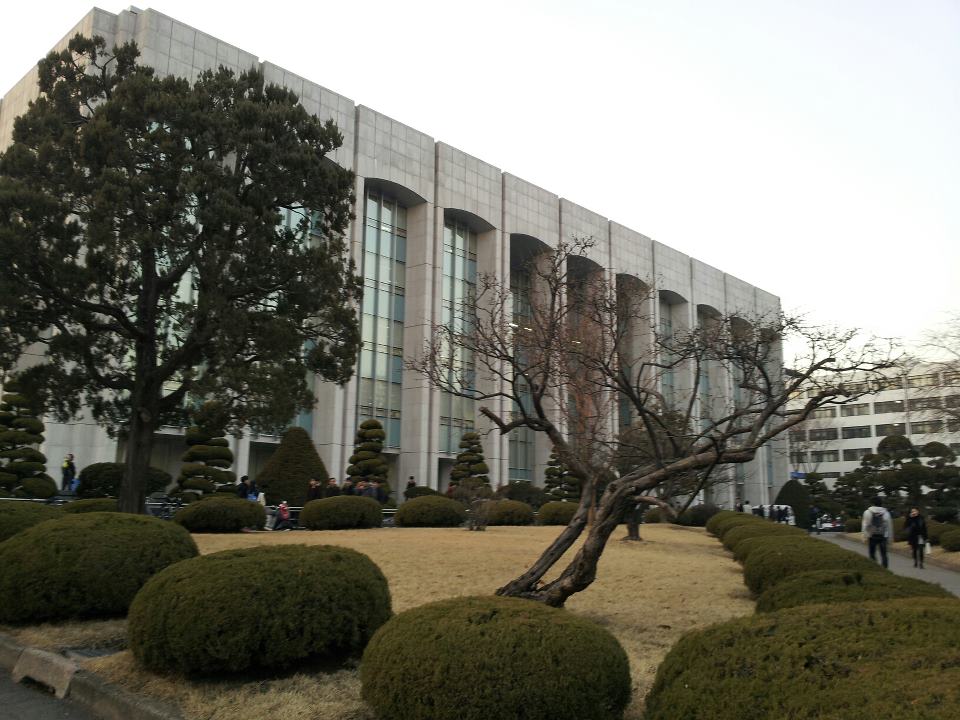
Beautiful Central Library at Yonsei University

Beautiful Central Library

It really feels like this place is growing on me and I like that feeling. 🙂


정신이 충만한: Big City Life, Spicy Food, Classes, and Uppsala Reunion (posted by Indira in South Korea)

March 8, 2013

It’s my second week in Seoul and I’m starting to get used to life in the big city. It is crazy how everything here seems to go so fast and everyone is in rush. The city is so lively and something is always going on whether its 4:00 a.m. or 4:00 p.m. It can be truly overwhelming. I find it funny that now I live in a city that has almost three times more inhabitants than my entire country. It’s really insane!

After days of fighting against the spicy food I’m starting to give in: I’m experimenting and testing how I react to certain spicy foods (many say they don’t find it spicy, but I have major issues eating it). It’s usually funny for the people I’m with – I can’t resist coughing and making faces when I eat something spicy. It’s going to be a long way before I’m able to eat kimchi (spicy fermented cabbage) like everyone else. But I’m getting there!

Last week I managed to go with a group of exchange students to the immigration office and apply for an alien card. Basically, anyone staying longer than 90 days in Korea must apply for one. We were stuck at the immigration office for about three hours. There is so much waiting and a gazillion administrative things to do. We were lucky to have Leo, an American-Korean student, to take us there and help us out. I really appreciate it when I have a Korean speaker around! It was also great that the person working at the counter figured out we were all exchange students from Yonsei so we didn’t have to go through the process individually, but as a group, which cut down our waiting time. It took us almost that entire day to sort the immigration things out, but we are finally done! All that’s left to do is to wait for the cards to be mailed to us. I really don’t think I’d be able to go through the whole process again!

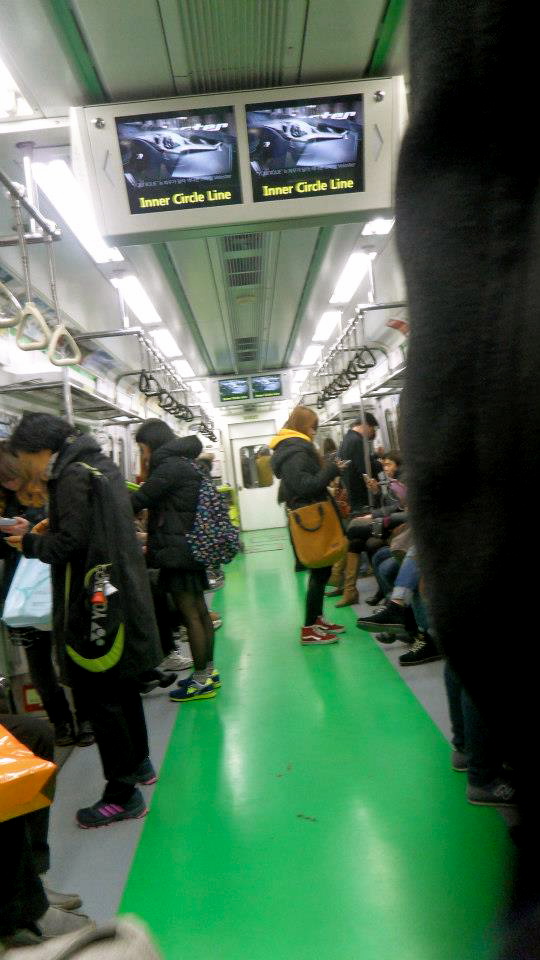
Subway in Seoul (on our way to the immigration office) to apply for our alien card

Subway in Seoul (on our way to the immigration office)

Before school started this week, the Yonsei International Committee organized many welcome events such as parties and dinner. There was even a party for all exchange students at the universities in Seoul so we could get to know more people.

There were also a lot of events held related to the Mentors Club. The Mentors Club is the equivalent of UR’s Ambassador Club: exchange students are paired up with a Korean student who will help them adapt to the new environment and show them the best of the Korean life, culture, language, and traditions. Mentors and mentees are then grouped in cells (groups of about 25 people) that do things together, go out for dinner, or attend some cultural events. Last Friday some of my cell members and I met for dinner to learn more about Korean cuisine and traditions. We had some dish with chicken and vegetables (relatively spicy I’d say, but nobody else really agreed with me) and then we had this huge pancake with sea food (I loved it! It was so delicious and not spicy at all so I was able to eat loads of it) and makkoli (very refreshing beverage made out of rice). It was really fun (apart from the fact I wasn’t able to eat much of the food we were served)! And my mentor is really amazing. His name is Junhyung and he’s a senior at Yonsei with a great passion for djing. He’s also the leader of the cell so he’s in charge of organizing events. I loved how during that cell evening we were all able to get to know each other better and to learn more about Korea.

Seafood pancake and makkoli, a Korean food that I really like!

Seafood pancake and makkoli

Inevitably all the tours, new climate and environment, and very cold weather took their toll on me and I got sick (I know I was in Sweden last semester in temperatures of -8F and I didn’t get sick, but Korea is something different). It was frustrating being in bed the past few days; I just got here and I wanted to go out, explore Korea, and meet new people, but instead I was chained to the bed by my fever and cough. At least I did get better in time for school!

This week is the first week of classes. Initially I was registered for four classes: US-Korea Relations, International Conflicts and Cooperation, Free Trade Agreements, and German Romanticism (this one has a funny story behind it). I thought of taking Beginner Korean, but I just wasn’t able to fit it in my schedule. That is why I will participate in FLE (free language exchange) where I will be paired with a person who will teach me Korean and I will teach them one of the languages I speak. I am really looking forward to the program to start!

All of my classes seem really good and I like them, particularly Free Trade Agreements as the professor seems to be so passionate and knowledgeable about the topic (she used to work in this field in the US, Korea, and China) and as I don’t really know much about anything related to economics, this will be a new experience for me. All the classes I am taking are in the “Study Abroad” department and basically all students in the classes are exchange and/or international students.

German would have been the only class I would be taking outside the “Study Abroad” department if it wasn’t for a big misunderstanding I had about this class. On Tuesday I was supposed to have my first German class and I went to the assigned classroom. The professor comes in and starts lecturing. IN KOREAN! I was so shocked. That was supposed to be a 300-level language class that at UR would be taught entirely in German, but Yonsei is apparently much different than UR when it comes to foreign languages. I was really sad as I was looking forward to my first German class in over a year. I had to improvise and get an override for the Modern Korean History class (also in the “Study Abroad” department). Now I am all set for the school!

Classes are structurally similar to UR classes as the final grade is based on attendance and participation, essays, projects, a midterm, and a final (unlike in Sweden where the final exam is 100% of the final grade). As this was the first week of classes we didn’t do much, just general introduction and course related explanations. Next week real lectures start.

The absolute highlight of this week was an Uppsala reunion I had with three Korean students I met while we were on exchange at Uppsala University – Taesung (he picked me up at the airport), Suji (she helped me get a Korean phone), and Eun Chong (back in Sweden we were in the same project group for one of our classes so we used to spend a lot of time together). In the spirit of the country (or the region) that bonded us, we went to the Scandinavian Design House near the Gangnam area (yes, like the “Gangnam Style” song). The was a Fika – Swedish Coffee Break café where we could get Swedish coffee, tea (or some other beverage) and typical Swedish cookies, cakes, and pastries (you can read more about the tradition of fika in the blog I was writing about my time in Uppsala last semester). We had kanelbulle and semla! They were so good – I really felt like I was partially back in Sweden. The most amazing part was seeing the three people who helped me make my decision about the spring semester study abroad destination and who helped me settle in once I got to Seoul. It was such a great afternoon and I had so much fun with Taesung, Suji, and Eun Chong. This was also kind of a farewell party as Taesung is leaving this weekend for Germany where he will be doing an internship until Fall.

My Korean friends who I met in Sweden - Teasung and Suji (Eun Chong left before we took the picture) - in front of the Fika place, where we enjoyed a typical Swedish tea time

My Korean friends who I met in Sweden – Teasung and Suji (Eun Chong
left before we took the picture) – in front of the Fika place

I guess now I have a bit more time to enjoy before the schoolwork kicks in, so I’m looking forward to the weekend! 🙂


시작: Culture shocked, confused, surprised, amazed (Indira in South Korea)

March 1, 2013

Wow. I can’t believe that I got to Seoul a week ago. It seems as if it happened so much longer ago, and yet it feels like yesterday. This past week has been such a roller-coaster of culture shock and first-hand learning about Korea and Yonsei University.

I don’t think I’ve ever been more nervous about going somewhere than during my layover in Frankfurt. I had about 4 hours before I had to board the plane for Seoul. I used that time to talk to my family and friends who showed me incredible support that I needed so much at that moment. I was excited to get to Korea, but also afraid of how I might adjust to everything. After all, I’ve never been to Asia before and I knew almost nothing about Korea, not to mention that I don’t speak a word of Korean. I think what made me so nervous is that never before have I been to a country whose local language I didn’t speak even just a little bit or where I couldn’t rely on English to get around.  And leaving Europe was weird. I spent the last 10 months in Europe, had a great time back home in Bosnia, and the most memorable semester at Uppsala University in Sweden. It felt  like I was leaving behind all those great memories and yet I carried great expectations for Korea and my semester at Yonsei.

After a 10 hour flight we finally landed at Seoul Incheon airport. I was super tired, and had to go through immigration and claim my baggage. I have never been at a bigger airport (or maybe Incheon airport seemed so big because I arrived exhausted and had to drag my luggage from one part of the airport to the other) and it all seemed confusing, but I managed to get on the subway to Seoul. I have arranged with a Korean friend I met in Sweden, Taesung, to pick me up at Sincheon station in the area where Yonsei University is located. I got a chance to figure out the subway system here right away and after an hour of traveling I met Taesung. I don’t think I have ever been happier to hear someone call my name. I felt so relieved when I finally met him as that meant that I had come to the right place and I didn’t get lost. He helped me get a cab and took me to my dorm, International House. Walking down the hall I saw two Swedish names at one of the doors and I met the Swedish girls who live there immediately. It made me so happy since it kind of prolonged my ‘Swedish experience’ and that meant that I will have someone to practice my Swedish with! After I found my room and dropped off my luggage, Teasung took me out to the city so we walked around a lot, got fika (my favorite Swedish tradition) for the sake of the amazing semester in Uppsala, and tried to figure out how can I get a Korean phone (as my European phone doesn’t work with a Korean sim card). I can’t even start to explain how happy I was to have Taesung here the first day I got to Seoul. He helped me so much in a place that I found so confusing.

Over the past few days I have met a lot of exchange students as we all live in two dorms that are connected – SK Global and International House. Oh, and we had such an interesting orientation. Apart from the regular talk about culture, immigration, health, and academic matters, we had a “cheering orientation.” Yonsei is big on cheers! There are three big university rivals in Seoul – Yonsei University, Korea University, and Seoul National University. Yonsei’s biggest rival is Korea University so we spent about an hour learning the dance and cheers that would intimidate the students of Korea University. One of the cheering songs was about Yonsei beating and stomping Korea University. Even though it kind of sounds brutal, the cheers are amazing and you can feel the school spirit everywhere. The funny thing is that all the Koreans I met in Sweden attend Korea University so we are kind of rivals now.

During the orientation we saw a lot of performances, including K-Pop. It is unbelievable how everyone here is obsessed with K-Pop. We saw two school dance groups dance to some K-Pop songs, and of course the grand finale was a joint performance to Psy’s “Gangnam Style.”

Yonsei International Committee also organized the City Tours for the exchange students so we were able to visit places such as Gyeongbukgang Palace, Ewha Village, Tteok Museum, Ssamzigil, Namsangol, Hanok Village, Cheongwadae Sarangchae, Bukchon Hanok Village and much more. It was really great as we were able to learn more about Korean history, learn how to write our names in hangeul (Korean alphabet), and see the Blue House (basically a Korean version of the White House). I really enjoyed the tours as it was both bonding time with our new ‘home’ and with other exchange students.

My tour group in one of the most popular streets in Bukchon Hanok Village in Seoul

My tour group in one of the most popular streets in Bukchon Hanok Village

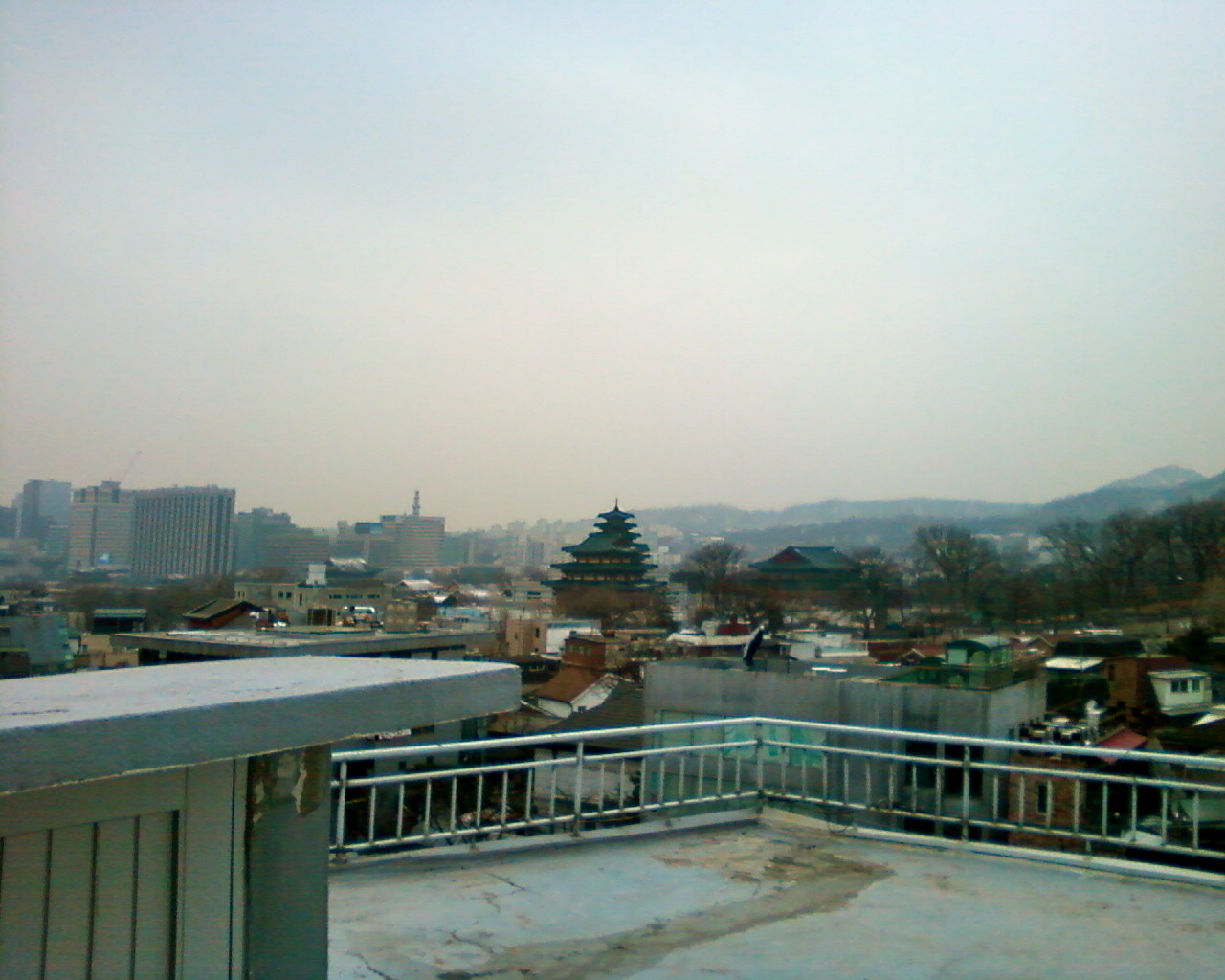
A view of the Gyeongbok Palace and the City of Seoul from my first week

A view of the Gyeongbok Palace and the City of Seoul

I also met with Sheetal, another UofR student who is here for a year (she was at Yonsei last semester too). We went out for a dinner a couple of times and we went to a Cat Cafe. Yes, a cat cafe. Basically, there is a cafe with a whole lot of cats in it and everything is organized in a way that it serves the cats – they are free to go anywhere, sleep, play, eat; it’s almost a heaven for cats, really. It was interesting going there and I had great time. And hanging out with Sheetal is great as we have so much in common and we can always talk about Richmond related things. Also, since she was here last semester, she is such a great help with everything. I’m really happy she’s around.

One of the cats at the Cat Cafe a cafe in Seoul with cats walking around

One of the cats at the Cat Cafe

There is another UR student here, Patrick. I still haven’t met him, but I hope to do so soon. And there are a whole lot of Virginians here: I remember meeting people from Norfolk and Alexandria, and a few other places around Virginia.

After a week  in Korea I can say that I have eaten  a whole lot rice (I don’t think I have ever had this much rice before haha), made new friends, but also experienced a lot of things that culture shocked me:

  • Food is so spicy! Ok, I knew this was going to happen, but I really can’t eat spicy food, and it’s always a challenge to find something on the menu that isn’t too spicy.
  • People here are obsessed with the technology. On the subway from the airport to the Sincheon station there was a group of Chinese tourists sitting opposite of me and they were all using their tablets, phones, cameras – there was no conversation going on. The same thing is true for Koreans. This really struck me as surprising! 
  • K-Pop everywhere – really! Everywhere you go you can hear K-Pop music blasting and K-Pop faces are everywhere advertising a whole lot of things (not that I know who they are, but other people who do, talk about it)
  • A lot of people here smoke cigarettes. Smoking is allowed in public spaces and even in clubs. Very few places have designated smoking areas. There are some streets that are partially non-smoking and there are signs indicating that. But I really think this is so shocking especially after spending so much time in Europe since people don’t really smoke in public spaces (especially in Sweden, as the most of them use snus)
  • I have to give Koreans credit for one thing – they are extremely fashionable. Everyone cares about how they look, and they all have the latest shoes and follow the latest fashion trends. It’s unbelievable; I thought that Swedes are fashionable, but this is a whole new level.
  • Holding hands – everyone holds hands. It’s just a thing here. Even guy friends do so.
  • American stores and chain restaurants are everywhere saluting to globalization. I don’t think I’ve seen this many Starbucks cafes even in the States (but Koreans do love coffee).
  • Crazy drivers – be super careful when crossing the street as some drivers don’t care even if it’s a red light, especially taxi and scooter drivers. Keep your eyes open and triple-check when crossing smaller streets.
  • Toilet paper. I think it will take quite some time to get used to this (in case I ever do), but since sewage system in Seoul is really old and toilets can clog easily in all places there are signs saying to throw the toilet paper in the bin, and not flush it. It is really a challenge not to flush it, though.

So far Korea’s been very interesting, and I’m really looking forward to see how will my first week of classes end up being.


Alpsolutely Amazing! (posted by Pierre en Suisse)

March 1, 2013

Okay, so quick confession: I have been to the Alps so far about three times and I have yet to actually write about it. When I say I have been to the Alps three times, I am talking about skiing. What’s it like here in Europe? Well my title says a lot, because it is just incredible!

I had always planned on doing some skiing while in Switzerland, but I honestly had no idea what to expect, aside from huge mountains of course. I have skied my entire life but mostly on the East Coast, and have been out west before as well. As many of my friends know, I could tell you basically anything you would want to know about North American skiing, but Europe was a mystery! Someone had told me once that Europeans spend more time just relaxing while at the mountains and skiing every now and then. Someone else had also told me that in Europe you spend half the day going up the mountain and the other half actually skiing down. Both of these myths have not ended up being my actual experience. However, I can happily report that skiing here is better than I could have ever imagined! I’ll do my best to actually describe it, but I warn you it is difficult to put into words.

Because Switzerland is a country completely connected by rails, the ski day starts for us with a train ride into the mountains. The first morning I went, I was on the train at 6:30 in the morning while it was still completely dark. About an hour later, when the sun began to rise my view from the train window was just the silhouettes of the jagged summits and snow-covered peaks of the mountains. Once off the train, we always have to take a connector bus or an additional train to get to the actual mountain. I won’t lie, Swiss engineering is impressive. The first place that I went to, or “station” as it is called in French, was really far from the train and required a bus ride to get there. The roads are a continuous series of windy turns as you head up the steep sides of the mountain. In many instances, there need to be tunnels to get around. Whatever the case, I couldn’t help but wonder how people were able to live in this country before the modern technology that was put in place to simply move around. It was impressive to see what people are capable of doing! This may be worth looking into more, but hopefully it is done in the most environmentally conscious manner possible.

The actual skiing is completely different than what I am used to. As soon as you get to the top of one of these mountains, you are above tree line. That means it is completely wide open, unlike what I am used to where there are trees lining the trails. You can also be at the top just looking at glaciers all around you. These can be quite scary but at the same time amazingly impressive to just see the blue crystallized ice that has been there for such a long time! It is also deceiving for me of how high these mountains are. Because everything is in metrics here, I’ll be at the top of a mountain and everyone around me will be gawking at the fact that they are 3500 meters in the air! The first time this happened, we literally rode the highest mountain subway in the world. It was an actual train to carry skiers through a tunnel to the very top of the skiable area. When we got to the top, we had to walk up a set of stairs to get out of the “metro.” It hit me just how high we were when I got light headed and had to sit for a while to adjust to breathing the thin air. While waiting, I looked on my phone for the conversion and realized that we had started out at 5,905 feet at the base of the mountain, and by the time we were at the top, we were almost 11,500 feet high. Like I said, the elevation really hit me when we were at the top. But the views are unreal! Everything at the top is so open! From one of the places, I could see Italy at the top! At another one, I could see France (even though I can see France every day just across the lake). It is simply a magnificent scene; pictures cannot do it justice.

Alps2

Alps3


Alps1

Skiing adventures will keep coming, and I will say I am especially excited for next weekend, when we will have a three day trip planned by the exchange student association here in Lausanne. Because skiing is literally such a part of the culture here in Switzerland, they said it was necessary for them to host one. I’m excited! But that’s all for now! Until next time, à bien tôt!


Education and Experience (Posted by Blair in Ecuador)

February 25, 2013

We have now successfully made it through the first week of classes! For the SIT program, we have a Spanish Exam at the beginning of the semester, in which our language level is determined. In this SIT Ecuador program, the Spanish instruction is done through a program called Experiment in International Learning (EIL). EIL has a staff of Ecuadorian professors who have Spanish instruction education and experience. EIL also helped SIT with the homestay placements, so the Spanish classes sometimes incorporate specific interactions with the homestay families.

 The yellow bus gang is ready for our first day of school in Ecuador!

The yellow bus gang is ready for our first day of school!

On Monday, we were placed in our different classes; ours is the biggest class. We are seven girls sitting around our square table with Profe Vladimir at the white board at the front. School is in some extra classrooms of a state pre-school/childcare facility, so there is a picture of the pope and some holy crosses scattered throughout the room. The general class layout is a two hour segment of grammar, followed by an hour and a half of cultural learning, then a final hour of vocabulary and slang. We have breaks between each section and chow down some snacks brought by the EIL program, usually typical Ecuadorian food.

For instance, on Monday, we went over the subjunctive and conditional tenses, ate an Ecuadorian bread-wrapped-in-a-leaf snack called quimbolitos, read about the Incan history of the Valley of Los Chillos, then learned about the history of Ecuadorian slang and its connection to Kichwa, the language of the Incans.

On Wednesday, after learning about connecting words in the morning, we watched an Ecuadorian movie named “Qué tan lejos” about the journey of an Ecuadorian girl to get to Cuenca and break up a wedding. Throughout the whole movie, we were asked to write down Ecuadorian slang and our profe paused it every once in a while to make sure we were clear on what was happening. He also paused at points to talk about the Ecuadorian landscapes we were seeing and the different cultural aspects, such as the music, and political connections with the roadblock. We finished the day off with a game: each person chooses a Hispanic character, writes it on a piece of paper, and tapes it to their neighbor’s head. Everyone then has to ask questions to determine who they are. The best part was that our profe, the only guy in the room, was the only female character: Dora la Exploradora.

Class photo after the game, still with our character nametags which we used for the game in class

Class photo after the game, still with our character nametags

We also have special days that provide a different type of learning. On Thursday, we had a mini learning excursion into a nearby town, Sangolquí. We went to the church in the center plaza, where our professor told us about how the Spaniards used the Catholic church, from the architecture of the actual building to the masses and ceremonies held inside, to assert their control over indigenous Ecuadorians. Afterward, we went to the town park and library, where we read a bit about the history of the town and checked out the library. Sangolquí is a small town, much like Ashland, Virginia. However, its library is one floor of a tiny building with about 5 small bookshelves, 3 computers, and a stack of newspapers. Our profe was explaining that reading is not a popular activity among any age group, which is reflected in this library. We then went to the town market, where we spoke with some of the vendors about their sales, which have gone down significantly with the installment of a Wal-mart brand supermarket, MegaMaxi.

Profe Vladimir and class heading into Sangolquí Church as part of a class "field trip"

Profe Vladimir and class heading into Sangolquí Church

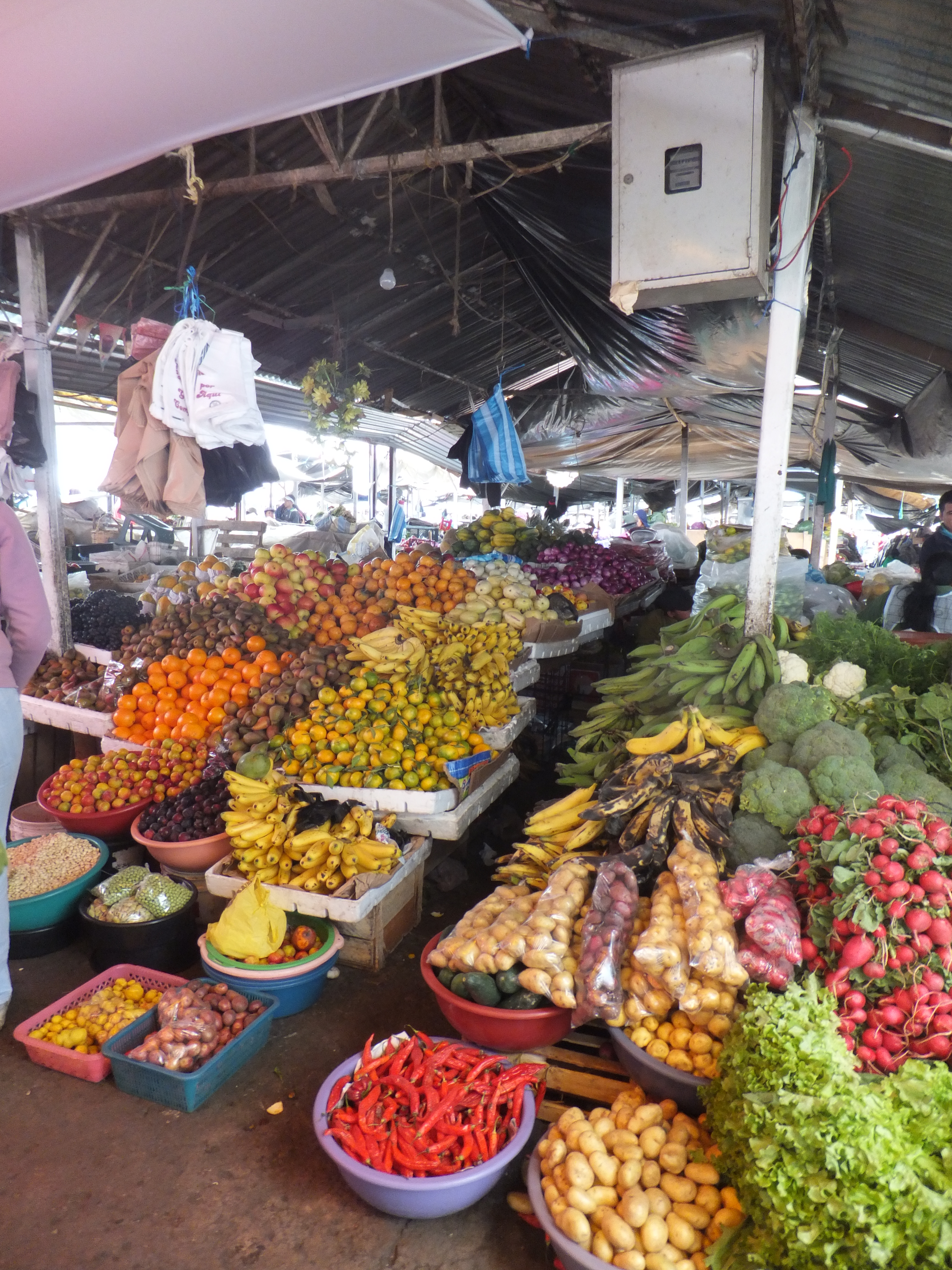
A tiny selection of the wide array of fruits, veggies, and other produce items at the main Feria of Sangolquí, a local market

A tiny selection of the wide array of fruits, veggies, and other produce items at the main Feria of Sangolquí

We also have had a couple academic seminars during this week. We have a 20 Questions activity that we have to complete throughout the semester. It is an opportunity for cross-cultural learning, with questions from “How much importance do people place on appearances?” to “What does it mean to be a part of a family?” and “How can you ascertain the importance of God in people’s lives?” There are four parts to the assignment: the first part is observations of how people naturally behave, followed by explanations of why this might be the case. The hard part is that we then have to talk with two or more people about what they think of our observations and explanations, but without simply asking them the question. The final section is reflections, in which we discuss how willing people were to actually converse on the subject and how the culture ties into the question and answers.

At first, I really felt this was a silly assignment, it seemed we could learn more simply observing and that the conversations would be uncomfortable. However, I have realized that the assignment leads to an essential learning and very informative conversations. People are generally very willing to talk about the question, they are often interested to know what I think and sometimes see an aspect of their own culture for the first time.

This program ensures that we are always learning. From waking up and insisting that I do not need to eat three pieces of bread with ham and egg along with my fruit and smoothie for breakfast, to navigating my way back home in the evening and attempting to discuss the day around the dinner table, Spanish class is the least learning of it all! More than just taking in information, we’re forced to analyze and use it every single day. I have to remember that my profe said that we do not throw things in Ecuador because it’s seen as rude, as well as the warning we received during a 20 Questions Seminar about lending things because you might not see them again.

The only source of knowledge is experience. -Albert Einstein