Midterms: No Fun

March 16, 2012

Yes….another blog post about school.  School has been consuming much more of my time than usual these past two weeks because I have had midterms!  Which has meant two weeks of catching up on the whole semester.  The way midterms are administered at Thammasat was very interesting though, and something I personally would love to see implemented at UofR for final exams.

Midterms at Thammasat are scheduled just like finals at Richmond: one week is set aside with no class (usually) and three-hour midterms scheduled throughout the week.  Students are required to wear full uniform to midterms.  When you show up the day of the exam, the classroom is closed, but there is a class list outside with a corresponding number next to each name.  The numbers are completely randomized, and are not known until before the exam.  Once you walk into the classroom ten minutes before the exam, each place has an exam and answer notebook already set down, with the place number right next to it.  So after entering the room you must gather your necessary exam materials (pens, pencils, calculator, ID card, water, etc…) show the proctors that your cell phone has been turned off, and place your bag at the front of the classroom.  Then you find your number and corresponding seat, and can start the exam.  The places, however, are set far apart so that there is no possible way to cheat on the exam, which personally I find fantastic.  In one exam, we even each had our own table.  On the whiteboard at the front of the room is projected a countdown for the time left of the exam, and for the last half hour, last fifteen minutes, and last five minutes, an automated voice reminds you of the time left.  Two proctors monitor the exam and continuously walk around the classroom in and out of every aisle to make sure there is no cheating.  You are not allowed to use the restroom, and once finished, you leave your exam on the table and leave the room, while the proctors come and collect your completed test.  The only downside in this system is that the professor is not there to answer questions about the exam.  I would love to see this system implemented at Richmond for final exams.

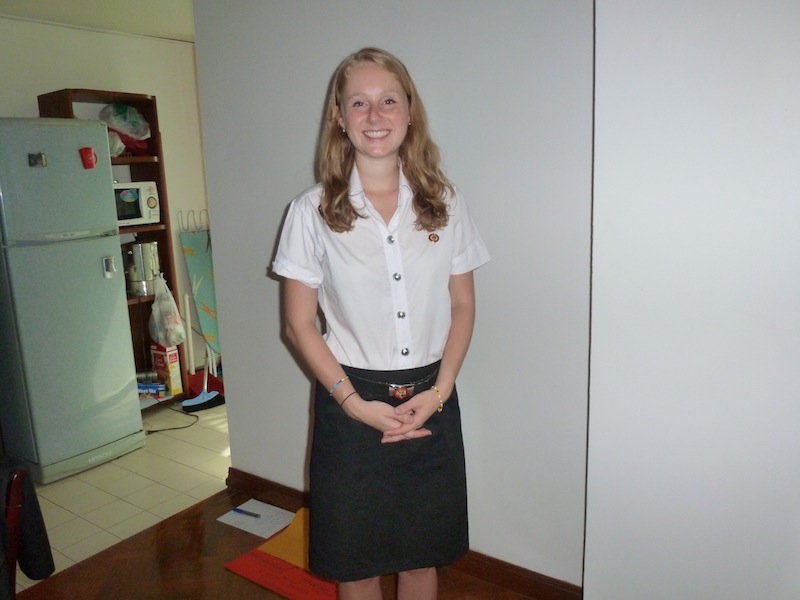
Now that midterms are over, however, I am off to Myanmar (Burma) for five days! I will leave you with a photo of me in my Thammasat uniform:


The Classroom Culture

March 12, 2012

After two and a half months of studying abroad in Thailand, it seems fitting to actually blog about the studying part of this experience.  The much-discussed stereotype about studying abroad is that the classes will be easy and there will be no work.  Well, clearly those students did not study at Thammasat in the BBA program. There is definitely work, and classes are not at all something you can blow off…it will eventually catch up with you.  So here are four of the most notable differences between University of Richmond courses and Thammsat BBA courses (Disclaimer: the academic faculties at Thammasat are very different from one another, so this blog post only applies to the BBA program).

1.  Unlike Richmond, there is not much day-to-day homework at Thammasat, but classes are very much oriented around case studies and group projects. While I don’t have to worry about day to day homework in each class, there is always a group project meeting that I have to attend – and this has been the case since the first day of school, not just something that has crept up at the end of the semester.  While sometimes the group projects are overwhelming, doing case-based learning is extremely helpful for applying what we are learning in class and understanding “real-world” examples.

2. Attendance is extremely serious.  The rule is that if you miss more than 30% of a class, then you are not eligible to take the midterm or the final.  Because all of my classes are three hours long, I am allowed to miss three classes throughout the whole semester – which seems like a lot, but when I’d love to be traveling around Southeast Asia most weekends, those missed classes can add up quite quickly.  During the first fifteen minutes of each class, a few BBA administrators sit in the hallways, each assigned to watch over one clipboard as students sign in for their respective courses. Students are required to sign in wearing a full uniform — otherwise, they are considered absent.

3.  Regarding class format, most professors use the typical PowerPoint lecture model.  I learned very quickly that Thais love PowerPoint.  In the US, it is sometimes encouraged for students to ditch PowerPoint and find a more creative way to prepare a presentation, but here it is mandatory to use PowerPoint for presentations.  I have to say, though, the presentations that Thai students create are incredible, and much more creative than anything I have ever done with PowerPoint.

4. Classroom culture.  This has been one of the biggest paradoxes of my time in Thailand.  I have remarked in previous posts about how Thai people are so respectful, and how they value hierarchy and respect their elders and teachers.  Yet the actions of the students in classes do not seem to fully reflect these values.  Students talk throughout the class, they constantly text on their phones (above their desks, in plain sight!) Some even take calls and just stick their heads under the desks while on the phone. Most students are constantly checking their email or Facebook on their iPads or laptops.  Some will leave classes in small groups and come back with Starbucks or other drinks in hand.  And throughout class, there are students continuously walking in and out of the room to print something, get a snack, or take a phone call.  I have had only one professor actually address this behavior in class, on one occasion.  I would never be comfortable acting so informally in a class at Richmond, and professors at UR strongly discourage this behavior.  Certainly an interesting nuance of classroom culture compared to Thai culture in general.

Note: I don’t have any pictures relating to this blog, but enjoy some of the pictures from around the city these past few weeks.


A Different Side of Bangkok

March 2, 2012

For the first time in weeks, I did not travel this past weekend.  Granted, it was because I had a huge group presentation and midterms to study for, but still, it was quite an event.  Sadly, studying took up most of the weekend, and there was a lot of studying required, because, truth be told, I have not been great at keeping up with school work here. With it being 96 degrees every day, so many places to visit, and so many delicious types of food to discover, it sort of feels like I am on summer vacation.  It’s just so difficult to concentrate with so many fun things to do.  So to have midterms now is like having exams in the middle of summer vacation… which is not easy.

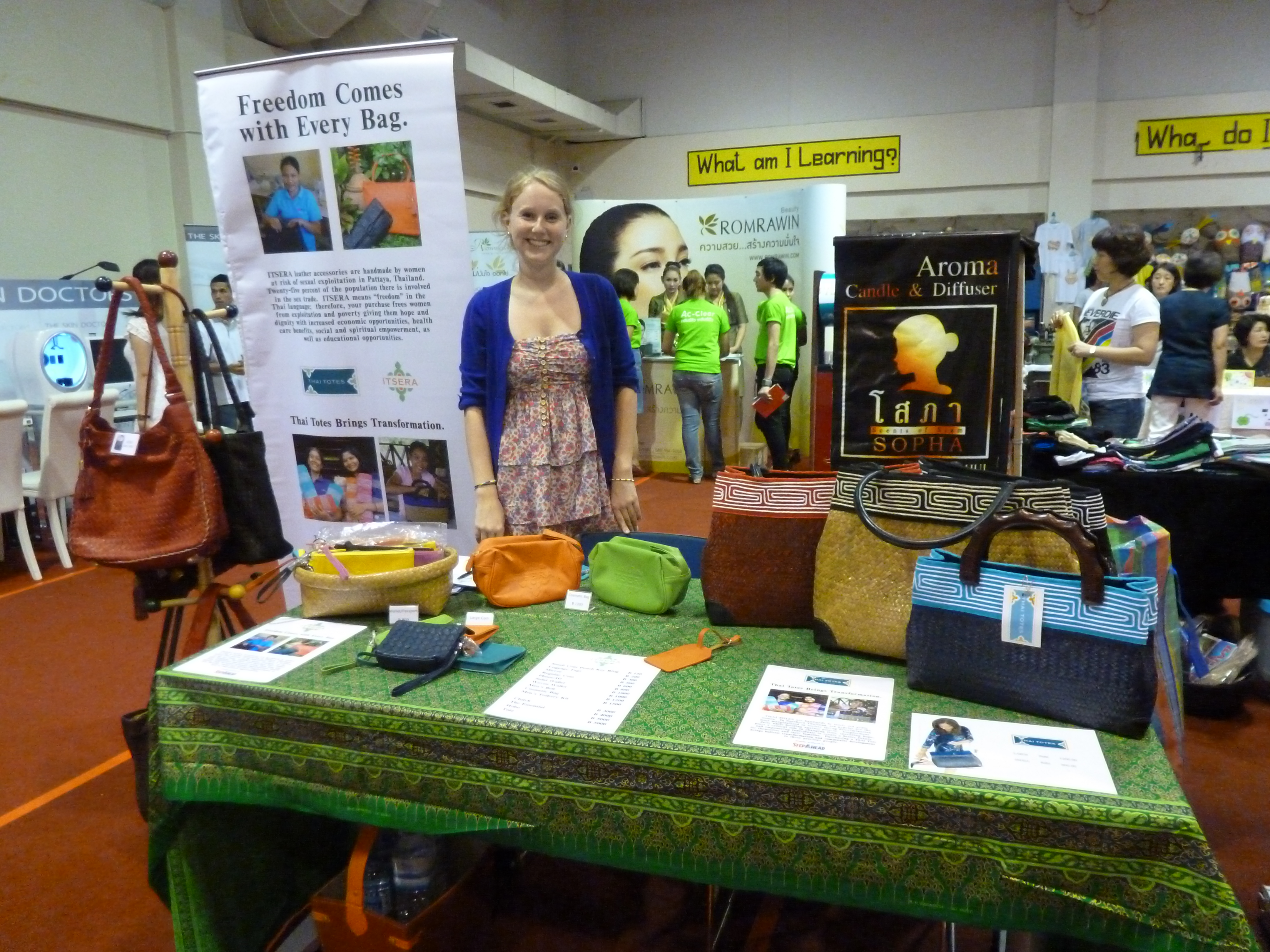
Nonetheless, I spent Saturday at an event for my internship. I am interning part-time with Step Ahead, a fantastic NGO headquartered here in Bangkok.  Step Ahead was founded by John and Kim Quinley, whose daughter, Carter Quinley, graduated from Richmond this past May.  Step Ahead is a community development organization that works all over Thailand with various populations.  One of their projects is a “Purse Project” that works with women in Pattaya, Thailand.  One in four people living in Pattaya are involved in the sex industry, so this purse project aims at prevention: to prevent poor women from being sexually exploited by giving them an alternative way to make a stable living by making these leather purses.  The products are beautiful — the link to the website is stepahead.myshopify.com.

As part of this internship, my roommate and I went to the International School of Bangkok for a Food Fair event to sell these Itsera bags; the event revolved around a huge room filled with large stands representing the nationalities of  students at ISB, each serving their own traditional food.  So, for example, at the “Israel” stand they were serving falafel, and at the “American” stand, there were delicious brownies, cookies, and apple pie.  Next to this large room was a smaller room where we were selling our bags along with other vendors.

All in all, this was quite a different side of Thailand.  Addie and I live in a very local Thai neighborhood, so we don’t see foreigners on our side of the river often.  ISB, however, is located in a planned community (there is literally a sign at the entrance gates that say “Planned Community”).  It’s like magic; as soon as you pass the guards and drive through the gates you are literally in what looks like an American suburb. There are clusters of gorgeous houses that all surround their own pools; there is a country club, a shopping center, and – get this – golf carts.  The residents get around the enclosed neighborhood (which includes the international school) in golf carts.  Literally, the outside of the school is lined with golf carts belonging to residents. I attended an international school when I lived in Holland when I was younger so this was a bit nostalgic, remembering a similar event we held at my school, overflowing with nationalities from around the world.  But, my goodness, this was also reminiscent of the Stepford Wives.  Nonetheless, I am extremely grateful to be able to experience so many different sides of life in this wonderful city.


The Temples of Angkor Wat: Cambodia

February 24, 2012

This weekend, I took my first international trip to one of Thailand’s neighbors, Cambodia.  Specifically, we went to Siem Reap, which is the center for all of the tourism surrounding Cambodia’s famous Angkor Wat.  The journey to get there is not exactly quick; it began with a four-hour minivan ride to the Cambodian border, then about one hour spent actually crossing the border, an hour spent waiting at the bus station, a two-hour minivan ride to Siem Reap, and then a 20-minute tuk tuk ride to our hostel.  All in all, about a ten-hour journey door to door.  We arrived in Siem Reap Saturday afternoon and left early Monday afternoon – it may seem crazy to some of you to travel to Cambodia for such a short time, but a) with the very strict attendance policy at Thammasat it is the only way I can travel, and b) we really felt we did not need any more time in Siem Reap.  So here are the notable highlights:

1) Cambodia is not Thailand.  It may seem obvious, yes, but I have always had a magical view of Southeast Asian countries – friendly, smiling people always willing to help you, greenery everywhere, rice fields lining both sides of the road.  I assumed that the hospitality and kindness that are normal in Thailand would also be present in Cambodia.  But from the second that we stamped out of Thailand and started the visa/entry process into Cambodia we immediately noticed a change in atmosphere.  The guards at the border were not friendly whatsoever, and immediately after officially entering Cambodia we were overwhelmed by men trying to get us to go into their taxi, or in their minivan to Siem Reap.  We have very much become accustomed to Thai courtesy and friendliness; in Thailand I never have to worry about being scammed.  But Cambodia is known for its scams, particularly at the border, so we had to be extremely cautious.  There is even a “fake” border that has been set up.  Literally, a building was built complete with guards, and signs, and visas.  They bribe tuktuk and minivan drivers to bring tourists to the fake border, who then pay a lot of money for what may or may not be a valid visa.

2) Siem Reap is essentially the main city where tourists go in order to see Angkor Wat and the surrounding temples.  The city provides a stark contrast between wealth and poverty – while there are five-star hotels lining both sides of the streets, between those manicured lawns and marble entryways are dirt roads filled with children, running around begging tourists for money.  It was a surprising and uncomfortable reality.  Despite the hotels everywhere, we opted for a much more modest accommodation in a fantastic hostel near the old town, for only $3 USD per night.  Saturday evening we had traditional Khmer red curry for dinner, which was easily the most delicious curry I have had since landing in Southeast Asia.

3) The temples.  The temples of Angkor Wat are located about a 20-30min tuktuk ride from Siem Reap.  The area surrounding the temples has been well preserved, so instead of endless hotels and restaurants, Ankor Wat is surrounded by beautiful forest.  We hired a tuktuk for the whole day (only $15) and left Siem Reap at 5am to see the sunrise over Angkor Wat.  We were joined by many tourists, but the early start was completely worth it – Angkor Wat is incredible and utterly breathtaking.  It is an expansive structure (only pictures can do it justice) that is considered to be the largest religious structure on earth; some place Angkor Wat in the same category as Machu Picchu and other wonders of the world.  It is this fact that I could not get over.  Construction of the temple was started in the year 1112 by the king of the Khmer empire at the time.  It is thought that he created the Hindu temple, which ended up being changed to a Buddhist temple, in dedication to the Hindu god Vishnu.  It took 37 years to complete. The thing is, in my lifetime, I have visited many castles that immediately strike any visitor by their opulence and grandeur.  For example, the Château de Versailles, in France, created by King Louis XIV, is just ridiculously extravagant.  But Angkor Wat was not created for the purpose of living, it was purely in dedication to a Hindu god.  It is purely religious — that’s just hard to fathom, because it is so big!  Though commoners used it for prayer throughout the year, our tour guide explained that the king usually only visited it once per year.

4) Angkor Wat is not the only temple to see. We also visited Ta Prohm, which is the only temple in the area that has not been protected against the jungle.  It is therefore covered with trees and roots that have wound their way around the ruins.  Fun Fact: Ta Prohm was featured in the film “Tomb Raider.”  We then visited Ta Keo, and Bayon, and ended our day by going back to Angkor Wat and having a guided tour of the temple.  I am definitely glad we spent the $3 for a tour guide, because it is not easy to understand the meaning of the temple without some history and explanation. We spent nine hours, from 5:30 am to 2:30pm on our feet visiting temples.  And it was completely worth it.

All in all, Cambodia was incredible – once I realized that Cambodia has only been out of Civil War since 1998, it became very clear as to why there is such a stark contrast between wealth and poverty in Siem Reap.  Cambodia is very much still recovering from the Khmer Rouge regime, and as of now the country relies heavily on tourism, which is why so much money has been poured into hotels and restaurants in Siem Reap, but nowhere else.  I would have loved one more day to travel the six hours to Phnom Penh, the capital of Cambodia, to learn more about the history of the country as well as to see some of the museums there chronicling Cambodia’s recent history.  But otherwise, by the end of our stay we felt we had seen all there was to see in Siem Reap. I have to say, after a nine-hour trip  back to Bangkok which included one very offensive, drunk Irish man, who didn’t stop talking for our four hour-minivan ride, offended every race and religion represented in the van, swore every other word, smoked in the van, threatened to kill most of us, and almost assaulted one of the guys in our minivan – it certainly felt good to be back “home” in Bangkok!


The Power of The Uniform

February 17, 2012

Here in Bangkok, the uniform that I wear gives me more privileges and attention than I could ever have imagined. Some previous exchange students had warned me about this before coming, but I didn’t fully understand it until I started spending 95% of my time in a uniform. So, here goes uniform 101:

1. Anyone with any excuse to wear a uniform does so. I don’t know why, or where the tradition came from, but it is just the way it is. During my first few weeks in Thailand, I kept seeing pictures and posters of individuals in what looked like military uniforms everywhere. Their uniforms were white and decorated with all sorts of medals and badges. Well, it turns out that they are government workers, and that all government workers wear a uniform. Even bank workers wear a uniform. Each bank has its signature “color,” and their employees (many of them women) all wear what looks like an flight attendant’s uniform.

2. “No Uniform, No Service.” All Thammasat University BBA (business administration) students are required to wear a uniform to all classes. At the BBA counter, there is a sign in English, and then translated into Thai that clearly states “No Uniform, No Service.” And they mean it. I have a friend who went to the counter to ask the BBA staff a question, and they refused her because she was not wearing a uniform.

3. No Uniform, No Attendance. Thammasat has a strict attendance policy – miss three classes and you cannot take the midterm or final exams. If you don’t show up within the first 15 minutes of class, you are counted late, and then another 15 minutes and you are counted absent, no exceptions. The kicker is that if you show up perfectly on time, but are not wearing the proper uniform, you will be counted as absent. No. Exceptions.

4. Thammasat is the Harvard of Thailand. And therefore, wearing the Thammasat uniform speaks volumes. The most crucial components of my uniform include a black skirt, a white short-sleeved collared shirt, official Thammasat pin, and a belt with an official Thammasat buckle. It is these buckles and pins that differentiate a Thammasat student from a student in any other school, as most student also wear a black skirt and white shirt. Here is a photo from the Thammasat website that shows some students in uniform:

The other night, I went straight from school to meet up with some friends on Khao San Road, Bangkok’s official tourist/backpacker/hippie heaven. As I was walking through the streets, everyone was staring at me. The foreigners were staring, seemingly wondering “Who is this white person in a school uniform?!” and the Thais were probably thinking the same thing. I went into a McDonalds to buy a water, and the girls behind the counters were whispering, and all I understood was “Thammasat, Thammasat.” So in Thai I said “Yes, I am a Thammasat student.” They couldn’t believe it.

Most days, if I am walking in my uniform, I hear the people behind me whispering “Thammasat” or the people crossing my path in the other direction staring at my belt with intense eyes, trying to see which school I study at. When and if they are able to figure it out, I hear a chorus of “Ahhhh, Thammasat!” My favorite uniform moment came this evening when I was in a 7-eleven with my roommate, and the employees behind the counter were obnoxiously greeting incoming tourists in Thai, which I’m sure is their way of messing with tourists to make a boring work shift fun. It was hilarious, so we couldn’t help but laugh. Soon, the employees were also laughing, and they quickly noticed my uniform and figured out that I was a Thammasat student. As soon as I confirmed this, they started saying “Ohhhh, Thammasat, Thammasat!!” and each of them reached to shake my hand, meanwhile repeating “Ahh, Thammasat, Thammasat.” I have to say, one of my favorite Thailand moments.


A Weekend Trip….to Tropical Paradise

February 10, 2012

One of the perks of living in this beautiful country is that after a week of stress, no sleep, and lots of late nights, a tropical island is just a few hours away.  My roommate and I decided we had to take full advantage of this, and traveled to the beautiful island of Koh Samet this past weekend.  Koh Samet is located right in the Gulf of Thailand, only a 40min ferry ride offshore, so it is a popular spot for anyone in Bangkok hoping for an island retreat.  The whole process of getting there is very Thai – don’t book anything in advance, just go to a monument in the middle of the city, hand over 200 baht ($6 USD) to a woman sitting at a table, hop into a mini van with a bunch of strangers, and get driven to the coast.

On the island, we stayed at the LungWang Wonderland Resort.  The name makes it sound glamorous, but it was anything but.  Very backpacker-ish, and very simple.  Nevertheless, it had clean rooms and bathrooms, decent food, and most importantly, was right on the beach, with beach chairs and lounge chairs included.  We could have not asked for anything more – just a weekend with our Kindles, catching up on sleep, lying on the beach, and waking up to the sound of the ocean in the morning (yes, that’s how close we were to the water!). And that was all for $10 USD per night.

Our only excursion was to go snorkeling one afternoon right before sunset. I have been snorkeling before in Mexico and the Caribbean, but there the snorkeling was always in crystal clear water;  the fish and coral were at the bottom of the sea, very far away from us, but still very much visible.  Well, that was absolutely not the case here…the coral was so close to the surface of the water that I bumped into it at one point (frightening) and the fish were swarming around us the whole time.  Our excursion ended at a beautiful resort on the island where we laid on lounge chairs, ate fresh fruit, and watched an incredible sunset over the sea.  A perfect weekend getaway.


Only in Bangkok

February 3, 2012

I thought I would share some details about what I did this past Saturday, to give you a good idea of an average, ordinary day in Bangkok.

My day began by meeting a friend in the lobby of my apartment building, so that we could catch the bus together to meet a few friends for breakfast.  We said our usual “Sa wat dee kha”  to the lovely guards at the bottom of our building, and headed out on a walk to the bus.  At only 10am, it was already 85 degrees outside; the sun was shining, and all of the street vendors who crowd the Bangkok streets were just beginning to set up their food and clothing stands to begin their long weekend of work.  We climbed up the stairs of the overpass, which provides a safe way to cross the huge, 10-lane highway, passing the usual homeless men lying on the concrete, and the standard installments of individuals singing into a microphone hoping to make some money.  We hopped onto our bus, being careful not to touch the monks, clad in their orange robes, who were also boarding the bus.  We sat down, and the bus “tout” came over to collect our money – only 8 baht (about 25 cents), because the bus was open-air and not air-conditioned.  I quickly noticed what looked like an animal’s cage resting at the front of the bus next to the driver – based on the tail that was visible we assumed it must be a squirrel.  Well, that’s odd.  After the bus tout was finished collecting money, she proceeded to the front of the bus, opened the cage, pulled out what we think was a baby squirrel, wrapped it up in a small baby-squirrel-sized blanket, and proceeded to feed it with a syringe, squeezing something into its mouth for the remainder of the ride.  I tried to get a good picture, but the bus ride was so bumpy that a blurry one will have to do.

We then proceeded to Ethos, our new favorite earthy-crunchy, all-natural, sing-kumbaya, can’t-wear-shoes-inside, sit-on-the-floor type of restaurant. We had the most incredible banana mango gluten-free pancakes. I know it doesn’t sound like much, but they were delicious.

Afterwards, we ventured out to the main road in the now sweltering heat.  We waited for a bus that we knew would take us to the mall right by our apartment complex.  We fully expected to have at least a 30 minute bus ride – it takes minimum of thirty minutes to get anywhere in Bangkok, because there is always traffic.  Well, no one had mentioned to us that this bus takes the most roundabout, absurd path to go from point A to point B.  The ride ended up taking us 2 hours.  Don’t get me wrong, seeing the scenery of a weekend in the city was great, but my gosh, in that heat, with no air-conditioning, it was rough.

After two hours, our mall destination was finally in sight, so we got up and pressed the red button which signals to the driver that we want to get off at the next stop.  He was driving particularly aggressively at this point, especially considering how bad the traffic was.  And then, like slow motion, I saw it: bus jerking left, small helpless car turning right, and then — CRRUUUNCCHHH.  The horrible sound of metal crunching.  Our bus crashed straight into the car next us.  We all looked at each other, decided it would be best to just get off that bus as fast as possible, and into the refuge of the huge and nicely air-conditioned Central Pinklao mall.

Just another morning in Bangkok, Thailand.


Elephants, Waterfalls, and Bamboo Rafts

January 27, 2012

I just got back from an incredible weekend in Chiang Mai, Thailand, which is a ten hour bus ride north of Bangkok.  Chiang Mai is close to the Burmese border in Northern Thailand.  I was there with my roommate, Addie, as well as two other exchange students.  Thanks to the fantastic recommendations of another Spider (thank you, Dora!), we packed a lot into a three-day weekend.

We took the night bus to and from Chiang Mai, meaning we had three full days there — Saturday through Monday.  Because we had such a short time, we wanted to make sure we made the most of our stay.  Through the hostel that we were recommended, Libra Guesthouse, we were able to book a 2-day, 1-night “trek,” which ended up being incredible.  Our trek started off Saturday morning with a stop at Mork-Fa Waterfall, in Doi Suthep Pui National Park. The water was freezing, but the sight was incredible, and in the end, very refreshing.  After the waterfall, we stopped for some delicious lunch (vegetable fried rice with fresh pineapple). and then we headed to yet another national park, which was home to hot springs.  When I say hot, I mean hot — upwards of 110 degrees Fahrenheit, or 40 degrees Celsius.  It was at this point that we begun our “walk through the jungle,” as it was advertised on Libra’s website.  Well, let me tell you, this was not just a casual stroll. This was, in fact, a 5-hour hike through the jungle.  The walk provided us with incredible views of the mountains, and in the end, it was fantastic, but certainly not what we were anticipating.

On our hike, we came across a few “hill tribes.”  Hill tribes are essentially groups of people — most of the time not recognized as Thai citizens — who, over the past few centuries, have migrated from China and Tibet, settling in the border between Northern Thailand, Laos, and Burma (Myanmar).  It was wonderful to be able to see a different part of Thailand, and to learn a little bit about the hill tribes, especially because most of our guides on the trek are members of those hill tribes.  So after five hours of trekking, crossing many unstable bridges made of bamboo, and finishing every last drop of our precious bottled water, we finally made it to our campsite for the night.  We bundled up quickly, because unlike Bangkok, where the temperature never drops below 85 degrees F (30 Celsius), it was freezing.  We had a delicious freshly made dinner by our guides (fresh fruit with homemade chicken and potato curry), and spent the evening sitting around the campfire, hearing hilarious and inappropriate stories from our guides, as well as learning an elephant song that none of us could quite understand. I must also mention that we were joined by eight crazy Russians on this trek. They did not speak a word of English, but somehow thought that speaking Russian very loudly to us would help us understand what they were saying.  After they had a few drinks that evening, it certainly made for an interesting campfire.

After a freezing cold night with only a thin, damp mat separating us from the bamboo floor, we woke up on Day 2 of the trek, and before we knew it, there were elephants in the river! We could not believe our eyes – our guides were on top of them, washing them, and the elephants casually strolled out of the river towards us, at which point we were able to feed them and touch them.  We were then mounted on the elephants – at first sitting on a contraption they had tied to the elephant, but wanting the real jungle experience, I opted to slide down and ride on the elephant’s back.  We spent about an hour just wading through the jungle and the river on the elephants.  A truly incredible experience.  Instead of hiking back down the mountain to get back to our starting point, we opted for a more relaxing variety of transport, taking a bamboo raft that our guides made for a two hour trip down the river.  Definitely a fun way to end the two day trek!

For the last day of our trip, once we were back at the hostel in Chiang Mai, we were able to see the many sights of the beautiful city.  These included the Sunday night market, the Night Bazaar, and many Buddhist temples, including the most famous temple in Chiang Mai, Doi Suthep.  Doi Suthep is situated in the mountains above the city — about a 30 minute drive away.  It has incredible views of the city, and like many of the other temples we have visited, the beauty of the temple was breathtaking.

All in all, it was a fantastic weekend! And I have to say, for anyone who is wondering… the weekend was unbelievably cheap.  For the entire weekend, door-to-door, bus, taxi, food, water, trekking, hostel, everything; the weekend came to a grand total of $140 USD.  Not bad, right? Still on a high from this weekend, Addie and I are certainly excited to plan our next adventure…we have our sights set on Cambodia next!

Learning a lot in Thailand

January 16, 2012

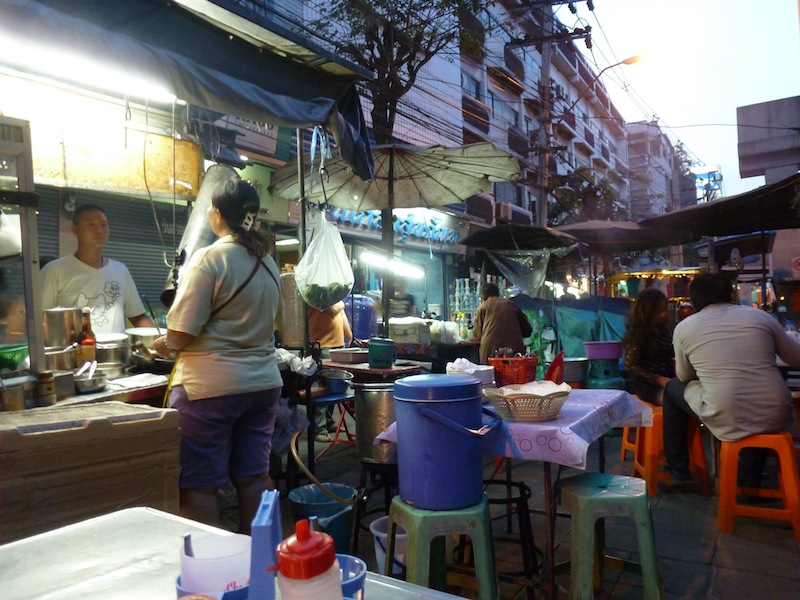
I have been here for almost two weeks now, and since my last entry, a lot has happened: school orientation, moving into my apartment, opening a bank account, my first week of classes, exploring the city, joining a gym, conquering the Bangkok bus system, using the river boat taxis, navigating Thai malls, grocery shopping, dealing with the warning of a terrorist attack in Bangkok, and my first adventure in Chinatown with some Richmond Spiders.  I have included some pictures taken around the city to give you an idea of the setting.  All of these firsts have included learning many interesting nuances of Thai culture:

1.  The importance of politeness:  as I mentioned in my last blog post, Thais as a whole are some of the most kind and friendly people that I have ever met.  They are always smiling, always willing to help, and completely accommodating and understanding of the fact that I am a foreigner in this city.  Most of the time, Thais are not out to rip you off in order to make an extra baht or two.  That being said, many natives have warned us that it is essential to reciprocate this kindness.  Once you get angry or hostile with a Thai, the smile stays but suddenly their helpful, genuinely kind demeanor goes out the window.

2.  Eating street food is much cheaper than cooking at home: counterintuitive, right?  In the US, cooking meals at home is emphasized everywhere – partly because it is healthier, but also because it is cheaper than going out to eat.  Here, however, on average, eating a big meal on the street costs about a dollar or two.  Buying fruits and vegetables on the street is easy and cheap, but buying fruits and vegetables in the supermarket is extremely expensive.  I am not complaining, though; fresh mango and pineapple at every hour of the day, with stir fry, rice, Pad Thai, and spring rolls on every corner…  Thailand is truly food heaven.

3.  Some strict cultural customs are NOT negotiable: a) Never say anything bad about the King and the royal family, because it is against the law and very offensive.  The current King is a beloved man here in Thailand, because he is truly someone concerned with his people and has done an incredible amount for Thailand in his sixty-some years of rule.  He is also the longest reigning monarch in the world. b) Never put your feet up anywhere — for example, on a seat in the bus, in the movie theater, or on your desk.  Showing a Thai the bottom of your feet is one of the rudest offenses, and is taken very seriously. Apparently a picture of President Obama with his feet up on his desk in the oval office caused quite an uproar here. C) Twice a day, when Thailand’s national anthem (of sorts) is blasted on the loudspeakers around the city, everyone — including foreigners — must stop and pay respect until it is finished.  Not doing this is considered incredibly rude.

4.  Buddhism has a big influence on Thai culture: By some estimates, Thailand is 95% Buddhist, which is made very evident by the thousands of temples and shrines blanketing the city.  As I mentioned before, I have been overwhelmed by the politeness and genuine kindness of Thai people, and I learned recently that much of this has to do with Buddhism.  There are five precepts of Buddhism, which guide people to live a happy and enlightened life. This will, in turn, help them to reach the afterlife.  These precepts include refraining from stealing, killing, lying, and engaging in adultery.  These rules, and the hope of accumulating enough karma to reach the afterlife, are taken very seriously, which I believe is a large reason why Thais seem so incredibly kind.


Falling in Love with Bangkok

January 5, 2012

After a 6 hour flight to London, and then an 11 hour flight to Bangkok, I have finally arrived in Thailand!!

What did I first notice after arriving here? Despite the fact that this is very much a city, there is greenery everywhere!! Lining the highways are palm trees, plants, and every tropical flower imaginable.  It is truly paradise.  Today I had my first adventure in Bangkok, alone, and after only two days here I have completely fallen in love with the city.

One of my main missions of the day was to get my uniform for Thammasat University where I will be studying for the next semester.  There are many signs around the university that state that any student without a uniform will not be served; so they take the uniform thing very seriously. I went to the bookstore at Thammasat and after many hand motions and pointing to a picture of the uniform, I was able to communicate that I needed to buy a uniform– only to be told uniforms are no longer sold at the bookstore.  Great. My Thammasat orientation packet said it would be at the bookstore, and the email I received yesterday about orientation reiterated this fact.  But nonetheless, no uniform.  The gentleman at the bookstore who was helping me kept repeating “tuktuk” and “market” meaning I could take a tuktuk to get the uniform at a local market.  I had him write down the name of the market in Thai because I have learned this is the best way to accomplish anything around here: with actual words, in Thai, written on a piece of paper.  I walked outside and ending up hailing a cab.  After much more confusion my taxi driver motioned down a street saying “here, here.”  The only problem was that the street was completely packed with millions of identical looking clothing stands, none of which seemed to be selling official Thammasat uniforms.

I went up to one of the stall owners to ask where I could find a Thammasat uniform, and he was wonderful.   He took it upon himself to guide me through the market, bringing me to each stall that I needed to go to to get the essentials for my uniform.  Every stall owner was so incredibly sweet.  I was overwhelmed with how generous and kind everyone was to me.  I never felt taken advantage of, and felt such genuine warmth from everyone.  After my shopping was complete I grabbed a taxi to go back to the house.  Instead of taking a taxi to the doorstep, however, I decided to walk the last bit of the way to completely soak up my surroundings.   Here are a couple of pictures of the street I am staying on until I move into my apartment:

I am in love the freedom of being able to walk alone and explore the city all by myself, on only my second day in Thailand.  It is the most liberating and wonderful feeling, a feeling that I never had studying abroad in Kenya last semester.  I am so excited for the next five months here!!