Botswana – Mokoro!

April 2, 2012

Last week we had spring break, or what the locals would call “mid-time.” It was possibly one of the most amazing experiences that I have had! However, it wasn’t easy to maneuver around Botswana during the trip — especially the Delta!

We started off by stuffing ourselves into a 15-seater bus to the local bus station. There were about 30 of us. Needless to say, it wasn’t the most comfortable experience, but it did bring everyone closer together to sit 3 in one seat!

After packing into the next bus, we realized that it seated 60, but there were only 30 of us. So, we initially thought to ourselves, “Excellent! We can finally relax, lay back, and enjoy this 15 hour bus ride up to the Okavango.” We couldn’t have been more wrong: The bus stopped every 15-20 km to a new stop that always had at least 2-5 people entering the bus. Some of the windows did not open correctly, and others made strange noises; it was very uncomfortable.  The majority of the time, about 1/4 of the people were left without anywhere to sit, and had to stand the entire time. Yes, 15 hours of standing! Thankfully, we had very generous passengers and students offer their seats to others and interchange over time. I offered my seat to an elderly gentleman with a cane. He was more than grateful. Although the bus ride seems like somewhat of a drag, everyone still enjoyed themselves and I understood that this was more of a learning experience than anything else!

Finally, after arriving, we were quickly welcomed by other locals, goats roaming the streets, cows eating grass, and stray dogs looking for food. An interesting experience. We even had a few locals attempt to speak to us in their own version of English. It was very hard to understand them, but their smiles said enough about them and the wonderful country of Botswana. Soon afterwards, three large safari trucks pulled up, let us jump in the tour seats, and took us away to our campsite.

As we arrived, we noticed that the crew we had hired had completely done everything for us — from setting up the tents and our sleeping bags, to even making us a welcoming dinner with dessert! Due to our long 15-hour journey, we were exhausted and decided to stay in for the night at the campsite.

I woke up the next morning at 4am, with no shower, no combs, no mirrors, and only the ability to brush my teeth with a limited supply of water from a water bottle and my own toothpaste and toothbrush. I, and the others, did not realize how real and serious this trip really was. It was a reality check for us; we were in the Okavango Delta. The nature of Africa. Anything could go wrong at any time, and help is a 10-13 hour safari truck ride away. No KFC, Nando’s, or school food, nor showers or bathrooms.

Our guides drove us to a secluded, marshy area of the Delta. We thought to ourselves, “What in the world is this place, and why are we here?” We passed over 15-20 local Botswana who all had long sticks measuring at least 20 feet. Again, the same question of confusion came to our mind.

Our Guide, Mr. Costa:

As we pulled up and parked in the Bush, we noticed that the locals with long sticks were coming towards us. At first, we were fearful of what was going on, but then we realized that they are part of our tour; they were our water guides!

Before departure:

We quickly jumped into our Mokoros with our partners and our personal guides took us into the high water grasses. At first, it was amazing to be in the Okavango waters – where anything can happen in any second. However, we slowly realized that the Mokoro trip was 3 hours long, and none of us brought sunscreen, nor any way to cover up from the sun. We were as red as the sun after the first 30 minutes.

Although the trip was long, it was still amazingly beautiful and interesting. Our Mokoro guide was very knowledgeable and even showed us a few tricks of nature: how to make a flower necklace and leaf hat!

Everywhere we travelled in the Mokoro, we encountered beautiful white flowers growing out of the muddy and brown water. After an hour of gently streaming through, our guide leaned down into the water, took a drink (he advised us not to), and then pulled out the flower by the stem. Most of these flowers’ stems are around 3 feet long. He bit the bottom off, then started to peel one end of the skin from the bottom to the top of the flower and same for the other side, but also breaking the strong core of it each time. Then he tied the ends together and said to put it around our neck. We were trying to keep our body temperatures cool by stacking as many wet flower necklaces around ourselves as we could!


Botswana, Week 4: The City!

February 24, 2012

I’ve been in Gaborone, Botswana since mid-January, but I’ve only had a chance to explore the city and surrounding area for about 3 weeks. This is mainly due to the fact that we either have to take a taxi, combi, or walk to local areas. However, the weather here is almost always the same (hot and sunny) which means walking is sometimes out of the question.

Most of our shopping centres are located at the local Main Mall, convenient River Walk Mall, and the highly commercialized Game Mall. Game Mall and River Walk Mall have the most options, but are still very similar to any other, smaller mall in Gaborone.  They basically have everything you would find in a local mall back in the States, except with an African touch to it. The Botswana ways and culture are different than American customs. Even customer service, buying items, and viewing items is different. Also, 90% of the items bought in department stores in Botswana come from South Africa.

The Main Mall

River Walk Mall

Game City Mall

In terms of restaurants, we have several here. Nando’s serves delicious wraps, pitas, and salads, etc. It’s equivalent to a sit-down Panera Bread with available wi-fi and they even bring the food to you. Tip: If you ask for french fries, the employees and locals will stare at you for what seems like an eternity. They call it “chips” and they’re just as good as they are in the states!

Nando’s is well known for their international sauces. Be careful when ordering because what we consider “mild” back home is actually very spicy and hot here. Nando’s is also known for hilarious billboards and signs across Africa such as the one below.


Believe it or not, they have KFC here. And yes, it’s delicious. However, the menu is completely different, but the secret recipe is the same and still a “secret,” so they say, even on the African continent. It’s very interesting to see the same KFC logo of Colonel Sanders smiling when walking by local vendors and local businesses as I would see back in Richmond, VA.

Chicken Licken is the equivalent to KFC, but the African version. It’s good food for the great price one would pay for a piece of chicken and chips. Interesting event: KFC sued Chicken Licken and took them to court. KFC claimed that the slogan “Finger Licken Good” resembled Chicken Licken’s company name and confused customers. Needless to say, KFC lost their claim in court.


Botswana, Week 3: Protests

February 17, 2012

A couple of weeks ago, there was some tension on campus. The University of Botswana (UB) is working very hard to improve the image, credibility, and stability of the school. However, the actions being taken by the university caused an uprising among students. Although the students that I have spoken with understood the circumstances surrounding the situation, they disagreed upon how to handle it.

Some of the measures UB indicated they would take included:

Close 411:

All of the buildings on campus have a number, unlike at U of R, and most schools in the States, where we name our buildings for other numerous reasons. The bar we have on campus is referred to as “411” and is located only walking distance away.

UB decided that they would consider the closing of 411. The intended date for permanent closure was fall 2012. UB chose to close 411 due to the fact that it caused many problems, such as excess consumption of alcohol, unwanted physical and emotional risks, and constant visitation from outside guests that were not students. Also, unless one orders a soda (known as pop), then he or she will receive a fragile glass bottle with no way of recycling or properly disposing it around campus; trash cans and other forms of waste are still ongoing issues in most developing countries, including Botswana.

However, the UB students are looking at it in a differesent perspective. They know that closing of 411 does not just mean that there will not be a bar on campus – it’s a matter of student rights and freedom. The school has offered to compromise by moving the bar on the edge of campus, instead of closing it entirely, but students’ protests only gained momentum. This is mainly due to the fact that the students saw the real meaning of moving the bar away from middle of campus: Botswana law says that alcohol may be consumed only 500 meters away from any alcohol-serving establishment. Therefore, if the bar is moved to the edge of campus (away from student housing and comfortable seating areas), then that means that any forms of alcohol in open areas of campus, and especially living hostels/dorms, is strictly prohibited.

End Supplementary Exams:

UB’s rules and procedures for students are very different from schools in the United States. For example, if a student fails any subject during the semester, then they are allowed to take what is called a “Supplementary Exam.” This exam is taken once at the end of the year and can erase the previous failing grade received (if passed, of course). The students became very angry upon hearing the news that supplementary exams might be done away with.

Lower Allowance:

Currently, most UB students have their tuition and most other academic needs paid for by the government. Also, a monthly allowance is given in what is considered “to be used for living purposes” only. The allowance comes in cash form and may be used for anything, without any restrictions. UB has been contemplating lowering the allowance because they believe that it is being used for alternative and undesirable purposes that lead to unhealthy choices. Although there is no substantial and realistic evidence for the school to believe this, 411 always happens to be at full capacity immediately after the 23rd of each month – the date that the allowances are distributed.

No More Games:

The Inter Varsity games are like the Olympics, but on a college level, with surrounding country universities participating against each other. UB has decided to not host the Inter Varsity games this semester. This angered students and contributed to the protests that were to come. The school’s reasoning for this was for the safety and security of the students, because the IV Games attract the general population and students from other schools, which can create security concerns.

—————————————————————————————————-

Fortunately for my friends and I, we had left for a trip to Namibia. Windows, signs, buildings, and many other things were broken during the protests. Many students, especially those in charge, were arrested and suspended.

UB closed from January 25th-27th, and upon re-opening, there have been no more protests. As of now, none of the initial propositions by the school have been put in place. Even the IV games seem like a possibility, but a very unlikely possibility. Even though the school has not initiated anything yet, they seem to be moving in the direction of what they originally intended. For example, although they haven’t closed down 411 yet, but we’ve noticed the prices have gone up 15% – slowly pushing students and guests to go elsewhere.


Botswana, Week 2: The Botswana Way!

February 6, 2012

We’ve kicked off our second week with an intense reality check… except this reality check has a Botswana twist to it! Our week consisted of an immersion to Botswana culture and way of life.

https://fbcdn-sphotos-a.akamaihd.net/hphotos-ak-ash4/395155_10150482057608015_514083014_8971467_1298084400_n.jpg

We met some really nice local Batswana in a tiny village, named Mmokolodi, just about 2 hours away from University of Botswana. The chief greeted us with open arms, the older ladies of the village sang for us, and the younger males taught us how to dance African style!

https://fbcdn-sphotos-a.akamaihd.net/hphotos-ak-snc7/398016_10150482058378015_514083014_8971481_918416941_n.jpg

As soon as sun hid away under the beautiful Botswana trees and mountains, we began the festivities. We kicked it all off with sounds of dance and rhythm! The males were told to go with the young boys and older males, while the females were sectioned away to watch the males dance right before they began their own group dances.

https://fbcdn-sphotos-a.akamaihd.net/hphotos-ak-snc7/397821_10151184865300451_673750450_22932065_2047271341_n.jpg

Botswana traditional dancing is much different than what I am accustomed to in the States and back in Europe. Instead of using machine-made instruments, such as a guitar, microphone, or keyboard, the locals use handmade –with very dependable and strong materials from animals — instruments to make sounds and with their hands and feet, accompanied by vocal rhythms! It was very interesting to see, and partake in, the traditional Botswana dances, especially in groups. It had a lot of soul and sense of individualism and community within it. We weren’t dancing to an iPod or a repeated sound; everything felt personal and special in the dances and music. It was as if I was a part of something special with my group and the Batswana people and it really bonded us by forcing us out of our shells!

I played a traditional Botswana game with the local Chief (on the left of the above photo). It involves going in circles around a sketched piece of wood with rocks and trying to overlap the opponent to take away his rocks. It’s very simple and clearly traditional. I’ve learned quickly that even items and objects as simple as a piece of wood, rocks, a board, and a friend to play with can pass time by the hours as quickly as any video game back home!

https://fbcdn-sphotos-a.akamaihd.net/hphotos-ak-snc7/381531_10150482058518015_514083014_8971483_260130149_n.jpg

During our stay, we had a chance to hike a mountain nearby and take a scenic walk around the villages. We even ran into a sectioned-off piece of land in the mountains that we were told held a 2,000 year old cave drawing.

https://fbcdn-sphotos-a.akamaihd.net/hphotos-ak-ash4/403840_10150482060563015_1430147558_n.jpg

https://fbcdn-sphotos-a.akamaihd.net/hphotos-ak-snc7/407069_10150482061888015_514083014_8971525_1526760536_n.jpg

Our last stop consisted of us driving about 30 minutes away to view the oldest living tree in the Southern African region. This tree is named The Livingstone, in honor of the African explorer and missionary David Livingstone, and it was originally dated to be over 200 years old, but is expected to have been growing much longer than documented. It is said that Livingstone’s heart was buried under this Mvula tree by a local tribe – appreciating his love of nature.

https://fbcdn-sphotos-a.akamaihd.net/hphotos-ak-ash4/378975_10150482063188015_514083014_8971545_429038321_n.jpg

When the entire weekend was finished, it was finally bedtime. We didn’t expect anything but the stars above us and our sleeping bags below us at the Botswana village. To our surprise, we ended up in a very well-constructed traditional hut. Not only was it well built, but it also had doors, windows, and even seats with thin, cool blankets inside. Also, the pyramid-shaped roof with specially designed wooden vents created breezes throughout the night to allow us to escape the African heat!

https://fbcdn-sphotos-a.akamaihd.net/hphotos-ak-snc7/401078_10150482058698015_514083014_8971486_54403790_n.jpg


Botswana, Week 1: Intro, Facts and Excursions!

February 3, 2012

Hello, everyone. My name is Igor Martic, and I am junior (class of 2013) studying International Economics at the University of Richmond (UR). Currently, I am acting as a Foreign Correspondent for UR while representing the student exchange program at University of Botswana (UB), Africa. Welcome to my blog! Feel free to contact me at any time via e-mail: Igor.Martic@Richmond.edu. Enjoy, and I encourage my readers to leave comments. Thanks! Now, for an introduction to UB…

Here is a video I recorded while flying into the Gaborone, Botswana airport:

Next, I’ll answer some basic questions you might have about University of Botswana.

How many people attend University of Botswana (UB)?

Botswana, a country with a population of a little over two million, has a very limited amount of space in its one University, UB. There are approximately 15,484 (1,445 postgraduate) students and 2,658 faculty and staff.

What does University of Botswana (UB) have to offer?

UB provides many options and locations for its students. With four campus locations nationwide, this University has grown to become internationally renowned for its academics. UB offers seven areas of study: Business, Education, Social Sciences, Science, Engineering, Humanities, and Medicine.

When are the important dates for University of Botswana?

UB was established in 1982 as a public university in Gaborone, Botswana. Semester 2 (referred to as spring semester in the States) begins around January 9 of the new year and ends May 6. Exam week ends May 10, final grades are due May 24, and grades are finalized May 26.

The UB course catalog:

http://www.ub.bw/documents/UB_UnderGrad_Academic_Cal_2010_2011.pdf

Where is University of Botswana?

UB has 4 locations: 2 in Gaborone, 1 in Francistown, and 1 in Maun. The main campus, and the one I attend primarily, is located in Gaborone, Botswana, Africa.

Why was University of Botswana established?

UB was established for the purpose of educating the citizens of Botswana. With an economy that depends on primarily one resource as its main source of income (diamonds), Botswana understands that a limited resource also brings limited opportunities. UB exists to create a better social, private, and professional life for everyone across the Botswana lands. An educated and innovative society will bring intelligent and creative new ways of life and business to a nation that relies heavily on a depleting natural commodity.

How do I get more information about University of Botswana?

UB is an amazing academic institution. Please stay tuned to my blog for more personal information about this anything-but-ordinary study abroad experience. Also, please contact your advisor, international education office, or http://www.ub.bw for statistics, facts, and ways of applying to study here with the great citizens of Botswana and the “internationals” like me!

Finally, I’ll discuss some of the excursions I’ve had so far and will enjoy over the coming weeks.

After being in Botswana for a little under a week, I’ve had a quick, but simultaneously slow, transition into the culture, environment, and atmosphere of this new life.

To become more acquainted with our new home for this semester, the local students and the school have set up excursions for us to attend. This includes visiting the local village, a hike into the Gorge, local village dancing and an overnight stay, learning African pottery techniques, a game drive, and viewing one of the oldest living African trees and rock paintings in the world.

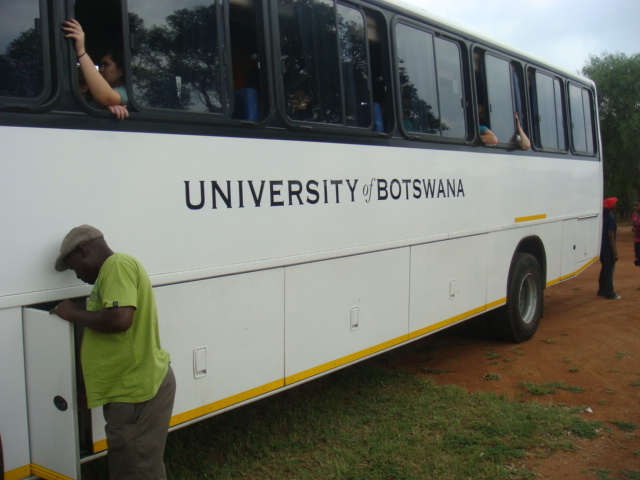
For our first excursion, we packed into a UB bus and headed out to the Kanye Village in Botswana, Africa. The trip lasted a brief 2 hours, but was well worth it! When we arrived, we were told that all males had to change into long pants and a collared shirt, and the females were required to cover their legs and shoulders. This was to respect the local customs of the tribe.

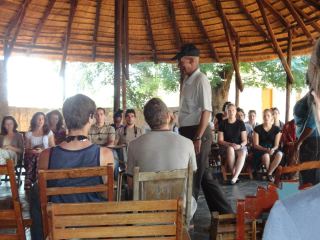
They had us seated in their local “courthouse.” A local directed the males to sit in the front of the females in traditional, hand-made chairs. He was very well-spoken and groomed, educated, and made everyone feel like he was their grandfather with a cheek-to-cheek smile and open arms. Surprisingly, he spoke my language, Serbo-Croatian, with almost perfect grammar and a slight African accent.

Group discussion

Side wall of village