Change is inevitable. The economy goes in cycles. The unemployment rate will fluctuate. And gentrification and development will overcome cities. If these processes are inevitable, how do we, as a community, adapt with the change? How can institutions, as part of the community, continue to preserve the population’s culture and diversity?
Before 24 of my fellow classmates and I take off for India, we are spending two weeks in the nation’s capital. While in Washington, D.C., we are studying America’s health systems, health inequities, and the related role of systems and institutions within the field.
The International Honors Program pushes their students to view health holistically — understanding there are ample factors influencing one’s health. One major factor to the health of an individual is their home and community. During a recent experiential learning day, we explored a city within the D.C. area. My group, a total of five students, set out on the metro to study the area of Howard-Shaw.

The Howard-Shaw area has beautiful murals scattered among the neighborhood. The street art represents and maintains the city’s rich history and culture.
When we emerged from the underground metro station at Howard-Shaw, we were met with vibrant store fronts, colorful restaurants, and a lot of construction. I stood in the center of a city that very clearly was overcome by the controversial topic of gentrification. To explain, gentrification is the process of developing an area. This involves stimulating a neighborhood’s economy through the building of up-scale real estate, restaurants, and modern boutiques. As a result, the neighborhood generally becomes more aesthetically pleasing and economically viable. However, this also displaces the original locals of the neighborhood, as they become priced out of their current homes. Rents increase and developers pressure homeowners to sell their homes for a portion of their worth. In Washington, D.C., Blacks are disproportionately affected by this forced moving as a result of gentrification.
In Howard-Shaw, as you look beyond the beautiful architecture of a historic building, you are struck by the overwhelming and ever-consuming construction cranes, trucks, and bulldozers. This week, I had the opportunity to listen to the locals of Howard-Shaw voice their opinions on how they are directly affected by gentrification.
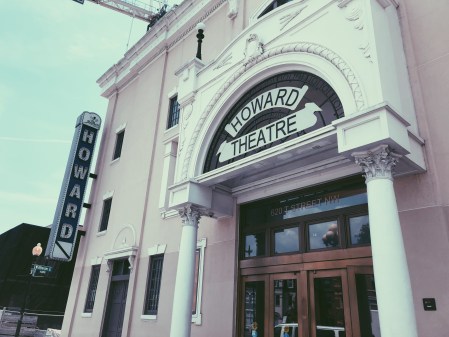
The Howard Theatre is a historic landmark in the neighborhood. It was recently renovated in 2012, and it still acts as a functioning theatre. The crane in the background demonstrates the ever-present condominium construction across the city.
A physical education teacher at a local school, named Pamela, had the biggest impact on me. She works at a public school with grades pre-school to fifth grade. Her official title is the physical education and health teacher, but unofficially she is the community liaison. Pamela described the changing demographics within the school as a result of the last couple years’ development. The older grades are predominately made up of Black and Hispanic students. Whereas the younger grades are predominately made up of White students. We asked Pamela what these new changes to the neighborhood meant for her and the students. Her response, “I’m a half-full kind of person. You just have to take advantage of it.” And taking advantage of the situation is certainly what she is doing. She creates partnerships with the new businesses that inhabit the neighborhood as a result of the development. She brought in local businesses and their employees for a school-wide Career Day. She partnered with a nearby recreation center so the students have the opportunity to swim. When she was not able to stop a bar from moving in across the street from the school, she convinced the business to instead donate a portion of their profits to the school. Last but not least, she assisted with the partnership of a nearby clinic, Mary’s Center, to open within the school. The clinic has health services — including mental health — for the students and their parents, open from 8am to 6pm. A change and evolution of a neighborhood is inevitable. Nonetheless, Pamela is bravely ensuring the change is positively influencing the children of the area.
Additionally, to reference Lawerence, another employee of the Howard-Shaw area, individuals who contribute to gentrification are part of a complicated relationship. As they bring something new and vibrant into the area, they also push history and culture out of its original place. However, Lawerence believes development does not have to constitute displacement. Lawerence urges the development companies to change their plans to accommodate those who already live in the area. He believes condominiums should be built for a mix of incomes. Apartments should be of mixed value, so that a range of income levels can live in a newly developed building. Nonetheless, in order for this to happen, development companies and contractors must prioritize communities, culture, and individuals over profits.
Neighborhoods are pleating and begging for their voice to be heard over the noise and selfishness of big businesses. And without their voice and opinion, culture and history will be lost to modern and expensive real estate.

The future calls for development without displacement. Beauty without a loss of history. Diversity without isolation. It calls for a culture that uplifts entire communities, not just particular groups of individuals.


 Posted by Brooke

 urtravelogues.com